

India Data Center Water Availability & Cooling Constraint Market, 2032
- Energy, Power & Storage, Grid & Power Infrastructure
- Oct 2026
- Pages 140
- Report Format: pdf
- Report Price: $2400 USD
India’s data center water availability & cooling constraint market is witnessing strong structural growth, driven by installed capacity crossing 1,500 MW in 2025, heavy clustering of new campuses in water-stressed cities, rising heat loads from AI and GPU racks, hyperscaler water positive commitments, Central Ground Water Authority permit rules and state treated wastewater reuse policies that are lifting demand for low-water cooling, recycling, alternative sourcing and water monitoring systems.
| Study Duration | 2021-2032 |
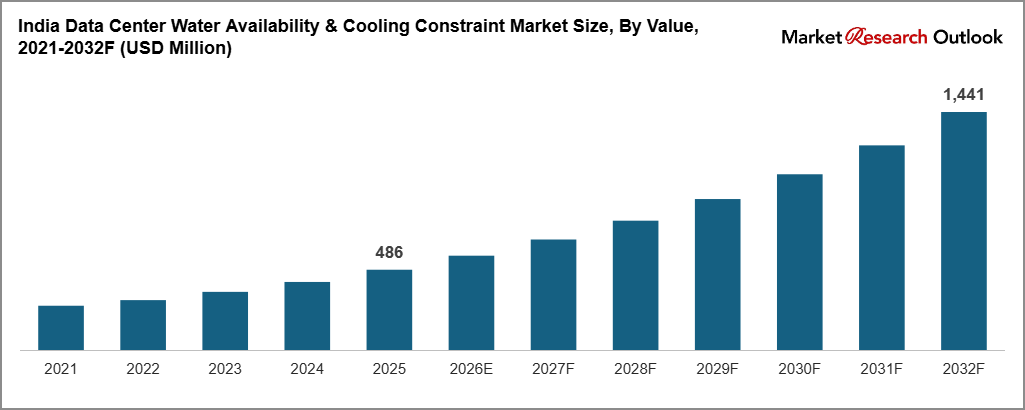
| Market Size (2025) | USD 486 Million |
| CAGR (2026-2032) | 16.8% |
| Leading Segment | Water-Efficient Cooling Systems |
| Fastest Growing Segment | Alternative Water Sourcing (Treated Sewage Water Reuse) |
| Market Size (2032) | USD 1,441 Million |
Source:
Market Overview: India Data Center Water Availability & Cooling Constraint Market
The India data center water availability & cooling constraint market size is witnessing rapid expansion, driven by fast capacity additions in water-stressed cities, rising rack heat loads, sustainability commitments from hyperscalers and tighter groundwater rules. Valued at USD 486 million in 2025 and projected to reach USD 1,441 million by 2032, growing at a CAGR of 16.8%, the market is being fuelled by hyperscale and colocation operators that must secure water for cooling while keeping power usage effectiveness low. Water-efficient cooling systems lead spending, while alternative water sourcing through treated sewage water reuse is emerging as the fastest growing category. India holds 18% of the world’s population but only 4% of its freshwater, and its main data center hubs in Mumbai, Chennai, Hyderabad and Bengaluru have all faced severe water shortages in recent years. As water technology firms including Thermax, VA Tech Wabag, Ion Exchange and Veolia expand data center programs, and cooling suppliers including Blue Star, Voltas, Daikin and Vertiv launch low-water designs, India’s data center water availability & cooling constraint market is evolving into a resource-led, technology-driven and policy-backed infrastructure category with strong long-term growth potential.
Key Report Takeaways: India Data Center Water Availability & Cooling Constraint Market
- India’s data center water availability & cooling constraint market size is projected to grow from USD 486 million in 2025 to USD 1,441 million by 2032, registering a strong CAGR of 16.8%, driven by capacity growth in water-stressed cities, AI heat loads and the structural shift toward closed-loop and recycled-water cooling.
- Water-efficient cooling systems dominate spending, accounting for 38.4% of market value in 2025, driven by demand for adiabatic coolers, air-cooled chillers with free-cooling coils, dry coolers and high cycles of concentration cooling tower programs that cut makeup water.
- Alternative water sourcing through treated sewage water reuse is the fastest growing category, expected to expand at a CAGR of 24.3% through 2032 as operators in Mumbai, Chennai, Hyderabad and Bengaluru sign supply agreements with municipal sewage treatment plants.
- Installed data center capacity in India crossed 1,500 MW in 2025, a fourfold rise from 375 MW in 2020, with Mumbai and Navi Mumbai hosting 790 MW, Chennai 305 MW, Bengaluru 182 MW, Hyderabad 152 MW and Delhi NCR 76 MW, most of it in cities with high water stress.
- Hyperscaler water positive targets, Central Ground Water Authority permit rules, state treated wastewater reuse policies and essential service status for data centers in Maharashtra and Telangana are shaping investment in recycling, storage and monitoring behind the market forecast 2032.
Key Market Drivers: India Data Center Water Availability & Cooling Constraint Market
Rapid Data Center Capacity Additions in Water-Stressed Cities Raising Demand for Water-Efficient Cooling
Growth in the market is being driven by the location of new capacity. India’s data center base crossed 1,500 MW in 2025, up from 375 MW in 2020, and nearly all of it sits in Mumbai, Chennai, Bengaluru, Hyderabad and Delhi NCR, cities that already compete for limited freshwater. A 100 MW facility using evaporative cooling can consume about 800,000 litres of water a day, equal to the daily supply for about 5,900 urban residents at the CPHEEO norm of 135 litres per person. Chennai faced a severe water crisis in 2019, Bengaluru went through acute shortages in 2024, and Mumbai imposed a 10% citywide water cut in 2024 as lake levels fell. Google’s USD 15 billion AI hub in Visakhapatnam and fresh campus plans in Hyderabad and Navi Mumbai will add hundreds of megawatts more. Every new project now needs a secure water plan to win approvals and tenant confidence, creating strong pull-through demand for low-water cooling and recycling systems across India’s data center water availability & cooling constraint market.
AI and GPU Rack Densities Increasing Heat Loads and Shifting Cooling Toward Closed-Loop and Liquid Systems
The market is benefiting from a sharp rise in heat per rack. Conventional Indian colocation halls were designed for an average of 7 kW per rack, while a single liquid-cooled rack of current generation GPU servers draws about 120 kW, and almost all of that power leaves the hall as heat. The IndiaAI Mission had onboarded more than 38,000 GPUs on its common compute portal by March 2026, and hyperscalers are adding dedicated AI clusters. Rejecting this heat through open cooling towers would push water use sharply higher, so operators are moving toward closed-loop chilled water systems, direct-to-chip cold plates and immersion tanks that run warmer coolant and need little or no evaporation. Closed-loop designs can cut freshwater use by 70% or more compared with open evaporative systems. Direct-to-chip liquid cooling is expected to grow at a CAGR of 29.6% through 2032, creating strong demand for coolant distribution units, dry coolers and heat exchangers across India’s data center water availability & cooling constraint market.
Sustainability Commitments, WUE Disclosure and State Water Reuse Policies Driving Investment in Recycling and Alternative Sources
Policy and customer pressure is a major catalyst for the market. Global hyperscalers including Google, Microsoft and Amazon have public water positive or water replenishment goals for 2030, and they apply these goals to Indian leases, asking operators to report water usage effectiveness and source mix. The Central Ground Water Authority requires a no objection certificate for groundwater extraction by industrial users, along with metering and water conservation measures, which limits borewell dependence. The Ministry of Jal Shakti’s National Framework on Safe Reuse of Treated Water and state treated wastewater policies in Maharashtra and Gujarat encourage industries to use recycled sewage water for non-potable needs such as cooling. Several state data center policies also offer incentives for green buildings and water conservation. These measures are steering capital toward treated sewage water pipelines, on-site tertiary treatment, zero liquid discharge plants and smart metering, structurally expanding India’s data center water availability & cooling constraint market through 2032.
Key Market Challenges: India Data Center Water Availability & Cooling Constraint Market
Competing Municipal and Industrial Water Demand and Seasonal Scarcity Threatening Supply Security
The market continues to face challenges around supply security, as data centers draw on the same municipal and groundwater sources that serve households, farms and factories. In dry years and late summer, urban local bodies in Chennai, Bengaluru, Hyderabad and Mumbai cut supply or ration water, and private tankers become the fallback at much higher cost per kilolitre. Maharashtra and Telangana have classified data centers as essential services, which helps continuity but also draws public scrutiny over priority access during scarcity. The Ministry of Jal Shakti’s Dynamic Ground Water Resources Assessment 2025 continues to flag over-exploited and critical blocks in several districts close to data center clusters, which restricts new borewell permits. Until treated wastewater networks and storage reach scale, supply risk will remain a central planning issue across India’s data center water availability & cooling constraint market.
High Ambient Temperatures and Humidity Limiting Free Cooling and Raising the Energy Penalty of Waterless Designs
The market faces structural complexity from climate. Summer temperatures above 45°C in North and Central India, and high humidity in coastal hubs such as Mumbai and Chennai through the monsoon, reduce the hours when outside air can cool a hall directly. Air-cooled chillers and dry coolers save water but use more electricity on hot days, which raises power usage effectiveness and operating cost. Evaporative systems save power but consume large volumes of water, so operators face a direct trade-off between water usage effectiveness and power usage effectiveness. The global industry benchmark for water usage effectiveness is about 1.8 litres per kWh, yet hot and humid Indian sites struggle to reach it with conventional towers. Hybrid coolers, thermal storage and liquid cooling can narrow this gap, but they need careful design and add capital cost. Climate therefore remains a near-term constraint on cooling choices across India’s data center water availability & cooling constraint market.
High Capital Cost of Water Treatment, Recycling and Liquid Cooling Systems and Limited Retrofit Space in Existing Facilities
The market faces practical constraints from cost and space. Tertiary treatment plants, reverse osmosis and ultrafiltration skids, zero liquid discharge systems, large storage tanks and treated sewage water pipelines add significant capital cost per megawatt, and returns depend on local water tariffs that are often low for industrial users. Liquid cooling equipment such as coolant distribution units, cold plates and immersion tanks is still largely imported, which adds currency risk and lead time. Many older facilities in Mumbai, Chennai and Delhi NCR were built on tight urban plots with little plant room space for new treatment trains, tanks or dry coolers. Smaller colocation operators also face higher financing costs than global hyperscalers. Local production by Thermax, VA Tech Wabag, Ion Exchange, Blue Star and Voltas is lowering costs, but full adoption of recycling and liquid cooling will take several years across India’s data center water availability & cooling constraint market.
Key Market Trends: India Data Center Water Availability & Cooling Constraint Market
Shift From Evaporative Cooling Towers to Air-Cooled Chillers, Dry Coolers and Closed-Loop Designs
The market is undergoing a clear technology shift away from open evaporative cooling. Air-cooled chillers, dry and hybrid coolers and direct-to-chip liquid cooling are expected to account for 52.4% of cooling technology value by 2032, up from 42.8% in 2025. Air-cooled chillers with integrated free-cooling coils can run with no makeup water, while adiabatic and hybrid coolers spray water only on the hottest days, cutting annual use sharply compared with cooling towers. Direct-to-chip systems run warm coolant that can be rejected through dry coolers for most of the year, even in Indian conditions. Cooling majors including Vertiv, Schneider Electric, Blue Star, Voltas and Daikin have expanded air-cooled and liquid cooling portfolios for Indian data centers through 2025 and 2026. Water-cooled chillers with cooling towers still lead at 34.6% of 2025 value, but operators are raising cycles of concentration and adding side-stream filtration to cut blowdown losses. This technology transition is reinforcing the market forecast 2032 across both new build and retrofit projects.
Use of Treated Sewage Water, Rainwater Harvesting and Zero Liquid Discharge Systems at Data Center Campuses
A clear shift toward alternative water sources is reshaping the market, particularly at large campuses. Treated sewage and recycled water accounted for 17.8% of cooling water supply value in 2025, and operators are signing supply agreements with municipal sewage treatment plants to replace freshwater for cooling. On-site tertiary treatment with ultrafiltration and reverse osmosis brings this water to cooling tower quality, while zero liquid discharge plants recover blowdown so that no wastewater leaves the site. Rainwater harvesting with large storage tanks is now standard in new campus designs in Chennai, Bengaluru and Hyderabad, where monsoon rain can recharge aquifers and cut summer tanker use. Coastal sites in Chennai already draw on city desalination capacity at Minjur and Nemmeli, and new coastal campuses are studying seawater-based heat rejection. Water treatment firms such as VA Tech Wabag, Ion Exchange, Thermax and Veolia are building dedicated programs for data center clients, lifting demand for treatment and recycling systems across the market.
Real-Time Water Monitoring, WUE Analytics and Digital Twins for Cooling Optimisation
A wave of digital investment is reshaping how operators manage water in the market. Smart meters on makeup, blowdown and recycled water lines now feed water usage effectiveness dashboards that sit alongside power usage effectiveness in data center infrastructure management software. Conductivity, pH and turbidity sensors allow automatic chemical dosing and blowdown control, reducing both water and chemical waste. Digital twins model how a hall will behave under different weather, load and water scenarios, helping operators decide when to switch from evaporative to dry modes. Ecolab, Xylem, Schneider Electric and Vertiv are packaging monitoring hardware, analytics and remote services for Indian sites. Water monitoring and analytics accounted for 6.3% of market value in 2025 and is expected to grow at 21.5% annually through 2032. Combined with tenant reporting needs from hyperscalers, these developments are reinforcing the market forecast 2032 across the entire value chain.
Segmental Insights: India Data Center Water Availability & Cooling Constraint Market
By End-User: Hyperscale & Cloud Operators Dominate India’s Data Center Water Availability & Cooling Constraint Market
The hyperscale and cloud operators segment dominates the market, accounting for 44.8% of market value in 2025, driven by self-built and build-to-suit campuses for Google, Microsoft, Amazon Web Services and Oracle, which apply global water positive goals and strict water usage effectiveness targets to Indian sites. These customers specify closed-loop cooling, treated sewage water supply and real-time metering, which raises spend per megawatt. Colocation providers contribute 31.6% of demand, led by Yotta, CtrlS, NTT, STT GDC India, Nxtra, Sify and AdaniConneX, which are upgrading cooling plants to win hyperscale and AI tenants. BFSI and enterprise users account for 15.1%, supported by captive data centers of banks and IT services firms. Government and public sector users make up the remaining 8.5%, led by state data centers and sovereign cloud projects. In 2025 and 2026, new hyperscale leases with water reporting clauses reinforced segment leadership in the market.
By Solution Type: Water-Efficient Cooling Leads While Alternative Water Sourcing Grows Fastest
Water-efficient cooling systems lead the market solution mix, accounting for 38.4% of total value, driven by the high cost of air-cooled chillers, adiabatic and hybrid coolers, dry coolers and liquid cooling units needed to cut evaporation. Water treatment and recycling systems contribute another 24.7%, followed by alternative water sourcing at 11.6% and water storage and conveyance at 9.8%. Water monitoring and WUE analytics accounts for 6.3% of value, while operation and maintenance services and water chemicals together form 9.2%. Alternative water sourcing through treated sewage water reuse is the fastest growing category, expanding at a CAGR of 24.3% through 2032 as municipal supply agreements scale. By water source, municipal supply still meets 41.2% of demand, groundwater 23.5% and private tankers and others 12.6%. Leading suppliers including Thermax, VA Tech Wabag, Ion Exchange, Blue Star and Vertiv have aligned portfolios to this mix, driving higher value per megawatt across the market.
Regional Insights: India Data Center Water Availability & Cooling Constraint Market
Regional analysis of the market shows that West India leads with 47.9% of market value in 2025, driven by Mumbai and Navi Mumbai, which host 790 MW of operational capacity and depend on lake-fed municipal supply that faced a 10% cut in 2024, along with Pune. South India follows with 38.6%, supported by Chennai at 305 MW, Bengaluru at 182 MW and Hyderabad at 152 MW, and it is the fastest growing region at a CAGR of 19.1% as Visakhapatnam develops into a new AI hub with tight groundwater availability. North India contributes 9.8%, led by Noida and Greater Noida in Uttar Pradesh, where summer heat raises cooling loads and groundwater permits are closely controlled. East India accounts for 2.5% and Central India 1.2%, with Kolkata and Bhubaneswar emerging as edge and disaster recovery locations with better water availability. In 2025 and 2026, new campus plans in Navi Mumbai, Chennai, Hyderabad, Visakhapatnam and Greater Noida reinforced the need for regional water planning across the market.
Recent Developments: India Data Center Water Availability & Cooling Constraint Market
- The market witnessed strong momentum in capacity and water planning during 2025 and 2026. The Ministry of Electronics and Information Technology reported in March 2026 that India’s data center capacity crossed 1,500 MW in 2025, a fourfold increase from 375 MW in 2020. In December 2025, the Ministry of Jal Shakti released the Dynamic Ground Water Resources Assessment 2025, giving operators and regulators updated block-level data on groundwater stress around data center clusters.
- Hyperscalers deepened India-focused commitments that raise cooling water needs. In October 2025, Google announced a USD 15 billion AI hub in Visakhapatnam with AdaniConneX and Bharti Airtel. In December 2025, Microsoft announced USD 17.5 billion for cloud and AI infrastructure in India, and Amazon outlined a USD 35 billion investment plan through 2030. These projects are pushing developers toward closed-loop cooling, recycled water and larger storage, supporting the market forecast 2032.
- Policy momentum has gained strong traction in the market. In February 2026, the Union Budget 2026-27 introduced a tax holiday up to 2047 for notified foreign cloud service providers using MeitY-notified Indian data centers, which is expected to draw more hyperscale capacity onshore. Combined with Central Ground Water Authority permit rules, state treated wastewater reuse policies and essential service status for data centers in Maharashtra and Telangana, this is making water planning a core part of project approval, strengthening long-term competitiveness in the market forecast 2032.
Key Market Players: India Data Center Water Availability & Cooling Constraint Market
- Thermax Limited
- VA Tech Wabag Limited
- Ion Exchange (India) Limited
- Ecolab India (Nalco Water)
- Xylem Water Solutions India Pvt. Ltd.
- Veolia India Pvt. Ltd.
- Grundfos Pumps India Pvt. Ltd.
- Kirloskar Brothers Limited
- Blue Star Limited
- Voltas Limited
- Daikin Airconditioning India Pvt. Ltd.
- Vertiv Energy Pvt. Ltd.
- Schneider Electric India Pvt. Ltd.
| By Solution Type | By Cooling Tech | By Water Source | By DC Type | By End-User |
| Water-Efficient Cooling Treatment & Recycling Alternative Sourcing Storage Monitoring Others | Evaporative Water-Cooled Chillers Air-Cooled Chillers Dry Coolers Direct-to-Chip Immersion Others | Municipal Groundwater Treated Sewage Rainwater Tanker | Hyperscale Colocation Enterprise Edge Government | Hyperscale & Cloud Colocation BFSI & Enterprises Government |
Report Scope
In this report, the India Data Center Water Availability & Cooling Constraint Market has been segmented into the following categories, in addition to detailed analysis of key industry trends, market dynamics, competitive environment, and growth opportunities across the forecast period:
- By Solution Type
- Water-Efficient Cooling Systems
- Water Treatment & Recycling Systems
- Alternative Water Sourcing (Treated Sewage Water, Rainwater Harvesting, Desalination)
- Water Storage & Conveyance
- Water Monitoring & WUE Analytics
- Others (O&M Services & Water Chemicals)
- By Cooling Technology
- Evaporative & Adiabatic Cooling
- Water-Cooled Chillers with Cooling Towers
- Air-Cooled Chillers
- Dry & Hybrid Coolers
- Direct-to-Chip Liquid Cooling
- Immersion Cooling
- Others (Free Cooling & Thermal Storage)
- By Water Source
- Municipal Supply
- Groundwater
- Treated Sewage & Recycled Water
- Rainwater Harvesting
- Private Tanker & Others
- By Data Center Type
- Hyperscale Data Centers
- Wholesale Colocation
- Retail Colocation
- Enterprise & Captive Data Centers
- Edge Data Centers
- Government & Sovereign Data Centers
- By End-User
- Hyperscale & Cloud Operators
- Colocation Providers
- BFSI & Enterprises
- Government & Public Sector
- By Geography
- North India
- South India
- West India
- East India
- Central India
Competitive Landscape
Company Profiles:
Detailed analysis of the leading companies operating in India’s Data Center Water Availability & Cooling Constraint Market, including business overview, product portfolio, strategic initiatives, competitive positioning, and recent developments.
Company Information
Detailed profiling and strategic analysis of additional market players (up to five companies), including emerging water treatment firms, liquid cooling specialists, cooling tower and dry cooler makers, regional EPC contractors, or niche water monitoring providers.
For a free sample of the India Data Center Water Availability & Cooling Constraint Market report, customised insights or delivery timelines, submit your query here
India Data Center Water Availability & Cooling Constraint Market, 2032
- Research Framework
- Market Segmentation
- Research Objective
- Research Methodology
- Qualitative Research
- Primary Research
- Secondary Research
- Quantitative Research
- Market Breakdown & Data Triangulation
- Demand Side
- Supply Side
- Primary Research Respondents
- Assumption & Limitation
- Executive Summary
- Market Overview, 2021-2032
- By Solution Type
- By Cooling Technology
- By Water Source
- By Data Center Type
- By End-User
- By Region
- Analyst Recommendations
- Geopolitical Impact on Data Center Water and Cooling in India
- Data Center Water Availability & Cooling Constraint Insights: India
- Market Dynamics
- Growth Drivers
- Rapid data center capacity additions in water-stressed cities raising demand for water-efficient cooling.
- AI and GPU rack densities increasing heat loads and shifting cooling toward closed-loop and liquid systems.
- Sustainability commitments, WUE disclosure and state water reuse policies driving investment in recycling and alternative sources.
- Restraints
- Competing municipal and industrial water demand and seasonal scarcity threatening supply security.
- High ambient temperatures and humidity limiting free cooling and raising the energy penalty of waterless designs.
- High capital cost of water treatment, recycling and liquid cooling systems and limited retrofit space in existing facilities.
- Opportunities
- Liquid cooling adoption in AI halls opening demand for dry coolers, CDUs and closed-loop heat rejection.
- Municipal partnerships supplying treated sewage water to data center parks and campuses.
- Desalination and seawater heat rejection for coastal campuses in Chennai, Mumbai and Visakhapatnam.
- Challenges
- Lack of mandatory WUE reporting and uniform water norms for data centers across states.
- Variable source water quality raising treatment, scaling and corrosion control costs.
- Public scrutiny and community concerns over data center water use during droughts.
- Technological Advancements
- Recent Technological Advancements
- Prior to 2020
- Porter’s Five Forces Analysis
- PESTLE Analysis
- Industry Value Chain & Entry Points
- Water Sources & Utilities (municipal corporations, groundwater authorities, sewage treatment plants, desalination plants)
- Water Treatment Equipment Makers (RO, UF, softeners, ZLD systems; Thermax, VA Tech Wabag, Ion Exchange, Veolia)
- Cooling Equipment Manufacturers (chillers, cooling towers, dry coolers, CDUs; Blue Star, Voltas, Daikin, Vertiv)
- Pumps, Valves & Piping Suppliers (Grundfos, Kirloskar Brothers, Xylem)
- Water Chemicals & Consumables (Ecolab Nalco Water, scale and corrosion inhibitors, biocides, membranes)
- Monitoring, Metering & Software Providers (smart meters, water quality sensors, WUE analytics, DCIM, digital twins)
- Regulators, Standards & Certification (CGWA, CPCB, state pollution control boards, BIS, IGBC)
- EPC & MEP Contractors (Larsen & Toubro, Sterling and Wilson, specialist water EPC firms)
- Data Center Developers & Operators (Yotta, CtrlS, NTT, STT GDC India, AdaniConneX, Nxtra, Sify)
- End-Users (hyperscalers, cloud providers, BFSI, government agencies, enterprises)
- India Data Center Water Availability & Cooling Constraint Market: Regulatory Framework
- India Data Center Water Availability & Cooling Constraint Market Overview
- Market Size & Forecast, 2021-2032
- By Value (USD Million)
- By Volume (Million Litres)
- Market Share & Forecast
- By Solution Type
- Water-Efficient Cooling Systems
- Water Treatment & Recycling Systems
- Alternative Water Sourcing (Treated Sewage Water, Rainwater Harvesting, Desalination)
- Water Storage & Conveyance
- Water Monitoring & WUE Analytics
- Others (O&M Services & Water Chemicals)
- By Cooling Technology
- Evaporative & Adiabatic Cooling
- Water-Cooled Chillers with Cooling Towers
- Air-Cooled Chillers
- Dry & Hybrid Coolers
- Direct-to-Chip Liquid Cooling
- Immersion Cooling
- Others (Free Cooling & Thermal Storage)
- By Water Source
- Municipal Supply
- Groundwater
- Treated Sewage & Recycled Water
- Rainwater Harvesting
- Private Tanker & Others
- By Data Center Type
- Hyperscale Data Centers
- Wholesale Colocation
- Retail Colocation
- Enterprise & Captive Data Centers
- Edge Data Centers
- Government & Sovereign Data Centers
- By End-User
- Hyperscale & Cloud Operators
- Colocation Providers
- BFSI & Enterprises
- Government & Public Sector
- By Geography
- North India
- South India
- West India
- East India
- Central India
- Competitive Landscape
- Company Market Share Analysis: India Data Center Water and Cooling Solutions, 2025
- Competitive Benchmarking, By Operating Parameters
- Key Strategic Development (Mergers, Acquisitions, Partnerships, Etc.)
- List of Emerging Players
- Company Profile
- Thermax Limited
- Introduction & Company Profile
- Product Benchmarking
- Strategic Outlook
- Key Competitors
- Financial Analysis
- SWOT Analysis
(Same Data Pointers Will Be Provided for The Below Companies)
- VA Tech Wabag Limited
- Ion Exchange (India) Limited
- Ecolab India (Nalco Water)
- Xylem Water Solutions India Pvt. Ltd.
- Veolia India Pvt. Ltd.
- Grundfos Pumps India Pvt. Ltd.
- Kirloskar Brothers Limited
- Blue Star Limited
- Voltas Limited
- Daikin Airconditioning India Pvt. Ltd.
- Vertiv Energy Pvt. Ltd.
- Schneider Electric India Pvt. Ltd.
- Other Prominent Players
* Financial information in case of non-listed companies will be provided as per availability
** The segmentation and the companies are subjected to modifications based on in-depth secondary for the final deliverable
Frequently Asked Questions
1. How large is the India data center water availability & cooling constraint market and what is its growth forecast?
Ans: The market is valued at USD 486 million in 2025 and is projected to reach USD 1,441 million by 2032, growing at a CAGR of 16.8%, supported by capacity growth in water-stressed cities and rising AI heat loads.
2. Which segments are driving demand in India's data center water availability & cooling constraint market?
Ans: Water-efficient cooling systems lead with a 38.4% value share in 2025, while alternative water sourcing through treated sewage water reuse is the fastest growing segment at a 24.3% CAGR through 2032.
3. What are the key drivers of growth in this market?
Ans: Key drivers include rapid capacity additions in water-stressed cities, rising heat loads from AI and GPU racks, hyperscaler water positive goals, groundwater permit rules and state treated wastewater reuse policies across India.
4. Which regions are driving growth in data center water and cooling solutions in India?
Ans: West India leads with a 47.9% share, driven by Mumbai and Navi Mumbai. South India holds 38.6% and is the fastest growing region, supported by Chennai, Hyderabad, Bengaluru and Visakhapatnam.
5. What are the latest trends in data center water and cooling management in India?
Ans: The latest trends include the shift from cooling towers to air-cooled and closed-loop designs, treated sewage water reuse with zero liquid discharge, and real-time water monitoring with WUE analytics and digital twins.