

Global AI Data Center Water Consumption & Cooling Infrastructure Market, 2032
- Global Markets
- Oct 2026
- Pages 140
- Report Format: pdf
- Report Price: $3500 USD
The global market for AI data center cooling and water infrastructure is witnessing strong structural growth, driven by record AI compute investment, GPU racks above 100 kW, the shift from air to liquid cooling, tighter water permits and reporting rules, corporate water positive pledges, rising use of reclaimed water, and heavy investment by cooling vendors in CDU, chiller, cold plate, and water treatment capacity.
| Study Duration | 2021-2032 |
| Market Size (2025) | USD 8,450 Million |
| CAGR (2026-2032) | 20.7% |
| Leading Segment | Chilled Water & Air-Based Cooling (Chillers & CRAH) |
| Fastest Growing Segment | Direct-to-Chip & Immersion Liquid Cooling |
| Market Size (2032) | USD 31,600 Million |
Market Overview: Global AI Data Center Water Consumption & Cooling Infrastructure Market
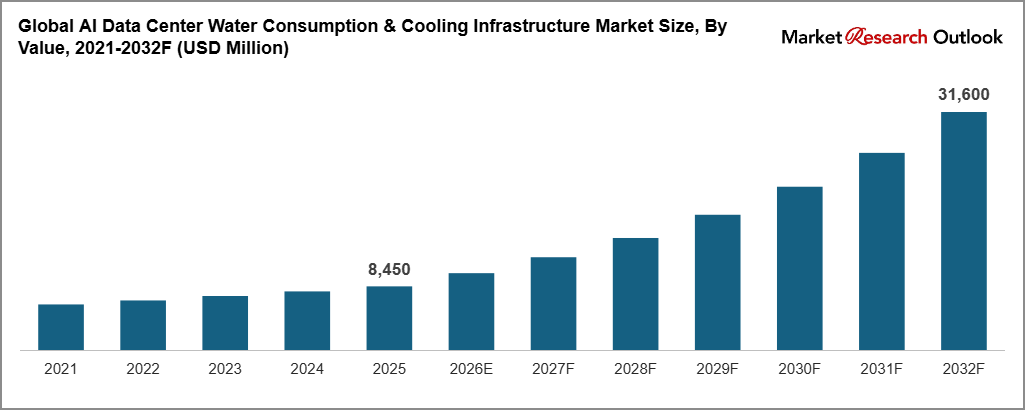
The global AI data center water consumption and cooling infrastructure market size is witnessing rapid expansion, driven by record AI capital spending, rapidly rising chip and rack power, tighter limits on water withdrawal, and the move from air to liquid cooling in new halls. Valued at USD 8,450 million in 2025 and projected to reach USD 31,600 million by 2032, growing at a CAGR of 20.7%, growth is being fuelled by hyperscale AI training campuses of 100 MW to 1 GW, AI inference regions in every major cloud market, and GPU racks that now draw 120 kW and are heading past 500 kW by the end of the decade. Chilled water and air-based cooling lead spending today, while direct-to-chip and immersion liquid cooling form the fastest growing category. Water scarcity, public scrutiny, and new disclosure rules are reshaping how heat rejection is designed. As cooling majors including Vertiv, Schneider Electric, Johnson Controls, Trane, and Carrier add capacity, and liquid cooling specialists including CoolIT Systems, LiquidStack, and Submer scale production, the market is evolving into an engineered, water-aware, and fast-scaling segment with strong long-term growth potential.
Key Report Takeaways: Global AI Data Center Water Consumption & Cooling Infrastructure Market
- The global AI data center water consumption and cooling infrastructure market size is projected to grow from USD 8,450 million in 2025 to USD 31,600 million by 2032, registering a strong CAGR of 20.7%, driven by AI compute investment, rising rack densities, and the structural shift toward liquid cooling and water-efficient heat rejection.
- Chilled water and air-based cooling dominate the market, accounting for 34% of total value in 2025, driven by the large installed base of chillers and CRAH units, their role in heat rejection even for liquid-cooled halls, and continued demand from AI inference and colocation sites using mixed air and liquid designs.
- Direct-to-chip and immersion liquid cooling are the fastest growing segments, expected to grow at a combined CAGR of 31.5% through 2032 as GPU racks pass 100 kW and chip makers design new accelerators for liquid cooling only.
- Rapid growth in data center power use, which the International Energy Agency projects to rise from 415 TWh in 2024 to 945 TWh by 2030, is structurally expanding demand for cooling plant, liquid cooling, and water treatment across hyperscale, colocation, and enterprise facilities.
- Rising investments by cooling suppliers such as Vertiv, Schneider Electric, Trane, and Johnson Controls in CDU, chiller, and cold plate capacity, together with acquisitions of liquid cooling specialists, are strengthening supply and supporting the market forecast 2032.
Key Market Drivers: Global AI Data Center Water Consumption & Cooling Infrastructure Market
Surging AI Compute Demand and Rack Densities Above 100 kW Driving Liquid Cooling and Heat Rejection Investment Worldwide
Growth in the global AI data center water consumption and cooling infrastructure market is being driven first by the scale of AI infrastructure being built. The International Energy Agency estimates that data centers consumed 415 TWh of electricity in 2024, about 1.5% of global demand, and projects 945 TWh by 2030, with accelerated servers for AI the fastest growing load. Almost every watt of that power ends up as heat. Traditional air-cooled racks drew 8 kW to 15 kW, while NVIDIA’s GB200 NVL72 rack draws 120 kW and next-generation designs announced for 2027 aim for 600 kW. Air alone cannot remove heat at these levels, so new AI halls are designed around direct-to-chip liquid cooling with 70% to 80% of heat captured in liquid loops. Large operators including Microsoft, Google, Amazon Web Services, Meta, Oracle, and CoreWeave have announced gigawatt-scale AI campuses, creating a steady order book for CDUs, chillers, dry coolers, and cold plates through 2032.
Source:
Rising Scrutiny of Data Center Water Use, Water Reporting Rules, and Corporate Water Positive Pledges Reshaping Cooling Design
AI data center water use is now under close public and regulatory watch. The International Energy Agency estimates that data centers consume around 560 billion litres of water a year, a figure that could reach 1,200 billion litres by 2030. Google reported data center water consumption of 6.1 billion gallons in 2023, up 17% on 2022, and Microsoft reported a 34% increase in total water consumption in 2022. The recast EU Energy Efficiency Directive now requires data centers of 500 kW and above to report energy and water use each year, and local authorities in Arizona, the Netherlands, Ireland, Chile, and Singapore are tying permits to water efficiency. Microsoft, Google, Meta, and Amazon Web Services have all pledged to be water positive by 2030. As a result, an estimated 46% of new AI data center capacity announced in 2025 specified closed-loop or low-water cooling, lifting spend across the market.
Record Hyperscale Capital Expenditure on AI Campuses Expanding Demand for Chillers, CDUs, Cooling Towers, and Water Treatment
Capital spending is a major catalyst for the global AI data center water consumption and cooling infrastructure market. Combined capital expenditure by Microsoft, Alphabet, Amazon, and Meta exceeded USD 300 billion in 2025, most of it directed at AI data centers and servers, and neocloud providers, sovereign AI programmes, and Gulf investors are adding further projects. Mechanical and cooling systems typically account for 15% to 20% of data center construction cost, and liquid cooling raises cooling value per megawatt by 30% to 50% compared with air-cooled designs because of CDUs, manifolds, cold plates, and secondary fluid networks. Water treatment, reuse, and monitoring add a further layer of spend as operators push cooling towers to higher cycles of concentration. Together, these factors are lifting cooling and water infrastructure spend faster than overall data center capacity.
Key Market Challenges: Global AI Data Center Water Consumption & Cooling Infrastructure Market
Water Stress, Drought Conditions, and Community Opposition Delaying AI Data Center Permits in Key Growth Regions
The sector continues to face hard limits on water in many of the places where AI campuses are being built. Large clusters in Arizona, Texas, northern Virginia, Spain, Chile, Mexico, and parts of India sit in regions with medium to high water stress. A 100 MW campus using evaporative cooling can consume 1.5 million to 2 million litres of water a day in peak summer, which places it in direct competition with households and farms. Projects in Chile, Uruguay, the Netherlands, and several US counties have faced public opposition, redesigns, or delays over water use. Utilities are also asking for long-term water supply agreements and infrastructure contributions. Until closed-loop and reclaimed water designs become standard, water access will remain a key constraint on AI data center siting.
Trade-Off Between Water Savings and Higher Energy Use, Plus Complex Liquid Cooling Retrofits in Existing Halls
Cooling buyers face a real trade-off between water and power. Evaporative cooling uses water to save energy, while dry coolers and mechanical chillers save water but can raise power usage effectiveness by 0.05 to 0.15 in hot climates, adding millions of dollars a year in electricity cost at a large campus and increasing indirect water use at power plants. Liquid cooling retrofits are also difficult in existing halls, which were not built for secondary fluid networks, heavier racks, or leak detection. Floor loading, pipe routing, and downtime limit how fast older colocation sites can host dense AI racks. These factors slow adoption and push some operators toward hybrid designs.
Supply Chain Bottlenecks for CDUs, Cold Plates, and Chillers, Along With Leak Risk and Coolant Regulation Concerns
The market faces practical supply constraints as demand jumps. Lead times for large chillers and CDUs stretched to 30 to 50 weeks in 2024 and 2025, and cold plate and quick-disconnect suppliers struggled to keep pace with GPU shipments. Leak risk remains a concern for operators new to liquid cooling, and coolant quality must be tightly controlled to avoid corrosion and clogging in micro-channel cold plates. Two-phase immersion faces added uncertainty from PFAS regulation after 3M announced its exit from PFAS manufacturing by the end of 2025. Price escalation for copper, steel, and pumps has also reduced margins on fixed-price contracts. Operators are responding with frame agreements and standard designs, but delays can push back AI hall go-live dates by one to two quarters.
Key Market Trends: Global AI Data Center Water Consumption & Cooling Infrastructure Market
Rapid Shift From Air Cooling to Direct-to-Chip and Immersion Liquid Cooling for AI Racks
The global AI data center water consumption and cooling infrastructure market is undergoing a clear technology shift from air cooling to direct-to-chip and immersion liquid cooling, with liquid cooling expected to account for over 60% of cooling value in new AI data centers by 2028. Direct-to-chip systems capture 70% to 80% of server heat in a closed liquid loop that can run at supply temperatures of 30 degrees Celsius and above, which allows dry coolers to replace evaporative towers in many climates. Leading suppliers including Vertiv, Schneider Electric through Motivair, CoolIT Systems, nVent, and Boyd have expanded CDU and cold plate output through 2024 and 2025. Single-phase immersion from Submer, LiquidStack, and Green Revolution Cooling is also gaining ground in edge and high-density inference sites, reinforcing the market forecast 2032 across hyperscale and colocation facilities.
Growth of Closed-Loop, Zero-Water, and Reclaimed Water Cooling Designs in the Global AI Data Center Water Consumption & Cooling Infrastructure Market
A clear move toward low-water cooling is reshaping thermal design, particularly at hyperscale AI campuses in water-stressed regions. In August 2024, Microsoft announced a new data center design that uses chip-level cooling in a closed loop and consumes zero water for cooling, with first sites planned in Phoenix and Mount Pleasant, Wisconsin. Google uses recycled wastewater at its Douglas County, Georgia, site and seawater at Hamina in Finland, while Amazon Web Services has widened its use of recycled water at US sites. Hybrid adiabatic coolers that run dry for most of the year are becoming standard in Europe. By 2025, an estimated 38% of new hyperscale AI capacity worldwide used closed-loop or reclaimed water cooling, up from less than 15% in 2021, and the share is rising each year.
Acquisitions, Capacity Expansion, and Partnerships Among Cooling and Water Technology Suppliers
A wave of acquisitions and capacity expansion is reshaping the supply side of the global AI data center water consumption and cooling infrastructure market. Schneider Electric acquired a controlling stake in Motivair in 2024, Vertiv acquired CoolTera in 2023, and KKR acquired CoolIT Systems in 2023, giving each a stronger liquid cooling offer. Trane, Johnson Controls, Carrier, and Daikin have expanded chiller and heat rejection plants in North America, Europe, and Asia, and Ecolab has launched water treatment programmes designed for direct-to-chip cooling loops. Chip and server makers are working directly with cooling vendors on reference designs for each new GPU generation. Combined with gigawatt-scale AI campus construction and tighter water rules, these developments are reinforcing the market forecast 2032 across the full value chain.
Segmental Insights: Global AI Data Center Water Consumption & Cooling Infrastructure Market
By Data Center Type: Hyperscale AI Training Facilities Dominate the Global AI Data Center Water Consumption & Cooling Infrastructure Market
The hyperscale AI training segment dominates the global AI data center water consumption and cooling infrastructure market, accounting for an estimated 41% of total value in 2025, driven by gigawatt-scale campuses, the highest rack densities, and early adoption of direct-to-chip cooling. CDUs, cold plates, and large dry coolers or chillers are the main purchases within this segment. AI inference and cloud data centers contribute another 24% of demand, followed by colocation data centers at 21%, where operators are building liquid-ready halls for AI tenants. Enterprise AI data centers account for 8%, while edge AI and sovereign AI facilities make up the remaining 6%. In 2025, Microsoft, Google, Amazon Web Services, Meta, Oracle, and CoreWeave placed large cooling orders for new AI campuses, reinforcing segment dominance in the market.
By Cooling Technology: Chilled Water Leads While Direct-to-Chip and Immersion Grow Fastest
Chilled water and air-based cooling lead the global AI data center water consumption and cooling infrastructure market technology mix, accounting for 34% of total value in 2025, driven by the installed base and their continued role in heat rejection. Direct-to-chip liquid cooling contributes another 26% and is the largest liquid category. Evaporative and adiabatic cooling hold 21%, rear-door heat exchangers 8%, and immersion cooling 7%, while other technologies make up the remaining 4%. Direct-to-chip and immersion together are the fastest growing categories, expanding at 31.5% annually as GPU racks pass 100 kW. By water source, municipal potable water still supplies 58% of cooling water, but reclaimed wastewater at 17% is growing quickly. Leading suppliers including Vertiv, Schneider Electric, Trane, CoolIT Systems, and Submer have aligned their portfolios to this mix.
Regional Insights: Global AI Data Center Water Consumption & Cooling Infrastructure Market
Regional analysis of the global AI data center water consumption and cooling infrastructure market shows that North America accounts for 44% of total value, driven by AI campuses in northern Virginia, Texas, Arizona, Georgia, Ohio, and Wisconsin, where water permits and drought risk are pushing closed-loop designs. Asia Pacific contributes 29% of demand, led by China, Japan, Singapore, Malaysia, India, and Australia, with Johor in Malaysia and Singapore applying strict water efficiency rules. Europe accounts for 19%, supported by Ireland, the Netherlands, Germany, the Nordics, and Spain, where EU water reporting rules and district heating links shape design. The Middle East and Africa hold 5%, led by Saudi Arabia and the UAE, where seawater and dry cooling are common, and Latin America holds 3%, led by Brazil, Mexico, and Chile. In 2025, new AI campus launches across these regions reinforced demand for water-efficient cooling.
Recent Developments: Global AI Data Center Water Consumption & Cooling Infrastructure Market
- The global AI data center water consumption and cooling infrastructure market saw strong momentum in orders and design change during 2024 and 2025. Liquid cooling accounted for an estimated 37% of cooling spend in new AI data centers in 2025, against 9% in 2021. Water consumed by AI data centers worldwide is estimated at 148 billion litres in 2025, up from 92 billion litres in 2023, and is projected to reach 410 billion litres by 2032 without wider adoption of closed-loop systems. Liquid cooling shipments are projected to grow at an average 30% annually through 2030.
- Cooling suppliers have deepened capacity expansion. In 2025, Vertiv, Schneider Electric, Trane, Johnson Controls, and Carrier expanded CDU, chiller, and heat rejection output, while CoolIT Systems, LiquidStack, and Submer added liquid cooling production lines. NVIDIA shipped GB200 and GB300 rack systems designed for liquid cooling, making direct-to-chip the default for new AI training halls. These developments are strengthening supply and supporting the market forecast 2032.
- Hyperscale momentum has gained strong traction in the global AI data center water consumption and cooling infrastructure market. In 2025, leading operators including Microsoft, Google, Amazon Web Services, Meta, Oracle, and CoreWeave expanded AI campus pipelines and water-efficient cooling programmes across North America, Europe, and Asia Pacific. Long-term agreements between operators, cooling suppliers, and water utilities are positioning liquid and closed-loop cooling as the standard for AI infrastructure, strengthening the long-term outlook.
Key Market Players: Global AI Data Center Water Consumption & Cooling Infrastructure Market
- Vertiv Holdings Co.
- Schneider Electric SE (Motivair)
- Johnson Controls International plc
- Trane Technologies plc
- Carrier Global Corporation
- Daikin Industries Ltd.
- Munters Group AB
- nVent Electric plc
- CoolIT Systems Inc.
- LiquidStack Holding B.V.
- Submer Technologies SL
- Green Revolution Cooling Inc.
- Ecolab Inc. (Nalco Water)
| By Cooling Technology | By Component | By Water Source | By DC Type | By End-User |
| Direct-to-Chip Immersion Rear-Door Evaporative Chilled Water Others | CDUs Chillers Cooling Towers Cold Plates CRAH Water Treatment Others | Municipal Reclaimed Groundwater Seawater Others | AI Training AI Inference Colocation Enterprise Edge Sovereign | Hyperscale Cloud AI & GPU Cloud BFSI & Enterprise Government & Research |
Report Scope
In this report, the Global AI Data Center Water Consumption & Cooling Infrastructure Market has been segmented into the following categories, in addition to detailed analysis of key industry trends, market dynamics, competitive landscape, and growth opportunities across the forecast period:
- By Cooling Technology
- Direct-to-Chip Liquid Cooling
- Immersion Cooling
- Rear-Door Heat Exchangers
- Evaporative & Adiabatic Cooling
- Chilled Water & Air-Based Cooling
- Others
- By Component
- Coolant Distribution Units (CDUs)
- Chillers
- Cooling Towers & Dry Coolers
- Cold Plates & Manifolds
- CRAH & CRAC Units
- Water Treatment & Reuse Systems
- Others
- By Water Source
- Municipal Potable Water (Utility Supply)
- Reclaimed & Recycled Wastewater
- Groundwater
- Seawater & Surface Water
- Rainwater Harvesting & Others
- By Data Center Type
- Hyperscale AI Training Facilities
- AI Inference & Cloud Data Centers
- Colocation Data Centers
- Enterprise AI Data Centers
- Edge AI Data Centers
- Sovereign & Government AI Facilities
- By End-User
- Hyperscale Cloud Providers
- AI & GPU Cloud Companies
- BFSI & Enterprise
- Government & Research
- By Geography
- North America
- Europe
- Asia Pacific
- Latin America
- Middle East & Africa
Competitive Landscape
Company Profiles:
Detailed analysis of the leading companies operating in the Global AI Data Center Water Consumption & Cooling Infrastructure Market, including business overview, product portfolio, strategic initiatives, competitive positioning, and recent developments.
Company Information
Detailed profiling and strategic analysis of additional market players (up to five companies), including emerging liquid cooling start-ups, specialty CDU and cold plate makers, regional chiller brands, or niche water treatment and reuse providers.
For a free sample of the Global AI Data Center Water Consumption & Cooling Infrastructure Market report, customised insights or delivery timelines, submit your query here
Global AI Data Center Water Consumption & Cooling Infrastructure Market, 2032
- Research Framework
- Market Segmentation
- Research Objective
- Research Methodology
- Qualitative Research
- Primary Research
- Secondary Research
- Quantitative Research
- Market Breakdown & Data Triangulation
- Demand Side
- Supply Side
- Primary Research Respondents
- Assumption & Limitation
- Executive Summary
- Market Overview, 2021-2032
- By Cooling Technology
- By Component
- By Water Source
- By Data Center Type
- By End-User
- By Region
- Analyst Recommendations
- Geopolitical Impact on Global AI Data Center Water Consumption & Cooling Infrastructure Market
- Global AI Data Center Water Consumption & Cooling Infrastructure Market Insights
- Market Dynamics
- Growth Drivers
- Surging AI compute demand and rack densities above 100 kW driving liquid cooling and heat rejection investment worldwide.
- Rising scrutiny of data center water use, water reporting rules, and corporate water positive pledges reshaping cooling design.
- Record hyperscale capital expenditure on AI campuses expanding demand for chillers, CDUs, cooling towers, and water treatment.
- Restraints
- Water stress, drought conditions, and community opposition delaying AI data center permits in key growth regions.
- Trade-off between water savings and higher energy use, plus complex liquid cooling retrofits in existing halls.
- Supply chain bottlenecks for CDUs, cold plates, and chillers, along with leak risk and coolant regulation concerns.
- Opportunities
- Closed-loop and zero-water cooling designs opening a premium segment for new hyperscale AI campuses.
- Reclaimed wastewater, seawater, and on-site water treatment creating new demand for water reuse systems.
- Waste heat recovery and district heating links turning cooling infrastructure into a revenue source in Europe.
- Challenges
- Intense competition among cooling vendors compressing margins on large hyperscale liquid cooling contracts.
- Shortage of skilled technicians for installing, commissioning, and maintaining liquid cooling systems.
- Lack of common standards for coolant quality, CDU interfaces, and water use reporting across regions.
- Technological Advancements
- Recent Technological Advancements
- Prior to 2020
- Porter’s Five Forces Analysis
- PESTLE Analysis
- Industry Value Chain & Entry Points
- Upstream Materials & Components (copper, aluminium, pumps, valves, heat exchangers, compressors, coolant fluids)
- Cooling Equipment Manufacturers (Vertiv, Schneider Electric, Johnson Controls, Trane, Carrier, Daikin)
- Liquid Cooling Specialists (CoolIT Systems, Motivair, LiquidStack, Submer, Green Revolution Cooling)
- Water Treatment & Reuse Providers (Ecolab, Xylem, Veolia, municipal reclaimed water utilities)
- Testing, Standards & Compliance Bodies (ASHRAE, Open Compute Project, The Green Grid, EU and national regulators)
- Distributors, Mechanical Contractors & System Integrators (MEP contractors and design-build firms)
- Chip & Server Makers (NVIDIA, AMD, Intel, Supermicro, Dell, HPE defining thermal requirements)
- Data Center Developers & Colocation Operators (Equinix, Digital Realty, NTT DATA, CyrusOne, Vantage, STACK)
- Hyperscale Cloud & AI Operators (Microsoft, Google, Amazon Web Services, Meta, Oracle, CoreWeave)
- End-Users (AI model developers, enterprises, banks, governments, research institutions)
- Global AI Data Center Water Consumption & Cooling Infrastructure Market: Regulatory Framework
- Global AI Data Center Water Consumption & Cooling Infrastructure Market Overview
- Market Size & Forecast, 2021-2032
- By Value (USD Million)
- By Volume (Billion Litres)
- Market Share & Forecast
- By Cooling Technology
- Direct-to-Chip Liquid Cooling
- Immersion Cooling
- Rear-Door Heat Exchangers
- Evaporative & Adiabatic Cooling
- Chilled Water & Air-Based Cooling
- Others
- By Component
- Coolant Distribution Units (CDUs)
- Chillers
- Cooling Towers & Dry Coolers
- Cold Plates & Manifolds
- CRAH & CRAC Units
- Water Treatment & Reuse Systems
- Others
- By Water Source
- Municipal Potable Water (Utility Supply)
- Reclaimed & Recycled Wastewater
- Groundwater
- Seawater & Surface Water
- Rainwater Harvesting & Others
- By Data Center Type
- Hyperscale AI Training Facilities
- AI Inference & Cloud Data Centers
- Colocation Data Centers
- Enterprise AI Data Centers
- Edge AI Data Centers
- Sovereign & Government AI Facilities
- By End-User
- Hyperscale Cloud Providers
- AI & GPU Cloud Companies
- BFSI & Enterprise
- Government & Research
- By Geography
- North America
- Europe
- Asia Pacific
- Latin America
- Middle East & Africa
- Competitive Landscape
- Global AI Data Center Water Consumption & Cooling Infrastructure Market Company Market Share Analysis, 2025
- Competitive Benchmarking, By Operating Parameters
- Key Strategic Development (Mergers, Acquisitions, Partnerships, Etc.)
- List of Emerging Players
- Company Profile
- Vertiv Holdings Co.
- Introduction & Company Profile
- Product Benchmarking
- Strategic Outlook
- Key Competitors
- Financial Analysis
- SWOT Analysis
(Same Data Pointers Will Be Provided for The Below Companies)
- Schneider Electric SE (Motivair)
- Johnson Controls International plc
- Trane Technologies plc
- Carrier Global Corporation
- Daikin Industries Ltd.
- Munters Group AB
- nVent Electric plc
- CoolIT Systems Inc.
- LiquidStack Holding B.V.
- Submer Technologies SL
- Green Revolution Cooling Inc.
- Ecolab Inc. (Nalco Water)
- Other Prominent Players
* Financial information in case of non-listed companies will be provided as per availability
** The segmentation and the companies are subjected to modifications based on in-depth secondary for the final deliverable
Frequently Asked Questions
1. How large is the global AI data center water consumption and cooling infrastructure market and what is its growth forecast?
Ans: The global AI data center water consumption and cooling infrastructure market is valued at USD 8,450 million in 2025 and is projected to reach USD 31,600 million by 2032, growing at a CAGR of 20.7%.
2. Which segments are driving demand in the global AI data center water consumption and cooling infrastructure market?
Ans: Chilled water and air-based cooling lead with a 34% value share, while direct-to-chip and immersion liquid cooling grow fastest at 31.5% annually, as GPU racks above 100 kW move beyond the limits of air cooling.
3. What are the key drivers of growth in the global AI data center water consumption and cooling infrastructure market?
Ans: Key drivers include surging AI compute demand, rack densities above 100 kW, water reporting rules, corporate water positive pledges for 2030, and record hyperscale capital expenditure on gigawatt-scale AI campuses.
4. Which regions are driving growth in the global AI data center water consumption and cooling infrastructure market?
Ans: North America leads with 44% of value, driven by Virginia, Texas, and Arizona, followed by Asia Pacific at 29% and Europe at 19%. The Middle East, Africa, and Latin America hold the remaining 8%.
5. What are the latest trends in the global AI data center water consumption and cooling infrastructure market?
Ans: Latest trends include the shift to direct-to-chip and immersion cooling, closed-loop and zero-water designs, reclaimed and seawater cooling, waste heat recovery, and acquisitions of liquid cooling specialists by major suppliers.