

India Data Center Backup Power & Energy Storage Market, 2032
- Battery Storage & Materials, Energy, Power & Storage, Grid & Power Infrastructure
- Oct 2026
- Pages 140
- Report Format: pdf
- Report Price: $2400 USD
India’s backup power and storage market for data centers is witnessing strong structural growth, driven by rapid hyperscale and colocation capacity additions, rising AI rack densities, strict Tier III and Tier IV uptime requirements, grid reliability gaps across key metros, falling lithium-ion cell prices, tighter CPCB IV+ genset emission norms, and rising interest from global and domestic suppliers investing in local genset, UPS, battery, and energy storage capacity.
| Study Duration | 2021-2032 |
| Market Size (2025) | USD 640 Million |
| CAGR (2026-2032) | 16.1% |
| Leading Segment | Diesel Generator Sets (2,001-2,500 kVA) |
| Fastest Growing Segment | Lithium-Ion Batteries & BESS |
| Market Size (2032) | USD 1,820 Million |
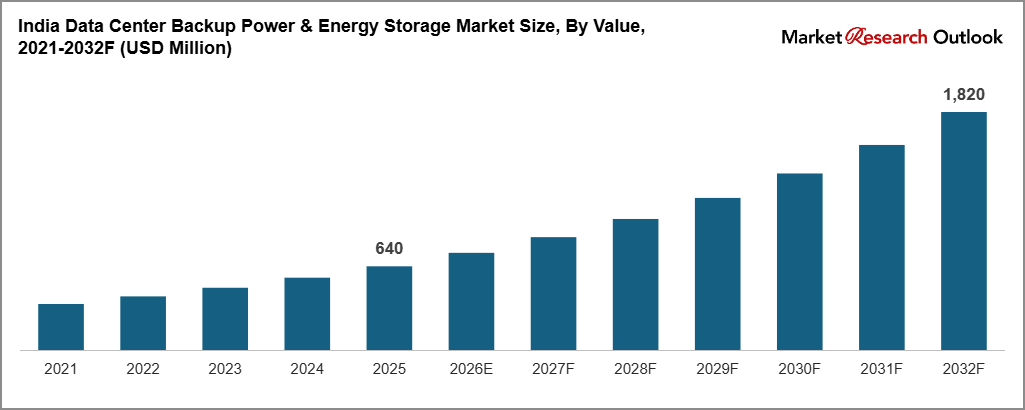
Source:
Market Overview: India Data Center Backup Power & Energy Storage Market
The India data center backup power and energy storage market size is witnessing rapid expansion, driven by record data center construction, rising rack densities, strict uptime commitments to cloud and banking clients, and the steady move from lead-acid batteries to lithium-ion and on-site storage. Valued at USD 640 million in 2025 and projected to reach USD 1,820 million by 2032, growing at a CAGR of 16.1%, growth is being fuelled by hyperscale cloud regions, colocation campuses of 50 MW to 300 MW, and the AI build-out that is pushing power per rack from 6 kW to more than 40 kW in new halls. Diesel generator sets lead spending, while lithium-ion batteries and battery energy storage systems form the fastest growing category. Tighter emission norms, rising diesel costs, and pressure from global clients to cut Scope 1 emissions are reshaping how backup is specified. As genset makers including Cummins India, Kirloskar Oil Engines, Caterpillar, and Rolls-Royce Power Systems add high-kVA capacity, and UPS and battery suppliers including Schneider Electric, Vertiv, Eaton, Exide Industries, and Amara Raja localize production, the market is evolving into an engineered, low-emission, and grid-aware segment with strong long-term growth potential.
Key Report Takeaways: India Data Center Backup Power & Energy Storage Market
- The India data center backup power and energy storage market size is projected to grow from USD 640 million in 2025 to USD 1,820 million by 2032, registering a strong CAGR of 16.1%, driven by hyperscale and colocation capacity additions, rising AI rack densities, and the structural shift toward lithium-ion batteries and on-site storage.
- Diesel generator sets dominate the market, accounting for 41% of total value in 2025, driven by mandatory standby capacity for Tier III and Tier IV facilities, typical fuel autonomy of 24 to 72 hours, the strong service networks of Cummins India and Kirloskar Oil Engines, and rising demand for units rated between 2,001 kVA and 2,500 kVA.
- Lithium-ion batteries and battery energy storage systems are the fastest growing segments, expected to grow at a combined CAGR of 27.4% through 2032 as operators replace VRLA battery rooms, free up floor space, and add storage that can shave peaks and reduce generator starts.
- Rapid scaling of data center capacity, with operational IT load crossing 1,300 MW in 2025 and projected to exceed 3,000 MW by 2030, is structurally expanding demand for gensets, UPS, batteries, and storage across hyperscale, colocation, and enterprise facilities.
- Rising investments by domestic suppliers such as Exide Industries and Amara Raja in lithium-ion cell gigafactories, together with local UPS and genset assembly by Schneider Electric, Vertiv, Cummins India, and Kirloskar Oil Engines, are strengthening supply and supporting the market forecast 2032.
Key Market Drivers: India Data Center Backup Power & Energy Storage Market
Hyperscale and Colocation Capacity Additions and Rising AI Rack Densities Driving Backup Power Demand Across India
Growth in the India data center backup power and energy storage market is being driven first and foremost by the pace of new data center construction. Operational IT load in India crossed 1,300 MW in 2025 and is projected to exceed 3,000 MW by 2030, with Mumbai and Navi Mumbai hosting close to half of current capacity, followed by Chennai, Hyderabad, Delhi NCR, Pune, and Bengaluru. Every megawatt of IT load needs between 2.0 MVA and 3.5 MVA of standby generation plus UPS and battery autonomy of 5 to 15 minutes, so each 100 MW campus represents USD 90 million to USD 120 million of backup equipment. AI training clusters are raising rack densities from 6 kW to 40 kW and above, which increases backup capacity per square foot and favours larger gensets and lithium-ion UPS. Large developers including AdaniConneX, Yotta, CtrlS, NTT DATA, STT GDC India, Nxtra by Airtel, and Sify have announced multi-hundred megawatt pipelines, creating a steady order book for backup suppliers through 2032.
Grid Reliability Gaps and Tier III and Tier IV Uptime Requirements Pushing Operators Toward 2N Backup Architecture
Backup demand in India is also supported by the gap between grid supply quality and the uptime promised to clients. National peak demand crossed 250 GW in 2024, and while metro grids have improved, voltage dips, feeder trips, and planned maintenance outages still occur several times a year at many sites. Colocation operators sign service level agreements of 99.982% to 99.995% availability, matching Uptime Institute Tier III and Tier IV designs, which in practice means N+1 or 2N generator and UPS configurations with on-site fuel for 24 to 72 hours. Banking clients regulated by the RBI and government workloads hosted under MeitY empanelment add their own continuity requirements. As a result, an estimated 58% of new capacity commissioned in 2025 used 2N architecture for UPS, roughly doubling backup equipment value per megawatt compared with N+1 designs and lifting spend across the India data center backup power and energy storage market.
Falling Lithium-Ion Cell Prices, PLI-Backed Cell Manufacturing, and Storage Incentives Accelerating Battery Adoption
Battery technology is a major catalyst for the India data center backup power and energy storage market, with lithium-ion batteries and storage systems projected to grow at 27.4% annually through 2032. LFP cell prices fell by more than 40% between 2023 and 2025, narrowing the upfront gap with VRLA batteries, while lithium-ion offers a 10 to 15 year life against 4 to 6 years for VRLA, 50% to 70% less floor space, and lower cooling needs. The PLI scheme for advanced chemistry cell manufacturing, with an outlay of INR 18,100 crore for 50 GWh of capacity, is backing new plants by Exide Energy Solutions in Bengaluru and Amara Raja in Telangana. Viability gap funding for grid-scale battery storage, first approved in 2023 and extended in 2025, is building local supply chains and integration skills that data center projects can draw on. Together, these factors are moving lithium-ion from a premium option to the default choice for new UPS rooms.
Key Market Challenges: India Data Center Backup Power & Energy Storage Market
CPCB IV+ Emission Norms, Diesel Storage Approvals, and Fuel Logistics Raising the Cost of Generator-Based Backup
The sector continues to face cost and compliance pressure on diesel backup. CPCB IV+ emission norms, in force since July 2023 for gensets up to 800 kW, require after-treatment systems that raised unit prices by 25% to 40% in affected ratings, and larger engines face stricter local scrutiny from state pollution control boards. Bulk diesel storage above licensing limits needs PESO approval, and urban sites often struggle to fit tanks for 48 to 72 hours of autonomy. With diesel priced near INR 90 per litre, a 2,500 kVA genset burns 500 to 550 litres per hour at full load, so monthly testing and long outages add up. Global clients with net zero targets are also asking operators to cut generator run hours, which limits the appeal of diesel-only backup designs.
High Upfront Cost, Fire Safety Scrutiny, and Import Dependence for Lithium-Ion Batteries and Storage Systems
Backup buyers in India face real hurdles in moving fully to lithium-ion. A lithium-ion UPS battery system still costs 1.6 to 2.0 times a comparable VRLA system upfront, even though total cost of ownership favours lithium-ion over 10 years. Fire safety rules for battery rooms, including thermal runaway detection, gas-based suppression, and spacing requirements, are still being harmonized across state fire services and insurers, which slows approvals for large storage installations inside buildings. India also imports more than 75% of its lithium-ion cells, mostly from China, exposing buyers to currency swings, customs duty changes, and shipping delays. Until domestic cell plants reach full output, these factors will keep some operators on VRLA for edge and enterprise sites across the India data center backup power and energy storage market.
Long Lead Times for High-kVA Gensets, Transformers, and Switchgear Delaying Backup Commissioning at Large Campuses
The market faces practical supply constraints for the largest equipment. Lead times for gensets rated above 2,500 kVA stretched to 40 to 60 weeks in 2024 and 2025 as global data center demand absorbed engine capacity, while medium-voltage transformers and switchgear also saw longer delivery schedules. Smaller system integrators face added working capital pressure when equipment arrives in phases. Price escalation clauses, steel and copper cost moves, and currency swings have reduced margins on fixed-price EPC contracts by 3% to 8%. Operators are responding with frame agreements, early reservation of engine slots, and standardized designs, but delays in backup commissioning can still push back campus go-live dates by one to two quarters.
Key Market Trends: India Data Center Backup Power & Energy Storage Market
Rapid Shift From VRLA to Lithium-Ion UPS Batteries and On-Site Battery Energy Storage in India
The India data center backup power and energy storage market is undergoing a clear technology shift from VRLA batteries to lithium-ion UPS systems and on-site battery energy storage, with lithium-ion expected to account for over 55% of new UPS battery installations at large Indian data centers by 2028. Modular lithium-ion cabinets deliver 5 to 15 minutes of autonomy in roughly half the floor space of VRLA, tolerate higher room temperatures, and report cell-level health data to the building management system. Leading suppliers including Schneider Electric, Vertiv, Eaton, ABB, and Delta Electronics have expanded lithium-ion UPS ranges for the Indian market through 2024 and 2025. Larger campuses are also adding containerized LFP storage of 2 MWh to 10 MWh that can cover short outages, smooth load swings from AI clusters, and cut peak demand charges, reinforcing the market forecast 2032 across hyperscale and colocation facilities.
Growth of Low-Emission Gensets, Gas Engines, and Hybrid Genset-Battery Systems in the India Data Center Backup Power & Energy Storage Market
A clear move toward lower-emission backup is reshaping backup design in India, particularly at hyperscale and colocation campuses serving global cloud clients. CPCB IV+ compliant diesel gensets with after-treatment have become standard for new orders, and engine makers are offering units certified to run on hydrotreated vegetable oil, a renewable diesel that can cut lifecycle emissions by up to 90%. Natural gas and dual-fuel gensets are being trialled at sites with city gas connections in Gujarat, Maharashtra, and Uttar Pradesh. Hybrid designs that let batteries carry the load for the first minutes of an outage, then start gensets only if needed, are reducing generator starts by 60% to 80%. By 2025, an estimated 18% of new backup tenders in India asked for some form of genset-battery hybrid control, up from less than 5% in 2021, and the share is rising each year.
Capacity Expansion by Genset, UPS, and Battery Manufacturers and Localization Investments
A wave of capacity expansion and localization is reshaping the supply side of the India data center backup power and energy storage market. Combined India-focused investment announcements in genset assembly, UPS manufacturing, and lithium-ion cell and pack production exceeded USD 2.5 billion across 2023 to 2025. Exide Energy Solutions is building a 12 GWh lithium-ion cell plant in Bengaluru, Amara Raja is developing a giga corridor in Telangana planned for up to 16 GWh, Cummins India and Kirloskar Oil Engines have launched full CPCB IV+ ranges, and Schneider Electric and Vertiv have expanded local UPS production. Production Linked Incentive allocations of INR 18,100 crore for advanced chemistry cells, Make in India procurement preferences, and state data center policies offering capital subsidies have structurally favoured local supply. Combined with hyperscale construction and lithium-ion retrofits, these developments are reinforcing the market forecast 2032 across the full value chain.
Segmental Insights: India Data Center Backup Power & Energy Storage Market
By Data Center Type: Colocation Data Centers Dominate the India Data Center Backup Power & Energy Storage Market
The colocation data center segment dominates the India data center backup power and energy storage market, accounting for an estimated 52% of total value in 2025, driven by multi-tenant campuses in Mumbai, Chennai, and Hyderabad, strict service level agreements, and build-to-suit halls for hyperscale tenants. Diesel gensets above 2,000 kVA and 2N UPS systems are the dominant products within this segment, with lithium-ion now specified in over 60% of new colocation UPS rooms. Hyperscale self-built data centers contribute another 26% of demand, led by cloud regions in Mumbai, Delhi NCR, and Hyderabad. Enterprise data centers account for 14%, while edge, government, and AI-focused facilities make up the remaining 8%. In 2025, colocation leaders including AdaniConneX, Yotta, CtrlS, NTT DATA, STT GDC India, and Nxtra placed large backup orders for new campuses, reinforcing segment dominance in the market.
By Product Type: Diesel Gensets Lead While Lithium-Ion Batteries and BESS Grow Fastest
Diesel generator sets lead the India data center backup power and energy storage market product mix, accounting for 41% of total value in 2025, driven by mandatory standby capacity, long fuel autonomy, and wide service networks. UPS systems contribute another 27%, mainly modular and large-frame units of 500 kVA and above. VRLA batteries hold 12% but are losing share every year. Lithium-ion batteries account for 11% and battery energy storage systems for 5%, and together they are the fastest growing categories, expanding at 27.4% annually on the back of lower cell prices, longer life, and smaller footprint. Fuel cells, flywheels, and other technologies make up the remaining 4%, with pilots under way at a few hyperscale sites. Leading suppliers including Cummins India, Kirloskar Oil Engines, Schneider Electric, Vertiv, and Exide Industries have aligned their portfolios to this product mix, supporting the shift toward integrated backup packages.
Regional Insights: India Data Center Backup Power & Energy Storage Market
Regional analysis of the India data center backup power and energy storage market shows that West India accounts for 49% of total value, driven by Mumbai, Navi Mumbai, Thane, and Pune, where submarine cable landing stations, financial sector demand, and large colocation campuses are concentrated. South India contributes 31% of demand, led by Chennai, which hosts several cable landing stations, Hyderabad, where hyperscale cloud regions are expanding quickly, and Bengaluru, with its strong enterprise base. North India accounts for 16%, supported by Delhi NCR, Noida, and Greater Noida, where the Uttar Pradesh data center policy has attracted large campuses. East and Central India together make up the remaining 4%, led by Kolkata and emerging edge sites in Bhubaneswar and Indore. In 2025, new campus launches across Navi Mumbai, Chennai, Hyderabad, and Greater Noida reinforced these regional hubs, keeping backup equipment demand closely tied to where hyperscale and colocation capacity is being built.
Recent Developments: India Data Center Backup Power & Energy Storage Market
- The India data center backup power and energy storage market saw strong momentum in orders and capacity progress during 2024 and 2025. India added a record volume of new data center IT capacity in 2025, and backup generation installed at data centers is estimated to have reached 3,900 MW of genset capacity by the end of the year, up from 2,600 MW in 2023. Lithium-ion accounted for 38% of new UPS battery deployments by value in 2025, against 15% in 2021. Total backup capacity commissioned for data centers is projected to grow at an average 17% annually through 2030.
- Domestic suppliers have deepened India-focused capacity expansion. In 2025, Exide Energy Solutions moved ahead with its lithium-ion cell plant in Bengaluru, Amara Raja progressed its giga corridor in Telangana, Cummins India and Kirloskar Oil Engines widened their CPCB IV+ genset ranges for high-kVA ratings, and Schneider Electric and Vertiv expanded local UPS output. The Ministry of Power also extended viability gap funding to a further 30 GWh of battery storage. These developments are strengthening domestic supply and supporting the market forecast 2032.
- Data center developer momentum has gained strong traction in the India data center backup power and energy storage market. In 2025, leading operators including AdaniConneX, Yotta, CtrlS, NTT DATA, STT GDC India, Nxtra by Airtel, and Sify expanded campus pipelines in Mumbai, Chennai, Hyderabad, and Noida. Long-term supply agreements between developers and genset, UPS, and battery makers are positioning India as one of the fastest growing backup power markets in Asia, strengthening the long-term outlook.
Key Market Players: India Data Center Backup Power & Energy Storage Market
- Cummins India Limited
- Kirloskar Oil Engines Limited
- Caterpillar India Pvt. Ltd.
- Rolls-Royce Power Systems AG (mtu)
- Mahindra Powerol (Mahindra & Mahindra Ltd.)
- Schneider Electric India Pvt. Ltd.
- Vertiv Energy Pvt. Ltd.
- Eaton Power Quality Pvt. Ltd.
- ABB India Limited
- Delta Electronics India Pvt. Ltd.
- Exide Industries Limited
- Amara Raja Energy & Mobility Limited
- Legrand India Pvt. Ltd. (Numeric)
| By Product Type | By Power Rating | By Redundancy | By DC Type | By End-User |
| Diesel Gensets UPS Lithium-Ion VRLA BESS Others | Below 500 kVA 500-1,000 kVA 1,001-1,500 kVA 1,501-2,000 kVA 2,001-2,500 kVA 2,501-3,000 kVA Above 3,000 kVA | N N+1 2N 2N+1 Distributed Redundant | Hyperscale Colocation Enterprise Edge Government AI-Ready | Cloud & IT BFSI Telecom & Media Government & Healthcare |
Report Scope
In this report, the India Data Center Backup Power & Energy Storage Market has been segmented into the following categories, in addition to detailed analysis of key industry trends, market dynamics, competitive landscape, and growth opportunities across the forecast period:
- By Product Type
- Diesel Generator Sets
- Uninterruptible Power Supply (UPS) Systems
- Lithium-Ion Batteries
- VRLA Batteries
- Battery Energy Storage Systems (BESS)
- Others (Fuel Cells, Flywheels)
- By Power Rating
- Below 500 kVA
- 500-1,000 kVA
- 1,001-1,500 kVA
- 1,501-2,000 kVA
- 2,001-2,500 kVA
- 2,501-3,000 kVA
- Above 3,000 kVA
- By Redundancy Architecture
- N (Basic Capacity)
- N+1
- 2N
- 2N+1
- Distributed Redundant
- By Data Center Type
- Hyperscale Data Centers
- Colocation Data Centers
- Enterprise Data Centers
- Edge & Micro Data Centers
- Government & Public Sector Data Centers
- AI & High-Density Computing Facilities
- By End-User
- Cloud & IT Services
- BFSI
- Telecom & Media
- Government & Healthcare
- By Geography
- North India
- South India
- West India
- East India
- Central India
Competitive Landscape
Company Profiles:
Detailed analysis of the leading companies operating in the India Data Center Backup Power & Energy Storage Market, including business overview, product portfolio, strategic initiatives, competitive positioning, and recent developments.
Company Information
Detailed profiling and strategic analysis of additional market players (up to five companies), including emerging domestic genset assemblers, specialty lithium-ion and storage integrators, regional UPS brands, or niche fuel cell and flywheel suppliers.
For a free sample of the India Data Center Backup Power & Energy Storage Market report, customised insights or delivery timelines, submit your query here
India Data Center Backup Power & Energy Storage Market, 2032
- Research Framework
- Market Segmentation
- Research Objective
- Research Methodology
- Qualitative Research
- Primary Research
- Secondary Research
- Quantitative Research
- Market Breakdown & Data Triangulation
- Demand Side
- Supply Side
- Primary Research Respondents
- Assumption & Limitation
- Executive Summary
- Market Overview, 2021-2032
- By Product Type
- By Power Rating
- By Redundancy Architecture
- By Data Center Type
- By End-User
- By Region
- Analyst Recommendations
- Geopolitical Impact on India Data Center Backup Power & Energy Storage Market
- India Data Center Backup Power & Energy Storage Market Insights
- Market Dynamics
- Growth Drivers
- Hyperscale and colocation capacity additions and rising AI rack densities driving backup power demand across India.
- Grid reliability gaps and Tier III and Tier IV uptime requirements pushing operators toward 2N backup architecture.
- Falling lithium-ion cell prices, PLI-backed cell manufacturing, and storage incentives accelerating battery adoption.
- Restraints
- CPCB IV+ emission norms, diesel storage approvals, and fuel logistics raising the cost of generator-based backup.
- High upfront cost, fire safety scrutiny, and import dependence for lithium-ion batteries and storage systems.
- Long lead times for high-kVA gensets, transformers, and switchgear delaying backup commissioning at large campuses.
- Opportunities
- Lithium-ion retrofits of legacy VRLA battery rooms opening a large replacement pool across older data center sites.
- Grid-interactive battery storage supporting peak shaving, demand response, and reduced diesel run hours.
- Low-emission gensets ready for natural gas and renewable diesel creating next-generation backup demand.
- Challenges
- Intense price competition among genset and UPS suppliers compressing margins on large campus tenders.
- Limited availability of skilled engineers for commissioning and maintaining lithium-ion and storage systems.
- Space, structural load, and fuel tank permitting limits at dense urban data center sites in Mumbai and Chennai.
- Technological Advancements
- Recent Technological Advancements
- Prior to 2020
- Porter’s Five Forces Analysis
- PESTLE Analysis
- Industry Value Chain & Entry Points
- Upstream Raw Materials & Components (engine blocks, alternators, lithium cells, lead, copper, power semiconductors, enclosures)
- Genset & Engine Manufacturers (Cummins India, Kirloskar Oil Engines, Caterpillar, mtu, Mahindra Powerol)
- UPS & Power Electronics Suppliers (Schneider Electric, Vertiv, Eaton, ABB, Delta Electronics)
- Battery Cell & Storage System Makers (Exide Industries, Amara Raja, LFP cell and BESS integrators)
- Testing, Certification & Compliance Bodies (CPCB, PESO, BIS, CEA, Uptime Institute Tier standards)
- Distributors, Dealers & System Integrators (OEM dealer networks and electrical EPC contractors)
- Data Center Developers & Operators (AdaniConneX, Yotta, CtrlS, NTT DATA, STT GDC India, Nxtra, Sify)
- Design, EPC & Facility Management Firms (MEP consultants, turnkey builders, O&M service providers)
- Fuel Supply, Service & Aftermarket Networks (diesel suppliers, AMC providers, battery recyclers)
- End-Users (cloud providers, banks, telecom operators, government agencies, hospitals, enterprises)
- India Data Center Backup Power & Energy Storage Market: Regulatory Framework
- India Data Center Backup Power & Energy Storage Market Overview
- Market Size & Forecast, 2021-2032
- By Value (USD Million)
- By Volume (MW)
- Market Share & Forecast
- By Product Type
- Diesel Generator Sets
- Uninterruptible Power Supply (UPS) Systems
- Lithium-Ion Batteries
- VRLA Batteries
- Battery Energy Storage Systems (BESS)
- Others (Fuel Cells, Flywheels)
- By Power Rating
- Below 500 kVA
- 500-1,000 kVA
- 1,001-1,500 kVA
- 1,501-2,000 kVA
- 2,001-2,500 kVA
- 2,501-3,000 kVA
- Above 3,000 kVA
- By Redundancy Architecture
- N (Basic Capacity)
- N+1
- 2N
- 2N+1
- Distributed Redundant
- By Data Center Type
- Hyperscale Data Centers
- Colocation Data Centers
- Enterprise Data Centers
- Edge & Micro Data Centers
- Government & Public Sector Data Centers
- AI & High-Density Computing Facilities
- By End-User
- Cloud & IT Services
- BFSI
- Telecom & Media
- Government & Healthcare
- By Geography
- North India
- South India
- West India
- East India
- Central India
- Competitive Landscape
- India Data Center Backup Power & Energy Storage Market Company Market Share Analysis, 2025
- Competitive Benchmarking, By Operating Parameters
- Key Strategic Development (Mergers, Acquisitions, Partnerships, Etc.)
- List of Emerging Players
- Company Profile
- Cummins India Limited
- Introduction & Company Profile
- Product Benchmarking
- Strategic Outlook
- Key Competitors
- Financial Analysis
- SWOT Analysis
(Same Data Pointers Will Be Provided for The Below Companies)
- Kirloskar Oil Engines Limited
- Caterpillar India Pvt. Ltd.
- Rolls-Royce Power Systems AG (mtu)
- Mahindra Powerol (Mahindra & Mahindra Ltd.)
- Schneider Electric India Pvt. Ltd.
- Vertiv Energy Pvt. Ltd.
- Eaton Power Quality Pvt. Ltd.
- ABB India Limited
- Delta Electronics India Pvt. Ltd.
- Exide Industries Limited
- Amara Raja Energy & Mobility Limited
- Legrand India Pvt. Ltd. (Numeric)
- Other Prominent Players
* Financial information in case of non-listed companies will be provided as per availability
** The segmentation and the companies are subjected to modifications based on in-depth secondary for the final deliverable
Frequently Asked Questions
1. How large is the India data center backup power and energy storage market and what is its growth forecast?
Ans: The India data center backup power and energy storage market is valued at USD 640 million in 2025 and is projected to reach USD 1,820 million by 2032, growing at a CAGR of 16.1%, supported by hyperscale capacity additions.
2. Which segments are driving demand in the India data center backup power and energy storage market?
Ans: Diesel generator sets lead with a 41% value share, while lithium-ion batteries and battery energy storage systems grow fastest at 27.4% annually, as operators replace VRLA batteries and cut generator run hours.
3. What are the key drivers of growth in the India data center backup power and energy storage market?
Ans: Key drivers include hyperscale and colocation capacity additions, rising AI rack densities, Tier III and Tier IV uptime requirements, grid reliability gaps, and falling lithium-ion cell prices backed by PLI incentives.
4. Which regions are driving growth in the India data center backup power and energy storage market?
Ans: West India leads with 49% of value, driven by Mumbai and Navi Mumbai, followed by South India at 31%, led by Chennai and Hyderabad. North India holds 16%, supported by Delhi NCR and Noida.
5. What are the latest trends in the India data center backup power and energy storage market?
Ans: Latest trends include the shift from VRLA to lithium-ion UPS batteries, on-site battery storage, CPCB IV+ and gas-ready gensets, hybrid genset-battery controls, and local cell and UPS manufacturing by Indian suppliers.