

India Power Transformer Market Size, Share & Forecast 2032
- Energy, Power & Storage, Grid & Power Infrastructure
- Oct 2026
- Pages 140
- Report Format: pdf
- Report Price: $2400 USD
India’s power transformer market is witnessing strong structural growth, driven by a transformation capacity target of 2,345 GVA by 2031-32, 1,270 GVA of planned additions under the national transmission plan, accelerating renewable evacuation and data centre demand, ageing fleet replacement, export pull from a worldwide equipment shortage, and rising interest from domestic and global manufacturers investing in India-specific assembly, testing and core material capacity.
| Study Duration | 2021-2032 |
| Market Size (2025) | USD 2,150 Million |
| CAGR (2026-2032) | 13.7% |
| Leading Segment | Power Transformers Above 100 MVA (400 kV Class) |
| Fastest Growing Segment | 765 kV & HVDC Converter Transformers |
| Market Size (2032) | USD 5,280 Million |
India Power Transformer Market Overview
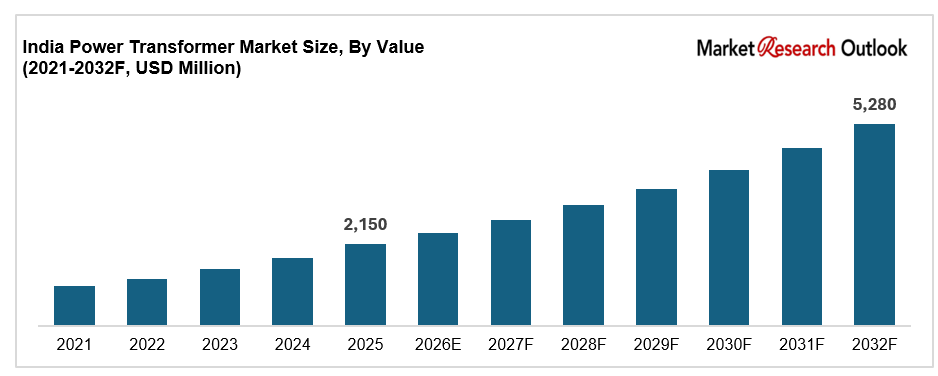
The India power transformer market size is witnessing rapid expansion, driven by the national grid plan, accelerating renewable evacuation orders, data centre and industrial load growth, ageing fleet replacement, and export pull created by a worldwide equipment shortage. Valued at USD 2,150 million in 2025 and projected to reach USD 5,280 million by 2032, growing at a CAGR of 13.7%, the India power transformer market growth is being fuelled by transformation capacity additions across Gujarat, Maharashtra, Rajasthan, Tamil Nadu, Karnataka and Uttar Pradesh. Units above 100 MVA lead the product mix, while 765 kV and HVDC converter transformers are emerging as the fastest growing categories. Capacity, not demand, is the binding constraint, with CRGO electrical steel roughly 90% imported and lead times on 220 kV units near 20 months. As Bharat Heavy Electricals, Hitachi Energy India, Siemens Energy India, GE Vernova T&D India and CG Power expand assembly and testing capability, the Indian transformer industry is evolving into a supply-constrained, high-realisation, and export-linked sector with strong long-term growth potential.
Related research: India Transmission Infrastructure Market, India Distribution Transformer Market and India Electricity Demand Market.
Key Report Takeaways: India Power Transformer Market
- The India power transformer market size is projected to grow from USD 2,150 million in 2025 to USD 5,280 million by 2032, registering a strong CAGR of 13.7%, driven by the national transformation capacity target, renewable evacuation demand, and the structural shift toward extra high voltage units across the Indian grid.
- Units above 100 MVA dominate the India power transformer market, accounting for 41% of value in 2025, driven by inter-regional corridors, pooling substations and renewable evacuation schemes that concentrate demand at the top of the rating range rather than in smaller utility replacements.
- The 765 kV class and HVDC converter transformers are emerging as the fastest growing segments in the India power transformer market, expected to grow at 19.8% annually as 33 GW of bi-pole links are built and inter-regional capacity rises from 119 GW toward 143 GW.
- The capacity constraint is acute, with lead times on 220 kV units stretching from 9 months to 20 months, prices more than doubling, and a CRGO electrical steel shortfall near 30%, structurally reshaping how the India power transformer market prices, schedules and allocates output.
- Rising investment by manufacturers such as Bharat Heavy Electricals, Hitachi Energy India, Siemens Energy India, CG Power and Transformers and Rectifiers in assembly bays, tank shops and EHV testing is strengthening domestic supply and supporting the India power transformer market forecast 2032.
Key Drivers of the India Power Transformer Market
Grid Expansion Plan of 1,270 GVA and the 2,345 GVA Transformation Target Driving Transformer Demand
Growth in the India power transformer market is being driven by a grid plan that finally sizes transformation capacity to the generation fleet it must serve. The National Electricity Plan for transmission commits to 1,270 GVA of transformation capacity and 1,91,000 circuit kilometres of lines at 220 kV and above between FY2023 and FY2032, alongside 33 GW of high-voltage direct current bi-pole links, within a transmission investment opportunity above INR 9,15,000 crore. Installed transformation capacity at 220 kV and above reached 1,407 GVA by January 2026 against a target near 2,345 GVA by 2031-32, implying sustained annual additions far above the historical run rate. Inter-regional capacity is set to rise from 119 GW to 143 GW by 2027. That arithmetic gives qualified manufacturers unusually long procurement visibility and underpins order book growth across the Indian transformer market.
Renewable Evacuation, Data Centre Load and Ageing Fleet Replacement Widening the Order Book
The India power transformer market is benefiting from demand arriving through several channels at once. Renewable evacuation schemes require pooling substations, autotransformers and generator step-up units sized for solar and wind parks in Rajasthan, Gujarat and the southern wind belts, where network build has lagged capacity addition. Data centre campuses have become a distinct buyer class and rank among the fastest growing end-user segments, drawing firm capacity at 220 kV and above. Railway traction, metro networks, steel and cement expansions, and green hydrogen projects add industrial pull. Alongside new demand, a large installed fleet commissioned during the 1990s and 2000s is reaching end of design life, and utilities are replacing units rather than extending them because efficiency norms have tightened. Power utilities alone account for close to 47% of transformer revenue in India, and replacement now travels with expansion across the power transformer market.
Export Pull From the Global Transformer Shortage Lifting Capacity Utilisation and Realisation
Export demand remains a major catalyst for the India power transformer market. Lead times for large power transformers worldwide have moved from a historical norm of 20 weeks at the low end and 26 weeks at the high end to 104 weeks and 156 weeks respectively, as grid investment accelerates across the United States, Europe and the Gulf. Imports meet 80% of United States power transformer supply, leaving a gap Indian manufacturers are well placed to fill on cost and qualification. Indian manufacturers have responded by allocating output to higher-margin export orders, lifting plant utilisation and price realisation. The trade-off is direct: export diversion has been cited as a contributor to domestic shortage, with 220 kV lead times stretching from 9 months to 20 months and prices more than doubling. Exports therefore strengthen earnings while tightening domestic availability across the Indian transformer market.
India Power Transformer Market Challenges
CRGO Electrical Steel Shortfall and Import Dependence Constraining Transformer Core Supply
The India power transformer market continues to face a hard constraint in the material that makes the core. Cold rolled grain oriented electrical steel accounts for 35% of transformer material cost, and India consumes roughly 400,000 tonnes a year against domestic production meeting only 11% of requirement, leaving a structural shortfall near 30% documented by the Global Trade Research Initiative. Close to 90% of supply is imported from Japanese, Korean and European mills, and certification requirements under the Bureau of Indian Standards determine which mills can ship, so licence renewal cycles quietly tighten availability and stretch lead times. Hi-B and low core loss grades face the sharpest pressure as efficiency labelling and utility specifications tighten. Smaller manufacturers carry the worst of it, lacking the purchasing power to hold buffer stock. Until domestic capacity scales, core material will remain the binding constraint on the India power transformer market.
Lead Times, Testing Slots and Skilled Engineering Capacity Limiting Order-to-Delivery Conversion
The India power transformer market faces structural complexity in converting a swollen backlog into dispatch. Lead times on 220 kV units have moved from 9 months historically to around 14 months and then to 20 months by 2026, and specialised high rating units can take considerably longer. Assembly bays, vapour phase drying plants, tank fabrication shops and oil filling facilities are all sequential, so a single constraint holds the whole line. Extra high voltage type testing and short circuit testing capacity is limited to a small number of laboratories, and qualification for utility supply depends on those slots. Skilled winding and design engineering resources are equally scarce after a decade of muted capacity addition. Bushing shortages have delayed deliveries independently of core availability. Order books therefore grow faster than revenue across the Indian transformer market, and the capacity-versus-backlog gap has become the measure that matters.
Copper, Bushing and Insulator Price Volatility Against Fixed-Price Utility Contracts
The India power transformer market faces practical constraints around input cost and contract structure. Copper winding wire and continuously transposed conductor track London Metal Exchange pricing, while insulator prices have moved from INR 5,000 to INR 20,000 with supply running at 80% of requirement, and bushing availability remains tight. Utility supply contracts are frequently awarded on fixed prices with limited pass-through, so manufacturers carry commodity exposure between bid and delivery over cycles that now run beyond a year. Aggressive bidding by manufacturers with Indian subsidiaries has kept tender pricing competitive even as input costs rise. Hedging, escalation clauses, buffer stock and backward integration into core and conductor supply are the recognised responses, but each demands working capital that mid-sized manufacturers in the India power transformer market do not always hold.
India Power Transformer Market Trends
Order Book Outrunning Capacity and the Rise of the Capacity Versus Backlog Gap in India
The India power transformer market is being re-rated around a single question, which is how much of a reported backlog a manufacturer can actually build. Order books across listed manufacturers have grown faster than installed assembly capacity, so analysts increasingly model the capacity versus order book gap rather than headline bookings. Central utility tenders account for 24% of procurement and state utility tenders 28%, with EPC and turnkey contractor supply at 19% and private transmission developer orders at 14%, and each of these buyers is now competing for the same delivery slots. Manufacturers have responded with brownfield debottlenecking, additional tank shops, second shift working and selective order acceptance, while buyers have begun placing orders two to three years ahead of need. This dynamic is reinforcing the India power transformer market forecast 2032 across both utility and industrial procurement.
CRGO Localisation, Backward Integration and Core Material Security Reshaping Supply
A visible push toward material security is reshaping the India power transformer market. JSW JFE Electrical Steel is expanding its Nashik plant from 50,000 tonnes a year toward 2,50,000 tonnes a year, the single largest domestic addition against a national requirement of 400,000 tonnes, though operational capacity at scale is not expected before FY2028, which means the absolute supply gap widens before it narrows. Incentive support for domestic core material production is shortening import-dependent lead times for manufacturers able to contract volume early. Larger manufacturers are securing multi-year CRGO contracts, holding buffer inventory and qualifying additional mills under Bureau of Indian Standards certification, while some are integrating backward into core cutting and conductor supply. Material security has become a competitive differentiator rather than a procurement function across the Indian transformer market.
Shift to 765 kV, HVDC Converter and Higher-Efficiency Transformer Designs
A wave of design upgrading is reshaping value across the India power transformer market. The 400 kV class still carries 31% of value and 220 kV a further 26%, but growth is concentrated at 765 kV, which holds 17%, and in HVDC converter transformers at 8%, because renewable generation sits far from load and 33 GW of bi-pole links are planned through 2032. Operating voltage ambitions extend to 1,200 kV alternating current. Efficiency labelling and utility specifications are pushing low core loss designs that consume less CRGO per MVA, which eases material exposure while raising design effort. Ester fluid filled units are gaining ground at fire-sensitive and urban sites, and condition monitoring is increasingly specified as standard. Combined with 1,270 GVA of planned additions, these developments are reinforcing the India power transformer market forecast 2032 across the entire value chain.
India Power Transformer Market Share by Segment
By End-User: Transmission Utilities & Grid Operators Segment Dominates the Market
The transmission utilities and grid operators segment dominates the India power transformer market, accounting for an estimated 47% of value, driven by inter-regional corridors, pooling substations and the transformation capacity additions committed under the national plan. The 400 kV and 220 kV classes are the dominant configurations within this segment, with units above 100 MVA taking the largest share of value. Renewable generators and independent power producers contribute another 21% of demand, concentrated in generator step-up units and evacuation substations at solar and wind parks. Distribution utilities account for 18%, led by 132 kV and 110 kV intake substations and replacement of ageing units. Industrial buyers, railways and data centres make up 14%, the fastest growing buyer class. In 2025, procurement by Power Grid Corporation and state utilities reinforced segment dominance across the Indian transformer industry.
By Product Type: Units Above 100 MVA Lead While 765 kV and HVDC Converter Units Grow Fastest
Power transformers above 100 MVA lead the India power transformer market product mix, accounting for approximately 41% of value, driven by inter-regional corridors and pooling substations that concentrate demand at the top of the rating range. Units between 10 MVA and 100 MVA contribute another 24%, autotransformers 15%, generator step-up units 8%, shunt and series reactors 7%, and converter and special purpose units the remaining 5%. The 765 kV class and HVDC converter transformers are the fastest growing categories within the India power transformer market, expanding at 19.8% annually. Oil-immersed designs hold 46% of the cooling mix and forced oil a further 38%, with ester fluid filled units growing from a small base. Leading manufacturers including Bharat Heavy Electricals, Hitachi Energy India, Siemens Energy India, GE Vernova T&D India and CG Power have aligned capacity to this mix across the Indian transformer industry.
India Power Transformer Market by Region
Regional analysis of the India power transformer market shows that West India and North India collectively account for approximately 56% of value, driven by Gujarat and Maharashtra, which host the largest concentration of manufacturing plants and pooling substations, alongside Rajasthan, Haryana and Uttar Pradesh, where renewable evacuation and load growth are strongest. West India also leads as a production base, with Vadodara, Ahmedabad and Nashik forming the industry’s densest cluster. South India contributes around 24% of value, led by Tamil Nadu, Karnataka, Telangana and Andhra Pradesh, supported by wind evacuation, data centre campuses and industrial demand. East India accounts for 12%, supported by West Bengal, Odisha and Jharkhand, while Central India accounts for 8%, led by Madhya Pradesh and Chhattisgarh. In 2025, capacity additions across Gujarat and Maharashtra reinforced these hubs across the India power transformer market.
Recent Developments in the India Power Transformer Market
- The India power transformer market recorded strong momentum in demand and pricing during 2025 and 2026. Installed transformation capacity at 220 kV and above reached 1,407 GVA by January 2026 against a national target near 2,345 GVA by 2031-32, while the transmission plan committed 1,270 GVA of additions and 33 GW of high-voltage direct current bi-pole links across FY2023 to FY2032 within an investment opportunity above INR 9,15,000 crore. Lead times on 220 kV units moved from 9 months historically to around 20 months by 2026, and transformer prices more than doubled over the same period, shifting negotiating power decisively toward manufacturers.
- Material supply stayed tight across the India power transformer market. The Global Trade Research Initiative documented a CRGO electrical steel shortfall near 30% against an annual requirement of 400,000 tonnes, with domestic production meeting about 11% and close to 90% imported. JSW JFE Electrical Steel advanced its Nashik expansion from 50,000 tonnes a year toward 2,50,000 tonnes a year, though capacity at scale is not expected before FY2028. Insulator prices moved from INR 5,000 to INR 20,000 with supply at 80% of requirement, and bushing shortages independently delayed deliveries.
- Capacity and competitive positions continued to shift in the India power transformer market. Bharat Heavy Electricals, Hitachi Energy India, Siemens Energy India, GE Vernova T&D India and CG Power retained the leading positions in extra high voltage ratings, while Transformers and Rectifiers (India), Voltamp Transformers, Atlanta Electricals, Bharat Bijlee and Danish Power expanded mid-range capacity and order books. Global lead times of 104 weeks at the low end and 156 weeks at the high end for large units pulled Indian output toward exports, strengthening long-term positioning in the India power transformer market forecast 2032.
Key Companies in the India Power Transformer Market
- Bharat Heavy Electricals Limited (BHEL)
- Hitachi Energy India Limited
- Siemens Energy India Limited
- GE Vernova T&D India Limited
- CG Power and Industrial Solutions Limited
- Transformers and Rectifiers (India) Limited
- Toshiba Transmission & Distribution Systems (India) Private Limited
- TBEA Energy (India) Private Limited
- Voltamp Transformers Limited
- Atlanta Electricals Limited
- Bharat Bijlee Limited
- Kirloskar Electric Company Limited
- Danish Power Limited
| By Product Type | By Voltage Class | By Cooling | By Procurement | By End-User |
| Above 100 MVA 10-100 MVA Autotransformers GSU Reactors Converter Units | 765 kV 400 kV 220 kV 132 kV & 110 kV 66 kV & Below HVDC Converter Others | Oil-Immersed Forced Oil Dry Type Ester Filled Gas Insulated | Central Tenders State Tenders Private Developers EPC Supply Direct Orders Aftermarket | Transmission Utilities Distribution Utilities RE Generators & IPPs Industry & Data Centres |
Report Scope
In this report, the India Power Transformer Capacity & Grid Expansion Constraint Market has been segmented into the following categories, in addition to detailed analysis of key industry trends, market dynamics, competitive landscape, and growth opportunities across the forecast period:
- By Product Type
- Power Transformers (Above 100 MVA)
- Power Transformers (10 MVA to 100 MVA)
- Autotransformers
- Generator Step-Up Transformers
- Shunt & Series Reactors
- Converter & Special Purpose Transformers
- By Voltage Class
- 765 kV
- 400 kV
- 220 kV
- 132 kV & 110 kV
- 66 kV & Below
- HVDC Converter Transformers
- Others
- By Cooling & Insulation
- Oil-Immersed (ONAN & ONAF)
- Forced Oil (OFAF & ODAF)
- Dry Type & Cast Resin
- Ester Fluid Filled
- Gas Insulated & Others
- By Procurement Route
- Central Utility Tenders
- State Utility Tenders
- Private Transmission Developer Orders
- EPC & Turnkey Contractor Supply
- Renewable & Industrial Direct Orders
- Replacement & Aftermarket
- By End-User
- Transmission Utilities & Grid Operators
- Distribution Utilities
- Renewable Generators & Independent Power Producers
- Industrial, Railways & Data Centres
- By Geography
- North India
- South India
- West India
- East India
- Central India
Competitive Landscape
Company Profiles:
Detailed analysis of the leading companies operating in the India Power Transformer Capacity & Grid Expansion Constraint Market, including business overview, product portfolio, strategic initiatives, competitive positioning, and recent developments.
Company Information
Detailed profiling and strategic analysis of additional market players (up to five companies), including emerging transformer manufacturers, specialty component suppliers, regional repair and retrofit specialists, or niche core material and testing service providers.
For a free sample of the India Power Transformer Capacity & Grid Expansion Constraint Market report, customised insights or delivery timelines, submit your query here
India Power Transformer Capacity & Grid Expansion Constraint Market, 2032
- Research Framework
- Market Segmentation
- Research Objective
- Research Methodology
- Qualitative Research
- Primary Research
- Secondary Research
- Quantitative Research
- Market Breakdown & Data Triangulation
- Demand Side
- Supply Side
- Primary Research Respondents
- Assumption & Limitation
- Executive Summary
- Market Overview, 2021-2032
- By Product Type
- By Voltage Class
- By Cooling & Insulation
- By Procurement Route
- By End-User
- By Region
- Analyst Recommendations
- Geopolitical Impact on India Power Transformer Market
- India Power Transformer Market Insights
- Market Dynamics
- Growth Drivers
- Grid expansion plan of 1,270 GVA and the 2,345 GVA transformation target driving India power transformer market demand.
- Renewable evacuation, data centre load growth and ageing asset replacement widening the order book in India.
- Export pull from the global transformer shortage lifting capacity utilisation and price realisation.
- Restraints
- CRGO electrical steel shortfall of 30% with 90% import dependence constraining transformer core supply.
- Lead times stretching to 20 months, limiting how fast power transformer orders convert into deliveries.
- Limited EHV testing, short-circuit laboratory and skilled engineering capacity across Indian manufacturers.
- Opportunities
- Domestic CRGO capacity expansion under JSW JFE and incentive schemes easing the core material bottleneck.
- 765 kV, HVDC converter and ester-filled power transformer designs lifting value realised per unit shipped.
- Brownfield debottlenecking and new assembly bays converting swollen order books into delivered revenue.
- Challenges
- Copper, bushing and insulator price volatility running against fixed-price utility supply contracts.
- Export diversion by domestic manufacturers tightening power transformer availability for Indian utilities.
- Matching capacity additions to an order book growing faster than assembly, tank and testing slots.
- Technological Advancements
- Recent Technological Advancements
- Prior to 2020
- Porter’s Five Forces Analysis
- PESTLE Analysis
- Industry Value Chain & Entry Points
- CRGO Electrical Steel Mills & Importers (JSW JFE, Japanese, Korean and European mills)
- Copper Winding Wire & Continuously Transposed Conductor Manufacturers
- Insulation, Pressboard & Transformer Oil Suppliers (kraft paper, mineral and ester fluids)
- Bushing, On-Load Tap Changer & Radiator Component Makers
- Core Cutting, Slitting & Lamination Service Units (core building and stacking)
- Power Transformer OEMs & Assembly Plants (BHEL, Hitachi Energy, Siemens Energy, CG Power)
- EHV Testing, Short-Circuit & Type Test Laboratories (CPRI, ERDA, in-house EHV facilities)
- EPC Contractors, Logistics & Heavy Haulage Providers (site erection, oil filling, charging)
- Transmission Utilities, Developers & Procurement Agencies (PGCIL, CTUIL, state utilities)
- End-Users (renewable generators, distribution utilities, railways, industry, data centres)
- India Power Transformer Market: Regulatory Framework
- India Power Transformer Market Overview
- Market Size & Forecast, 2021-2032
- By Value (USD Million)
- By Volume (GVA)
- Market Share & Forecast
- By Product Type
- Power Transformers (Above 100 MVA)
- Power Transformers (10 MVA to 100 MVA)
- Autotransformers
- Generator Step-Up Transformers
- Shunt & Series Reactors
- Converter & Special Purpose Transformers
- By Voltage Class
- 765 kV
- 400 kV
- 220 kV
- 132 kV & 110 kV
- 66 kV & Below
- HVDC Converter Transformers
- Others
- By Cooling & Insulation
- Oil-Immersed (ONAN & ONAF)
- Forced Oil (OFAF & ODAF)
- Dry Type & Cast Resin
- Ester Fluid Filled
- Gas Insulated & Others
- By Procurement Route
- Central Utility Tenders
- State Utility Tenders
- Private Transmission Developer Orders
- EPC & Turnkey Contractor Supply
- Renewable & Industrial Direct Orders
- Replacement & Aftermarket
- By End-User
- Transmission Utilities & Grid Operators
- Distribution Utilities
- Renewable Generators & Independent Power Producers
- Industrial, Railways & Data Centres
- By Geography
- North India
- South India
- West India
- East India
- Central India
- Competitive Landscape
- India Power Transformer Market Company Market Share Analysis, 2025
- Competitive Benchmarking, By Operating Parameters
- Key Strategic Development (Mergers, Acquisitions, Partnerships, Etc.)
- List of Emerging Players
- Company Profile
- Bharat Heavy Electricals Limited (BHEL)
- Introduction & Company Profile
- Product Benchmarking
- Strategic Outlook
- Key Competitors
- Financial Analysis
- SWOT Analysis
(Same Data Pointers Will Be Provided for The Below Companies)
- Hitachi Energy India Limited
- Siemens Energy India Limited
- GE Vernova T&D India Limited
- CG Power and Industrial Solutions Limited
- Transformers and Rectifiers (India) Limited
- Toshiba Transmission & Distribution Systems (India) Private Limited
- TBEA Energy (India) Private Limited
- Voltamp Transformers Limited
- Atlanta Electricals Limited
- Bharat Bijlee Limited
- Kirloskar Electric Company Limited
- Danish Power Limited
- Other Prominent Players
* Financial information in case of non-listed companies will be provided as per availability
** The segmentation and the companies are subjected to modifications based on in-depth secondary for the final deliverable
Frequently Asked Questions
1. How large is the India power transformer market and what is its growth forecast?
Ans: The India power transformer market is valued at USD 2,150 million in 2025 and is projected to reach USD 5,280 million by 2032, growing at a CAGR of 13.7% on delivered equipment value across all voltage classes.
2. Which segments are driving demand in the India power transformer market?
Ans: Units above 100 MVA lead with 41% of value, while the 765 kV class and HVDC converter transformers are the fastest growing segments, supported by inter-regional corridors and renewable evacuation schemes.
3. What are the key drivers of growth in the India power transformer market?
Ans: Key drivers include the 2,345 GVA transformation capacity target, 1,270 GVA of planned additions, renewable evacuation orders, data centre and railway load growth, ageing fleet replacement, and strong export demand.
4. Which regions are driving growth in the India power transformer market?
Ans: West India and North India lead with around 56% of value, driven by Gujarat, Maharashtra, Rajasthan and Uttar Pradesh. South India follows at 24%, led by Tamil Nadu, Karnataka and Telangana.
5. What are the latest trends in the India power transformer market?
Ans: Latest trends include order books outrunning assembly capacity, CRGO localisation and backward integration into core material, the shift toward 765 kV and HVDC converter units, and ester filled higher-efficiency transformer designs.