

India Electricity Demand Market from Data Centres, EVs and Industry: Size & Forecast 2032
- Energy, Power & Storage, Grid & Power Infrastructure
- Oct 2026
- Pages 140
- Report Format: pdf
- Report Price: $2400 USD
India’s new-load electricity demand is witnessing strong structural growth, driven by data centre capacity moving from 2.2 GW toward 12 GW by 2030, artificial intelligence compute expansion, accelerating electric vehicle adoption and charging network build-out, the National Green Hydrogen Mission, substitution of fuel-fired process heat with electric equipment, falling renewable and storage cost, and rising interest from hyperscalers and industrial buyers contracting firm clean power directly in India.
| Study Duration | 2021-2032 |
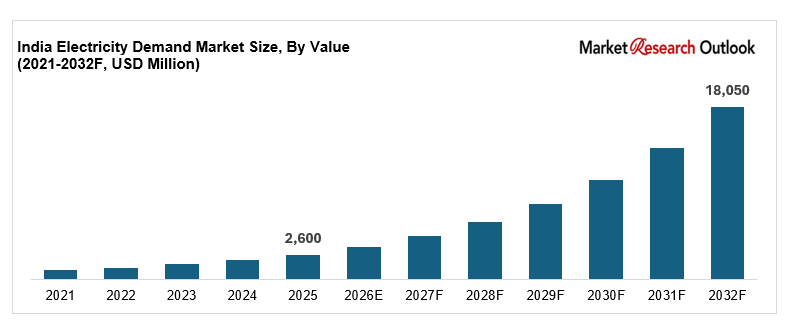
| Market Size (2025) | USD 2,600 Million |
| CAGR (2026-2032) | 31.9% |
| Leading Segment | Data Centres & AI Compute (Base Load, Grid Supply) |
| Fastest Growing Segment | Green Hydrogen Electrolysis & EV Charging |
| Market Size (2032) | USD 18,050 Million |
India Electricity Demand Market Overview
The India electricity demand market size is witnessing rapid expansion, driven by data centre and artificial intelligence compute build-out, electric vehicle charging networks, green hydrogen electrolysis, and the substitution of fuel-fired process heat with electric equipment. Valued at USD 2,600 million in 2025 and projected to reach USD 18,050 million by 2032, growing at a CAGR of 31.9%, the Indian electricity demand growth is being fuelled by load additions across Maharashtra, Tamil Nadu, Karnataka, Telangana, Gujarat and Uttar Pradesh. Data centres and AI compute lead the demand source mix, while green hydrogen and vehicle charging are the fastest growing categories. Supply, not appetite, is the binding constraint, with firm round-the-clock clean power scarce and grid connectivity timelines long. As operators including AdaniConnex, CtrlS, Yotta, NTT and Sify build capacity, and as Tata Power, Adani Green Energy, ReNew and JSW Energy contract supply, Indian power consumption is evolving into a contract-led, carbon-aware, and infrastructure-constrained market with strong long-term growth potential.
Related research: India Transmission Infrastructure Market, India Power Transformer Market and India Distribution Transformer Market.
Key Report Takeaways: India Electricity Demand Market
- The India electricity demand market size is projected to grow from USD 2,600 million in 2025 to USD 18,050 million by 2032, registering a strong CAGR of 31.9%, driven by data centre build-out, vehicle charging networks, and industrial electrification across the Indian grid.
- Data centres and AI compute dominate the India electricity demand market, accounting for 29% of value in 2025, driven by capacity moving from 2.2 GW toward 12 GW by 2030, flat round-the-clock consumption, and the willingness of hyperscale buyers to contract supply years ahead of energisation.
- Green hydrogen electrolysis and electric vehicle charging are emerging as the fastest growing segments in the India electricity demand market, expected to grow at 44.8% annually as electrolyser projects reach commissioning and charging networks scale beyond metropolitan corridors.
- New-load volume is scaling sharply, with these three demand engines consuming 34 TWh in 2025 and projected to reach 258 TWh by 2032, structurally expanding the India electricity demand market across generation, transmission, and retail supply categories.
- Rising investment by operators such as AdaniConnex, CtrlS, Yotta, NTT and Sify in campuses, and by Tata Power, Adani Green Energy, ReNew and JSW Energy in firm renewable supply, is strengthening delivery capability and supporting the India electricity demand market forecast 2032.
Key Drivers of the India Electricity Demand Market
Data Centre and AI Compute Build-Out Creating Concentrated, Round-the-Clock Electricity Demand
Growth in the India electricity demand market is being driven first by digital infrastructure. Operational data centre capacity is projected to rise from 2.2 GW in 2025 to 12 GW by 2030, a compound growth rate close to 40%, while artificial intelligence dedicated capacity expands nearly 24-fold from 275 MW to 6,546 MW over the same window. Installed capacity has already tripled from about 520 MW in 2020 to nearly 1.5 GW by mid-2025, and India hosted around 271 facilities as of January 2026, with Mumbai holding close to a quarter of them. Electricity consumption from this segment stood at 10 TWh in 2025, roughly 0.5% of national consumption, and is forecast to reach 191 TWh by 2040, or about 7% of total demand. Committed investment reached approximately USD 95 billion between 2019 and 2025 and is expected to pass USD 100 billion by 2027, giving the Indian electricity demand unusually visible load growth.
Electric Vehicle Adoption and Fast-Charging Networks Adding Distributed, Time-Shifted Load
The India electricity demand market is benefiting from mobility electrification arriving as a distributed load across thousands of connection points rather than a handful of campuses. Two and three wheelers carry the bulk of current consumption, charging mostly on low tension connections at homes and small depots, while electric buses, fleet vehicles and passenger cars concentrate draw at depot and highway fast-charging sites on high tension supply. Night-charging load accounts for 14% of the new-load profile and is valuable to utilities because it fills the overnight trough without adding to evening peak. Charge point operators including Charge Zone and utility-linked networks are expanding along highway corridors and in metropolitan clusters. Because charging timing is far more flexible than data centre consumption, this segment is where managed charging and time-of-day tariffs will do most work across the India electricity demand market.
Industrial Electrification, Green Hydrogen and Process Heat Substitution Expanding Consumption
Industrial electrification remains the largest of the three engines in the India electricity demand market. Industry already accounts for 41.8% of national electricity consumption, and that base is growing as fuel-fired boilers, furnaces and dryers are replaced with electric boilers, induction and arc melting, industrial heat pumps and electrified material handling. The National Green Hydrogen Mission, launched in 2023, adds a distinct new load, since electrolysis converts electricity directly into a chemical feedstock for refining, fertiliser and steel. Overall national consumption rose 33% between FY21 and FY25 at a five-year compound rate of 7.4%, and the Central Electricity Authority projects the electricity requirement to climb from about 1,725 billion units in FY25 to 3,365 billion units by FY36 at a 6.41% compound rate. Process electrification and hydrogen together carry a rising share of that increment across the Indian electricity demand.
India Electricity Demand Market Challenges
Grid Connectivity, Evacuation Delays and Substation Capacity Constraining New Load Energisation
The India electricity demand market continues to face a hard constraint in getting new load connected. Electricity access, rather than land or capital, has become the defining factor in where large campuses are sited, and connection timelines for extra high voltage supply routinely run longer than the construction programme of the facility itself. The concentration of demand compounds the problem, with Maharashtra and Tamil Nadu holding about 65% of installed data centre load, so a small number of substations carry a disproportionate share of new draw. National peak demand reached a record 241.2 GW in December 2025 and is projected to rise toward 458 GW by 2032, while installed generation capacity must expand from around 520 GW in January 2026 to 1,121 GW by FY36. Until transmission and substation build-out keeps pace with siting decisions, energisation will remain the binding constraint on Indian power consumption growth.
Open Access Charges, Cross-Subsidy Surcharge and Tariff Friction Raising Delivered Power Cost
The India electricity demand market faces structural complexity in the cost of buying power outside the standard retail tariff. Large consumers seeking cheaper or cleaner supply through open access carry cross-subsidy surcharge, additional surcharge, wheeling and transmission charges, and state level rules differ enough that a procurement structure viable in one state is uneconomic in the next. Distribution utilities depend on high tension and commercial consumers to cross-subsidise agricultural and residential supply, so every large load that migrates to open access or captive generation weakens utility finances and invites further charges. Approval timelines, banking rules and scheduling restrictions add friction. Group captive structures, behind-the-meter generation and long-term bilateral contracts are the common workarounds, but each demands scale and legal effort that mid-sized buyers in the Indian electricity demand struggle to carry.
Round-the-Clock Clean Power Scarcity and Storage Cost Limiting Firm Renewable Supply
The India electricity demand market faces practical constraints in matching flat consumption to variable generation. Data centres draw close to constant power and account for 44% of the new-load profile as base load, but solar delivers only during daylight and wind is seasonal, so serving a 24×7 campus on renewable supply requires oversized generation paired with storage. Round-the-clock and firm renewable contracts account for just 5% of procurement in this segment today because the firming premium remains material. Buyers therefore blend solar and wind power purchase agreements with grid supply and unbundled renewable certificates rather than contracting genuinely firm clean power. Falling battery cost, pumped storage additions and hybrid tender design are closing the gap, but until firming is affordable, carbon-matched supply will stay aspirational for much of the India electricity demand market.
India Electricity Demand Market Trends
Power Access Rather Than Land Becoming the Binding Constraint on Data Centre Siting in India
The India electricity demand market is reorganising around where firm power can actually be delivered. Developers now screen sites for substation headroom, evacuation availability and tariff structure before assessing land or connectivity, a reversal of the sequence used a decade ago. That is pulling investment beyond the established hubs of Maharashtra and Tamil Nadu, which hold about 65% of installed capacity, into Andhra Pradesh, Telangana, Uttar Pradesh, Karnataka and Gujarat where renewable resource and grid headroom coincide. AdaniConnex has announced a development pipeline of 2.6 GW, and a one gigawatt facility is planned at Visakhapatnam in Andhra Pradesh, anchoring a coastal corridor built around port connectivity and renewable supply. State policies increasingly compete on power tariff, open access exemption and land rather than incentives alone, reinforcing the India electricity demand market forecast 2032.
Round-the-Clock Renewable and Storage-Firmed Contracts Replacing Plain Solar Agreements
A visible shift in contracting is reshaping the India electricity demand market. Plain solar power purchase agreements deliver cheap energy but cover only part of a flat load, so buyers are moving toward hybrid solar and wind portfolios, round-the-clock structures and storage-firmed supply that match consumption hour by hour. Discom grid supply still carries 46% of procurement for these loads, with open access at 18%, captive and group captive at 13% and renewable power purchase agreements at 11%, but round-the-clock and firm contracts are the fastest growing route from a small base. Generators including Adani Green Energy, ReNew, JSW Energy and Tata Power are structuring bundled offerings that combine generation, storage and grid balancing under one agreement. Carbon accounting requirements from global technology buyers are accelerating the move across the Indian electricity demand.
Managed Charging, Flexible Industrial Load and Demand Response Entering the Supply Mix
A wave of flexibility-led thinking is reshaping the India electricity demand market. Not all new load needs to be firm, and the difference is commercially valuable. Flexible and interruptible load accounts for 8% of the new-load profile and seasonal or batch load a further 4%, while night-charging load at 14% sits in the overnight trough where surplus capacity already exists. Managed charging platforms shift vehicle consumption into midday solar surplus and overnight windows, electrolysers can follow renewable output rather than run flat, and electric boilers and melting operations can be scheduled around tariff signals. Daily peak load rose by more than 7 GW for each incremental degree of temperature in 2024 and is expected to pass 11 GW per degree by 2027, which makes every controllable megawatt more valuable. Combined with time-of-day tariffs, these developments are reinforcing the India electricity demand market forecast 2032.
India Electricity Demand Market Share by Segment
By End-User: Process Industry & Manufacturing Segment Dominates the India Electricity Demand Market
The process industry and manufacturing segment dominates the India electricity demand market, accounting for an estimated 39% of value, driven by electrified process heat, induction and arc melting, industrial heat pumps and electrified material handling across steel, cement, chemicals, textiles and food processing. High tension supply at 33 kV and 11 kV is the dominant connection configuration within this segment. Data centre and colocation operators contribute another 29% of value, concentrated on extra high voltage supply with dedicated feeders and flat base load. Electric mobility and charge point operators account for 24%, split between low tension home charging and high tension depot and highway sites. Green hydrogen and chemicals producers make up 8%, the fastest growing buyer class. In 2025, procurement across Maharashtra, Tamil Nadu, Gujarat and Karnataka reinforced segment dominance in the India electricity demand market.
By Demand Source: Data Centres Lead While Green Hydrogen and Vehicle Charging Grow Fastest
Data centres and AI compute lead the India electricity demand market source mix, accounting for approximately 29% of value, driven by flat consumption, rapid capacity addition and long contracting horizons. Electric vehicle charging contributes another 24%, electrified process heat and boilers 21%, electric melting, furnaces and material handling 18%, green hydrogen and electrolysis 5%, and other items the remaining 3%. Green hydrogen and vehicle charging are the fastest growing categories within the Indian electricity demand, expanding at 44.8% annually as electrolyser projects reach commissioning and charging networks widen. Base load takes 44% of the load profile, day-peak 19% and night-charging 14%. Leading operators including AdaniConnex, CtrlS, Yotta, NTT and Sify have aligned campus pipelines to this mix across Indian power consumption.
India Electricity Demand Market by Region
Regional analysis of the India electricity demand market shows that West India and South India collectively account for approximately 61% of value, driven by Maharashtra and Tamil Nadu, which together hold about 65% of installed data centre load, alongside Gujarat, Karnataka, Telangana and Andhra Pradesh, where industrial electrification, green hydrogen and charging networks are scaling together. Mumbai remains the single largest cluster, holding close to a quarter of national facilities. North India contributes around 22% of value, led by Uttar Pradesh, Haryana, Rajasthan and Delhi NCR, supported by fleet electrification and new campus commitments. East India accounts for 10%, supported by West Bengal and Odisha, while Central India accounts for 7%, led by Madhya Pradesh and Chhattisgarh. In 2025, capacity commitments across Maharashtra, Tamil Nadu and Andhra Pradesh reinforced these hubs across the India electricity demand market.
Recent Developments in the India Electricity Demand Market
- The India electricity demand market recorded strong momentum in load growth and commitments during 2025 and 2026. Operational data centre capacity was placed at 2.2 GW in 2025 with a projection of 12 GW by 2030 at close to 40% compound growth, while artificial intelligence dedicated capacity was forecast to rise from 275 MW to 6,546 MW over the same period. Electricity consumption from this segment stood at 10 TWh in 2025, around 0.5% of national demand, with a path to 191 TWh by 2040 or roughly 7% of total consumption. India hosted about 271 facilities as of January 2026 across some 23 million square metres of land.
- Demand planning was revised upward across the India electricity demand market. The Central Electricity Authority placed peak demand at 459 GW and the electricity requirement at 3,365 billion units by FY36, with peak growing at 5.58% and energy at 6.41% compound from FY25, and installed capacity rising from around 520 GW in January 2026 to 1,121 GW by FY36. National peak demand reached a record 241.2 GW in December 2025. Consumption grew only 1.4% during 2025, the weakest since 1972 excluding the pandemic, before a forecast rebound of 6.9% in 2026 and 6.4% average growth through 2030.
- Investment and siting decisions continued to shift the India electricity demand market. Committed data centre investment reached approximately USD 95 billion between 2019 and 2025 and is expected to exceed USD 100 billion by 2027, while AdaniConnex announced a development pipeline of 2.6 GW and a one gigawatt facility was proposed at Visakhapatnam in Andhra Pradesh. Amazon Web Services, Google and domestic operators expanded commitments beyond Maharashtra and Tamil Nadu, strengthening long-term positioning in the India electricity demand market forecast 2032.
Key Companies in the India Electricity Demand Market
- AdaniConnex Private Limited
- NTT Global Data Centers (India) Private Limited
- CtrlS Datacenters Limited
- Sify Infinit Spaces Limited
- Yotta Data Services Private Limited
- Tata Communications Limited
- Tata Power Company Limited
- Adani Green Energy Limited
- ReNew Energy Global Plc
- JSW Energy Limited
- Charge Zone Private Limited
- ACME Cleantech Solutions Private Limited
- Hygenco Green Energies Private Limited
| By Demand Source | By Procurement Route | By Voltage | By Load Profile | By End-User |
| Data Centres EV Charging Process Heat Melting & Furnaces Green Hydrogen Others | Discom Supply Open Access Captive Renewable PPA Round-the-Clock Exchange Behind-the-Meter | EHV HT LT Dedicated Feeder Islanded & Microgrid | Base Load Day-Peak Evening-Peak Night-Charging Flexible Seasonal & Batch | Data Centre Operators Charge Point Operators Process Industry Green Hydrogen Producers |
Report Scope
In this report, the India Electricity Demand from Data Centers, EVs & Industrial Electrification Market has been segmented into the following categories, in addition to detailed analysis of key industry trends, market dynamics, competitive landscape, and growth opportunities across the forecast period:
- By Demand Source
- Data Centres & AI Compute
- Electric Vehicle Charging
- Electrified Process Heat & Boilers
- Electric Melting, Furnaces & Material Handling
- Green Hydrogen & Electrolysis
- Others
- By Power Procurement Route
- Discom Grid Supply
- Open Access (Green & Conventional)
- Captive & Group Captive
- Renewable Power Purchase Agreements
- Round-the-Clock & Firm Renewable Contracts
- Power Exchange & Short-Term Market
- Behind-the-Meter Solar & Storage
- By Connection Voltage
- EHV (132 kV & Above)
- HT (33 kV & 11 kV)
- LT (Below 11 kV)
- Dedicated Feeder & Captive Substation
- Islanded & Microgrid Supply
- By Load Profile
- Base Load (24×7 Continuous)
- Day-Peak Load
- Evening-Peak Load
- Night-Charging Load
- Flexible & Interruptible Load
- Seasonal & Batch Load
- By End-User
- Data Centre & Colocation Operators
- Electric Mobility & Charge Point Operators
- Process Industry & Manufacturing
- Green Hydrogen & Chemicals Producers
- By Geography
- North India
- South India
- West India
- East India
- Central India
Competitive Landscape
Company Profiles:
Detailed analysis of the leading companies operating in the India Electricity Demand from Data Centers, EVs & Industrial Electrification Market, including business overview, capacity portfolio, strategic initiatives, competitive positioning, and recent developments.
Company Information
Detailed profiling and strategic analysis of additional market players (up to five companies), including emerging colocation operators, specialty charge point networks, regional industrial electrification providers, or niche electrolyser and firm power suppliers.
For a free sample of the India Electricity Demand from Data Centers, EVs & Industrial Electrification Market report, customised insights or delivery timelines, submit your query here
India Electricity Demand from Data Centers, EVs & Industrial Electrification Market, 2032
- Research Framework
- Market Segmentation
- Research Objective
- Research Methodology
- Qualitative Research
- Primary Research
- Secondary Research
- Quantitative Research
- Market Breakdown & Data Triangulation
- Demand Side
- Supply Side
- Primary Research Respondents
- Assumption & Limitation
- Executive Summary
- Market Overview, 2021-2032
- By Demand Source
- By Power Procurement Route
- By Connection Voltage
- By Load Profile
- By End-User
- By Region
- Analyst Recommendations
- Geopolitical Impact on India Electricity Demand Market
- India Electricity Demand Market Insights
- Market Dynamics
- Growth Drivers
- Data centre and AI compute build-out creating concentrated, round-the-clock India electricity demand market growth.
- Electric vehicle adoption and fast-charging networks adding distributed, time-shifted electricity demand.
- Industrial electrification, green hydrogen and process heat substitution expanding industrial consumption.
- Restraints
- Grid connectivity and evacuation delays constraining how fast new electricity demand can be energised.
- Cross-subsidy surcharge, network charges and open access friction raising delivered power cost in India.
- Round-the-clock clean power scarcity and storage cost limiting firm renewable supply for new loads.
- Opportunities
- Round-the-clock renewable contracts and storage-firmed supply serving 24×7 data centre electricity demand.
- Managed and smart charging shifting electric vehicle load into surplus solar hours and off-peak windows.
- Captive, group captive and behind-the-meter generation lowering delivered cost for large consumers.
- Challenges
- Matching concentrated gigawatt-scale electricity demand to substation capacity in a few dense districts.
- Water availability, cooling load and land constraints at the scale new demand centres now require.
- Forecasting new load accurately when adoption curves shift faster than planning cycles allow in India.
- Technological Advancements
- Recent Technological Advancements
- Prior to 2020
- Porter’s Five Forces Analysis
- PESTLE Analysis
- Industry Value Chain & Entry Points
- Generation Companies & Renewable Developers (solar, wind, hybrid and firm supply portfolios)
- Transmission Utilities & Grid Operators (CTUIL, Power Grid, state transmission utilities)
- Distribution Utilities & Supply Licensees (retail supply, open access approval, network charges)
- Power Traders, Exchanges & Aggregators (IEX, PXIL, bilateral and short-term contracting)
- Energy Storage & Firming Providers (battery storage, pumped hydro, demand response platforms)
- Data Centre Developers & Colocation Operators (AdaniConnex, CtrlS, Yotta, NTT, Sify)
- Charge Point Operators & Fleet Electrification Providers (public, depot and destination charging)
- Industrial Electrification & Process Equipment Suppliers (electric boilers, furnaces, heat pumps)
- Electrolyser Makers & Green Hydrogen Producers (ACME, Hygenco, Ohmium, domestic manufacturers)
- End-Users (hyperscalers, electric fleets, process industry, chemicals and refining consumers)
- India Electricity Demand Market: Regulatory Framework
- India Electricity Demand Market Overview
- Market Size & Forecast, 2021-2032
- By Value (USD Million)
- By Volume (TWh)
- Market Share & Forecast
- By Demand Source
- Data Centres & AI Compute
- Electric Vehicle Charging
- Electrified Process Heat & Boilers
- Electric Melting, Furnaces & Material Handling
- Green Hydrogen & Electrolysis
- Others
- By Power Procurement Route
- Discom Grid Supply
- Open Access (Green & Conventional)
- Captive & Group Captive
- Renewable Power Purchase Agreements
- Round-the-Clock & Firm Renewable Contracts
- Power Exchange & Short-Term Market
- Behind-the-Meter Solar & Storage
- By Connection Voltage
- EHV (132 kV & Above)
- HT (33 kV & 11 kV)
- LT (Below 11 kV)
- Dedicated Feeder & Captive Substation
- Islanded & Microgrid Supply
- By Load Profile
- Base Load (24×7 Continuous)
- Day-Peak Load
- Evening-Peak Load
- Night-Charging Load
- Flexible & Interruptible Load
- Seasonal & Batch Load
- By End-User
- Data Centre & Colocation Operators
- Electric Mobility & Charge Point Operators
- Process Industry & Manufacturing
- Green Hydrogen & Chemicals Producers
- By Geography
- North India
- South India
- West India
- East India
- Central India
- Competitive Landscape
- India Electricity Demand Market Company Market Share Analysis, 2025
- Competitive Benchmarking, By Operating Parameters
- Key Strategic Development (Mergers, Acquisitions, Partnerships, Etc.)
- List of Emerging Players
- Company Profile
- AdaniConnex Private Limited
- Introduction & Company Profile
- Product Benchmarking
- Strategic Outlook
- Key Competitors
- Financial Analysis
- SWOT Analysis
(Same Data Pointers Will Be Provided for The Below Companies)
- NTT Global Data Centers (India) Private Limited
- CtrlS Datacenters Limited
- Sify Infinit Spaces Limited
- Yotta Data Services Private Limited
- Tata Communications Limited
- Tata Power Company Limited
- Adani Green Energy Limited
- ReNew Energy Global Plc
- JSW Energy Limited
- Charge Zone Private Limited
- ACME Cleantech Solutions Private Limited
- Hygenco Green Energies Private Limited
- Other Prominent Players
* Financial information in case of non-listed companies will be provided as per availability
** The segmentation and the companies are subjected to modifications based on in-depth secondary for the final deliverable
Frequently Asked Questions
1. How large is the India electricity demand market from these new loads and what is its growth forecast?
Ans: The India electricity demand market from data centres, vehicle charging and industrial electrification is valued at USD 2,600 million in 2025 and is projected to reach USD 18,050 million by 2032, growing at 31.9%.
2. Which segments are driving demand in the India electricity demand market?
Ans: Data centres and AI compute lead with 29% of value, while green hydrogen electrolysis and electric vehicle charging are the fastest growing sources, supported by commissioning pipelines and widening charging networks.
3. What are the key drivers of growth in the India electricity demand market?
Ans: Key drivers include data centre capacity moving from 2.2 GW toward 12 GW by 2030, rising electric vehicle adoption, the National Green Hydrogen Mission, and substitution of fuel-fired process heat with electric equipment.
4. Which regions are driving growth in the India electricity demand market?
Ans: West India and South India lead with around 61% of value, driven by Maharashtra, Tamil Nadu, Gujarat, Karnataka and Telangana. North India follows at 22%, led by Uttar Pradesh and Haryana.
5. What are the latest trends in the India electricity demand market?
Ans: Latest trends include power access deciding where data centres are sited, round-the-clock renewable and storage-firmed contracts replacing plain solar agreements, and managed charging with flexible industrial load entering the supply mix.