

India Decor Paper Market, 2032
- Chemicals & Advanced Materials, Polymers, Plastics & Packaging
- Nov 2026
- Pages 140
- Report Format: pdf
- Report Price: $2400 USD
India’s decor paper market is witnessing strong structural growth, driven by rising housing completions, rapid growth in modular furniture and kitchens, large capacity additions in high-pressure laminates, prelam boards, and MDF, wider adoption of digital printing, growing laminate exports, and rising investment by domestic printers and global decor paper majors in India-specific designs, base paper supply, and faster distribution networks.
| Study Duration | 2021-2032 |
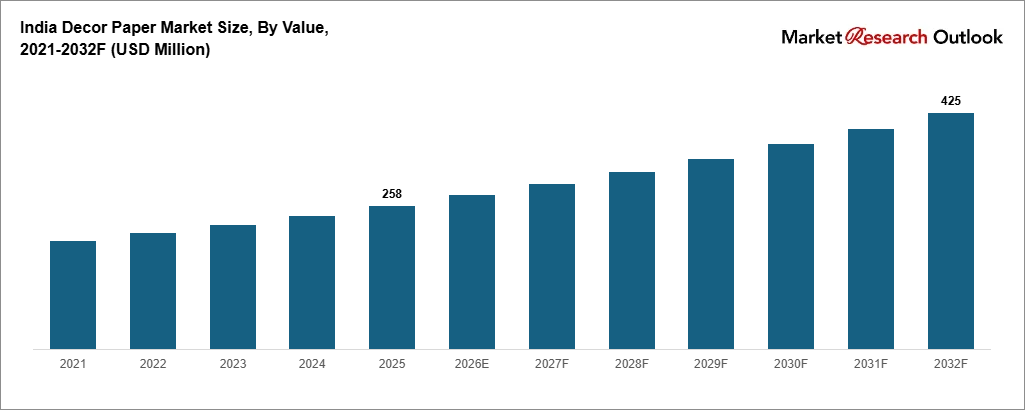
| Market Size (2025) | USD 258 Million |
| CAGR (2026-2032) | 7.4% |
| Leading Segment | Print Base Paper (High-Pressure Laminates) |
| Fastest Growing Segment | Pre-Impregnated & Digitally Printed Paper |
| Market Size (2032) | USD 425 Million |
Market Overview: India Decor Paper Market
The India decor paper market size is witnessing rapid expansion, driven by rising housing completions, the boom in modular furniture and kitchens, large capacity additions in laminates, prelam boards, and MDF, and growing demand for premium wood, stone, and solid color surfaces. Valued at USD 258 million in 2025 and projected to reach USD 425 million by 2032, growing at a CAGR of 7.4%, the India decor paper market is drawing strong demand from high-pressure laminate makers, prelam board producers, flooring brands, and furniture manufacturers across Gujarat, Haryana, Punjab, Maharashtra, and South India. Print base paper leads decor paper consumption, while pre-impregnated and digitally printed decor paper is emerging as the fastest growing category. Shorter design cycles, rising demand for textured and matching surfaces, and the steady shift from carpenter-made to factory-made furniture are reshaping the decor paper supply landscape. As ITC, Pudumjee Paper Products, Ahlstrom, Felix Schoeller, Schattdecor, Interprint, Toppan, and Indian printers such as Match Graphics and Unique Décor widen their decor paper ranges, and laminate majors including Greenlam, Century Plyboards, Merino, and Stylam scale capacity, the India decor paper market is evolving into a design-led, quality-driven, and export-linked segment with strong long-term growth potential.
Key Report Takeaways: India Decor Paper Market
- The India decor paper market size is projected to grow from USD 258 million in 2025 to USD 425 million by 2032, registering a strong CAGR of 7.4%, driven by housing growth, modular furniture demand, and capacity expansion in laminates, prelam boards, and MDF across India.
- Print base paper dominates the India decor paper market, accounting for around 52% of total value in 2025, driven by its wide use in high-pressure laminates, the deep presence of wood grain and stone designs, and steady demand from organized laminate brands such as Greenlam, Century, Merino, and Stylam.
- Pre-impregnated and digitally printed decor paper are emerging as the fastest growing segments in the India decor paper market, expected to grow at 10% to 12% annually as prelam board makers, flooring brands, and furniture OEMs look for faster, lower-cost, and customised surfaces.
- High-pressure laminates account for 44% to 48% of decor paper demand, while low-pressure laminates and prelam boards hold 30% to 34% and are growing faster, structurally expanding the India decor paper market across furniture, panelling, and flooring categories.
- Rising investments by laminate and panel majors such as Greenlam, Century Plyboards, Greenpanel, Rushil Décor, and Action Tesa in new laminate, MDF, and particle board capacity are strengthening local demand and supporting the India decor paper market forecast 2032.
Key Market Drivers: India Decor Paper Market
Rising Housing Completions, Urban Real Estate Growth, and Modular Furniture Demand Driving Decor Paper Consumption Across India
Growth in the India decor paper market is being driven by rising housing completions, steady urban real estate activity, and the rapid shift toward modular furniture and kitchens across tier-1, tier-2, and tier-3 cities. Residential sales across India’s top seven cities stayed close to 4 lakh units in 2025, while PMAY-Urban 2.0 targets 1 crore new urban homes, each creating demand for wardrobes, kitchens, doors, and wall panels finished with decor paper surfaces. The organized modular furniture and kitchen segment is growing at 12% to 15% annually, led by brands such as Godrej Interio, Livspace, HomeLane, and Hettich partner workshops. A typical 2BHK interior uses 40 to 70 laminate sheets, and every sheet carries at least one layer of decor paper. Per-capita laminate consumption in India still trails China and Southeast Asia by a wide margin, indicating significant long-term headroom for growth. A young population, rising home ownership, and faster replacement cycles for interiors are creating strong structural pull-through demand across the India decor paper market.
Expansion of Laminate, Prelam Board, and MDF Capacity Fuelling Domestic Decor Paper Demand
The India decor paper market is benefiting from sustained capacity additions in high-pressure laminates, prelam boards, and MDF. Greenlam commissioned its laminate plant at Naidupeta in Andhra Pradesh, Century Plyboards started its MDF plant at Badvel in Andhra Pradesh, and Rushil Décor, Greenpanel, and Action Tesa expanded MDF and particle board output to serve furniture OEMs. Each new prelam line consumes large volumes of pre-impregnated and solid color decor paper, while HPL plants need print base, overlay, and backer decor paper grades. India is also one of the world’s leading laminate exporters, shipping to more than 100 countries, which adds steady export-linked demand for decor paper. Average decor paper prices in India range between INR 180 and INR 320 per kg depending on GSM, print type, and finish, with premium decor paper designs commanding higher margins. Organized laminate and panel brands now account for over 55% of decorative surface sales, supported by BIS quality norms and growing trust in branded products. This capacity cycle is supporting volume growth and price stability across the India decor paper market.
Digital Printing, Design Innovation, and Premium Textures Strengthening High-Value Decor Paper Segment
Rapid growth in digital printing and design innovation is a major catalyst for the India decor paper market, with pre-impregnated and digitally printed paper projected to grow at 10% to 12% annually through 2032. Design cycles for laminates have shortened to 12 to 18 months, and leading brands now launch 200 to 400 new decor paper designs every year across wood grains, stone, concrete, fabric, and solid colors. Digital inkjet printing of decor paper allows short runs of 500 to 2,000 metres, custom designs for hotels and retail chains, and faster sampling, which suits the fragmented Indian laminate industry. Indian printers such as Match Graphics, Unique Décor, and Tanish have added high-speed rotogravure and digital lines, while global majors including Schattdecor, Interprint, Toppan, and Surteco bring large decor paper design libraries and matching edge band and flooring decors. Rising demand for synchronised textures, anti-fingerprint finishes, and matching surfaces across furniture, doors, and panels is pushing laminate makers toward higher value decor paper. These shifts are structurally expanding India decor paper market growth across all major application categories through 2032.
Key Market Challenges: India Decor Paper Market
Volatility in Pulp, Titanium Dioxide, and Resin Costs Pressuring Decor Paper Margins
The India decor paper market continues to face challenges around raw material price volatility, with decor base paper containing up to 40% titanium dioxide by weight along with bleached hardwood pulp and wet-strength resins. Most titanium dioxide used by Indian decor paper makers is imported, which exposes them to currency moves and global supply swings. In May 2025, decor base paper prices rose by 6% to 8%, and Indian printers signalled increases of INR 10 to INR 15 per kg, putting pressure on liner laminate, 0.8 mm laminate, and prelam board producers. Melamine and urea resin prices used in impregnation have also stayed volatile, tracking natural gas and urea markets. Average gross margins for decor paper printers in India range between 18% and 26%, and smaller printers struggle to pass on cost increases to price-sensitive laminate makers in Gujarat and North India. These decor paper cost swings reduce planning visibility and limit investment by smaller players across the India decor paper market.
High Import Dependence for Decor Base Paper and Competition from Chinese Printed Paper
The India decor paper market faces structural complexity from limited domestic base paper capacity and heavy reliance on imports from Europe, China, Indonesia, and South Korea. While ITC and Pudumjee Paper Products supply part of India’s specialty and base paper needs, a large share of high-opacity print base paper is still imported, with lead times of 45 to 75 days. This forces printers and laminate makers to hold high decor paper inventories and carry currency risk. Low-priced printed decor paper from China has also competed with Indian printers for years, and anti-dumping duties imposed on some Chinese suppliers have added price uncertainty across the supply chain. Differences in opacity, absorbency, and colour consistency between decor paper sources create operational complexity for printers such as Match Graphics, Unique Décor, and Tanish serving laminate makers across India. While domestic specialty and decor paper investments are growing, import dependence remains a near-term challenge for the India decor paper market.
Competition from Alternative Surfaces and Price Pressure from the Unorganized Laminate Segment
The India decor paper market faces practical constraints from alternative surface materials, unorganized competition, and price pressure across the value chain. PVC and PET films, acrylic sheets, natural veneers, PU paint, and lacquer finishes compete with decor paper based laminate surfaces in premium kitchens, wardrobes, and retail fixtures. At the lower end, unorganized laminate makers often use low-GSM, low-opacity decor paper to cut costs, which pulls down average realisations. Laminate prices in tier-2 and tier-3 markets can vary by 20% to 30% between branded and unbranded products, and many small furniture makers choose on price alone. Average selling prices for low-end liner and 0.7 mm laminates have stayed under pressure, reducing the effective value growth of new decor paper launches by 3% to 6%. Premium decor paper textures, digital designs, and stronger brand marketing are emerging as ways to differentiate, but price sensitivity remains a barrier to faster value growth across the India decor paper market.
Key Market Trends: India Decor Paper Market
Rapid Adoption of Digital Printing and Short-Run Customised Decor Paper in India
The India decor paper market is undergoing a clear technology shift toward digital printing and short-run customised decor paper, with digitally printed paper expected to capture over 12% of new decor launches by 2028, up from about 3% in 2020. Digital inkjet lines allow printers to produce 500 to 2,000 metre runs at viable cost, compared with minimum runs of 8,000 to 10,000 metres on rotogravure cylinders. This makes it easier for decor paper printers to serve hotels, retail chains, offices, and export buyers who want exclusive or matching designs. Leading domestic and global players including Schattdecor, Interprint, Toppan, Surteco, Match Graphics, and Unique Décor have expanded digital decor paper design studios and sampling capacity through 2024 and 2025. Large-format scanning of real wood, stone, and fabric is also improving decor paper print realism, particularly in premium markets such as Mumbai, Bengaluru, Delhi NCR, and Hyderabad. This technology transition is reinforcing the India decor paper market forecast 2032 across both laminate and prelam board categories.
Growing Demand for Sustainable, FSC-Certified, and Low-Emission Decor Paper
A clear shift toward sustainable and low-emission surfaces is reshaping the India decor paper market, particularly in the premium furniture, office, and export segments. Laminate and panel makers increasingly ask for FSC or PEFC certified decor paper, water-based inks, and low-formaldehyde impregnation resins to meet E1 and E0 emission norms. Export buyers in Europe, the Middle East, and North America now request chain-of-custody documents and emission test reports for every shipment. Green building projects under IGBC, GRIHA, and LEED also reward low-emitting interior materials, which supports demand for certified decor paper surfaces. Anti-bacterial, anti-fingerprint, and scratch-resistant finishes on decor paper laminates gained wider use after 2020 in hospitals, schools, and kitchens. By 2025, certified and low-emission products account for an estimated 22% of decor paper sales in India, up from less than 10% in 2020, with metro buyers and exporters leading the shift.
Capacity Expansion by Domestic Printers, Base Paper Makers, and Laminate Majors
A wave of capacity expansion is reshaping the India decor paper market supply landscape. Indian printers have steadily gained share over imported printed decor paper, and companies such as Match Graphics, Unique Décor, and Tanish have added high-speed printing lines and new decor paper design collections. On the base paper side, ITC and Pudumjee Paper Products continue to build specialty paper capabilities, while global suppliers such as Ahlstrom, Felix Schoeller, and Toppan serve Indian printers through local teams. Downstream, Greenlam’s Naidupeta laminate plant, Century Plyboards’ Badvel MDF plant, and new MDF and particle board lines by Rushil Décor, Greenpanel, and Action Tesa are adding steady demand for print base, solid color, and pre-impregnated papers. Anti-dumping duties on some Chinese suppliers, rising freight costs, and buyer preference for shorter lead times have structurally favoured domestic supply. Combined with housing growth and modular furniture demand, these developments are reinforcing the India decor paper market forecast 2032 across the entire value chain.
Segmental Insights: India Decor Paper Market
By End-Use: Furniture & Cabinets Segment Dominates the India Decor Paper Market
The furniture and cabinets end-use segment dominates the India decor paper market, accounting for an estimated 46% to 50% of total value, driven by modular kitchens, wardrobes, office furniture, and ready-to-assemble furniture made from laminated boards. Wood grain and solid color decor paper designs are the dominant variants within this segment, with HPL and prelam board formats capturing over 80% of furniture-related decor paper use. Wall panelling and partitions contribute another 18% to 21% of decor paper demand, driven by offices, hotels, hospitals, and premium homes. Doors account for 9% to 11%, led by flush doors and door skins, while flooring holds 8% to 10%, supported by laminate flooring in offices, retail, and apartments. In 2025, leading laminate and furniture players including Greenlam, Century Plyboards, Merino, Godrej Interio, and Livspace scaled up modular furniture and interior programmes, reinforcing segment dominance in the India decor paper market.
By Product Type: Print Base Paper Leads While Pre-Impregnated and Digital Paper Grow Fastest
Print base paper leads the India decor paper market product landscape, accounting for approximately 52% of total value, driven by its use in printed wood, stone, and abstract designs for high-pressure laminates and prelam boards. Solid color decor paper contributes another 18% to 21%, primarily across kitchens, offices, and institutional furniture. Pre-impregnated and digitally printed papers are the fastest growing categories within the India decor paper market, expanding at 10% to 12% annually, driven by prelam board growth, faster processing, and lower minimum order quantities. Overlay decor paper accounts for 6% to 8%, while backer and other papers together account for 6% to 8% of the market. By basis weight, the 65-80 GSM decor paper range holds the largest share, while papers above 80 GSM are gaining ground in premium HPL and flooring. Leading suppliers including ITC, Pudumjee Paper Products, Ahlstrom, Felix Schoeller, and Schattdecor have aligned product portfolios to this mix, driving premium decor paper adoption across the India decor paper market.
Regional Insights: India Decor Paper Market
Regional analysis of the India decor paper market shows that North India and West India collectively account for approximately 60% to 64% of total decor paper consumption, driven by Gujarat (the Ahmedabad, Himmatnagar, and Mehsana laminate belt), Haryana (the Yamunanagar plywood and panel cluster), Punjab, Delhi NCR, Rajasthan, and Maharashtra, supported by dense laminate manufacturing and strong urban furniture demand. South India contributes around 21% to 24% of decor paper demand, led by Andhra Pradesh, Kerala, Karnataka, and Tamil Nadu, supported by new laminate and MDF plants and strong modular kitchen adoption in Bengaluru, Chennai, Hyderabad, and Kochi. East and Central India together account for 14% to 17% of demand, supported by West Bengal, Odisha, Madhya Pradesh, and Bihar, where organized furniture retail is growing. In 2025, laminate and panel capacity at Naidupeta and Badvel in Andhra Pradesh, printing operations in Gujarat and North India, and expanding dealer networks of Greenlam, Century, Merino, and Stylam reinforced regional supply hubs, supporting faster decor paper delivery across the India decor paper market.
Recent Developments: India Decor Paper Market
- The India decor paper market witnessed strong momentum in demand and capacity progress during 2024 and 2025. Decor paper consumption in India is estimated at around 165,000 tonnes in 2025, up from about 80,000 tonnes of print base paper use reported in 2018, reflecting fast growth in HPL, prelam boards, and flooring. Laminate exports continued to reach more than 100 countries, while prelam board output rose with new MDF and particle board lines. Decor paper volume in India is projected to reach 190,000 to 200,000 tonnes by FY28, growing at an average 6% to 7% annually.
- Laminate and panel majors have deepened India-focused capacity expansion. Greenlam ramped up its Naidupeta laminate plant in Andhra Pradesh, Century Plyboards scaled its Badvel MDF plant, and Rushil Décor, Greenpanel, and Action Tesa added MDF and particle board output. In May 2025, decor base paper prices rose by 6% to 8% on higher titanium dioxide costs, prompting printers to revise decor paper prices. These developments are reshaping domestic supply and supporting the India decor paper market forecast 2032.
- Design and digital printing momentum has gained strong traction in the India decor paper market. In 2025, Indian printers including Match Graphics, Unique Décor, and Tanish launched new decor paper collections on high-speed lines, while Schattdecor, Interprint, Toppan, and Surteco expanded decor paper digital sampling and design support. Partnerships between printers, laminate brands, and furniture OEMs are positioning India as one of the most actively scaling decor surface markets in Asia, strengthening long-term competitive positioning in the India decor paper market forecast 2032.
Key Market Players: India Decor Paper Market
- ITC Limited (Paperboards & Specialty Papers Division)
- Pudumjee Paper Products Limited
- Ahlstrom Oyj
- Felix Schoeller Group
- Schattdecor AG
- Toppan Holdings Inc.
- Interprint GmbH
- Surteco Group SE
- Fortune Paper Mills
- Fakirsons Papchem
- Match Graphics Pvt. Ltd.
- Unique Décor (India) Pvt. Ltd.
| By Product Type | By Basis Weight | By Printing Technology | By Application | By End-Use |
| Print Base Paper Solid Color Paper Pre-Impregnated Paper Overlay Paper Backer Paper Others |
Below 65 GSM 65-80 GSM 80-100 GSM Above 100 GSM |
Rotogravure Digital Inkjet Others |
High-Pressure Laminates (HPL) Low-Pressure Laminates & Prelam Boards Laminate Flooring Edge Bands Door Skins & Others |
Furniture & Cabinets Wall Panelling & Partitions Flooring Doors Retail & Store Fixtures Others |
Report Scope
In this report, the India Decor Paper Market has been segmented into the following categories, in addition to detailed analysis of key industry trends, market dynamics, competitive landscape, and growth opportunities across the forecast period:
- By Product Type
- Print Base Paper
- Solid Color Paper
- Pre-Impregnated Paper
- Overlay Paper
- Backer Paper
- Others
- By Basis Weight
- Below 65 GSM
- 65-80 GSM
- 80-100 GSM
- Above 100 GSM
- By Printing Technology
- Rotogravure
- Digital Inkjet
- Others
- By Application
- High-Pressure Laminates (HPL)
- Low-Pressure Laminates & Prelam Boards
- Laminate Flooring
- Edge Bands
- Door Skins & Others
- By End-Use
- Furniture & Cabinets
- Wall Panelling & Partitions
- Flooring
- Doors
- Retail & Store Fixtures
- Others
- By Geography
- North India
- South India
- West India
- East India
- Central India
Competitive Landscape
Company Profiles:
Detailed analysis of the leading companies operating in the India Decor Paper Market, including business overview, product portfolio, strategic initiatives, competitive positioning, and recent developments.
Company Information
Detailed profiling and strategic analysis of additional market players (up to five companies), including emerging domestic decor paper printers, specialty base paper producers, impregnation houses, or regional laminate and prelam board manufacturers.
For a free sample of the India Decor Paper Market report, customised insights or delivery timelines, submit your query here
India Decor Paper Market, 2032
- Research Framework
- Market Segmentation
- Research Objective
- Research Methodology
- Qualitative Research
- Primary Research
- Secondary Research
- Quantitative Research
- Market Breakdown & Data Triangulation
- Demand Side
- Supply Side
- Primary Research Respondents
- Assumption & Limitation
- Executive Summary
- Market Overview, 2021-2032
- By Product Type
- By Basis Weight
- By Printing Technology
- By Application
- By End-Use
- By Region
- Analyst Recommendations
- Geopolitical Impact on India Decor Paper Market
- India Decor Paper Market Insights
- Market Dynamics
- Growth Drivers
- Rising housing completions, urban real estate growth, and modular furniture demand driving decor paper consumption across India.
- Expansion of laminate, prelam board, and MDF capacity fuelling domestic decor paper demand.
- Digital printing, design innovation, and premium textures strengthening high-value decor paper segment.
- Restraints
- Volatility in pulp, titanium dioxide, and resin costs pressuring decor paper margins.
- High import dependence for decor base paper and competition from Chinese printed paper.
- Competition from alternative surfaces and price pressure from the unorganized laminate segment.
- Opportunities
- Digital printing, short-run customisation, and premium textured designs opening high-value demand across metro markets.
- Rapid growth of prelam boards, MDF, and laminate flooring supporting next-generation decor paper demand.
- Import substitution, domestic base paper capacity, and laminate exports creating large supply opportunities.
- Challenges
- Intense competition from unorganized printers and low-GSM, low-cost imported decor paper.
- Long import lead times and currency fluctuation risks for base paper and titanium dioxide.
- Maintaining colour consistency, print quality, and design matching across large production batches.
- Technological Advancements
- Recent Technological Advancements
- Prior to 2020
- Porter’s Five Forces Analysis
- PESTLE Analysis
- Industry Value Chain & Entry Points
- Upstream Raw Materials (bleached hardwood pulp, titanium dioxide, fillers, wet-strength resins, printing inks)
- Decor Base Paper Manufacturers (ITC, Pudumjee Paper Products, Ahlstrom, Felix Schoeller, Fortune Paper Mills)
- Decor Paper Printers & Design Studios (Schattdecor, Interprint, Toppan, Surteco, Match Graphics, Unique Décor)
- Impregnators & Resin Suppliers (melamine, phenolic, and urea formaldehyde impregnation lines)
- Quality Control, R&D & Testing Laboratories (BIS, ISO, FSC, PEFC, formaldehyde emission testing)
- Distributors, Traders & Importers (base paper and printed paper supply networks)
- Laminate, Prelam Board & MDF Manufacturers (Greenlam, Century Plyboards, Merino, Stylam, Greenpanel, Action Tesa)
- Furniture, Modular Kitchen & Interior Brands (Godrej Interio, Livspace, HomeLane, furniture OEMs)
- Retail Channels & Dealer Networks (laminate dealers, hardware stores, design galleries, online interior platforms)
- End-Users (households, offices, hotels, retail stores, hospitals, educational institutions)
- India Decor Paper Market: Regulatory Framework
- India Decor Paper Market Overview
- Market Size & Forecast, 2021-2032
- By Value (USD Million)
- By Volume (Thousand Tonnes)
- Market Share & Forecast
- By Product Type
- Print Base Paper
- Solid Color Paper
- Pre-Impregnated Paper
- Overlay Paper
- Backer Paper
- Others
- By Basis Weight
- Below 65 GSM
- 65-80 GSM
- 80-100 GSM
- Above 100 GSM
- By Printing Technology
- Rotogravure
- Digital Inkjet
- Others
- By Application
- High-Pressure Laminates (HPL)
- Low-Pressure Laminates & Prelam Boards
- Laminate Flooring
- Edge Bands
- Door Skins & Others
- By End-Use
- Furniture & Cabinets
- Wall Panelling & Partitions
- Flooring
- Doors
- Retail & Store Fixtures
- Others
- By Geography
- North India
- South India
- West India
- East India
- Central India
- Competitive Landscape
- India Decor Paper Market Company Market Share Analysis, 2025
- Competitive Benchmarking, By Operating Parameters
- Key Strategic Development (Mergers, Acquisitions, Partnerships, Etc.)
- List of Emerging Players
- Company Profile
- ITC Limited (Paperboards & Specialty Papers Division)
- Introduction & Company Profile
- Product Benchmarking
- Strategic Outlook
- Key Competitors
- Financial Analysis
- SWOT Analysis
(Same Data Pointers Will Be Provided for The Below Companies)
- Pudumjee Paper Products Limited
- Ahlstrom Oyj
- Felix Schoeller Group
- Schattdecor AG
- Toppan Holdings Inc.
- Interprint GmbH
- Surteco Group SE
- Fortune Paper Mills
- Fakirsons Papchem
- Match Graphics Pvt. Ltd.
- Unique Décor (India) Pvt. Ltd.
- Other Prominent Players
* Financial information in case of non-listed companies will be provided as per availability
** The segmentation and the companies are subjected to modifications based on in-depth secondary for the final deliverable
Frequently Asked Questions
1. How large is the India decor paper market and what is its growth forecast?
Ans: The India decor paper market is valued at USD 258 million in 2025 and is projected to reach USD 425 million by 2032, growing at a CAGR of 7.4%, supported by housing growth and laminate capacity expansion.
2. Which segments are driving demand in the India decor paper market?
Ans: Print base paper leads with around 52% value share, while pre-impregnated and digitally printed papers grow fastest at 10% to 12% annually, driven by prelam boards, flooring, and modular furniture demand.
3. What are the key drivers of growth in the India decor paper market?
Ans: Key drivers include rising housing completions, modular furniture and kitchen demand, new laminate, prelam board, and MDF capacity, laminate exports, and rapid adoption of digital printing and premium textured designs.
4. Which regions are driving growth in the India decor paper market?
Ans: North and West India lead with around 60% to 64% of consumption, driven by laminate clusters in Gujarat, Haryana, Punjab, and Delhi NCR. South India is growing fast with new laminate and MDF plants.
5. What are the latest trends in the India decor paper market?
Ans: Key trends include digital and short-run printing, FSC-certified and low-emission decor paper, synchronised textures, anti-fingerprint finishes, and capacity expansion by Indian printers and laminate majors such as Greenlam and Century.