

India Titanium Dioxide Market, 2032
- Chemicals & Advanced Materials, Specialty Chemicals
- Nov 2026
- Pages 140
- Report Format: pdf
- Report Price: $2400 USD
India’s titanium dioxide market is witnessing steady structural growth, driven by rising paint and coatings consumption from housing and infrastructure, expanding plastics, masterbatch and packaging output, growing decor laminate and printing ink demand, capacity additions by paint majors and new entrants, and rising interest from domestic and global producers in backward integration, chloride-process grades and supply diversification.
| Study Duration | 2021-2032 |
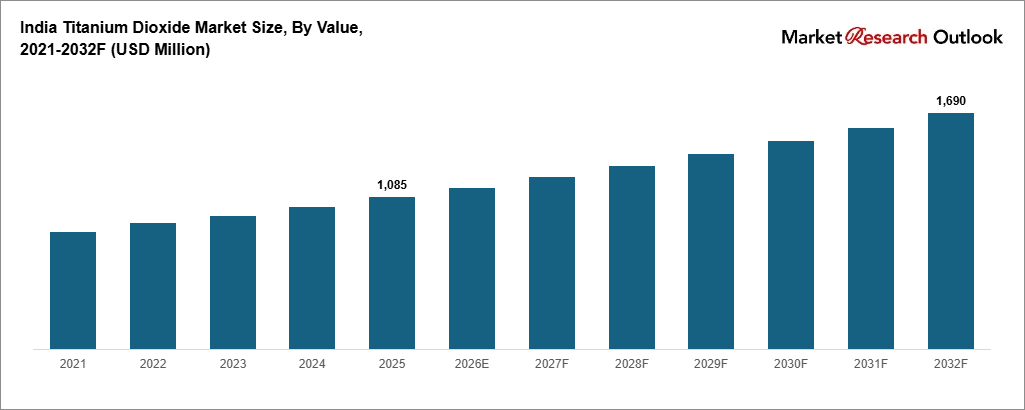
| Market Size (2025) | USD 1,085 Million |
| CAGR (2026-2032) | 6.5% |
| Leading Segment | Rutile Titanium Dioxide (Paints & Coatings) |
| Fastest Growing Segment | Chloride-Process Rutile & Plastics Masterbatch |
| Market Size (2032) | USD 1,690 Million |
Market Overview: India Titanium Dioxide Market
The India titanium dioxide market size is witnessing steady expansion, driven by strong growth in paints and coatings, rising plastics and masterbatch output, expanding packaging and laminate production, and fresh capacity added by paint majors and new entrants. Valued at USD 1,085 million in 2025 and projected to reach USD 1,690 million by 2032, growing at a CAGR of 6.5%, India titanium dioxide market growth is being supported by housing and infrastructure spending, rising per-capita paint use, and a shift toward premium decorative and industrial coatings. Rutile titanium dioxide leads consumption, while chloride-process rutile and the plastics and masterbatch segment are emerging as the fastest growing categories. India consumed around 400 thousand tonnes of titanium dioxide in 2025, with imports meeting 75% to 80% of demand and China alone supplying about 57%. As domestic producers including KMML, Travancore Titanium Products, Kilburn Chemicals and V.V. Titanium Pigments improve output, and global suppliers such as Chemours, Tronox, Kronos, Venator and LB Group deepen their India presence, the India titanium dioxide market is evolving into a larger, quality-led and more diversified market with strong long-term growth potential.
Key Report Takeaways: India Titanium Dioxide Market
- The India titanium dioxide market size is projected to grow from USD 1,085 million in 2025 to USD 1,690 million by 2032, registering a CAGR of 6.5%, driven by paint and coatings expansion, rising plastics output, and a steady shift toward premium rutile titanium dioxide grades across India.
- Rutile titanium dioxide dominates the India titanium dioxide market, accounting for 78% to 82% of total volume in 2025, driven by its superior opacity, brightness and outdoor durability, and its wide use in decorative emulsions, exterior paints, industrial coatings and plastics.
- Chloride-process rutile and plastics masterbatch are the fastest growing segments in the India titanium dioxide market, expected to grow at 7% to 8.5% annually as premium paint makers, packaging converters and appliance makers seek higher whiteness and consistent quality.
- Paints and coatings use 56% to 60% of India’s titanium dioxide, and India’s per-capita paint consumption of around 4 kg a year remains far below the roughly 15 kg seen in developed economies, structurally expanding the India titanium dioxide market.
- Heavy import dependence, with imports meeting 75% to 80% of demand, is pushing domestic producers such as KMML, Travancore Titanium Products, Kilburn Chemicals and V.V. Titanium Pigments to expand titanium dioxide capacity, supporting the India titanium dioxide market forecast 2032.
Key Market Drivers: India Titanium Dioxide Market
Construction, Housing and Infrastructure Growth Driving Paints & Coatings Demand for Titanium Dioxide Across India
Growth in the India titanium dioxide market is being driven by rapid construction activity, a large housing push and record infrastructure spending, all of which lift paint and coatings demand. Paints and coatings account for 56% to 60% of titanium dioxide consumption in India, as titanium dioxide is the main white pigment that gives paint its opacity and brightness. The PMAY-Urban 2.0 scheme targets 1 crore additional urban homes, while the Union Budget has set capital spending above INR 11 lakh crore a year for roads, railways, metros and airports. Decorative paints make up about 70% of India’s paint demand, and repainting cycles are shortening as urban households upgrade to premium emulsions with higher titanium dioxide loading. India’s per-capita paint use is still around 4 kg a year, compared with roughly 15 kg in developed economies, which signals large long-term headroom. Rising urbanisation, more nuclear families and growing real estate launches in tier-2 cities are creating strong pull-through demand across the India titanium dioxide market.
Expanding Plastics, Masterbatch, Packaging and Laminates Production Fuelling Titanium Dioxide Consumption
The India titanium dioxide market is benefiting from steady growth in plastics, masterbatch, packaging and decor laminate manufacturing. Plastics and masterbatch account for 17% to 19% of titanium dioxide demand, with white masterbatch used in films, bottles, pipes, appliance housings and automotive parts. India’s polymer consumption has crossed 20 million tonnes a year, and FMCG, e-commerce and food delivery packaging continue to grow at high single digits. Paper and laminates use another 6% to 8% of titanium dioxide, led by decor paper for high-pressure laminates and furniture boards, while printing inks account for 4% to 5%. Landed prices of Chinese sulphate-process rutile ranged between USD 2,300 and USD 2,800 per tonne during 2024 and 2025, keeping titanium dioxide affordable for compounders. Growing consumer durables output under the PLI scheme for white goods and higher passenger vehicle production are also widening the base of titanium dioxide users across the India titanium dioxide market.
Paint Industry Capacity Additions and Premiumisation Strengthening High-Grade Rutile Titanium Dioxide Demand
Rapid capacity addition in the Indian paint industry is a major catalyst for the India titanium dioxide market. Birla Opus launched in 2024 with six plants and a combined capacity of 1,332 million litres a year, while JSW Paints, Asian Paints, Berger Paints, Kansai Nerolac and Indigo Paints have also added or announced new capacity. Titanium dioxide typically accounts for 15% to 25% of the raw material cost of decorative paints, so every new paint plant creates long-term pigment demand. Paint makers are moving their product mix toward premium and luxury emulsions, weather-proof exterior coatings and low-VOC products, which need higher loadings of high-durability rutile titanium dioxide. Industrial, protective, powder and automotive coatings are also growing as manufacturing expands under Make in India. This combination of new capacity and premiumisation is structurally expanding India titanium dioxide market growth through 2032.
Key Market Challenges: India Titanium Dioxide Market
Heavy Import Dependence and Exposure to Global Titanium Dioxide Price and Currency Volatility
The India titanium dioxide market continues to face challenges from heavy import dependence, with imports meeting 75% to 80% of national demand. China alone supplied about 57% of Indian titanium dioxide demand during the most recent trade remedy investigation period, with the rest coming from producers in Europe, the United States, Japan, South Korea and Australia. Domestic titanium dioxide capacity remains limited at roughly 90 to 100 thousand tonnes a year, against consumption of around 400 thousand tonnes. As a result, Indian buyers are exposed to global price cycles, freight disruptions and rupee movements, with landed costs swinging by 10% to 20% within a year. Smaller paint and plastics companies with limited inventory buffers find it hard to absorb these swings, and this dependence remains a key risk across the India titanium dioxide market.
Volatile Feedstock, Energy and Acid Costs Impacting Domestic Titanium Dioxide Production Economics
The India titanium dioxide market faces cost pressure from volatile prices of ilmenite, synthetic rutile, sulphuric acid, chlorine, petroleum coke and energy. Sulphate-process plants use about 3.5 to 4 tonnes of sulphuric acid and 2.5 to 3 tonnes of ilmenite per tonne of titanium dioxide, while chloride-process plants need high-grade feedstock and steady chlorine supply. Ilmenite supply from beach sand mining in Kerala, Tamil Nadu and Odisha has faced regulatory and environmental hurdles, which limits access to local feedstock. Domestic producers such as KMML, Travancore Titanium Products and Kilburn Chemicals operate at smaller scale than global leaders, so cost increases have a larger effect on their margins. Feedstock security and energy efficiency upgrades are underway, but cost volatility remains a near-term challenge for the India titanium dioxide market.
Environmental Compliance for Sulphate-Process Waste and Regulatory Scrutiny on Titanium Dioxide Use
The India titanium dioxide market faces practical constraints around environmental compliance and regulatory scrutiny. The sulphate process generates large volumes of spent acid and ferrous sulphate, with 3 to 4 tonnes of by-products for every tonne of titanium dioxide, which require treatment, recovery or safe disposal under CPCB and state pollution control norms. Plants near coastal and residential areas face strict consent conditions, adding 8% to 12% to operating costs for older units. On the demand side, the European Union’s ban on titanium dioxide as a food additive (E171) has raised questions among Indian food and pharmaceutical brands about future FSSAI rules. Acid recovery, ferrous sulphate reuse and cleaner chloride technology offer solutions, but high investment needs and long approval timelines remain barriers across the India titanium dioxide market.
Key Market Trends: India Titanium Dioxide Market
Shift Toward Chloride-Process Rutile and High-Durability Titanium Dioxide Grades in India
The India titanium dioxide market is seeing a clear move toward chloride-process rutile and high-durability grades. Chloride-process material accounted for about 32% to 36% of Indian titanium dioxide consumption in 2025 and is growing at 7% to 8% annually, faster than sulphate-process grades. Chloride rutile offers higher brightness, a bluer undertone and better weather resistance, making it the preferred choice for premium exterior paints, automotive coatings, coil coatings and engineering plastics. Global producers including Chemours, Tronox, Kronos and Venator, along with domestic chloride producer KMML, are promoting application specific grades with improved surface treatment for easier dispersion. Chinese producers such as LB Group have also started supplying chloride-process titanium dioxide to India. This grade shift is reinforcing the India titanium dioxide market forecast 2032 across both coatings and plastics.
Trade Remedies, Supply Diversification and Domestic Backward Integration in the India Titanium Dioxide Market
A clear shift toward supply diversification and domestic integration is reshaping the India titanium dioxide market. India first imposed anti-dumping duties on Chinese titanium dioxide in February 2025, but the Calcutta High Court quashed those findings in September 2025. In August 2026, the Directorate General of Trade Remedies issued fresh final findings recommending duties of USD 460 to USD 681 per tonne on Chinese imports, while excluding food, pharmaceutical, cosmetic, fibre and nano grades. Paint makers are responding by qualifying multiple suppliers from Europe, Japan, South Korea, Australia and the United States. At the same time, India’s large beach sand ilmenite resources, estimated at over 650 million tonnes, are drawing interest in new domestic pigment capacity. These shifts are supporting long-term supply security across the India titanium dioxide market.
Rising Use of Ultrafine, Nano and Functional Titanium Dioxide in Cosmetics, Photocatalytic and Cool-Roof Coatings
A wave of specialty applications is reshaping the India titanium dioxide market. Ultrafine and nano titanium dioxide accounted for about 5% of demand in 2025 but is growing at 10% to 12% annually, led by sunscreens, colour cosmetics and skin care products that use titanium dioxide as a mineral UV filter. India’s beauty and personal care market is growing at double digits, and brands are shifting toward mineral sunscreens with SPF 30 and above. Photocatalytic titanium dioxide coatings for self-cleaning facades and air-purifying surfaces are gaining early adoption in metro projects, while cool-roof coatings with high solar reflectance are supported by state heat action plans in Telangana, Gujarat and Maharashtra. Anatase grades also remain important in pharmaceutical coatings and synthetic fibres. These developments are reinforcing the India titanium dioxide market forecast 2032 across the entire value chain.
Segmental Insights: India Titanium Dioxide Market
By Application: Paints & Coatings Segment Dominates the India Titanium Dioxide Market
The paints and coatings segment dominates the India titanium dioxide market by application, accounting for an estimated 56% to 60% of total consumption, driven by decorative paint growth, rising premium emulsion sales and expanding industrial and automotive coatings. Rutile grades are dominant within this segment, capturing over 90% of titanium dioxide used by paint makers. Plastics and masterbatch contribute another 17% to 19% of demand, driven by packaging films, moulded goods, pipes and consumer durables. Paper and laminates account for 6% to 8%, printing inks 4% to 5%, and cosmetics, personal care, food and pharmaceuticals together 3% to 4%. By end-use industry, building and construction leads with 52% to 55% of demand. In 2025, capacity additions by Asian Paints, Birla Opus, JSW Paints, Berger Paints and Kansai Nerolac lifted titanium dioxide offtake, reinforcing the lead of paints and coatings in the India titanium dioxide market.
By Type: Rutile Titanium Dioxide Leads While Chloride-Process Grades Grow Fastest
Rutile titanium dioxide leads the India titanium dioxide market by type, accounting for 78% to 82% of total volume, driven by its higher refractive index, superior hiding power and better outdoor durability compared with anatase. Anatase titanium dioxide contributes 18% to 22% of volume, mainly in paper, synthetic fibres, rubber, ceramics, pharmaceuticals and some interior paints. By production process, sulphate-process material holds 64% to 68% of consumption, while chloride-process grades are the fastest growing, expanding at 7% to 8% annually on the back of premium coatings and engineering plastics demand. Pigmentary grades make up around 95% of the market, with ultrafine and nano grades forming the rest. Leading suppliers including KMML, Chemours, Tronox, Kronos and LB Group have aligned titanium dioxide portfolios to this product mix, supporting premium titanium dioxide adoption across the India titanium dioxide market.
Regional Insights: India Titanium Dioxide Market
Regional analysis of the India titanium dioxide market shows that West India accounts for approximately 38% to 42% of total titanium dioxide consumption, driven by Maharashtra (Mumbai, Pune, Thane and Raigad) and Gujarat (Ankleshwar, Vapi, Ahmedabad and Sanand), supported by dense clusters of paint plants, masterbatch makers, plastics processors and packaging converters. South India contributes around 24% to 27% of demand, led by Tamil Nadu, Karnataka, Kerala, Andhra Pradesh and Telangana, which also host domestic titanium dioxide producers in Kerala and Tamil Nadu. North India accounts for 20% to 22%, supported by Haryana, Uttar Pradesh, Punjab and Rajasthan through paint, laminate, automotive and consumer durables industries. East and Central India together account for 12% to 14% of demand, supported by West Bengal, Odisha, Madhya Pradesh and Chhattisgarh. In 2025, new paint plants by Birla Opus and JSW Paints, capacity expansion by Asian Paints and Berger Paints, and operations by KMML, Travancore Titanium Products, Kilburn Chemicals and V.V. Titanium Pigments in the south reinforced regional supply hubs across the India titanium dioxide market.
Recent Developments: India Titanium Dioxide Market
- The India titanium dioxide market saw strong momentum in demand and trade policy during 2024 to 2026. India consumed around 400 thousand tonnes of titanium dioxide in 2025, and consumption is projected to reach nearly 580 thousand tonnes by 2032, growing at about 5.5% annually. In August 2026, the Directorate General of Trade Remedies issued final findings recommending anti-dumping duties of USD 460 to USD 681 per tonne on titanium dioxide from China, after the earlier 2025 duty was set aside by the Calcutta High Court.
- Domestic and global titanium dioxide suppliers have deepened their focus on India. In 2024 and 2025, KMML worked on improving output and feedstock security at its chloride-process plant in Chavara, Travancore Titanium Products and Kilburn Chemicals focused on anatase and rutile grades for paper, fibre and coatings users, and global producers including Chemours, Tronox, Kronos and Venator expanded technical service and distribution for Indian paint and plastics customers. These developments are strengthening supply and supporting the India titanium dioxide market forecast 2032.
- Paint industry momentum has gained strong traction in the India titanium dioxide market. In 2024 and 2025, Birla Opus commissioned its six-plant network, JSW Paints scaled up decorative paint operations, and Asian Paints, Berger Paints and Kansai Nerolac continued brownfield expansions. Long-term supply agreements between paint companies and titanium dioxide producers are positioning India as one of the fastest growing titanium dioxide markets in Asia, strengthening long-term competitive positioning in the India titanium dioxide market forecast 2032.
Key Market Players: India Titanium Dioxide Market
- The Kerala Minerals and Metals Limited (KMML)
- Travancore Titanium Products Limited
- Kilburn Chemicals Limited
- V.V. Titanium Pigments Private Limited
- The Chemours Company
- Tronox Holdings plc
- Kronos Worldwide, Inc.
- Venator Materials PLC
- LB Group Co., Ltd.
- Ishihara Sangyo Kaisha, Ltd.
- CNNC Hua Yuan Titanium Dioxide Co., Ltd.
- Pangang Group Vanadium Titanium & Resources Co., Ltd.
- Shandong Jinhai Titanium Resources Technology Co., Ltd.
| By Type | By Production Process | By Grade | By Application | By End-Use Industry |
| Rutile Anatase |
Sulphate Process Chloride Process |
Pigmentary Grade Ultrafine & Nano Grade |
Paints & Coatings Plastics & Masterbatch Paper & Laminates Printing Inks Cosmetics & Personal Care Food & Pharmaceuticals Others (Rubber, Ceramics, Synthetic Fibres) |
Building & Construction Automotive Packaging Consumer Goods Industrial |
Report Scope
In this report, the India Titanium Dioxide Market has been segmented into the following categories, in addition to detailed analysis of key industry trends, market dynamics, competitive landscape, and growth opportunities across the forecast period:
- By Type
- Rutile
- Anatase
- By Production Process
- Sulphate Process
- Chloride Process
- By Grade
- Pigmentary Grade
- Ultrafine & Nano Grade
- By Application
- Paints & Coatings
- Plastics & Masterbatch
- Paper & Laminates
- Printing Inks
- Cosmetics & Personal Care
- Food & Pharmaceuticals
- Others (Rubber, Ceramics, Synthetic Fibres)
- By End-Use Industry
- Building & Construction
- Automotive
- Packaging
- Consumer Goods
- Industrial
- By Geography
- North India
- South India
- West India
- East India
- Central India
Competitive Landscape
Company Profiles:
Detailed analysis of the leading companies operating in the India Titanium Dioxide Market, including business overview, product portfolio, strategic initiatives, competitive positioning, and recent developments.
Company Information
Detailed profiling and strategic analysis of additional market players (up to five companies), including emerging domestic titanium dioxide producers, specialty ultrafine and nano titanium dioxide suppliers, mineral sand and feedstock players, or regional pigment distributors.
For a free sample of the India Titanium Dioxide Market report, customised insights or delivery timelines, submit your query here
India Titanium Dioxide Market, 2032
- Research Framework
- Market Segmentation
- Research Objective
- Research Methodology
- Qualitative Research
- Primary Research
- Secondary Research
- Quantitative Research
- Market Breakdown & Data Triangulation
- Demand Side
- Supply Side
- Primary Research Respondents
- Assumption & Limitation
- Executive Summary
- Market Overview, 2021-2032
- By Type
- By Production Process
- By Grade
- By Application
- By End-Use Industry
- By Region
- Analyst Recommendations
- Geopolitical Impact on India Titanium Dioxide Market
- India Titanium Dioxide Market Insights
- Market Dynamics
- Growth Drivers
- Construction, housing and infrastructure growth driving paints & coatings demand for titanium dioxide across India.
- Expanding plastics, masterbatch, packaging and laminates production fuelling titanium dioxide consumption.
- Paint industry capacity additions and premiumisation strengthening high-grade rutile titanium dioxide demand.
- Restraints
- Heavy import dependence and exposure to global titanium dioxide price and currency volatility.
- Volatile feedstock, energy and acid costs impacting domestic titanium dioxide production economics.
- Environmental compliance for sulphate-process waste and regulatory scrutiny on titanium dioxide use.
- Opportunities
- Backward integration using India’s ilmenite reserves for domestic chloride-route titanium dioxide capacity.
- High-durability rutile, ultrafine and nano titanium dioxide for cosmetics, sunscreens and photocatalytic coatings.
- Plastics masterbatch, packaging, automotive and cool-roof coatings creating new titanium dioxide demand pools.
- Challenges
- Uncertainty around anti-dumping duties on Chinese titanium dioxide imports and trade remedy litigation.
- Limited domestic production scale and restricted access to chloride-process technology.
- Pressure from titanium dioxide thrifting, extenders and substitutes such as calcined kaolin and calcium carbonate.
- Technological Advancements
- Recent Technological Advancements
- Prior to 2020
- Porter’s Five Forces Analysis
- PESTLE Analysis
- Industry Value Chain & Entry Points
- Upstream Raw Materials (ilmenite, rutile, leucoxene, synthetic rutile, titanium slag, sulphuric acid, chlorine)
- Mineral Sand Miners & Feedstock Suppliers (IREL, KMML, Indian and global beach sand miners)
- Process Technology & Equipment Providers (sulphate and chloride process technology, calciners, milling systems)
- Titanium Dioxide Producers (KMML, Travancore Titanium Products, Kilburn Chemicals, V.V. Titanium Pigments)
- Quality Control, R&D & Testing Laboratories (BIS, IS 411, CPCB, ISO standards)
- Global Exporters & Importers (Chemours, Tronox, Kronos, Venator, LB Group)
- Distributors, Traders & Stockists (B2B pigment distributors, regional chemical traders)
- Paint & Coatings Manufacturers (Asian Paints, Berger Paints, Kansai Nerolac, Birla Opus, JSW Paints)
- Plastics, Masterbatch, Paper & Ink Converters (compounders, masterbatch makers, decor paper and ink producers)
- End-Use Sectors (construction, automotive, packaging, consumer goods, cosmetics, pharmaceuticals)
- India Titanium Dioxide Market: Regulatory Framework
- India Titanium Dioxide Market Overview
- Market Size & Forecast, 2021-2032
- By Value (USD Million)
- By Volume (Thousand Tonnes)
- Market Share & Forecast
- By Type
- Rutile
- Anatase
- By Production Process
- Sulphate Process
- Chloride Process
- By Grade
- Pigmentary Grade
- Ultrafine & Nano Grade
- By Application
- Paints & Coatings
- Plastics & Masterbatch
- Paper & Laminates
- Printing Inks
- Cosmetics & Personal Care
- Food & Pharmaceuticals
- Others (Rubber, Ceramics, Synthetic Fibres)
- By End-Use Industry
- Building & Construction
- Automotive
- Packaging
- Consumer Goods
- Industrial
- By Geography
- North India
- South India
- West India
- East India
- Central India
- Competitive Landscape
- India Titanium Dioxide Market Company Market Share Analysis, 2025
- Competitive Benchmarking, By Operating Parameters
- Key Strategic Development (Mergers, Acquisitions, Partnerships, Etc.)
- List of Emerging Players
- Company Profile
- The Kerala Minerals and Metals Limited (KMML)
- Introduction & Company Profile
- Product Benchmarking
- Strategic Outlook
- Key Competitors
- Financial Analysis
- SWOT Analysis
(Same Data Pointers Will Be Provided for The Below Companies)
- Travancore Titanium Products Limited
- Kilburn Chemicals Limited
- V.V. Titanium Pigments Private Limited
- The Chemours Company
- Tronox Holdings plc
- Kronos Worldwide, Inc.
- Venator Materials PLC
- LB Group Co., Ltd.
- Ishihara Sangyo Kaisha, Ltd.
- CNNC Hua Yuan Titanium Dioxide Co., Ltd.
- Pangang Group Vanadium Titanium & Resources Co., Ltd.
- Shandong Jinhai Titanium Resources Technology Co., Ltd.
- Other Prominent Players
* Financial information in case of non-listed companies will be provided as per availability
The segmentation and the companies are subjected to modifications based on in-depth secondary for the final deliverable
Frequently Asked Questions
1. How large is the India titanium dioxide market and what is its growth forecast?
Ans: The India titanium dioxide market is valued at USD 1,085 million in 2025 and is projected to reach USD 1,690 million by 2032, growing at a CAGR of 6.5%, led by paints, plastics and packaging demand.
2. Which segments are driving demand in the India titanium dioxide market?
Ans: Rutile titanium dioxide leads with 78% to 82% volume share, while chloride-process rutile and plastics masterbatch are the fastest growing segments, supported by premium coatings and packaging growth.
3. What are the key drivers of growth in the India titanium dioxide market?
Ans: Key drivers include housing and infrastructure growth, rising paint and coatings use, expanding plastics and packaging output, and new capacity from paint majors and entrants such as Birla Opus.
4. Which regions are driving growth in the India titanium dioxide market?
Ans: West India leads with 38% to 42% of titanium dioxide consumption, driven by Maharashtra and Gujarat paint and plastics clusters, while South India follows with 24% to 27% of demand.
5. What are the latest trends in the India titanium dioxide market?
Ans: Latest trends include a shift toward chloride-process rutile, supply diversification after anti-dumping reviews, domestic backward integration, and rising use of nano titanium dioxide in sunscreens and functional coatings.