

India Phenol Market Size, Share & Demand Analysis 2032
- Chemicals & Advanced Materials, Petrochemicals & Intermediates
- May 2026
- Pages 140
- Report Format: pdf
- Report Price: $2400 USD
India’s phenol market is witnessing strong growth, driven by rapid expansion of polycarbonate and bisphenol-A consumption, accelerated demand for phenolic resins in plywood and laminates, rising use in caprolactam and aniline derivatives, growth in pharmaceuticals, agrochemicals and personal care end-uses, government-led infrastructure investment, and rising interest from global phenol majors investing in India-specific manufacturing capacity to reduce import dependence.
Related research: India Styrene Market, India Ortho Xylene Market and India 2-Ethyl Hexanol Market.
Report Description
| Study Duration | 2021 to 2032 |
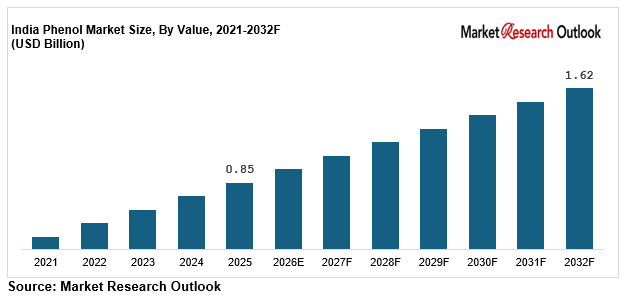
| Market Size (2025) | USD 0.85 Billion |
| CAGR (2026 to 2032) | 9.6% |
| Leading Segment | Bisphenol-A Grade Phenol |
| Fastest Growing Segment | Phenolic Resins for Plywood and Laminates |
| Market Size (2032) | USD 1.62 Billion |
Market Overview: India Phenol Market
The India phenol market is witnessing steady expansion, driven by rising demand across polycarbonate and bisphenol-A applications, increasing consumption of phenolic resins in plywood and laminates, and a structural shift toward high-purity and bio-based phenol grades. Valued at USD 0.85 billion in 2025 and projected to reach USD 1.62 billion by 2032, the India phenol market is expected to grow at a CAGR of 9.6%, supported by strong demand from engineering plastics, construction materials, pharmaceuticals, agrochemicals, and specialty chemicals.
Bisphenol-A grade phenol currently leads consumption, while phenolic resins for plywood and laminates are emerging as the fastest-growing application segment, driven by growth in construction and interior infrastructure. Demand is also expanding across caprolactam and aniline derivatives, reinforcing phenol’s role as a critical intermediate in downstream chemical value chains.
Regulatory and sustainability frameworks are playing an increasingly important role in shaping the market. Tightening VOC and effluent norms under CPCB, along with the adoption of green building certifications such as IGBC and LEED and broader ESG commitments, are accelerating the shift toward cleaner and higher-purity phenol production.
At the competitive level, global players such as INEOS, Mitsui Chemicals, Covestro, and SI Group are strengthening India-focused manufacturing and supply strategies. In parallel, domestic companies including Hindustan Organic Chemicals Limited, Deepak Phenolics, Atul Limited, and Jubilant Ingrevia are expanding capacity in specialty and high-purity phenol segments.
As a result, the India phenol market is evolving into a more application-driven, sustainability-focused, and import-substitution-oriented ecosystem, with strong long-term growth potential across multiple industrial value chains.
Key Report Takeaways: India Phenol Market
- The India phenol market is projected to grow from USD 0.85 billion in 2025 to USD 1.62 billion by 2032, registering a CAGR of 9.6%, driven by rising demand across polycarbonate and bisphenol-A applications, expansion in plywood and laminate consumption, and the shift toward high-purity phenol grades.
- Bisphenol-A grade phenol dominates the India phenol market, accounting for over 45% of total demand, supported by strong consumption in polycarbonate, epoxy resins, engineering plastics, and electrical applications.
- Phenolic resins used in plywood and laminates are the fastest-growing segment, expected to expand at 11% to 14% annually, driven by urbanisation, growth in organised plywood manufacturing, and rising demand for modular furniture and interior solutions.
- Expansion of downstream industries, led by Covestro, SABIC, Century Plyboards, Greenply Industries, Greenlam Industries, and Merino Industries, is structurally increasing phenol consumption across both industrial and decorative applications.
- Increasing investments by domestic and global producers such as Deepak Phenolics, Hindustan Organic Chemicals Limited, INEOS Phenol, SI Group, and Mitsui Chemicals in India-focused manufacturing and application development are strengthening local supply chains and supporting long-term market growth through 2032.
Key Market Drivers: India Phenol Market
Rising Demand from Polycarbonate and Bisphenol-A Applications
The India phenol market is being driven by strong growth in polycarbonate and bisphenol-A consumption, with polycarbonate demand expanding at 9% to 11% annually. Bisphenol-A accounts for 45% to 48% of total phenol consumption, supported by its use in polycarbonate, epoxy resins, and engineering plastics across electronics, automotive, and electrical applications.
India’s per-capita polycarbonate consumption remains low at 0.4 to 0.5 kg compared to 2.5 to 4 kg in developed markets, indicating significant long-term growth potential. Key consumers such as Covestro and SABIC, along with domestic compounders and automotive suppliers, are expanding downstream capacity, creating sustained demand for high-purity phenol.
Growth in Phenolic Resins for Plywood and Laminates
Demand for phenolic resins is expanding rapidly, supported by growth in construction, interior infrastructure, and modular furniture. Phenolic resins used in plywood and laminates are growing at 10% to 12% annually, driven by rising urbanisation and organised manufacturing.
Leading players such as Century Plyboards, Greenply Industries, Greenlam Industries, and Merino Industries are scaling capacity, reinforcing phenol demand across wood adhesives and engineered panels.
Expansion of Pharmaceuticals and Agrochemical Derivatives
Pharmaceuticals and agrochemicals are emerging as key demand drivers, with growth rates of 9% to 11% and 8% to 10% respectively. Phenol derivatives such as salicylic acid, aniline, and alkyl phenols are widely used in APIs, disinfectants, herbicides, and surfactants.
Companies including Sun Pharmaceutical Industries, Dr. Reddy’s Laboratories, Cipla, UPL Limited, and PI Industries are expanding capacity, supported by export demand and government initiatives such as the PLI scheme for bulk drugs.
Key Market Challenges: India Phenol Market
High Import Dependence and Supply Risk
The India phenol market remains structurally dependent on imports, with 55% to 65% of phenol and a similar share of bisphenol-A sourced from international markets. Domestic capacity, led by Hindustan Organic Chemicals Limited and Deepak Phenolics, stands at ~0.32 million tonnes, compared to demand of 0.55 to 0.60 million tonnes.
This supply gap exposes downstream industries to volatility in global pricing, foreign exchange fluctuations, and extended lead times of 6 to 12 weeks. While capacity expansions by Deepak Phenolics and global players like INEOS Phenol are expected to reduce dependence over the medium term, supply security remains a critical near-term concern.
Feedstock Price Volatility Impacting Margins
The India phenol market is highly exposed to volatility in benzene and propylene prices, which account for 60% to 75% of total production cost through the cumene process. Fluctuations in crude oil prices have led to 20% to 35% swings in feedstock costs over the past two years, directly impacting producer margins and pricing stability for downstream industries .
Dependence on imported feedstocks from the Middle East and Asia further increases exposure to supply disruptions. Producers are increasingly focusing on backward integration, long-term contracts, and alternative pathways to manage cost risks.
Rising Environmental Compliance and Regulatory Complexity
Phenol production faces increasing regulatory pressure due to stringent environmental and effluent norms. Compliance with CPCB standards, Zero Liquid Discharge requirements, and emission controls is adding 8% to 12% to operating costs.
Export-oriented manufacturers must also comply with global regulations such as REACH and TSCA, along with evolving ESG and sustainability disclosure frameworks, increasing operational complexity across the value chain.
Key Market Trends: India Phenol Market
Shift Toward Bio-Based and Low-Carbon Phenol Production
The India phenol market is witnessing a gradual shift toward bio-based, lignin-derived, and low-carbon production pathways, driven by ESG commitments and sustainability mandates. Research and pilot investments in renewable phenol are growing at 12% to 15% annually as downstream industries target Scope 3 emission reductions.
Capacity Expansion and Domestic Supply Strengthening
Significant investments in domestic capacity are reshaping the supply landscape, with over USD 1.5 billion in announced capex between 2023 and 2025. Companies such as Deepak Phenolics and INEOS Phenol are expanding production, while modernisation by Hindustan Organic Chemicals Limited is strengthening domestic supply chains.
Rising Demand from Polycarbonate and Phenolic Resins
Polycarbonate, phenolic resins, and specialty derivatives are emerging as the core demand drivers, expected to account for over 80% of total phenol consumption by 2032. Growth in construction, automotive, electronics, and specialty chemicals is reinforcing long-term demand visibility.
Segmental Insights: India Phenol Market
By Application: Polycarbonate and Phenolic Resins Lead
Polycarbonate applications dominate the India phenol market, accounting for 45% to 48% of total demand, driven by electronics, automotive, and electrical components. Phenolic resins for plywood and laminates contribute 22% to 25%, while caprolactam and other derivatives account for the remaining share.
By Grade: Bisphenol-A Grade Dominates
Bisphenol-A grade phenol leads consumption with a 45% to 48% share, supported by demand from polycarbonate and epoxy resins. Phenolic resin grade and pharmaceutical-grade phenol are the fastest-growing segments, expanding at 11% to 14% annually due to rising construction and healthcare demand.
Regional Insights: West and South India Dominate
West and South India account for 60% to 64% of total demand, led by chemical clusters in Gujarat, Maharashtra, and Tamil Nadu. North India contributes 18% to 22%, while East and Central India account for 14% to 18%, supported by plywood, laminates, and pharmaceutical manufacturing hubs.
Recent Developments: India Phenol Market
- The India phenol market has witnessed strong momentum in capacity expansion and downstream integration during 2024 and 2025. Key players such as Deepak Phenolics have expanded phenol and acetone capacity at Dahej, while INEOS Phenol has strengthened its India operations. Hindustan Organic Chemicals Limited has modernised its Kochi facility, and SI Group has scaled specialty phenolic resin production. Additional investments by Atul Limited and Jubilant Ingrevia in phenol derivatives are reinforcing India’s position as a competitive phenol manufacturing hub.
- Downstream demand is strengthening as polycarbonate, plywood, and pharmaceutical manufacturers deepen domestic sourcing. Companies such as Covestro, SABIC, Century Plyboards, Greenply Industries, and Greenlam Industries have expanded long-term procurement and capacity. Additional growth from laminate and panel manufacturers such as Merino Industries and Action Tesa is further strengthening downstream linkage across the India phenol market.
- Sustainability-led innovation is gaining traction, with both global and domestic players focusing on high-purity, low-VOC, and bio-based phenol solutions. Companies including Deepak Phenolics, INEOS Phenol, SI Group, and Atul Limited are expanding advanced product portfolios tailored for polycarbonate, plywood, and pharmaceutical applications. Strategic partnerships across phenol producers, compounders, and downstream manufacturers are positioning India as an emerging hub for sustainable phenol chemistries, strengthening long-term market outlook through 2032.
Key Market Players: India Phenol Market
- Hindustan Organic Chemicals Limited (HOCL)
- Deepak Phenolics Limited
- SI Group India Private Limited
- INEOS Phenol India Pvt. Ltd.
- Atul Limited
- Aditya Birla Chemicals (Thai) Ltd. India Operations
- Jubilant Ingrevia Limited
- Coromandel International Limited
- PCBL Chemical Limited
- Phenolika Specialty Chemicals Pvt. Ltd.
- Bayer MaterialScience India Pvt. Ltd. (Covestro India)
- Mitsui Chemicals India Pvt. Ltd.
Report Scope
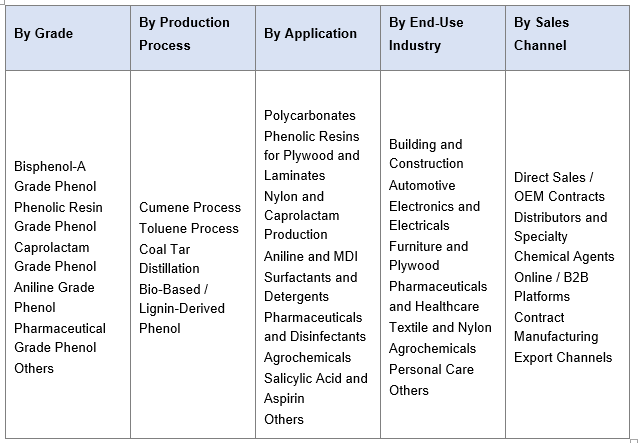
In this report, the India Phenol Market has been segmented into the following categories, in addition to detailed analysis of key industry trends, market dynamics, competitive landscape, and growth opportunities across the forecast period:
- By Grade
- Bisphenol-A Grade Phenol
- Phenolic Resin Grade Phenol
- Caprolactam Grade Phenol
- Aniline Grade Phenol
- Pharmaceutical Grade Phenol
- Others
- By Derivative
- Bisphenol-A (BPA)
- Phenolic Resins
- Caprolactam
- Aniline
- Alkyl Phenols
- Salicylic Acid
- Others
- By Production Process
- Cumene Process
- Toluene Process
- Coal Tar Distillation
- Bio-Based / Lignin-Derived Phenol
- By Form
- Liquid Phenol
- Solid / Crystalline Phenol
- Aqueous Phenol Solutions
- By Purity Grade
- Below 99%
- 99% to 99.5%
- Above 99.5%
- By Application
- Polycarbonates
- Phenolic Resins for Plywood and Laminates
- Nylon and Caprolactam Production
- Aniline and MDI
- Surfactants and Detergents
- Pharmaceuticals and Disinfectants
- Agrochemicals
- Salicylic Acid and Aspirin
- Others
- By End-Use Industry
- Building and Construction
- Automotive
- Electronics and Electricals
- Furniture and Plywood
- Pharmaceuticals and Healthcare
- Textile and Nylon
- Agrochemicals
- Personal Care
- Others
- By Sales Channel
- Direct Sales / OEM Contracts
- Distributors and Specialty Chemical Agents
- Online / B2B Platforms
- Contract Manufacturing
- Export Channels
- By Geography
- North India
- South India
- West India
- East India
- Central India
Competitive Landscape
Company Profiles:
Detailed analysis of the leading companies operating in the India Phenol Market, including business overview, product portfolio, strategic initiatives, competitive positioning, and recent developments.
Company Information
Detailed profiling and strategic analysis of additional market players (up to five companies), including emerging domestic phenol producers, specialty derivative chemistry specialists, global entrants, or niche segment leaders.
For a free sample of the India Phenol Market report, customised insights or delivery timelines, submit your query here
Table of Contents
- Research Framework
- Market Segmentation
- Research Objective
- Research Methodology
- Qualitative Research
- Primary Research
- Secondary Research
- Quantitative Research
- Market Breakdown & Data Triangulation
- Demand Side
- Supply Side
- Primary Research Respondents
- Assumption & Limitation
- Executive Summary
- Market Overview, 2021 to 2032
- By Grade
- By Application
- By End-Use Industry
- By Derivative
- By Sales Channel
- By Region
- Analyst Recommendations
- Geopolitical Impact on India Phenol Market
- India Phenol Market Insights
- Market Dynamics
- Growth Drivers
- Rapid expansion of polycarbonate, bisphenol-A, and engineering plastics demand driving core phenol consumption.
- Accelerated phenolic resins, plywood, and laminates demand tied to construction and furniture growth.
- Accelerated pharmaceuticals, agrochemicals, and specialty chemicals demand for phenol derivatives.
- Restraints
- Heavy import dependence for phenol and bisphenol-A creating structural supply risk.
- Benzene and propylene feedstock price volatility linked to crude oil and global supply disruptions pressuring producer margins.
- Environmental compliance, effluent management, and tightening regulatory complexity raising compliance costs.
- Opportunities
- Rapid scale-up of bio-based and lignin-derived phenol aligned with green chemistry and sustainability mandates.
- High-growth demand from polycarbonate, phenolic resins, plywood, and laminates supporting infrastructure and furniture build-out.
- Emerging export opportunity for specialty phenol derivatives to Middle East, Southeast Asia, and African markets with growing pharmaceuticals and agrochemicals industries.
- Challenges
- Intense price-led competition between global phenol majors and domestic producers compressing margins.
- Shortage of skilled chemical engineers, process operators, and reactor specialists limiting scale-up speed of new capacity.
- Fragmented downstream plywood, laminates, and pharmaceutical customer base with diverse specifications increasing formulation and inventory complexity.
- Technological Advancements
- Recent Technological Advancements
- Prior to 2020
- Porter’s Five Forces Analysis
- PESTLE Analysis
- Industry Value Chain & Entry Points
- Upstream Petrochemical Feedstock (crude oil, naphtha, propylene, benzene, cumene)
- Cumene and Phenol Producers (cumene oxidation, hydroperoxide cleavage)
- Bio-Based Phenol Producers (lignin-derived, fermentation-derived pathways)
- Phenol Manufacturing & Reactor Operations (cumene process, distillation, purification)
- Quality Control, R&D & Application Laboratories (BIS, REACH, TSCA, ecolabels)
- Distributors, Specialty Chemical Agents & B2B Marketplaces
- Downstream Formulators (polycarbonate, phenolic resins, caprolactam, aniline, salicylic acid)
- Brand Owners & Manufacturers (polycarbonate compounders, plywood brands, pharmaceutical companies)
- Installation & Retail Channels (laminate retailers, plywood dealers, pharma distributors)
- End-Use Industries (construction, automotive, electronics, plywood, pharmaceuticals, agrochemicals)
- India Phenol Market: Regulatory Framework
- India Phenol Market Overview
- Market Size & Forecast, 2021 to 2032
- By Value (USD Million)
- By Volume (‘000 Tons)
- Market Share & Forecast
- By Grade
- Bisphenol-A Grade Phenol
- Phenolic Resin Grade Phenol
- Caprolactam Grade Phenol
- Aniline Grade Phenol
- Pharmaceutical Grade Phenol
- Others
- By Derivative
- Bisphenol-A (BPA)
- Phenolic Resins
- Caprolactam
- Aniline
- Alkyl Phenols
- Salicylic Acid
- Others
- By Production Process
- Cumene Process
- Toluene Process
- Coal Tar Distillation
- Bio-Based / Lignin-Derived Phenol
- By Form
- Liquid Phenol
- Solid / Crystalline Phenol
- Aqueous Phenol Solutions
- By Purity Grade
- Below 99%
- 99% to 99.5%
- Above 99.5%
- By Application
- Polycarbonates
- Phenolic Resins for Plywood and Laminates
- Nylon and Caprolactam Production
- Aniline and MDI
- Surfactants and Detergents
- Pharmaceuticals and Disinfectants
- Agrochemicals
- Salicylic Acid and Aspirin
- Others
- By End-Use Industry
- Building and Construction
- Automotive
- Electronics and Electricals
- Furniture and Plywood
- Pharmaceuticals and Healthcare
- Textile and Nylon
- Agrochemicals
- Personal Care
- Others
- By Sales Channel
- Direct Sales / OEM Contracts
- Distributors and Specialty Chemical Agents
- Online / B2B Platforms
- Contract Manufacturing
- Export Channels
- By Geography
- North India
- South India
- West India
- East India
- Central India
- Competitive Landscape
- India Phenol Market Company Market Share Analysis, 2025
- Competitive Benchmarking, By Operating Parameters
- Key Strategic Development (Mergers, Acquisitions, Partnerships, Etc.)
- List of Emerging Players
- Company Profile
- Hindustan Organic Chemicals Limited (HOCL)
- Introduction & Company Profile
- Product Benchmarking
- Strategic Outlook
- Key Competitors
- Financial Analysis
- SWOT Analysis
- Hindustan Organic Chemicals Limited (HOCL)
- Market Size & Forecast, 2021 to 2032
*(Same Data Pointers Will Be Provided for The Below Companies)
- Deepak Phenolics Limited
- SI Group India Private Limited
- INEOS Phenol India Pvt. Ltd.
- Atul Limited
- Aditya Birla Chemicals (Thai) Ltd. India Operations
- Jubilant Ingrevia Limited
- Coromandel International Limited
- PCBL Chemical Limited
- Phenolika Specialty Chemicals Pvt. Ltd.
- Bayer MaterialScience India Pvt. Ltd. (Covestro India)
- Mitsui Chemicals India Pvt. Ltd.
- Other Prominent Players
** Financial information in case of non-listed companies will be provided as per availability**
*** The segmentation and the companies are subjected to modifications based on in-depth secondary for the final deliverable***
Frequently Asked Questions
1. How large is the India phenol market and what is its growth forecast?
Ans: The India phenol market size is valued at USD 0.85 Billion in 2025 and is projected to reach USD 1.62 Billion by 2032, growing at a CAGR of around 9.6%. This strong India phenol market growth is driven by accelerated polycarbonate and bisphenol-A demand, rising phenolic resin consumption from plywood and laminates, structural shift toward high-purity grades, and major domestic and global capacity expansions. The report provides detailed market sizing, forecast modelling, and segment-wise growth analysis across value and volume terms, helping businesses identify high-opportunity areas and plan long-term strategies.
2. Which segments are driving demand in the India phenol market?
Ans: The India phenol market segmentation shows that polycarbonate and bisphenol-A applications dominate with approximately 45% to 48% share, followed by phenolic resins for plywood and laminates at 22% to 25% and caprolactam at 10% to 12%. Bisphenol-A grade phenol leads by grade with 45% to 48% share, while phenolic resin grade phenol is the fastest growing segment, expanding at 11% to 14% annually. The report breaks down demand across grades, derivatives, production processes, applications, end-use industries, and sales channels, helping businesses understand where growth is accelerating across the India phenol market.
3. What are the key drivers of growth in the India phenol market?
Ans: Key India phenol market drivers include rapid expansion of polycarbonate and bisphenol-A demand growing at 9% to 11% annually, accelerated phenolic resin consumption from plywood and laminates growing at 10% to 12%, and rising pharmaceutical, agrochemical, and specialty derivative demand. Domestic phenol majors such as Hindustan Organic Chemicals, Deepak Phenolics, INEOS Phenol India, and SI Group are investing in India-specific manufacturing capacity and application laboratories. The report provides in-depth analysis of growth drivers, supported by data-backed insights and real market trends shaping the India phenol market.
4. Which regions are driving growth in the India phenol market?
Ans: Regional analysis of the India phenol market shows that West and South India together account for nearly 60% to 64% of total demand, driven by specialty chemical clusters in Gujarat, Maharashtra, and Tamil Nadu, along with strong polycarbonate and plywood manufacturing. North India contributes around 18% to 22%, supported by furniture, laminates, and pharmaceutical clusters. East and Central India together account for 14% to 18%, supported by West Bengal's plywood industry and growing chemical activity. The report offers state-level and regional insights, helping businesses identify high-growth markets and optimise expansion strategies.
5. What are the latest trends in the India phenol market?
Ans: The latest India phenol market trends include rapid adoption of bio-based and lignin-derived phenol pathways, major capacity expansion by domestic producers and new greenfield announcements, and the rising role of phenolic resins, polycarbonate, and specialty derivatives in phenol demand. Sustainable phenol research is growing at 12% to 15% annually, while capacity additions exceeded USD 1.5 billion across 2023 to 2025. The report provides detailed insights into emerging trends, innovation pipelines, and future demand shifts, helping businesses stay ahead of competition and capture new growth opportunities in the India phenol market.