

India Switchgear Market, 2032
- Energy, Power & Storage, Grid & Power Infrastructure
- Nov 2026
- Pages 140
- Report Format: pdf
- Report Price: $2400 USD
India’s switchgear market is witnessing strong structural growth, driven by record transmission investment, distribution upgrades under RDSS, rapid renewable energy additions, rising industrial and data center power demand, metro and railway electrification, and growing commitment from domestic and multinational manufacturers investing in India-based breaker, GIS and vacuum interrupter capacity and digital switchgear platforms.
| Study Duration | 2021-2032 |
| Market Size (2025) | USD 6,240 Million |
| CAGR (2026-2032) | 7.2% |
| Leading Segment | Circuit Breakers (Low Voltage) |
| Fastest Growing Segment | Gas-Insulated & SF6-Free Switchgear |
| Market Size (2032) | USD 10,150 Million |
Market Overview: India Switchgear Market
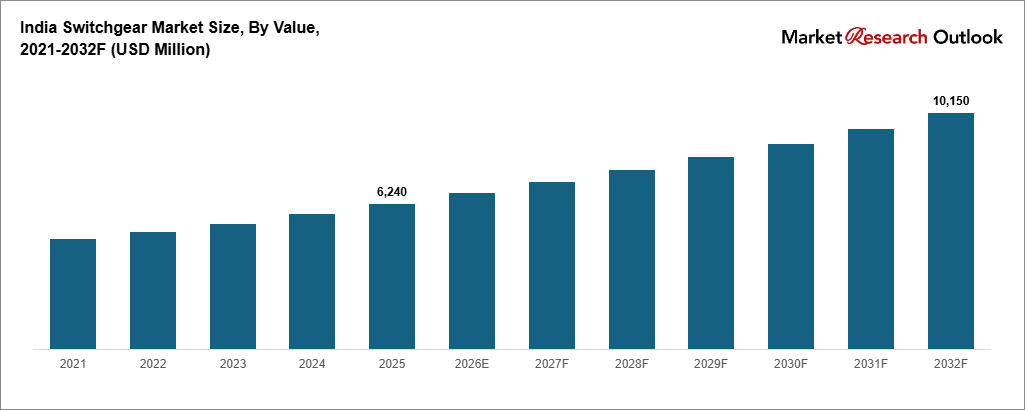
The India switchgear market size is expanding quickly, driven by record transmission spending, distribution network modernisation, rising electricity demand, faster renewable energy integration, growth in data centers and metro rail, and major capacity additions by domestic and multinational manufacturers. Valued at USD 6,240 million in 2025 and projected to reach USD 10,150 million by 2032, growing at a CAGR of 7.2%, the India switchgear market growth is supported by peak power demand that touched 250 GW in May 2024, installed generation capacity of 475 GW in March 2025, and the national goal of 500 GW of non-fossil capacity by 2030. Low voltage circuit breakers lead demand by value, while gas-insulated and SF6-free switchgear is the fastest growing category. Utilities remain the largest buyer group, but industrial plants, commercial buildings and data centers are adding a growing share of orders. As ABB India, Siemens, Hitachi Energy India, CG Power, Havells and Lauritz Knudsen expand local production, and Siemens Energy India, GE Vernova T&D India and Toshiba T&D India scale high voltage supply, switchgear demand in India is becoming more localised, more digital and more specification-driven, with strong long-term growth potential.
Key Report Takeaways: India Switchgear Market
- The India switchgear market size is projected to grow from USD 6,240 million in 2025 to USD 10,150 million by 2032, registering a CAGR of 7.2%, driven by transmission expansion under the National Electricity Plan, distribution upgrades under RDSS and the steady shift toward gas-insulated and digital switchgear.
- Circuit breakers lead the market with a 38% share of value in 2025, supported by high replacement volumes in low voltage air and moulded case breakers, strong vacuum circuit breaker demand from discoms, and growing EHV breaker orders from POWERGRID and state transmission utilities.
- Gas-insulated and SF6-free switchgear is the fastest growing category, expanding at a CAGR of 10.6% through 2032 as urban substations, metro systems, data centers and renewable pooling stations move toward compact, low-maintenance and lower-emission designs.
- The National Electricity Plan for transmission targets 191,000 circuit km of new lines and 1,270 GVA of transformation capacity at 220 kV and above between 2022-23 and 2031-32, structurally expanding substation switchgear demand across all voltage classes.
- Rising investment by ABB India, Siemens, Hitachi Energy India, CG Power and Havells in breaker, GIS and vacuum interrupter capacity is strengthening local supply, cutting import reliance and supporting the India switchgear market forecast 2032.
Key Market Drivers: India Switchgear Market
Transmission Expansion Under the National Electricity Plan and Distribution Upgrades Under RDSS Driving Switchgear Demand Across India
Growth in the India switchgear market is closely linked to grid investment. The Ministry of Power’s National Electricity Plan for transmission, released in October 2024, calls for more than 191,000 circuit km of new lines and 1,270 GVA of transformation capacity at 220 kV and above by 2031-32, with estimated spending above Rs 9.15 lakh crore. Inter-regional transfer capacity is planned to rise from 119 GW to 168 GW by 2032, and 33 GW of HVDC bipole links are part of the plan. Each new substation needs breakers, isolators, instrument transformers and protection panels, so every GVA added translates directly into switchgear orders. At the distribution end, the Revamped Distribution Sector Scheme, with an outlay of Rs 3,03,758 crore, is funding feeder separation, network strengthening and loss reduction, which drives volume demand for vacuum circuit breakers, ring main units and compact substations. IEEMA reports that HV switchgear production rose 16.8% and RMU output grew 52.9% in FY25, showing how quickly utility orders are flowing through the India switchgear market.
Renewable Energy Integration Toward 500 GW Non-Fossil Capacity by 2030 Creating Demand for Substation and Collector Switchgear
India’s commitment to 500 GW of non-fossil capacity by 2030, and more than 600 GW of renewable energy to be integrated by 2032, is a major demand engine for switchgear. Every solar park, wind farm and hybrid project needs 33 kV collector switchgear, pooling substations at 220 kV and 400 kV, and protection systems that meet grid code requirements. The transmission plan also includes 47 GW of battery energy storage and 31 GW of pumped storage, each adding fresh breaker and GIS demand. Rajasthan, Gujarat, Karnataka, Tamil Nadu and Maharashtra lead renewable additions, and green energy corridors are being built to evacuate this power. Inverter-based generation brings higher fault current variability and more frequent switching, which favours vacuum and gas-insulated designs with digital relays. Developers are placing steady orders for outdoor breakers, compact substations and 33 kV smart load break switches, as seen in Sharika Enterprises’ 2025 contract with JSW Renew Energy for a wind farm, keeping renewable integration among the steadiest demand sources for the India switchgear market.
Industrial Growth, Data Centers, Metro Rail and Urban Infrastructure Fuelling Low and Medium Voltage Switchgear Adoption
Low and medium voltage demand is rising with India’s manufacturing, real estate and digital infrastructure build-out. IEEMA data shows production of air circuit breakers up 18.7%, moulded case circuit breakers up 18.6% and miniature circuit breakers up 10.4% in FY25, reflecting strong orders from factories, commercial buildings and housing projects. Data center capacity in India crossed 1,500 MW in 2025, and each hyperscale campus needs medium voltage switchboards, arc-resistant LV panels and busway systems with redundant configurations. Metro rail expansion in major cities, Vande Bharat and dedicated freight corridor electrification, and PLI-backed electronics, battery and solar module plants are adding further demand. Smart city projects, airports and hospitals are moving to digital switchgear with energy metering and remote diagnostics. Leading suppliers such as Schneider Electric, Lauritz Knudsen, Havells, Legrand, Siemens and ABB India have widened their LV and MV portfolios to serve these buyers, broadening the customer base of the India switchgear market through 2032.
Key Market Challenges: India Switchgear Market
Volatility in Copper, Silver, Steel and Aluminium Prices Compressing Margins on Fixed-Price Switchgear Contracts
The India switchgear market is exposed to sharp swings in raw material costs, since copper busbars, silver contacts, CRCA steel enclosures and aluminium castings make up a large part of the bill of materials. Utility tenders are often awarded on fixed or partly indexed prices, with delivery often spread over 18 months, so a rise in metal prices between bid and supply erodes margin directly. Copper and silver reached multi-year highs during 2024 and 2025, raising input costs for breakers, panels and RMUs. Smaller panel builders and MSME switchgear makers carry the most risk because they lack hedging capacity and bargaining power with suppliers. Price variation clauses exist in many central tenders, but coverage at state discom level is uneven, which keeps margin pressure a real constraint on the sector.
Import Dependence for Vacuum Interrupters, GIS Components and SF6 Gas, With Competition From Low-Cost Imported Switchgear
Although India has a deep switchgear manufacturing base, several critical inputs are still imported. Vacuum interrupters for higher ratings, GIS enclosures and drives, certain relay electronics and SF6 gas depend on overseas supply, mostly from China, Germany and Korea. IEEMA trade data for FY25 shows HV switchgear imports of Rs 3,308 crore, up 79%, and LT switchgear imports of Rs 21,914 crore, up 17%. Low-cost imported products compete hard in price-led LV segments and in some EPC packages, pulling down realisations for domestic makers. Supply chain disruptions and freight cost spikes also stretch lead times for GIS bays. New interrupter lines by ABB India at Nashik and Siemens at Goa, along with BIS quality control orders, are helping, but import reliance remains a structural challenge for the India switchgear market.
Delayed Discom Payments and Long Utility Tender Cycles Straining Working Capital of Switchgear Suppliers
Utilities are the largest buyer group, which makes the finances of state distribution companies a key risk. Several discoms continue to carry high accumulated losses and overdue payables, and suppliers often wait well beyond contract terms for payment. Tender cycles for substation and distribution projects can run beyond 12 months from enquiry to award, followed by type tests, inspections and staged deliveries. This ties up working capital in inventory, bank guarantees and receivables, and limits the order intake that smaller manufacturers can safely take on. The Late Payment Surcharge Rules of 2022 and RDSS-linked reforms have improved discipline, yet payment risk still shapes bidding behaviour and pricing across the sector.
Key Market Trends: India Switchgear Market
Rapid Shift Toward Gas-Insulated and SF6-Free Switchgear in India
The India switchgear market is seeing a clear technology shift toward gas-insulated switchgear for urban, industrial and renewable substations where land is scarce and reliability is critical. GIS needs a fraction of the footprint of an equivalent air-insulated yard and offers lower maintenance in polluted and coastal sites. At the same time, concern over SF6, a gas with a global warming potential far above CO2, is pushing utilities and private buyers toward clean air, vacuum and alternative-gas designs. Siemens invested Rs 333 crore to expand its Goa factory for GIS and clean air Blue GIS products, and ABB India plans to localise 33 kV primary GIS and introduce SF6-free technology at Nashik by 2028. Toshiba T&D India delivered India’s first indigenous 220 kV mobile GIS to POWERGRID, giving utilities a fast-restoration option. This transition is lifting value per bay and reinforcing the India switchgear market forecast 2032 across transmission and distribution.
Growth of Digital Switchgear, Smart RMUs and Condition Monitoring in the India Switchgear Market
A clear move toward digital switchgear is changing how utilities and plant owners buy and run equipment. IEC 61850-based substations, numerical relays, sensors for temperature, partial discharge and gas density, and cloud dashboards are now specified in many new tenders. Smart ring main units with SCADA connectivity are being rolled out under RDSS distribution automation, helping discoms locate faults and restore supply faster. In buildings and data centers, connected air and moulded case breakers provide energy metering, load data and trip alerts through mobile and building management platforms. Suppliers including Schneider Electric, Siemens, ABB India, Lauritz Knudsen and Havells now bundle software, monitoring and service contracts with hardware. This shift supports predictive maintenance, raises lifetime revenue per installation and adds a recurring service layer to the business.
Capacity Expansion and Localisation by Domestic and Multinational Switchgear Manufacturers
A wave of capacity expansion is reshaping supply in the India switchgear market. ABB announced about USD 75 million of investment in India for 2026, on top of more than USD 35 million in 2025, including about USD 22 million at Nashik for indoor and outdoor circuit breakers and an expanded vacuum interrupter factory. CG Power plans a greenfield medium and extra high voltage switchgear plant in western India at about Rs 748 crore that will double its switchgear capacity, and in June 2026 commissioned a new Nashik unit adding 7,200 EHV circuit breakers a year. Siemens committed Rs 333 crore to its Goa GIS factory, and Siemens Energy India began trading as a separate listed company in June 2025. Schneider Electric agreed in 2025 to acquire the remaining 35% stake in its Indian joint venture. With ABB stating that about 85% of its products sold in India are made locally, these moves are improving delivery times and reinforcing the India switchgear market forecast 2032.
Segmental Insights: India Switchgear Market
By End-User: Utilities Segment Dominates the India Switchgear Market
The utilities segment dominates the India switchgear market, accounting for an estimated 41% of total value in 2025, driven by transmission expansion, substation additions and distribution upgrades under RDSS. POWERGRID, state transmission utilities, private transmission licensees and discoms buy the full range from 11 kV vacuum breakers and RMUs to 400 kV and 765 kV GIS and live tank breakers. The industrial segment contributes another 33% of demand, led by steel, cement, chemicals, oil and gas, automotive and electronics plants. The commercial segment, including offices, malls, hospitals, airports and data centers, accounts for 19%, while residential demand makes up 7%, mainly through miniature circuit breakers, RCCBs and distribution boards. In 2025, ABB India, Siemens Energy India, Hitachi Energy India, GE Vernova T&D India and CG Power won major utility substation orders, reinforcing segment leadership in the India switchgear market.
By Product Type: Circuit Breakers Lead While GIS and SF6-Free Switchgear Grow Fastest
Circuit breakers lead the product mix of the India switchgear market with a 38% share of value, driven by high volumes of miniature, moulded case and air circuit breakers in buildings and industry, and vacuum and SF6 breakers in utility substations. Switches and disconnectors contribute 17%, relays and protection devices 15%, ring main units 12%, and fuses and fuse switches 8%, with contactors, busbar trunking and other products making up the remaining 10%. Measured by insulation type, air-insulated switchgear still holds 58% of value, but gas-insulated and SF6-free switchgear is the fastest growing category at a CAGR of 10.6%, supported by urban substations, metro systems and data centers. By voltage, low voltage products up to 1 kV account for 44% of value, medium voltage for 33% and high voltage and above for 23%. Leading manufacturers including ABB India, Siemens, Schneider Electric, Havells and CG Power have aligned their portfolios to this mix, driving higher-value adoption across the market.
Regional Insights: India Switchgear Market
Regional analysis of the India switchgear market shows that West India and South India together account for 52% of total value, led by Maharashtra, Gujarat, Tamil Nadu, Karnataka and Telangana, which host dense industrial clusters, large renewable additions, data center hubs in Mumbai, Chennai and Hyderabad, and most switchgear manufacturing plants. North India contributes 29% of demand, led by Uttar Pradesh, Delhi NCR, Rajasthan, Haryana and Punjab, supported by transmission corridors from Rajasthan solar zones, metro expansion and fast urban housing growth. East and Central India together account for 19%, led by Odisha, West Bengal, Jharkhand, Chhattisgarh and Madhya Pradesh, where steel, mining, aluminium and thermal power projects drive industrial and utility orders. In 2025, factory investment by ABB India at Nashik, Siemens at Goa, CG Power in Maharashtra and Hitachi Energy India in Gujarat strengthened western supply hubs, shortening lead times for projects across the country.
Recent Developments: India Switchgear Market
- The India switchgear market saw strong order and capacity momentum during 2025 and 2026. IEEMA reported that switchgear production grew 15.1% in FY25, with HV switchgear up 16.8%, LV switchgear up 14.8% and RMUs up 52.9%. Exports also rose, with HV switchgear shipments of Rs 3,926 crore, up 29%, and LT switchgear exports of Rs 17,150 crore, up 23%, led by demand from the USA, Germany, UAE and UK. Installed generation capacity reached 475 GW by March 2025, adding to substation and switchgear demand.
- Manufacturers have deepened India-focused capacity. In March 2026, ABB announced about USD 75 million of new investment in India, including circuit breaker and vacuum interrupter expansion at Nashik. In June 2026, CG Power commissioned a new EHV circuit breaker unit at Nashik with 7,200 units of annual capacity, and it is also building a greenfield plant in western India to double its switchgear output. Siemens is expanding GIS and clean air Blue GIS production at Goa. These developments are strengthening domestic supply and supporting the India switchgear market forecast 2032.
- Corporate restructuring and product launches have also shaped competition in the India switchgear market. Siemens Energy India listed separately in June 2025 after its demerger from Siemens Limited, Schneider Electric agreed in July 2025 to buy the remaining 35% stake in its Indian joint venture, and Lauritz Knudsen Electrical & Automation, formerly L&T Switchgear, launched a new switchgear and automation range at ELECRAMA 2025. Toshiba T&D India delivered India’s first indigenous 220 kV mobile GIS to POWERGRID, strengthening long-term competitive positioning in the India switchgear market forecast 2032.
Key Market Players: India Switchgear Market
- ABB India Limited
- Siemens Limited
- Siemens Energy India Limited
- Schneider Electric India Pvt. Ltd.
- Lauritz Knudsen Electrical & Automation (Schneider Electric)
- Hitachi Energy India Limited
- GE Vernova T&D India Limited
- Havells India Limited
- CG Power and Industrial Solutions Limited
- Legrand India Pvt. Ltd.
- Toshiba Transmission & Distribution Systems (India) Pvt. Ltd.
- Mitsubishi Electric India Pvt. Ltd.
- Bharat Heavy Electricals Limited (BHEL)
| By Product Type | By Voltage | By Insulation Type | By Application | By End-User |
| Circuit Breakers Switches & Disconnectors Fuses & Fuse Switches Relays & Protection Devices Ring Main Units Others |
Up to 1 kV 1-36 kV 36-72.5 kV 72.5-145 kV 145-245 kV 245-420 kV Above 420 kV |
Air-Insulated Switchgear (AIS) Gas-Insulated Switchgear (GIS) SF6-Free & Clean Air Switchgear Hybrid Switchgear Solid & Oil-Insulated Switchgear |
Transmission & Sub-Transmission Power Distribution Power Generation Renewable Energy Integration Railways & Metro Data Centers & Others |
Utilities Industrial Commercial Residential |
Report Scope
In this report, the India Switchgear Market has been segmented into the following categories, in addition to detailed analysis of key industry trends, market dynamics, competitive positioning and growth opportunities across the forecast period:
- By Product Type
- Circuit Breakers
- Switches & Disconnectors
- Fuses & Fuse Switches
- Relays & Protection Devices
- Ring Main Units
- Others
- By Voltage
- Up to 1 kV
- 1-36 kV
- 36-72.5 kV
- 72.5-145 kV
- 145-245 kV
- 245-420 kV
- Above 420 kV
- By Insulation Type
- Air-Insulated Switchgear (AIS)
- Gas-Insulated Switchgear (GIS)
- SF6-Free & Clean Air Switchgear
- Hybrid Switchgear
- Solid & Oil-Insulated Switchgear
- By Application
- Transmission & Sub-Transmission
- Power Distribution
- Power Generation
- Renewable Energy Integration
- Railways & Metro
- Data Centers & Others
- By End-User
- Utilities
- Industrial
- Commercial
- Residential
- By Geography
- North India
- South India
- West India
- East India
- Central India
Competitive Landscape
Company Profiles:
Detailed analysis of the leading companies operating in the India Switchgear Market, including business overview, product portfolio, strategic initiatives, competitive positioning and recent developments.
Company Information
Detailed profiling and strategic analysis of additional market players (up to five companies), including emerging domestic switchgear brands, specialist GIS and RMU producers, regional panel builders, or niche protection relay manufacturers.
For a free sample of the India Switchgear Market report, customised insights or delivery timelines, submit your query here
India Switchgear Market, 2032
- Research Framework
- Market Segmentation
- Research Objective
- Research Methodology
- Qualitative Research
- Primary Research
- Secondary Research
- Quantitative Research
- Market Breakdown & Data Triangulation
- Demand Side
- Supply Side
- Primary Research Respondents
- Assumption & Limitation
- Executive Summary
- Market Overview, 2021-2032
- By Product Type
- By Voltage
- By Insulation Type
- By Application
- By End-User
- By Region
- Analyst Recommendations
- Geopolitical Impact on India Switchgear Market
- India Switchgear Market Insights
- Market Dynamics
- Growth Drivers
- Transmission expansion under the National Electricity Plan and distribution upgrades under RDSS driving switchgear demand across India.
- Renewable energy integration toward 500 GW non-fossil capacity by 2030 creating demand for substation and collector switchgear.
- Industrial growth, data centers, metro rail and urban infrastructure fuelling low and medium voltage switchgear adoption.
- Restraints
- Volatility in copper, silver, steel and aluminium prices compressing margins on fixed-price switchgear contracts.
- Import dependence for vacuum interrupters, GIS components and SF6 gas, with competition from low-cost imported switchgear.
- Delayed discom payments and long utility tender cycles straining working capital of switchgear suppliers.
- Opportunities
- SF6-free, clean air and vacuum-based switchgear opening a new replacement and greenfield demand pool.
- Digital switchgear, smart ring main units and condition monitoring supporting distribution automation and higher value per bay.
- Data centers, green hydrogen, battery storage and export markets creating new high-value switchgear opportunities.
- Challenges
- Presence of unorganised and counterfeit low voltage switchgear products in price-sensitive retail channels.
- Limited high-power testing capacity and long type-test lead times for new switchgear designs.
- Shortage of skilled installation, commissioning and maintenance workforce for GIS and digital substations.
- Technological Advancements
- Recent Technological Advancements
- Prior to 2020
- Porter’s Five Forces Analysis
- PESTLE Analysis
- Industry Value Chain & Entry Points
- Upstream Raw Materials (copper, silver contacts, steel, aluminium, epoxy resin, SF6 and alternative gases)
- Component Makers (vacuum interrupters, contacts, relays, current and voltage transformers, operating mechanisms)
- Switchgear Manufacturers (ABB India, Siemens, Hitachi Energy India, CG Power, Havells, Lauritz Knudsen)
- Panel Builders & System Integrators (LV panels, MCC, PCC, APFC and MV switchboards)
- Testing, Certification & R&D Laboratories (CPRI, BIS, ERDA, IEC and IS type testing)
- Distributors, Dealers & Channel Partners (B2B and retail distribution networks)
- EPC Contractors & Substation Integrators (Tata Projects, L&T, KEC International, Kalpataru)
- Utilities & Transmission Companies (POWERGRID, state transcos, discoms, private transmission licensees)
- Service, Retrofit & Lifecycle Management Providers (O&M, refurbishment, digital monitoring)
- End-Users (utilities, industries, commercial buildings, data centers, railways, residential)
- India Switchgear Market: Regulatory Framework
- India Switchgear Market Overview
- Market Size & Forecast, 2021-2032
- By Value (USD Million)
- By Volume (Thousand Units)
- Market Share & Forecast
- By Product Type
- Circuit Breakers
- Switches & Disconnectors
- Fuses & Fuse Switches
- Relays & Protection Devices
- Ring Main Units
- Others
- By Voltage
- Up to 1 kV
- 1-36 kV
- 36-72.5 kV
- 72.5-145 kV
- 145-245 kV
- 245-420 kV
- Above 420 kV
- By Insulation Type
- Air-Insulated Switchgear (AIS)
- Gas-Insulated Switchgear (GIS)
- SF6-Free & Clean Air Switchgear
- Hybrid Switchgear
- Solid & Oil-Insulated Switchgear
- By Application
- Transmission & Sub-Transmission
- Power Distribution
- Power Generation
- Renewable Energy Integration
- Railways & Metro
- Data Centers & Others
- By End-User
- Utilities
- Industrial
- Commercial
- Residential
- By Geography
- North India
- South India
- West India
- East India
- Central India
- Competitive Landscape
- India Switchgear Market Company Market Share Analysis, 2025
- Competitive Benchmarking, By Operating Parameters
- Key Strategic Development (Mergers, Acquisitions, Partnerships, Etc.)
- List of Emerging Players
- Company Profile
- ABB India Limited
- Introduction & Company Profile
- Product Benchmarking
- Strategic Outlook
- Key Competitors
- Financial Analysis
- SWOT Analysis
(Same Data Pointers Will Be Provided for The Below Companies)
- Siemens Limited
- Siemens Energy India Limited
- Schneider Electric India Pvt. Ltd.
- Lauritz Knudsen Electrical & Automation (Schneider Electric)
- Hitachi Energy India Limited
- GE Vernova T&D India Limited
- Havells India Limited
- CG Power and Industrial Solutions Limited
- Legrand India Pvt. Ltd.
- Toshiba Transmission & Distribution Systems (India) Pvt. Ltd.
- Mitsubishi Electric India Pvt. Ltd.
- Bharat Heavy Electricals Limited (BHEL)
- Other Prominent Players
* Financial information in case of non-listed companies will be provided as per availability
** The segmentation and the companies are subjected to modifications based on in-depth secondary for the final deliverable
Frequently Asked Questions
1. How large is the India switchgear market and what is its growth forecast?
Ans: The India switchgear market is valued at USD 6,240 million in 2025 and is projected to reach USD 10,150 million by 2032, growing at a CAGR of 7.2%, backed by transmission investment, RDSS upgrades and renewable energy integration.
2. Which segments are driving demand in the India switchgear market?
Ans: Circuit breakers lead with a 38% share of value and utilities are the largest end-user at 41%, while gas-insulated and SF6-free switchgear is the fastest growing category at a CAGR of 10.6% through 2032.
3. What are the key drivers of growth in the India switchgear market?
Ans: Key drivers include transmission expansion under the National Electricity Plan, distribution upgrades under RDSS, renewable integration toward 500 GW by 2030, and rising demand from industry, data centers, metro rail and urban infrastructure.
4. Which regions are driving growth in the India switchgear market?
Ans: West India and South India lead with a combined 52% share, driven by Maharashtra, Gujarat, Tamil Nadu and Karnataka. North India follows at 29%, supported by Uttar Pradesh, Rajasthan and Delhi NCR.
5. What are the latest trends in the India switchgear market?
Ans: Major trends include the shift toward gas-insulated and SF6-free switchgear, digital switchgear with smart RMUs and condition monitoring, and new local capacity from ABB India, Siemens, CG Power and other manufacturers.