

India Wires and Cables Market, 2032
- Energy, Power & Storage, Grid & Power Infrastructure
- Nov 2026
- Pages 140
- Report Format: pdf
- Report Price: $2400 USD
India’s wire and cable sector is witnessing strong structural growth, driven by power transmission and distribution expansion under the National Electricity Plan, rising housing and commercial construction, growing solar, data centre and EV charging investment, a steady shift from unorganised to organised supply, rising exports, and large capacity additions by domestic cable makers and new entrants.
| Study Duration | 2021-2032 |
| Market Size (2025) | USD 11,640 Million |
| CAGR (2026-2032) | 10.8% |
| Leading Segment | Power Cables (LV & MV) |
| Fastest Growing Segment | Solar, EV & Specialty Cables |
| Market Size (2032) | USD 23,870 Million |
Market Overview: India Wires and Cables Market
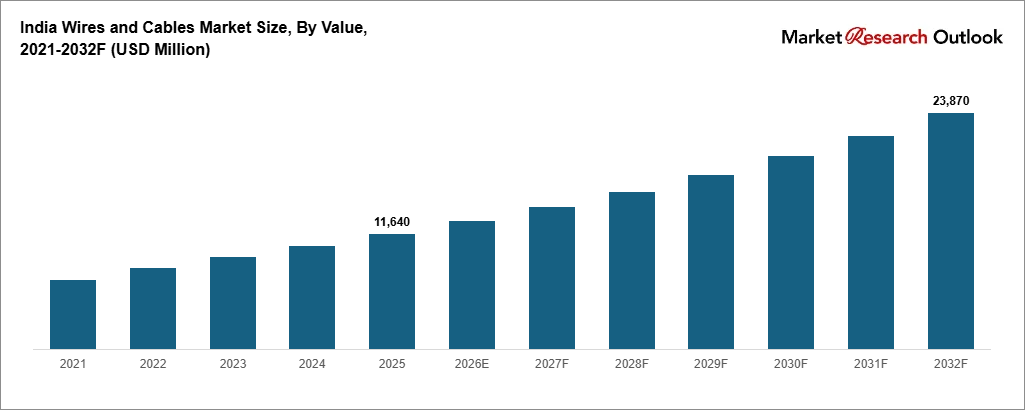
The India wires and cables market size is witnessing rapid expansion, driven by power transmission and distribution projects, housing and real estate growth, metro and railway works, solar and wind capacity additions, data centre construction and rising exports. Valued at USD 11,640 million in 2025 and projected to reach USD 23,870 million by 2032, growing at a CAGR of 10.8%, India wires and cables market growth is being fuelled by the National Electricity Plan, under which inter-state transmission capacity at 220 kV and above is planned to grow from 4.85 lakh circuit km in 2024 to 6.48 lakh circuit km by 2032. Power cables lead the product mix, while solar, EV and specialty cables form the fastest growing category. Organised players account for about two-thirds of sector revenue and continue to gain share from local makers as buyers prefer certified, branded products. As Polycab, KEI Industries, Havells, Finolex Cables, RR Kabel and Apar Industries expand capacity, and UltraTech Cement enters through its Ultravolt brand, the sector is evolving into a quality-led, project-driven and brand-focused industry with strong long-term growth potential.
Key Report Takeaways: India Wires and Cables Market
- The India wires and cables market size is projected to grow from USD 11,640 million in 2025 to USD 23,870 million by 2032, registering a strong CAGR of 10.8%, driven by transmission build-out, housing growth and the structural shift toward certified, higher-voltage and fire-safe cable products across India.
- Power cables dominate the product mix, accounting for 44% of total value in 2025, driven by transmission and distribution projects, industrial capex, solar parks and metro and railway electrification, with strong supply from Polycab, KEI Industries, Havells and Apar Industries.
- Solar, EV and specialty cables are emerging as the fastest growing product segment, expected to grow at a CAGR of 17.6% through 2032, as utility-scale solar, rooftop solar, EV charging networks and data centres call for UV-resistant, e-beam cured and high-temperature cables.
- Inter-state transmission capacity is planned to grow from 4.85 lakh circuit km in 2024 to 6.48 lakh circuit km by 2032, with transformation capacity rising from 1,251 GVA to 2,342 GVA, creating a long pipeline of HV and EHV cable demand.
- Rising investment by leading manufacturers, including KEI Industries’ INR 2,000 crore Sanand plant, its INR 700 crore Salarpur project and UltraTech’s INR 1,800 crore Jhagadia plant, is strengthening domestic supply and supporting the India wires and cables market forecast 2032.
Key Market Drivers: India Wires and Cables Market
Power Transmission and Distribution Build-Out Under the National Electricity Plan Driving Demand for Power Cables
Growth in the India wires and cables market is driven first by power sector investment. The National Electricity Plan for transmission covers the period up to 2032 with an investment of INR 9.15 lakh crore, taking the network at 220 kV and above from 4.85 lakh circuit km in 2024 to 6.48 lakh circuit km by 2032. Transformation capacity is set to rise from 1,251 GVA to 2,342 GVA, nine HVDC systems with 33.25 GW of transfer capacity are planned, and inter-regional transfer capacity is planned to grow from 119 GW to 168 GW, against peak demand projected at 458 GW by 2032. Each substation, solar park connection and distribution upgrade needs LV, MV, HV and EHV power cables, along with control and instrumentation cables. Distribution reform and urban underground cabling projects add steady demand for XLPE-insulated MV cables, creating strong pull-through demand across the sector.
Housing, Commercial Real Estate and Urban Infrastructure Growth Fuelling Building Wire and LV Cable Consumption
The sector benefits from sustained construction activity. Building and construction is the largest end-user segment, accounting for 38% of total value in 2025, as residential projects, commercial offices, malls, hospitals, hotels and warehouses use house wires, flexible wires and LV cables in large volumes. The PMAY-Urban 2.0 programme, which targets 1 crore urban houses, adds affordable housing demand, while metro rail, airport and smart city projects use fire-safe and low-smoke cables. Rising awareness of electrical fire safety is pushing builders toward FR, FR-LSH and LSZH wires that carry higher prices than standard PVC wires. Dealers and distributors handle 46% of sales, giving organised brands with wide retail reach, such as Polycab, Havells, Finolex Cables, RR Kabel and V-Guard, an edge in housing demand across tier-1, tier-2 and tier-3 cities, supporting steady growth in wire and cable demand.
Renewable Energy, Data Centre and EV Charging Expansion Creating Demand for Solar, Specialty and High-Value Cables
Rapid growth in clean energy and digital infrastructure is a major catalyst for wire and cable demand in India. India’s target of 500 GW of non-fossil power capacity by 2030 requires large volumes of solar DC cables, LV and MV array cables, and HV evacuation cables for every solar and wind park. The PM Surya Ghar Muft Bijli Yojana, with an outlay of INR 75,021 crore for rooftop solar on 1 crore households, adds demand for solar and building wires. Hyperscale data centres in Mumbai, Chennai, Hyderabad and Noida use high-current power cables, fire-rated cables and optical fibre links, while EV charging stations need flexible, high-temperature charging cables. KEI Industries plans to start e-beam cured solar cable production at its Sanand plant, and leading makers are widening specialty ranges. These segments, growing at a CAGR of 17.6% through 2032, are structurally expanding India wires and cables market growth across all major end-user categories.
Key Market Challenges: India Wires and Cables Market
Copper and Aluminium Price Volatility Raising Input Costs and Squeezing Margins
The sector faces a clear cost challenge from metal price movements. Copper and aluminium make up close to 70% of material cost for cable makers, so any sharp rise in metal prices quickly lifts production cost. Branded makers can pass on part of the increase to dealers through price revisions, but fixed-price project contracts and tender commitments limit pass-through, and frequent price changes unsettle dealer stocking. Smaller makers without metal hedging or long-term supply contracts are hit hardest. Currency movement adds a further layer of risk, as a large share of copper cathode and rod is linked to global prices, keeping margin pressure a near-term challenge for wire and cable makers in India.
Competition from Unorganised and Sub-Standard Local Manufacturers Limiting Price Realisation
The industry still carries a large unorganised segment, which accounts for about one-third of sector revenue. Local workshops often sell wires with lower copper content, thinner insulation or uncertified compounds at prices well below branded products, which attracts cost-sensitive buyers in tier-3 towns and rural areas. This limits price realisation for organised makers and creates safety risks for households. BIS quality control orders and mandatory certification for many wire and cable types are tightening the field, and rising awareness of fire safety is shifting buyers toward brands. Polycab alone holds an estimated 30% share of the organised segment. Even so, enforcement across thousands of small units and local markets remains uneven, keeping unorganised competition a near-term challenge in the sector.
Working Capital Pressure from Long Project Cycles and Delayed Payments by Utilities and EPC Contractors
Cable makers serving power, railway and infrastructure projects face long cash cycles. Project orders involve tender processes, type testing, staggered deliveries and retention money, while state utilities and EPC contractors often pay late. This raises receivable days and working capital needs, especially for mid-sized makers with a high share of institutional sales. Institutional and direct sales account for 18% of channel value, EPC and project sales for 14% and government tenders for 10%, together forming 42% of the sector. Larger players manage this through channel financing, bill discounting and a higher share of dealer sales, but smaller suppliers often turn down orders or accept lower prices to maintain cash flow, which limits their ability to scale.
Key Market Trends: India Wires and Cables Market
Rapid Shift Toward Fire-Safe, Halogen-Free and Premium Building Wires
The sector is undergoing a clear shift toward fire-safe and premium building wires, with FR, FR-LSH and LSZH products gaining share in residential towers, hospitals, malls, metro stations and data centres. Halogen-free insulation accounted for 7% of insulation material value in 2025 and is growing faster than standard PVC, as these wires release less smoke and toxic gas in a fire. Builders and architects are writing fire-safe wires into specifications, and leading brands such as Polycab, Havells, Finolex Cables and RR Kabel are promoting premium ranges with higher conductivity, longer life and better insulation. Smart home wiring, modular switch systems and branded retail stores are lifting average selling prices, reinforcing long-term growth across both retail and project categories.
Growth of EHV, XLPE and HVDC Cable Manufacturing for Transmission and Green Energy Corridors
A clear shift toward higher voltage and XLPE insulation is reshaping cable manufacturing in India. XLPE accounted for 31% of insulation material value in 2025, driven by MV and HV power cables for utilities, solar parks and industrial plants. Demand for EHV cables of 220 kV and above is rising with urban substations, underground transmission and green energy corridors, and the planned addition of nine HVDC systems by 2032 creates new opportunities. KEI Industries expects EHV production at its Sanand plant by March 2027 and holds an EHV order book of INR 793 crore, while Apar Industries and Universal Cables continue to expand high-voltage capability. Domestic EHV production reduces reliance on imports for critical transmission projects, raising the value of each kilometre sold across the sector.
Capacity Expansion by Leading Manufacturers and Entry of New Large Players
A wave of capacity expansion is reshaping the supply side of the sector. Organised players plan capital spending of over INR 8,000 crore across 2025 and 2026, which is expected to lift installed capacity by about 40%. Polycab reported FY26 wire and cable revenue of INR 25,179 crore, up 33%, with international business at 5.4% of wire and cable revenue. KEI Industries has invested about INR 1,722 crore in its INR 2,000 crore Sanand plant up to June 2026, and its board approved an INR 700 crore Salarpur plant in August 2026 with capacity of 50,000 km of cables per year. UltraTech Cement launched Ultravolt in 2026 with an INR 1,800 crore plant at Jhagadia, Gujarat. These developments are reinforcing the India wires and cables market forecast 2032 across the value chain.
Segmental Insights: India Wires and Cables Market
By End-User: Building & Construction Segment Dominates Wire and Cable Demand in India
The building and construction end-user segment dominates the market, accounting for 38% of total value in 2025, driven by housing projects, commercial real estate, hospitals, hotels and warehouses. House wires, flexible wires and LV power cables are the main products within this segment, sold largely through dealers and electrical retailers. The power generation, T&D and renewables segment contributes 31% of demand, led by transmission projects, distribution upgrades and solar and wind parks. The industrial and infrastructure segment accounts for 21%, supported by factories, refineries, metro rail, railways and airports, while telecom, IT and data centres contribute 10% and are growing fast. In 2025 and 2026, Polycab, Havells, Finolex Cables, RR Kabel and V-Guard expanded dealer networks and premium wire ranges, reinforcing building segment leadership.
By Product Type: Power Cables Lead While Solar, EV and Specialty Cables Grow Fastest
Power cables lead the product mix, accounting for 44% of total value in 2025, driven by transmission and distribution projects, industrial plants and renewable energy parks. Building and house wires contribute 28%, mainly across residential and commercial construction, while control and instrumentation cables hold 8% for process industries, power plants and metro systems. Communication and optical fibre cables account for 7%, supported by 5G rollout, BharatNet and data centre links. Solar, EV and specialty cables, at 7% of value, are the fastest growing category with a CAGR of 17.6% through 2032, while others, including winding and automotive wires, hold 6%. By voltage, low voltage cables account for 63% of value and medium voltage for 22%. Leading manufacturers including Polycab, KEI Industries, Havells, Finolex Cables and Apar Industries have aligned product portfolios to this mix across the sector.
Regional Insights: India Wires and Cables Market
Regional analysis shows that West India leads with 32% of total market value in 2025, driven by Maharashtra and Gujarat, which host large housing markets, industrial clusters, solar parks and major cable plants at Halol, Daman, Sanand, Jhagadia and Umbergaon. North India contributes 27%, led by Uttar Pradesh, Delhi NCR, Rajasthan, Haryana and Punjab, supported by housing, data centres in Noida and solar parks in Rajasthan. South India accounts for 23%, supported by Tamil Nadu, Karnataka, Telangana and Andhra Pradesh, where data centres, electronics manufacturing and renewable energy projects are expanding. East India holds 11%, led by West Bengal, Odisha, Bihar and Jharkhand, while Central India accounts for 7%, led by Madhya Pradesh and Chhattisgarh. Large transmission projects and industrial corridors are spreading cable demand across all regions of India.
Recent Developments: India Wires and Cables Market
- The sector recorded strong momentum through 2025 and 2026. Polycab’s FY26 wire and cable revenue rose 33% to INR 25,179 crore, and its share of the organised segment rose to an estimated 30%, up from about 26% in FY25, while industry volume growth stood at about 11% in FY26. Exports by organised players were expected to grow over 20% in FY26, supported by China+1 sourcing.
- Domestic manufacturers deepened capacity expansion. KEI Industries completed the first phase of its Sanand plant for LV and MV power cables, plans EHV production by March 2027, and approved an INR 700 crore Salarpur plant in August 2026 with 50,000 km of cable capacity per year and 40,000 tonnes of GI wire capacity. These developments are strengthening domestic supply and supporting sector growth through 2032.
- New entrants have gained strong attention in the sector. In 2026, UltraTech Cement launched its Ultravolt wires and cables brand with an INR 1,800 crore plant at Jhagadia, Gujarat, covering home wires, flexible wires and cables for residential, commercial, industrial and infrastructure use. The entry of a large building materials group is raising competition in the building wire segment and strengthening long-term competitive positioning for the sector through 2032.
Key Market Players: India Wires and Cables Market
- Polycab India Limited
- KEI Industries Limited
- Havells India Limited
- Finolex Cables Limited
- RR Kabel Limited
- Apar Industries Limited
- UltraTech Cement Limited (Ultravolt)
- V-Guard Industries Limited
- Universal Cables Limited
- Sterlite Technologies Limited
- Paramount Communications Limited
- Dynamic Cables Limited
- Panasonic Life Solutions India Private Limited
| By Product Type | By Insulation Material | By Voltage | By Sales Channel | By End-User |
| Power Cables (LV, MV, HV & EHV) Building & House Wires Control & Instrumentation Cables Communication & Optical Fibre Cables Solar, EV & Specialty Cables Others (Winding & Automotive Wires) |
Polyvinyl Chloride (PVC) Cross-Linked Polyethylene (XLPE) Halogen-Free (LSZH & FR-LSH) Rubber (EPR & CSP) Silicone Thermoplastic Elastomers (TPE) Others |
Low Voltage (Up to 1.1 kV) Medium Voltage (3.3 kV to 33 kV) High Voltage (66 kV to 132 kV) Extra High Voltage (220 kV & Above) Others (Signal & Data Grade) |
Dealers & Distributors Electrical Retail Stores Institutional & Direct Sales EPC Contractors & Project Sales Government & PSU Tenders Online & E-Commerce |
Building & Construction Power Generation, T&D & Renewables Industrial & Infrastructure Telecom, IT & Data Centres |
Report Scope
In this report, the India Wires and Cables Market has been segmented into the following categories, in addition to detailed analysis of key industry trends, market dynamics, competitive landscape and growth opportunities across the forecast period:
- By Product Type
- Power Cables (LV, MV, HV & EHV)
- Building & House Wires
- Control & Instrumentation Cables
- Communication & Optical Fibre Cables
- Solar, EV & Specialty Cables
- Others (Winding & Automotive Wires)
- By Insulation Material
- Polyvinyl Chloride (PVC)
- Cross-Linked Polyethylene (XLPE)
- Halogen-Free (LSZH & FR-LSH)
- Rubber (EPR & CSP)
- Silicone
- Thermoplastic Elastomers (TPE)
- Others
- By Voltage
- Low Voltage (Up to 1.1 kV)
- Medium Voltage (3.3 kV to 33 kV)
- High Voltage (66 kV to 132 kV)
- Extra High Voltage (220 kV & Above)
- Others (Signal & Data Grade)
- By Sales Channel
- Dealers & Distributors
- Electrical Retail Stores
- Institutional & Direct Sales
- EPC Contractors & Project Sales
- Government & PSU Tenders
- Online & E-Commerce
- By End-User
- Building & Construction
- Power Generation, T&D & Renewables
- Industrial & Infrastructure
- Telecom, IT & Data Centres
- By Geography
- North India
- South India
- West India
- East India
- Central India
Competitive Landscape
Company Profiles:
Detailed analysis of the leading companies operating in the Indian wire and cable industry, including business overview, product portfolio, strategic initiatives, competitive positioning and recent developments.
Company Information
Detailed profiling and strategic analysis of additional market players (up to five companies), including emerging domestic cable brands, specialty solar and EV cable producers, regional wire makers, or niche optical fibre and instrumentation cable manufacturers.
For a free sample of the India Wires and Cables Market report, customised insights or delivery timelines, submit your query here
India Wires and Cables Market, 2032
- Research Framework
- Market Segmentation
- Research Objective
- Research Methodology
- Qualitative Research
- Primary Research
- Secondary Research
- Quantitative Research
- Market Breakdown & Data Triangulation
- Demand Side
- Supply Side
- Primary Research Respondents
- Assumption & Limitation
- Executive Summary
- Market Overview, 2021-2032
- By Product Type
- By Insulation Material
- By Voltage
- By Sales Channel
- By End-User
- By Region
- Analyst Recommendations
- Geopolitical Impact on the Indian Wire and Cable Industry
- India Wires and Cables Market Insights
- Market Dynamics
- Growth Drivers
- Power transmission and distribution build-out under the National Electricity Plan driving demand for power cables.
- Housing, commercial real estate and urban infrastructure growth fuelling building wire and LV cable consumption.
- Renewable energy, data centre and EV charging expansion creating demand for solar, specialty and high-value cables.
- Restraints
- Copper and aluminium price volatility raising input costs and squeezing margins for cable makers.
- Competition from unorganised and sub-standard local manufacturers limiting price realisation.
- Working capital pressure from long project cycles and delayed payments by utilities and EPC contractors.
- Opportunities
- EHV, HVDC and submarine cable demand linked to green energy corridors and inter-regional transmission.
- Export growth to the US, Europe and the Middle East supported by China+1 supplier diversification.
- Premium fire-safe, halogen-free and smart home wires gaining share in residential and commercial buildings.
- Challenges
- Capacity additions by incumbents and new entrants raising the risk of oversupply and price competition.
- Compliance with BIS quality control orders and testing standards across a fragmented supplier base.
- Dependence on imported XLPE compounds, EHV insulation materials and specialised testing equipment.
- Technological Advancements
- Recent Technological Advancements
- Prior to 2020
- Porter’s Five Forces Analysis
- PESTLE Analysis
- Industry Value Chain & Entry Points
- Upstream Raw Materials (copper, aluminium, PVC and XLPE compounds, steel wire, armouring tape, optical fibre)
- Conductor & Rod Producers (copper rods, aluminium rods, alloy conductors, drawing and annealing)
- Insulation & Compound Suppliers (PVC, XLPE, LSZH, rubber and silicone compounds)
- Wire & Cable Manufacturers (Polycab, KEI, Havells, Finolex, RR Kabel, Apar)
- Testing, Certification & Standards Bodies (BIS, CPRI, NABL laboratories, IS 694 and IS 7098 standards)
- Distributors, Dealers & Electrical Retailers (B2B and B2C distribution networks)
- EPC Contractors & System Integrators (power, railway, metro, solar and industrial projects)
- Utilities & Government Buyers (state DISCOMs, transmission utilities, railways, PSUs)
- Export Channels & Overseas Buyers (US, Europe, Middle East, Africa)
- End-Users (households, builders, industries, power utilities, telecom operators, data centres)
- India Wires and Cables Market: Regulatory Framework
- India Wires and Cables Market Overview
- Market Size & Forecast, 2021-2032
- By Value (USD Million)
- By Volume (Million Km)
- Market Share & Forecast
- By Product Type
- Power Cables (LV, MV, HV & EHV)
- Building & House Wires
- Control & Instrumentation Cables
- Communication & Optical Fibre Cables
- Solar, EV & Specialty Cables
- Others (Winding & Automotive Wires)
- By Insulation Material
- Polyvinyl Chloride (PVC)
- Cross-Linked Polyethylene (XLPE)
- Halogen-Free (LSZH & FR-LSH)
- Rubber (EPR & CSP)
- Silicone
- Thermoplastic Elastomers (TPE)
- Others
- By Voltage
- Low Voltage (Up to 1.1 kV)
- Medium Voltage (3.3 kV to 33 kV)
- High Voltage (66 kV to 132 kV)
- Extra High Voltage (220 kV & Above)
- Others (Signal & Data Grade)
- By Sales Channel
- Dealers & Distributors
- Electrical Retail Stores
- Institutional & Direct Sales
- EPC Contractors & Project Sales
- Government & PSU Tenders
- Online & E-Commerce
- By End-User
- Building & Construction
- Power Generation, T&D & Renewables
- Industrial & Infrastructure
- Telecom, IT & Data Centres
- By Geography
- North India
- South India
- West India
- East India
- Central India
- Competitive Landscape
- India Wires and Cables Market Company Market Share Analysis, 2025
- Competitive Benchmarking, By Operating Parameters
- Key Strategic Development (Mergers, Acquisitions, Partnerships, Etc.)
- List of Emerging Players
- Company Profile
- Polycab India Limited
- Introduction & Company Profile
- Product Benchmarking
- Strategic Outlook
- Key Competitors
- Financial Analysis
- SWOT Analysis
(Same Data Pointers Will Be Provided for The Below Companies)
- KEI Industries Limited
- Havells India Limited
- Finolex Cables Limited
- RR Kabel Limited
- Apar Industries Limited
- UltraTech Cement Limited (Ultravolt)
- V-Guard Industries Limited
- Universal Cables Limited
- Sterlite Technologies Limited
- Paramount Communications Limited
- Dynamic Cables Limited
- Panasonic Life Solutions India Private Limited
- Other Prominent Players
* Financial information in case of non-listed companies will be provided as per availability
** The segmentation and the companies are subjected to modifications based on in-depth secondary for the final deliverable
Frequently Asked Questions
1. How large is the India wires and cables market and what is its growth forecast?
Ans: The India wires and cables market is valued at USD 11,640 million in 2025 and is projected to reach USD 23,870 million by 2032, growing at a CAGR of 10.8%, supported by transmission projects, housing and renewable energy.
2. Which segments are driving demand for wires and cables in India?
Ans: Power cables lead with 44% of 2025 value and building and construction users hold 38%, while solar, EV and specialty cables are the fastest growing product segment at a CAGR of 17.6% through 2032.
3. What are the key drivers of growth in the wire and cable sector in India?
Ans: Key drivers include transmission and distribution build-out under the National Electricity Plan, housing and urban infrastructure growth, and rising solar, data centre and EV charging investment that needs specialty, high-value cables.
4. Which regions are driving growth in wires and cables demand in India?
Ans: West India leads with 32% of 2025 value, driven by Maharashtra and Gujarat, followed by North India at 27%, led by Uttar Pradesh and Delhi NCR, and South India at 23%.
5. What are the latest trends in the wire and cable sector in India?
Ans: Latest trends include fire-safe and halogen-free building wires, growth of XLPE, EHV and HVDC cable manufacturing, rising exports, and large capacity expansion by leading makers and new entrants such as UltraTech.