

India Data Center Renewable Power Procurement & Grid Constraint Market, 2032
- Energy, Power & Storage, Grid & Power Infrastructure, Renewables & Clean Fuels
- Oct 2026
- Pages 140
- Report Format: pdf
- Report Price: $2400 USD
India’s market for clean power sourcing and grid access at data centers is witnessing strong structural growth, driven by rapid hyperscale and colocation capacity additions, rising AI power loads, hyperscaler carbon-free energy goals, Green Energy Open Access Rules, renewable consumption obligations, lower landed cost of open access power, and rising investment by renewable developers and transmission utilities in data center supply.
| Study Duration | 2021-2032 |
| Market Size (2025) | USD 540 Million |
| CAGR (2026-2032) | 22.1% |
| Leading Segment | Group Captive Projects (Wind-Solar Hybrid) |
| Fastest Growing Segment | Round-the-Clock Renewables & Storage-Firmed PPAs |
| Market Size (2032) | USD 2,180 Million |
Market Overview: India Data Center Renewable Power Procurement & Grid Constraint Market
The India data center renewable power procurement and grid constraint market size is witnessing rapid expansion, driven by record data center construction, rising power use per rack, strict emission targets set by global cloud clients, and the growing cost of waiting for grid capacity. Valued at USD 540 million in 2025 and projected to reach USD 2,180 million by 2032, growing at a CAGR of 22.1%, growth is being fuelled by hyperscale cloud regions, colocation campuses of 50 MW to 300 MW, and AI halls that draw 40 kW or more per rack. Group captive projects lead spending, while round-the-clock renewables and storage-firmed PPAs form the fastest growing category. The market covers the value of renewable power contracted by data centers together with spending on dedicated substations, transmission access, firming storage, and power quality systems needed to bring that power to site. As renewable developers including Tata Power Renewable Energy, Adani Green Energy, ReNew, CleanMax, and AMPIN build dedicated capacity, and transmission utilities including Power Grid expand corridors, the market is evolving into a contract-led, grid-aware, and fast-scaling segment with strong long-term growth potential.
Key Report Takeaways: India Data Center Renewable Power Procurement & Grid Constraint Market
- The India data center renewable power procurement and grid constraint market size is projected to grow from USD 540 million in 2025 to USD 2,180 million by 2032, registering a strong CAGR of 22.1%, driven by data center capacity additions, hyperscaler clean energy targets, and the structural shift toward round-the-clock renewable supply and dedicated grid connections.
- Group captive projects dominate the market, accounting for 38% of total value in 2025, driven by exemption from cross subsidy surcharge and additional surcharge, landed tariffs of INR 4.5 to INR 6.0 per kWh, and the willingness of developers such as CleanMax, AMPIN, and Tata Power Renewable Energy to build dedicated capacity.
- Round-the-clock renewables and storage-firmed PPAs are the fastest growing segments, expected to grow at a CAGR of 34.6% through 2032 as hyperscale clients ask for hourly clean energy matching and operators look to cover night-time and low-wind hours.
- Rapid scaling of data center capacity, with operational IT load crossing 1,300 MW in 2025 and projected to exceed 3,000 MW by 2030, is structurally expanding demand for renewable power, substations, transmission access, and storage across hyperscale, colocation, and enterprise facilities.
- Rising investments by renewable developers such as Adani Green Energy, ReNew, JSW Neo Energy, and Avaada in hybrid and storage-backed capacity, together with transmission expansion by Power Grid and state utilities, are strengthening supply and supporting the market forecast 2032.
Key Market Drivers: India Data Center Renewable Power Procurement & Grid Constraint Market
Rapid Growth in Data Center Power Demand and Hyperscaler Carbon-Free Energy Commitments Driving Long-Term Renewable Contracts
Growth in the India data center renewable power procurement and grid constraint market is being driven first by the pace of new data center construction. Operational IT load in India crossed 1,300 MW in 2025 and is projected to exceed 3,000 MW by 2030, with Mumbai and Navi Mumbai hosting close to half of current capacity, followed by Chennai, Hyderabad, Delhi NCR, Pune, and Bengaluru. At a power usage effectiveness of 1.4 to 1.6, every 100 MW of IT load needs 140 MW to 160 MW of grid supply, and data center electricity use is projected to rise from 11 TWh in 2025 to over 30 TWh by 2030. Global cloud and AI clients have set net zero and 24×7 carbon-free energy targets that apply to their Indian regions, and they now write renewable sourcing clauses into colocation contracts. Large developers including AdaniConneX, Yotta, CtrlS, NTT DATA, STT GDC India, Nxtra by Airtel, and Sify have announced renewable targets alongside multi-hundred megawatt pipelines, creating a steady flow of long-term contracts through 2032.
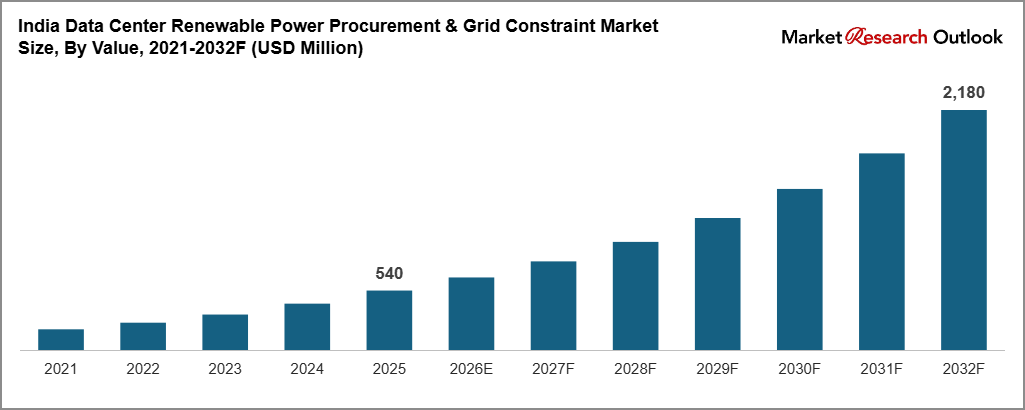
Source:
Green Energy Open Access Rules, Renewable Consumption Obligations, and State Data Center Policies Widening Procurement Routes
Data center renewable power sourcing in India is also supported by a steady run of policy reform. The Green Energy Open Access Rules notified by the Ministry of Power in 2022 cut the open access threshold from 1 MW to 100 kW, capped additional surcharge, allowed monthly banking, and set a 15-day timeline for approvals. Renewable consumption obligations for designated consumers rise each year to 43.33% by 2029-30, and the waiver of interstate transmission charges for projects commissioned up to June 2025, now tapering in 25% annual steps, gave developers a strong push to build capacity early. State data center policies in Uttar Pradesh, Tamil Nadu, Maharashtra, and Telangana add open access, banking, or duty benefits for data center parks. As a result, an estimated 46% of operational data center load in India was covered by some form of renewable contract in 2025, lifting spend across the market.
Lower Landed Cost of Group Captive and Open Access Renewable Power Compared With Commercial Grid Tariffs
Cost is a major catalyst for the India data center renewable power procurement and grid constraint market, since power makes up 50% to 60% of a data center’s operating cost. Commercial and industrial grid tariffs in major data center states range between INR 8 and INR 10 per kWh once fixed charges and duties are added, while group captive and open access renewable power is landing at INR 4.5 to INR 6.5 per kWh, including transmission and wheeling charges. For a 100 MW campus, that gap is worth INR 250 crore to INR 350 crore a year. Solar and wind auction tariffs of INR 2.5 to INR 3.5 per kWh, and falling battery prices that make 2 to 4 hour storage viable, are widening the savings. Long contract terms of 15 to 25 years also protect operators from future tariff increases, which matters when colocation contracts fix power pass-through rates for years at a time. Together, these factors are moving renewable sourcing from an optional green premium to a cost advantage.
Key Market Challenges: India Data Center Renewable Power Procurement & Grid Constraint Market
Transmission Congestion, Connectivity Delays, and Renewable Curtailment in Rajasthan, Gujarat, and Other Resource States
The sector continues to face hard limits on moving renewable power from where it is generated to where data centers sit. Most solar and wind capacity is built in Rajasthan, Gujarat, Karnataka, and Tamil Nadu, while the largest data center cluster is in Mumbai and Navi Mumbai. Transmission projects in western Rajasthan have faced delays, including route changes linked to Great Indian Bustard habitat protection, and several gigawatts of completed renewable capacity faced curtailment or delayed connectivity in 2025. Generators that cannot evacuate power cannot deliver on corporate PPAs, which pushes up contract risk and price. Until new interstate corridors are commissioned, grid congestion will remain the single biggest constraint on renewable supply to data centers.
State-Level Variation in Open Access Charges, Banking Rules, and Approval Timelines Raising Procurement Complexity
Renewable buyers in India face real hurdles from the way open access is applied state by state. Cross subsidy surcharge, additional surcharge, wheeling charges, and banking charges differ widely, and some states have raised additional surcharge or limited banking to monthly or time-of-day windows, which reduces the value of solar-heavy contracts. Approval timelines still stretch well beyond the 15-day target in several states, and group captive structures face scrutiny on the 26% equity and 51% consumption tests. Regulatory changes during a 15 to 25 year contract can shift landed costs by INR 0.5 to INR 1.5 per kWh. These variations make it harder for multi-state operators to run one procurement strategy across the India data center renewable power procurement and grid constraint market.
Mismatch Between Intermittent Solar and Wind Output and 24×7 Data Center Load Raising Firming and Storage Costs
The market faces practical constraints from the shape of renewable supply. A data center draws a near-flat load around the clock, while solar delivers power for 8 to 10 hours a day and wind output swings by season, with strong monsoon months and weak winters. A solar-only contract can cover just 25% to 30% of annual data center consumption on an hourly basis, and even well-designed wind-solar hybrids reach 50% to 65%. Closing the gap requires battery storage, pumped hydro, or overbuilt capacity, which adds INR 1.0 to INR 2.5 per kWh to firm supply. Banking helps, but state limits on banking reduce its value. Hourly matching tools and settlement systems are also still developing, which slows the move to verified 24×7 clean energy contracts.
Key Market Trends: India Data Center Renewable Power Procurement & Grid Constraint Market
Rapid Shift Toward Round-the-Clock, Hybrid, and Storage-Firmed Renewable PPAs in India
The India data center renewable power procurement and grid constraint market is undergoing a clear shift from solar-only contracts toward wind-solar hybrid, round-the-clock, and storage-firmed supply, with these structures expected to account for over 45% of new data center renewable contracts in India by 2028. Hybrid projects deliver capacity utilization factors of 40% to 50% against 20% to 25% for solar alone, and round-the-clock contracts backed by 2 to 4 hours of storage can cover 70% to 85% of hourly load. National tenders for firm and dispatchable renewable energy have helped developers build the design and financing skills now being offered to corporate buyers. Leading developers including ReNew, Adani Green Energy, Tata Power Renewable Energy, JSW Neo Energy, and Avaada have expanded hybrid and storage-backed pipelines through 2024 and 2025, reinforcing the market forecast 2032 across hyperscale and colocation facilities.
Growth of Dedicated Substations, Private Transmission Links, and Campus Battery Storage in the India Data Center Renewable Power Procurement & Grid Constraint Market
A clear move toward owning or funding grid infrastructure is reshaping power sourcing for Indian data centers, particularly at hyperscale and colocation campuses above 100 MW. Developers are building dedicated 220 kV and 400 kV substations, paying for feeder upgrades, and in some cases funding private transmission lines to secure connection dates. Campus battery storage of 10 MWh to 50 MWh is being planned to shave peaks, manage contract demand, and support grid stability during fast AI load swings. Lead times for high-voltage substations of 24 to 36 months now shape project schedules as much as building construction. By 2025, an estimated 31% of new hyperscale campuses in India included a dedicated substation in the base design, up from less than 10% in 2021, and the share is rising each year.
Large Renewable Contracts by Data Center Operators and Capacity Expansion by Renewable Developers
A wave of long-term contracts and capacity expansion is reshaping the supply side of the India data center renewable power procurement and grid constraint market. Combined renewable capacity contracted or under development for Indian data center clients crossed an estimated 3.5 GW by the end of 2025. AdaniConneX draws on Adani Green Energy’s large renewable pipeline, Nxtra by Airtel and Sify have signed captive and group captive solar and wind arrangements, and colocation operators including CtrlS, Yotta, NTT DATA, and STT GDC India have announced renewable sourcing targets for their campuses. Green Energy Open Access Rules, the phased interstate transmission charge waiver, and state data center policies with banking and open access support have structurally favoured long-term sourcing. Combined with hyperscale construction and storage-backed tenders, these developments are reinforcing the market forecast 2032 across the full value chain.
Segmental Insights: India Data Center Renewable Power Procurement & Grid Constraint Market
By Data Center Type: Colocation Data Centers Dominate the India Data Center Renewable Power Procurement & Grid Constraint Market
The colocation data center segment dominates the India data center renewable power procurement and grid constraint market, accounting for an estimated 51% of total value in 2025, driven by multi-tenant campuses in Mumbai, Chennai, and Hyderabad, tenant demand for renewable power clauses, and large build-to-suit halls for hyperscale clients. Group captive wind-solar hybrid supply and dedicated substations are the main purchases within this segment. Hyperscale self-built data centers contribute another 28% of demand, led by cloud regions in Mumbai, Delhi NCR, and Hyderabad, where operators prefer large open access PPAs and round-the-clock supply. Enterprise data centers account for 13%, while edge, government, and AI-focused facilities make up the remaining 8%. In 2025, colocation leaders including AdaniConneX, Yotta, CtrlS, NTT DATA, STT GDC India, and Nxtra expanded renewable sourcing for new campuses, reinforcing segment dominance.
By Procurement Model: Group Captive Leads While Round-the-Clock Renewables Grow Fastest
Group captive projects lead the India data center renewable power procurement and grid constraint market procurement mix, accounting for 38% of total value in 2025, driven by surcharge exemptions, landed tariffs well below grid rates, and flexible capacity sizing. Third-party open access PPAs contribute another 24%, mainly from hyperscale buyers that want large volumes without equity stakes. Captive projects hold 14%, utility green tariffs 11%, and renewable energy certificates 8%, while the green term-ahead market and rooftop solar make up the remaining 5%. By energy source, wind-solar hybrid supply holds 34%, solar 29%, round-the-clock renewables 14%, and wind 13%. Round-the-clock renewables and storage-firmed PPAs are the fastest growing category, expanding at 34.6% annually. Leading providers including CleanMax, AMPIN, Tata Power Renewable Energy, ReNew, and Fourth Partner Energy have aligned their offerings to this mix.
Regional Insights: India Data Center Renewable Power Procurement & Grid Constraint Market
Regional analysis of the India data center renewable power procurement and grid constraint market shows that West India accounts for 47% of total value, driven by Mumbai, Navi Mumbai, Thane, and Pune, where the largest data center loads sit and renewable supply is drawn from Maharashtra, Gujarat, and Rajasthan through state and interstate networks. South India contributes 34% of demand, led by Chennai and Hyderabad, which benefit from wind and solar resources in Tamil Nadu, Karnataka, Andhra Pradesh, and Telangana. North India accounts for 15%, supported by Delhi NCR, Noida, and Greater Noida, where Uttar Pradesh policy support and supply from Rajasthan are attracting large campuses. East and Central India together make up the remaining 4%, led by Kolkata and emerging edge sites in Bhubaneswar and Indore. In 2025, new campus launches and substation works across Navi Mumbai, Chennai, Hyderabad, and Greater Noida reinforced these hubs, keeping procurement demand closely tied to where data center load is being built.
Recent Developments: India Data Center Renewable Power Procurement & Grid Constraint Market
- The India data center renewable power procurement and grid constraint market saw strong momentum in contracting and grid progress during 2024 and 2025. Renewable energy procured by Indian data centers is estimated to have reached 5,100 GWh in 2025, up from 2,900 GWh in 2023, with group captive and open access routes accounting for 62% of the total. Wind-solar hybrid and round-the-clock contracts made up an estimated 48% of new capacity signed in 2025, against 21% in 2021. Renewable energy procured by data centers is projected to grow at an average 25% annually through 2030.
- Renewable developers have deepened data center focused capacity expansion. In 2025, Adani Green Energy, ReNew, Tata Power Renewable Energy, JSW Neo Energy, and Avaada expanded hybrid and storage-backed pipelines, while CleanMax, AMPIN, and Fourth Partner Energy added group captive capacity for commercial and data center buyers. The Ministry of Power also extended viability gap funding to a further 30 GWh of battery storage. These developments are strengthening supply and supporting the market forecast 2032.
- Data center developer momentum has gained strong traction in the India data center renewable power procurement and grid constraint market. In 2025, leading operators including AdaniConneX, Yotta, CtrlS, NTT DATA, STT GDC India, Nxtra by Airtel, and Sify expanded campus pipelines and renewable targets in Mumbai, Chennai, Hyderabad, and Noida. Long-term agreements between developers, renewable IPPs, and transmission utilities are positioning India as one of the fastest growing markets for clean data center power in Asia, strengthening the long-term outlook.
Key Market Players: India Data Center Renewable Power Procurement & Grid Constraint Market
- Tata Power Renewable Energy Limited
- Adani Green Energy Limited
- ReNew Energy Global Plc
- CleanMax Enviro Energy Solutions Pvt. Ltd.
- AMPIN Energy Transition Pvt. Ltd.
- Fourth Partner Energy Pvt. Ltd.
- JSW Neo Energy Limited
- Torrent Power Limited
- Avaada Energy Pvt. Ltd.
- Hero Future Energies Pvt. Ltd.
- NTPC Green Energy Limited
- Sprng Energy Pvt. Ltd.
- Power Grid Corporation of India Limited
| By Procurement Model | By Energy Source | By Grid Solution | By DC Type | By End-User |
| Group Captive Open Access PPAs Captive Green Tariffs RECs Others | Solar PV Onshore Wind Wind-Solar Hybrid Round-the-Clock Hydropower Bioenergy Others | Substations Transmission Access Storage Firming Demand Response Power Quality | Hyperscale Colocation Enterprise Edge Government AI-Ready | Cloud & IT BFSI Telecom & Media Government & Healthcare |
Report Scope
In this report, the India Data Center Renewable Power Procurement & Grid Constraint Market has been segmented into the following categories, in addition to detailed analysis of key industry trends, market dynamics, competitive landscape, and growth opportunities across the forecast period:
- By Procurement Model
- Group Captive Projects
- Third-Party Open Access PPAs
- Captive Projects
- Utility Green Tariffs
- Renewable Energy Certificates (RECs)
- Others (Green Term-Ahead Market, Rooftop Solar)
- By Energy Source
- Solar PV
- Onshore Wind
- Wind-Solar Hybrid
- Round-the-Clock Renewables (with Storage)
- Hydropower
- Bioenergy
- Others
- By Grid Constraint Solution
- Dedicated Substations & Grid Interconnection (EHV)
- Transmission Access (ISTS & InSTS)
- Battery Energy Storage for Firming
- Demand Response & Load Management
- Power Quality & Reactive Compensation
- By Data Center Type
- Hyperscale Data Centers
- Colocation Data Centers
- Enterprise Data Centers
- Edge & Micro Data Centers
- Government & Public Sector Data Centers
- AI & High-Density Computing Facilities
- By End-User
- Cloud & IT Services
- BFSI
- Telecom & Media
- Government & Healthcare
- By Geography
- North India
- South India
- West India
- East India
- Central India
Competitive Landscape
Company Profiles:
Detailed analysis of the leading companies operating in the India Data Center Renewable Power Procurement & Grid Constraint Market, including business overview, project portfolio, strategic initiatives, competitive positioning, and recent developments.
Company Information
Detailed profiling and strategic analysis of additional market players (up to five companies), including emerging commercial and industrial renewable providers, storage integrators, substation EPC firms, or niche state-level open access suppliers.
For a free sample of the India Data Center Renewable Power Procurement & Grid Constraint Market report, customised insights or delivery timelines, submit your query here
India Data Center Renewable Power Procurement & Grid Constraint Market, 2032
- Research Framework
- Market Segmentation
- Research Objective
- Research Methodology
- Qualitative Research
- Primary Research
- Secondary Research
- Quantitative Research
- Market Breakdown & Data Triangulation
- Demand Side
- Supply Side
- Primary Research Respondents
- Assumption & Limitation
- Executive Summary
- Market Overview, 2021-2032
- By Procurement Model
- By Energy Source
- By Grid Constraint Solution
- By Data Center Type
- By End-User
- By Region
- Analyst Recommendations
- Geopolitical Impact on India Data Center Renewable Power Procurement & Grid Constraint Market
- India Data Center Renewable Power Procurement & Grid Constraint Market Insights
- Market Dynamics
- Growth Drivers
- Rapid growth in data center power demand and hyperscaler carbon-free energy commitments driving long-term renewable contracts.
- Green Energy Open Access Rules, renewable consumption obligations, and state data center policies widening procurement routes.
- Lower landed cost of group captive and open access renewable power compared with commercial grid tariffs.
- Restraints
- Transmission congestion, connectivity delays, and renewable curtailment in Rajasthan, Gujarat, and other resource states.
- State-level variation in open access charges, banking rules, and approval timelines raising procurement complexity.
- Mismatch between intermittent solar and wind output and 24×7 data center load raising firming and storage costs.
- Opportunities
- Round-the-clock and storage-firmed renewable PPAs opening a premium procurement segment for hyperscale campuses.
- Dedicated substations, private transmission links, and campus-scale battery storage creating grid infrastructure demand.
- Data center campuses co-located with renewable parks and transmission hubs reducing delivery losses and charges.
- Challenges
- Intense competition among renewable developers compressing tariffs and margins on large corporate PPAs.
- Land acquisition, right-of-way, and environmental clearance delays for renewable parks and transmission lines.
- Limited availability of accurate hourly carbon accounting and settlement tools for 24×7 clean energy matching.
- Technological Advancements
- Recent Technological Advancements
- Prior to 2020
- Porter’s Five Forces Analysis
- PESTLE Analysis
- Industry Value Chain & Entry Points
- Upstream Equipment & Inputs (solar modules, wind turbines, inverters, battery cells, transformers, conductors)
- Renewable Power Developers & IPPs (Tata Power Renewable Energy, Adani Green, ReNew, JSW Neo Energy, Avaada)
- Commercial & Industrial Renewable Providers (CleanMax, AMPIN, Fourth Partner Energy, Sprng Energy)
- Transmission Utilities & Grid Operators (Power Grid, CTUIL, state transmission utilities, Grid-India)
- Regulators & Market Platforms (CERC, SERCs, CEA, power exchanges for green term-ahead and REC trading)
- Distribution Companies & Green Tariff Providers (state DISCOMs, Tata Power, Adani Electricity, Torrent Power)
- Storage & Grid Solution Providers (BESS integrators, substation EPC firms, power quality equipment suppliers)
- Advisory, Legal & Carbon Accounting Firms (PPA structuring, open access approvals, emissions reporting)
- Data Center Developers & Operators (AdaniConneX, Yotta, CtrlS, NTT DATA, STT GDC India, Nxtra, Sify)
- End-Users (cloud providers, banks, telecom operators, government agencies, enterprises with IT loads)
- India Data Center Renewable Power Procurement & Grid Constraint Market: Regulatory Framework
- India Data Center Renewable Power Procurement & Grid Constraint Market Overview
- Market Size & Forecast, 2021-2032
- By Value (USD Million)
- By Volume (GWh)
- Market Share & Forecast
- By Procurement Model
- Group Captive Projects
- Third-Party Open Access PPAs
- Captive Projects
- Utility Green Tariffs
- Renewable Energy Certificates (RECs)
- Others (Green Term-Ahead Market, Rooftop Solar)
- By Energy Source
- Solar PV
- Onshore Wind
- Wind-Solar Hybrid
- Round-the-Clock Renewables (with Storage)
- Hydropower
- Bioenergy
- Others
- By Grid Constraint Solution
- Dedicated Substations & Grid Interconnection (EHV)
- Transmission Access (ISTS & InSTS)
- Battery Energy Storage for Firming
- Demand Response & Load Management
- Power Quality & Reactive Compensation
- By Data Center Type
- Hyperscale Data Centers
- Colocation Data Centers
- Enterprise Data Centers
- Edge & Micro Data Centers
- Government & Public Sector Data Centers
- AI & High-Density Computing Facilities
- By End-User
- Cloud & IT Services
- BFSI
- Telecom & Media
- Government & Healthcare
- By Geography
- North India
- South India
- West India
- East India
- Central India
- Competitive Landscape
- India Data Center Renewable Power Procurement & Grid Constraint Market Company Market Share Analysis, 2025
- Competitive Benchmarking, By Operating Parameters
- Key Strategic Development (Mergers, Acquisitions, Partnerships, Etc.)
- List of Emerging Players
- Company Profile
- Tata Power Renewable Energy Limited
- Introduction & Company Profile
- Product Benchmarking
- Strategic Outlook
- Key Competitors
- Financial Analysis
- SWOT Analysis
(Same Data Pointers Will Be Provided for The Below Companies)
- Adani Green Energy Limited
- ReNew Energy Global Plc
- CleanMax Enviro Energy Solutions Pvt. Ltd.
- AMPIN Energy Transition Pvt. Ltd.
- Fourth Partner Energy Pvt. Ltd.
- JSW Neo Energy Limited
- Torrent Power Limited
- Avaada Energy Pvt. Ltd.
- Hero Future Energies Pvt. Ltd.
- NTPC Green Energy Limited
- Sprng Energy Pvt. Ltd.
- Power Grid Corporation of India Limited
- Other Prominent Players
* Financial information in case of non-listed companies will be provided as per availability ** The segmentation and the companies are subjected to modifications based on in-depth secondary for the final deliverable
Frequently Asked Questions
1. How large is the India data center renewable power procurement and grid constraint market and what is its growth forecast?
Ans: The India data center renewable power procurement and grid constraint market is valued at USD 540 million in 2025 and is projected to reach USD 2,180 million by 2032, growing at a CAGR of 22.1%, supported by capacity additions.
2. Which segments are driving demand in the India data center renewable power procurement and grid constraint market?
Ans: Group captive projects lead with a 38% value share, while round-the-clock renewables and storage-firmed PPAs grow fastest at 34.6% annually, as hyperscale and colocation clients seek hourly clean energy matching for their Indian campuses.
3. What are the key drivers of growth in the India data center renewable power procurement and grid constraint market?
Ans: Key drivers include rising data center power demand, hyperscaler carbon-free energy targets, Green Energy Open Access Rules, renewable consumption obligations, and lower landed cost of renewable power versus grid tariffs.
4. Which regions are driving growth in the India data center renewable power procurement and grid constraint market?
Ans: West India leads with 47% of value, driven by Mumbai and Navi Mumbai, followed by South India at 34%, led by Chennai and Hyderabad. North India holds 15%, supported by Delhi NCR and Noida.
5. What are the latest trends in the India data center renewable power procurement and grid constraint market?
Ans: Latest trends include the shift to wind-solar hybrid and round-the-clock PPAs, dedicated campus substations, private transmission links, campus battery storage, and hourly carbon accounting tools that support verified 24x7 clean energy reporting.