

India Neem Extract Market Size, Share & Demand Outlook 2032
- Food, Beverage & Nutrition
- Jul 2026
- Pages 140
- Report Format: pdf
- Report Price: $2400 USD
India’s neem extract market is being reshaped by technology upgrades, export growth, capacity expansion, and consolidation. Rising demand from agriculture, biopesticides, personal care, pharmaceuticals, and nutraceuticals, supported by government initiatives and growing organic exports, is strengthening standardized neem extract supply and driving market growth through 2032.
Report Description
| Study Duration | 2021-2032 |
| Market Size (2025) | USD 230 Million |
| CAGR (2026-2032) | 14.0% |
| Leading Segment | Neem Leaf Extract |
| Fastest Growing Segment | Neem Seed & Fruit Extract |
| Market Size (2032) | USD 575 Million |
Source:
Market Overview: India Neem Extract Market
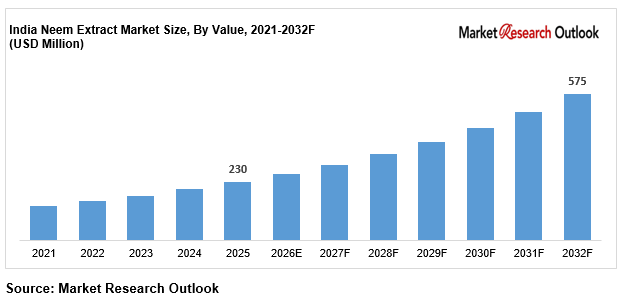
The India neem extract market size is witnessing rapid expansion, driven by accelerating organic farming, rising biopesticide demand, the neem-coated urea mandate, growing natural personal care and Ayurveda demand, expanding pharmaceutical applications, and India’s abundant neem raw-material base. Valued at USD 230 million in 2025 and projected to reach USD 575 million by 2032, growing at a CAGR of 14.0%, the India Neem Extract Market growth is being fuelled by strong demand from agriculture, cosmetics, and pharmaceutical buyers, rising natural-product awareness, and the scaling of standardized and export-oriented extraction. Neem leaf extract leads consumption, while the neem seed and fruit extract segment is emerging as the fastest growing category on the back of higher azadirachtin content. Shifting preferences toward standardized, high-potency, and application-specific neem extract, growing organic farming, and rising clean-label demand are reshaping the supply landscape of the India neem extract market. As domestic majors including E.I.D. Parry, PJ Margo, Parker Biotech, and GreeNeem Agri expand standardized azadirachtin capacity, and specialty players including Ozone Biotech, Fortune Biotech, and Camson Bio Technologies scale value-added pipelines, the market is evolving into a standardized, innovation-driven, and export-enabled ecosystem with strong long-term growth potential.
Related research: India Health and Wellness Food Market, India Vegan Vitamins & Supplements Market and India Food Flavor and Enhancer Market.
Key Report Takeaways: India Neem Extract Market
- The India neem extract market size is projected to grow from USD 230 million in 2025 to USD 575 million by 2032, registering a strong CAGR of 14.0%, driven by accelerated organic farming, rising biopesticide demand, and the structural shift toward standardized high-value extracts across agriculture and personal care.
- Neem leaf extract dominates the India neem extract market, accounting for 35% of total value in 2025, driven by wide use across agriculture, herbal medicine, and personal care, the deep presence of players such as E.I.D. Parry, PJ Margo, and Parker Biotech, and rising demand across biopesticide and cosmetic channels.
- Neem seed and fruit extract is emerging as the fastest growing segment in the India neem extract market, expected to grow at 17% annually as higher azadirachtin content, standardized formulations, and export demand reshape sourcing strategies across agriculture and pharmaceutical markets.
- India’s abundant neem base, with nearly 18 million hectares of neem cultivation and over 442,000 tonnes of neem seed collected annually, is structurally expanding the market across biopesticide, personal care, and pharmaceutical categories.
- Rising investments by domestic majors such as E.I.D. Parry, PJ Margo, GreeNeem Agri, and Parker Biotech in standardized azadirachtin, cosmetic-grade extraction, and export capacity are strengthening supply and supporting the market forecast 2032.
Key Market Drivers: India Neem Extract Market
Organic Farming Expansion, Biopesticide Demand, and the Neem-Coated Urea Mandate Driving Demand
Growth in the market is being driven by organic farming expansion, rising biopesticide demand, and the neem-coated urea mandate across agriculture. India registered 7.3 million hectares of certified organic farmland in FY 2024, providing a substantial platform for botanical pest management solutions such as neem leaf and seed extracts. India’s mandate for 100% neem-coating of urea has structurally embedded neem oil and extract demand into the fertilizer value chain, eliminating demand cyclicality. Biopesticides remain the fastest-growing pesticide segment, expanding at 15% annually, with azadirachtin from neem acting as a natural insecticide that disrupts insect growth cycles without harming non-target species. The National Mission for Sustainable Agriculture allocated INR 3,104 crore to promote organic farming practices, directly benefiting neem extract demand. Rising integrated pest management adoption and regulatory restrictions on synthetic pesticides are creating strong structural pull-through demand across the market.
Rising Demand for Natural Personal Care, Ayurveda, and Herbal Pharmaceuticals Strengthening Consumption
The India neem extract market is benefiting from rising demand for natural personal care, Ayurveda, and herbal pharmaceuticals. India is a global hub for Ayurveda and natural medicine, with neem recognized for its antibacterial, antifungal, antiviral, and immune-enhancing properties. Over 70% of urban consumers now actively seek products labelled herbal, natural, or clean-label, driving demand for neem-based skincare, haircare, and oral-care actives. Government support under the National AYUSH Mission, with a funding of INR 4,607.3 crore, has been a key driver in promoting neem-derived products in the healthcare space. India’s pharmaceutical market, valued at USD 61.36 billion in 2024, is increasingly incorporating neem extracts in formulations targeting skin diseases, diabetes, immunity, and oral health. Domestic processing and standardization capacity has scaled rapidly, led by E.I.D. Parry, PJ Margo, Parker Biotech, and GreeNeem Agri. Rising consumer awareness of the side effects of chemical-based products and growing acceptance of botanical actives have further strengthened value realisation across the market. Cosmetic-grade and pharmaceutical-grade neem extracts now account for a rising share of premium demand.
Government Support, Export Demand, and India’s Abundant Neem Raw-Material Base Accelerating Adoption
Strong government support, rising export demand, and India’s abundant neem raw-material base are major catalysts for the India neem extract market, with the neem seed and fruit extract segment projected to grow at 17% annually through 2032. India cultivates neem across nearly 18 million hectares and collects over 442,000 tonnes of neem seed annually, yielding roughly 88,400 tonnes of neem oil and 353,800 tonnes of neem cake that feed both biopesticide and biofertilizer value chains. India’s organic exports are projected to reach INR 20,000 crore, approximately USD 2,500 million, by 2028, expanding demand for neem-based botanical inputs. Global acceptance is broad, with the EU approving azadirachtin as an active substance and the US EPA granting tolerance exemptions for cold-pressed neem oil. Leading players including E.I.D. Parry, PJ Margo, and GreeNeem Agri have scaled standardized and export pipelines, with the standardized azadirachtin segment representing an estimated USD 90 million addressable opportunity in India. Government support combined with export demand is structurally expanding India neem extract market growth across all major categories through 2032.
Key Market Challenges: India Neem Extract Market
Raw Material Seasonality, Neem-Seed Price Volatility, and Fragmented Supply
The India neem extract market continues to face challenges around raw material seasonality, neem-seed price volatility, and fragmented supply. Neem seed is harvested seasonally, and year-to-year variation in collection creates supply and price volatility across the value chain. Fragmented rural collection networks, inconsistent seed quality, and logistical inefficiencies limit predictable feedstock for standardized extraction. Since a large portion of neem seed collection is handled by small and informal collectors, supply reliability and azadirachtin consistency remain difficult to maintain. India’s dependence on seasonal, rain-fed neem seed collection and the fragmented nature of upstream sourcing limit consistent supply across the market.
Competition from Synthetic Pesticides and Cheaper Chemical Alternatives
The India neem extract market faces structural complexity from competition with synthetic pesticides and cheaper chemical alternatives. While organic farming and biopesticide adoption are rising, synthetic pesticides remain cheaper and faster-acting, limiting neem extract adoption among price-sensitive farmers. Established habits of chemical pesticide use and immediate visible results continue to favour synthetic products in many regions. Farmers outside organic and premium clusters often prioritise cost and speed over sustainability, limiting adoption of neem-based inputs. Differential awareness, pricing, and availability of standardized neem extract across states create operational complexity for players such as E.I.D. Parry, PJ Margo, Parker Biotech, and GreeNeem Agri operating pan-India. While regulatory restrictions on synthetic pesticides support growth, chemical competition remains a near-term challenge for the India neem extract market.
Standardization, Quality Consistency, and Export-Certification Complexity
The India neem extract market faces practical constraints around standardization, quality consistency, and export-certification complexity. Maintaining consistent azadirachtin potency and purity across batches is difficult given variable feedstock and processing methods. Smaller processors face additional complexity in meeting stringent purity and residue requirements for premium personal care, pharmaceutical, and export markets. Average gross margins for standardized neem extract in India stand near 33%, reducing the effective profitability of new launches amid raw material and compliance costs. Export-certification complexity, CIB&RC registration, and stringent international purity requirements raise time and cost. Investment in standardization, cold-press and nanoemulsion technology, and quality-testing infrastructure is emerging as a solution to differentiate, but consistency and certification remain barriers to widespread adoption across the market.
Key Market Trends: India Neem Extract Market
Shift to Standardized, High-Azadirachtin, and Value-Added Neem Extracts in India
The India neem extract market is undergoing a clear shift toward standardized, high-azadirachtin, and value-added extracts, with these premium variants expected to capture 40% of new product launches by 2027. Standardized azadirachtin concentrates, cosmetic-grade extracts, and pharmaceutical-grade actives deliver higher value realisation, while consistent potency serves demanding buyers. Leading players including E.I.D. Parry, PJ Margo, Parker Biotech, GreeNeem Agri, and Fortune Biotech have scaled standardized and value-added production capacity through 2024 and 2025. High-purity azadirachtin, nimbolide, and nimbin formulations are increasingly used in premium serums, lotions, and therapeutics, particularly for markets such as personal care and pharmaceuticals, with brands like Ozone Biotech, Gujarat Medicorp, and Camson Bio Technologies offering value-positioned neem variants. This product transition is reinforcing the market forecast 2032 across both agriculture and premium application categories.
Growth of Natural Personal Care, Nutraceuticals, and Clean-Label Applications
A clear shift toward natural personal care, nutraceuticals, and clean-label applications is reshaping the India neem extract market, particularly in the premium segment. Consumer enthusiasm for botanical actives in skin-repair, acne-control, and oral-care lines is pushing formulators to standardize high-purity neem extracts. Neem-based capsules, powders, and extracts are increasingly used in dietary supplements targeting immunity, blood sugar, and skin health, accelerated by rising health consciousness. Personal care and cosmetics is the fastest-growing application globally, expanding at nearly 13% annually, with Indian formulators and Ayurvedic brands rapidly adopting neem actives. Clean-label demand and natural-origin claims are reducing reliance on synthetic actives and accelerating adoption across both domestic and export segments of the India neem extract market. Regulatory certainty from EU and US reviews of azadirachtin for cosmetic and crop use is further supporting new product pipelines across the market.
Technology Upgrades, Export Growth, and Consolidation Across India
A wave of technology upgrades, export growth, and consolidation is reshaping the market supply landscape. Combined India-focused capital and capacity activity in neem processing exceeded USD 120 million across 2023 to 2025. Technology upgrades, from continuous counter-current extraction to cold-press and nanoemulsion processing, are lifting product consistency and opening premium opportunities in personal care and therapeutics. Domestic players including E.I.D. Parry, PJ Margo, and GreeNeem Agri expanded standardized and export capacity, while digital-first initiatives improved reach for neem-based products. Government schemes, the neem-coated urea mandate, and rising organic exports have structurally favoured standardized supply. Combined with rising biopesticide demand and export procurement scaling rapidly, these developments are reinforcing the market forecast 2032 across the entire value chain.
Segmental Insights: India Neem Extract Market
By Application: Agriculture Segment Dominates the India Neem Extract Market
The agriculture and crop protection application segment dominates the India neem extract market, accounting for 55% of total consumption, driven by rising organic farming, biopesticide adoption, and the neem-coated urea mandate. Neem oil, cake, and standardized extracts capture the majority of agricultural demand across biopesticides and biofertilizers. The personal care and cosmetics segment contributes 20% of demand, driven by natural skincare, haircare, and oral-care actives, and is the fastest-growing application. Pharmaceuticals and nutraceuticals account for 15%, led by immunity, skin, and therapeutic formulations, while animal feed and other applications account for 10%. In 2025, leading players including E.I.D. Parry, PJ Margo, Parker Biotech, and GreeNeem Agri scaled up agricultural and personal care neem extract deployment under organic farming and export expansion, reinforcing segment dominance in the India neem extract market.
By Product Type: Leaf Extract Leads While Seed and Fruit Extract Grows Fastest
Neem leaf extract leads the market product landscape, accounting for 35% of total value, driven by wide use across agriculture, herbal medicine, and personal care, and its ease of extraction and antibacterial, antifungal, and antioxidant properties. Neem oil contributes a significant share, supported by biopesticide and neem-coated urea demand, while neem cake supports biofertilizer applications. Neem seed and fruit extract is the fastest growing category within the India neem extract market, expanding at 17% annually, driven by higher azadirachtin content, standardized formulations, and premium and export demand. Neem bark extract and powder add niche volume across pharmaceutical and personal care uses. Leading manufacturers including E.I.D. Parry, PJ Margo, Parker Biotech, GreeNeem Agri, and Fortune Biotech have aligned product portfolios to this product mix, driving standardized adoption across the market.
Regional Insights: India Neem Extract Market
Regional analysis of the market shows that South India and West India collectively account for 57% of total neem extract value, driven by Tamil Nadu, Karnataka, Andhra Pradesh, Telangana, Maharashtra, Gujarat, and Madhya Pradesh, supported by strong neem cultivation, established processing clusters, and organic farming adoption. South India alone contributes 30% of demand, anchored by Tamil Nadu, Karnataka, and Andhra Pradesh, home to major processors such as E.I.D. Parry, making it the leading production and consumption hub. West India adds 27%, anchored by Maharashtra, Gujarat, and Madhya Pradesh, major neem cultivation and processing belts. North India contributes 25% of demand, led by Rajasthan, Uttar Pradesh, and Haryana, supported by abundant neem trees and organic farming, while East and Central India together account for 18%, supported by Odisha, West Bengal, and Chhattisgarh, where biopesticide adoption is accelerating. In 2025, capacity additions and sourcing operations by E.I.D. Parry across South India, PJ Margo across Karnataka, and processors across West India reinforced regional supply hubs, supporting closer execution of biopesticide and export projects across the market.
Recent Developments: India Neem Extract Market
- The India neem extract market witnessed strong momentum in capacity and product progress during 2024 and 2025. India cultivates neem across nearly 18 million hectares and collects over 442,000 tonnes of neem seed annually, yielding roughly 88,400 tonnes of neem oil and 353,800 tonnes of neem cake. Standardized azadirachtin and cosmetic-grade extracts recorded strong double-digit growth, with the seed and fruit extract segment accounting for a rising share of new premium demand.
- Domestic majors have deepened standardization and export capacity. In 2024 and 2025, players including E.I.D. Parry, PJ Margo, Parker Biotech, and GreeNeem Agri expanded standardized azadirachtin, cosmetic-grade, and export pipelines, and digital-first initiatives improved reach for neem-based products. These developments are strengthening supply and supporting the market forecast 2032.
- Policy and export momentum has gained strong traction in the India neem extract market. Government support under the National Mission for Sustainable Agriculture and the National AYUSH Mission, the neem-coated urea mandate, and rising organic exports continue to expand demand. Strategic focus on standardization and exports is positioning India as the global hub for neem extract, strengthening long-term competitive positioning in the market forecast 2032.
Key Market Players: India Neem Extract Market
- I.D. Parry (India) Ltd.
- PJ Margo Pvt. Ltd.
- Parker Biotech Pvt. Ltd.
- GreeNeem Agri Pvt. Ltd.
- Ozone Biotech
- Agro Extracts Ltd.
- Fortune Biotech Ltd.
- Neem India Products Pvt. Ltd.
- Gujarat Medicorp Ltd.
- Dhanuka Agritech Ltd.
- Patanjali Ayurved Ltd.
- Godrej Agrovet Ltd.
- Camson Bio Technologies Ltd.
Report Scope
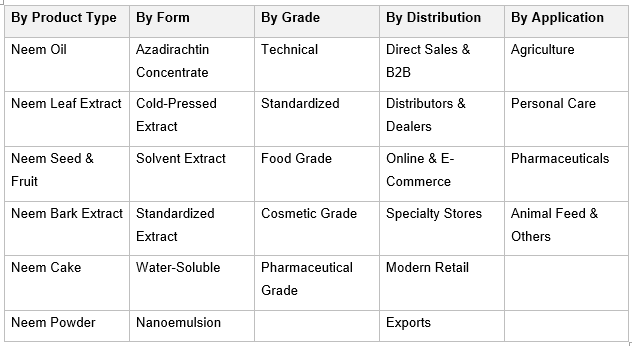
In this report, the India Neem Extract Market has been segmented into the following categories, in addition to detailed analysis of key industry trends, market dynamics, competitive landscape, and growth opportunities across the forecast period:
- By Product Type
- Neem Oil
- Neem Leaf Extract
- Neem Seed & Fruit Extract
- Neem Bark Extract
- Neem Cake
- Neem Powder
- By Form
- Azadirachtin Concentrate
- Cold-Pressed Extract
- Solvent Extract
- Standardized Extract
- Water-Soluble Extract
- Nanoemulsion
- Others
- By Grade
- Technical Grade
- Standardized Grade
- Food Grade
- Cosmetic Grade
- Pharmaceutical Grade
- By Distribution Channel
- Direct Sales & B2B
- Distributors & Agro-Dealers
- Online Retail & E-Commerce
- Specialty Stores
- Modern Retail
- Exports
- By Application
- Agriculture & Crop Protection
- Personal Care & Cosmetics
- Pharmaceuticals & Nutraceuticals
- Animal Feed & Others
- By Geography
- North India
- South India
- West India
- East India
- Central India
Competitive Landscape
Company Profiles:
Detailed analysis of the leading companies operating in the India Neem Extract Market, including business overview, product portfolio, strategic initiatives, competitive positioning, and recent developments.
Company Information
Detailed profiling and strategic analysis of additional market players (up to five companies), including emerging neem processors, specialty azadirachtin producers, regional players, or niche export-oriented neem extract brands.
For a free sample of the India Neem Extract Market report, customised insights or delivery timelines, submit your query here
Table of Contents
- Research Framework
- Market Segmentation
- Research Objective
- Research Methodology
- Qualitative Research
- Primary Research
- Secondary Research
- Quantitative Research
- Market Breakdown & Data Triangulation
- Demand Side
- Supply Side
- Primary Research Respondents
- Assumption & Limitation
- Executive Summary
- Market Overview, 2021-2032
- By Product Type
- By Form
- By Grade
- By Distribution Channel
- By Application
- By Region
- Analyst Recommendations
- Geopolitical Impact on India Neem Extract Market
- India Neem Extract Market Insights
- Market Dynamics
- Growth Drivers
- Organic farming expansion, biopesticide demand, and the neem-coated urea mandate driving neem extract demand across India.
- Rising demand for natural personal care, Ayurveda, and herbal pharmaceuticals strengthening neem extract consumption.
- Government support, export demand, and India’s abundant neem raw-material base accelerating neem extract adoption.
- Restraints
- Raw material seasonality, neem-seed price volatility, and fragmented supply restricting neem extract production.
- Competition from synthetic pesticides and cheaper chemical alternatives restricting neem extract penetration.
- Standardization, quality consistency, and export-certification complexity impacting overall neem extract margins.
- Opportunities
- Standardized azadirachtin, cosmetic-grade, and pharma-grade high-value neem extract innovation.
- Export growth to EU, US, and Asia-Pacific, and clean-label natural personal care.
- Nanoemulsion, cold-press technology, and value-added neem formulations.
- Challenges
- Intense competition from synthetic agrochemicals, cheaper imports, and unstandardized local extracts.
- Limited standardization, testing, and cold-chain-free processing infrastructure across smaller clusters.
- Maintaining azadirachtin potency, purity, and quality consistency at scale across diverse supply chains.
- Technological Advancements
- Recent Technological Advancements
- Prior to 2020
- Porter’s Five Forces Analysis
- PESTLE Analysis
- Industry Value Chain & Entry Points
- Neem Cultivation & Sourcing (neem trees, plantations, seed collection)
- Seed Collectors, Farmers & Aggregators (rural collection networks, FPOs)
- Neem Oil & Cake Processing (crushing, cold-press, expeller, solvent extraction)
- Extraction & Standardization (azadirachtin concentration, purification)
- Quality Control & Testing (azadirachtin assay, purity, residue, laboratories)
- Formulation & Value Addition (biopesticides, cosmetics, pharma, feed)
- Brand Owners & Manufacturers (E.I.D. Parry, PJ Margo, Parker Biotech, GreeNeem)
- Regulatory & Certification (CIB&RC, FSSAI, organic, export certification)
- Distribution, Agro-Dealers & E-Commerce (dealers, online retail, exports)
- End-Users (farmers, cosmetic, pharmaceutical, nutraceutical, animal feed industries)
- India Neem Extract Market: Regulatory Framework
- India Neem Extract Market Overview
- Market Size & Forecast, 2021-2032
- By Value (USD Million)
- By Volume (Thousand Tonnes)
- Market Share & Forecast
- By Product Type
- Neem Oil
- Neem Leaf Extract
- Neem Seed & Fruit Extract
- Neem Bark Extract
- Neem Cake
- Neem Powder
- By Form
- Azadirachtin Concentrate
- Cold-Pressed Extract
- Solvent Extract
- Standardized Extract
- Water-Soluble Extract
- Nanoemulsion
- Others
- By Grade
- Technical Grade
- Standardized Grade
- Food Grade
- Cosmetic Grade
- Pharmaceutical Grade
- By Distribution Channel
- Direct Sales & B2B
- Distributors & Agro-Dealers
- Online Retail & E-Commerce
- Specialty Stores
- Modern Retail
- Exports
- By Application
- Agriculture & Crop Protection
- Personal Care & Cosmetics
- Pharmaceuticals & Nutraceuticals
- Animal Feed & Others
- By Geography
- North India
- South India
- West India
- East India
- Central India
- Competitive Landscape
- India Neem Extract Market Company Market Share Analysis, 2025
- Competitive Benchmarking, By Operating Parameters
- Key Strategic Development (Mergers, Acquisitions, Partnerships, Etc.)
- List of Emerging Players
- Company Profile
- I.D. Parry (India) Ltd.
- Introduction & Company Profile
- Product Benchmarking
- Strategic Outlook
- Key Competitors
- Financial Analysis
- SWOT Analysis
(Same Data Pointers Will Be Provided for The Below Companies)
- PJ Margo Pvt. Ltd.
- Parker Biotech Pvt. Ltd.
- GreeNeem Agri Pvt. Ltd.
- Ozone Biotech
- Agro Extracts Ltd.
- Fortune Biotech Ltd.
- Neem India Products Pvt. Ltd.
- Gujarat Medicorp Ltd.
- Dhanuka Agritech Ltd.
- Patanjali Ayurved Ltd.
- Godrej Agrovet Ltd.
- Camson Bio Technologies Ltd.
- Other Prominent Players
* Financial information in case of non-listed companies will be provided as per availability
** The segmentation and the companies are subjected to modifications based on in-depth secondary for the final deliverable
Frequently Asked Questions
1. How large is the India Neem Extract Market and what is its growth forecast?
Ans: The India neem extract market is valued at USD 230 million in 2025 and is projected to reach USD 575 million by 2032, growing at a CAGR of 14.0%.
2. Which segments are driving demand in the India Neem Extract Market?
Ans: Neem leaf extract leads with a 35% value share, while neem seed and fruit extract is the fastest-growing segment, driven by higher azadirachtin content and export demand.
3. What are the key drivers of growth in the India Neem Extract Market?
Ans: Key drivers include organic farming expansion, biopesticide demand, the neem-coated urea mandate, natural personal care and Ayurveda demand, and export growth.
4. Which regions are driving growth in the India Neem Extract Market?
Ans: South India and West India lead with around 57% of total value. South India alone contributes 30%, anchored by Tamil Nadu, Karnataka, and Andhra Pradesh.
5. What are the latest trends in the India Neem Extract Market?
Ans: Latest trends include standardized high-azadirachtin extracts, natural personal care and nutraceutical growth, cold-press and nanoemulsion technology, and export expansion.