

India Immersion Cooling Fluids Market, 2032
- Chemicals & Advanced Materials, Specialty Chemicals
- Nov 2026
- Pages 140
- Report Format: pdf
- Report Price: $2400 USD
India’s immersion cooling fluids market is witnessing strong structural growth, driven by rapid data center capacity additions, GPU deployment under the IndiaAI Mission, rising rack densities in AI and HPC halls, power and water saving targets in hot climates, the move away from PFAS-based fluorocarbon coolants, and rising interest from lubricant and chemical majors in India-specific supply, blending, and fluid service.
| Study Duration | 2021-2032 |
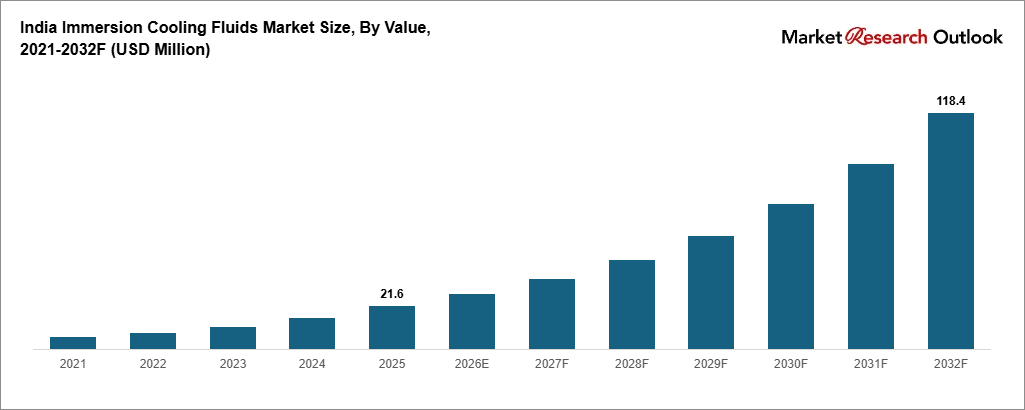
| Market Size (2025) | USD 21.6 Million |
| CAGR (2026-2032) | 27.5% |
| Leading Segment | Synthetic Hydrocarbon (PAO) Fluids (Single-Phase) |
| Fastest Growing Segment | Bio-Based & Ester Fluids (AI & HPC Clusters) |
| Market Size (2032) | USD 118.4 Million |
Market Overview: India Immersion Cooling Fluids Market
The India immersion cooling fluids market size is growing fast, driven by data center capacity additions, AI and GPU cluster rollouts, rising rack power, and the need to cut energy and water use in hot and humid cities. Valued at USD 21.6 million in 2025 and projected to reach USD 118.4 million by 2032, growing at a CAGR of 27.5%, growth rests on hyperscale and colocation campuses in Navi Mumbai, Chennai, Hyderabad, and Noida, and on national GPU capacity under the IndiaAI Mission. India’s operational data center capacity reached 1.8 GW of IT load in mid-2026 and is projected to pass 7 GW by 2030. Synthetic hydrocarbon fluids lead demand, while bio-based and ester fluids are the fastest growing type as buyers seek PFAS-free and biodegradable options. Each kilowatt of immersion-cooled IT load needs about 8.3 litres of fluid at first fill, so every new AI hall adds a sizeable volume order. As Shell, ExxonMobil, Castrol, FUCHS, and Gulf Oil expand local supply, and integrators such as GRC and Submer scale tank deployments, the sector is turning into a specialised, service-led industry with strong long-term growth potential.
Key Report Takeaways: India Immersion Cooling Fluids Market
- The India immersion cooling fluids market size is projected to grow from USD 21.6 million in 2025 to USD 118.4 million by 2032, registering a CAGR of 27.5%, driven by AI cluster rollouts, data center capacity growth, and the shift from air cooling to liquid cooling in dense racks.
- Synthetic hydrocarbon (PAO) fluids dominate demand, accounting for 41% of market value in 2025, supported by their high flash point, low viscosity, long service life, and wide approval among tank integrators and server makers supplied by Shell, ExxonMobil, Castrol, and FUCHS.
- Bio-based and ester fluids are the fastest growing product segment, expected to expand at a CAGR of 38.6% through 2032, as operators chasing biodegradable, PFAS-free, and high fire point coolants test them in AI halls across Mumbai, Chennai, and Hyderabad.
- Data center build-out keeps the demand base growing, with India adding 258 MW of IT capacity in the first half of 2026, a 59% rise over the first half of 2025, taking operational capacity to 1.8 GW.
- AI compute is lifting rack densities, with the IndiaAI Mission onboarding over 38,000 GPUs by February 2026 against a target of at least 200,000, strengthening fluid demand through the forecast period.
Key Market Drivers: India Immersion Cooling Fluids Market
Rapid Data Center Capacity Growth and Hyperscale Campus Expansion Driving Immersion Cooling Fluid Demand Across India
Growth in immersion fluid demand is driven first by the pace of data center construction. India’s operational capacity reached 1.8 GW of IT load in mid-2026 after 258 MW was added in the first half of the year, up 59% from 162 MW in the first half of 2025, and capacity is projected to pass 7 GW by 2030. Hyperscale facilities account for 36% of operational capacity, and sites serving both hyperscale and enterprise clients account for 55%. Large campuses in Navi Mumbai, Chennai, Hyderabad, Noida, and Pune are being designed with liquid-ready halls, heavier floors, and higher power per rack. Each kilowatt of immersion-cooled IT load needs about 8.3 litres of fluid at first fill, plus regular top-ups and testing over the life of the tank. As more halls move from pilot to production, steady first-fill and replacement orders give fluid suppliers clear volume visibility across the industry.
AI and GPU Cluster Deployment Under the IndiaAI Mission Pushing Rack Densities Beyond the Limits of Air Cooling
AI compute is the second big demand engine. The IndiaAI Mission, approved with an outlay of INR 10,371.92 crore, had over 38,000 GPUs on board by February 2026, and the government has set a target of at least 200,000 GPUs. Modern GPU racks can draw up to 130 kW each, many times the 10 kW that typical air-cooled halls were built for. At these levels, air cooling needs large chiller plants, high fan power, and wide aisle spacing, while single-phase immersion can remove the heat with far lower cooling energy and a much smaller footprint. Cloud providers, AI start-ups, and research institutes building sovereign AI capacity are therefore testing and buying immersion systems alongside direct-to-chip cooling. Each new GPU hall adds a large first-fill order, which moves demand well beyond pilot tanks into commercial supply contracts.
Energy Efficiency, PUE, and Water Saving Targets Favouring Immersion Cooling in Hot and Humid Indian Cities
Operating conditions in India strongly favour liquid cooling. Mumbai, Chennai, and Hyderabad face high ambient temperatures and humidity for much of the year, which raises the energy and water needed by evaporative and chilled-water systems. Single-phase immersion removes most of the need for chillers and cooling towers, cuts fan power inside servers, and allows warm-water heat rejection through dry coolers, which helps operators lower power usage effectiveness and water use together. Many state data center policies and green building ratings now reward lower energy and water intensity, and large cloud buyers set their own targets for renewable power and efficiency. Immersion also protects servers from dust, humidity, and corrosion, which matters at edge sites in tier-2 cities. These factors are making efficiency a direct reason to choose immersion fluids rather than a secondary benefit.
Key Market Challenges: India Immersion Cooling Fluids Market
High Upfront Cost of Immersion Tanks and Fluids Compared With Air and Direct-to-Chip Cooling Systems
The sector still faces a cost hurdle at the point of purchase. An immersion hall needs tanks, pumps, heat exchangers, filtration, and a full first fill of engineered fluid, and the fluid alone can be a large share of the cooling budget for a GPU hall. Synthetic and ester fluids cost several times more per litre than ordinary industrial oils, and fluorocarbon two-phase fluids are far more costly still. Many Indian colocation contracts are still priced per rack on air-cooled terms, so operators find it hard to pass on extra capex to tenants. Direct-to-chip cold plates, which fit existing halls more easily, compete for the same liquid cooling budgets. Until lifetime savings are proven across more Indian sites, upfront cost will remain a key barrier for the sector.
Uneven Server Warranty Coverage and Limited Hardware Compatibility Approvals for Submerged IT Equipment
Hardware support is a binding constraint. Server, storage, and network makers do not cover every model for use in immersion, and warranty terms for submerged equipment vary by vendor and region. Fluids must be checked for compatibility with cable jackets, labels, thermal pastes, gaskets, and plastics, and some components need removal or replacement before servers go into a tank. Hard drives and certain optical modules are not suited to submersion, which complicates mixed deployments. Enterprise and BFSI buyers in particular are cautious about anything that could affect support contracts. OEM-certified immersion servers and joint testing programmes between fluid makers and hardware vendors are expanding, but the approval gap remains a near-term challenge for the sector.
Reliance on Imported Base Stocks and Specialty Fluids Exposing Buyers to Price and Supply Swings
The industry depends heavily on imports for its key inputs. PAO base stocks, GTL base oils, synthetic esters, and fluorochemicals are produced mostly outside India, and many finished immersion fluids are shipped in from overseas plants. This leaves buyers exposed to currency moves, freight costs, and supply shifts in global chemical markets. The planned exit of 3M from PFAS manufacturing by the end of 2025 has already forced users of fluorocarbon two-phase fluids to qualify replacements. Local blending capacity for data center grade fluids is still small, and lead times for large first-fill orders can stretch for weeks. Domestic blending by lubricant majors and local stocking by integrators are the main responses, but supply risk is likely to weigh on project schedules in the near term.
Key Market Trends: India Immersion Cooling Fluids Market
Rapid Shift to PFAS-Free Single-Phase Synthetic, GTL, and Bio-Based Fluids in India
The industry is moving quickly away from fluorocarbon two-phase fluids toward PFAS-free single-phase chemistries. Global restrictions on PFAS, and 3M’s exit from PFAS manufacturing at the end of 2025, have pushed buyers to synthetic hydrocarbon, gas-to-liquid, and ester-based fluids. Shell, ExxonMobil, Castrol, FUCHS, and TotalEnergies offer single-phase fluids built on synthetic or GTL base stocks, while Cargill and other suppliers offer plant-based options with high fire points and ready biodegradability. Chemours is developing low global warming potential two-phase fluids for buyers who still prefer boiling-liquid designs. Fluid makers are also improving oxidation stability, lowering viscosity for better heat transfer, and extending service life past ten years. This chemistry shift lifts value per litre and supports pricing through 2032.
Partnerships Between Fluid Makers, Integrators, and IT Service Companies to Scale Immersion Deployments
Commercial partnerships are turning pilots into real deployments. In February 2026, Infosys expanded its collaboration with ExxonMobil to develop and deploy immersion cooling for AI-driven data centers, combining ExxonMobil’s data center immersion fluids with Infosys platforms for cooling optimisation and monitoring. GRC has partnered with Prasa Infocom to take its single-phase immersion systems to Indian customers, and Indian start-up Refroid has launched liquid immersion cooling systems for local data centers. Gulf Oil Lubricants India has announced plans to supply data center cooling fluids, estimating national demand at about 14 million litres at full penetration. These tie-ups bundle fluid, tanks, monitoring, and service into one offer, which lowers risk for buyers and builds repeat demand for fluid suppliers.
Growth of Edge Data Centers, EV Battery Cooling, and Fluid Reclamation Services
New use cases are widening demand for dielectric fluids. Edge data centers in tier-2 cities and at telecom sites benefit from sealed immersion units that need no chilled water and protect hardware from dust and humidity. Electric vehicle makers and battery pack suppliers are testing immersion cooling for fast-charging packs and power electronics, where dielectric fluids can manage heat and reduce thermal runaway risk. Fluid service is also emerging as a business line, covering periodic testing, filtration, top-ups, and reclamation of used fluid at end of life. These services extend fluid life, lower total cost for operators, and create recurring revenue for suppliers. Together, these trends add higher-value demand pockets beyond large data center halls.
Segmental Insights: India Immersion Cooling Fluids Market
By End-User: Cloud & Colocation Providers Segment Dominates the India Immersion Cooling Fluids Market
The cloud and colocation providers segment dominates demand, accounting for 52% of market value in 2025, driven by hyperscale campus expansion, GPU cloud halls, and AI hosting contracts in Navi Mumbai, Chennai, and Hyderabad. Single-phase synthetic hydrocarbon fluids in tanks rated above 50 kW per rack are the standard choice in this segment. Government and research users contribute 16% of value, led by national supercomputing, IndiaAI compute capacity, and academic HPC clusters. IT and telecom companies hold 19%, using immersion in AI labs and edge sites, while BFSI users account for 13%, mainly for trading, risk, and fraud analytics systems. In 2025, operators and integrators scaled pilot tanks into production halls, keeping cloud and colocation demand at the centre of the market.
By Product Type: Synthetic Hydrocarbon Leads While Bio-Based and Ester Fluids Grow Fastest
Synthetic hydrocarbon (PAO) fluids lead the product mix, accounting for 41% of market value in 2025, supported by high flash points, low viscosity, strong oxidation stability, and broad acceptance by tank and server makers. Mineral oil fluids hold 17% of value, mainly in cost-sensitive crypto mining and early pilots, while gas-to-liquid fluids account for 15% and are gaining share through their purity and consistent quality. Fluorocarbon fluids hold 14% of value but are set to decline at a CAGR of 6.8% through 2032 as PFAS rules tighten. Bio-based and ester fluids hold 9% today but are the fastest growing type, expanding at a CAGR of 38.6%, with others making up the remaining 4%. Leading suppliers including Shell, ExxonMobil, Castrol, FUCHS, and Cargill have aligned portfolios with this PFAS-free shift, lifting average fluid performance nationwide.
Regional Insights: India Immersion Cooling Fluids Market
Regional analysis shows that West India accounts for 48% of immersion cooling fluid demand in 2025, led by Navi Mumbai, Mumbai, and Pune, which host the largest cluster of hyperscale and colocation capacity and landing stations for subsea cables. South India contributes 33%, driven by Chennai, Hyderabad, and Bengaluru, where cable landings, cloud regions, and AI start-ups are concentrated. North India accounts for 14% of demand, led by Noida, Greater Noida, and Delhi NCR, with fast growth in hyperscale campuses. East India holds 3%, mainly Kolkata and Bhubaneswar, while Central India accounts for the remaining 2%. Most fluid importers and blenders stock product near Mumbai and Chennai ports, placing supply close to the largest demand centres.
Recent Developments: India Immersion Cooling Fluids Market
- The sector saw strong activity in capacity and AI build-out during 2025 and 2026. India added 258 MW of data center IT capacity in the first half of 2026, up 59% from 162 MW in the first half of 2025, taking operational capacity to 1.8 GW. Hyperscale facilities made up 36% of that capacity, and the market is projected to pass 7 GW by 2030.
- AI compute and cooling partnerships kept scaling. In February 2026, Infosys expanded its collaboration with ExxonMobil to deploy immersion cooling for AI-driven data centers. The same month, the government set a target of at least 200,000 GPUs under the IndiaAI Mission, up from over 38,000 already on board. These steps are deepening liquid cooling demand across the country.
- Supplier momentum has also gained strong traction. Gulf Oil Lubricants India announced plans to enter data center cooling fluids, GRC partnered with Prasa Infocom to supply immersion systems in India, and Refroid launched locally built immersion cooling systems. Lubricant majors including Shell, Castrol, FUCHS, and TotalEnergies are promoting single-phase fluids to Indian operators, strengthening long-term positioning for fluid suppliers.
Key Market Players: India Immersion Cooling Fluids Market
- Shell plc (Shell India Markets Pvt. Ltd.)
- ExxonMobil (ExxonMobil Lubricants Pvt. Ltd.)
- Castrol India Limited
- Gulf Oil Lubricants India Limited
- FUCHS Lubricants (India) Pvt. Ltd.
- TotalEnergies Marketing India Pvt. Ltd.
- The Chemours Company
- Cargill India Pvt. Ltd.
- The Lubrizol Corporation
- SK Enmove Co., Ltd.
- Engineered Fluids Inc.
- Green Revolution Cooling (GRC)
- Submer Technologies
| By Product Type | By Application | By Rack Density | By Sales Channel | By End-User |
| Synthetic Hydrocarbon (PAO) Fluids Mineral Oil Fluids Gas-to-Liquid (GTL) Fluids Fluorocarbon Fluids Bio-Based & Ester Fluids Others |
Hyperscale & Colocation Data Centers Enterprise Data Centers AI & HPC Clusters Edge Data Centers Cryptocurrency Mining EV Battery & Power Electronics Others |
Below 20 kW 20-50 kW 51-100 kW 101-200 kW Above 200 kW |
Direct Sales to Data Center Operators Immersion System OEMs & Integrators IT Hardware OEMs Lubricant Distributors Online & Industrial Supply Platforms Fluid Service & Reclamation Providers |
Cloud & Colocation Providers IT & Telecom BFSI Government & Research |
Report Scope
In this report, the India Immersion Cooling Fluids Market has been segmented into the following categories, in addition to detailed analysis of key industry trends, market dynamics, competitive landscape, and growth opportunities across the forecast period:
- By Product Type
- Synthetic Hydrocarbon (PAO) Fluids
- Mineral Oil Fluids
- Gas-to-Liquid (GTL) Fluids
- Fluorocarbon Fluids
- Bio-Based & Ester Fluids
- Others
- By Application
- Hyperscale & Colocation Data Centers
- Enterprise Data Centers
- AI & HPC Clusters
- Edge Data Centers
- Cryptocurrency Mining
- EV Battery & Power Electronics
- Others
- By Rack Density
- Below 20 kW
- 20-50 kW
- 51-100 kW
- 101-200 kW
- Above 200 kW
- By Sales Channel
- Direct Sales to Data Center Operators
- Immersion System OEMs & Integrators
- IT Hardware OEMs
- Lubricant Distributors
- Online & Industrial Supply Platforms
- Fluid Service & Reclamation Providers
- By End-User
- Cloud & Colocation Providers
- IT & Telecom
- BFSI
- Government & Research
- By Geography
- North India
- South India
- West India
- East India
- Central India
Competitive Landscape
Company Profiles:
Detailed analysis of the leading companies operating in the India Immersion Cooling Fluids Market, including business overview, product portfolio, fluid chemistry, strategic initiatives, competitive positioning, and recent developments.
Company Information
Detailed profiling and strategic analysis of additional market players (up to five companies), including emerging fluid blenders, specialty ester and bio-based coolant producers, Indian immersion system integrators, or niche fluid service and reclamation firms.
For a free sample of the India Immersion Cooling Fluids Market report, customised insights or delivery timelines, submit your query here
India Immersion Cooling Fluids Market, 2032
- Research Framework
- Market Segmentation
- Research Objective
- Research Methodology
- Qualitative Research
- Primary Research
- Secondary Research
- Quantitative Research
- Market Breakdown & Data Triangulation
- Demand Side
- Supply Side
- Primary Research Respondents
- Assumption & Limitation
- Executive Summary
- Market Overview, 2021-2032
- By Product Type
- By Application
- By Rack Density
- By Sales Channel
- By End-User
- By Region
- Analyst Recommendations
- Geopolitical Impact on India Immersion Cooling Fluids Market
- Indian Immersion Cooling Fluids Market Insights
- Market Dynamics
- Growth Drivers
- Rapid data center capacity growth and hyperscale campus expansion driving immersion cooling fluid demand across India.
- AI and GPU cluster deployment under the IndiaAI Mission pushing rack densities beyond the limits of air cooling.
- Energy efficiency, PUE, and water saving targets favouring immersion cooling in hot and humid Indian cities.
- Restraints
- High upfront cost of immersion tanks and fluids compared with air and direct-to-chip cooling systems.
- Uneven server warranty coverage and limited hardware compatibility approvals for submerged IT equipment.
- Reliance on imported base stocks and specialty fluids exposing buyers to price and supply swings.
- Opportunities
- GPU cloud halls and AI training clusters opening large new demand pools in Mumbai, Chennai, and Hyderabad.
- PFAS-free synthetic, GTL, and bio-based fluids replacing fluorocarbon two-phase coolants.
- Edge data centers, EV battery cooling, and fluid reclamation services creating new revenue streams.
- Challenges
- Retrofit limits in existing raised-floor facilities built for air and chilled-water cooling.
- Shortage of trained technicians for tank handling, fluid testing, and server maintenance.
- Fluid disposal, fire safety approvals, and the lack of India-specific standards for dielectric coolants.
- Technological Advancements
- Recent Technological Advancements
- Prior to 2020
- Porter’s Five Forces Analysis
- PESTLE Analysis
- Industry Value Chain & Entry Points
- Upstream Raw Materials (PAO base stocks, GTL base oils, white mineral oils, synthetic esters, vegetable oils, fluorochemicals, additives)
- Fluid Formulators & Blenders (Shell, ExxonMobil, Castrol, FUCHS, TotalEnergies, Gulf Oil)
- Specialty Chemical Suppliers (Chemours, Lubrizol, Cargill, SK Enmove, Engineered Fluids)
- Immersion Tank & System Integrators (GRC, Submer, and Indian integrators)
- Testing, Certification & Quality Bodies (BIS, ASTM D877 and D1816 dielectric tests, OCP immersion requirements)
- Distributors, Dealers & Channel Partners (B2B industrial and lubricant distribution networks)
- IT Hardware OEMs & Server Makers (immersion-ready servers, GPU systems, storage)
- Data Center Developers & Colocation Operators (hyperscale, enterprise, and edge facilities)
- Fluid Service, Filtration & Reclamation Providers (top-up, testing, recycling, disposal)
- End-Users (cloud providers, AI firms, telecom operators, banks, government, research institutes)
- India Immersion Cooling Fluids Market: Regulatory Framework
- India Immersion Cooling Fluids Market Overview
- Market Size & Forecast, 2021-2032
- By Value (USD Million)
- By Volume (Thousand Litres)
- Market Share & Forecast
- By Product Type
- Synthetic Hydrocarbon (PAO) Fluids
- Mineral Oil Fluids
- Gas-to-Liquid (GTL) Fluids
- Fluorocarbon Fluids
- Bio-Based & Ester Fluids
- Others
- By Application
- Hyperscale & Colocation Data Centers
- Enterprise Data Centers
- AI & HPC Clusters
- Edge Data Centers
- Cryptocurrency Mining
- EV Battery & Power Electronics
- Others
- By Rack Density
- Below 20 kW
- 20-50 kW
- 51-100 kW
- 101-200 kW
- Above 200 kW
- By Sales Channel
- Direct Sales to Data Center Operators
- Immersion System OEMs & Integrators
- IT Hardware OEMs
- Lubricant Distributors
- Online & Industrial Supply Platforms
- Fluid Service & Reclamation Providers
- By End-User
- Cloud & Colocation Providers
- IT & Telecom
- BFSI
- Government & Research
- By Geography
- North India
- South India
- West India
- East India
- Central India
- Competitive Landscape
- India Immersion Cooling Fluids Market Company Market Share Analysis, 2025
- Competitive Benchmarking, By Operating Parameters
- Key Strategic Development (Mergers, Acquisitions, Partnerships, Etc.)
- List of Emerging Players
- Company Profile
- Shell plc (Shell India Markets Pvt. Ltd.)
- Introduction & Company Profile
- Product Benchmarking
- Strategic Outlook
- Key Competitors
- Financial Analysis
- SWOT Analysis
(Same Data Pointers Will Be Provided for The Below Companies)
- ExxonMobil (ExxonMobil Lubricants Pvt. Ltd.)
- Castrol India Limited
- Gulf Oil Lubricants India Limited
- FUCHS Lubricants (India) Pvt. Ltd.
- TotalEnergies Marketing India Pvt. Ltd.
- The Chemours Company
- Cargill India Pvt. Ltd.
- The Lubrizol Corporation
- SK Enmove Co., Ltd.
- Engineered Fluids Inc.
- Green Revolution Cooling (GRC)
- Submer Technologies
- Other Prominent Players
* Financial information in case of non-listed companies will be provided as per availability
** The segmentation and the companies are subjected to modifications based on in-depth secondary for the final deliverable
Frequently Asked Questions
1. How large is the India immersion cooling fluids market and what is its growth forecast?
Ans: The India immersion cooling fluids market is valued at USD 21.6 million in 2025 and is projected to reach USD 118.4 million by 2032, growing at a CAGR of 27.5%, supported by AI clusters and data center growth.
2. Which segments are driving demand in the India immersion cooling fluids market?
Ans: Synthetic hydrocarbon fluids lead with 41% of 2025 value and cloud and colocation providers hold 52% of demand. Bio-based and ester fluids are the fastest growing type as buyers move to PFAS-free coolants.
3. What are the key drivers of growth in the India immersion cooling fluids market?
Ans: Key drivers include rapid data center capacity growth, GPU deployment under the IndiaAI Mission, rising rack densities in AI halls, and power and water saving targets in hot and humid Indian cities.
4. Which regions are driving growth in the India immersion cooling fluids market?
Ans: West India leads with 48% of 2025 demand, driven by Navi Mumbai, Mumbai, and Pune. South India follows with 33% through Chennai, Hyderabad, and Bengaluru, while Noida and Delhi NCR are growing fast.
5. What are the latest trends in the India immersion cooling fluids market?
Ans: Key trends include the shift to PFAS-free single-phase synthetic, GTL, and bio-based fluids, partnerships such as Infosys and ExxonMobil, edge and EV battery cooling, and new fluid testing and reclamation services.