

India Bioresorbable Polymers Market Size & Forecast 2032
- Chemicals & Advanced Materials, Polymers, Plastics & Packaging
- Jul 2026
- Pages 140
- Report Format: pdf
- Report Price: $2400 USD
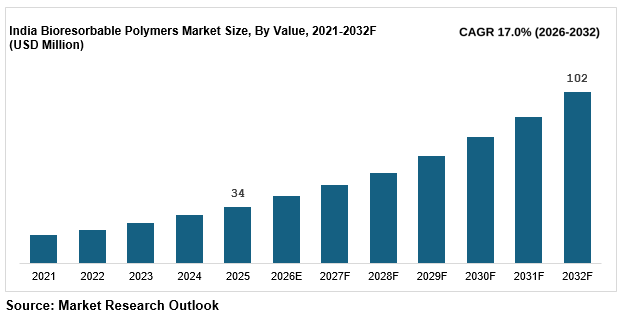
India’s bioresorbable polymers market is witnessing strong structural growth, driven by rising orthopedic trauma and cardiovascular procedure volumes, expanding absorbable suture and fixation device manufacturing, accelerating PLGA-based controlled release drug delivery research, growing hospital preference for implants that need no removal surgery, Production Linked Incentive support for domestic medical device manufacturing, and rising interest from global medical grade resin producers targeting India as a long-term absorbable device manufacturing base.
Report Description
| Study Duration | 2021-2032 |
| Market Size (2025) | USD 34 Million |
| CAGR (2026-2032) | 17.0% |
| Leading Segment | Polylactic Acid (PLA) for Surgical Sutures |
| Fastest Growing Segment | Poly(Lactic-co-Glycolic Acid) (PLGA) |
| Market Size (2032) | USD 102 Million |
Source:
Market Overview: India Bioresorbable Polymers Market
The India bioresorbable polymers market size is witnessing rapid expansion, driven by rising surgical procedure volumes, growing absorbable suture and orthopedic fixation manufacturing, accelerating pharmaceutical adoption of PLGA microspheres, expanding medical device clusters, and clinical preference for implants that resorb without secondary removal surgery. Valued at USD 34 million in 2025 and projected to reach USD 102 million by 2032, growing at a CAGR of 17.0%, the India bioresorbable polymers market growth is being fuelled by strong demand from medical device manufacturers, pharmaceutical formulators, and tertiary care hospitals across tier-1 and tier-2 cities. Polylactic acid leads consumption, while poly(lactic-co-glycolic acid) is emerging as the fastest growing polymer type. India consumed 30 metric tonnes of medical grade bioresorbable resin in 2025, of which 96% was imported at an average landed cost of USD 1,133 per kilogram. As domestic device makers including Healthium Medtech, Meril Life Sciences, and Sahajanand Medical Technologies scale absorbable device output, and global resin producers including Evonik Industries, Corbion, Mitsui Chemicals, and Poly-Med expand Indian distribution, the India bioresorbable polymers market is evolving into a specification-led, regulation-intensive, and import-linked market with strong long-term growth potential.
Related research: India Engineering Plastics Market, India CPVC Market and India Polyester Staple Fiber Market.
Key Report Takeaways: India Bioresorbable Polymers Market
- The India bioresorbable polymers market size is projected to grow from USD 34 million in 2025 to USD 102 million by 2032, registering a strong CAGR of 17.0%, driven by rising absorbable implant adoption, expanding domestic medical device manufacturing, and the structural shift away from permanent metallic fixation across Indian surgical practice.
- Polylactic acid dominates the India bioresorbable polymers market, accounting for 38% of total resin consumption in 2025, driven by its established regulatory history, favourable strength retention profile, and widespread use in absorbable sutures and orthopedic fixation devices manufactured across Gujarat, Maharashtra, and Karnataka.
- Poly(lactic-co-glycolic acid) is emerging as the fastest growing polymer type in the India bioresorbable polymers market, expected to grow at 20.4% annually as pharmaceutical formulators, depot injectable developers, and controlled release researchers reshape sourcing strategies across metro and tier-1 markets.
- Rapid scaling of domestic medical device manufacturing, supported by Production Linked Incentive allocations of INR 3,420 crore and four approved medical device parks, is structurally expanding the India bioresorbable polymers market across implant, drug delivery, and surgical consumable categories.
- Rising investments by Indian device makers such as Healthium Medtech, Meril Life Sciences, and Sahajanand Medical Technologies in absorbable suture lines, orthopedic fixation capacity, and vascular scaffold platforms are strengthening local conversion and supporting the India bioresorbable polymers market forecast 2032.
Key Market Drivers: India Bioresorbable Polymers Market
Rising Orthopedic Trauma, Cardiovascular, and Surgical Procedure Volumes Driving Bioresorbable Polymers Demand Across India
Growth in the India bioresorbable polymers market is being driven by rising surgical volumes, expanding orthopedic trauma caseloads, and growing cardiovascular intervention across tier-1, tier-2, and tier-3 cities. Surgical sutures and meshes absorbed 34% of Indian bioresorbable polymer consumption in 2025, while orthopedic fixation devices accounted for a further 23%, together representing 57% of national offtake. India consumed 30 metric tonnes of medical grade bioresorbable resin in 2025 against 16 metric tonnes in 2021, an average annual increase of 17.0%. Absorbable fixation removes the need for a second removal surgery, cutting hospital stay and follow-up cost in trauma and paediatric orthopedic cases. Per-capita absorbable implant consumption in India remains at 0.02 grams per year against a global average of 0.07 grams, indicating substantial long-term headroom. Ayushman Bharat procedure coverage, rising road trauma caseloads, and growing sports injury volumes are creating strong structural pull-through demand across the India bioresorbable polymers market.
PLI Scheme for Medical Devices and Medical Device Parks Accelerating Domestic Bioresorbable Implant Manufacturing
The India bioresorbable polymers market is benefiting from sustained policy support for domestic medical device manufacturing, with Production Linked Incentive allocations of INR 3,420 crore under the medical devices scheme and INR 400 crore committed under the Promotion of Medical Device Parks scheme covering four approved parks in Himachal Pradesh, Madhya Pradesh, Tamil Nadu, and Uttar Pradesh. Medical device manufacturers absorbed 58% of Indian bioresorbable polymer demand in 2025, the largest end-use share in the India bioresorbable polymers market. Domestic absorbable suture output has scaled rapidly, with Healthium Medtech supplying absorbable surgical sutures to more than 90 countries, while Meril Life Sciences and Sahajanand Medical Technologies have built absorbable fixation and vascular scaffold platforms at Vapi and Surat. CDSCO Medical Device Rules classification clarity, ISO 10993 biocompatibility conformity, and USP Class VI qualification have further strengthened organised supply, supporting competitiveness across the India bioresorbable polymers market.
Growing PLGA-Based Controlled Release Drug Delivery Research Strengthening Pharmaceutical Bioresorbable Polymers Adoption
Rapid growth in controlled release drug delivery is a major catalyst for the India bioresorbable polymers market, with the PLGA segment projected to grow at 20.4% annually through 2032. Drug delivery systems absorbed 19% of Indian bioresorbable polymer consumption in 2025, and pharmaceutical and biotechnology companies accounted for 24% of end-use demand. PLGA microspheres allow therapeutic release windows to be tuned between 6 and 24 months by varying the lactide to glycolide ratio, a property Indian formulators are applying to depot injectables in oncology, psychiatry, and hormone therapy. Powders and microspheres represent 14% of Indian bioresorbable polymer form demand, the third largest form category. Indian contract research and development organisations serving global innovators have expanded resorbable formulation capability, with the depot injectable pipeline alone representing an estimated USD 9 million addressable resin opportunity by 2032. Government biotechnology research funding combined with growing academic scaffold research is structurally expanding India bioresorbable polymers market growth across all major end-use categories through 2032.
Key Market Challenges: India Bioresorbable Polymers Market
Near Total Import Dependence on Medical Grade Bioresorbable Resin Raising Landed Cost and Lead Times
The India bioresorbable polymers market continues to face challenges around import dependence and landed cost, with 96% of medical grade bioresorbable resin requirement imported in 2025. India has no commercial-scale domestic producer of clinical grade PLA, PGA, or PLGA, so device makers source from Evonik Industries, Corbion, Mitsui Chemicals, Poly-Med, and Ashland through authorised distributors at an average landed cost of USD 1,133 per kilogram against USD 3 per kilogram for commodity engineering resin. Average lead time from purchase order to Indian delivery stands at 84 days, forcing device makers to carry inventory that ties up working capital and consumes shelf life. Currency movement and freight volatility feed directly into implant cost, and price cap regulation on cardiac stents limits the ability to pass this through. Absence of domestic lactide and glycolide chemistry remains the structural constraint across the India bioresorbable polymers market.
High Material Cost and Stringent Sterilisation Validation Limiting Adoption Across Price-Sensitive Indian Hospitals
The India bioresorbable polymers market faces structural complexity from material cost, sterilisation validation, and uneven clinical adoption across hospital tiers. While tertiary care centres in Delhi, Mumbai, Bengaluru, Chennai, and Hyderabad routinely use absorbable fixation, adoption in district and tier-3 hospitals remains limited by price. An absorbable orthopedic fixation set costs 3.4 times the equivalent stainless steel set in India, a gap that outweighs the avoided cost of removal surgery in the eyes of many procurement committees. Bioresorbable polymers cannot tolerate steam autoclaving, so device makers must validate ethylene oxide, gamma, or electron beam sterilisation, adding 14 months to product development timelines. Surgeon familiarity with absorbable fixation technique remains concentrated in metro teaching hospitals. While Ayushman Bharat has widened procedure access, cost sensitivity remains a near-term challenge for the India bioresorbable polymers market.
Limited Domestic Polymerisation, Purification, and Molecular Weight Control Capability Constraining Local Supply
The India bioresorbable polymers market faces practical constraints around domestic technical capability, quality control, and process consistency across the value chain. Ring opening polymerisation of lactide and glycolide demands monomer purity above 99.9% and tight control of residual tin catalyst, water content, and inherent viscosity, capability that Indian specialty chemical producers have not yet commercialised at clinical grade. Batch to batch variation of 5% in inherent viscosity shifts the in-vivo degradation window materially, so device makers requalify every incoming lot. Average gross margins for Indian absorbable device manufacturers stand at 41%, but resin accounts for 28% of finished device cost, leaving limited room for supplier switching. Domestic pilot-scale polymerisation initiatives, academic technology transfer, and contract manufacturing partnerships are emerging as solutions, but qualification timelines and regulatory revalidation remain barriers to widespread adoption across the India bioresorbable polymers market.
Key Market Trends: India Bioresorbable Polymers Market
Rapid Adoption of Tunable PLGA Copolymers, High-Purity PLLA, and Composite Bioresorbable Grades in India
The India bioresorbable polymers market is undergoing a clear technology shift toward tunable PLGA copolymers, high-purity PLLA, and composite bioresorbable grades, with these advanced materials expected to capture 34% of Indian bioresorbable polymer consumption by 2030 against 22% in 2025. High-purity PLLA delivers strength retention above 70% at 12 weeks, compared with 40% for standard PLGA grades, making it the preferred choice for load-bearing orthopedic fixation. PLA-PEG copolymers combine hydrophobic polylactide behaviour with hydrophilic polyethylene glycol segments for implantable device applications. Leading global producers including Evonik Industries, Corbion, Mitsui Chemicals, Poly-Med, and Zeus have expanded bioresorbable portfolios covering copolymers, oriented tubing, and monofilament fibre through 2024 and 2025. Composite grades reinforced with beta-tricalcium phosphate and hydroxyapatite are also gaining traction in Indian spine and craniomaxillofacial procedures, where osteoconductivity matters. This material transition is reinforcing the India bioresorbable polymers market forecast 2032 across both implant and drug delivery categories.
Growth of Contract Manufacturing, Authorised Distribution, and Regulatory-Ready Supply in the India Bioresorbable Polymers Market
A clear shift toward structured sourcing and contract manufacturing is reshaping the India bioresorbable polymers market, particularly among mid-sized device makers and pharmaceutical formulators. Direct sales from resin producers to device manufacturers accounted for 41% of Indian bioresorbable polymer volume in 2025, imports through authorised distributors for 27%, and contract supply agreements for 15%, with the balance moving through contract manufacturing organisations, research supply, and digital B2B platforms. Authorised distributors holding temperature-controlled stock in Mumbai, Ahmedabad, and Bengaluru have cut effective lead times for repeat grades to 32 days from 84 days on direct import. Drug master file support, certificates of analysis, and change notification commitments now form part of 76% of Indian supply agreements, reflecting the regulatory weight buyers place on resin traceability. Contract manufacturing organisations represent 11% of volume and are growing as global innovators shift absorbable device and depot injectable production to India across the India bioresorbable polymers market.
Capacity Expansion by Domestic Device Manufacturers and Absorbable Implant Platform Investments
A wave of domestic capacity expansion and absorbable implant platform investment is reshaping the India bioresorbable polymers market supply landscape. Combined India-focused capital expenditure announcements across absorbable sutures, orthopedic fixation, and vascular scaffold capacity exceeded USD 240 million between 2023 and 2025. Healthium Medtech expanded absorbable suture manufacturing serving more than 90 export markets, Meril Life Sciences scaled absorbable fixation and vascular platforms at its Vapi campus, Sahajanand Medical Technologies advanced its MeRes100 bioresorbable vascular scaffold programme at Surat, and contract manufacturers added ethylene oxide and gamma sterilisation capacity in Gujarat and Karnataka. Production Linked Incentive allocations of INR 3,420 crore for medical devices, four approved medical device parks, and CDSCO regulatory clarity have structurally favoured organised domestic supply. Combined with rising absorbable implant adoption in tertiary care and pharmaceutical depot injectable scaling, these developments are reinforcing the India bioresorbable polymers market forecast 2032 across the entire value chain.
Segmental Insights: India Bioresorbable Polymers Market
By End-Use Industry: Medical Device Manufacturers Segment Dominates the India Bioresorbable Polymers Market
The medical device manufacturers end-use segment dominates the India bioresorbable polymers market, accounting for 58% of total resin consumption in 2025, driven by expanding absorbable suture output, growing orthopedic fixation capacity, and improving export competitiveness across Gujarat, Maharashtra, and Karnataka. Fibres and filaments are the dominant form within this segment, with monofilament and multifilament grades capturing 38% of total Indian bioresorbable polymer form demand. Pharmaceutical and biotechnology companies contribute another 24% of demand, driven by PLGA microsphere formulation for depot injectables in oncology, psychiatry, and hormone therapy. Hospitals and ambulatory surgical centres account for 13%, led by direct procurement of absorbable fixation sets and meshes, while research institutes and academia represent 5%, supported by tissue engineering and scaffold research. In 2025, leading suppliers including Evonik Industries, Corbion, Mitsui Chemicals, Poly-Med, and Ashland scaled deliveries into Indian device and pharmaceutical accounts, reinforcing segment dominance in the India bioresorbable polymers market.
By Polymer Type: PLA Leads While PLGA and PCL Grow Fastest
Polylactic acid leads the India bioresorbable polymers market product landscape, accounting for 38% of total resin volume in 2025, driven by its established regulatory history, superior strength retention, deep supplier base, and improving cost economics. Poly(lactic-co-glycolic acid) contributes another 27%, primarily across drug delivery and soft tissue fixation. PLGA and polycaprolactone are the fastest growing polymer types within the India bioresorbable polymers market, expanding at 20.4% and 18.6% annually, driven by tunable degradation windows between 6 and 24 months, superior formulation flexibility, and growing adoption in depot injectable and scaffold applications. Polyglycolic acid accounts for 14% of the market, polycaprolactone for 11%, and polydioxanone for 7%, with other chemistries including polyhydroxyalkanoates and collagen representing the remaining 3%. Leading global producers including Evonik Industries, Corbion, Mitsui Chemicals, Poly-Med, and Foster Corporation have aligned grade portfolios to this product mix, driving specification-led adoption across the India bioresorbable polymers market.
Regional Insights: India Bioresorbable Polymers Market
Regional analysis of the India bioresorbable polymers market shows that West India and South India collectively account for 64% of total resin consumption, driven by Gujarat (Vapi and Surat medical device belt), Maharashtra (Mumbai and Pune pharmaceutical and device clusters), Karnataka (Bengaluru suture and device manufacturing base), Tamil Nadu (Chennai medical device park corridor), and Telangana (Hyderabad pharmaceutical formulation hub), supported by established regulatory infrastructure and strong export orientation. West India alone contributes 36% of demand and South India 28%, reflecting the concentration of absorbable device manufacturing capacity. North India contributes 21% of demand, led by Delhi NCR, Haryana, Punjab, and Himachal Pradesh, supported by hospital procurement and the Himachal Pradesh medical device park. East and Central India together account for 15% of demand, supported by West Bengal, Odisha, and Madhya Pradesh, where tertiary care capacity and medical device park development are accelerating. In 2025, capacity additions by Healthium Medtech across Karnataka, Meril Life Sciences across Gujarat, and Sahajanand Medical Technologies across Gujarat reinforced regional supply hubs, supporting closer execution of absorbable device projects across the India bioresorbable polymers market.
Recent Developments: India Bioresorbable Polymers Market
- The India bioresorbable polymers market witnessed strong momentum in device launches and capacity progress during 2024 and 2025. Indian consumption of medical grade bioresorbable resin reached 30 metric tonnes in 2025 against 26 metric tonnes in 2024, an increase of 15.4%. Imports supplied 96% of national requirement, principally from Germany, the Netherlands, Japan, and the United States. Absorbable suture output accounted for 34% of Indian bioresorbable polymer consumption, with cumulative Indian absorbable device output projected to reach 44 metric tonnes of resin equivalent by FY28 against 30 metric tonnes in FY25.
- Domestic device manufacturers have deepened India-focused capacity expansion. In 2025, Healthium Medtech expanded absorbable surgical suture manufacturing serving more than 90 export markets, Meril Life Sciences scaled absorbable fixation and vascular scaffold capacity at its Vapi campus, Sahajanand Medical Technologies advanced its MeRes100 bioresorbable vascular scaffold programme at Surat, and contract manufacturers added ethylene oxide and gamma sterilisation lines in Gujarat and Karnataka. These developments are strengthening domestic conversion capability and supporting the India bioresorbable polymers market forecast 2032.
- Global resin supply momentum has gained strong traction in the India bioresorbable polymers market. Leading producers including Evonik Industries, Corbion, Mitsui Chemicals, Poly-Med, Ashland, Zeus, and Foster Corporation expanded bioresorbable grade portfolios covering PLGA copolymers, oriented tubing, and monofilament fibre, and widened authorised distribution into India. Strategic partnerships between global resin producers and Indian device makers are positioning India as one of the fastest scaling absorbable device manufacturing bases globally, strengthening long-term competitive positioning in the India bioresorbable polymers market forecast 2032.
Key Market Players: India Bioresorbable Polymers Market
- Evonik Industries AG (RESOMER)
- Corbion N.V. (Purasorb)
- Ashland Inc.
- Mitsui Chemicals Inc.
- Poly-Med Inc.
- Foster Corporation
- Zeus Company Inc.
- Merck KGaA
- KLS Martin Group
- Bezwada Biomedical LLC
- Healthium Medtech Limited
- Meril Life Sciences Pvt. Ltd.
- Sahajanand Medical Technologies Limited
Report Scope
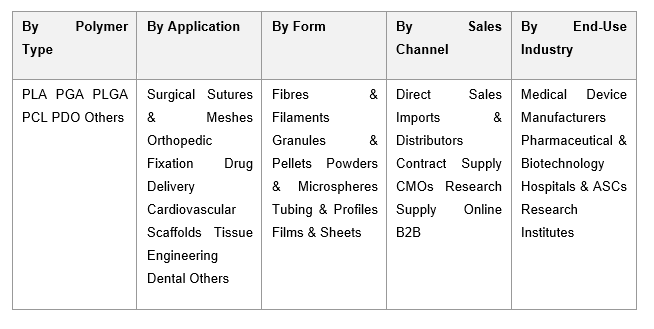
In this report, the India Bioresorbable Polymers Market has been segmented into the following categories, in addition to detailed analysis of key industry trends, market dynamics, competitive landscape, and growth opportunities across the forecast period:
- By Polymer Type
- Polylactic Acid (PLA, PLLA, PDLLA)
- Polyglycolic Acid (PGA)
- Poly(Lactic-co-Glycolic Acid) (PLGA)
- Polycaprolactone (PCL)
- Polydioxanone (PDO)
- Others (PHA, Polyanhydrides, Collagen)
- By Application
- Surgical Sutures & Meshes
- Orthopedic Fixation Devices
- Drug Delivery Systems
- Cardiovascular Stents & Scaffolds
- Tissue Engineering Scaffolds
- Dental & Maxillofacial Implants
- Others (Wound Care, Ophthalmic)
- By Form
- Fibres & Filaments
- Granules & Resin Pellets
- Powders & Microspheres
- Tubing & Extruded Profiles
- Films & Sheets
- By Sales Channel
- Direct Sales (Resin Producer to Device Maker)
- Imports & Authorised Distributors
- Contract Supply Agreements
- Contract Manufacturing Organisations
- Research & Academic Supply
- Online & B2B Platforms
- By End-Use Industry
- Medical Device Manufacturers
- Pharmaceutical & Biotechnology Companies
- Hospitals & Ambulatory Surgical Centres
- Research Institutes & Academia
- By Geography
- North India
- South India
- West India
- East India
- Central India
Competitive Landscape
Company Profiles:
Detailed analysis of the leading companies operating in the India Bioresorbable Polymers Market, including business overview, product portfolio, strategic initiatives, competitive positioning, and recent developments.
Company Information
Detailed profiling and strategic analysis of additional market players (up to five companies), including emerging absorbable device manufacturers, specialty resin importers and distributors, contract manufacturing organisations, or niche tissue engineering scaffold developers.
For a free sample of the India Bioresorbable Polymers Market report, customised insights or delivery timelines, submit your query here
Table of Contents
- Research Framework
- Market Segmentation
- Research Objective
- Research Methodology
- Qualitative Research
- Primary Research
- Secondary Research
- Quantitative Research
- Market Breakdown & Data Triangulation
- Demand Side
- Supply Side
- Primary Research Respondents
- Assumption & Limitation
- Executive Summary
- Market Overview, 2021-2032
- By Polymer Type
- By Application
- By Form
- By Sales Channel
- By End-Use Industry
- By Region
- Analyst Recommendations
- Geopolitical Impact on India Bioresorbable Polymers Market
- India Bioresorbable Polymers Market Insights
- Market Dynamics
- Growth Drivers
- Rising orthopedic trauma, cardiovascular, and surgical procedure volumes driving bioresorbable polymers demand across India.
- PLI scheme for medical devices and medical device parks accelerating domestic bioresorbable implant manufacturing.
- Growing PLGA-based controlled release drug delivery research strengthening pharmaceutical bioresorbable polymers adoption.
- Restraints
- Near total import dependence on medical grade bioresorbable resin raising landed cost and lead times.
- High material cost and stringent sterilisation validation limiting adoption across price-sensitive Indian hospitals.
- Limited domestic polymerisation, purification, and molecular weight control capability constraining local supply.
- Opportunities
- Domestic medical grade PLA and PLGA polymerisation capacity opening import substitution potential across India.
- Absorbable suture and orthopedic fixation exports positioning India as a global bioresorbable device supply base.
- Tissue engineering, 3D printed scaffolds, and regenerative medicine research creating next generation demand pools.
- Challenges
- Complex CDSCO and USFDA regulatory pathways lengthening approval timelines for bioresorbable implant devices.
- Cold chain storage, moisture sensitivity, and short resin shelf life complicating bioresorbable polymers handling.
- Maintaining batch to batch molecular weight and degradation profile consistency across clinical grade production.
- Technological Advancements
- Recent Technological Advancements
- Prior to 2020
- Porter’s Five Forces Analysis
- PESTLE Analysis
- Industry Value Chain & Entry Points
- Upstream Feedstock (lactic acid, glycolic acid, caprolactone, dioxanone, corn and sugarcane derived monomers)
- Monomer & Lactide Producers (lactide, glycolide, ring opening polymerisation precursors)
- Medical Grade Resin Producers (Evonik, Corbion, Mitsui Chemicals, Poly-Med, Ashland)
- Importers, Authorised Distributors & Bonded Warehousing (India distribution and cold storage)
- Quality Control, R&D & Testing Laboratories (USP Class VI, ISO 10993, CDSCO conformity)
- Compounders, Extruders & Fibre Spinners (tubing, monofilament, and multifilament processing)
- Medical Device Manufacturers (Healthium Medtech, Meril Life Sciences, Sahajanand Medical Technologies)
- Pharmaceutical & Drug Delivery Formulators (PLGA microspheres and depot injectable systems)
- Contract Manufacturing Organisations & Sterilisation Providers (ethylene oxide, gamma, e-beam)
- End-Users (hospitals, orthopedic and cardiac centres, ambulatory surgical centres, research institutes)
- India Bioresorbable Polymers Market: Regulatory Framework
- India Bioresorbable Polymers Market Overview
- Market Size & Forecast, 2021-2032
- By Value (USD Million)
- By Volume (Metric Tonnes)
- Market Share & Forecast
- By Polymer Type
- Polylactic Acid (PLA, PLLA, PDLLA)
- Polyglycolic Acid (PGA)
- Poly(Lactic-co-Glycolic Acid) (PLGA)
- Polycaprolactone (PCL)
- Polydioxanone (PDO)
- Others (PHA, Polyanhydrides, Collagen)
- By Application
- Surgical Sutures & Meshes
- Orthopedic Fixation Devices
- Drug Delivery Systems
- Cardiovascular Stents & Scaffolds
- Tissue Engineering Scaffolds
- Dental & Maxillofacial Implants
- Others (Wound Care, Ophthalmic)
- By Form
- Fibres & Filaments
- Granules & Resin Pellets
- Powders & Microspheres
- Tubing & Extruded Profiles
- Films & Sheets
- By Sales Channel
- Direct Sales (Resin Producer to Device Maker)
- Imports & Authorised Distributors
- Contract Supply Agreements
- Contract Manufacturing Organisations
- Research & Academic Supply
- Online & B2B Platforms
- By End-Use Industry
- Medical Device Manufacturers
- Pharmaceutical & Biotechnology Companies
- Hospitals & Ambulatory Surgical Centres
- Research Institutes & Academia
- By Geography
- North India
- South India
- West India
- East India
- Central India
- Competitive Landscape
- India Bioresorbable Polymers Market Company Market Share Analysis, 2025
- Competitive Benchmarking, By Operating Parameters
- Key Strategic Development (Mergers, Acquisitions, Partnerships, Etc.)
- List of Emerging Players
- Company Profile
- Evonik Industries AG (RESOMER)
- Introduction & Company Profile
- Product Benchmarking
- Strategic Outlook
- Key Competitors
- Financial Analysis
- SWOT Analysis
(Same Data Pointers Will Be Provided for The Below Companies)
- Corbion N.V. (Purasorb)
- Ashland Inc.
- Mitsui Chemicals Inc.
- Poly-Med Inc.
- Foster Corporation
- Zeus Company Inc.
- Merck KGaA
- KLS Martin Group
- Bezwada Biomedical LLC
- Healthium Medtech Limited
- Meril Life Sciences Pvt. Ltd.
- Sahajanand Medical Technologies Limited
- Other Prominent Players
* Financial information in case of non-listed companies will be provided as per availability
** The segmentation and the companies are subjected to modifications based on in-depth secondary for the final deliverable
Frequently Asked Questions
1. How large is the India bioresorbable polymers market and what is its growth forecast?
Ans: The India bioresorbable polymers market is valued at USD 34 million in 2025 and is projected to reach USD 102 million by 2032, growing at a CAGR of 17.0%.
2. Which polymer types are driving demand in the India bioresorbable polymers market?
Ans: Polylactic acid leads with 38% share, while poly(lactic-co-glycolic acid) grows fastest at 20.4% annually, driven by depot injectable and controlled release drug delivery demand.
3. What are the key drivers of growth in the India bioresorbable polymers market?
Ans: Key drivers include rising orthopedic and cardiovascular procedure volumes, PLI-backed domestic medical device manufacturing, and growing PLGA-based controlled release drug delivery research.
4. Which regions are driving growth in the India bioresorbable polymers market?
Ans: West India and South India lead with 64% of consumption, driven by Gujarat, Maharashtra, Karnataka, Tamil Nadu, and Telangana. North India contributes 21% of national demand.
5. What are the latest trends in the India bioresorbable polymers market?
Ans: Latest trends include tunable PLGA copolymer adoption, high-purity PLLA for load-bearing fixation, composite bioresorbable grades, contract manufacturing growth, and regulatory-ready authorised distribution.