

India Caprolactam Market Size, Share & Demand Outlook 2032
- Chemicals & Advanced Materials, Petrochemicals & Intermediates
- Jul 2026
- Pages 140
- Report Format: pdf
- Report Price: $2400 USD
India’s caprolactam market is witnessing steady structural growth, driven by expanding nylon 6 fibre and filament yarn demand, rising tyre cord fabric consumption, accelerating engineering plastics adoption across automotive and electrical applications, growing technical textile output, sustained import substitution supported by anti-dumping protection, capacity debottlenecking at domestic caprolactam plants, and rising interest from global caprolactam producers targeting India as a long-term polyamide demand centre.
Report Description
| Study Duration | 2021-2032 |
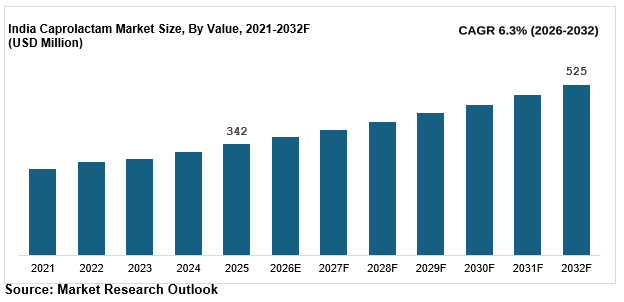
| Market Size (2025) | USD 342 Million |
| CAGR (2026-2032) | 6.3% |
| Leading Segment | Nylon 6 Fibre & Filament Yarn (Polymer Grade) |
| Fastest Growing Segment | Nylon 6 Resin & Engineering Plastics |
| Market Size (2032) | USD 525 Million |
Source:
Market Overview: India Caprolactam Market
The India caprolactam market size is witnessing steady expansion, driven by rising nylon 6 fibre consumption, growing tyre cord fabric output, accelerating engineering plastics demand, expanding technical textile capacity, and sustained import substitution across the domestic polyamide chain. Valued at USD 342 million in 2025 and projected to reach USD 525 million by 2032, growing at a CAGR of 6.3%, the India caprolactam market growth is being fuelled by firm offtake from textile, automotive, and electrical end-use industries, alongside improved domestic price realisation supported by anti-dumping duties on imports from the European Union, South Korea, Russia, and Thailand. Nylon 6 fibre and filament yarn leads caprolactam consumption, while nylon 6 resin and engineering plastics is emerging as the fastest growing application. India consumed 152 thousand tonnes of caprolactam in 2025 against installed domestic capacity of 120 thousand tonnes per annum, leaving an import gap of 62 thousand tonnes. As Gujarat State Fertilizers & Chemicals Limited and Fertilisers and Chemicals Travancore Limited raise plant reliability and downstream integration, and global suppliers including BASF, Domo Chemicals, Grupa Azoty, UBE Corporation, and Highsun Group compete for Indian offtake, the India caprolactam market is evolving into a supply-constrained, specification-led, and trade-sensitive market with durable long-term growth potential.
Related research: India Polyester Staple Fiber Market, India Bioresorbable Polymers Market and India High-Performance Polymers Market.
Key Report Takeaways: India Caprolactam Market
- The India caprolactam market size is projected to grow from USD 342 million in 2025 to USD 525 million by 2032, registering a CAGR of 6.3%, driven by rising nylon 6 fibre demand, expanding tyre cord fabric output, and the structural shift toward domestically produced caprolactam across Indian polyamide value chains.
- Nylon 6 fibre and filament yarn dominates the India caprolactam market, accounting for 44% of total caprolactam consumption in 2025, driven by sustained demand from textile mills, apparel and saree yarn producers, industrial fabric converters, and the concentration of nylon 6 chip capacity across Gujarat, Maharashtra, and Tamil Nadu.
- Nylon 6 resin and engineering plastics is emerging as the fastest growing application in the India caprolactam market, expected to grow at 8.4% annually as automotive lightweighting, electric vehicle component localisation, and electrical insulation demand reshape caprolactam offtake across Indian industrial clusters.
- Domestic caprolactam capacity of 120 thousand tonnes per annum, split across Gujarat State Fertilizers & Chemicals Limited at 70 thousand tonnes and Fertilisers and Chemicals Travancore Limited at 50 thousand tonnes, met 59% of Indian demand in 2025, structurally expanding the India caprolactam market opportunity for import substitution.
- Rising investment by Indian producers in plant reliability, effluent treatment, ammonium sulphate by-product handling, and nylon 6 chip integration is strengthening local supply and supporting the India caprolactam market forecast 2032.
Key Market Drivers: India Caprolactam Market
Expanding Nylon 6 Fibre, Tyre Cord Fabric, and Technical Textile Demand Driving Caprolactam Consumption Across India
Growth in the India caprolactam market is being driven by expanding nylon 6 fibre production, rising tyre cord fabric output, and accelerating technical textile capacity across Gujarat, Maharashtra, Tamil Nadu, and Punjab. Nylon 6 fibre and filament yarn absorbed 44% of Indian caprolactam consumption in 2025, while tyre cord fabric accounted for a further 19%, together representing 63% of national offtake. India consumed 152 thousand tonnes of caprolactam in 2025 against 118 thousand tonnes in 2021, an average annual increase of 6.5%. Nylon 6 tyre cord fabric remains the preferred reinforcement for bias truck, bus, and two-wheeler tyres, segments where Indian output continues to expand. Per-capita polyamide consumption in India stands at 0.4 kg per year against a global average of 1.1 kg, indicating substantial long-term headroom. Production Linked Incentive support for textiles and national technical textile targets are creating strong structural pull-through demand across the India caprolactam market.
Rising Automotive Production and Lightweighting Shifting Engineering Plastics Demand Toward Nylon 6 Resin Grades
The India caprolactam market is benefiting from sustained growth in vehicle production, which reached 28 million units in 2023-24 against 2 million units in 1991-92, alongside accelerating polymer substitution of metal components. Nylon 6 resin and engineering plastics absorbed 17% of Indian caprolactam consumption in 2025 and is growing at 8.4% annually, the fastest of any application in the India caprolactam market. Each passenger vehicle produced in India now carries 9 kg of polyamide content on average, spread across air intake manifolds, radiator end tanks, cooling fans, connectors, and cable ties, against 6 kg a decade earlier. Electric vehicle platforms lift this further through battery housings, busbar insulation, and high-voltage connectors that require glass-filled nylon 6 grades. Automotive and tyre applications together represent 29% of Indian caprolactam end-use demand, second only to textiles, and are expanding faster than the market average, supporting resin grade realisation across the India caprolactam market.
Import Substitution, Anti-Dumping Protection, and Domestic Capacity Debottlenecking Strengthening India Caprolactam Supply
Import substitution is a major catalyst for the India caprolactam market, with domestic output meeting 59% of national demand in 2025 against 53% in 2021. India imported 62 thousand tonnes of caprolactam in 2025, principally from South Korea, Russia, Thailand, Belgium, and Taiwan, at an average landed cost of USD 2,010 per tonne. The Directorate General of Trade Remedies has recommended anti-dumping duties on caprolactam originating in the European Union, South Korea, Russia, and Thailand, improving realisation for Indian producers and narrowing the gap between domestic and imported material. Gujarat State Fertilizers & Chemicals Limited operates two caprolactam plants at Vadodara with rated capacities of 20 thousand tonnes and 50 thousand tonnes per annum, alongside a 25 thousand tonne nylon 6 chip unit, while Fertilisers and Chemicals Travancore Limited operates a 50 thousand tonne caprolactam plant at Udyogamandal in Kerala. Domestic capacity utilisation improved to 75% in 2025 from 52% in 2021, structurally expanding India caprolactam market growth across all major end-use categories through 2032.
Key Market Challenges: India Caprolactam Market
Heavy Import Dependence and Volatile Benzene Feedstock Prices Compressing Domestic Caprolactam Margins
The India caprolactam market continues to face challenges around import dependence and feedstock volatility, with 41% of national caprolactam demand met through imports in 2025. Benzene, the principal feedstock, accounts for 42% of caprolactam cash cost, and Indian benzene prices averaged USD 935 per tonne between 2022 and 2025 with peak-to-trough movement of 44%. Each tonne of caprolactam consumes 1.15 tonnes of benzene alongside ammonia, oleum, and sulphur, leaving Indian producers exposed to crude-linked aromatics cycles they cannot fully pass through. Domestic caprolactam prices track the CFR Far East Asia benchmark closely, so periods of Chinese oversupply compress Indian realisation regardless of local demand strength. Limited domestic benzene availability and the absence of a fully integrated aromatics-to-caprolactam complex continue to constrain cost competitiveness across the India caprolactam market.
Ammonium Sulphate By-Product Load and Environmental Compliance Costs Weighing on Indian Caprolactam Producers
The India caprolactam market faces structural complexity from by-product handling, effluent load, and tightening environmental compliance. Conventional oleum-based Beckmann rearrangement generates 4.0 tonnes of ammonium sulphate for every tonne of caprolactam produced, a low-value fertiliser co-product whose realisation moves with the Indian subsidy cycle. Modern hydroxylamine phosphate oxime routes cut this ratio to 1.8 tonnes, but retrofitting Indian plants requires capital that competes with core capacity spend. Effluent treatment, sulphur dioxide abatement, and Central Pollution Control Board consent conditions add USD 74 per tonne to Indian caprolactam conversion cost. Unplanned shutdowns linked to ageing equipment have historically removed capacity from the market, as seen when the Udyogamandal caprolactam plant remained offline for more than six months, tightening domestic availability. These pressures remain a near-term constraint for the India caprolactam market.
Substitution by Polyester Tyre Cord and Nylon 66 Limiting Caprolactam Consumption Growth in Select Applications
The India caprolactam market faces practical constraints from material substitution across its two largest applications. Polyester tyre cord fabric has displaced nylon 6 in radial passenger car tyres, where dimensional stability matters more than impact resistance, and radialisation of the Indian truck and bus tyre fleet reached 58% in 2025 against 42% in 2021. Nylon 66 competes directly in under-the-hood automotive parts and electrical connectors that require higher heat resistance, capping nylon 6 resin penetration in premium grades. Recycled polyamide from post-industrial waste is also entering Indian carpet and apparel yarn supply, meeting 4% of nylon 6 fibre feedstock in 2025. Average gross margins for Indian caprolactam producers stood at 14% in 2025, leaving limited room to defend share through price. Differentiation through polymer grade purity, colour consistency, and delivery reliability remains the principal defence across the India caprolactam market.
Key Market Trends: India Caprolactam Market
Rapid Shift Toward Polymer Grade, Low-Sulphate, and Recycled Caprolactam in India
The India caprolactam market is undergoing a clear technology shift toward polymer grade, low-sulphate, and recycled caprolactam, with these advanced grades expected to account for 21% of Indian caprolactam consumption by 2030 against 13% in 2025. Polymer grade caprolactam delivers a permanganate absorption number below 3 and a volatile base content under 0.5 milliequivalents per kilogram, specifications that Indian fibre spinners now require for fine denier filament yarn. Chemical depolymerisation of post-consumer nylon 6 carpet and fishing net waste is scaling globally through Aquafil, Domo Chemicals, and BASF, and Indian textile exporters serving European brands increasingly specify recycled content to meet buyer sustainability mandates. Bio-based caprolactam derived from lysine and adipic acid routes remains pre-commercial in India but is drawing evaluation from downstream converters. This grade transition is reinforcing the India caprolactam market forecast 2032 across both fibre and resin categories.
Growth of Direct Producer Contracts, Import Trading Houses, and Digital B2B Distribution in the India Caprolactam Market
A clear shift toward structured procurement is reshaping the India caprolactam market, particularly among mid-sized nylon 6 converters. Direct sales from producers to converters accounted for 47% of Indian caprolactam volume in 2025, captive consumption for 21%, and import trading houses for 18%, with the balance moving through distributors, contract supply agreements, and digital B2B platforms. Annual contract pricing linked to the CFR Far East Asia benchmark now covers 62% of Indian caprolactam volume, replacing the spot purchase pattern that dominated before 2021. Import trading houses holding bonded stock at Mundra, Nhava Sheva, and Chennai have cut average lead times for imported caprolactam to 21 days from 38 days in 2021. Digital B2B chemical platforms remain a small channel at 1% of volume but are lowering search and comparison costs for smaller converters buying caprolactam in flake form across the India caprolactam market.
Capacity Debottlenecking by Domestic Producers and Downstream Nylon 6 Integration Investments
A wave of debottlenecking and downstream integration is reshaping the India caprolactam market supply position. Combined India-focused capital expenditure announced across caprolactam, nylon 6 chip, and tyre cord fabric capacity reached USD 410 million between 2023 and 2025. Gujarat State Fertilizers & Chemicals Limited raised caprolactam plant availability at Vadodara and continues to route material into its 25 thousand tonne Gujlon nylon 6 chip line, while Fertilisers and Chemicals Travancore Limited restored operations at its 50 thousand tonne Udyogamandal unit. Indian tyre cord fabric producers have added nylon 6 dipping and twisting capacity in Gujarat and Maharashtra, and engineering plastics compounders have expanded glass-filled nylon 6 lines serving automotive tier-one suppliers. Production Linked Incentive allocations for textiles of INR 10,683 crore, alongside anti-dumping protection on imported caprolactam, have structurally favoured domestic supply, reinforcing the India caprolactam market forecast 2032 across the entire value chain.
Segmental Insights: India Caprolactam Market
By End-Use Industry: Textile & Apparel Segment Dominates the India Caprolactam Market
The textile and apparel end-use industry dominates the India caprolactam market, accounting for 46% of total caprolactam consumption in 2025, driven by nylon 6 filament yarn demand from saree and dress material weaving, sportswear, hosiery, and industrial fabric converters concentrated in Surat, Bhiwandi, Tiruppur, and Ludhiana. Polymer grade caprolactam is the dominant input within this segment, with liquid deliveries capturing 71% of textile-linked purchases. The automotive and tyre industry contributes a further 29% of demand, driven by nylon 6 tyre cord fabric for bias and cross-ply tyres and by glass-filled nylon 6 components for engine bay and electrical applications. Electrical and electronics accounts for 14%, led by connectors, circuit breaker housings, and cable ties, while packaging and industrial applications represent 11%, supported by multilayer nylon 6 barrier films for food packaging. In 2025, leading suppliers including Gujarat State Fertilizers & Chemicals Limited, Fertilisers and Chemicals Travancore Limited, BASF, Domo Chemicals, and UBE Corporation scaled deliveries into textile and automotive accounts, reinforcing segment dominance in the India caprolactam market.
By Application: Nylon 6 Fibre Leads While Resin and Engineering Plastics Grow Fastest
Nylon 6 fibre and filament yarn leads the India caprolactam market application mix, accounting for 44% of total caprolactam volume in 2025, driven by established spinning capacity, favourable cost economics against imported yarn, and steady replacement demand across apparel and home textiles. Tyre cord fabric contributes a further 19%, concentrated in bias truck, bus, and two-wheeler tyre production. Nylon 6 resin and engineering plastics is the fastest growing application within the India caprolactam market, expanding at 8.4% annually, driven by automotive lightweighting, electric vehicle component localisation, and mechanical performance at 78 megapascals of tensile strength. Industrial yarn and ropes account for 9%, nylon 6 films for 6%, and monomer casting nylon for 3%, with the remaining 2% spread across specialty uses. Leading suppliers including Gujarat State Fertilizers & Chemicals Limited, Fertilisers and Chemicals Travancore Limited, Grupa Azoty, Highsun Group, and AdvanSix have aligned grade portfolios to this application mix, driving polymer grade caprolactam adoption across the India caprolactam market.
Regional Insights: India Caprolactam Market
Regional analysis of the India caprolactam market shows that West India and South India collectively account for 61% of total caprolactam consumption, driven by Gujarat (Vadodara production base and Surat textile belt), Maharashtra (Mumbai, Pune, and Bhiwandi industrial clusters), Tamil Nadu (Chennai automotive and Coimbatore textile corridors), and Kerala (Udyogamandal production base), supported by port access at Mundra, Nhava Sheva, and Chennai. West India alone contributes 34% of demand and South India 27%, reflecting the concentration of both domestic caprolactam capacity and downstream nylon 6 conversion. North India contributes 22% of demand, led by Punjab, Haryana, Uttar Pradesh, and Delhi NCR, supported by hosiery, industrial yarn, and automotive component clusters around Ludhiana, Panipat, Gurugram, and Noida. East and Central India together account for 17% of demand, supported by West Bengal, Odisha, and Madhya Pradesh, where technical textile and engineering plastics conversion is expanding. In 2025, plant availability improvements by Gujarat State Fertilizers & Chemicals Limited across Gujarat and by Fertilisers and Chemicals Travancore Limited across Kerala reinforced regional supply hubs, supporting closer execution of downstream conversion projects across the India caprolactam market.
Recent Developments: India Caprolactam Market
- The India caprolactam market recorded steady momentum in supply and demand alignment during 2024 and 2025. Indian caprolactam consumption reached 152 thousand tonnes in 2025 against 141 thousand tonnes in 2024, an increase of 7.8%, while domestic caprolactam production rose to 90 thousand tonnes from 83 thousand tonnes. Caprolactam imports stood at 62 thousand tonnes in 2025, equivalent to 41% of national demand, with South Korea, Russia, and Thailand supplying the majority of arrivals. Cumulative Indian nylon 6 chip output is projected to reach 168 thousand tonnes by FY28 against 132 thousand tonnes in FY25.
- Domestic producers have deepened India-focused reliability and integration programmes. In 2025, Gujarat State Fertilizers & Chemicals Limited sustained caprolactam output across its 20 thousand tonne and 50 thousand tonne Vadodara plants while feeding its 25 thousand tonne Gujlon nylon 6 chip line, and Fertilisers and Chemicals Travancore Limited maintained operations at its 50 thousand tonne Udyogamandal plant after earlier technical outages. Combined national caprolactam capacity held at 120 thousand tonnes per annum, with utilisation improving to 75%. These developments are strengthening domestic supply and supporting the India caprolactam market forecast 2032.
- Trade policy momentum has gained strong traction in the India caprolactam market. The Directorate General of Trade Remedies has recommended anti-dumping duties on caprolactam originating in or exported from the European Union, South Korea, Russia, and Thailand, following an application filed by Gujarat State Fertilizers & Chemicals Limited. Global producers including BASF, Domo Chemicals, Grupa Azoty, UBE Corporation, Highsun Group, and AdvanSix continue to target Indian offtake through trading houses and direct contracts, positioning India as one of the largest structurally import-linked caprolactam markets in Asia and strengthening long-term competitive positioning in the India caprolactam market forecast 2032.
Key Market Players: India Caprolactam Market
- Gujarat State Fertilizers & Chemicals Limited (GSFC)
- Fertilisers and Chemicals Travancore Limited (FACT)
- BASF SE
- AdvanSix Inc.
- Domo Chemicals
- Grupa Azoty S.A.
- UBE Corporation
- Sumitomo Chemical Co. Ltd.
- Highsun Group
- China Petrochemical Corporation (Sinopec)
- LANXESS AG
- Aquafil S.p.A.
- KuibyshevAzot PJSC
Report Scope
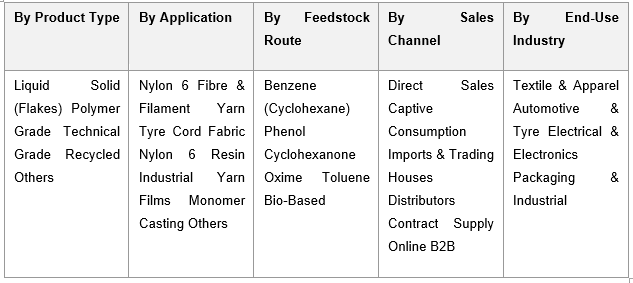
In this report, the India Caprolactam Market has been segmented into the following categories, in addition to detailed analysis of key industry trends, market dynamics, competitive landscape, and growth opportunities across the forecast period:
- By Product Type
- Liquid Caprolactam
- Solid Caprolactam (Flakes)
- Polymer Grade Caprolactam
- Technical Grade Caprolactam
- Recycled Caprolactam
- Others
- By Application
- Nylon 6 Fibre & Filament Yarn
- Tyre Cord Fabric
- Nylon 6 Resin & Engineering Plastics
- Industrial Yarn & Ropes
- Nylon 6 Films
- Monomer Casting Nylon
- Others
- By Feedstock Route
- Benzene (Cyclohexane Route)
- Phenol Route
- Cyclohexanone Oxime (Ammoximation)
- Toluene Route
- Bio-Based Feedstock
- By Sales Channel
- Direct Sales (Producer to Converter)
- Captive Consumption
- Imports & Trading Houses
- Distributors & Traders
- Contract Supply Agreements
- Online & B2B Platforms
- By End-Use Industry
- Textile & Apparel
- Automotive & Tyre
- Electrical & Electronics
- Packaging & Industrial
- By Geography
- North India
- South India
- West India
- East India
- Central India
Competitive Landscape
Company Profiles:
Detailed analysis of the leading companies operating in the India Caprolactam Market, including business overview, product portfolio, strategic initiatives, competitive positioning, and recent developments.
Company Information
Detailed profiling and strategic analysis of additional market players (up to five companies), including emerging caprolactam import traders, specialty nylon 6 chip producers, regional engineering plastics compounders, or niche recycled polyamide suppliers.
For a free sample of the India Caprolactam Market report, customised insights or delivery timelines, submit your query here
Table of Contents
- Research Framework
- Market Segmentation
- Research Objective
- Research Methodology
- Qualitative Research
- Primary Research
- Secondary Research
- Quantitative Research
- Market Breakdown & Data Triangulation
- Demand Side
- Supply Side
- Primary Research Respondents
- Assumption & Limitation
- Executive Summary
- Market Overview, 2021-2032
- By Product Type
- By Application
- By Feedstock Route
- By Sales Channel
- By End-Use Industry
- By Region
- Analyst Recommendations
- Geopolitical Impact on India Caprolactam Market
- India Caprolactam Market Insights
- Market Dynamics
- Growth Drivers
- Expanding nylon 6 fibre, tyre cord fabric, and technical textile demand driving caprolactam consumption across India.
- Rising automotive production and lightweighting shifting engineering plastics demand toward nylon 6 resin grades.
- Import substitution, anti-dumping protection, and domestic capacity debottlenecking strengthening India caprolactam supply.
- Restraints
- Heavy import dependence and volatile benzene feedstock prices compressing domestic caprolactam margins.
- Ammonium sulphate by-product load and environmental compliance costs weighing on Indian caprolactam producers.
- Substitution by polyester tyre cord and nylon 66 limiting caprolactam consumption growth in select applications.
- Opportunities
- Chemical recycling and bio-based caprolactam routes opening premium sustainable nylon 6 supply pools.
- PLI-backed technical textile and electric vehicle component demand supporting resin grade caprolactam growth.
- Brownfield capacity expansion and downstream integration reducing India’s structural caprolactam import gap.
- Challenges
- Competition from low-cost Chinese and South Korean caprolactam supply pressuring domestic price realisation.
- Ageing plant infrastructure and unplanned shutdowns restricting consistent domestic caprolactam availability.
- Maintaining polymer grade purity and colour consistency at scale across textile and resin applications.
- Technological Advancements
- Recent Technological Advancements
- Prior to 2020
- Porter’s Five Forces Analysis
- PESTLE Analysis
- Industry Value Chain & Entry Points
- Upstream Feedstock (benzene, cyclohexane, ammonia, oleum, sulphur, hydrogen, carbon dioxide)
- Domestic Caprolactam Producers (Gujarat State Fertilizers & Chemicals, Fertilisers and Chemicals Travancore)
- Intermediate Suppliers (cyclohexanone, cyclohexanone oxime, hydroxylamine, oleum)
- Global Caprolactam Suppliers & Import Traders (BASF, Domo Chemicals, Grupa Azoty, UBE, Highsun)
- Quality Control, R&D & Testing Laboratories (BIS, ISO, REACH conformity standards)
- Distributors, Traders & Bonded Warehousing (B2B distribution and port-linked stocking)
- Nylon 6 Polymerisation & Chip Producers (Gujlon, Century Enka, SRF, regional chip units)
- Fibre, Filament Yarn & Tyre Cord Fabric Manufacturers (Century Enka, SRF, JCT, Garware Technical Fibres)
- Engineering Plastics Compounders & Film Producers (glass-filled nylon 6, multilayer barrier films)
- End-Users (textile mills, tyre makers, automotive component suppliers, electrical OEMs)
- India Caprolactam Market: Regulatory Framework
- India Caprolactam Market Overview
- Market Size & Forecast, 2021-2032
- By Value (USD Million)
- By Volume (Thousand Tonnes)
- Market Share & Forecast
- By Product Type
- Liquid Caprolactam
- Solid Caprolactam (Flakes)
- Polymer Grade Caprolactam
- Technical Grade Caprolactam
- Recycled Caprolactam
- Others
- By Application
- Nylon 6 Fibre & Filament Yarn
- Tyre Cord Fabric
- Nylon 6 Resin & Engineering Plastics
- Industrial Yarn & Ropes
- Nylon 6 Films
- Monomer Casting Nylon
- Others
- By Feedstock Route
- Benzene (Cyclohexane Route)
- Phenol Route
- Cyclohexanone Oxime (Ammoximation)
- Toluene Route
- Bio-Based Feedstock
- By Sales Channel
- Direct Sales (Producer to Converter)
- Captive Consumption
- Imports & Trading Houses
- Distributors & Traders
- Contract Supply Agreements
- Online & B2B Platforms
- By End-Use Industry
- Textile & Apparel
- Automotive & Tyre
- Electrical & Electronics
- Packaging & Industrial
- By Geography
- North India
- South India
- West India
- East India
- Central India
- Competitive Landscape
- India Caprolactam Market Company Market Share Analysis, 2025
- Competitive Benchmarking, By Operating Parameters
- Key Strategic Development (Mergers, Acquisitions, Partnerships, Etc.)
- List of Emerging Players
- Company Profile
- Gujarat State Fertilizers & Chemicals Limited (GSFC)
- Introduction & Company Profile
- Product Benchmarking
- Strategic Outlook
- Key Competitors
- Financial Analysis
- SWOT Analysis
(Same Data Pointers Will Be Provided for The Below Companies)
- Fertilisers and Chemicals Travancore Limited (FACT)
- BASF SE
- AdvanSix Inc.
- Domo Chemicals
- Grupa Azoty S.A.
- UBE Corporation
- Sumitomo Chemical Co. Ltd.
- Highsun Group
- China Petrochemical Corporation (Sinopec)
- LANXESS AG
- Aquafil S.p.A.
- KuibyshevAzot PJSC
- Other Prominent Players
* Financial information in case of non-listed companies will be provided as per availability
** The segmentation and the companies are subjected to modifications based on in-depth secondary for the final deliverable
Frequently Asked Questions
1. How large is the India caprolactam market and what is its growth forecast?
Ans: The India caprolactam market is valued at USD 342 million in 2025 and is projected to reach USD 525 million by 2032, growing at a CAGR of 6.3%, supported by rising nylon 6 demand.
2. Which applications are driving demand in the India caprolactam market?
Ans: Nylon 6 fibre and filament yarn leads with 44% share, while nylon 6 resin and engineering plastics grows fastest at 8.4% annually, supported by automotive lightweighting demand.
3. What are the key drivers of growth in the India caprolactam market?
Ans: Key drivers include expanding nylon 6 fibre and tyre cord demand, rising automotive engineering plastics use, and import substitution supported by anti-dumping duties on caprolactam imports.
4. Which regions are driving growth in the India caprolactam market?
Ans: West India and South India lead with 61% of caprolactam consumption, driven by Gujarat, Maharashtra, Tamil Nadu, and Kerala. North India contributes 22% of national demand.
5. What are the latest trends in the India caprolactam market?
Ans: Latest trends include polymer grade and recycled caprolactam adoption, benchmark-linked contract pricing, domestic capacity debottlenecking, and downstream nylon 6 chip integration by Indian producers.