

India Generic Drug Exports to the US Market, 2032
- Pharmaceuticals & Life Sciences
- Nov 2026
- Pages 140
- Report Format: pdf
- Report Price: $2400 USD
India generic drug exports to the US are witnessing strong structural growth, driven by a large wave of US patent expiries, rising generic penetration in US prescriptions that lifts generic drug exports, India’s leading base of USFDA-approved plants, a fast-growing pipeline of complex generics and biosimilars, recurring US drug shortages, and rising interest from US buyers in diversifying supply away from China, while Indian generic drug exporters invest in US manufacturing, backward integration, and specialty portfolios.
| Study Duration | 2021-2032 |
| Market Size (2025) | USD 8,730 Million |
| CAGR (2026-2032) | 6.2% |
| Leading Segment | Simple Oral Solid Generics (Cardiovascular) |
| Fastest Growing Segment | Complex Generics & Biosimilars |
| Market Size (2032) | USD 13,300 Million |
Market Overview: India Generic Drug Exports to the US Market
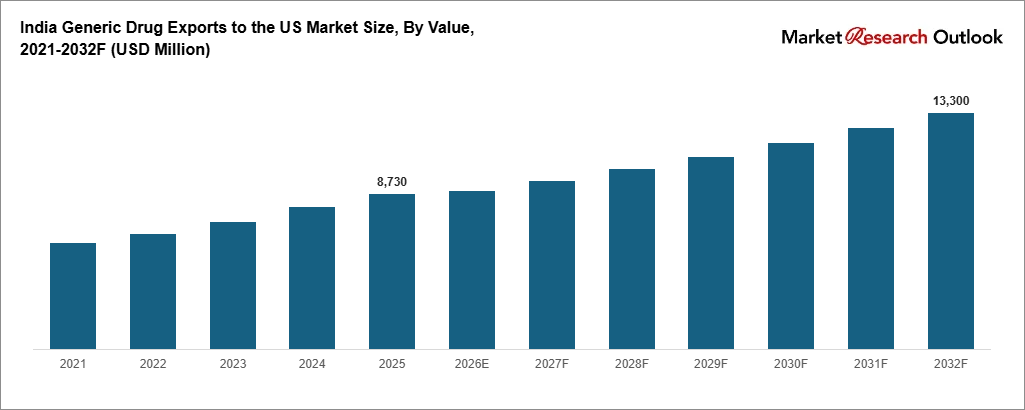
The India generic drug exports to the US market size is expanding steadily, driven by US patent expiries, high generic substitution rates, payer pressure to lower drug costs, growing demand for complex generics and biosimilars, and continued capacity additions by Indian generic drug exporters. India generic drug exports to the US were valued at USD 8,730 million in 2025 and projected to reach USD 13,300 million by 2032, growing at a CAGR of 6.2%, these exports are supported by India’s share of about 47% of US generic prescriptions and more than 600 USFDA-approved plants. Simple oral solid generics lead generic drug export value, while complex generics and biosimilars form the fastest growing category. Around 90% of India’s pharmaceutical shipments to the US are generic drug exports, which kept the sector outside the branded drug tariffs announced in April 2026. As leading exporters including Sun Pharma, Dr. Reddy’s, Aurobindo, Lupin, Cipla, and Zydus Lifesciences expand injectable, inhalation, and biosimilar capacity, and US buyers such as McKesson, Cencora, and Cardinal Health deepen supply contracts, India generic drug exports to the US market are evolving into a compliance-led, pipeline-driven, and supply-secure ecosystem with solid long-term growth potential.
Key Report Takeaways: India Generic Drug Exports to the US Market
- The India generic drug exports to the US market size is projected to grow from USD 8,730 million in 2025 to USD 13,300 million by 2032, registering a CAGR of 6.2%, driven by US patent expiries, complex generic launches, and the steady shift of US buyers toward reliable non-China suppliers.
- Simple generics dominate India generic drug exports to the US, accounting for about 64% of generic drug export value in 2025, supported by high-volume cardiovascular, CNS, anti-infective, and anti-diabetic molecules, the deep US presence of Sun Pharma, Aurobindo, Lupin, and Zydus, and long-standing contracts with US wholesalers and pharmacy chains.
- Complex generics and biosimilars are the fastest growing segments in India generic drug exports to the US market, expected to grow at 11% to 14% annually as Indian generic drug exporters target injectables, inhalers, peptides, and biosimilars that face fewer competitors and slower price erosion.
- Indian generic drug exporters supply about 47% of US generic prescriptions and run more than 600 USFDA-approved plants, the largest base outside the US, which structurally anchors India generic drug exports to the US across retail, hospital, and long-term care channels.
- Rising investments by Sun Pharma, Dr. Reddy’s, Lupin, Cipla, Zydus Lifesciences, and Glenmark in complex generic capacity, API backward integration under PLI, and US-based manufacturing are strengthening supply resilience and supporting the India generic drug exports to the US market forecast 2032.
Key Market Drivers: India Generic Drug Exports to the US Market
US Patent Expiries, Rising Generic Penetration, and Healthcare Cost Pressure Driving Demand for Indian Generic Drugs
Growth in India generic drug exports to the US market is being driven by a large wave of US patent expiries, high generic substitution, and constant pressure from payers, PBMs, and government programs to cut drug costs. For generic drug exports, branded drugs with combined US sales of more than USD 200 billion are set to lose exclusivity between 2025 and 2030, covering cardiovascular, diabetes, oncology, and CNS therapies. Generics already account for roughly 90% of US prescriptions but only about 13% of total prescription spending, which makes Indian generic drug exports the main cost lever for the US system. Indian generic drug exporters supply about 47% of US generic prescriptions, and drugs from India fill more than half of US prescriptions in several categories such as blood pressure, anti-depressants, and oral contraceptives. These factors create strong structural pull for India generic drug exports to the US through 2032.
Largest Base of USFDA-Approved Plants Outside the US and Strong Cost Competitiveness Strengthening India’s Export Position
India generic drug exports to the US benefit from the largest base of USFDA-approved manufacturing sites outside the US, with more than 600 facilities spread across Gujarat, Maharashtra, Telangana, Andhra Pradesh, Himachal Pradesh, and Madhya Pradesh. Production costs behind India generic drug exports are estimated at 30% to 35% lower than in the US and Europe, helped by integrated API and formulation sites, a large skilled workforce, and scale in bioequivalence testing. Indian generic drug exporters have consistently secured around 40% of US generic approvals in recent years, giving India generic drug exports broad coverage across almost every major therapy area. The PLI scheme for pharmaceuticals with an outlay of INR 15,000 crore and the PLI scheme for bulk drugs worth INR 6,940 crore are lifting domestic capacity for high-value formulations and critical APIs. Together, these strengths keep Indian generic drug exporters price competitive and reliable, supporting India generic drug exports to the US market across both high-volume and niche products.
Shift Toward Complex Generics, Injectables, and Biosimilars Lifting Export Value Realisation
A steady move into complex products is a major catalyst for India generic drug exports to the US market, with complex generics and biosimilars projected to grow at 11% to 14% annually through 2032. Indian companies filed about 600 ANDAs in FY2025, down from around 740 a year earlier, but roughly 17% of those filings were complex, showing that generic drug exports from India now favour value over volume. Complex injectables, long-acting formulations, inhalers, ophthalmics, and peptides typically face three to five competitors instead of 15 to 20 for a plain tablet, so prices hold far better. Biocon Biologics, Dr. Reddy’s, Lupin, Zydus, and Cipla have widened their US biosimilar and specialty pipelines, while Sun Pharma and Glenmark are scaling specialty and respiratory products. The complex segment of India generic drug exports to the US is expected to add an estimated USD 1,800 million in incremental generic drug export value by 2032, which is reshaping India generic drug exports to the US across oncology, CNS, and respiratory therapies.
Key Market Challenges: India Generic Drug Exports to the US Market
Persistent US Generic Price Erosion and Buyer Consolidation Squeezing Export Margins
India generic drug exports to the US market continue to face steady price erosion, with base portfolio prices for simple oral solids falling by 5% to 8% each year. Three large purchasing groups, linked to major US wholesalers and pharmacy chains, control about 90% of US generic buying volume, which gives them strong power over generic drug export pricing in annual tenders. Many commoditised molecules in India generic drug exports to the US carry 15 or more approved suppliers, and a single lost contract can wipe out a product’s US revenue for a full year. High inventory levels across the US generic drug export channel in 2025 and 2026 added further pricing pressure. Smaller Indian generic drug exporters with narrow portfolios feel this most, as they lack the scale to absorb repeated price cuts. This keeps margin pressure high across a large part of India generic drug exports to the US.
USFDA Compliance Scrutiny, Warning Letters, and Import Alerts Disrupting Supply
India generic drug exports to the US market face recurring disruption from USFDA inspections, Form 483 observations, warning letters, and import alerts. Unannounced and short-notice inspections of Indian generic drug export sites have increased since 2023, with data integrity, cleaning validation, and sterility assurance remaining common findings. A single Official Action Indicated (OAI) status can block new generic drug export approvals from a plant for 12 to 24 months and delay launch plans worth tens of millions of dollars. Remediation is costly for generic drug exporters, often requiring new equipment, digital quality systems, and outside consultants. Large exporters such as Sun Pharma, Aurobindo, Lupin, and Granules India have faced site-level actions at different points, which shows that compliance risk affects generic drug exporters of every size. Strong quality culture therefore remains a near-term challenge for India generic drug exports to the US.
US Tariff Uncertainty Under Section 232 and Heavy Dependence on Chinese APIs and Key Starting Materials
India generic drug exports to the US market face rising policy risk. The April 2, 2026 Section 232 proclamation placed tariffs of up to 100% on patented drugs but left generics out. In July 2026, however, the US announced that generics will stay at a 0% tariff for two years from August 1, 2026, rise to 100% from August 2028, and reach 200% from August 2029 for companies that do not build US production. At the same time, India generic drug exports to the US still rely on imports of about 70% of key APIs and starting materials from China, which exposes generic drug exporters to supply shocks and input price swings. US-made pilot programs that fast-track domestically produced generics add another layer of competitive pressure. PLI-backed API plants and US site investments are emerging as answers, but they need time and capital, keeping uncertainty high for India generic drug exports to the US.
Key Market Trends: India Generic Drug Exports to the US Market
Rapid Growth of Complex Injectables, Inhalers, and Biosimilars in Indian Exports to the US
India generic drug exports to the US market are going through a clear product shift toward complex injectables, inhalation products, and biosimilars, with these products expected to make up over 25% of new Indian US launches by 2028. Sterile injectables, a fast-rising part of India generic drug exports to the US, are among the items most often listed on the US drug shortage list, which gives reliable Indian generic drug exporters a strong opening. Indian generic drug exporters are also building capability in peptides, liposomal products, and drug-device combinations, areas that need advanced process know-how. Biocon Biologics, Dr. Reddy’s, Lupin, Zydus Lifesciences, and Cipla have expanded biosimilar and complex generic capacity through 2024 and 2025. Oncology generic drug exports are another rising focus as Indian generic drug exporters target a share of the large US cancer drug market. This transition is reinforcing the India generic drug exports to the US market forecast 2032 across hospital and specialty channels.
Expansion of US Manufacturing Footprint and Onshoring Investments by Indian Generic Drugmakers
A clear shift toward local US production is reshaping India generic drug exports to the US market, especially after the tariff plan announced in July 2026. Dr. Reddy’s, Glenmark, Granules India, Lupin, Zydus Lifesciences, Jubilant, and Piramal Pharma have all announced plans to invest in US operations, while Zydus acquired US biologics manufacturing facilities from Agenus in 2025. Sun Pharma, Aurobindo, and Cipla already run US plants that can absorb part of the shift. In most cases, the model for India generic drug exports to the US blends Indian API and development strength with final manufacturing or packaging in the US, so generic drug exports move up the value chain rather than disappear. Industry executives tracking generic drug exports estimate that building a full cost-competitive US generics base will take at least five years, which gives Indian generic drug exporters time to adjust and keeps India generic drug exports to the US central to American supply.
Backward Integration, PLI-Led API Capacity, and Supply Chain Diversification Investments
A wave of API backward integration and supply chain investments is reshaping the supply base behind India generic drug exports to the US. Under the PLI scheme for bulk drugs worth INR 6,940 crore and the PLI scheme for pharmaceuticals worth INR 15,000 crore, Indian generic drug exporters have commissioned capacity for critical starting materials, fermentation-based APIs, and high-value formulations. API makers supplying generic drug exporters, such as Divi’s Laboratories, Aurobindo, Granules India, Laurus Labs, and Hetero are expanding integrated sites in Telangana and Andhra Pradesh, while Gujarat and Maharashtra continue to add formulation and injectable lines. US buyers are also signing longer generic drug export supply deals with Indian vendors to reduce China exposure and shortage risk. Combined with steady ANDA approvals and a growing complex pipeline, these developments are reinforcing the India generic drug exports to the US market forecast 2032 across the full value chain.
Segmental Insights: India Generic Drug Exports to the US Market
By End-User: Outpatient & Retail Patients Segment Dominates India Generic Drug Exports to the US Market
The outpatient and retail patients segment dominates India generic drug exports to the US market, accounting for an estimated 58% to 62% of generic drug export value, driven by high-volume chronic therapies for blood pressure, cholesterol, diabetes, depression, and pain dispensed through retail and mail-order pharmacies. Tablets and capsules make up over 75% of India generic drug exports to the US in this segment. Hospitals contribute another 22% to 25% of generic drug export demand, led by injectables, oncology products, and anti-infectives bought through group purchasing organizations. Long-term care facilities account for 9% to 11%, while specialty clinics make up the balance. In 2025, leading generic drug exporters including Sun Pharma, Aurobindo, Lupin, Zydus, and Cipla widened retail and hospital portfolios through new launches and longer wholesaler contracts, reinforcing segment leadership in India generic drug exports to the US.
By Generic Type: Simple Generics Lead While Complex Generics and Biosimilars Grow Fastest
Simple generics lead India generic drug exports to the US market, accounting for about 64% of export value, supported by wide portfolios, proven bioequivalence, and low-cost production at scale. Complex generics contribute another 16% to 18% of generic drug exports, mainly across injectables, inhalers, ophthalmics, and long-acting products. Complex generics and biosimilars are the fastest growing categories in India generic drug exports to the US, expanding at 11% to 14% annually, driven by limited competition, better price stability, and rising hospital demand. Specialty generics hold 7% to 9% of India generic drug exports to the US, while biosimilars and OTC generics together account for 8% to 11%, with biosimilars expected to scale quickly through 2032 as key biologics lose exclusivity. Leading generic drug exporters including Sun Pharma, Dr. Reddy’s, Lupin, Biocon, and Zydus Lifesciences have aligned pipelines with this mix, lifting value realisation across India generic drug exports to the US.
Regional Insights: India Generic Drug Exports to the US Market
Regional analysis of India generic drug exports to the US market shows that West India and South India together account for about 78% to 82% of generic drug export value. West India, led by Gujarat (Ahmedabad and Vadodara) and Maharashtra (Mumbai, Pune, and Aurangabad), holds an estimated 44% to 47%, backed by large generic drug export clusters for formulations and injectables. South India contributes 33% to 36% of generic drug exports, led by Telangana (Hyderabad), Andhra Pradesh (Visakhapatnam), Karnataka, and Tamil Nadu, which together host much of India’s API and bulk drug capacity. North India accounts for 9% to 11% of generic drug exports, supported by the Baddi cluster in Himachal Pradesh, Punjab, and Uttarakhand. Central and East India together contribute 8% to 10% of India generic drug exports to the US, led by Pithampur and Indore in Madhya Pradesh and the Sikkim pharma hub. In 2025, capacity additions by Zydus and Torrent in Gujarat, Lupin and Cipla in Maharashtra, Dr. Reddy’s and Aurobindo in Telangana and Andhra Pradesh, and Glenmark in Madhya Pradesh strengthened export hubs serving India generic drug exports to the US.
Pharma data: see the India Pharma Exports Tracker for monthly drug exports by region, the USFDA Approvals Tracker for selected US approvals, and the USFDA Warning Letters Tracker for warning letters to Indian sites. The India Drug Market Entry Tracker shows patent expiry, Indian makers and price control for 22 medicines.
Recent Developments: India Generic Drug Exports to the US Market
- India generic drug exports to the US held firm through a volatile 2025 and 2026. India shipped about USD 9.7 billion of pharmaceuticals to the US in 2025, equal to about 38% of its global pharma exports, and around 90% of that value was generics, placing India generic drug exports to the US near USD 8,730 million for the year. In April 2026, several Indian generic drug exporters including Lupin, Biocon, Alembic, and Aurobindo received USFDA approvals for generic dapagliflozin.
- Indian generic drug exporters deepened US-focused capacity and investment. In 2025 and 2026, Dr. Reddy’s, Glenmark, Granules India, Lupin, Zydus Lifesciences, Jubilant, and Piramal Pharma announced plans to invest in US operations, and Zydus acquired US biologics manufacturing sites from Agenus. Indian generic drug exporters also expanded complex injectable and biosimilar lines across Gujarat, Telangana, and Maharashtra. These steps are strengthening supply resilience and supporting the India generic drug exports to the US market forecast 2032.
- US trade policy has become a defining factor for India generic drug exports to the US market. The April 2, 2026 Section 232 proclamation excluded generics from tariffs on patented drugs, while the July 2026 announcement set a 0% tariff on generics for two years, followed by 100% from August 2028 and 200% from August 2029 for firms without US production. The Indian Pharmaceutical Alliance has sought engagement with Washington, and the outcome will shape long-term positioning in the India generic drug exports to the US market forecast 2032.
Key Market Players: India Generic Drug Exports to the US Market
- Sun Pharmaceutical Industries Ltd.
- Dr. Reddy’s Laboratories Ltd.
- Aurobindo Pharma Limited
- Lupin Limited
- Cipla Limited
- Zydus Lifesciences Limited
- Glenmark Pharmaceuticals Limited
- Torrent Pharmaceuticals Limited
- Alkem Laboratories Limited
- Biocon Limited (Biocon Biologics Ltd.)
- Granules India Limited
- Alembic Pharmaceuticals Limited
- Natco Pharma Limited
| By Generic Type | By Therapeutic Area | By Dosage Form | By Distribution Channel | By End-User |
| Simple Generics Complex Generics Specialty Generics Biosimilars OTC Generics Others |
Cardiovascular Central Nervous System Anti-Infectives Oncology Anti-Diabetic Respiratory Others |
Tablets Capsules Injectables Oral Liquids Topicals & Inhalers |
Wholesalers & Distributors Retail Pharmacy Chains Hospital Pharmacies Mail-Order & Online Pharmacies Group Purchasing Organizations Government & Institutional |
Outpatient & Retail Patients Hospitals Long-Term Care Facilities Specialty Clinics |
Report Scope
In this report, the India Generic Drug Exports to the US Market has been segmented into the following categories, in addition to detailed analysis of key industry trends, market dynamics, competitive landscape, and growth opportunities across the forecast period:
- By Generic Type
- Simple Generics
- Complex Generics
- Specialty Generics
- Biosimilars
- OTC Generics
- Others
- By Therapeutic Area
- Cardiovascular
- Central Nervous System
- Anti-Infectives
- Oncology
- Anti-Diabetic
- Respiratory
- Others
- By Dosage Form
- Tablets
- Capsules
- Injectables
- Oral Liquids
- Topicals & Inhalers
- By Distribution Channel
- Wholesalers & Distributors
- Retail Pharmacy Chains
- Hospital Pharmacies
- Mail-Order & Online Pharmacies
- Group Purchasing Organizations
- Government & Institutional
- By End-User
- Outpatient & Retail Patients
- Hospitals
- Long-Term Care Facilities
- Specialty Clinics
- By Geography
- North India
- South India
- West India
- East India
- Central India
Competitive Landscape
Company Profiles:
Detailed analysis of the leading companies operating in the India Generic Drug Exports to the US Market, including business overview, product portfolio, strategic initiatives, competitive positioning, and recent developments.
Company Information
Detailed profiling and strategic analysis of additional market players (up to five companies), including emerging Indian generic exporters, specialty injectable and biosimilar developers, API-integrated mid-sized players, or niche CDMO partners serving the US market.
For a free sample of the India Generic Drug Exports to the US Market report, customised insights or delivery timelines, submit your query here
India Generic Drug Exports to the US Market, 2032
- Research Framework
- Market Segmentation
- Research Objective
- Research Methodology
- Qualitative Research
- Primary Research
- Secondary Research
- Quantitative Research
- Market Breakdown & Data Triangulation
- Demand Side
- Supply Side
- Primary Research Respondents
- Assumption & Limitation
- Executive Summary
- Market Overview, 2021-2032
- By Generic Type
- By Therapeutic Area
- By Dosage Form
- By Distribution Channel
- By End-User
- By Region
- Analyst Recommendations
- Geopolitical Impact on India Generic Drug Exports to the US Market
- India Generic Drug Exports to the US Market Insights
- Market Dynamics
- Growth Drivers
- US patent expiries, rising generic penetration, and healthcare cost pressure driving demand for Indian generic drugs.
- Largest base of USFDA-approved plants outside the US and strong cost competitiveness strengthening India’s export position.
- Shift toward complex generics, injectables, and biosimilars lifting generic drug export value realisation for Indian drugmakers.
- Restraints
- Persistent US generic price erosion and buyer consolidation squeezing export margins of Indian generic drugmakers.
- USFDA compliance scrutiny, warning letters, and import alerts disrupting supply from Indian manufacturing sites.
- US tariff uncertainty under Section 232 and heavy dependence on Chinese APIs and key starting materials.
- Opportunities
- Patent expiries worth over USD 200 billion opening first-to-file and complex generic opportunities through 2030.
- Recurring US drug shortages and supply chain diversification away from China favouring Indian suppliers.
- US manufacturing acquisitions, CDMO partnerships, and biosimilar launches creating new export revenue streams.
- Challenges
- Intense competition from Chinese, US-based, and other low-cost generic manufacturers in commoditised molecules.
- Rising cost of bioequivalence studies, Paragraph IV litigation, and US regulatory compliance for Indian generic drug exporters.
- Freight disruptions, API price volatility, and inventory build-up across the US generic supply chain.
- Technological Advancements
- Recent Technological Advancements
- Prior to 2020
- Porter’s Five Forces Analysis
- PESTLE Analysis
- Industry Value Chain & Entry Points
- Upstream Raw Materials (key starting materials, intermediates, solvents, excipients, packaging materials)
- API & Bulk Drug Manufacturers (Divi’s Laboratories, Aurobindo, Granules India, Laurus Labs, Hetero)
- Finished Dosage Formulation Makers (Sun Pharma, Dr. Reddy’s, Lupin, Cipla, Zydus Lifesciences)
- Complex Generics & Biosimilar Developers (injectables, inhalers, peptides, liposomals, biosimilars)
- Quality Control, Bioequivalence & Regulatory Bodies (USFDA, CDSCO, cGMP, ANDA filing support)
- Contract Research & Manufacturing Organizations (CROs, CDMOs, bioequivalence centres)
- Export Logistics & Cold-Chain Providers (air freight, ocean freight, temperature-controlled shipping)
- US Wholesalers & Distributors (McKesson, Cencora, Cardinal Health)
- Pharmacy Chains, GPOs & PBMs (CVS Health, Walgreens, Walmart, Vizient, Premier)
- End-Users (outpatient and retail patients, hospitals, long-term care facilities, specialty clinics)
- India Generic Drug Exports to the US Market: Regulatory Framework
- India Generic Drug Exports to the US Market Overview
- Market Size & Forecast, 2021-2032
- By Value (USD Million)
- By Volume (Billion Units)
- Market Share & Forecast
- By Generic Type
- Simple Generics
- Complex Generics
- Specialty Generics
- Biosimilars
- OTC Generics
- Others
- By Therapeutic Area
- Cardiovascular
- Central Nervous System
- Anti-Infectives
- Oncology
- Anti-Diabetic
- Respiratory
- Others
- By Dosage Form
- Tablets
- Capsules
- Injectables
- Oral Liquids
- Topicals & Inhalers
- By Distribution Channel
- Wholesalers & Distributors
- Retail Pharmacy Chains
- Hospital Pharmacies
- Mail-Order & Online Pharmacies
- Group Purchasing Organizations
- Government & Institutional
- By End-User
- Outpatient & Retail Patients
- Hospitals
- Long-Term Care Facilities
- Specialty Clinics
- By Geography
- North India
- South India
- West India
- East India
- Central India
- Competitive Landscape
- India Generic Drug Exports to the US Market Company Market Share Analysis, 2025
- Competitive Benchmarking, By Operating Parameters
- Key Strategic Development (Mergers, Acquisitions, Partnerships, Etc.)
- List of Emerging Players
- Company Profile
- Sun Pharmaceutical Industries Ltd.
- Introduction & Company Profile
- Product Benchmarking
- Strategic Outlook
- Key Competitors
- Financial Analysis
- SWOT Analysis
(Same Data Pointers Will Be Provided for The Below Companies)
- Dr. Reddy’s Laboratories Ltd.
- Aurobindo Pharma Limited
- Lupin Limited
- Cipla Limited
- Zydus Lifesciences Limited
- Glenmark Pharmaceuticals Limited
- Torrent Pharmaceuticals Limited
- Alkem Laboratories Limited
- Biocon Limited (Biocon Biologics Ltd.)
- Granules India Limited
- Alembic Pharmaceuticals Limited
- Natco Pharma Limited
- Other Prominent Players
* Financial information in case of non-listed companies will be provided as per availability
** The segmentation and the companies are subjected to modifications based on in-depth secondary for the final deliverable
Frequently Asked Questions
1. How large is the India generic drug exports to the US market and what is its growth forecast?
Ans: India generic drug exports to the US market is valued at USD 8,730 million in 2025 and is projected to reach USD 13,300 million by 2032, growing at a CAGR of 6.2%, led by US patent expiries.
2. Which segments are driving India generic drug exports to the US market?
Ans: Simple generics lead with about 64% of generic drug export value, while complex generics and biosimilars are the fastest growing segments at 11% to 14% annually, led by injectables, inhalers, and oncology products for US hospitals.
3. What are the key drivers of India generic drug exports to the US market?
Ans: Key drivers include over USD 200 billion of US patent expiries through 2030, India's 47% share of US generic prescriptions, more than 600 USFDA-approved plants, and a growing complex generic and biosimilar pipeline.
4. Which Indian regions lead generic drug exports to the US market?
Ans: West India and South India lead with about 78% to 82% of generic drug export value, driven by Gujarat, Maharashtra, Telangana, and Andhra Pradesh, while Himachal Pradesh, Madhya Pradesh, and Sikkim add growing capacity.
5. How do US tariffs affect India generic drug exports to the US market?
Ans: Generics remain at a 0% US tariff until August 2028. After that, duties of 100% and then 200% may apply to firms without US production, pushing Indian generic drug exporters toward US plants and partnerships.