

India Biosimilars Market, 2032
- Pharmaceuticals & Life Sciences
- Nov 2026
- Pages 140
- Report Format: pdf
- Report Price: $2400 USD
India’s biosimilars market is witnessing strong structural growth, driven by the rising burden of cancer, diabetes, and autoimmune disorders, a steady wave of biologic patent expiries, the wide price gap between biosimilars and originator biologics, broader insurance cover under Ayushman Bharat PM-JAY, supportive CDSCO regulatory reforms, and rising investment from domestic biopharma majors in cell line development, fill-finish capacity, and export-ready manufacturing.
| Study Duration | 2021-2032 |
| Market Size (2025) | USD 1,120 Million |
| CAGR (2026-2032) | 16.6% |
| Leading Segment | Monoclonal Antibodies (Oncology Indication) |
| Fastest Growing Segment | Insulin Analogues & Immunology Biosimilars |
| Market Size (2032) | USD 3,280 Million |
Market Overview: India Biosimilars Market
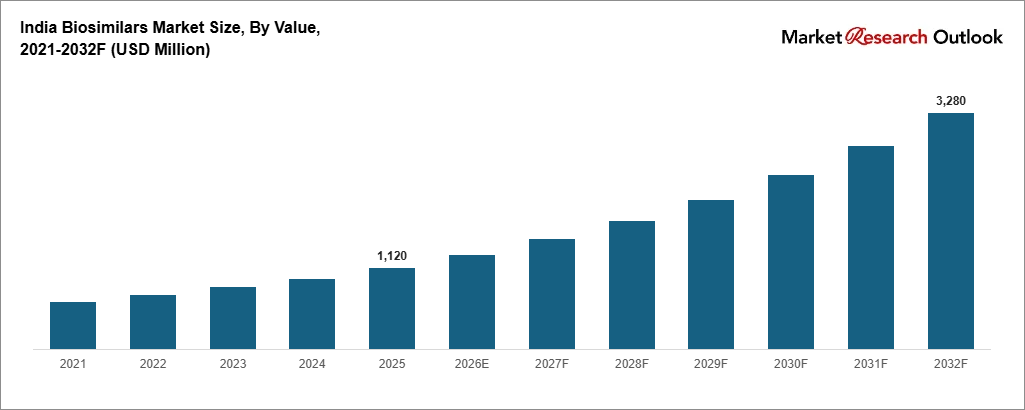
The India biosimilars market size is expanding at a fast pace, supported by the rising incidence of cancer and diabetes, broader health insurance coverage, a deep pipeline of off-patent biologics, growing physician acceptance, and major capacity additions by domestic biopharma companies. Valued at USD 1,120 million in 2025 and projected to reach USD 3,280 million by 2032, growing at a CAGR of 16.6%, the India biosimilars market growth is being fuelled by price-sensitive patients, hospital procurement that favours lower-cost biologics, and steady regulatory clarity from the Central Drugs Standard Control Organisation (CDSCO). Monoclonal antibodies lead revenue, while insulin analogues and immunology biosimilars are emerging as the fastest growing categories. India had approved 146 biosimilars by December 2025, one of the largest portfolios in the world, built by around 33 domestic and global companies. Rising treatment costs, longer survival in oncology, and the need to stretch public health budgets are changing how hospitals buy biologics. As domestic leaders including Biocon Biologics, Intas Pharmaceuticals, Dr. Reddy’s Laboratories, Zydus Lifesciences, and Lupin expand integrated development and manufacturing capacity, and specialty players such as Reliance Life Sciences, Hetero Biopharma, and Enzene Biosciences widen their portfolios, the India biosimilars market is evolving into a patient-led, innovation-driven, and export-ready ecosystem with strong long-term growth potential.
Key Report Takeaways: India Biosimilars Market
- The India biosimilars market size is projected to grow from USD 1,120 million in 2025 to USD 3,280 million by 2032, registering a strong CAGR of 16.6%, driven by a rising chronic disease burden, a wave of biologic patent expiries, and the structural shift toward affordable biologic therapy across public and private hospitals.
- Monoclonal antibodies dominate the India biosimilars market, accounting for around 38% of total revenue in 2025, driven by high use of trastuzumab, rituximab, bevacizumab, and adalimumab biosimilars, the deep oncology presence of Biocon Biologics, Intas, Dr. Reddy’s, and Zydus, and rising demand from organized hospital chains.
- Insulin analogues and immunology biosimilars are emerging as the fastest growing segments in the India biosimilars market, expected to grow at 19% to 22% annually as more than 101 million diabetic patients and a rising autoimmune patient pool push hospitals and pharmacies toward lower-cost biologic options.
- Rapid expansion of insurance cover, with Ayushman Bharat PM-JAY reaching over 55 crore beneficiaries and more than 30,000 empanelled hospitals, is structurally widening access to biologic therapy and expanding the India biosimilars market across tier-2 and tier-3 cities.
- Rising investments by domestic biopharma majors such as Biocon Biologics, Intas, Dr. Reddy’s, Zydus, and Lupin in mammalian cell culture capacity, fill-finish lines, and new monoclonal antibody pipelines are strengthening local supply and supporting the India biosimilars market forecast 2032.
Key Market Drivers: India Biosimilars Market
Rising Burden of Cancer, Diabetes, and Autoimmune Disorders Driving Biosimilar Demand Across India
Growth in the India biosimilars market is being driven by a sharp rise in chronic and lifestyle diseases that need long-term biologic treatment. ICMR estimates suggest India recorded close to 1.57 million new cancer cases in 2025, and the number keeps climbing as the population ages and screening improves. Diabetes affects over 101 million Indians, with another 136 million living with prediabetes, while rheumatoid arthritis, psoriasis, and inflammatory bowel disease together affect well over 10 million patients. Biologics are now standard care in many of these conditions, yet originator prices remain out of reach for most households. Biosimilar versions of trastuzumab, rituximab, bevacizumab, pegfilgrastim, and insulin glargine typically sell at 30% to 70% below the reference product, which lets oncologists and endocrinologists start therapy earlier and keep patients on treatment longer. Oncology alone accounts for about 41% of biosimilar spending in India, and around 75% of CDSCO approved biosimilars target cancer treatment and supportive care. With out-of-pocket payments still covering close to 40% of national health spending, cost-effective biologics are creating strong structural pull-through demand across the India biosimilars market.
Patent Expiries of Blockbuster Biologics and Strong Cost Advantage Fuelling Wider Biosimilar Adoption
The India biosimilars market is benefiting from a long run of patent expiries on high-value biologics, alongside steady cost reductions in cell line development, upstream bioprocessing, and fill-finish operations. Biologics with combined global sales above USD 150 billion are expected to lose exclusivity before 2032, including key molecules in oncology, immunology, ophthalmology, and bone health such as pembrolizumab, nivolumab, denosumab, aflibercept, and ustekinumab. Indian developers spend roughly USD 15 million to USD 40 million to take a biosimilar to the domestic market, compared to USD 100 million to USD 250 million for regulated markets, which keeps local launch prices competitive. The cost of a full course of biosimilar trastuzumab in India has fallen by more than half over the past decade, opening therapy to middle-income families. Price caps set by the National Pharmaceutical Pricing Authority (NPPA) on NLEM-listed biologics such as trastuzumab and insulin, hospital tender pricing, and growing trust in domestic brands have further strengthened organized supply, supporting price competitiveness across the India biosimilars market. Private hospital chains and state procurement agencies now account for a rising share of volume, and both prefer lower-cost biologics backed by solid clinical data.
Regulatory Reforms, PLI Incentives, and BioE3 Policy Support Strengthening Domestic Biosimilar Manufacturing
Policy support is a major catalyst for the India biosimilars market, with domestic biologics manufacturing capacity projected to grow at 14% to 16% annually through 2032. In May 2025, CDSCO released draft revised Guidelines on Similar Biologics, aligned with the latest World Health Organization guidance, which allow a more science-based approach to animal studies and confirmatory clinical trials. This change could cut development timelines by 12 to 18 months for several molecules. The Production Linked Incentive (PLI) scheme for pharmaceuticals, with an outlay of INR 15,000 crore, lists biopharmaceuticals among its priority products, while the BioE3 policy approved in August 2024 backs biomanufacturing hubs and bio-foundries. The Promotion of Research and Innovation in Pharma MedTech (PRIP) scheme, with an outlay of INR 5,000 crore, is funding research infrastructure and early-stage biologics work. Leading developers such as Biocon Biologics, Intas, Dr. Reddy’s, Zydus, and Lupin are using these incentives to scale monoclonal antibody and insulin pipelines, with the immunology biosimilar segment alone representing an estimated USD 260 million addressable opportunity by 2032. Government procurement combined with insurance-led hospital demand is structurally expanding India biosimilars market growth across all major end-user categories through 2032.
Key Market Challenges: India Biosimilars Market
High Development Cost and Complex Manufacturing Limiting Entry of Smaller Biosimilar Players
The India biosimilars market continues to face challenges around high development cost and technical complexity, with a single monoclonal antibody biosimilar often taking 6 to 8 years to move from cell line to launch. While regulatory reforms by CDSCO and growing CDMO capacity have eased some pressure, only around 33 companies hold active biosimilar approvals in India, reflecting bottlenecks in process know-how, analytical capability, and access to large-scale bioreactors. A new mammalian cell culture plant can need capital expenditure of USD 50 million to USD 150 million, and batch failure rates during early scale-up can run between 5% and 10%. Smaller firms also struggle with the cost of comparability studies and global-standard quality systems. Continued dependence on imported cell culture media, chromatography resins, and single-use bioreactor bags, which make up over 70% of key consumables, limits margins and slows new entrants across the India biosimilars market.
Limited Physician Confidence, Low Awareness, and Cold-Chain Gaps Across Tier-2 and Tier-3 Cities
The India biosimilars market faces structural complexity from uneven physician confidence, patient awareness, and cold-chain coverage across different cities. While metros such as Delhi, Mumbai, Bengaluru, Chennai, and Hyderabad have large oncology centres and validated 2°C to 8°C storage networks with penetration above 80%, many smaller cities still lack trained specialists and reliable refrigerated logistics. Industry surveys suggest that 35% to 45% of physicians outside metro cities remain cautious about switching patients from an originator biologic to a biosimilar, citing concerns around immunogenicity and interchangeability. India does not yet have a formal interchangeability designation, so switching decisions rest entirely with the treating doctor. Uneven availability of oncology day-care units, infusion chairs, and distributor-level cold storage creates operational complexity for players such as Biocon Biologics, Intas, Dr. Reddy’s, and Zydus operating pan-India. While pharmacovigilance programmes and medical education drives are improving trust, this awareness gap remains a near-term challenge for the India biosimilars market.
Price Erosion, Tender-Driven Competition, and Reimbursement Gaps Impacting Overall Biosimilar Margins
The India biosimilars market faces practical constraints around price erosion, tender-led buying, and margin compression across the value chain. Prices for mature biosimilars such as filgrastim, erythropoietin, and trastuzumab fell by 15% to 30% between 2022 and 2025 as more brands entered each molecule, while input costs for media, resins, and primary packaging moved up by 8% to 12% over the same period. Smaller brands find it hard to pass cost increases through state tenders without losing volume. Average gross margins for biosimilars sold in India range between 35% and 50%, but heavy discounting in hospital tenders can cut the effective profitability of new launches by 6% to 12%. Limited reimbursement for outpatient biologic therapy under many private insurance policies adds further pressure. Long-acting formulations, prefilled syringes, and autoinjector devices are emerging as ways to differentiate, but higher pricing and limited patient awareness remain barriers to wider adoption across the India biosimilars market.
Key Market Trends: India Biosimilars Market
Rapid Adoption of Monoclonal Antibody Biosimilars in Oncology and Immunology in India
The India biosimilars market is going through a clear shift toward complex monoclonal antibody biosimilars, with these molecules expected to capture over 45% of new biosimilar launches by 2027. Oncology antibodies such as trastuzumab, bevacizumab, and rituximab are now widely used in public and private hospitals, and newer launches in denosumab, ranibizumab, and adalimumab are widening use in bone health, ophthalmology, and autoimmune care. Zydus launched the world’s first biosimilar antibody-drug conjugate, trastuzumab emtansine, in India in 2021, a clear sign of how far domestic science has moved. Leading domestic players including Biocon Biologics, Intas, Dr. Reddy’s, Zydus, Lupin, and Reliance Life Sciences scaled antibody production capacity through 2024 and 2025. Immunology biosimilars are also gaining traction, particularly in metro cities such as Mumbai and Bengaluru where rheumatology and dermatology practices are growing fast, with brands offering adalimumab, etanercept, and infliximab biosimilars at 40% to 60% below originator prices. This product transition is reinforcing the India biosimilars market forecast 2032 across both hospital and retail channels.
Growth of Online Pharmacies, Specialty Distribution, and Government Procurement in the India Biosimilars Market
A clear shift toward online pharmacies, specialty distribution, and organized government procurement is reshaping the India biosimilars market, particularly for chronic therapies such as insulin and immunology biologics. Online pharmacy platforms such as Tata 1mg, PharmEasy, Apollo 24|7, and Netmeds now deliver cold-chain products to patients within 24 to 48 hours in most metro cities, often at 10% to 20% below the printed MRP. Specialty pharmacy networks attached to large hospital chains manage storage, patient support, and adherence programmes for high-value biologics. Government buying through central and state medical services corporations, along with over 16,000 Pradhan Mantri Bhartiya Janaushadhi Kendras, is pushing lower-cost biologics into public facilities. By 2025, online and specialty channels together account for over 14% of biosimilar sales in India, up from less than 5% in 2020, with chronic-care patients increasingly preferring home delivery and refill reminders over repeat hospital visits.
Capacity Expansion by Domestic Biopharma Majors and Global Partnership Investments
A wave of domestic capacity expansion and global partnership deals is reshaping the India biosimilars market supply landscape. Combined India-focused capital expenditure announcements in biologics manufacturing, fill-finish lines, and CDMO capacity exceeded USD 1.5 billion across 2023 to 2025. Biocon Biologics continued to scale insulin and monoclonal antibody output at its Bengaluru campus, Intas expanded biologics capacity in Ahmedabad, Dr. Reddy’s added new antibody lines in Hyderabad, Zydus grew its biologics hub in Ahmedabad, and Lupin strengthened its Pune biotech facility. Enzene Biosciences, Reliance Life Sciences, and Hetero Biopharma also widened their antibody and recombinant protein portfolios. CDSCO regulatory reforms, PLI scheme allocations for pharmaceuticals of INR 15,000 crore, and BioE3 biomanufacturing incentives have structurally favoured organized supply. Combined with insurance-led hospital demand and fast-growing export orders from regulated markets, these developments are reinforcing the India biosimilars market forecast 2032 across the entire value chain.
Segmental Insights: India Biosimilars Market
By End-User: Hospitals Segment Dominates the India Biosimilars Market
The hospitals end-user segment dominates the India biosimilars market, accounting for an estimated 52% to 56% of total revenue, driven by in-patient oncology care, infusion-based therapy, and bulk procurement under PM-JAY and state health schemes. Monoclonal antibodies and G-CSF products are the dominant categories within this segment, with vial and prefilled syringe formats capturing over 70% of hospital purchases. The specialty clinics segment contributes another 18% to 21% of demand, driven by rheumatology, nephrology, and endocrinology practices that manage long-term biologic patients. Cancer care centres account for 15% to 17%, led by dedicated oncology hospitals and day-care chemotherapy units, while homecare settings make up the remaining 8% to 10%, mainly through self-injected insulin and pegfilgrastim. In 2025, leading players including Biocon Biologics, Intas, Dr. Reddy’s, Zydus, and Lupin scaled hospital-focused supply contracts and patient support programmes, reinforcing segment dominance in the India biosimilars market.
By Product Type: Monoclonal Antibodies Lead While Insulin and Immunology Biosimilars Grow Fastest
Monoclonal antibodies lead the India biosimilars market product landscape, accounting for approximately 38% of total revenue, driven by wide use in breast cancer, lymphoma, colorectal cancer, and autoimmune disease, plus a deep domestic supply base. Insulin and insulin analogues contribute another 21% to 23%, primarily through glargine, aspart, and lispro biosimilars sold in retail and hospital pharmacies. G-CSF products such as filgrastim and pegfilgrastim hold 13% to 15%, while recombinant hormones including erythropoietin and growth hormone account for 12% to 14%. Insulin analogues and immunology antibodies are the fastest growing categories within the India biosimilars market, expanding at 19% to 22% annually, driven by a large diabetic population, a shift toward long-acting analogues, and wider rheumatology care. Interferons and other molecules together account for 11% to 13% of the market. Leading domestic manufacturers including Biocon Biologics, Intas, Dr. Reddy’s, Zydus, and Lupin have aligned their portfolios to this product mix, driving premium biosimilar adoption across the India biosimilars market.
Regional Insights: India Biosimilars Market
Regional analysis of the India biosimilars market shows that South India and West India collectively account for approximately 54% to 58% of total revenue, driven by Karnataka (Bengaluru biotech cluster), Telangana (Hyderabad Genome Valley), Tamil Nadu (Chennai hospital belt), Maharashtra (Mumbai and Pune pharma belt), and Gujarat (Ahmedabad biologics hub), supported by dense hospital networks and strong manufacturing bases. North India contributes around 24% to 27% of demand, led by Delhi NCR, Punjab, Haryana, and Uttar Pradesh, supported by large public hospitals such as AIIMS and growing private oncology chains in Delhi, Gurugram, Noida, and Lucknow. Central and East India together account for 16% to 19% of demand, supported by Madhya Pradesh, West Bengal, Bihar, and Odisha, where PM-JAY coverage and new cancer centres are lifting access. In 2025, capacity additions and distribution operations by Biocon Biologics across Karnataka, Dr. Reddy’s and Hetero across Telangana, Intas and Zydus across Gujarat, and Lupin across Maharashtra reinforced regional supply hubs, supporting faster hospital and pharmacy coverage across the India biosimilars market.
Pharma data: see the USFDA Approvals Tracker for selected US approvals won by Indian companies, and the India Pharma Plant Projects Tracker for new biologics and API plants. The India Drug Market Entry Tracker shows patent expiry, Indian makers and price control for 22 medicines.
Recent Developments: India Biosimilars Market
- The India biosimilars market witnessed strong momentum in approvals and launches during 2024 and 2025. India’s approved biosimilar count rose from 135 in January 2025 to 146 by December 2025, adding 11 new approvals within the year across insulins, growth factors, fusion proteins, and monoclonal antibodies. Around 33 companies now hold active approvals, with the big five domestic players accounting for the largest share. Organized biosimilar volume in India is projected to reach 72 to 76 million units by FY27 from about 58 million units in FY25, growing at an average 12% annually.
- Domestic biopharma majors have deepened India-focused capacity expansion. In 2025, Biocon Biologics scaled insulin and antibody output at its Bengaluru campus, Intas widened its oncology and immunology portfolio from Ahmedabad, Dr. Reddy’s expanded antibody manufacturing in Hyderabad, Zydus grew its biologics pipeline with new antibody filings, and Lupin strengthened its biosimilar presence in ophthalmology and immunology. Enzene Biosciences and Reliance Life Sciences also added new antibody launches. These developments are strengthening domestic supply and supporting the India biosimilars market forecast 2032.
- Policy and export momentum has gained strong traction in the India biosimilars market. In May 2025, CDSCO released draft revised Guidelines on Similar Biologics for public consultation, aligning Indian requirements with WHO guidance and easing some animal and clinical study needs. Strategic partnerships between Indian developers and global pharma companies for US, European, and emerging market supply are positioning India as one of the most actively scaling biosimilar hubs globally, strengthening long-term competitive positioning in the India biosimilars market forecast 2032.
Key Market Players: India Biosimilars Market
- Biocon Biologics Limited
- Intas Pharmaceuticals Limited
- Dr. Reddy’s Laboratories Limited
- Zydus Lifesciences Limited
- Lupin Limited
- Reliance Life Sciences Pvt. Ltd.
- Hetero Biopharma Limited
- Enzene Biosciences Limited (Alkem Laboratories Ltd.)
- Cipla Limited
- Sun Pharmaceutical Industries Limited
- Glenmark Pharmaceuticals Limited
- Wockhardt Limited
- Gennova Biopharmaceuticals Ltd. (Emcure Pharmaceuticals Ltd.)
| By Product Type | By Indication | By Dosage Form | By Distribution Channel | By End-User |
| Monoclonal Antibodies Insulin & Insulin Analogues Recombinant Hormones (Erythropoietin, Growth Hormone, Others) Granulocyte Colony-Stimulating Factors (G-CSF) Interferons Others |
Oncology Diabetes Autoimmune Disorders Blood Disorders Growth Hormone Deficiency Infectious Diseases Others |
Prefilled Syringes Vials Pens & Autoinjectors Cartridges Lyophilized Powder |
Hospital Pharmacies Retail Pharmacies Online Pharmacies Specialty Pharmacies Government & Institutional Supply Clinics & Infusion Centres |
Hospitals Specialty Clinics Cancer Care Centres Homecare Settings |
Report Scope
In this report, the India Biosimilars Market has been segmented into the following categories, in addition to detailed analysis of key industry trends, market dynamics, competitive landscape, and growth opportunities across the forecast period:
- By Product Type
- Monoclonal Antibodies
- Insulin & Insulin Analogues
- Recombinant Hormones (Erythropoietin, Growth Hormone, Others)
- Granulocyte Colony-Stimulating Factors (G-CSF)
- Interferons
- Others
- By Indication
- Oncology
- Diabetes
- Autoimmune Disorders
- Blood Disorders
- Growth Hormone Deficiency
- Infectious Diseases
- Others
- By Dosage Form
- Prefilled Syringes
- Vials
- Pens & Autoinjectors
- Cartridges
- Lyophilized Powder
- By Distribution Channel
- Hospital Pharmacies
- Retail Pharmacies
- Online Pharmacies
- Specialty Pharmacies
- Government & Institutional Supply
- Clinics & Infusion Centres
- By End-User
- Hospitals
- Specialty Clinics
- Cancer Care Centres
- Homecare Settings
- By Geography
- North India
- South India
- West India
- East India
- Central India
Competitive Landscape
Company Profiles:
Detailed analysis of the leading companies operating in the India Biosimilars Market, including business overview, product portfolio, strategic initiatives, competitive positioning, and recent developments.
Company Information
Detailed profiling and strategic analysis of additional market players (up to five companies), including emerging domestic biosimilar developers, specialty antibody and insulin producers, regional biopharma players, or niche CDMO-led biosimilar brands.
For a free sample of the India Biosimilars Market report, customised insights or delivery timelines, submit your query here
India Biosimilars Market, 2032
- Research Framework
- Market Segmentation
- Research Objective
- Research Methodology
- Qualitative Research
- Primary Research
- Secondary Research
- Quantitative Research
- Market Breakdown & Data Triangulation
- Demand Side
- Supply Side
- Primary Research Respondents
- Assumption & Limitation
- Executive Summary
- Market Overview, 2021-2032
- By Product Type
- By Indication
- By Dosage Form
- By Distribution Channel
- By End-User
- By Region
- Analyst Recommendations
- Geopolitical Impact on India Biosimilars Market
- India Biosimilars Market Insights
- Market Dynamics
- Growth Drivers
- Rising burden of cancer, diabetes, and autoimmune disorders driving biosimilar demand across India.
- Patent expiries of blockbuster biologics and strong cost advantage fuelling wider biosimilar adoption.
- Regulatory reforms, PLI incentives, and BioE3 policy support strengthening domestic biosimilar manufacturing.
- Restraints
- High development cost and complex manufacturing limiting entry of smaller biosimilar players.
- Limited physician confidence, low awareness, and cold-chain gaps restricting biosimilar uptake across tier-2 and tier-3 cities.
- Price erosion, tender-driven competition, and reimbursement gaps impacting overall biosimilar margins.
- Opportunities
- Upcoming patent expiries of pembrolizumab, nivolumab, denosumab, and aflibercept opening a deep biosimilar pipeline.
- Insulin analogues, immunology antibodies, and long-acting formulations supporting next-generation growth in chronic care.
- PM-JAY expansion, Jan Aushadhi Kendras, online pharmacies, and export markets creating large distribution opportunities.
- Challenges
- Intense competition from originator biologics, branded generics, and price-led rivalry among domestic biosimilar makers.
- Limited specialist access and inconsistent cold-chain coverage across smaller Indian cities.
- Maintaining batch consistency, comparability, and quality at scale across diverse manufacturing sites.
- Technological Advancements
- Recent Technological Advancements
- Prior to 2020
- Porter’s Five Forces Analysis
- PESTLE Analysis
- Industry Value Chain & Entry Points
- Upstream Raw Materials (cell lines, culture media, chromatography resins, single-use bioreactor bags, excipients, primary packaging)
- Biosimilar Developers & Manufacturers (Biocon Biologics, Intas, Dr. Reddy’s, Zydus, Lupin)
- Contract Development & Manufacturing Organisations (Syngene, Enzene, Aragen, Stelis Biopharma)
- Analytical, Preclinical & Clinical Research Partners (CROs, bioanalytical labs, comparability study providers)
- Quality Control, R&D & Testing Laboratories (CDSCO, RCGM, IPC, WHO-GMP standards)
- Distributors, Wholesalers & Cold-Chain Logistics (B2B and B2C distribution networks)
- Hospitals & Cancer Care Centres (AIIMS, Tata Memorial, Apollo, Fortis, Max Healthcare)
- Brand Owners & Marketing Partners (Biocon Biologics, Intas, Dr. Reddy’s, Zydus, Sun Pharma)
- Retail, Online & Institutional Channels (Apollo Pharmacy, MedPlus, Tata 1mg, PharmEasy, Jan Aushadhi Kendras)
- End-Users (oncology patients, diabetic patients, autoimmune patients, nephrology patients, hospitals)
- India Biosimilars Market: Regulatory Framework
- India Biosimilars Market Overview
- Market Size & Forecast, 2021-2032
- By Value (USD Million)
- By Volume (Million Units)
- Market Share & Forecast
- By Product Type
- Monoclonal Antibodies
- Insulin & Insulin Analogues
- Recombinant Hormones (Erythropoietin, Growth Hormone, Others)
- Granulocyte Colony-Stimulating Factors (G-CSF)
- Interferons
- Others
- By Indication
- Oncology
- Diabetes
- Autoimmune Disorders
- Blood Disorders
- Growth Hormone Deficiency
- Infectious Diseases
- Others
- By Dosage Form
- Prefilled Syringes
- Vials
- Pens & Autoinjectors
- Cartridges
- Lyophilized Powder
- By Distribution Channel
- Hospital Pharmacies
- Retail Pharmacies
- Online Pharmacies
- Specialty Pharmacies
- Government & Institutional Supply
- Clinics & Infusion Centres
- By End-User
- Hospitals
- Specialty Clinics
- Cancer Care Centres
- Homecare Settings
- By Geography
- North India
- South India
- West India
- East India
- Central India
- Competitive Landscape
- India Biosimilars Market Company Market Share Analysis, 2025
- Competitive Benchmarking, By Operating Parameters
- Key Strategic Development (Mergers, Acquisitions, Partnerships, Etc.)
- List of Emerging Players
- Company Profile
- Biocon Biologics Limited
- Introduction & Company Profile
- Product Benchmarking
- Strategic Outlook
- Key Competitors
- Financial Analysis
- SWOT Analysis
(Same Data Pointers Will Be Provided for The Below Companies)
- Intas Pharmaceuticals Limited
- Dr. Reddy’s Laboratories Limited
- Zydus Lifesciences Limited
- Lupin Limited
- Reliance Life Sciences Pvt. Ltd.
- Hetero Biopharma Limited
- Enzene Biosciences Limited (Alkem Laboratories Ltd.)
- Cipla Limited
- Sun Pharmaceutical Industries Limited
- Glenmark Pharmaceuticals Limited
- Wockhardt Limited
- Gennova Biopharmaceuticals Ltd. (Emcure Pharmaceuticals Ltd.)
- Other Prominent Players
* Financial information in case of non-listed companies will be provided as per availability
** The segmentation and the companies are subjected to modifications based on in-depth secondary for the final deliverable
Frequently Asked Questions
1. How large is the India biosimilars market and what is its growth forecast?
Ans: The India biosimilars market is valued at USD 1,120 million in 2025 and is projected to reach USD 3,280 million by 2032, growing at a CAGR of 16.6%, supported by rising chronic disease and patent expiries.
2. Which segments are driving demand in the India biosimilars market?
Ans: Monoclonal antibodies lead with about 38% revenue share, while insulin analogues and immunology biosimilars are the fastest growing segments, expanding at 19% to 22% annually across hospital and retail channels.
3. What are the key drivers of growth in the India biosimilars market?
Ans: Key drivers include the rising burden of cancer, diabetes, and autoimmune disorders, patent expiries of blockbuster biologics, a strong cost advantage over originators, and supportive CDSCO, PLI, and BioE3 policies.
4. Which regions are driving growth in the India biosimilars market?
Ans: South India and West India lead with around 54% to 58% of total revenue, driven by Karnataka, Telangana, Tamil Nadu, Maharashtra, and Gujarat. North India and Delhi NCR also show strong hospital demand.
5. What are the latest trends in the India biosimilars market?
Ans: Latest trends include rapid adoption of monoclonal antibody biosimilars, growth in online and specialty pharmacy channels, rising government procurement, and large capacity expansion by domestic biopharma majors.