

India Pharmaceutical Packaging Market, 2032
- Chemicals & Advanced Materials, Pharmaceuticals & Life Sciences, Polymers, Plastics & Packaging
- Nov 2026
- Pages 140
- Report Format: pdf
- Report Price: $2400 USD
India’s pharmaceutical packaging market is witnessing strong structural growth, driven by record pharmaceutical exports, expanding domestic drug production, rising healthcare spending, accelerating demand for biologics, vaccines, and injectables, stricter serialization and QR code rules, rapid growth of online pharmacies, and rising interest from global and domestic packaging majors investing in India-specific glass, polymer, and flexible packaging capacity.
| Study Duration | 2021-2032 |
| Market Size (2025) | USD 4,860 Million |
| CAGR (2026-2032) | 9.1% |
| Leading Segment | Plastics & Polymers (Blister Packs) |
| Fastest Growing Segment | Prefilled Syringes & Cartridges |
| Market Size (2032) | USD 8,940 Million |
Market Overview: India Pharmaceutical Packaging Market
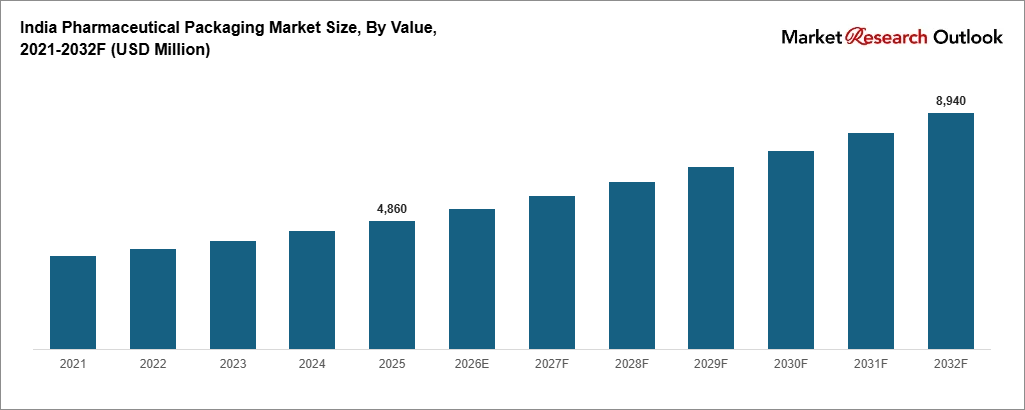
The India pharmaceutical packaging market size is witnessing steady expansion, driven by record pharmaceutical exports, growing domestic drug consumption, rising output of biologics and vaccines, stricter serialization rules, and major capacity additions by global and Indian packaging companies. Valued at USD 4,860 million in 2025 and projected to reach USD 8,940 million by 2032, growing at a CAGR of 9.1%, the India pharmaceutical packaging market growth is being fuelled by strong demand from generic drug makers, CDMOs, and vaccine producers, alongside fast growth of hospital and online pharmacy channels across tier-1 and tier-2 cities. Plastics and polymers lead material consumption, while prefilled syringes and cartridges are emerging as the fastest growing product category. Rising demand for drug stability, patient safety, and anti-counterfeit protection is reshaping the supply base. As packaging majors including SCHOTT Poonawalla, Gerresheimer, Amcor, UFlex, and ACG expand capacity, and drug makers such as Sun Pharma, Dr. Reddy’s, Cipla, Lupin, and Serum Institute of India scale output for regulated markets, the India pharmaceutical packaging market is evolving into a compliance-led, innovation-driven, and export-ready industry with strong long-term growth potential.
Key Report Takeaways: India Pharmaceutical Packaging Market
- The India pharmaceutical packaging market size is projected to grow from USD 4,860 million in 2025 to USD 8,940 million by 2032, registering a strong CAGR of 9.1%, driven by record pharma exports, rising biologics and injectable output, and the structural shift toward high-barrier and serialized packaging across India.
- Plastics and polymers dominate the India pharmaceutical packaging market, accounting for over 41% of total revenue in 2025, driven by wide use of PVC and PVDC blister films, HDPE bottles, and PP closures for oral solid doses, which make up the bulk of India’s generic drug output.
- Prefilled syringes and cartridges are emerging as the fastest growing segment in the India pharmaceutical packaging market, expected to grow at 12% to 15% annually as biologics, vaccines, insulin, and GLP-1 therapies scale across domestic and export supply chains.
- India’s base of around 3,000 drug companies and 10,500 manufacturing units, along with pharma exports of USD 30.47 billion in FY25, is structurally expanding the India pharmaceutical packaging market across oral, injectable, and topical drug categories.
- Rising investments by packaging majors such as SCHOTT Poonawalla, Gerresheimer, SGD Pharma, UFlex, and ACG in glass tubing, vial lines, blister films, and cleanroom capacity are strengthening local supply and supporting the India pharmaceutical packaging market forecast 2032.
Key Market Drivers: India Pharmaceutical Packaging Market
Expanding Pharmaceutical Production and Record Export Growth Driving Packaging Demand Across India
Growth in the India pharmaceutical packaging market is being driven by rising drug production and record export volumes. India is the third largest drug producer in the world by volume, and its pharmaceutical exports rose 9.4% to USD 30.47 billion in FY25, with the United States taking about 34% of shipments. The domestic pharma industry is valued at around USD 60 billion and is projected to reach USD 130 billion by 2030. Every exported strip, bottle, and vial needs packaging that meets USFDA, EU GMP, and WHO norms, which lifts demand for validated, high-barrier materials. India also has one of the largest counts of USFDA-compliant plants outside the United States, and these sites buy premium blister films, Type I glass, and serialized cartons. Generic formulations make up a large share of output, and each new product launch adds fresh packaging volume. The PLI scheme for pharmaceuticals, with an outlay of INR 15,000 crore, is adding new capacity, creating strong structural pull-through demand across the India pharmaceutical packaging market.
Rising Healthcare Spending, Chronic Disease Burden, and Expanding Pharmacy Retail Fuelling Packaged Medicine Consumption
The India pharmaceutical packaging market is benefiting from steady growth in healthcare spending, wider insurance cover, and a rising burden of chronic disease. India has more than 100 million people living with diabetes, and long-term therapies for diabetes, heart disease, and respiratory illness need monthly packs, unit-dose blisters, and pens. Ayushman Bharat and state health schemes have widened access to medicines, while Jan Aushadhi Kendras now number over 15,000 outlets, each selling large volumes of packed generics. India’s retail pharmacy network exceeds 8 lakh chemists, and online pharmacies such as Tata 1mg, PharmEasy, Netmeds, and Apollo 24|7 are adding demand for tamper-evident, transit-safe, and compact packs. Older and urban patients prefer easy-open, dose-marked, and child-resistant formats. Growing trust in branded generics and wider rural distribution have further raised the need for durable packs that protect drugs in hot and humid conditions, supporting volume growth across the India pharmaceutical packaging market.
Growth in Biologics, Vaccines, and Injectables Strengthening Demand for Advanced Primary Packaging
Rapid growth in biologics, biosimilars, vaccines, and injectables is a major catalyst for the India pharmaceutical packaging market, with injectable packaging projected to grow at 11% to 13% annually through 2032. India supplies a large share of the world’s vaccines, led by Serum Institute of India, Bharat Biotech, and Biological E, and every dose needs sterile vials, ampoules, stoppers, or syringes. Biologics and GLP-1 therapies call for Type I borosilicate glass, low-extractable elastomers, and silicone-controlled prefilled syringes. SCHOTT began local production of syringe and cartridge glass tubing at Jambusar, Gujarat, in August 2025, and SCHOTT Glass India has planned a further INR 150 crore expansion at the site. SCHOTT Poonawalla, the joint venture with Serum Institute of India, produces vials, ampoules, cartridges, and prefilled syringes at scale. Biosimilar launches by Biocon, Intas, Dr. Reddy’s, and Zydus, combined with growing insulin and oncology volumes, are structurally expanding India pharmaceutical packaging market growth across all major injectable categories through 2032.
Key Market Challenges: India Pharmaceutical Packaging Market
Volatility in Polymer Resin, Aluminium Foil, and Borosilicate Glass Prices Impacting Overall Packaging Margins
The India pharmaceutical packaging market continues to face challenges around raw material price volatility and margin pressure across the value chain. Prices of PVC, PET, and HDPE resins moved by 15% to 25% between 2022 and 2025, while aluminium foil used in cold-form and push-through blisters rose by 10% to 18% over the same period. Borosilicate glass tubing and furnace energy costs have also climbed, adding pressure on vial and ampoule makers. Drug makers, especially generic exporters, negotiate hard on price, so packaging suppliers often cannot pass full cost increases through. Average EBITDA margins for Indian pharma packaging converters range between 12% and 18%, and a sharp resin or foil swing can cut margins by 2% to 4% in a single quarter. Smaller converters with limited buying power and weak hedging feel this most. These cost swings slow new capacity decisions and remain a near-term challenge for the India pharmaceutical packaging market.
Stringent Regulatory Compliance, Track-and-Trace Mandates, and Revised Schedule M Raising Operational Costs for Packaging Suppliers
The India pharmaceutical packaging market faces rising complexity from stricter quality rules at home and abroad. Revised Schedule M, notified in December 2023, raised GMP standards for drug plants, and its rollout to MSME units has pushed many small drug makers to upgrade packaging lines and supplier audits. QR codes became mandatory on the top 300 drug brands in August 2023 and on APIs from January 2023, while DGFT track-and-trace rules apply serialization to export packs. Each change needs new printers, vision systems, aggregation software, and validated artwork, with line upgrade costs often ranging between INR 50 lakh and INR 2 crore. Packaging suppliers must also meet ISO 15378, extractables and leachables testing, and buyer audits from USFDA and EU regulated customers. Differences in rules across export markets add further work. While these norms raise quality, compliance costs remain a near-term challenge for small converters across the India pharmaceutical packaging market.
Dependence on Imported Pharmaceutical-Grade Glass Tubing and Specialty Materials Restricting Supply Flexibility
The India pharmaceutical packaging market faces practical constraints around import dependence for key high-grade materials. A large share of Type I borosilicate glass tubing, cyclic olefin polymers, PVDC and Aclar films, high-grade elastomers, and specialty coatings is still imported, with imports estimated to meet 45% to 55% of demand for these inputs in 2025. Long lead times, currency swings, and freight costs can add 6% to 10% to landed cost, and supply shocks during the COVID-19 vaccine surge showed how quickly shortages can delay fill-finish runs. Qualification of a new material source can take 12 to 18 months because drug makers must file changes with regulators. Local production of syringe and cartridge tubing by SCHOTT and capacity growth by Gerresheimer and SGD Pharma are easing the gap, but specialty films and elastomers remain barriers to full self-reliance across the India pharmaceutical packaging market.
Key Market Trends: India Pharmaceutical Packaging Market
Rapid Adoption of Sustainable, Recyclable, and Mono-Material Pharmaceutical Packaging in India
The India pharmaceutical packaging market is undergoing a clear material shift toward sustainable, recyclable, and mono-material packaging, with these formats expected to account for over 15% of new packaging launches by 2028. The Plastic Waste Management Rules and their 2024 amendment place Extended Producer Responsibility targets on brand owners, including drug makers, pushing them to cut virgin plastic and improve recyclability. Global buyers in Europe and the United States are also asking Indian exporters for lower-carbon packs. Suppliers such as UFlex, Amcor, Huhtamaki, and ACG have launched recyclable PET and PP-based blister films, PVC-free laminates, and lighter bottles through 2024 and 2025. Paper-based secondary packs and recycled-content cartons are gaining ground in OTC and nutraceutical lines, where regulatory change is simpler. This material transition is reinforcing the India pharmaceutical packaging market forecast 2032 across both domestic and export categories.
Growth of Smart Packaging, Serialization, and Anti-Counterfeit Technologies in the India Pharmaceutical Packaging Market
A clear shift toward smart packaging, serialization, and anti-counterfeit features is reshaping the India pharmaceutical packaging market, particularly in branded and export segments. QR codes on the top 300 drug brands let patients and pharmacists check the batch, maker, and expiry date with a phone scan, and exporters now serialize at unit, carton, and shipper level. Tamper-evident seals, holograms, and printed security inks are being added to high-value brands, oncology drugs, and vaccines. Smart labels with NFC tags and temperature indicators are being tested for cold-chain biologics. Packaging firms and serialization partners are building turnkey line solutions for mid-sized drug makers, cutting setup time. By 2025, an estimated 35% to 40% of Indian pharma packaging lines by value had some form of serialization, up from less than 15% in 2020, with branded drug makers increasingly treating packaging as a brand protection tool.
Capacity Expansion by Global and Domestic Packaging Majors and Prefilled Syringe Investments
A wave of capacity expansion and prefilled syringe investment is reshaping the India pharmaceutical packaging market supply base. Combined India-focused capital spending announcements in pharma glass, polymer containers, blister films, and cleanroom packaging exceeded USD 600 million across 2023 to 2025. SCHOTT added syringe and cartridge tubing at Jambusar and has invested over INR 1,000 crore in India since 2019, SCHOTT Poonawalla expanded vial and syringe output with TPG acquiring a 35% stake, Gerresheimer ramped up glass and plastic capacity in India, SGD Pharma grew its Type I vial output, and ACG and UFlex added blister film lines. The PLI scheme for pharmaceuticals, the PLI scheme for bulk drugs with INR 6,940 crore, and bulk drug park projects have structurally favoured organized supply. Combined with rising biologics output and export demand, these developments are reinforcing the India pharmaceutical packaging market forecast 2032 across the entire value chain.
Segmental Insights: India Pharmaceutical Packaging Market
By End-User: Pharmaceutical Manufacturers Segment Dominates the India Pharmaceutical Packaging Market
The pharmaceutical manufacturers end-user segment dominates the India pharmaceutical packaging market, accounting for an estimated 46% to 50% of total revenue, driven by large in-house packing at generic and branded drug plants, rising export volumes, and steady product launches. Blister packs and HDPE bottles are the dominant formats within this segment, with oral solid doses making up over 65% of manufacturer packaging demand. The contract packaging organizations segment contributes another 20% to 23% of demand, driven by mid-sized drug makers outsourcing serialization, blister, and bottle packing. Contract manufacturing organizations account for 18% to 20%, led by CDMO growth in injectables and biologics. Retail and online pharmacies make up the rest, mainly through repacking and secondary packs. In 2025, leading drug makers including Sun Pharma, Dr. Reddy’s, Cipla, Lupin, and Aurobindo scaled up packaging line automation, reinforcing segment dominance in the India pharmaceutical packaging market.
By Product Type: Blister Packs Lead While Prefilled Syringes and Cartridges Grow Fastest
Blister packs lead the India pharmaceutical packaging market product landscape, accounting for approximately 29% of total revenue, driven by India’s large output of tablets and capsules, strong moisture protection, and unit-dose convenience. Bottles and containers contribute another 21% to 23%, primarily for oral liquids, large-count tablets, and export packs. Vials and ampoules account for 14% to 16%, supported by vaccine and generic injectable production. Prefilled syringes and cartridges are the fastest growing category within the India pharmaceutical packaging market, expanding at 12% to 15% annually, driven by biologics, insulin, GLP-1 therapies, and dose accuracy benefits. Pouches, sachets, strip packs, caps, and closures together account for the rest of the market, with recyclable pouches expected to grow rapidly through 2032. Leading suppliers including SCHOTT Poonawalla, Gerresheimer, UFlex, ACG, and Bilcare have aligned product portfolios to this mix, driving premium packaging adoption across the India pharmaceutical packaging market.
Regional Insights: India Pharmaceutical Packaging Market
Regional analysis of the India pharmaceutical packaging market shows that West India and South India together account for approximately 60% to 64% of total revenue, driven by Gujarat (Ahmedabad, Vadodara, and Jambusar), Maharashtra (Mumbai, Pune, and Aurangabad), Telangana (Hyderabad’s Genome Valley), Andhra Pradesh (Visakhapatnam pharma city), and Karnataka (Bengaluru biologics cluster), supported by large drug plants, export ports, and packaging supplier hubs. North India contributes around 22% to 25% of demand, led by Himachal Pradesh (Baddi), Uttarakhand, Punjab, and Haryana, supported by large formulation clusters making generics for domestic sale. Central and East India together account for 12% to 15% of demand, supported by Madhya Pradesh (Pithampur), Sikkim, West Bengal, and Odisha, where new plants are coming up. In 2025, capacity additions by SCHOTT in Gujarat, Gerresheimer in Gujarat, and blister film suppliers in Maharashtra and Uttarakhand reinforced regional supply hubs across the India pharmaceutical packaging market.
Related data: see the India Drug Quality Alerts Tracker for drug samples flagged not of standard quality, and the India Packaging Films Capacity Tracker for packaging film capacity across India.
Recent Developments: India Pharmaceutical Packaging Market
- The India pharmaceutical packaging market witnessed strong momentum in exports and capacity progress during 2024 and 2025. Pharmaceutical exports reached USD 30.47 billion in FY25, up 9.4% from USD 27.85 billion in FY24, with March 2025 exports rising about 31% year-on-year. The US market alone took around USD 8.95 billion of Indian medicines, up 14.29%, adding steady demand for export-grade packs. Organized pharma packaging volume in India is projected to reach 1.25 to 1.35 trillion units by FY27 from around 1.05 trillion units in FY25, growing at an average 9% annually.
- Global and domestic packaging majors have deepened India-focused capacity expansion. In August 2025, SCHOTT began producing syringe and cartridge glass tubing at Jambusar, Gujarat, making it Asia’s largest producer of these tubes, and SCHOTT Glass India later announced a further INR 150 crore investment at the site. SCHOTT Poonawalla continued to scale vials, ampoules, cartridges, and prefilled syringes, Gerresheimer added glass and plastic capacity in India, and blister film suppliers grew recyclable film output. These developments are strengthening domestic supply and supporting the India pharmaceutical packaging market forecast 2032.
- Smart and compliant packaging momentum has gained strong traction in the India pharmaceutical packaging market. In 2025, leading drug makers and contract packers including Sun Pharma, Cipla, Dr. Reddy’s, Lupin, and Serum Institute of India widened QR code, serialization, and tamper-evident features across brands. Strategic partnerships between global packaging majors and Indian CDMOs are positioning India as one of the most actively scaling pharmaceutical packaging markets globally, strengthening long-term competitive positioning in the India pharmaceutical packaging market forecast 2032.
Key Market Players: India Pharmaceutical Packaging Market
- SCHOTT Poonawalla Private Limited
- Gerresheimer AG (Gerresheimer India)
- Amcor plc (Amcor Flexibles India)
- Huhtamaki India Limited
- UFlex Limited
- EPL Limited
- ACG Group (ACG Films & Foils)
- Bilcare Limited
- West Pharmaceutical Packaging India Pvt. Ltd.
- SGD Pharma India Limited
- PGP Glass Private Limited
- Hindustan National Glass & Industries Limited
- Aptar Pharma India Pvt. Ltd.
| By Material | By Product Type | By Drug Delivery Mode | By Drug Type | By End-User |
| Plastics & Polymers (PVC, PET, HDPE, PP) Glass (Type I, Type II, Type III) Aluminium Foil & Metal Paper & Paperboard Bio-Based & Composite Materials Others |
Bottles & Containers Blister Packs Vials & Ampoules Prefilled Syringes & Cartridges Pouches, Sachets & Strip Packs Caps & Closures Others (Tubes, Labels, Cartons) |
Oral Injectable (Parenteral) Topical Inhalation & Nasal Others |
Generic Formulations Branded Formulations Biologics & Biosimilars Vaccines OTC & Nutraceuticals Active Pharmaceutical Ingredients (APIs) |
Pharmaceutical Manufacturers Contract Packaging Organizations Contract Manufacturing Organizations Retail & Online Pharmacies |
Report Scope
In this report, the India Pharmaceutical Packaging Market has been segmented into the following categories, in addition to detailed analysis of key industry trends, market dynamics, competitive landscape, and growth opportunities across the forecast period:
- By Material
- Plastics & Polymers (PVC, PET, HDPE, PP)
- Glass (Type I, Type II, Type III)
- Aluminium Foil & Metal
- Paper & Paperboard
- Bio-Based & Composite Materials
- Others
- By Product Type
- Bottles & Containers
- Blister Packs
- Vials & Ampoules
- Prefilled Syringes & Cartridges
- Pouches, Sachets & Strip Packs
- Caps & Closures
- Others (Tubes, Labels, Cartons)
- By Drug Delivery Mode
- Oral
- Injectable (Parenteral)
- Topical
- Inhalation & Nasal
- Others
- By Drug Type
- Generic Formulations
- Branded Formulations
- Biologics & Biosimilars
- Vaccines
- OTC & Nutraceuticals
- Active Pharmaceutical Ingredients (APIs)
- By End-User
- Pharmaceutical Manufacturers
- Contract Packaging Organizations
- Contract Manufacturing Organizations
- Retail & Online Pharmacies
- By Geography
- North India
- South India
- West India
- East India
- Central India
Competitive Landscape
Company Profiles:
Detailed analysis of the leading companies operating in the India Pharmaceutical Packaging Market, including business overview, product portfolio, strategic initiatives, competitive positioning, and recent developments.
Company Information
Detailed profiling and strategic analysis of additional market players (up to five companies), including emerging domestic packaging converters, specialty glass and polymer producers, contract packaging firms, or niche state-level blister and bottle suppliers.
For a free sample of the India Pharmaceutical Packaging Market report, customised insights or delivery timelines, submit your query here
India Pharmaceutical Packaging Market, 2032
- Research Framework
- Market Segmentation
- Research Objective
- Research Methodology
- Qualitative Research
- Primary Research
- Secondary Research
- Quantitative Research
- Market Breakdown & Data Triangulation
- Demand Side
- Supply Side
- Primary Research Respondents
- Assumption & Limitation
- Executive Summary
- Market Overview, 2021-2032
- By Material
- By Product Type
- By Drug Delivery Mode
- By Drug Type
- By End-User
- By Region
- Analyst Recommendations
- Geopolitical Impact on India Pharmaceutical Packaging Market
- India Pharmaceutical Packaging Market Insights
- Market Dynamics
- Growth Drivers
- Expanding pharmaceutical production and record export growth driving packaging demand across India.
- Rising healthcare spending, chronic disease burden, and expanding pharmacy retail fuelling packaged medicine consumption.
- Growth in biologics, vaccines, and injectables strengthening demand for advanced primary packaging.
- Restraints
- Volatility in polymer resin, aluminium foil, and borosilicate glass prices impacting overall packaging margins.
- Stringent regulatory compliance, track-and-trace mandates, and revised Schedule M raising operational costs for packaging suppliers.
- Dependence on imported pharmaceutical-grade glass tubing and specialty materials restricting supply flexibility.
- Opportunities
- Prefilled syringes, cartridges, and biologics packaging opening high-value growth pools across injectable drug manufacturing.
- Sustainable, recyclable, and mono-material packaging supporting next-generation compliance with EPR rules and global buyer needs.
- Smart packaging, serialization, and anti-counterfeit technologies creating major value-added opportunities for export-oriented drug makers.
- Challenges
- Intense price competition from unorganized and small-scale regional packaging converters.
- Limited domestic capacity for Type I borosilicate glass and specialty pharma-grade polymers.
- Maintaining consistent quality, sterility, and regulatory compliance at scale across diverse export markets.
- Technological Advancements
- Recent Technological Advancements
- Prior to 2020
- Porter’s Five Forces Analysis
- PESTLE Analysis
- Industry Value Chain & Entry Points
- Upstream Raw Materials (PVC, PET, HDPE and PP resins, borosilicate glass tubing, aluminium foil, paperboard, elastomers)
- Primary Packaging Manufacturers (SCHOTT Poonawalla, Gerresheimer, SGD Pharma, PGP Glass, West Pharmaceutical)
- Flexible Packaging & Blister Film Suppliers (UFlex, ACG Films & Foils, Bilcare, Amcor, Huhtamaki)
- Closures, Elastomers & Drug Delivery Components (rubber stoppers, seals, droppers, dispensing systems)
- Quality Control, Testing & Validation Laboratories (CDSCO, BIS, IP, USP, ISO 15378 standards)
- Contract Packaging & Serialization Service Providers (blister, bottle, and track-and-trace services)
- Pharmaceutical Manufacturers & CDMOs (Sun Pharma, Dr. Reddy’s, Cipla, Lupin, Serum Institute of India)
- Distributors, C&F Agents & Cold-Chain Logistics (B2B pharma distribution networks)
- Retail Channels & Online Pharmacies (Apollo Pharmacy, MedPlus, Tata 1mg, PharmEasy, Netmeds)
- End-Users (hospitals, clinics, retail pharmacies, patients, government health programs)
- India Pharmaceutical Packaging Market: Regulatory Framework
- India Pharmaceutical Packaging Market Overview
- Market Size & Forecast, 2021-2032
- By Value (USD Million)
- By Volume (Million Units)
- Market Share & Forecast
- By Material
- Plastics & Polymers (PVC, PET, HDPE, PP)
- Glass (Type I, Type II, Type III)
- Aluminium Foil & Metal
- Paper & Paperboard
- Bio-Based & Composite Materials
- Others
- By Product Type
- Bottles & Containers
- Blister Packs
- Vials & Ampoules
- Prefilled Syringes & Cartridges
- Pouches, Sachets & Strip Packs
- Caps & Closures
- Others (Tubes, Labels, Cartons)
- By Drug Delivery Mode
- Oral
- Injectable (Parenteral)
- Topical
- Inhalation & Nasal
- Others
- By Drug Type
- Generic Formulations
- Branded Formulations
- Biologics & Biosimilars
- Vaccines
- OTC & Nutraceuticals
- Active Pharmaceutical Ingredients (APIs)
- By End-User
- Pharmaceutical Manufacturers
- Contract Packaging Organizations
- Contract Manufacturing Organizations
- Retail & Online Pharmacies
- By Geography
- North India
- South India
- West India
- East India
- Central India
- Competitive Landscape
- India Pharmaceutical Packaging Market Company Market Share Analysis, 2025
- Competitive Benchmarking, By Operating Parameters
- Key Strategic Development (Mergers, Acquisitions, Partnerships, Etc.)
- List of Emerging Players
- Company Profile
- SCHOTT Poonawalla Private Limited
- Introduction & Company Profile
- Product Benchmarking
- Strategic Outlook
- Key Competitors
- Financial Analysis
- SWOT Analysis
(Same Data Pointers Will Be Provided for The Below Companies)
- Gerresheimer AG (Gerresheimer India)
- Amcor plc (Amcor Flexibles India)
- Huhtamaki India Limited
- UFlex Limited
- EPL Limited
- ACG Group (ACG Films & Foils)
- Bilcare Limited
- West Pharmaceutical Packaging India Pvt. Ltd.
- SGD Pharma India Limited
- PGP Glass Private Limited
- Hindustan National Glass & Industries Limited
- Aptar Pharma India Pvt. Ltd.
- Other Prominent Players
* Financial information in case of non-listed companies will be provided as per availability
** The segmentation and the companies are subjected to modifications based on in-depth secondary for the final deliverable
Frequently Asked Questions
1. How large is the India pharmaceutical packaging market and what is its growth forecast?
Ans: The India pharmaceutical packaging market is valued at USD 4,860 million in 2025 and is projected to reach USD 8,940 million by 2032, growing at a CAGR of 9.1%.
2. Which segments are driving demand in the India pharmaceutical packaging market?
Ans: Plastics and polymers lead with over 41% revenue share, blister packs lead product types, and prefilled syringes and cartridges are the fastest growing segment at 12% to 15% annually.
3. What are the key drivers of growth in the India pharmaceutical packaging market?
Ans: Key drivers include record pharma exports of USD 30.47 billion in FY25, rising healthcare spending, chronic disease growth, and fast expansion of biologics, vaccines, and injectables.
4. Which regions are driving growth in the India pharmaceutical packaging market?
Ans: West India and South India lead with 60% to 64% of revenue, driven by Gujarat, Maharashtra, Telangana, Andhra Pradesh, and Karnataka. North India follows, led by Baddi in Himachal Pradesh.
5. What are the latest trends in the India pharmaceutical packaging market?
Ans: Key trends include recyclable mono-material packs, QR code and serialization rollout, anti-counterfeit features, and new capacity for Type I glass and prefilled syringes.