

India Active Pharmaceutical Ingredients (API) Market, 2032
- Pharmaceuticals & Life Sciences
- Nov 2026
- Pages 140
- Report Format: pdf
- Report Price: $2400 USD
India’s active pharmaceutical ingredients market is witnessing strong structural growth, driven by the PLI scheme for bulk drugs, development of three bulk drug parks, China+1 sourcing by global generic buyers, rising domestic formulation demand, rapid growth in HPAPIs and peptide APIs, the March 2026 semaglutide patent expiry, and rising interest from domestic and global pharma majors investing in KSM integration, complex chemistry capacity, and CDMO platforms across the India API market.
| Study Duration | 2021-2032 |
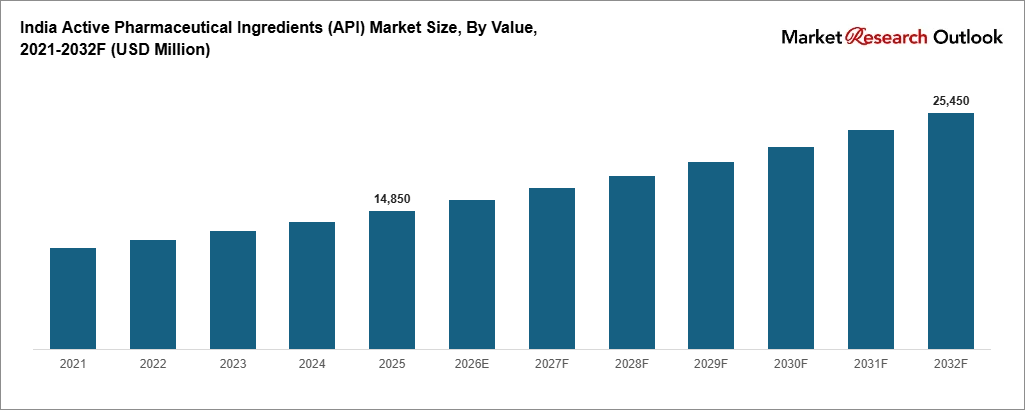
| Market Size (2025) | USD 14,850 Million |
| CAGR (2026-2032) | 8.0% |
| Leading Segment | Generic APIs (Small Molecule) |
| Fastest Growing Segment | HPAPIs & Peptide APIs |
| Market Size (2032) | USD 25,450 Million |
Market Overview: India Active Pharmaceutical Ingredients (API) Market
The India API market size is witnessing steady expansion, driven by the PLI scheme for bulk drugs, development of bulk drug parks, China+1 sourcing by global pharma buyers, rising domestic formulation demand, growing demand for complex APIs and high potency molecules, and major capacity additions by domestic API majors. Valued at USD 14,850 million in 2025 and projected to reach USD 25,450 million by 2032, growing at a CAGR of 8.0%, the India API market growth is being fuelled by strong export demand from the US and Europe, a domestic pharmaceutical market of about USD 60 billion, and the rapid scaling of CDMO services for global innovators. Generic APIs lead the India API market, while HPAPIs and peptide APIs are emerging as the fastest growing categories. Within the India API market, shifting buyer preferences toward reliable second sources, growing focus on supply chain security, and rising demand for oncology, diabetes, and cardiovascular molecules are reshaping the India API market supply landscape. As domestic majors including Divi’s Laboratories, Sun Pharma, Dr. Reddy’s, Aurobindo Pharma, and Laurus Labs expand integrated KSM-to-API capacity, and CDMO players including Piramal Pharma, Neuland Laboratories, and Granules India scale complex chemistry platforms, the India API market is evolving into a quality-led, innovation-driven, and export-oriented ecosystem with strong long-term growth potential.
Key Report Takeaways: India API Market
- The India API market size is projected to grow from USD 14,850 million in 2025 to USD 25,450 million by 2032, registering a strong CAGR of 8.0%, driven by PLI-backed capacity creation, China+1 sourcing, and the structural shift toward complex and specialty APIs across the India API market.
- Generic APIs dominate the India API market, accounting for about 71% of total value in 2025, driven by India’s role as a leading supplier of affordable generics, deep expertise in small molecule chemistry, a large base of USFDA and EU GMP approved plants, and strong demand from domestic and export formulation makers, reinforcing India API market share leadership in small molecules.
- HPAPIs and peptide APIs are emerging as the fastest growing segments in the India API market, expected to grow at 12% to 15% annually as oncology pipelines widen, GLP-1 generics scale after the March 2026 semaglutide patent expiry, and global innovators shift complex chemistry work to the India API market.
- Strong policy support for the India API market, with 48 projects approved under the INR 6,940 crore PLI scheme for bulk drugs and three bulk drug parks under development in Gujarat, Himachal Pradesh, and Andhra Pradesh, is structurally expanding the India API market across KSMs, intermediates, and finished APIs.
- Rising investments by domestic API majors such as Divi’s Laboratories, Aurobindo Pharma, Laurus Labs, Granules India, and Neuland Laboratories in backward integration, containment suites, peptide capacity, and green chemistry are strengthening India API market supply and supporting the India API market forecast 2032.
Key Market Drivers: India API Market
PLI Scheme, Bulk Drug Parks, and Policy Support Driving Domestic Manufacturing in the India API Market
Growth in the India API market is being driven by strong policy support for domestic bulk drug production. For the India API market, the PLI scheme for bulk drugs, with an outlay of INR 6,940 crore, targets 41 critical KSMs, drug intermediates, and APIs where India was highly import dependent. As of June 2026, 48 projects had been approved, investment had crossed INR 5,210 crore, and 39 projects covering 28 products had been commissioned. Notable India API market plants include a Penicillin G facility at Kakinada in Andhra Pradesh with 15,000 MT annual capacity and a Potassium Clavulanate unit at Nalagarh in Himachal Pradesh. In parallel, the INR 3,000 crore Scheme for Promotion of Bulk Drug Parks is funding common infrastructure at Jambusar in Gujarat, Haroli in Himachal Pradesh, and Nakkapalli in Andhra Pradesh, with central grants of INR 1,000 crore per park. The wider INR 15,000 crore PLI scheme for pharmaceuticals is adding India API market demand for complex generics and specialty molecules, creating strong structural pull-through demand across the India API market.
Rising Global Generic Demand, Patent Expiries, and China+1 Sourcing Fuelling Export-Led API Growth
The India API market is benefiting from sustained growth in global generic consumption, with India’s pharmaceutical exports reaching USD 30.47 billion in FY25, up 9.4% year-on-year, according to Pharmexcil. Bulk drugs and drug intermediates contributed about USD 4.32 billion of these exports, and India’s API exports of nearly INR 41,500 crore moved ahead of API imports in FY25. India ranks as the third largest API producer globally, giving the India API market an estimated 8% share of the global API industry, and it supplies around 57% of WHO-prequalified APIs. Large patent expiries across cardiovascular, diabetes, and oncology molecules through 2030, along with China+1 sourcing strategies by US and European buyers, are pushing more volume into the India API market, especially toward suppliers with approved DMFs and CEPs. These trends are supporting price competitiveness and volume growth across the India API market, especially in regulated markets where filing depth and inspection history matter most.
Growth in Complex APIs, HPAPIs, Peptides, and CDMO Capabilities Strengthening Value-Added Segment Growth
Rapid growth in complex and specialty APIs is a major catalyst for the India API market, with the HPAPI and peptide API segments projected to grow at 12% to 15% annually through 2032. The patent expiry of semaglutide in India on March 20, 2026 triggered launches by Natco Pharma, Sun Pharma, Dr. Reddy’s, Zydus Lifesciences, and Glenmark, creating fresh India API market demand for peptide API synthesis and purification capacity. Oncology pipelines are lifting India API market demand for HPAPIs that require containment at Occupational Exposure Limits below 1 microgram per cubic metre. Indian CDMOs, a fast-growing part of the India API market, are on track to grow from USD 3 to 3.5 billion in 2025 to more than USD 20 billion by 2035 and are adding peptide, oligonucleotide, and high potency suites for global innovators. Leading India API market players such as Divi’s Laboratories, Laurus Labs, Neuland Laboratories, Piramal Pharma, and Aurobindo Pharma have scaled complex API pipelines, structurally expanding India API market growth across all major end-user categories through 2032.
Key Market Challenges: India API Market
High Import Dependence on China for KSMs and Intermediates Limiting Supply Chain Resilience
The India API market continues to face challenges around high dependence on Chinese key starting materials and intermediates. China’s share of India’s bulk drug import value rose from about 68% in FY20 to nearly 72% in FY24, and API import volumes from China grew by around 30% between 2021 and 2024. While PLI plants in the India API market have started production of several critical molecules, most new capacity is still stabilising, and many fermentation-based inputs such as antibiotic intermediates remain cheaper to import. Any disruption at Chinese plants or ports can quickly raise KSM prices across the India API market and delay batches for Indian API makers. This continued reliance limits supply chain resilience and margin visibility for small and mid-sized players across the India API market.
Stringent Regulatory Compliance and Revised Schedule M Norms Raising Costs for MSME API Units
The India API market faces structural complexity from tighter quality rules at home and abroad. Revised Schedule M, aligned with WHO GMP norms, has applied to all pharmaceutical units in India since January 1, 2026, including around 8,500 MSME units that earlier received an extension. India API market compliance now requires pharmaceutical quality systems, quality risk management, validated equipment, and in many cases structural civil work that can take 12 to 18 months. Export-focused plants in the India API market must also clear USFDA, EDQM, and other regulator inspections, where warning letters or import alerts can halt shipments for long periods. Rising audit frequency, data integrity expectations, and documentation costs are adding operational pressure on smaller players, making compliance a near-term challenge for the India API market.
Volatility in Raw Material, Solvent, and Energy Prices Impacting India API Market Margins
The India API market faces practical constraints around raw material price swings, solvent cost inflation, and energy expenses across the value chain. Prices of key starting materials and solvents sourced from China have moved by 10% to 25% in short cycles over recent years, while power, steam, and effluent treatment costs have risen steadily in major API clusters. At the same time, generic price erosion of 5% to 8% annually in the US market limits the ability of the India API market to pass on cost increases. Average EBITDA margins in the India API market range between 18% and 26%, and sharp input swings can cut this by 3% to 6% within a few quarters. Backward integration, solvent recovery, and green chemistry are emerging as solutions, but high upfront capital needs remain a barrier for wider adoption across the India API market.
Key Market Trends: India API Market
Rapid Adoption of HPAPIs, Peptide APIs, and GLP-1 Molecules in India
The India API market is undergoing a clear technology shift toward high potency, peptide, and GLP-1 molecules, with these advanced categories expected to account for over 15% of new API capacity additions by 2028. Oncology drugs, antibody drug conjugate payloads, and hormone therapies are driving demand for HPAPI suites with closed transfer systems and isolators. After the semaglutide patent expiry in March 2026, more than 40 Indian companies announced plans for generic versions, which has lifted India API market interest in solid phase and hybrid peptide synthesis. Leading India API market players including Divi’s Laboratories, Neuland Laboratories, Laurus Labs, Dr. Reddy’s, and Sun Pharma have expanded peptide and complex API capacity through 2025 and 2026. Oligonucleotide building blocks and biotech APIs are also gaining traction, particularly in Hyderabad and Bengaluru, where biotech clusters are deepening. This product transition is reinforcing the India API market forecast 2032 across both domestic and export categories.
Growth of CDMO Partnerships, Continuous Manufacturing, and Green Chemistry in the India API Market
A clear shift toward CDMO partnerships, continuous manufacturing, and green chemistry is reshaping the India API market, particularly in the regulated export segment. Global innovators are moving early and late phase molecules into the India API market through Indian CDMOs to diversify supply, with Indian players offering development cost savings of 30% to 40% compared with Western sites. Continuous flow reactors are cutting batch cycle times by 20% to 40% and solvent use by up to 50% for selected steps, while biocatalysis is improving yields for chiral molecules. Leading CDMO and API players in the India API market, such as Piramal Pharma, Divi’s Laboratories, Laurus Labs, Granules India, and Aurobindo Pharma, are investing in digital batch records, process analytical technology, and zero liquid discharge plants. By 2025, CDMO and custom synthesis work accounted for an estimated 12% of India API market revenue, with regulated market clients increasingly preferring partners with clean inspection records and strong process chemistry teams.
Capacity Expansion by Domestic API Majors and Bulk Drug Park Investments
A wave of domestic capacity expansion and bulk drug park investment is reshaping the India API market supply landscape. Cumulative India API market investment under the PLI scheme for bulk drugs crossed INR 5,210 crore by June 2026, exceeding committed investment, and commissioned PLI capacity reached about 56,800 MT per annum by December 2025. Aurobindo Pharma’s subsidiary Lyfius Pharma set up the Penicillin G project at Kakinada with an investment of about INR 1,910 crore, Divi’s Laboratories expanded custom synthesis and generic API capacity in Andhra Pradesh, Laurus Labs grew its CDMO and API footprint in Visakhapatnam, and Granules India strengthened its paracetamol and metformin value chain. Three bulk drug parks at Jambusar, Haroli, and Nakkapalli, with combined project costs of over INR 6,300 crore, will offer India API market participants common effluent treatment, solvent recovery, and utilities. Combined with India API market export growth and complex generic demand, these developments are reinforcing the India API market forecast 2032 across the entire value chain.
Segmental Insights: India API Market
By End-User: Pharmaceutical Companies Segment Dominates the India API Market
The pharmaceutical companies end-user segment dominates the India API market, accounting for an estimated 64% to 68% of total value, driven by large domestic formulation volumes, strong export demand for finished dosages, and rising captive API use by integrated players. Small molecule generic APIs for cardiovascular, anti-infective, and diabetes therapies are the dominant India API market purchases within this segment. The biotechnology companies segment contributes another 14% to 16% of India API market demand, driven by biologics, peptides, and specialty molecules. CROs and CDMOs account for 12% to 14%, led by outsourced development and commercial supply for global innovators, while research and academic institutes hold 4% to 6%. In 2025, leading India API market players including Sun Pharma, Dr. Reddy’s, Aurobindo Pharma, Cipla, and Lupin scaled captive and merchant supply to formulation makers, reinforcing segment dominance in the India API market.
By Type: Generic APIs Lead While HPAPIs and Peptide APIs Grow Fastest
Generic APIs lead the India API market type landscape, accounting for approximately 71% of total value, driven by India’s deep chemistry base, cost advantage, and large number of approved DMFs and CEPs. Innovative APIs make up the remaining 29% of the India API market, supported by contract manufacturing for patented molecules and early phase supply. By molecule, small molecule APIs hold over 80% share, while HPAPIs and peptide APIs are the fastest growing categories within the India API market, expanding at 12% to 15% annually, driven by oncology demand, GLP-1 generics, and higher realisation per kilogram. By manufacturer type, merchant API makers lead with about 54% India API market share, followed by captive producers at 34% and CDMOs at 12%. By therapeutic application, cardiovascular APIs lead the India API market with 22% to 24% share, while oncology APIs are growing fastest through 2032. Leading manufacturers including Divi’s, Laurus Labs, Granules India, Ipca Laboratories, and Alivus Life Sciences have aligned portfolios to this mix, driving premium API adoption across the India API market.
Regional Insights: India API Market
Regional analysis of the India API market shows that South India and West India collectively account for approximately 70% to 74% of total API value, driven by Telangana (Hyderabad bulk drug cluster), Andhra Pradesh (Visakhapatnam and Kakinada belt), Karnataka, Tamil Nadu, Gujarat (Ankleshwar, Vapi, Dahej, and Bharuch belt), and Maharashtra, supported by mature chemical infrastructure and a large base of export-approved plants. North India contributes around 16% to 19% of India API market value, led by Himachal Pradesh, Punjab, Haryana, Uttarakhand, and Uttar Pradesh, supported by the Baddi and Nalagarh pharma hub and the upcoming Haroli bulk drug park in Una. Central and East India together account for 8% to 11% of India API market value, supported by Madhya Pradesh, West Bengal, and Odisha, where new industrial parks are attracting API units. In 2025, India API market capacity additions by Divi’s Laboratories and Laurus Labs across Andhra Pradesh, Aurobindo Pharma and Granules India across Telangana and Andhra Pradesh, and Zydus Lifesciences across Gujarat reinforced regional supply hubs, supporting closer execution of domestic and export programs across the India API market.
Pharma data: see the India Pharma Plant Projects Tracker for new API and formulation plants, and the India Pharma Exports Tracker for monthly drug exports by region and product group. The India Drug Market Entry Tracker shows patent expiry, Indian makers and price control for 22 medicines.
Recent Developments: India API Market
- The India API market witnessed strong momentum in approvals and capacity progress during 2025 and 2026. Under the PLI scheme for bulk drugs, 39 projects covering 28 APIs and KSMs were commissioned by June 2026, up from 34 projects for 25 bulk drugs in December 2024. Domestic sales of PLI products reached INR 2,315 crore by September 2025, including exports of INR 508 crore, avoiding imports of about INR 1,807 crore. India’s API exports of nearly INR 41,500 crore in FY25 moved ahead of imports, marking a key milestone for the India API market.
- Domestic API majors have deepened India API market capacity expansion. In 2025 and 2026, Aurobindo Pharma advanced its Penicillin G project at Kakinada through Lyfius Pharma, Divi’s Laboratories expanded custom synthesis and peptide capacity, Laurus Labs grew CDMO operations in Visakhapatnam, Granules India strengthened backward integration for paracetamol and metformin, and Neuland Laboratories scaled peptide and complex API work. Alivus Life Sciences continued to widen its chronic therapy API portfolio. These developments are strengthening domestic supply and supporting the India API market forecast 2032.
- GLP-1 and peptide momentum has gained strong traction in the India API market. On March 20, 2026, semaglutide went off patent in India, and Natco Pharma, Sun Pharma, Dr. Reddy’s, Zydus Lifesciences, and Glenmark launched generic versions within days, with more than 40 companies preparing entries. Strategic India API market partnerships between API makers, formulation brands, and global buyers are positioning India as one of the most actively scaling peptide API hubs globally, strengthening long-term competitive positioning in the India API market forecast 2032.
Key Market Players: India API Market
- Divi’s Laboratories Limited
- Sun Pharmaceutical Industries Limited
- Dr. Reddy’s Laboratories Limited
- Aurobindo Pharma Limited
- Cipla Limited
- Lupin Limited
- Laurus Labs Limited
- Granules India Limited
- Zydus Lifesciences Limited
- Alivus Life Sciences Limited (formerly Glenmark Life Sciences)
- Ipca Laboratories Limited
- Neuland Laboratories Limited
- Piramal Pharma Limited
| By Type | By Molecule | By Manufacturer Type | By Therapeutic Application | By End-User |
| Generic APIs Innovative APIs |
Small Molecule APIs Large Molecule APIs (Biologics) Peptide & Oligonucleotide APIs High Potency APIs (HPAPIs) |
Captive API Manufacturers Merchant API Manufacturers Contract Development & Manufacturing Organizations (CDMOs) |
Cardiovascular Oncology Anti-Infectives Diabetes & Metabolic Disorders Central Nervous System (CNS) Respiratory Pain & Inflammation Others |
Pharmaceutical Companies Biotechnology Companies CROs & CDMOs Research & Academic Institutes |
Report Scope
In this report, the India Active Pharmaceutical Ingredients (API) Market has been segmented into the following categories, in addition to detailed analysis of key industry trends, market dynamics, competitive landscape, and growth opportunities across the forecast period:
- By Type
- Generic APIs
- Innovative APIs
- By Molecule
- Small Molecule APIs
- Large Molecule APIs (Biologics)
- Peptide & Oligonucleotide APIs
- High Potency APIs (HPAPIs)
- By Manufacturer Type
- Captive API Manufacturers
- Merchant API Manufacturers
- Contract Development & Manufacturing Organizations (CDMOs)
- By Therapeutic Application
- Cardiovascular
- Oncology
- Anti-Infectives
- Diabetes & Metabolic Disorders
- Central Nervous System (CNS)
- Respiratory
- Pain & Inflammation
- Others
- By End-User
- Pharmaceutical Companies
- Biotechnology Companies
- CROs & CDMOs
- Research & Academic Institutes
- By Geography
- North India
- South India
- West India
- East India
- Central India
Competitive Landscape
Company Profiles:
Detailed analysis of the leading companies operating in the India Active Pharmaceutical Ingredients (API) Market, including business overview, product portfolio, strategic initiatives, competitive positioning, and recent developments.
Company Information
Detailed profiling and strategic analysis of additional players operating in the India API market (up to five companies), including emerging domestic API makers, specialty HPAPI and peptide producers, regional bulk drug players, or niche CDMO companies.
For a free sample of the India Active Pharmaceutical Ingredients (API) Market report, customised insights or delivery timelines, submit your query here
India Active Pharmaceutical Ingredients (API) Market, 2032
- Research Framework
- Market Segmentation
- Research Objective
- Research Methodology
- Qualitative Research
- Primary Research
- Secondary Research
- Quantitative Research
- Market Breakdown & Data Triangulation
- Demand Side
- Supply Side
- Primary Research Respondents
- Assumption & Limitation
- Executive Summary
- India API Market Overview, 2021-2032
- By Type
- By Molecule
- By Manufacturer Type
- By Therapeutic Application
- By End-User
- By Region
- Analyst Recommendations for India API Market
- Geopolitical Impact on India Active Pharmaceutical Ingredients (API) Market
- India Active Pharmaceutical Ingredients (API) Market Insights
- India API Market Dynamics
- Growth Drivers
- PLI scheme, bulk drug parks, and policy support driving domestic manufacturing in the India API market.
- Rising global generic demand, patent expiries, and China+1 sourcing fuelling export-led API growth.
- Growth in complex APIs, HPAPIs, peptides, and CDMO capabilities strengthening value-added segment growth.
- Restraints
- High import dependence on China for KSMs and intermediates limiting supply chain resilience.
- Stringent regulatory compliance and revised Schedule M norms raising costs for MSME API units.
- Volatility in raw material, solvent, and energy prices impacting India API market margins.
- Opportunities
- HPAPI, peptide, and oncology API innovation opening high-value niches in the India API market.
- CDMO partnerships with global innovators supporting next-generation India API market growth in regulated markets.
- Bulk drug parks, PLI capacity, and China+1 sourcing creating large-scale backward integration opportunities.
- Challenges
- Intense price competition from Chinese API producers and fragmented domestic MSME players in the India API market.
- Environmental clearances, effluent treatment, and pollution control norms across India API market clusters.
- Maintaining data integrity, cGMP compliance, and consistent quality at scale across export markets.
- Technological Advancements in India API Market
- Recent Technological Advancements
- Prior to 2020
- Porter’s Five Forces Analysis of India API Market
- PESTLE Analysis of India API Market
- Industry Value Chain & Entry Points
- Upstream Raw Materials (basic chemicals, solvents, reagents, catalysts, fermentation media)
- KSM & Drug Intermediate Producers (domestic PLI units and imported key starting materials)
- API Manufacturers (Divi’s, Sun Pharma, Dr. Reddy’s, Aurobindo, Laurus Labs)
- Complex & Specialty API Makers (HPAPIs, peptides, oligonucleotides, biotech APIs)
- Quality Control, R&D & Testing Laboratories (CDSCO, USFDA, EDQM, WHO-GMP standards)
- Distributors, Traders & Export Houses (B2B domestic and export networks)
- CDMOs & Contract Manufacturers (Piramal Pharma, Neuland, Granules, Divi’s, Laurus Labs)
- Formulation Manufacturers & Brand Owners (Sun Pharma, Cipla, Lupin, Zydus, Ipca)
- Regulatory Filings & Export Channels (US DMFs, CEPs, WHO prequalification, regulated and semi-regulated markets)
- End-Users (pharmaceutical companies, biotech firms, CROs, research and academic institutes)
- India Active Pharmaceutical Ingredients (API) Market: Regulatory Framework
- India Active Pharmaceutical Ingredients (API) Market Overview
- India API Market Size & Forecast, 2021-2032
- By Value (USD Million)
- By Volume (Thousand Tonnes)
- India API Market Share & Forecast
- By Type
- Generic APIs
- Innovative APIs
- By Molecule
- Small Molecule APIs
- Large Molecule APIs (Biologics)
- Peptide & Oligonucleotide APIs
- High Potency APIs (HPAPIs)
- By Manufacturer Type
- Captive API Manufacturers
- Merchant API Manufacturers
- Contract Development & Manufacturing Organizations (CDMOs)
- By Therapeutic Application
- Cardiovascular
- Oncology
- Anti-Infectives
- Diabetes & Metabolic Disorders
- Central Nervous System (CNS)
- Respiratory
- Pain & Inflammation
- Others
- By End-User
- Pharmaceutical Companies
- Biotechnology Companies
- CROs & CDMOs
- Research & Academic Institutes
- By Geography
- North India
- South India
- West India
- East India
- Central India
- Competitive Landscape
- India Active Pharmaceutical Ingredients (API) Market Company Market Share Analysis, 2025
- Competitive Benchmarking, By Operating Parameters
- Key Strategic Development (Mergers, Acquisitions, Partnerships, Etc.)
- List of Emerging Players in India API Market
- Company Profile
- Divi’s Laboratories Limited
- Introduction & Company Profile
- Product Benchmarking
- Strategic Outlook
- Key Competitors
- Financial Analysis
- SWOT Analysis
(Same Data Pointers Will Be Provided for The Below Companies)
- Sun Pharmaceutical Industries Limited
- Dr. Reddy’s Laboratories Limited
- Aurobindo Pharma Limited
- Cipla Limited
- Lupin Limited
- Laurus Labs Limited
- Granules India Limited
- Zydus Lifesciences Limited
- Alivus Life Sciences Limited (formerly Glenmark Life Sciences)
- Ipca Laboratories Limited
- Neuland Laboratories Limited
- Piramal Pharma Limited
- Other Prominent Players
* Financial information in case of non-listed companies will be provided as per availability
** The segmentation and the companies are subjected to modifications based on in-depth secondary for the final deliverable
Frequently Asked Questions
1. How large is the India API market and what is its growth forecast?
Ans: The India API market is valued at USD 14,850 million in 2025 and is projected to reach USD 25,450 million by 2032, growing at a CAGR of 8.0%, supported by PLI incentives, China+1 sourcing, and complex API demand.
2. Which segments are driving demand in the India API market?
Ans: Generic APIs lead the India API market with about 71% value share, while HPAPIs and peptide APIs are the fastest-growing segments, driven by oncology pipelines and GLP-1 generics.
3. What are the key drivers of growth in the India API market?
Ans: Key drivers of the India API market include the PLI scheme for bulk drugs, bulk drug parks, rising global generic demand, China+1 sourcing, patent expiries, and growth in HPAPIs, peptides, and CDMO capabilities.
4. Which regions are driving growth in the India API market?
Ans: South India and West India lead the India API market with around 70% to 74% of total value, driven by Telangana, Andhra Pradesh, Gujarat, and Maharashtra. North India follows, led by Himachal Pradesh.
5. What are the latest trends in the India API market?
Ans: Latest India API market trends include rapid adoption of HPAPIs and peptide APIs, GLP-1 generics after semaglutide's patent expiry, CDMO partnerships, continuous manufacturing, green chemistry, and bulk drug park investments.