

India Pharmaceutical Excipients Market, 2032
- Chemicals & Advanced Materials, Pharmaceuticals & Life Sciences, Specialty Chemicals
- Nov 2026
- Pages 140
- Report Format: pdf
- Report Price: $2400 USD
India’s pharmaceutical excipients market is witnessing strong structural growth, driven by expanding generic drug manufacturing, rising pharmaceutical exports to regulated markets, revised Schedule M compliance, government PLI and bulk drug park incentives, growing demand for co-processed and functional pharmaceutical excipients, rapid CDMO expansion, and rising investment from domestic and global pharmaceutical excipient suppliers in local capacity, application laboratories, and regulatory documentation.
| Study Duration | 2021-2032 |
| Market Size (2025) | USD 412 Million |
| CAGR (2026-2032) | 7.2% |
| Leading Segment | Polymers (Fillers & Diluents) |
| Fastest Growing Segment | Coating Agents & Solubilizers |
| Market Size (2032) | USD 670 Million |
Market Overview: India Pharmaceutical Excipients Market
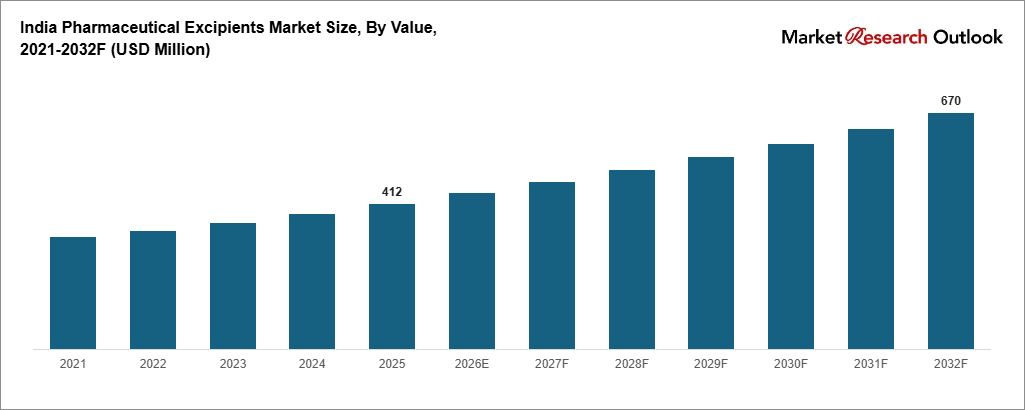
The India pharmaceutical excipients market size is witnessing steady expansion, driven by rising generic drug production, growing pharmaceutical exports, stricter GMP compliance under revised Schedule M, increasing CDMO activity, and major capacity additions by domestic pharmaceutical excipient manufacturers. Valued at USD 412 million in 2025 and projected to reach USD 670 million by 2032, growing at a CAGR of 7.2%, the India pharmaceutical excipients market growth is being fuelled by strong demand from oral solid dosage manufacturers, the rapid rise of complex generics and biosimilars, and the scaling of formulation clusters across Gujarat, Maharashtra, Telangana, and Himachal Pradesh. Polymers lead consumption, while coating agents and solubilizers are emerging as the fastest growing functional categories. Shifting formulator preferences toward direct compression, continuous manufacturing, and nitrosamine-safe pharmaceutical excipients are reshaping the supply base. As domestic producers including Sigachi Industries, Accent Microcell, Ideal Cures, Nitika, and Maple Biotech expand capacity, and global suppliers including Roquette, BASF, Ashland, DFE Pharma, and Colorcon deepen local operations, the India pharmaceutical excipients market is evolving into a quality-led, innovation-driven, and export-aligned ecosystem with strong long-term growth potential.
Key Report Takeaways: India Pharmaceutical Excipients Market
- The India pharmaceutical excipients market size is projected to grow from USD 412 million in 2025 to USD 670 million by 2032, registering a strong CAGR of 7.2%, driven by rising generic drug exports, revised Schedule M compliance, and the structural shift toward high-functionality and co-processed pharmaceutical excipients across Indian formulation plants.
- Polymers dominate the India pharmaceutical excipients market, accounting for around 41% of total value in 2025, driven by wide use of microcrystalline cellulose, HPMC, povidone, and starch in tablets and capsules, the strong domestic presence of producers such as Sigachi Industries and Accent Microcell, and rising demand from oral solid dosage manufacturers.
- Coating agents and solubilizers are emerging as the fastest growing functional segments in the India pharmaceutical excipients market, expected to grow at 10% to 12% annually as formulators develop poorly soluble APIs, modified release products, and taste-masked pediatric medicines for regulated export markets.
- Rapid growth of India’s pharmaceutical manufacturing base, with more than 10,500 drug manufacturing units and the largest number of USFDA-compliant plants outside the United States, is structurally expanding the India pharmaceutical excipients market across oral solids, oral liquids, topical, and parenteral formulations.
- Rising investments by domestic and global suppliers such as Sigachi Industries, Accent Microcell, Roquette, BASF, and Colorcon in MCC capacity, co-processed grades, and application laboratories are strengthening local supply and supporting the India pharmaceutical excipients market forecast 2032.
Key Market Drivers: India Pharmaceutical Excipients Market
Expanding Generic Drug Manufacturing, Export Growth, and USFDA-Compliant Capacity Driving Pharmaceutical Excipient Demand Across India
Growth in the India pharmaceutical excipients market is being driven by the steady expansion of generic drug manufacturing and rising exports to regulated and emerging markets. India’s pharmaceutical exports reached around USD 30.5 billion in FY25, and the country supplies about 20% of global generic medicines by volume. Pharmaceutical excipients make up 70% to 90% of the weight of a typical tablet, so every rise in formulation output translates directly into higher pharmaceutical excipient volume. The domestic industry now runs more than 10,500 drug manufacturing units, and India hosts the largest number of USFDA-compliant plants outside the United States. Oral solid dosage forms account for an estimated 72% of pharmaceutical excipient consumption, led by tablets and hard gelatin capsules. Per-capita medicine consumption in India also remains low compared with developed markets, pointing to long-term headroom. A rising chronic disease burden, wider insurance coverage under Ayushman Bharat, and more than 15,000 Jan Aushadhi generic outlets are creating strong pull-through demand across the India pharmaceutical excipients market.
Government PLI Schemes, Bulk Drug Parks, and Revised Schedule M Compliance Fuelling High-Quality Pharmaceutical Excipient Adoption
The India pharmaceutical excipients market is benefiting from strong policy support for domestic drug manufacturing. The PLI scheme for pharmaceuticals carries an outlay of INR 15,000 crore, the PLI scheme for critical KSMs and APIs adds INR 6,940 crore, and three bulk drug parks in Gujarat, Himachal Pradesh, and Andhra Pradesh are being developed with central support of INR 3,000 crore. These programmes raise formulation output and encourage local sourcing of quality inputs. The revised Schedule M, notified in December 2023, has brought Indian GMP closer to WHO-GMP standards, and MSME manufacturers had to comply by December 31, 2025. Stricter vendor qualification, raw material testing, and supplier audits under the new rules are pushing smaller formulators away from uncertified commodity grades toward pharmacopoeia-compliant pharmaceutical excipients with full documentation. Pharma-grade MCC in India typically sells between INR 180 and INR 260 per kg, while co-processed grades command INR 450 to INR 900 per kg, widening value growth for compliant suppliers across the India pharmaceutical excipients market.
Rising Demand for Functional, Co-Processed, and Novel Pharmaceutical Excipients in Advanced Drug Delivery Strengthening Value Growth
Rapid growth in functional and co-processed pharmaceutical excipients is a major catalyst for the India pharmaceutical excipients market, with coating agents and solubilizers projected to grow at 10% to 12% annually through 2032. About 40% of marketed drugs and up to 90% of pipeline molecules are poorly water soluble, which lifts demand for solubility-enhancing polymers such as HPMC-AS, copovidone, and polysorbates. Indian formulators are also moving toward direct compression and continuous manufacturing, which need co-processed fillers with better flow and compressibility. Ready-to-use film coating systems from Colorcon and Ideal Cures, co-processed MCC grades from Sigachi Industries and Accent Microcell, and solubilization platforms from BASF and Ashland are seeing wider use across export-focused plants. Growth in biosimilars, vaccines, and injectables is adding demand for parenteral-grade sugars, amino acids, and surfactants. Together, these shifts are moving the India pharmaceutical excipients market from volume-led buying toward performance-based selection across all major end-user categories through 2032.
Key Market Challenges: India Pharmaceutical Excipients Market
High Import Dependence on Specialty and High-Functionality Pharmaceutical Excipients Limiting Domestic Value Capture
The India pharmaceutical excipients market continues to face challenges around high import dependence for specialty and high-functionality grades. An estimated 55% to 60% of high-value pharmaceutical excipients used in Indian formulations, including pharma-grade lactose, HPMC, specialty polymers, and parenteral-grade surfactants, are imported from Europe, the United States, Japan, and China. While domestic producers hold strong positions in MCC, starch, and basic mineral pharmaceutical excipients, local capacity for cellulose ethers, co-processed lactose, and injectable-grade pharmaceutical excipients remains limited. Currency movements, shipping delays, and supplier concentration add cost and supply risk for formulators. Long qualification cycles also make customers slow to switch from proven imported grades to new domestic sources, even when local prices are 10% to 20% lower. This continued reliance on imports limits value capture for local players across the India pharmaceutical excipients market.
Stringent Regulatory Requirements and Lengthy Qualification Timelines Restricting Adoption of Novel Pharmaceutical Excipients
The India pharmaceutical excipients market faces structural complexity from strict regulatory expectations and long qualification timelines. Unlike APIs, novel pharmaceutical excipients have no standalone approval route in most markets, so a new pharmaceutical excipient is usually reviewed only as part of a drug filing, which raises risk for formulators. Changing a pharmaceutical excipient source in an approved product can require comparative dissolution or bioequivalence data, stability studies of 6 to 12 months, and fresh filings with USFDA, EDQM, or CDSCO. Indian suppliers must also meet several pharmacopoeia standards, including IP, USP-NF, Ph. Eur., and JP, along with IPEC-GMP and EXCiPACT expectations. Smaller domestic producers often lack Drug Master Files, elemental impurity data, and nitrosamine risk assessments demanded by global customers. While IPEC India and the Indian Pharmacopoeia Commission continue to align standards, documentation gaps remain a near-term challenge for the India pharmaceutical excipients market.
Volatility in Raw Material Prices and Energy Costs Impacting Overall Pharmaceutical Excipient Margins
The India pharmaceutical excipients market faces practical constraints around raw material price volatility, energy cost inflation, and margin pressure across the value chain. Prices of key inputs such as wood pulp, cotton linters, corn starch, whey-based lactose, and petrochemical derivatives rose by 10% to 16% between 2022 and 2025, while fuel and power costs for spray drying and milling went up by 8% to 12% over the same period. Smaller pharmaceutical excipient makers find it hard to pass these increases on to large formulators that lock in annual contracts. Average EBITDA margins for Indian pharmaceutical excipient producers range between 15% and 24%, and input swings can cut profitability on commodity grades by 3% to 6%. Backward integration, energy-efficient dryers, and a shift toward higher-margin co-processed products are emerging as responses, but price competition from Chinese suppliers continues to limit pricing power across the India pharmaceutical excipients market.
Key Market Trends: India Pharmaceutical Excipients Market
Rapid Adoption of Co-Processed, Multifunctional, and Low-Nitrite Pharmaceutical Excipients in India
The India pharmaceutical excipients market is undergoing a clear technology shift toward co-processed, multifunctional, and low-nitrite pharmaceutical excipients, with co-processed grades expected to account for over 15% of new pharmaceutical excipient qualifications in Indian formulation plants by 2027. Co-processed MCC and lactose blends can cut tablet processing steps by 30% to 40% compared with wet granulation, while improving flow and content uniformity. Following USFDA guidance on nitrosamine impurities, formulators now ask for pharmaceutical excipients with tightly controlled nitrite and nitrate levels for sensitive APIs. Leading suppliers including Roquette, DFE Pharma, BASF, JRS Pharma, and Sigachi Industries widened their low-nitrite and co-processed portfolios through 2024 and 2025. Ready-to-use coating systems are also gaining ground in the Ahmedabad, Hyderabad, and Mumbai clusters, where export-focused plants need faster scale-up and consistent film quality. This product transition is reinforcing the India pharmaceutical excipients market forecast 2032 across both domestic and export categories.
Growth of Parenteral-Grade and Biopharmaceutical Excipients in the India Pharmaceutical Excipients Market
A clear shift toward injectables, biosimilars, and vaccines is reshaping the India pharmaceutical excipients market, particularly in the high-purity segment. India is among the largest vaccine producers in the world, and companies such as Serum Institute of India, Bharat Biotech, Biocon Biologics, and Intas are scaling biologics and sterile capacity. These products need low-endotoxin sugars such as sucrose, trehalose, and mannitol, along with high-purity polysorbates, amino acids, and buffer salts. Parenteral pharmaceutical excipients sell at 5 to 10 times the price of oral grades, which supports value growth even at modest volumes. Global suppliers including Merck Life Science, Evonik, and Roquette are expanding local technical support and documentation for injectable-grade pharmaceutical excipients. By 2025, parenteral formulations account for an estimated 11% to 13% of pharmaceutical excipient market value in India, up from about 8% in 2020, with CDMOs serving US and European clients leading the shift.
Capacity Expansion by Domestic Pharmaceutical Excipient Manufacturers and Localization by Global Suppliers
A wave of domestic capacity expansion and localization by global suppliers is reshaping the India pharmaceutical excipients market supply base. Sigachi Industries began a 12,000 MTPA MCC expansion at its Dahej SEZ unit in Gujarat in 2025, which will lift its total installed MCC capacity to 30,000 MTPA and keep it the largest MCC producer in India. Accent Microcell has continued to scale cellulose-based pharmaceutical excipient output in Gujarat after its 2023 listing, while Signet Excipients, part of IMCD, has widened distribution and application support for global brands. On the global side, Roquette completed its acquisition of IFF Pharma Solutions in 2025, bringing cellulose ethers, alginates, and co-processed pharmaceutical excipients into one portfolio with a larger India footprint. PLI incentives, bulk drug parks, and state industrial policies in Gujarat, Telangana, and Andhra Pradesh have structurally favoured local supply. Combined with CDMO expansion and Schedule M-driven vendor upgrades, these developments are reinforcing the India pharmaceutical excipients market forecast 2032 across the entire value chain.
Segmental Insights: India Pharmaceutical Excipients Market
By End-User: Pharmaceutical Manufacturers Segment Dominates the India Pharmaceutical Excipients Market
The pharmaceutical manufacturers end-user segment dominates the India pharmaceutical excipients market, accounting for an estimated 58% to 62% of total value, driven by large-scale generic production, in-house formulation development, and high tablet and capsule output. Fillers, binders, and disintegrants are the dominant functional categories within this segment, with oral solid dosage forms capturing over 72% of pharmaceutical excipient purchases. The CDMOs and CMOs segment contributes another 22% to 25% of demand, driven by outsourcing from US, European, and Japanese clients and rising complex generic work. The nutraceutical manufacturers segment accounts for 11% to 13%, led by vitamins, supplements, and herbal tablets that use MCC, starch, and coating systems. In 2025, leading formulators including Sun Pharma, Cipla, Dr. Reddy’s, Lupin, Aurobindo, and Zydus scaled pharmaceutical excipient qualification programs linked to Schedule M upgrades, reinforcing segment dominance in the India pharmaceutical excipients market.
By Product Type: Polymers Lead While Cellulose Ethers and Specialty Polymers Grow Fastest
Polymers lead the India pharmaceutical excipients market product mix, accounting for approximately 41% of total market value, driven by heavy use of microcrystalline cellulose, starch, povidone, HPMC, and croscarmellose sodium across tablets and capsules. Sugars contribute another 16% to 19%, mainly lactose, mannitol, and sucrose for fillers, chewables, and parenterals. Minerals such as calcium carbonate, dicalcium phosphate, talc, and colloidal silicon dioxide account for 14% to 16%, while alcohols including glycerin, propylene glycol, and sorbitol hold 10% to 12%, largely in oral liquids and topicals. Cellulose ethers and specialty polymers used in coating and solubilization are the fastest growing categories, expanding at 10% to 12% annually on the back of modified release and poorly soluble drug development. Gelatin holds 6% to 8% of the pharmaceutical excipients market, linked to hard and soft capsule output. Leading suppliers including Sigachi Industries, Accent Microcell, Roquette, BASF, and Ashland have aligned portfolios to this product mix, driving higher-value pharmaceutical excipient adoption across the India pharmaceutical excipients market.
Regional Insights: India Pharmaceutical Excipients Market
Regional analysis of the India pharmaceutical excipients market shows that West India and South India together account for approximately 64% to 68% of total pharmaceutical excipient consumption, driven by Gujarat (Ahmedabad, Vadodara, and Dahej clusters), Maharashtra (Mumbai, Pune, and Aurangabad), Telangana (Hyderabad), Andhra Pradesh (Visakhapatnam), and Karnataka, supported by dense formulation capacity and a strong base of USFDA-approved plants. North India contributes around 20% to 23% of demand, led by Himachal Pradesh (Baddi), Punjab, Haryana, Uttarakhand, and Uttar Pradesh, supported by large domestic formulation output and incentive-led industrial clusters. Central and East India together account for 11% to 14% of demand, supported by Madhya Pradesh (Pithampur and Indore), Sikkim, West Bengal, and Odisha, where new formulation units are being added. In 2025, capacity additions by Sigachi Industries and Accent Microcell in Gujarat, distribution hubs run by Signet Excipients in Maharashtra, and bulk drug park development in Gujarat, Himachal Pradesh, and Andhra Pradesh reinforced regional supply hubs, supporting faster delivery to formulation clusters across the India pharmaceutical excipients market.
Pharma data: see the India Pharma Plant Projects Tracker for new pharma and excipients plants, and the India Drug Quality Alerts Tracker for drug samples flagged not of standard quality.
Recent Developments: India Pharmaceutical Excipients Market
- The India pharmaceutical excipients market witnessed strong momentum in capacity and product activity during 2024 and 2025. India’s pharmaceutical exports grew about 9% to USD 30.5 billion in FY25, lifting pharmaceutical excipient demand from export-focused oral solid plants. Total pharmaceutical excipient volume consumed in India is estimated at 160 to 180 thousand tonnes in 2025, and domestic demand for pharma-grade MCC is projected to reach 31,000 to 33,000 tonnes by FY27 from about 26,000 tonnes in FY25, growing at roughly 10% annually.
- Domestic and global pharmaceutical excipient suppliers have deepened India-focused capacity expansion. In 2025, Sigachi Industries started work on a 12,000 MTPA MCC line at Dahej SEZ to take total capacity to 30,000 MTPA, Accent Microcell expanded cellulose-based pharmaceutical excipient output in Gujarat, Signet Excipients widened its application laboratory support, Ideal Cures scaled its film coating range, and Roquette began integrating the former IFF Pharma Solutions portfolio into its Indian operations. These developments are strengthening domestic supply and supporting the India pharmaceutical excipients market forecast 2032.
- Schedule M compliance and CDMO momentum have gained strong traction in the India pharmaceutical excipients market. Through 2025, thousands of MSME formulation units upgraded vendor qualification and raw material testing to meet the revised Schedule M deadline, while CDMOs including Piramal Pharma Solutions, Syngene International, and Aragen Life Sciences expanded capacity for regulated market clients. Long-term supply agreements between formulators and qualified pharmaceutical excipient makers are positioning India as one of the fastest scaling pharmaceutical excipient markets in Asia, strengthening long-term competitive positioning in the India pharmaceutical excipients market forecast 2032.
Key Market Players: India Pharmaceutical Excipients Market
- Sigachi Industries Limited
- Accent Microcell Limited
- Signet Excipients Pvt. Ltd. (IMCD Group)
- Ideal Cures Pvt. Ltd.
- Nitika Pharmaceutical Specialities Pvt. Ltd.
- Maple Biotech Pvt. Ltd.
- Roquette India Pvt. Ltd.
- BASF India Limited
- Ashland India Pvt. Ltd.
- DFE Pharma India Pvt. Ltd.
- Colorcon Asia Pvt. Ltd.
- JRS Pharma India Pvt. Ltd.
- Evonik India Pvt. Ltd.
| By Product Type | By Functionality | By Formulation | By Origin | By End-User |
| Polymers (MCC, Starch, Povidone, HPMC, Others) Sugars (Lactose, Mannitol, Sucrose, Others) Alcohols (Glycerin, Propylene Glycol, Sorbitol) Minerals (Calcium Carbonate, Calcium Phosphate, Talc, Silicon Dioxide) Gelatin Others |
Fillers & Diluents Binders Disintegrants Coating Agents Lubricants & Glidants Solubilizers & Emulsifiers Others (Preservatives, Flavoring Agents, Colorants) |
Oral Solids (Tablets, Capsules) Oral Liquids Topical Parenteral Others (Inhalation, Ophthalmic) |
Plant-Based Animal-Based Synthetic Mineral-Based |
Pharmaceutical Manufacturers CDMOs & CMOs Nutraceutical Manufacturers Research & Academic Institutes |
Report Scope
In this report, the India Pharmaceutical Excipients Market has been segmented into the following categories, in addition to detailed analysis of key industry trends, market dynamics, competitive landscape, and growth opportunities across the forecast period:
- By Product Type
- Polymers (MCC, Starch, Povidone, HPMC, Others)
- Sugars (Lactose, Mannitol, Sucrose, Others)
- Alcohols (Glycerin, Propylene Glycol, Sorbitol)
- Minerals (Calcium Carbonate, Calcium Phosphate, Talc, Silicon Dioxide)
- Gelatin
- Others
- By Functionality
- Fillers & Diluents
- Binders
- Disintegrants
- Coating Agents
- Lubricants & Glidants
- Solubilizers & Emulsifiers
- Others (Preservatives, Flavoring Agents, Colorants)
- By Formulation
- Oral Solids (Tablets, Capsules)
- Oral Liquids
- Topical
- Parenteral
- Others (Inhalation, Ophthalmic)
- By Origin
- Plant-Based
- Animal-Based
- Synthetic
- Mineral-Based
- By End-User
- Pharmaceutical Manufacturers
- CDMOs & CMOs
- Nutraceutical Manufacturers
- Research & Academic Institutes
- By Geography
- North India
- South India
- West India
- East India
- Central India
Competitive Landscape
Company Profiles:
Detailed analysis of the leading companies operating in the India Pharmaceutical Excipients Market, including business overview, product portfolio, strategic initiatives, competitive positioning, and recent developments.
Company Information
Detailed profiling and strategic analysis of additional market players (up to five companies), including emerging domestic pharmaceutical excipient manufacturers, specialty co-processed and coating pharmaceutical excipient producers, regional distributors, or niche parenteral-grade pharmaceutical excipient suppliers.
For a free sample of the India Pharmaceutical Excipients Market report, customised insights or delivery timelines, submit your query here
India Pharmaceutical Excipients Market, 2032
- Research Framework
- Market Segmentation
- Research Objective
- Research Methodology
- Qualitative Research
- Primary Research
- Secondary Research
- Quantitative Research
- Market Breakdown & Data Triangulation
- Demand Side
- Supply Side
- Primary Research Respondents
- Assumption & Limitation
- Executive Summary
- Market Overview, 2021-2032
- By Product Type
- By Functionality
- By Formulation
- By Origin
- By End-User
- By Region
- Analyst Recommendations
- Geopolitical Impact on India Pharmaceutical Excipients Market
- India Pharmaceutical Excipients Market Insights
- Market Dynamics
- Growth Drivers
- Expanding generic drug manufacturing, export growth, and USFDA-compliant capacity driving pharmaceutical excipient demand across India.
- Government PLI schemes, bulk drug parks, and revised Schedule M compliance fuelling high-quality pharmaceutical excipient adoption.
- Rising demand for functional, co-processed, and novel pharmaceutical excipients in advanced drug delivery strengthening value growth.
- Restraints
- High import dependence on specialty and high-functionality pharmaceutical excipients limiting domestic value capture.
- Stringent regulatory requirements and lengthy qualification timelines restricting adoption of novel pharmaceutical excipients.
- Volatility in raw material prices and energy costs impacting overall pharmaceutical excipient margins.
- Opportunities
- Co-processed and multifunctional pharmaceutical excipients for direct compression and continuous manufacturing opening high-value demand across Indian formulators.
- Parenteral-grade and biologics pharmaceutical excipients supporting next-generation growth in biosimilars, vaccines, and injectables.
- Import substitution under Make in India, PLI schemes, and bulk drug parks creating large domestic manufacturing opportunities.
- Challenges
- Intense price competition from Chinese pharmaceutical excipient suppliers and fragmented small-scale local producers.
- Limited GMP certification specific to pharmaceutical excipients and inconsistent documentation across smaller domestic suppliers.
- Managing nitrosamine impurity risks and batch-to-batch consistency at scale across diverse formulations.
- Technological Advancements
- Recent Technological Advancements
- Prior to 2020
- Porter’s Five Forces Analysis
- PESTLE Analysis
- Industry Value Chain & Entry Points
- Upstream Raw Materials (wood pulp, cotton linters, corn starch, milk whey, petrochemicals, minerals)
- Pharmaceutical Excipient Manufacturers & Processors (Sigachi, Accent Microcell, Ideal Cures, Nitika, Maple Biotech)
- Global Specialty Pharmaceutical Excipient Suppliers (Roquette, BASF, Ashland, DFE Pharma, Colorcon, JRS Pharma)
- Co-Processed & Novel Pharmaceutical Excipient Developers (direct compression, taste masking, solubility enhancement)
- Quality Control, R&D & Testing Laboratories (IP, USP-NF, Ph. Eur., IPEC, EXCiPACT standards)
- Distributors, Importers & Channel Partners (Signet Excipients, IMCD, regional distributors)
- Formulation Manufacturers & CDMOs (Sun Pharma, Cipla, Dr. Reddy’s, Lupin, Aurobindo, Zydus)
- Nutraceutical & Consumer Health Manufacturers (vitamins, supplements, herbal tablets, capsules)
- Regulatory & Compliance Bodies (CDSCO, IPC, USFDA, EDQM, WHO-GMP)
- End-Users (patients, hospitals, retail pharmacies, Jan Aushadhi outlets, institutional buyers)
- India Pharmaceutical Excipients Market: Regulatory Framework
- India Pharmaceutical Excipients Market Overview
- Market Size & Forecast, 2021-2032
- By Value (USD Million)
- By Volume (Thousand Tonnes)
- Market Share & Forecast
- By Product Type
- Polymers (MCC, Starch, Povidone, HPMC, Others)
- Sugars (Lactose, Mannitol, Sucrose, Others)
- Alcohols (Glycerin, Propylene Glycol, Sorbitol)
- Minerals (Calcium Carbonate, Calcium Phosphate, Talc, Silicon Dioxide)
- Gelatin
- Others
- By Functionality
- Fillers & Diluents
- Binders
- Disintegrants
- Coating Agents
- Lubricants & Glidants
- Solubilizers & Emulsifiers
- Others (Preservatives, Flavoring Agents, Colorants)
- By Formulation
- Oral Solids (Tablets, Capsules)
- Oral Liquids
- Topical
- Parenteral
- Others (Inhalation, Ophthalmic)
- By Origin
- Plant-Based
- Animal-Based
- Synthetic
- Mineral-Based
- By End-User
- Pharmaceutical Manufacturers
- CDMOs & CMOs
- Nutraceutical Manufacturers
- Research & Academic Institutes
- By Geography
- North India
- South India
- West India
- East India
- Central India
- Competitive Landscape
- India Pharmaceutical Excipients Market Company Market Share Analysis, 2025
- Competitive Benchmarking, By Operating Parameters
- Key Strategic Development (Mergers, Acquisitions, Partnerships, Etc.)
- List of Emerging Players
- Company Profile
- Sigachi Industries Limited
- Introduction & Company Profile
- Product Benchmarking
- Strategic Outlook
- Key Competitors
- Financial Analysis
- SWOT Analysis
(Same Data Pointers Will Be Provided for The Below Companies)
- Accent Microcell Limited
- Signet Excipients Pvt. Ltd. (IMCD Group)
- Ideal Cures Pvt. Ltd.
- Nitika Pharmaceutical Specialities Pvt. Ltd.
- Maple Biotech Pvt. Ltd.
- Roquette India Pvt. Ltd.
- BASF India Limited
- Ashland India Pvt. Ltd.
- DFE Pharma India Pvt. Ltd.
- Colorcon Asia Pvt. Ltd.
- JRS Pharma India Pvt. Ltd.
- Evonik India Pvt. Ltd.
- Other Prominent Players
* Financial information in case of non-listed companies will be provided as per availability
- The segmentation and the companies are subjected to modifications based on in-depth secondary for the final deliverable
Frequently Asked Questions
1. How large is the India pharmaceutical excipients market and what is its growth forecast?
Ans: The India pharmaceutical excipients market is valued at USD 412 million in 2025 and is projected to reach USD 670 million by 2032, growing at a CAGR of 7.2%, supported by generic drug exports and Schedule M compliance.
2. Which segments are driving demand in the India pharmaceutical excipients market?
Ans: Polymers lead the India pharmaceutical excipients market with around 41% value share, while coating agents and solubilizers are the fastest growing segments, driven by poorly soluble drugs, modified release products, and export-focused formulation plants.
3. What are the key drivers of growth in the India pharmaceutical excipients market?
Ans: Key drivers include expanding generic drug manufacturing, rising pharmaceutical exports, PLI schemes, bulk drug parks, revised Schedule M compliance, and growing demand for functional and co-processed pharmaceutical excipients in advanced drug delivery.
4. Which regions are driving growth in the India pharmaceutical excipients market?
Ans: West India and South India lead with around 64% to 68% of total consumption, driven by Gujarat, Maharashtra, Telangana, and Andhra Pradesh. North India, led by Baddi in Himachal Pradesh, also shows strong demand.
5. What are the latest trends in the India pharmaceutical excipients market?
Ans: Latest trends include rapid adoption of co-processed and low-nitrite pharmaceutical excipients, growth in parenteral and biologics-grade pharmaceutical excipients, ready-to-use coating systems, and capacity expansion by domestic and global pharmaceutical excipients suppliers.