

India EV Charging Station Market, 2032
- Energy, Power & Storage
- Nov 2026
- Pages 140
- Report Format: pdf
- Report Price: $2400 USD
India’s EV charging station market is witnessing strong structural growth, driven by rising electric two-wheeler, three-wheeler, and car sales, PM E-DRIVE capital subsidies for 72,300 public chargers, Ministry of Power rules on station density and tariffs, fleet and e-bus electrification, network expansion by oil marketing companies, and rising investment by charge point operators and equipment makers in DC fast charging, battery swapping, and software-led network management.
| Study Duration | 2021-2032 |
| Market Size (2025) | USD 1,180 Million |
| CAGR (2026-2032) | 28.8% |
| Leading Segment | DC Fast Chargers (25 kW to 60 kW) |
| Fastest Growing Segment | DC Rapid & Ultra-Fast Chargers |
| Market Size (2032) | USD 6,940 Million |
Market Overview: India EV Charging Station Market
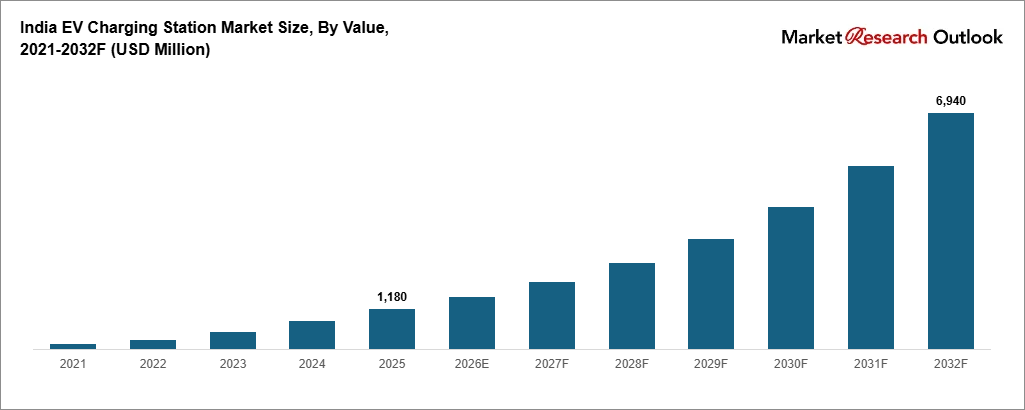
The India EV charging station market size is witnessing rapid expansion, driven by rising electric vehicle sales, PM E-DRIVE capital subsidies, Ministry of Power charging guidelines, fleet electrification, and fast network additions by oil marketing companies and charge point operators. Valued at USD 1,180 million in 2025 and projected to reach USD 6,940 million by 2032, growing at a CAGR of 28.8%, market growth is being fuelled by 2.36 million EV sales in calendar year 2025, an 8.36% share of all vehicle sales, and by the move of delivery, ride-hailing, and public transport fleets to electric models. DC fast chargers of 25 kW to 60 kW lead spending with a 34% value share, while DC rapid and ultra-fast chargers are the fastest growing category. Clear tariff rules, capped service charges, and an INR 1 per kWh land revenue model are improving project economics for site owners and operators. As Tata Power EZ Charge, Indian Oil, Bharat Petroleum, Hindustan Petroleum, and Jio-bp pulse expand public networks, and equipment makers such as Exicom, Delta Electronics, ABB India, and Mass-Tech scale local supply, EV charging in India is evolving into an investment-led, software-managed, and grid-integrated infrastructure segment with strong long-term growth potential.
Key Report Takeaways: India EV Charging Station Market
- The India EV charging station market size is projected to grow from USD 1,180 million in 2025 to USD 6,940 million by 2032, registering a strong CAGR of 28.8%, driven by fast EV adoption, PM E-DRIVE funding for public chargers, and the structural shift toward DC fast and fleet depot charging across urban and highway India.
- DC fast chargers of 25 kW to 60 kW lead the market with a 34% value share in 2025, driven by strong use at fuel stations, malls, and city hubs, the deep presence of Tata Power, Indian Oil, Bharat Petroleum, and Jio-bp pulse, and rising electric car traffic across metro and tier-1 cities.
- DC rapid and ultra-fast chargers above 60 kW are the fastest growing category, expected to expand at a CAGR of 38.6% as highway corridors, e-bus depots, and e-truck routes need high-power charging that can serve heavy vehicles within short dwell times across major freight and travel routes.
- Public charging is scaling quickly, with 29,277 public charging stations in operation by mid-2025 and PM E-DRIVE support for 72,300 more, including 22,100 fast chargers for electric cars, 1,800 for e-buses, and 48,400 for two-wheelers and three-wheelers, structurally expanding public, highway, and fleet charging demand.
- Rising investments by oil marketing companies, which added over 10,000 EV charging stations at fuel outlets in FY2025, together with charge point operators and equipment makers such as Exicom, Delta Electronics, and ABB India, are strengthening local supply and supporting the market forecast 2032.
Key Market Drivers: India EV Charging Station Market
Rising EV Adoption Across Two-Wheelers, Three-Wheelers, and Passenger Cars Driving Charging Demand Across India
Growth in EV charging is being driven by steady gains in electric vehicle sales across every major vehicle class. India sold 2.36 million electric vehicles in calendar year 2025, an 8.36% share of all vehicle sales and 16.62% higher than in 2024. High-speed electric two-wheelers accounted for 1,345,244 units, while electric car sales rose 85.1% to 196,724 units, lifting e-car penetration to 4.3% from 2.5% a year earlier. Passenger three-wheeler penetration reached 31.8%, and e-bus penetration reached 5.3% for the year. Each new car needs regular access to a home, workplace, or public point, while commercial three-wheelers and delivery two-wheelers depend on fast top-ups or swaps during working shifts. Uttar Pradesh led EV sales with a 17.15% share, while Bengaluru remained the largest city market for electric two-wheelers with 90,215 units. As more models launch with larger batteries and DC charging capability, demand is shifting from slow home charging toward public fast charging, creating strong structural pull-through for charging networks nationwide.
PM E-DRIVE Funding, Ministry of Power Charging Guidelines, and State EV Policies Accelerating Public Charging Rollout
Policy support has become a central growth engine for EV charging in India. The PM E-DRIVE scheme, with a total outlay of INR 10,900 crore, sets aside INR 2,000 crore to support 72,300 public chargers, including 22,100 fast chargers for cars, 1,800 chargers for e-buses, and 48,400 chargers for two-wheelers and three-wheelers. Guidelines issued in September 2025 offer 100% support for chargers at government buildings, 80% of upstream costs and 70% of charger costs at transport hubs, and 80% of upstream costs at other public sites. The Ministry of Power’s 2024 guidelines target one station in every 1 km by 1 km urban grid by 2030 and a station every 20 km on both sides of highways, with fast charging every 100 km for heavy-duty EVs. Supply tariffs are capped at the average cost of supply, set at 0.7 times that level during solar hours, while land-owning public agencies receive INR 1 per kWh sold. Together with state EV policies in Karnataka, Maharashtra, Delhi, Tamil Nadu, and Telangana, these rules lower entry costs and support steady growth of public charging in India.
Fleet Electrification, E-Bus Deployment, and Commercial Logistics Strengthening Depot and Captive Charging Growth
Fleet electrification is a major catalyst for charging demand, as delivery, ride-hailing, logistics, and public transport operators shift to electric models with predictable routes and high daily mileage. PM E-DRIVE supports 14,028 electric buses for state transport undertakings, and Ministry of Power rules require e-bus depots to install chargers with a minimum capacity of 240 kW. Delhi recorded the highest e-bus penetration at 49.18% in 2025, while electric goods carrier sales rose 77.52% year-on-year, with Maharashtra leading truck adoption. These operators need dedicated depot chargers, overnight AC points, and fast DC top-ups along fixed routes. Tata Power EZ Charge reported 1,100 bus charging points in early 2025, and fleet-focused operators such as Magenta ChargeGrid run captive hubs for logistics customers. Fleet and captive depot charging already accounts for an estimated 18% of market value in 2025, with electric trucks the fastest growing vehicle class at a CAGR of 41.2%, structurally expanding high-power charging demand through 2032.
Key Market Challenges: India EV Charging Station Market
Low Charger Utilisation and Long Payback Periods Limiting Returns for Charge Point Operators
Many public sites in India still record low utilisation, which keeps payback periods long for charge point operators. Average utilisation of public DC chargers is estimated at 9% in 2025, as EV density remains uneven outside metro clusters and many points sit at locations with weak traffic. While capped service charges of INR 11 per unit during solar hours and INR 13 per unit at other times for DC charging protect users, they also limit how quickly operators can recover capital. A 50 kW CCS2 charger carries a benchmark equipment cost of INR 7.25 lakh, while upstream electrical work ranges from INR 6.04 lakh for sites up to 50 kW and rises to INR 24 lakh for sites above 150 kW. Demand charges, maintenance costs, and site rentals add further pressure. Smaller operators with limited capital find it hard to hold sites through the early low-use years, which slows network density in tier-2 and tier-3 cities across the sector.
Grid Connection Delays, Upstream Power Costs, and DISCOM Readiness Gaps Across Tier-2 and Tier-3 Cities
EV charging projects in India face practical delays in getting new electricity connections, upgrading transformers, and laying cables to high-power sites. While metro DISCOMs in Delhi, Mumbai, Bengaluru, and Hyderabad have set processes for charging connections, many smaller utilities still lack clear timelines, trained staff, and spare network capacity near highways and city centres. The Ministry of Power’s 2024 guidelines allow open access power within 15 days of a complete application and require DISCOMs to pay penalties for delays, yet on-ground execution varies widely by state. High-power hubs of 150 kW and above often need a dedicated transformer, which adds months to project timelines and raises upfront costs. Differences in tariff orders, demand charge rules, and approval processes across states create operational complexity for national operators such as Tata Power EZ Charge, Jio-bp pulse, and GLIDA. Grid readiness therefore remains a near-term constraint for charging networks in India.
High DC Charger Costs, Import Dependence on Power Modules, and Interoperability Gaps Impacting Margins
The India EV charging station market faces cost pressure from high DC charger prices and dependence on imported parts. Power modules, IGBT and silicon carbide semiconductors, contactors, and liquid-cooled cables are largely sourced from China, Europe, and East Asia, which exposes local makers to currency movements and supply delays. Benchmark costs of INR 7.25 lakh for a 50 kW CCS2 charger and INR 11.68 lakh for a 100 kW CCS2 charger make DC sites far more capital intensive than AC points. Interoperability gaps add further strain, as drivers still need several apps and wallets across networks, while chargers from different makers vary in software and communication standards. Uptime issues, card and UPI payment failures, and inconsistent customer support reduce repeat use. Domestic assembly by Exicom, Delta Electronics, ABB India, and Mass-Tech is improving supply, but deeper local production of power electronics is still needed to cut costs across the sector.
Key Market Trends: India EV Charging Station Market
Rapid Shift Toward DC Fast, Rapid, and Ultra-Fast Charging Along Highways and Urban Hubs
Charging networks in India are moving clearly toward higher power, with DC rapid and ultra-fast chargers above 60 kW expected to grow at a CAGR of 38.6% through 2032. Newer electric cars accept 50 kW to 150 kW charging, while e-buses and e-trucks need 240 kW and higher depot and corridor chargers to keep vehicles in service. The Ministry of Power’s plan for charging every 20 km on highways and fast charging every 100 km for heavy-duty EVs is shaping corridor design across the Delhi-Mumbai, Mumbai-Pune, Bengaluru-Chennai, and Delhi-Jaipur routes. Tata Power EZ Charge has built infrastructure along more than 550 national highways and key routes, while Indian Oil, Bharat Petroleum, and Hindustan Petroleum use fuel stations as ready sites with power, parking, and food services. Multi-gun DC chargers, dynamic power sharing, and liquid-cooled cables are becoming standard at new hubs, and battery-buffered systems are being trialled at sites with weak grid supply. This move toward speed and higher site value is reinforcing long-term growth across both public and fleet categories.
Growth of App-Based Roaming, UPI Payments, and Software-Led Network Management in the India EV Charging Station Market
Digital tools are reshaping how charging is found, booked, and paid for in India. Most operators now run mobile apps that show live charger status, allow slot booking, and accept UPI, cards, and wallets, while open protocols such as OCPP allow remote monitoring, software updates, and fault alerts. Software platforms such as Numocity support network management and roaming for several operators, and government programmes are pushing for unified discovery and payment so that drivers can use any public charger through one interface. Automakers are also adding charger maps and plug-and-charge features into vehicle apps, which improves the user experience for electric car owners. For fleet customers, charge management software links charging with route plans, energy costs, and solar-hour tariffs, which can cut energy bills at depots. These digital layers are improving uptime, raising utilisation, and lowering customer acquisition costs, and they are becoming a key point of competition across Indian charging networks.
Network Expansion by Oil Marketing Companies, Power Utilities, and CPOs Alongside Domestic Charger Manufacturing
A wave of network expansion and local manufacturing is reshaping supply across EV charging in India. Oil marketing companies added over 10,000 EV charging stations at fuel outlets in FY2025, turning their large retail footprint into ready-made charging sites. Tata Power EZ Charge reported about 5,500 public and semi-public charging points across 550 cities and towns, more than 120,000 home chargers, and 1,100 bus charging points in early 2025. Jio-bp pulse, GLIDA, Magenta ChargeGrid, and Ather Grid are adding fast charging hubs in metro and tier-1 cities, while two-wheeler makers continue to build brand-linked fast charging grids. On the supply side, Exicom, Delta Electronics, ABB India, and Mass-Tech are scaling local assembly of AC and DC chargers, helped by PM E-DRIVE rules that favour compliant, tested equipment. Combined with capped tariffs, the land revenue model, and state incentives, these moves are strengthening the entire charging value chain.
Segmental Insights: India EV Charging Station Market
By Vehicle Type: Passenger Cars Lead the India EV Charging Station Market
The electric passenger car segment leads the India EV charging station market, accounting for an estimated 33% of total value in 2025, driven by fast-rising car sales, higher power needs per session, and the high cost of DC fast chargers built for cars. CCS2 and Type 2 AC connectors dominate this segment, with CCS2 alone accounting for 47% of market value across all vehicle classes. Electric two-wheelers contribute another 27% of value, driven by home charging, brand-linked fast chargers, and swap stations used by delivery riders. Electric three-wheelers, both passenger and cargo, account for 19%, led by Uttar Pradesh, Delhi, and Bihar, where e-rickshaws and cargo carriers depend on low-cost AC points and swap networks. Electric buses hold 12% of value, while light commercial vehicles and trucks together account for 9%, with trucks the fastest growing class at a CAGR of 41.2%. In 2025, Tata Power EZ Charge, Jio-bp pulse, GLIDA, and Ather Grid scaled car and two-wheeler focused networks, reinforcing segment leadership.
By Charger Type: DC Fast Chargers Lead While DC Rapid and Ultra-Fast Chargers Grow Fastest
DC fast chargers of 25 kW to 60 kW lead the India EV charging station market with a 34% value share in 2025, driven by their fit for city hubs, fuel stations, and malls, where cars can add useful range in under an hour. AC normal chargers of 7.4 kW to 22 kW contribute 21% of value, while AC slow chargers up to 3.3 kW account for 14%, though AC units together make up an estimated 82% of installed charging points by count because of their low cost and wide use at homes, offices, and for three-wheelers. DC rapid chargers of 60 kW to 150 kW hold 16% of value and DC ultra-fast chargers above 150 kW hold 5%, and together they form the fastest growing category at a CAGR of 38.6%, driven by highway corridors, e-bus depots, and e-truck routes. Battery swapping stations account for 10% of value and are growing at a CAGR of 33.4%. Leading players including Tata Power, Indian Oil, Exicom, Delta Electronics, and ABB India have aligned portfolios to this mix, supporting higher-power adoption across the market.
Regional Insights: India EV Charging Station Market
Regional analysis shows that South India and West India together account for an estimated 63% of market value in 2025, with South India at 36% and West India at 27%. Karnataka led the country with 6,097 public charging stations by mid-2025, followed by Maharashtra with 4,155, supported by strong EV adoption in Bengaluru, Mumbai, Pune, Chennai, and Hyderabad, along with state EV policies in Tamil Nadu, Telangana, and Gujarat. North India contributes 24% of market value, led by Delhi NCR, Uttar Pradesh, Haryana, and Rajasthan, where Uttar Pradesh had 2,326 public charging stations and leads national EV sales with a 17.15% share, driven by e-rickshaws. Central and East India together account for 13% of value, supported by Madhya Pradesh, West Bengal, Bihar, and Odisha, where West Bengal posted EV sales growth of 121.3% in 2025. Network additions by Tata Power EZ Charge, Indian Oil, Bharat Petroleum, and Jio-bp pulse along the Delhi-Mumbai, Bengaluru-Chennai, and Mumbai-Pune corridors are linking regional hubs, supporting balanced growth across the country.
State-wise EV sales: see the India EV Sales by State Tracker for EV registrations and EV share of new vehicles in every state, with the split between two-wheelers, three-wheelers, cars, buses and goods vehicles.
Recent Developments: India EV Charging Station Market
- EV charging in India recorded strong policy and network progress during 2024 and 2025. In September 2024, the Ministry of Power issued revised guidelines for installing and operating EV charging infrastructure, capping supply tariffs at the average cost of supply and setting service charge ceilings valid until 31 March 2028. In September 2025, the Ministry of Heavy Industries released PM E-DRIVE guidelines for 72,300 public chargers backed by INR 2,000 crore, including 22,100 fast chargers for cars, 1,800 for e-buses, and 48,400 for two-wheelers and three-wheelers. India had 29,277 public charging stations by mid-2025, as reported to Parliament.
- Network owners have deepened expansion across the country. Oil marketing companies added over 10,000 EV charging stations at fuel outlets in FY2025, while Tata Power EZ Charge reported about 5,500 public and semi-public charging points across 550 cities and towns, more than 120,000 home chargers, and 1,100 bus charging points at Bharat Mobility Global Expo 2025. Jio-bp pulse, GLIDA, Magenta ChargeGrid, and Ather Grid continued to add fast charging hubs in metro and tier-1 cities. These moves are strengthening public access and supporting long-term network growth through 2032.
- Fleet and heavy vehicle charging has gained strong traction across India. PM E-DRIVE support for 14,028 electric buses, a 240 kW minimum charger rule for e-bus depots, and 77.52% growth in electric goods carrier sales in 2025 are lifting demand for depot and corridor charging. Partnerships between charge point operators, fleet owners, automakers, and DISCOMs are positioning India as one of the fastest scaling charging markets in Asia, strengthening long-term competitive positioning in the India EV charging station market forecast 2032.
Key Market Players: India EV Charging Station Market
- Tata Power Company Limited (Tata Power EZ Charge)
- Indian Oil Corporation Limited
- Bharat Petroleum Corporation Limited
- Hindustan Petroleum Corporation Limited
- Jio-bp pulse (Reliance BP Mobility Limited)
- Exicom Tele-Systems Limited
- Delta Electronics India Private Limited
- ABB India Limited
- Ather Energy Limited (Ather Grid)
- GLIDA (Fortum Charge & Drive India Pvt. Ltd.)
- Magenta EV Solutions Pvt. Ltd. (ChargeGrid)
- Mass-Tech Controls Pvt. Ltd.
- Numocity Technologies Pvt. Ltd.
| By Charger Type | By Vehicle Type | By Connector Type | By Application | By Operator Type |
| AC Slow Chargers (Up to 3.3 kW) AC Normal Chargers (7.4 kW to 22 kW) DC Fast Chargers (25 kW to 60 kW) DC Rapid Chargers (60 kW to 150 kW) DC Ultra-Fast Chargers (Above 150 kW) Battery Swapping Stations |
Electric Two-Wheelers Electric Three-Wheelers (Passenger) Electric Three-Wheelers (Cargo) Electric Passenger Cars Electric Light Commercial Vehicles Electric Buses Electric Trucks |
CCS2 (Combined Charging System) Type 2 AC LECCS (Light EV Combined Charging System) Bharat AC-001 & DC-001 CHAdeMO & Others |
Urban Public Charging Highway & Expressway Charging Residential & Home Charging Workplace & Commercial Charging Fleet & Captive Depot Charging Government & Institutional Charging |
Charge Point Operators (CPOs) Oil Marketing Companies (OMCs) Automotive OEMs Power Utilities & Government Agencies |
Report Scope
In this report, the India EV Charging Station Market has been segmented into the following categories, in addition to detailed analysis of key industry trends, market dynamics, competitive landscape, and growth opportunities across the forecast period:
- By Charger Type
- AC Slow Chargers (Up to 3.3 kW)
- AC Normal Chargers (7.4 kW to 22 kW)
- DC Fast Chargers (25 kW to 60 kW)
- DC Rapid Chargers (60 kW to 150 kW)
- DC Ultra-Fast Chargers (Above 150 kW)
- Battery Swapping Stations
- By Vehicle Type
- Electric Two-Wheelers
- Electric Three-Wheelers (Passenger)
- Electric Three-Wheelers (Cargo)
- Electric Passenger Cars
- Electric Light Commercial Vehicles
- Electric Buses
- Electric Trucks
- By Connector Type
- CCS2 (Combined Charging System)
- Type 2 AC
- LECCS (Light EV Combined Charging System)
- Bharat AC-001 & DC-001
- CHAdeMO & Others
- By Application
- Urban Public Charging
- Highway & Expressway Charging
- Residential & Home Charging
- Workplace & Commercial Charging
- Fleet & Captive Depot Charging
- Government & Institutional Charging
- By Operator Type
- Charge Point Operators (CPOs)
- Oil Marketing Companies (OMCs)
- Automotive OEMs
- Power Utilities & Government Agencies
- By Geography
- North India
- South India
- West India
- East India
- Central India
Competitive Landscape
Company Profiles:
Detailed analysis of the leading companies operating in the India EV Charging Station Market, including business overview, product portfolio, strategic initiatives, competitive positioning, and recent developments.
Company Information
Detailed profiling and strategic analysis of additional market players (up to five companies), including emerging charge point operators, battery swapping providers, regional charger manufacturers, or niche fleet charging and software platform companies.
For a free sample of the India EV Charging Station Market report, customised insights or delivery timelines, submit your query here
India EV Charging Station Market, 2032
- Research Framework
- Market Segmentation
- Research Objective
- Research Methodology
- Qualitative Research
- Primary Research
- Secondary Research
- Quantitative Research
- Market Breakdown & Data Triangulation
- Demand Side
- Supply Side
- Primary Research Respondents
- Assumption & Limitation
- Executive Summary
- Market Overview, 2021-2032
- By Charger Type
- By Vehicle Type
- By Connector Type
- By Application
- By Operator Type
- By Region
- Analyst Recommendations
- Geopolitical Impact on EV Charging Infrastructure in India
- India EV Charging Station Market Insights
- Market Dynamics
- Growth Drivers
- Rising EV adoption across two-wheelers, three-wheelers, and passenger cars driving charging demand across India.
- PM E-DRIVE funding, Ministry of Power charging guidelines, and state EV policies accelerating public charging rollout.
- Fleet electrification, e-bus deployment, and commercial logistics strengthening depot and captive charging growth.
- Restraints
- Low charger utilisation and long payback periods limiting returns for charge point operators.
- Grid connection delays, upstream power costs, and DISCOM readiness gaps across tier-2 and tier-3 cities.
- High DC charger costs, import dependence on power modules, and interoperability gaps impacting margins.
- Opportunities
- Battery swapping for two-wheelers and three-wheelers opening new service revenue pools in dense urban clusters.
- Solar-integrated and battery-buffered charging hubs lowering energy costs through solar-hour tariffs.
- Highway corridor and e-truck charging networks creating large-ticket opportunities along freight routes.
- Challenges
- Fragmented competition from small regional operators and low-cost AC charger installers.
- Land availability, parking access, and permitting delays at high-traffic urban charging locations.
- Maintaining charger uptime, service quality, and payment reliability across diverse Indian regions.
- Technological Advancements
- Recent Technological Advancements
- Prior to 2020
- Porter’s Five Forces Analysis
- PESTLE Analysis
- Industry Value Chain & Entry Points
- Upstream Components (power modules, IGBT and SiC semiconductors, cables, connectors, enclosures, energy meters)
- Charger Manufacturers (Exicom, Delta Electronics, ABB India, Mass-Tech, Tata Power)
- Grid & Power Supply Partners (DISCOMs, transformers, substations, rooftop solar, battery storage)
- Charge Management Software & Payment Platforms (OCPP backends, roaming, UPI payments, Numocity)
- Testing, Certification & Standards Bodies (BIS, CEA, ARAI, ICAT)
- EPC Contractors & Installation Service Providers (civil works, electrical works, commissioning)
- Charge Point Operators (Tata Power EZ Charge, Jio-bp pulse, GLIDA, Magenta ChargeGrid)
- Oil Marketing Companies & Site Hosts (IOCL, BPCL, HPCL, malls, highway plazas, parking operators)
- Fleet Operators & Automotive OEMs (Ather Grid, e-bus operators, logistics and ride-hailing fleets)
- End-Users (private EV owners, commercial drivers, fleet operators, transit agencies, housing societies)
- India EV Charging Station Market: Regulatory Framework
- India EV Charging Station Market Overview
- Market Size & Forecast, 2021-2032
- By Value (USD Million)
- By Volume (Thousand Charging Points)
- Market Share & Forecast
- By Charger Type
- AC Slow Chargers (Up to 3.3 kW)
- AC Normal Chargers (7.4 kW to 22 kW)
- DC Fast Chargers (25 kW to 60 kW)
- DC Rapid Chargers (60 kW to 150 kW)
- DC Ultra-Fast Chargers (Above 150 kW)
- Battery Swapping Stations
- By Vehicle Type
- Electric Two-Wheelers
- Electric Three-Wheelers (Passenger)
- Electric Three-Wheelers (Cargo)
- Electric Passenger Cars
- Electric Light Commercial Vehicles
- Electric Buses
- Electric Trucks
- By Connector Type
- CCS2 (Combined Charging System)
- Type 2 AC
- LECCS (Light EV Combined Charging System)
- Bharat AC-001 & DC-001
- CHAdeMO & Others
- By Application
- Urban Public Charging
- Highway & Expressway Charging
- Residential & Home Charging
- Workplace & Commercial Charging
- Fleet & Captive Depot Charging
- Government & Institutional Charging
- By Operator Type
- Charge Point Operators (CPOs)
- Oil Marketing Companies (OMCs)
- Automotive OEMs
- Power Utilities & Government Agencies
- By Geography
- North India
- South India
- West India
- East India
- Central India
- Competitive Landscape
- India EV Charging Station Market Company Market Share Analysis, 2025
- Competitive Benchmarking, By Operating Parameters
- Key Strategic Development (Mergers, Acquisitions, Partnerships, Etc.)
- List of Emerging Players
- Company Profile
- Tata Power Company Limited (Tata Power EZ Charge)
- Introduction & Company Profile
- Product Benchmarking
- Strategic Outlook
- Key Competitors
- Financial Analysis
- SWOT Analysis
(Same Data Pointers Will Be Provided for The Below Companies)
- Indian Oil Corporation Limited
- Bharat Petroleum Corporation Limited
- Hindustan Petroleum Corporation Limited
- Jio-bp pulse (Reliance BP Mobility Limited)
- Exicom Tele-Systems Limited
- Delta Electronics India Private Limited
- ABB India Limited
- Ather Energy Limited (Ather Grid)
- GLIDA (Fortum Charge & Drive India Pvt. Ltd.)
- Magenta EV Solutions Pvt. Ltd. (ChargeGrid)
- Mass-Tech Controls Pvt. Ltd.
- Numocity Technologies Pvt. Ltd.
- Other Prominent Players
* Financial information in case of non-listed companies will be provided as per availability
** The segmentation and the companies are subjected to modifications based on in-depth secondary for the final deliverable
Frequently Asked Questions
1. How large is the India EV charging station market and what is its growth forecast?
Ans: The India EV charging station market is valued at USD 1,180 million in 2025 and is projected to reach USD 6,940 million by 2032, growing at a CAGR of 28.8%, supported by rising EV sales and PM E-DRIVE funding.
2. Which segments are driving demand in the India EV charging station market?
Ans: DC fast chargers of 25 kW to 60 kW lead with a 34% value share, while DC rapid and ultra-fast chargers grow fastest at a 38.6% CAGR, driven by highway corridors, e-bus depots, and e-truck routes.
3. What are the key drivers of growth in the India EV charging station market?
Ans: Key drivers include 2.36 million EV sales in 2025, PM E-DRIVE support for 72,300 public chargers, Ministry of Power tariff and density rules, and rising fleet, e-bus, and logistics electrification across Indian cities.
4. Which regions are driving growth in the India EV charging station market?
Ans: South India and West India lead with a combined 63% value share, driven by Karnataka, Maharashtra, Tamil Nadu, and Telangana. North India follows with 24%, led by Delhi NCR and Uttar Pradesh.
5. What are the latest trends in the India EV charging station market?
Ans: Key trends include the shift to DC rapid and ultra-fast charging, app-based roaming with UPI payments, battery swapping for two-wheelers, solar-integrated hubs, and fast network expansion by oil marketing companies.