

India Battery Materials Market Size, Share & Forecast 2032
- Battery Storage & Materials, Chemicals & Advanced Materials, Energy, Power & Storage
- Jul 2026
- Pages 140
- Report Format: pdf
- Report Price: $2400 USD
India’s battery materials market is witnessing strong structural growth, driven by rapid electric vehicle adoption, expanding energy storage deployment, accelerating domestic cell manufacturing across industrial corridors, rising government localisation support, growing demand for lithium-ion and LFP materials, expansion of PLI and Advanced Chemistry Cell schemes, and rising interest from domestic and global material majors investing in India-specific product innovation, processing capacity, and technology transfer platforms.
Report Description
| Study Duration | 2021-2032 |
| Market Size (2025) | USD 1,470 Million |
| CAGR (2026-2032) | 12.4% |
| Leading Segment | Cathode Materials (LFP Chemistry) |
| Fastest Growing Segment | Anode Materials (Silicon-Graphite) |
| Market Size (2032) | USD 3,323 Million |
Market Overview: India Battery Materials Market
The India battery materials market size is witnessing rapid expansion, driven by accelerating electric vehicle adoption, growing energy storage deployment, rising domestic cell manufacturing, expanding PLI-backed investment, increasing demand for lithium-ion and LFP materials, and major capacity additions by domestic material majors. Valued at USD 1,470 million in 2025 and projected to reach USD 3,323 million by 2032, growing at a CAGR of 12.4%, the India battery materials market growth is being fuelled by strong demand from EV and cell manufacturers, rising government localisation support, and the rapid scaling of gigafactory and processing capacity across industrial corridors. Cathode materials lead consumption, while the anode materials segment is emerging as the fastest growing category. Shifting industry preferences toward high-energy chemistries, growing energy security priorities, and rising demand for safe yet high-density materials are reshaping the supply landscape. As domestic majors including Epsilon Advanced Materials, Himadri Speciality Chemical, Hindalco Industries, Exide Industries, and Amara Raja expand integrated material-to-cell capacity, and global material majors including BASF, Umicore, Sumitomo Chemical, and UBE scale technology partnerships, the India battery materials market is evolving into an industry-led, innovation-driven, and localisation-enabled ecosystem with strong long-term growth potential.
Related research: India Fluoropolymers Market, India Carbon Black Market and India Battery Energy Storage System Market.
Key Report Takeaways: India Battery Materials Market
- The India battery materials market size is projected to grow from USD 1,470 million in 2025 to USD 3,323 million by 2032, registering a strong CAGR of 12.4%, driven by accelerated EV and energy storage penetration, rising domestic cathode and anode adoption, and the structural shift toward localised battery material supply across industrial India.
- Cathode materials dominate the India battery materials market, accounting for over 45% of total value in 2025, driven by strong demand for high-energy chemistries like LFP and NMC, the deep presence of material players such as Epsilon, Himadri, and Altmin, and rising demand across automotive and energy storage applications.
- Anode materials are emerging as the fastest growing segment in the India battery materials market, expected to grow at 16% annually as domestic graphite processors, silicon-anode innovators, and localisation-focused cell makers reshape sourcing strategies across automotive and storage markets.
- Rapid scaling of domestic cell manufacturing, with over 30 GWh of announced cell capacity across India by 2025 and projected expansion to 100 GWh by 2030, is structurally expanding the India battery materials market across automotive, energy storage, and electronics categories.
- Rising investments by domestic material majors such as Epsilon, Himadri, Hindalco, Exide, and Amara Raja in mineral processing infrastructure, cathode and anode capacity, and innovative material variants are strengthening local supply and supporting the India battery materials market forecast 2032.
Key Market Drivers: India Battery Materials Market
Rising EV Adoption, Energy Storage Expansion, and Domestic Cell Manufacturing Driving Battery Material Demand Across India
Growth in the India battery materials market is being driven by rapid electric vehicle adoption, the rise of energy storage, and aggressive expansion of domestic cell manufacturing across industrial corridors and states. India’s EV sales crossed 2 million units in 2025, with EV penetration climbing to 8% and projected to reach 30% by 2030. Announced domestic cell capacity has expanded from around 5 GWh in 2020 to over 30 GWh in 2025, led by players such as Ola Electric, Exide, Amara Raja, Reliance New Energy, and Tata. Cathode materials have become a signature category for cell makers, with average material cost ranging between 40% and 50% of total cell cost. Per-capita battery storage deployment in India remains below 0.5 kWh per year, indicating significant long-term headroom for growth. Rising EV production, with over 65% of two-wheeler sales expected to electrify, faster PLI-backed capacity ramp-up, and growing localisation mandates are creating strong structural pull-through demand across the India battery materials market.
Growing EV Ecosystem, Rising Government Support, and Shifting Chemistry Preferences Fuelling Premium Material Adoption
The India battery materials market is benefiting from sustained growth in EV demand, with EV sales rising by over 70% between 2020 and 2024 according to industry data, alongside continued cost reductions in cell manufacturing, material processing, and pack assembly. Average battery pack prices in India now range between USD 100 and USD 130 per kWh, with premium chemistries commanding USD 140 to USD 180 per kWh. Domestic material processing capacity has scaled rapidly, with announced cell capacity exceeding 30 GWh by 2025, led by Ola Electric, Exide, Amara Raja, Reliance New Energy, and Tata. PLI scheme reforms, BIS quality standards, and growing trust in domestically sourced materials have further strengthened organized supply, supporting cost competitiveness across the India battery materials market. Automotive and energy storage applications now account for over 60% of material consumption, with EV and grid-scale buyers preferring high-energy chemistries, safer formats, and localised supply.
Product Innovation in Silicon Anode, High-Nickel, and Solid-State Materials Strengthening Advanced Segment Growth
Rapid growth in silicon anode and advanced materials is a major catalyst for the India battery materials market, with the anode segment projected to grow at 16% annually through 2032. Rising fast-charging demand is creating strong demand for silicon-carbon, synthetic graphite, and natural graphite anode materials. Industry behavior under energy density and safety trends, science-based performance targets, and growing localisation awareness are driving cell makers toward advanced material consumption. The government’s PLI and Advanced Chemistry Cell guidelines have increased incentives for domestic material buyers, accelerating premium material adoption to hedge against import risks. Leading material innovators such as Epsilon Advanced Materials, Himadri, Altmin, Log9, and Neogen Chemicals have scaled cathode and anode pipelines, with the anode material segment alone representing an estimated USD 400 million addressable opportunity within Indian EV markets. Government incentive programs combined with EV-led procurement are structurally expanding India battery materials market growth across all major end-user categories through 2032.
Key Market Challenges: India Battery Materials Market
High Import Dependence on Critical Minerals Limiting Domestic Battery Material Supply
The India battery materials market continues to face challenges around high import dependence and limited domestic mineral processing, with over 70% of critical minerals such as lithium, cobalt, and nickel currently imported before any local value addition. While PLI reforms and growing demand for localised materials have improved momentum, domestic mineral processing capacity in India remains at only a fraction of demand, reflecting bottlenecks in refining infrastructure, mineral reserves, and technology access. Analysts continue to caution against over-reliance on imported precursors for critical supply chains, while cobalt-free and domestically refined material variants remain underdeveloped. India’s continued dependence on imported precursors and processed minerals limits self-reliance among domestic cell makers across the India battery materials market.
Technology, IP, and Processing Capability Gaps Across Cathode and Anode Manufacturing
The India battery materials market faces structural complexity from variations in technology access, IP ownership, and processing capability across different chemistries. While clusters such as Gujarat, Karnataka, Tamil Nadu, Maharashtra, and Andhra Pradesh have emerging cell manufacturing frameworks with capacity concentration above 80%, others maintain limited material processing infrastructure and longer ramp-up times. Average capacity ramp-up for new cathode and anode plants ranges between 18 and 36 months, and stable material quality remains a key bottleneck in early rollout. Differential availability of processing know-how, precursor chemistry, and qualified supply across states creates operational complexity for material players such as Epsilon, Himadri, Hindalco, and Altmin operating pan-India. While the Ministry of Heavy Industries has launched Advanced Chemistry Cell incentive schemes, capability fragmentation remains a near-term challenge for the India battery materials market.
Volatility in Lithium, Cobalt, and Nickel Prices and Processing Costs Impacting Overall Material Margins
The India battery materials market faces practical constraints around critical mineral price volatility, processing cost inflation, and margin compression across the value chain. Global lithium, cobalt, and nickel prices have swung by 30% between 2022 and 2025, while processing input costs including energy, precursors, and graphite have moved up by 12% over the same period. Smaller material players face additional complexity in passing through cost increases without losing supply contracts. Average gross margins for domestic battery materials in India range between 18% and 28%, reducing the effective profitability of new capacity by 8%. Recycled feedstock, precursor localisation, and high-nickel formulations are emerging as solutions to differentiate, but capital intensity and limited processing scale remain barriers to widespread adoption across the India battery materials market.
Key Market Trends: India Battery Materials Market
Rapid Adoption of LFP, High-Nickel, and Silicon Anode Materials in India
The India battery materials market is undergoing a clear technology shift toward LFP, high-nickel, and silicon anode materials, with these advanced variants expected to capture over 40% of new cell material demand by 2027. LFP cathodes deliver superior safety and cycle life, compared to nickel-rich chemistries for cost-sensitive applications, while silicon-graphite anodes add higher energy density and faster charging. Leading domestic and global players including Epsilon, Himadri, Altmin Advanced Materials, BASF, and Umicore have scaled cathode and anode production capacity through 2024 and 2025. Solid-state electrolytes and advanced separators are also gaining traction, particularly in research clusters such as Bengaluru and Hyderabad where next-generation R&D is rising, with players like Log9, Altmin, and Neogen Chemicals offering high-specification material variants for performance-focused buyers. This product transition is reinforcing the India battery materials market forecast 2032 across both automotive and storage categories.
Growth of Localisation, PLI Schemes, and Domestic Supply Chains in the India Battery Materials Market
A clear shift toward localisation, PLI schemes, and domestic supply chain models is reshaping the India battery materials market, particularly in the automotive and storage segment. Under PLI and Advanced Chemistry Cell schemes covering over INR 18,000 crore, domestic material sourcing is being incentivised at rates typically 5% to 12% above imports. Leading cell makers including Ola Electric and Exide have built combined announced capacity exceeding 30 GWh, with cathode and anode ranking among the top material categories procured. Government agencies and industry bodies such as NITI Aayog, the Ministry of Heavy Industries, and BIS are also reducing localisation barriers and accelerating material adoption across both automotive and storage segments of the India battery materials market. By 2025, domestic sourcing accounts for over 22% of battery material demand in India, up from less than 6% in 2020, with cell makers increasingly preferring local supply security over imports.
Capacity Expansion by Domestic Material Majors and Advanced Processing Investments
A wave of domestic capacity expansion and advanced processing investments is reshaping the India battery materials market supply landscape. Combined India-focused capital expenditure announcements in cathode processing, anode manufacturing, and material refining exceeded USD 3 billion across 2023 to 2025. Epsilon Advanced Materials invested INR 9,000 crore in a 90,000-tonne anode plant, Himadri scaled lithium-ion component capacity toward 2 lakh tonnes per annum, Hindalco commissioned battery-grade aluminium foil lines, Exide expanded its lithium-ion cell facility, and Amara Raja grew its gigafactory portfolio. PLI and Advanced Chemistry Cell reforms, incentive allocations exceeding INR 18,000 crore, and reduced duties on critical minerals have structurally favoured domestic supply. Combined with EV expansion driving automotive demand and energy storage procurement scaling rapidly, these developments are reinforcing the India battery materials market forecast 2032 across the entire value chain.
Segmental Insights: India Battery Materials Market
By End-User: EV Manufacturers Segment Dominates the India Battery Materials Market
The EV manufacturers end-user segment dominates the India battery materials market, accounting for an estimated 40% of total value, driven by rising EV production, growing automotive electrification, and improving domestic cell economics. Cathode and anode materials are the dominant materials within this segment, with LFP and NMC chemistries capturing over 72% of EV material demand. The cell & battery makers segment contributes another 26% of demand, driven by domestic gigafactories, PLI-backed plants, and cell makers adopting localised materials as a strategic input. The energy storage integrators segment accounts for 23%, led by grid-scale storage, renewable integration, and stationary storage variants. In 2025, leading material players including Epsilon, Himadri, Hindalco, Exide, and Amara Raja scaled up EV and cell-maker-focused material deployment under PLI and localisation expansion, reinforcing segment dominance in the India battery materials market.
By Material Type: Cathode Leads While Anode Materials Grow Fastest
Cathode materials lead the India battery materials market landscape, accounting for approximately 45% of total material value, driven by their critical role in energy density, deep demand across chemistries, and improving domestic economics. Electrolyte and separator materials contribute another 22%, primarily across lithium-ion and lead-acid applications. Anode materials are the fastest growing category within the India battery materials market, expanding at 16% annually, driven by superior positioning in fast charging and energy density, additional performance benefits, and growing adoption in EV and premium storage segments. Binders, additives, and other materials together account for 18% of the market, with the advanced material segment expected to grow rapidly through 2032 in automotive markets. Leading domestic manufacturers including Epsilon, Himadri, Hindalco, Altmin, and Neogen Chemicals have aligned product portfolios to this material mix, driving premium material adoption across the India battery materials market.
Regional Insights: India Battery Materials Market
Regional analysis of the India battery materials market shows that South India and West India collectively account for approximately 58% of total material value, driven by Karnataka (Bengaluru cell cluster), Tamil Nadu (Chennai EV belt), Telangana, Maharashtra (Pune industrial belt), and Gujarat (gigafactory hub), supported by favourable state policies and strong manufacturing bases. North India contributes around 25% of demand, led by Delhi NCR, Haryana, Uttar Pradesh, and Rajasthan, supported by EV and storage material adoption in industrial clusters around Gurugram, Noida, and Manesar. Central and East India together account for 17% of demand, supported by Madhya Pradesh, West Bengal, Odisha, and Jharkhand, where mineral processing and capacity addition are accelerating. In 2025, capacity additions and operations by Epsilon across Karnataka, Amara Raja across Andhra Pradesh, Exide across Gujarat, and Hindalco across Odisha reinforced regional supply hubs, supporting closer execution of automotive and storage projects across the India battery materials market.
Recent Developments: India Battery Materials Market
- The India battery materials market witnessed strong momentum in investments and capacity progress during 2024 and 2025. India added a record 25 GWh of new cell capacity commitments in calendar year 2025, representing a 38% year-on-year increase from 18 GWh in 2024, according to industry tracking. Domestic cell makers recorded over 30 GWh of announced capacity by mid-2025, with the cathode material segment accounting for 45% of material value. Cumulative domestic battery material value in India is projected to reach USD 2,100 million by FY27 from USD 1,470 million in FY25, growing at an average 17% annually.
- Domestic material majors have deepened India-focused capacity expansion. In 2025, Epsilon Advanced Materials scaled its synthetic graphite anode plant with INR 9,000 crore investment, Himadri expanded lithium-ion component capacity toward 2 lakh tonnes, Hindalco commissioned battery-grade aluminium foil lines near Sambalpur, Exide expanded its lithium-ion cell facility, and Amara Raja grew its gigafactory portfolio. Altmin entered the LFP cathode space with new domestic capacity. These developments are strengthening domestic supply and supporting the India battery materials market forecast 2032.
- EV and cell manufacturing momentum has gained strong traction in the India battery materials market. In 2025, leading cell and EV players including Ola Electric, Exide, Amara Raja, Reliance New Energy, Tata, and JSW expanded battery material sourcing. Strategic partnerships between domestic material players and global technology providers are positioning India as one of the most actively scaling battery materials markets globally, strengthening long-term competitive positioning in the India battery materials market forecast 2032.
Key Market Players: India Battery Materials Market
- Epsilon Advanced Materials Pvt. Ltd.
- Himadri Speciality Chemical Limited
- Hindalco Industries Limited
- Exide Industries Limited
- Amara Raja Energy & Mobility Limited
- Tata Chemicals Limited
- Aether Industries Limited
- Reliance New Energy Limited
- Log9 Materials Scientific Pvt. Ltd.
- Altmin India Pvt. Ltd.
- Neogen Chemicals Limited
- Ola Electric Mobility Limited
- JSW Energy Limited
Report Scope
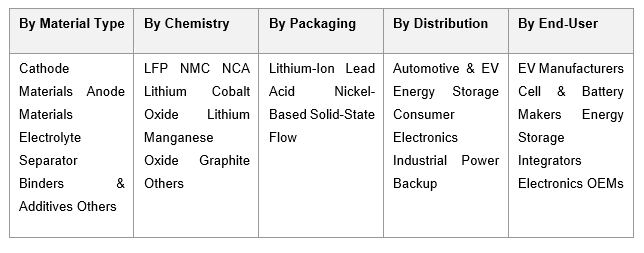
In this report, the India Battery Materials Market has been segmented into the following categories, in addition to detailed analysis of key industry trends, market dynamics, competitive landscape, and growth opportunities across the forecast period:
- By Material Type
- Cathode Materials
- Anode Materials
- Electrolyte
- Separator
- Binders & Additives
- Others
- By Chemistry
- Lithium Iron Phosphate (LFP)
- NMC
- NCA
- Lithium Cobalt Oxide
- Lithium Manganese Oxide
- Graphite
- Others
- By Packaging
- Lithium-Ion
- Lead Acid
- Nickel-Based
- Solid-State
- Flow
- By Distribution Channel
- Automotive & EV
- Energy Storage Systems
- Consumer Electronics
- Industrial
- Telecom & Data Centers
- Power Backup / UPS
- By End-User
- EV Manufacturers
- Cell & Battery Makers
- Energy Storage Integrators
- Electronics OEMs
- By Geography
- North India
- South India
- West India
- East India
- Central India
Competitive Landscape
Company Profiles:
Detailed analysis of the leading companies operating in the India Battery Materials Market, including business overview, product portfolio, strategic initiatives, competitive positioning, and recent developments.
Company Information
Detailed profiling and strategic analysis of additional market players (up to five companies), including emerging domestic material producers, specialty cathode and anode manufacturers, regional processing players, or niche technology-focused startups.
For a free sample of the India Battery Materials Market report, customised insights or delivery timelines, submit your query here
Table of Contents
- Research Framework
- Market Segmentation
- Research Objective
- Research Methodology
- Qualitative Research
- Primary Research
- Secondary Research
- Quantitative Research
- Market Breakdown & Data Triangulation
- Demand Side
- Supply Side
- Primary Research Respondents
- Assumption & Limitation
- Executive Summary
- Market Overview, 2021-2032
- By Material Type
- By Chemistry
- By Packaging
- By Distribution Channel
- By End-User
- By Region
- Analyst Recommendations
- Geopolitical Impact on India Battery Materials Market
- India Battery Materials Market Insights
- Market Dynamics
- Growth Drivers
- Rising EV adoption, energy storage expansion, and domestic cell manufacturing driving battery material demand across India.
- Growing EV ecosystem, rising government support, and shifting chemistry preferences fuelling premium material adoption.
- Product innovation in silicon anode, high-nickel, and solid-state materials strengthening advanced segment growth.
- Restraints
- High import dependence on critical minerals limiting domestic battery material supply across the value chain.
- Technology, IP, and processing capability gaps restricting cathode and anode manufacturing across India.
- Volatility in lithium, cobalt, and nickel prices and processing costs impacting overall material margins.
- Opportunities
- Silicon anode, solid-state, and recycled material innovation opening untapped supply pools across industrial clusters.
- Premium, high-nickel, and advanced materials supporting next-generation growth in EV and energy storage segments.
- PLI schemes, gigafactory investments, and localisation mandates creating massive domestic sourcing opportunities.
- Challenges
- Intense competition from imported cells, foreign material suppliers, and low-cost precursor imports.
- Limited mineral processing infrastructure and inconsistent refining coverage across domestic supply chains.
- Maintaining material quality, consistency, and performance at scale across diverse Indian manufacturing clusters.
- Technological Advancements
- Recent Technological Advancements
- Prior to 2020
- Porter’s Five Forces Analysis
- PESTLE Analysis
- Industry Value Chain & Entry Points
- Upstream Raw Materials (lithium, cobalt, nickel, manganese, graphite, precursors, processing chemicals)
- Material Processors & Manufacturers (Epsilon, Himadri, Hindalco, Altmin, Neogen Chemicals)
- Chemistry & Precursor Suppliers (LFP, NMC, NCA, graphite, electrolyte salts)
- Advanced & Specialty Material Makers (silicon anode, solid-state, ceramic separators)
- Quality Control, R&D & Testing Laboratories (BIS, ARAI, ISO battery safety standards)
- Distributors, Wholesalers & Modern Trade (B2B and B2C distribution networks)
- Cell & Battery Manufacturers (Ola Electric, Exide, Amara Raja, Reliance New Energy, Tata)
- OEMs & System Integrators (Tata Motors, Mahindra, Ola, JSW, Reliance)
- Distribution & Recycling Channels (Attero, Lohum, BatX, Tata Chemicals, Gravita)
- End-Users (EV makers, cell manufacturers, energy storage integrators, electronics OEMs, industrial)
- India Battery Materials Market: Regulatory Framework
- India Battery Materials Market Overview
- Market Size & Forecast, 2021-2032
- By Value (USD Million)
- By Volume (Thousand Tonnes)
- Market Share & Forecast
- By Material Type
- Cathode Materials
- Anode Materials
- Electrolyte
- Separator
- Binders & Additives
- Others
- By Chemistry
- Lithium Iron Phosphate (LFP)
- NMC
- NCA
- Lithium Cobalt Oxide
- Lithium Manganese Oxide
- Graphite
- Others
- By Packaging
- Lithium-Ion
- Lead Acid
- Nickel-Based
- Solid-State
- Flow
- By Distribution Channel
- Automotive & EV
- Energy Storage Systems
- Consumer Electronics
- Industrial
- Telecom & Data Centers
- Power Backup / UPS
- By End-User
- EV Manufacturers
- Cell & Battery Makers
- Energy Storage Integrators
- Electronics OEMs
- By Geography
- North India
- South India
- West India
- East India
- Central India
- Competitive Landscape
- India Battery Materials Market Company Market Share Analysis, 2025
- Competitive Benchmarking, By Operating Parameters
- Key Strategic Development (Mergers, Acquisitions, Partnerships, Etc.)
- List of Emerging Players
- Company Profile
- Epsilon Advanced Materials Pvt. Ltd.
- Introduction & Company Profile
- Product Benchmarking
- Strategic Outlook
- Key Competitors
- Financial Analysis
- SWOT Analysis
(Same Data Pointers Will Be Provided for The Below Companies)
- Himadri Speciality Chemical Limited
- Hindalco Industries Limited
- Exide Industries Limited
- Amara Raja Energy & Mobility Limited
- Tata Chemicals Limited
- Aether Industries Limited
- Reliance New Energy Limited
- Log9 Materials Scientific Pvt. Ltd.
- Altmin India Pvt. Ltd.
- Neogen Chemicals Limited
- Ola Electric Mobility Limited
- JSW Energy Limited
- Other Prominent Players
* Financial information in case of non-listed companies will be provided as per availability
** The segmentation and the companies are subjected to modifications based on in-depth secondary for the final deliverable
Frequently Asked Questions
1. How large is the India battery materials market and what is its growth forecast?
Ans: India battery materials market is valued at USD 1,470 million in 2025 and is projected to reach USD 3,323 million by 2032, growing at a CAGR of 12.4%, supported by rising EV adoption, energy storage expansion, and domestic cell manufacturing.
2. Which segments are driving demand in the India battery materials market?
Ans: Cathode materials lead the market with over 45% value share, while anode materials are the fastest-growing segment, driven by silicon-anode innovation, domestic graphite processing, and rising EV cell demand across industrial clusters.
3. What are the key drivers of growth in the India battery materials market?
Ans: Key drivers include rising EV adoption, expanding energy storage, growing domestic cell capacity, government PLI support, product innovation in LFP and silicon anode materials, and rapid scaling of localisation mandates across industrial clusters.
4. Which regions are driving growth in the India battery materials market?
Ans: South India and West India lead with around 58% of total value, driven by Karnataka, Tamil Nadu, Telangana, Maharashtra, and Gujarat. North India and Delhi NCR also show strong industrial material demand.
5. What are the latest trends in the India battery materials market?
Ans: The latest trends include rapid adoption of LFP and silicon anode materials, growth in domestic cell capacity, rising demand for high-nickel variants, solid-state innovation, and expanding localisation driving domestic material sourcing.