

India Solar Cell Manufacturing Market, 2032
- Energy, Power & Storage, Renewables & Clean Fuels
- Oct 2026
- Pages 140
- Report Format: pdf
- Report Price: $2400 USD
India’s solar cell manufacturing market is witnessing strong structural growth, driven by the ALMM List-II mandate for domestic cells, PLI scheme support for integrated capacity, Basic Customs Duty on imported cells, DCR rules under PM Surya Ghar and PM-KUSUM, a fast shift to TOPCon and heterojunction technology, and rising investment from domestic module makers and large conglomerates in cell, ingot, and wafer capacity.
| Study Duration | 2021-2032 |
| Market Size (2025) | USD 2,840 Million |
| CAGR (2026-2032) | 20.4% |
| Leading Segment | Mono PERC Cells (M10 Wafer) |
| Fastest Growing Segment | TOPCon & Heterojunction Cells |
| Market Size (2032) | USD 10,420 Million |
Market Overview: India Solar Cell Manufacturing Market
The India solar cell manufacturing market size is expanding quickly, driven by the ALMM List-II order that took effect on 1 June 2026, PLI-backed integrated capacity, import duties on foreign cells, mandatory domestic content for rooftop and agricultural schemes, and a national target of 500 GW of non-fossil power capacity by 2030. Valued at USD 2,840 million in 2025 and projected to reach USD 10,420 million by 2032, growing at a CAGR of 20.4%, the sector is gaining from domestic cell output of 18.2 GW in 2025, which is set to reach 96.5 GW by 2032. Mono PERC cells still lead output, while TOPCon and heterojunction cells form the fastest growing technology group. Enlisted cell capacity reached 37.8 GW in October 2026, still far below the 193 GW of listed module capacity, which shows how much room remains for new cell lines. As Waaree Energies, Adani Solar, Premier Energies, Tata Power Solar, and ReNew Photovoltaics expand integrated lines, and Jupiter International, Vikram Solar, Emmvee, and Avaada add TOPCon capacity, the sector is turning into a policy-backed, technology-led, and export-ready industry with strong long-term growth potential.
Key Report Takeaways: India Solar Cell Manufacturing Market
- Domestic solar cell production value is projected to grow from USD 2,840 million in 2025 to USD 10,420 million by 2032, registering a CAGR of 20.4%, driven by the ALMM List-II mandate, PLI-backed capacity additions, and a steady move toward higher-efficiency domestic cells across utility and rooftop projects.
- Mono PERC cells lead domestic production, accounting for 58% of output in 2025, supported by older lines at Waaree, Adani Solar, Premier Energies, and Tata Power Solar, though most new capacity announced since 2024 is based on n-type TOPCon.
- TOPCon and heterojunction cells are the fastest growing segments, with TOPCon output expected to grow at a CAGR of 31.6% through 2032, as developers seek higher module wattage, better bifacial gain, and lower land and balance-of-system cost per megawatt.
- Enlisted cell capacity under ALMM List-II reached 37.8 GW after the twelfth revision on 8 October 2026, up from 31 GW in April 2026, structurally expanding cell supply across captive, merchant, and export sales channels.
- Rising investment by Waaree Energies, Adani Solar, Premier Energies, Tata Power Solar, ReNew Photovoltaics, and Reliance New Energy in integrated cell, ingot, and wafer capacity is reducing import dependence and supporting the 2032 growth outlook for domestic cell makers.
Key Market Drivers: India Solar Cell Manufacturing Market
ALMM List-II Mandate and Domestic Content Rules Driving Solar Cell Demand Across India
The single largest driver is policy. The Approved List of Models and Manufacturers (ALMM) was introduced in 2019 for modules, and List-II for solar cells took effect on 1 June 2026 after MNRE declined a blanket extension in its order of 25 May 2026. Projects covered by the order must now use cells from enlisted domestic plants, which turns domestic cells from an optional input into a compliance requirement. Domestic Content Requirement (DCR) rules add a second layer of demand. PM Surya Ghar Muft Bijli Yojana, which targets rooftop solar for 1 crore households with an outlay of INR 75,021 crore, and the PM-KUSUM scheme for solar pumps and farm-level plants both require DCR cells and modules. India crossed 144 GW of installed solar capacity at the end of 2025, and the 500 GW non-fossil target means annual additions will stay high through 2030. Since enlisted cell capacity of 37.8 GW in October 2026 is still a fraction of listed module capacity, the gap creates a strong and lasting pull for new cell lines across the country.
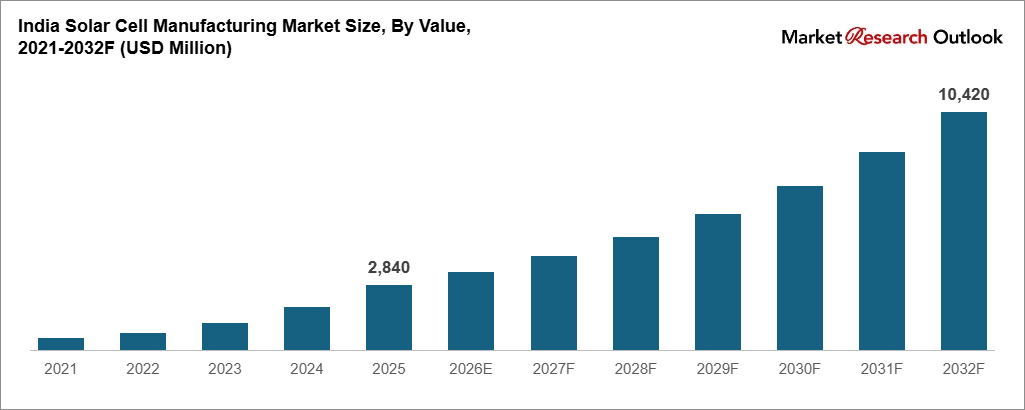
Source:
PLI Scheme Support, Import Duties and Rising Solar Installations Fuelling Domestic Cell Capacity Additions
The Production Linked Incentive (PLI) scheme for High Efficiency Solar PV Modules, running since 2021 with a total outlay of INR 24,000 crore, rewards producers who integrate from polysilicon or wafers through cells to modules. Tranche II alone allocated 39.6 GW of integrated capacity, and many of these plants are now entering cell and wafer production. Basic Customs Duty of 25% on imported cells and 40% on imported modules, introduced in April 2022, further narrows the price advantage of imports. On the demand side, utility tenders from SECI, NTPC, NHPC, and SJVN, along with state-level hybrid and round-the-clock auctions, keep a large pipeline of projects in place. Commercial and industrial buyers are also adding open-access and captive solar to cut power bills and meet green energy targets. Taken together, incentives, duties, and a deep project pipeline give cell producers better visibility on utilisation and payback, which is why new cell plant announcements continue month after month.
Shift to TOPCon, Heterojunction and Larger Wafer Formats Strengthening High-Efficiency Cell Output
Technology change is the third major driver. Most of the cell capacity built in India before 2023 used mono PERC, but new lines are almost entirely n-type TOPCon, with a smaller number of heterojunction and back contact projects. TOPCon cells enlisted in 2026 show average efficiency of 25.57% and output of 9.78 W per cell on G12R wafers, compared with 23.53% for a typical PERC cell. Higher cell efficiency lifts module wattage, cuts land and mounting cost per megawatt, and improves bifacial energy yield, which matters for large utility projects in Rajasthan and Gujarat. MNRE has also added larger G12R formats to List-II and proposed a 14-character naming standard for cell models covering origin, technology, wafer size, and efficiency. These changes give buyers clearer product data and reward producers who invest in newer lines. As a result, high-efficiency cells are expected to account for a rising share of domestic cell value through 2032.
Key Market Challenges: India Solar Cell Manufacturing Market
Heavy Dependence on Imported Polysilicon, Wafers and Production Equipment Limiting Value Addition
India’s cell industry still depends on imports for its most critical inputs. The country imports 95% of the polysilicon it uses, mostly from China, and domestic ingot and wafer capacity remains small compared with cell and module capacity. China holds over 90% of global polysilicon and wafer capacity and over 85% of global cell capacity, which gives Chinese suppliers strong control over input prices. Silver paste, specialty chemicals, and most diffusion, deposition, and printing tools are also imported. Any change in export rules, freight cost, or currency movement flows straight into Indian cell costs. MNRE has proposed ALMM List-III for wafers from June 2028 to push upstream integration, but building polysilicon and wafer plants takes time and large capital. Until then, limited upstream supply will cap how much value Indian cell makers can capture.
Wide Cost Gap Between Domestic and Imported Cells and Pressure on Project Tariffs
The price gap between domestic and imported cells remains wide. Domestic List-II cells sell for INR 13 per watt, while imported cells land at INR 5 per watt, a spread of more than two to one. For developers who won tenders at low tariffs before List-II came into force, this gap can hurt project returns. Some developers sought transitional relief, and MNRE allowed claims to be filed by the end of June 2026, while extending a limited exemption for certain net-metering and open-access projects until 31 December 2026. Smaller module assemblers without their own cell lines face the toughest position, since they must buy domestic cells from competitors who also sell modules. Short-term tightness in compliant cell supply can delay project schedules, raise module prices, and slow rooftop adoption among price-sensitive households, creating near-term friction for domestic cell suppliers.
Rapid Technology Obsolescence, High Capital Intensity and Skilled Workforce Shortages Impacting Cell Margins
Cell technology moves fast, and that creates financial risk. A PERC line built in 2021 may already be outdated, since TOPCon is now the base case and heterojunction and back contact designs are gaining ground. Upgrading or replacing lines needs fresh capital, and a gigawatt of new TOPCon capacity typically requires several hundred crore rupees of investment. Producers also face a shortage of trained process engineers, maintenance staff, and quality specialists with hands-on experience in high-volume cell lines. Yields on new lines often take months to stabilise, which reduces early margins. Global oversupply has pushed international cell prices to historic lows, limiting how far Indian producers can raise prices outside protected segments. Skill programmes, technology partnerships, and R&D support are improving the picture, but margin pressure from obsolescence and ramp-up risk remains a practical constraint for Indian cell producers.
Key Market Trends: India Solar Cell Manufacturing Market
Rapid Migration From Mono PERC to N-Type TOPCon and Heterojunction Cells in India
Indian producers are moving quickly from mono PERC to n-type TOPCon. Of the 193 GW of approved module capacity in April 2026, 172 GW was TOPCon-based, while TOPCon cell capacity stood at 10 GW, showing how far cell lines lag module lines. That gap is now closing. Jupiter Solartech added 1,297 MW of n-type TOPCon capacity at Solan, Himachal Pradesh in September 2026, Renewsys India enlisted 552 MW of n-type TOPCon at Maheshwaram, Telangana, and Gopin Semicon added 402 MW of G12R TOPCon at Surat, Gujarat in October 2026. Heterojunction and back contact cells remain at early scale but are drawing interest for premium rooftop and high-temperature sites. Producers are also adopting multi-busbar and zero-busbar designs, laser-assisted firing, and edge passivation to lift efficiency. This shift is lifting the value of domestic cell output across both utility and distributed solar segments.
Backward Integration Into Ingots, Wafers and Polysilicon by Indian Cell Producers
A clear move toward backward integration is reshaping cell production in India. Integrated players such as Adani Solar at Mundra, Reliance New Energy at Jamnagar, Waaree Energies, Avaada, and Premier Energies are building or planning ingot and wafer capacity alongside cell lines. The aim is to control input cost, secure supply ahead of the planned ALMM List-III for wafers, and qualify for PLI incentives that reward deeper integration. Integrated producers can also offer full traceability from wafer to module, which matters for export buyers in the United States and Europe who face strict supply-chain rules. Over time, upstream integration should lower cost per watt, reduce exposure to Chinese export controls, and give Indian cells a clearer path to global markets, strengthening long-term value capture for domestic producers.
Capacity Expansion by Integrated Module Makers and Large Conglomerate Investments
A wave of capacity investment is changing the supply base. Enlisted cell capacity rose from 31 GW in April 2026 to 37.8 GW by 8 October 2026, across twelve ALMM List-II revisions. Waaree Energies, Reliance Industries, and TP Solar were named in earlier List-II updates, while Tata Power Solar has built integrated cell and module capacity at Tirunelveli, Tamil Nadu, and Adani Solar continues to scale its Mundra complex in Gujarat. Premier Energies has expanded at Maheshwaram, Telangana, and ReNew Photovoltaics is growing cell output at Dholera, Gujarat. Large conglomerates bring access to low-cost capital and in-house demand from their own renewable power arms, which helps them run new lines at high utilisation. Combined with PLI support, import duties, and DCR-backed demand, these investments are reinforcing the 2032 growth outlook across the full solar value chain.
Segmental Insights: India Solar Cell Manufacturing Market
By Application: Utility-Scale Segment Dominates Domestic Solar Cell Demand
The utility-scale segment dominates domestic cell demand, accounting for 61% of cell value in 2025, driven by large central and state tenders, hybrid and round-the-clock auctions, and the growing reach of ALMM rules across government-backed projects. M10 and G12R TOPCon cells in bifacial modules are the preferred choice for this segment because higher wattage cuts land and structure cost per megawatt. Commercial and industrial projects account for 21% of demand, led by open-access and captive plants built by manufacturers, data centres, and large consumers seeking lower power bills. Residential rooftop solar contributes 13%, supported by PM Surya Ghar and its DCR requirement, while off-grid and agricultural uses under PM-KUSUM account for the remaining 5%. In 2025, Adani Solar, Waaree Energies, Tata Power Solar, Premier Energies, and ReNew Photovoltaics supplied a large share of compliant cells to utility developers, reinforcing segment leadership in the India solar cell manufacturing market.
By Technology: Mono PERC Leads While TOPCon and Heterojunction Grow Fastest
Mono PERC cells lead domestic output, accounting for 58% of production in 2025, because most lines commissioned before 2024 were built on PERC technology and remain in use for DCR rooftop and agricultural projects. TOPCon cells hold 34% of output and are the main growth engine, expanding at a CAGR of 31.6% through 2032 as nearly every new line uses n-type TOPCon. Heterojunction cells account for 3% of output and back contact cells for 1%, with both expected to gain share in premium and high-temperature applications. Polycrystalline cells hold 2% and continue to decline, while thin-film and tandem cells together account for the remaining 2%. Leading producers including Waaree Energies, Adani Solar, Premier Energies, Tata Power Solar, and Jupiter International are shifting their portfolios toward TOPCon, lifting average efficiency and value per watt across domestic cell output.
Regional Insights: India Solar Cell Manufacturing Market
Regional analysis shows that West India and South India together account for 87% of domestic cell output. West India leads with 54%, driven by Gujarat, where Adani Solar at Mundra, Waaree Energies, ReNew Photovoltaics at Dholera, Goldi Solar, and Gopin Semicon at Surat operate large plants close to ports and power infrastructure. Maharashtra adds further capacity through Avaada and other producers. South India contributes 33%, led by Telangana, where Premier Energies and Renewsys India run lines at Maheshwaram, and Tamil Nadu, home to Tata Power Solar at Tirunelveli and Vikram Solar expansion. Karnataka adds output through Emmvee. North India accounts for 6%, supported by Jupiter Solartech at Solan in Himachal Pradesh, while East India holds 5%, led by West Bengal and Odisha, and Central India accounts for the remaining 2%. State incentives, land banks, and port access will keep Gujarat and Telangana as the main cell hubs across the India solar cell manufacturing market through 2032.
Recent Developments: India Solar Cell Manufacturing Market
- Indian cell producers saw strong progress in 2025 and 2026. ALMM List-II for solar cells came into force on 1 June 2026, and MNRE issued twelve List-II revisions by 8 October 2026, bringing enlisted cell capacity to 37.8 GW. The ninth revision in August 2026 added larger G12R n-type TOPCon cells, and MNRE proposed a 14-character naming standard for enlisted cell models.
- Domestic producers continued to add capacity. In September 2026, Jupiter Solartech enlisted 1,297 MW of n-type TOPCon capacity at Solan, Himachal Pradesh. In October 2026, Premier Energies added a PERC cell model at Maheshwaram, Telangana, with average efficiency of 23.53%, Renewsys India updated 552 MW of n-type TOPCon capacity, and Gopin Semicon enlisted 402 MW of G12R TOPCon capacity at Surat, Gujarat. These additions are strengthening domestic supply and supporting the 2032 forecast for Indian cell output.
- Policy support also moved forward. MNRE extended a limited exemption for certain net-metering and open-access projects until 31 December 2026 while keeping List-II in place for the wider market, and progress continued on ALMM List-III for wafers from June 2028. Integrated producers including Adani Solar, Reliance New Energy, Waaree Energies, and Tata Power Solar advanced ingot, wafer, and cell plans, positioning India as one of the fastest growing cell producers outside China and strengthening long-term competitive positioning in the India solar cell manufacturing market.
Key Market Players: India Solar Cell Manufacturing Market
- Waaree Energies Limited
- Adani Solar (Mundra Solar PV Limited)
- Premier Energies Limited
- Tata Power Solar Systems Limited
- ReNew Photovoltaics Private Limited
- Vikram Solar Limited
- Emmvee Photovoltaic Power Limited
- Jupiter International Limited
- Avaada Electro Private Limited
- Reliance New Energy Limited
- Websol Energy System Limited
- Goldi Solar Private Limited
- Renewsys India Private Limited
| By Technology | By Wafer Size | By Efficiency Range | By Sales Channel | By Application |
| Mono PERC Cells TOPCon Cells Heterojunction (HJT) Cells Back Contact Cells (IBC, TBC) Polycrystalline Cells Others (Thin-Film & Tandem) |
M2 (156.75 mm) G1 (158.75 mm) M6 (166 mm) M10 (182 mm) G12R (182 x 210 mm) G12 (210 mm) Others |
Below 22% 22% to 23% 23% to 24% 24% to 25% Above 25% |
Captive Supply (Integrated Module Makers) Merchant Sales to Module Assemblers Contract & Tolling Manufacturing Government & PSU Procurement Export Sales Distributors & Traders |
Utility-Scale Commercial & Industrial Residential Rooftop Off-Grid & Agricultural |
Report Scope
In this report, the India Solar Cell Manufacturing Market has been segmented into the following categories, in addition to detailed analysis of key industry trends, market dynamics, competitive landscape, and growth opportunities across the forecast period:
- By Technology
- Mono PERC Cells
- TOPCon Cells
- Heterojunction (HJT) Cells
- Back Contact Cells (IBC, TBC)
- Polycrystalline Cells
- Others (Thin-Film & Tandem)
- By Wafer Size
- M2 (156.75 mm)
- G1 (158.75 mm)
- M6 (166 mm)
- M10 (182 mm)
- G12R (182 x 210 mm)
- G12 (210 mm)
- Others
- By Efficiency Range
- Below 22%
- 22% to 23%
- 23% to 24%
- 24% to 25%
- Above 25%
- By Sales Channel
- Captive Supply (Integrated Module Makers)
- Merchant Sales to Module Assemblers
- Contract & Tolling Manufacturing
- Government & PSU Procurement
- Export Sales
- Distributors & Traders
- By Application
- Utility-Scale
- Commercial & Industrial
- Residential Rooftop
- Off-Grid & Agricultural
- By Geography
- North India
- South India
- West India
- East India
- Central India
Competitive Landscape
Company Profiles:
Detailed analysis of the leading companies operating in the India Solar Cell Manufacturing Market, including business overview, product portfolio, strategic initiatives, competitive positioning, and recent developments.
Company Information
Detailed profiling and strategic analysis of additional market players (up to five companies), including emerging cell producers, specialty heterojunction and back contact manufacturers, ingot and wafer makers, or state-level module assemblers adding cell lines.
For a free sample of the India Solar Cell Manufacturing Market report, customised insights or delivery timelines, submit your query here
India Solar Cell Manufacturing Market, 2032
- Research Framework
- Market Segmentation
- Research Objective
- Research Methodology
- Qualitative Research
- Primary Research
- Secondary Research
- Quantitative Research
- Market Breakdown & Data Triangulation
- Demand Side
- Supply Side
- Primary Research Respondents
- Assumption & Limitation
- Executive Summary
- Market Overview, 2021-2032
- By Technology
- By Wafer Size
- By Efficiency Range
- By Sales Channel
- By Application
- By Region
- Analyst Recommendations
- Geopolitical Impact on India Solar Cell Manufacturing Market
- India Solar Cell Manufacturing Insights
- Market Dynamics
- Growth Drivers
- ALMM List-II mandate and domestic content rules driving solar cell demand across India.
- PLI scheme support, import duties, and rising solar installations fuelling domestic cell capacity additions.
- Shift to TOPCon, heterojunction, and larger wafer formats strengthening high-efficiency cell output.
- Restraints
- Heavy dependence on imported polysilicon, wafers, and production equipment limiting domestic value addition.
- Wide cost gap between domestic and imported cells placing pressure on project tariffs.
- Rapid technology obsolescence, high capital intensity, and skilled workforce shortages impacting cell margins.
- Opportunities
- Rooftop and agricultural solar under PM Surya Ghar and PM-KUSUM creating assured demand for DCR-compliant cells.
- Backward integration into ingots, wafers, and polysilicon opening higher value addition for integrated producers.
- Export supply to the United States, Europe, and the Middle East creating new markets for Indian cells.
- Challenges
- Intense price competition from low-cost imported cells and global oversupply in cell markets.
- Limited domestic supply of silver paste, high-purity chemicals, and industrial gases used in cell lines.
- Maintaining cell efficiency, yield, and quality consistency at gigawatt scale across new plants.
- Technological Advancements
- Recent Technological Advancements
- Prior to 2020
- Porter’s Five Forces Analysis
- PESTLE Analysis
- Industry Value Chain & Entry Points
- Upstream Raw Materials (polysilicon, ingots, wafers, silver paste, aluminium paste, process chemicals, industrial gases)
- Solar Cell Manufacturers (Waaree, Adani Solar, Premier Energies, Tata Power Solar, ReNew Photovoltaics)
- Production Equipment & Technology Suppliers (diffusion, deposition, laser, screen printing, metrology tools)
- Ingot & Wafer Makers (Adani Solar, Reliance New Energy, Waaree, Avaada, Premier Energies)
- Quality Control, Testing & Certification (ALMM, BIS, IEC, NISE testing standards)
- Distributors, Traders & Cell Merchants (B2B cell supply to standalone module assemblers)
- Module Assemblers & Integrated Manufacturers (Waaree, Vikram Solar, Goldi Solar, Emmvee, Renewsys)
- EPC Contractors & Independent Power Producers (Adani Green, ReNew, NTPC Green, Tata Power Renewables, Avaada)
- Government Programmes & Procurement Agencies (MNRE, SECI, NTPC, state DISCOMs, PM-KUSUM, PM Surya Ghar)
- End-Users (utility-scale plants, commercial and industrial buyers, residential rooftops, agricultural pump users)
- India Solar Cell Manufacturing Market: Regulatory Framework
- India Solar Cell Manufacturing Market Overview
- Market Size & Forecast, 2021-2032
- By Value (USD Million)
- By Volume (GW)
- Market Share & Forecast
- By Technology
- Mono PERC Cells
- TOPCon Cells
- Heterojunction (HJT) Cells
- Back Contact Cells (IBC, TBC)
- Polycrystalline Cells
- Others (Thin-Film & Tandem)
- By Wafer Size
- M2 (156.75 mm)
- G1 (158.75 mm)
- M6 (166 mm)
- M10 (182 mm)
- G12R (182 x 210 mm)
- G12 (210 mm)
- Others
- By Efficiency Range
- Below 22%
- 22% to 23%
- 23% to 24%
- 24% to 25%
- Above 25%
- By Sales Channel
- Captive Supply (Integrated Module Makers)
- Merchant Sales to Module Assemblers
- Contract & Tolling Manufacturing
- Government & PSU Procurement
- Export Sales
- Distributors & Traders
- By Application
- Utility-Scale
- Commercial & Industrial
- Residential Rooftop
- Off-Grid & Agricultural
- By Geography
- North India
- South India
- West India
- East India
- Central India
- Competitive Landscape
- India Solar Cell Manufacturing Market Company Market Share Analysis, 2025
- Competitive Benchmarking, By Operating Parameters
- Key Strategic Development (Mergers, Acquisitions, Partnerships, Etc.)
- List of Emerging Players
- Company Profile
- Waaree Energies Limited
- Introduction & Company Profile
- Product Benchmarking
- Strategic Outlook
- Key Competitors
- Financial Analysis
- SWOT Analysis
(Same Data Pointers Will Be Provided for The Below Companies)
- Adani Solar (Mundra Solar PV Limited)
- Premier Energies Limited
- Tata Power Solar Systems Limited
- ReNew Photovoltaics Private Limited
- Vikram Solar Limited
- Emmvee Photovoltaic Power Limited
- Jupiter International Limited
- Avaada Electro Private Limited
- Reliance New Energy Limited
- Websol Energy System Limited
- Goldi Solar Private Limited
- Renewsys India Private Limited
- Other Prominent Players
* Financial information in case of non-listed companies will be provided as per availability
** The segmentation and the companies are subjected to modifications based on in-depth secondary for the final deliverable
Frequently Asked Questions
1. How large is the India solar cell manufacturing market and what is its growth forecast?
Ans: Domestic solar cell production in India is valued at USD 2,840 million in 2025 and is projected to reach USD 10,420 million by 2032, growing at a CAGR of 20.4%, backed by ALMM List-II and PLI support.
2. Which segments are driving demand in the India solar cell manufacturing market?
Ans: Mono PERC cells lead with 58% of 2025 output, while TOPCon and heterojunction cells grow fastest. Utility-scale projects account for 61% of demand, followed by commercial and industrial users and residential rooftop solar.
3. What are the key drivers of growth in the India solar cell manufacturing market?
Ans: Key drivers include the ALMM List-II mandate effective from 1 June 2026, DCR rules under PM Surya Ghar and PM-KUSUM, the INR 24,000 crore PLI scheme, import duties, and the shift to TOPCon cells.
4. Which regions are driving growth in the India solar cell manufacturing market?
Ans: West India and South India together hold 87% of domestic cell output, led by Gujarat, Telangana, and Tamil Nadu, where Adani Solar, Waaree Energies, Premier Energies, and Tata Power Solar run large cell plants.
5. What are the latest trends in the India solar cell manufacturing market?
Ans: The latest trends include rapid migration from PERC to n-type TOPCon cells, adoption of larger G12R wafers, backward integration into ingots and wafers, and enlisted cell capacity reaching 37.8 GW in October 2026.