

Africa Data Center Power Availability & Grid Reliability Market, 2032
- Global Markets
- Oct 2026
- Pages 140
- Report Format: pdf
- Report Price: $3000 USD
Africa’s data center power availability & grid reliability market is witnessing strong structural growth, driven by operational capacity passing 500 MW with 890 MW in the pipeline, frequent grid collapses and load shedding in key markets, power market reforms in South Africa and Nigeria, falling solar and battery costs, and investment by hyperscalers, telecom operators and colocation developers that is lifting demand for backup generation, battery storage, captive renewable power and grid connection infrastructure.
| Study Duration | 2021-2032 |
| Market Size (2025) | USD 1,184 Million |
| CAGR (2026-2032) | 15.9% |
| Leading Segment | Backup Power Generation (Diesel & Gas Gensets) |
| Fastest Growing Segment | Captive Renewable & Hybrid Power |
| Market Size (2032) | USD 3,326 Million |
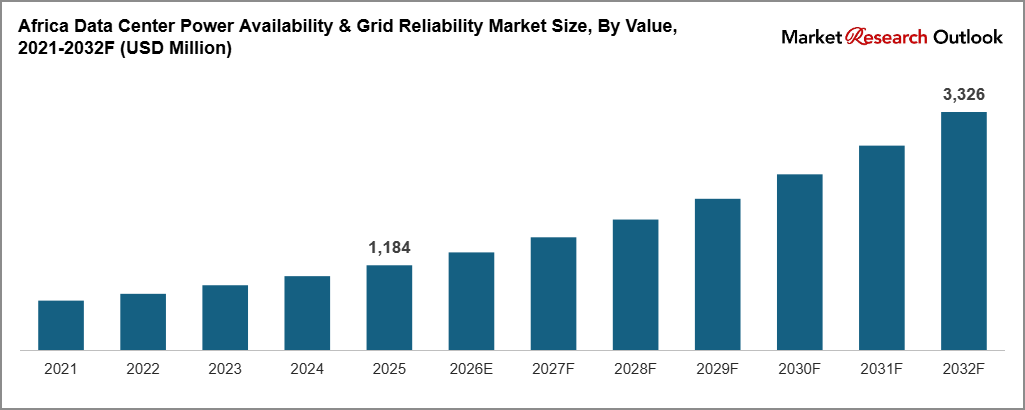
Source:
Market Overview: Africa Data Center Power Availability & Grid Reliability Market
The Africa data center power availability & grid reliability market size is witnessing rapid expansion, driven by fast capacity growth in African data center hubs, weak and unstable national grids, rising rack densities from cloud and AI workloads, and power sector reforms that allow private and renewable supply. Valued at USD 1,184 million in 2025 and projected to reach USD 3,326 million by 2032, growing at a CAGR of 15.9%, the market is being fuelled by colocation, hyperscale, telecom and banking operators that must guarantee uptime above 99.98% on grids that fail far more often. Backup power generation leads spending, while captive renewable and hybrid power is emerging as the fastest growing category. Africa’s operational data center capacity passed 500 MW, with South Africa holding more than 60% of it, yet about 600 million Africans still lack electricity, which shows how thin grid margins remain. As equipment majors including Schneider Electric, Vertiv, Eaton, Caterpillar and Cummins expand regional supply, and developers including Teraco, Africa Data Centres, Rack Centre, Nxtra and Open Access Data Centres add capacity, Africa’s data center power availability & grid reliability market is evolving into a reliability-led, technology-driven and reform-backed infrastructure category with strong long-term growth potential.
Key Report Takeaways: Africa Data Center Power Availability & Grid Reliability Market
- Africa’s data center power availability & grid reliability market size is projected to grow from USD 1,184 million in 2025 to USD 3,326 million by 2032, registering a strong CAGR of 15.9%, driven by capacity growth, unreliable grids and the structural shift from diesel-only backup toward hybrid solar, storage and gas power.
- Backup power generation dominates spending, accounting for 31.6% of market value in 2025, driven by diesel and gas gensets sized to carry full data center loads for days during grid collapses and load shedding.
- Captive renewable and hybrid power is the fastest growing category, expected to expand at a CAGR of 24.8% through 2032 as operators in South Africa, Nigeria, Kenya and Egypt sign solar and wind supply deals and add battery storage to cut diesel runtime.
- Operational data center capacity in Africa passed 500 MW with a further 890 MW in the pipeline, led by South Africa with more than 60% of capacity, Teraco’s 70 MW Isando campus and 78.6 MW already live in Lagos.
- Nigeria’s grid collapsed 12 times in 2024, South Africa endured its worst year of load shedding in 2023, and Kenya’s 3 GW installed base cannot yet host gigawatt-scale campuses, which keeps reliability spending central to the market forecast 2032.
Key Market Drivers: Africa Data Center Power Availability & Grid Reliability Market
Rapid Data Center Capacity Growth Across South Africa, Nigeria, Kenya and Egypt Raising Demand for Reliable Power
Growth in the market is being driven by new capacity in a small number of fast-growing hubs. Operational data center capacity across Africa has passed 500 MW, with a further 890 MW in development. South Africa holds more than 60% of this base, led by Teraco’s 70 MW Isando campus in Johannesburg and Africa Data Centres’ 20 MW JHB1 facility in Midrand. Lagos already hosts 78.6 MW, with 21st Century Technologies, Rack Centre, Nxtra by Airtel and Open Access Data Centres adding new halls. In Kenya, Airtel Africa has broken ground on a 44 MW data center, and Egypt’s East Cairo campus offers 25 MW of IT capacity scalable to 45 MW. Microsoft, AWS, Oracle and Google have opened or announced cloud regions in South Africa, Kenya and Nigeria, and Cassava Technologies announced plans with NVIDIA to deploy AI compute capacity in 2025. Every new megawatt needs grid connection, backup generation, UPS and fuel or storage, creating strong pull-through demand across Africa’s data center power availability & grid reliability market.
Frequent Grid Outages and Load Shedding Driving Investment in Backup Generation, UPS and Battery Storage
The market is benefiting from the gap between data center uptime targets and grid performance. Nigeria’s national grid collapsed 12 times in 2024, and on 11 December 2024 average generation of about 3,087 MW fell to zero within an hour, leaving data centers in Lagos and Abuja running fully on gensets. South Africa experienced its worst year of load shedding in 2023, and although Eskom has largely suspended load shedding since March 2024, operators still design for long outages and planned rotational cuts. In many other markets, voltage swings and frequency drops damage equipment even when the grid is technically available. As a result, African data centers typically install backup generation for the full critical load with N+1 redundancy, fuel storage for 72 hours of runtime, and UPS systems with power conditioning. UPS and battery energy storage accounts for 24.3% of market value in 2025, and grid-interactive lithium-ion systems are growing quickly as operators look to cut generator starts and fuel use across Africa’s data center power availability & grid reliability market.
Power Market Reforms, Wheeling Rules and Captive Renewable PPAs Enabling Cleaner, More Reliable Supply
Power sector reform is a major catalyst for the market. South Africa’s Electricity Regulation Amendment Act, signed in 2024, opens the path to a competitive wholesale market and supports wheeling, which lets data centers buy solar and wind power from private plants through the national grid. Nigeria’s Electricity Act 2023 allows states to regulate their own electricity markets and makes it easier for operators to build captive and embedded generation. Kenya, Egypt and Morocco are expanding geothermal, wind and solar capacity, and the World Bank and African Development Bank launched Mission 300 to connect 300 million Africans to electricity by 2030, which will strengthen grids over time. Hyperscalers bring global net zero targets to their African leases, asking operators to secure renewable supply. Falling prices for solar modules and battery cells make hybrid systems more affordable. These measures are steering capital toward wheeled PPAs, captive solar and gas plants, battery storage and new substations, structurally expanding Africa’s data center power availability & grid reliability market through 2032.
Key Market Challenges: Africa Data Center Power Availability & Grid Reliability Market
Limited Grid Capacity and Transmission Constraints Delaying Large Data Center Connections
The market continues to face challenges around grid capacity. Many African grids are small relative to the size of new data center campuses, so a single large project can absorb a meaningful share of national supply. Kenya’s installed capacity of about 3 GW could not accommodate the proposed 1 GW geothermal-powered data center announced by Microsoft and G42 in 2024, and the project was suspended in 2026. In Nigeria, grid generation often averages near 4 GW for a population of more than 200 million, and transmission constraints limit how much power reaches Lagos. Substation upgrades and dedicated high-voltage lines can take three years, longer than the time needed to build a data hall. Until transmission build-out catches up, grid capacity will remain the main gating factor for large campuses across Africa’s data center power availability & grid reliability market.
High Diesel Costs, Fuel Supply Risk and Emissions Pressure on Backup-Heavy Operations
The market faces structural complexity from fuel. In markets with weak grids, data centers can run gensets for thousands of hours a year, which makes diesel the largest operating cost after staff and rent. Nigeria removed its petrol subsidy in 2023, and currency depreciation has pushed fuel prices sharply higher in local terms, while diesel deliveries can be delayed by road congestion, security incidents and supply shortages. Long genset runtimes also raise maintenance costs and carbon emissions, which conflicts with hyperscaler net zero targets and investor reporting. Gas generation offers lower fuel cost and emissions where pipeline gas is available, as in parts of Lagos and Egypt, but gas networks remain limited in most markets. Fuel cost and supply risk therefore remain a near-term constraint on operating economics across Africa’s data center power availability & grid reliability market.
High Capital Cost, Currency Volatility and Financing Gaps for Power Infrastructure Projects
The market faces practical constraints from cost and finance. Gensets, lithium-ion UPS, battery storage, transformers, switchgear and solar plants are mostly imported and priced in US dollars or euros, while many operators earn part of their revenue in local currencies that have weakened sharply against the dollar. Import duties and port delays add further cost and lead time. Interest rates in several African markets remain high, and smaller colocation and enterprise operators struggle to finance captive power plants or long-term PPAs on their own. Skilled technicians for high-voltage systems, battery storage and genset maintenance are concentrated in major cities, which raises service costs elsewhere. Development finance institutions and international equipment suppliers are expanding support, but closing the financing gap will take several years across Africa’s data center power availability & grid reliability market.
Key Market Trends: Africa Data Center Power Availability & Grid Reliability Market
Shift From Diesel-Only Backup to Hybrid Solar, Battery Storage and Gas Power Systems
The market is undergoing a clear technology shift away from diesel-only backup. Hybrid configurations that combine grid supply with solar PV, battery storage and gas or diesel gensets are expected to account for 41.7% of power supply configuration value by 2032, up from 18.9% in 2025. Battery systems now carry loads through short outages and voltage dips without starting generators, while solar arrays on rooftops, carports and nearby land cut daytime grid and fuel use. Gas and dual-fuel gensets from Caterpillar, Cummins, Rolls-Royce Power Systems and Wärtsilä are replacing diesel units where pipeline gas is available in Nigeria and Egypt. Huawei Digital Power, Schneider Electric, Vertiv and Eaton have expanded lithium-ion UPS and battery storage offerings for African operators. Grid plus diesel gensets remains the most common configuration at 36.4% of 2025 value, but its share is falling. This technology transition is reinforcing the market forecast 2032 across both new build and retrofit projects.
Wheeled Renewable PPAs and Captive Power Plants for Hyperscale and Colocation Campuses
A clear shift toward contracted renewable and captive supply is reshaping the market, particularly in South Africa and Nigeria. South African operators are signing wheeled solar and wind power purchase agreements with independent power producers, using the national grid to deliver clean energy from plants in the Northern Cape, Free State and Western Cape to campuses in Johannesburg and Cape Town. In Lagos, larger campuses are building or contracting captive gas-fired plants and embedded generation under the new state-level rules. Captive renewable and hybrid power accounts for 14.7% of market value in 2025 and is expected to grow at 24.8% annually through 2032. Developers are also building dedicated substations and dual grid feeds from separate transmission points to improve reliability. Equipment suppliers including ABB, Siemens, Hitachi Energy and Schneider Electric are supplying switchgear, transformers and substation automation for these projects, lifting demand for integrated power systems across the market.
Lithium-Ion UPS, Grid-Interactive Battery Storage and Digital Energy Monitoring
A wave of digital and storage investment is reshaping how operators manage power in the market. Lithium-ion UPS systems are replacing valve-regulated lead-acid batteries because they last longer, take less space and tolerate the frequent cycling caused by unstable grids. Grid-interactive battery storage lets operators shave peaks, avoid demand charges and switch smoothly between grid, solar and gensets. Electrical power monitoring systems track voltage, frequency, harmonics and fuel levels across every feed, allowing teams to predict failures and plan fuel deliveries. Schneider Electric, Vertiv, Eaton, ABB and Huawei Digital Power are packaging hardware, software and remote services for African sites. Power quality and voltage regulation equipment accounted for 7.4% of market value in 2025, and monitoring software is among the fastest growing items within the others category. Combined with uptime requirements from hyperscale and banking tenants, these developments are reinforcing the market forecast 2032 across the entire value chain.
Segmental Insights: Africa Data Center Power Availability & Grid Reliability Market
By End-User: Colocation & Hyperscale Operators Dominate Africa’s Data Center Power Availability & Grid Reliability Market
The colocation and hyperscale operators segment dominates the market, accounting for 52.4% of market value in 2025, driven by campuses run by Teraco, Africa Data Centres, Open Access Data Centres, Rack Centre and 21st Century Technologies, along with cloud regions for Microsoft, AWS, Oracle and Google. These customers specify full-load backup generation, 2N UPS and renewable supply, which raises power spend per megawatt. Telecom operators contribute 21.3% of demand, led by MTN, Airtel Africa, Safaricom, Vodacom and Ethio Telecom, which run core and edge data centers across many countries with weak grids. BFSI users account for 14.8%, supported by central bank data residency rules and digital payments growth. Government and enterprise users make up the remaining 11.5%, led by national data centers and sovereign cloud projects. In 2025 and 2026, new colocation campus phases reinforced segment leadership in the market.
By Solution Type: Backup Power Generation Leads While Captive Renewable & Hybrid Power Grows Fastest
Backup power generation leads the market solution mix, accounting for 31.6% of total value, driven by the need to carry full critical loads through long grid outages with diesel and gas gensets. UPS and battery energy storage contributes another 24.3%, followed by captive renewable and hybrid power at 14.7% and grid connection and substation infrastructure at 13.2%. Power quality and voltage regulation equipment accounts for 7.4% of value, while fuel storage, monitoring and electrical power management software together form 8.8%. Captive renewable and hybrid power is the fastest growing category, expanding at a CAGR of 24.8% through 2032 as wheeling rules and falling solar and battery prices improve project returns. Facilities above 20 MW account for 47.6% of value in 2025, reflecting the growth of large campuses. Leading suppliers including Caterpillar, Cummins, Schneider Electric, Vertiv and Eaton have aligned portfolios to this mix, driving higher value per megawatt across the market.
Regional Insights: Africa Data Center Power Availability & Grid Reliability Market
Country analysis of the market shows that South Africa leads with 46.2% of market value in 2025, driven by Johannesburg and Cape Town, which host more than 60% of Africa’s operational data center capacity, along with wheeled renewable projects and battery storage investment after years of load shedding. Nigeria follows with 15.8% and is the fastest growing country at a CAGR of 19.6%, supported by 78.6 MW of live capacity in Lagos, new campuses at Eko Atlantic and Ilasan, and heavy spending on gensets and captive gas power due to frequent grid collapses. Egypt contributes 11.3%, led by East Cairo and new capacity linked to subsea cable landings. Kenya accounts for 9.4%, supported by Nairobi’s cloud and telecom data centers and geothermal-rich supply. The rest of Africa, including Morocco, Ghana, Côte d’Ivoire, Senegal, Tanzania and Ethiopia, holds 17.3%. In 2025 and 2026, new campus phases in Johannesburg, Lagos, Nairobi and Cairo reinforced regional capacity hubs across the market.
Recent Developments: Africa Data Center Power Availability & Grid Reliability Market
- The market witnessed strong momentum in capacity and power planning during 2025 and 2026. Operational data center capacity across Africa passed 500 MW, with a further 890 MW in development, led by South Africa, Nigeria, Egypt and Kenya. In January 2025, African leaders, the World Bank and the African Development Bank met in Dar es Salaam for the Mission 300 Africa Energy Summit, backing the goal of connecting 300 million people to electricity by 2030.
- Operators and telecom groups deepened African commitments. Airtel Africa broke ground on a 44 MW data center in Kenya, Nxtra advanced its 38 MW Eko Atlantic facility in Lagos, and Open Access Data Centres progressed its 24 MW Ilasan project. In 2026, Kenya suspended the proposed USD 1 billion Microsoft and G42 geothermal-powered data center, which needed about 1 GW of supply against a 3 GW national grid, highlighting how grid capacity shapes project feasibility and supporting the market forecast 2032.
- Policy momentum has gained strong traction in the market. South Africa is implementing its Electricity Regulation Amendment Act to open a competitive power market and expand wheeling, while Nigerian states are setting up their own electricity regulators under the Electricity Act 2023. Combined with renewable procurement programs, gas-to-power projects and development finance support, these reforms position Africa as one of the most promising growth regions for data center power solutions, strengthening long-term competitiveness in the market forecast 2032.
Key Market Players: Africa Data Center Power Availability & Grid Reliability Market
- Schneider Electric SE
- Vertiv Holdings Co.
- Eaton Corporation plc
- ABB Ltd.
- Siemens AG
- Hitachi Energy Ltd.
- Caterpillar Inc.
- Cummins Inc.
- Rolls-Royce Power Systems AG
- Rehlko (formerly Kohler Energy)
- Huawei Digital Power Technologies Co., Ltd.
- Wärtsilä Corporation
- Aggreko Ltd.
| By Solution Type | By Supply Config | By Capacity | By DC Type | By End-User |
| Backup Generation UPS & BESS Captive Renewable Grid Connection Power Quality Others | Grid & UPS Grid & Diesel Grid & Gas Solar & BESS Hybrid Captive Gas Off-Grid Microgrid Wheeled PPA | Below 1 MW 1-5 MW 5-20 MW 20-50 MW Above 50 MW | Hyperscale Colocation Enterprise Edge Government | Colocation & Hyperscale Telecom BFSI Government & Enterprises |
Report Scope
In this report, the Africa Data Center Power Availability & Grid Reliability Market has been segmented into the following categories, in addition to detailed analysis of key industry trends, market dynamics, competitive environment, and growth opportunities across the forecast period:
- By Solution Type
- Backup Power Generation (Diesel & Gas Gensets)
- UPS & Battery Energy Storage Systems
- Captive Renewable & Hybrid Power (Solar PV, Wind PPAs, Wheeling)
- Grid Connection & Substation Infrastructure
- Power Quality & Voltage Regulation Equipment
- Others (Fuel Storage, Monitoring & EPMS Software)
- By Power Supply Configuration
- Grid with UPS Only
- Grid plus Diesel Gensets
- Grid plus Gas Gensets
- Grid plus Solar & BESS Hybrid
- Captive Gas Power Plant
- Off-Grid Renewable Microgrid
- Wheeled Renewable PPA
- By Facility Capacity
- Below 1 MW
- 1 MW to 5 MW
- 5 MW to 20 MW
- 20 MW to 50 MW
- Above 50 MW
- By Data Center Type
- Hyperscale Data Centers
- Wholesale Colocation
- Retail Colocation
- Enterprise & Captive Data Centers
- Edge Data Centers
- Government & Sovereign Data Centers
- By End-User
- Colocation & Hyperscale Operators
- Telecom Operators
- BFSI
- Government & Enterprises
- By Geography
- South Africa
- Nigeria
- Kenya
- Egypt
- Rest of Africa
Competitive Landscape
Company Profiles:
Detailed analysis of the leading companies operating in Africa’s Data Center Power Availability & Grid Reliability Market, including business overview, product portfolio, strategic initiatives, competitive positioning, and recent developments.
Company Information
Detailed profiling and strategic analysis of additional market players (up to five companies), including independent power producers, battery storage integrators, regional genset distributors, substation EPC contractors, or niche power monitoring providers.
For a free sample of the Africa Data Center Power Availability & Grid Reliability Market report, customised insights or delivery timelines, submit your query here
Africa Data Center Power Availability & Grid Reliability Market, 2032
- Research Framework
- Market Segmentation
- Research Objective
- Research Methodology
- Qualitative Research
- Primary Research
- Secondary Research
- Quantitative Research
- Market Breakdown & Data Triangulation
- Demand Side
- Supply Side
- Primary Research Respondents
- Assumption & Limitation
- Executive Summary
- Market Overview, 2021-2032
- By Solution Type
- By Power Supply Configuration
- By Facility Capacity
- By Data Center Type
- By End-User
- By Country
- Analyst Recommendations
- Geopolitical Impact on Data Center Power Supply in Africa
- Data Center Power Availability & Grid Reliability Insights: Africa
- Market Dynamics
- Growth Drivers
- Rapid data center capacity growth across South Africa, Nigeria, Kenya and Egypt raising demand for reliable power.
- Frequent grid outages and load shedding driving investment in backup generation, UPS and battery storage.
- Power market reforms, wheeling rules and captive renewable PPAs enabling cleaner, more reliable supply.
- Restraints
- Limited grid capacity and transmission constraints delaying large data center connections.
- High diesel costs, fuel supply risk and emissions pressure on backup-heavy operations.
- High capital cost, currency volatility and financing gaps for power infrastructure projects.
- Opportunities
- Battery storage and solar hybrids replacing diesel runtime at existing facilities.
- Gas-to-power and captive plants for large campuses in Nigeria and Egypt.
- Edge data centers in secondary cities needing off-grid hybrid power systems.
- Challenges
- Thin local service networks for high-voltage, battery and genset maintenance outside major cities.
- Land, permitting and right-of-way delays for dedicated substations and transmission lines.
- Policy uncertainty and slow implementation of power market reforms in several countries.
- Technological Advancements
- Recent Technological Advancements
- Prior to 2020
- Porter’s Five Forces Analysis
- PESTLE Analysis
- Industry Value Chain & Entry Points
- Upstream Components & Materials (battery cells, power semiconductors, copper, steel, solar modules, fuel)
- Power Generation Equipment Makers (Caterpillar, Cummins, Rolls-Royce Power Systems, Rehlko, Wärtsilä)
- UPS, Battery Storage & Power Electronics Suppliers (Schneider Electric, Vertiv, Eaton, Huawei Digital Power)
- Grid & Substation Equipment Suppliers (ABB, Siemens, Hitachi Energy, transformer and switchgear makers)
- Utilities, Grid Operators & Regulators (Eskom, TCN, KPLC, national and state regulators)
- Independent Power Producers & Renewable Developers (solar, wind, gas-to-power, wheeling traders)
- EPC Contractors, Rental Power & Service Providers (Aggreko, regional electrical contractors, genset dealers)
- Data Center Developers & Operators (Teraco, Africa Data Centres, Rack Centre, Open Access Data Centres, Nxtra)
- Hyperscale Cloud & Telecom Operators (Microsoft, AWS, Oracle, Google, MTN, Airtel Africa, Safaricom)
- End-Users (colocation tenants, BFSI, government agencies, enterprises, content providers)
- Africa Data Center Power Availability & Grid Reliability Market: Regulatory Framework
- Africa Data Center Power Availability & Grid Reliability Market Overview
- Market Size & Forecast, 2021-2032
- By Value (USD Million)
- By Capacity (MW)
- Market Share & Forecast
- By Solution Type
- Backup Power Generation (Diesel & Gas Gensets)
- UPS & Battery Energy Storage Systems
- Captive Renewable & Hybrid Power (Solar PV, Wind PPAs, Wheeling)
- Grid Connection & Substation Infrastructure
- Power Quality & Voltage Regulation Equipment
- Others (Fuel Storage, Monitoring & EPMS Software)
- By Power Supply Configuration
- Grid with UPS Only
- Grid plus Diesel Gensets
- Grid plus Gas Gensets
- Grid plus Solar & BESS Hybrid
- Captive Gas Power Plant
- Off-Grid Renewable Microgrid
- Wheeled Renewable PPA
- By Facility Capacity
- Below 1 MW
- 1 MW to 5 MW
- 5 MW to 20 MW
- 20 MW to 50 MW
- Above 50 MW
- By Data Center Type
- Hyperscale Data Centers
- Wholesale Colocation
- Retail Colocation
- Enterprise & Captive Data Centers
- Edge Data Centers
- Government & Sovereign Data Centers
- By End-User
- Colocation & Hyperscale Operators
- Telecom Operators
- BFSI
- Government & Enterprises
- By Geography
- South Africa
- Nigeria
- Kenya
- Egypt
- Rest of Africa
- Competitive Landscape
- Company Market Share Analysis: Africa Data Center Power Solutions, 2025
- Competitive Benchmarking, By Operating Parameters
- Key Strategic Development (Mergers, Acquisitions, Partnerships, Etc.)
- List of Emerging Players
- Company Profile
- Schneider Electric SE
- Introduction & Company Profile
- Product Benchmarking
- Strategic Outlook
- Key Competitors
- Financial Analysis
- SWOT Analysis
(Same Data Pointers Will Be Provided for The Below Companies)
- Vertiv Holdings Co.
- Eaton Corporation plc
- ABB Ltd.
- Siemens AG
- Hitachi Energy Ltd.
- Caterpillar Inc.
- Cummins Inc.
- Rolls-Royce Power Systems AG
- Rehlko (formerly Kohler Energy)
- Huawei Digital Power Technologies Co., Ltd.
- Wärtsilä Corporation
- Aggreko Ltd.
- Other Prominent Players
* Financial information in case of non-listed companies will be provided as per availability
** The segmentation and the companies are subjected to modifications based on in-depth secondary for the final deliverable
Frequently Asked Questions
1. How large is the Africa data center power availability & grid reliability market and what is its growth forecast?
Ans: The market is valued at USD 1,184 million in 2025 and is projected to reach USD 3,326 million by 2032, growing at a CAGR of 15.9%, supported by capacity growth and frequent grid outages across key hubs.
2. Which segments are driving demand in Africa's data center power availability & grid reliability market?
Ans: Backup power generation leads with a 31.6% value share in 2025, while captive renewable and hybrid power is the fastest growing segment at a 24.8% CAGR as wheeling rules and cheaper batteries spread.
3. What are the key drivers of growth in this market?
Ans: Key drivers include fast data center capacity growth in South Africa, Nigeria, Kenya and Egypt, frequent grid collapses and load shedding, and power market reforms that enable wheeled renewable and captive supply.
4. Which countries are driving growth in data center power solutions across Africa?
Ans: South Africa leads with a 46.2% share, driven by Johannesburg and Cape Town. Nigeria holds 15.8% and is the fastest growing country, supported by Lagos capacity and heavy captive power spending.
5. What are the latest trends in data center power and grid reliability in Africa?
Ans: The latest trends include the shift from diesel-only backup to hybrid solar, storage and gas systems, wheeled renewable PPAs and captive plants, and lithium-ion UPS with digital energy monitoring across African sites.