

Middle East AI Data Center Infrastructure Feasibility Market, 2032
- Global Markets
- Oct 2026
- Pages 140
- Report Format: pdf
- Report Price: $3000 USD
The Middle East’s AI data center infrastructure feasibility market is witnessing strong structural growth, driven by sovereign AI strategies in Saudi Arabia and the UAE, gigawatt campus plans such as the 5 GW UAE-US AI Campus, HUMAIN and DataVolt’s Oxagon project, hyperscaler commitments backed by expanded GPU export approvals, and low-cost energy and land that are lifting demand for high-density power, liquid cooling, water supply and on-site energy systems.
| Study Duration | 2021-2032 |
| Market Size (2025) | USD 6,840 Million |
| CAGR (2026-2032) | 24.2% |
| Leading Segment | Power Distribution & Backup Infrastructure |
| Fastest Growing Segment | Direct-to-Chip & Immersion Liquid Cooling |
| Market Size (2032) | USD 31,182 Million |
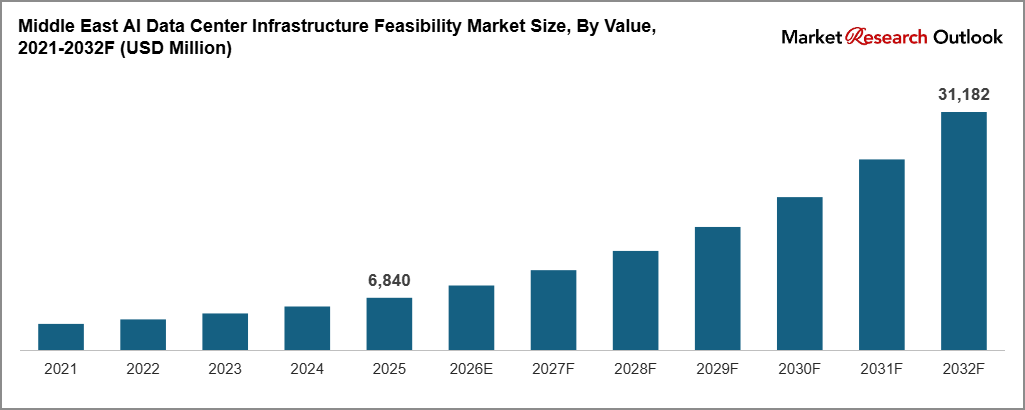
Source:
Market Overview: Middle East AI Data Center Infrastructure Feasibility Market
The Middle East AI data center infrastructure feasibility market size is witnessing rapid expansion, driven by sovereign AI programs, gigawatt campus announcements, hyperscaler capital commitments, rising rack power densities and competitive energy costs. Valued at USD 6,840 million in 2025 and projected to reach USD 31,182 million by 2032, growing at a CAGR of 24.2%, the market is being fuelled by national AI champions, hyperscalers, GPU cloud providers and government agencies that need halls able to support 40 kW and above per rack in ambient temperatures that pass 50°C in summer. Power distribution and backup infrastructure leads spending, while direct-to-chip and immersion liquid cooling is emerging as the fastest growing category. The UAE currently hosts the largest operational AI capacity, while Saudi Arabia holds the largest pipeline, led by HUMAIN’s target of 1.9 GW by 2030. As equipment majors including Schneider Electric, Vertiv, ABB, Siemens and Hitachi Energy expand regional supply, and developers including Khazna, HUMAIN and DataVolt build AI-ready campuses, the Middle East’s AI data center infrastructure feasibility market is evolving into a capacity-led, technology-driven and policy-backed infrastructure category with strong long-term growth potential.
Key Report Takeaways: Middle East AI Data Center Infrastructure Feasibility Market
- The Middle East’s AI data center infrastructure feasibility market size is projected to grow from USD 6,840 million in 2025 to USD 31,182 million by 2032, registering a strong CAGR of 24.2%, driven by sovereign AI campuses, hyperscaler investment and the shift toward liquid-cooled, high-density GPU capacity designed for desert heat.
- Power distribution and backup infrastructure dominates spending, accounting for 33.1% of market value in 2025, driven by demand for high-voltage substations, transformers, switchgear, busways, UPS and battery systems that can carry GPU loads with N+1 and 2N redundancy.
- Direct-to-chip and immersion liquid cooling is the fastest growing category, expected to expand at a CAGR of 34.6% through 2032 as GPU racks above 60 kW move into production clusters in Abu Dhabi, Riyadh, Dammam and NEOM.
- Announced AI capacity is led by the 5 GW UAE-US AI Campus in Abu Dhabi, including the 1 GW Stargate UAE cluster with its first 200 MW due in 2026, HUMAIN’s target of 6.6 GW by 2034 and DataVolt’s planned 1.5 GW Oxagon campus.
- Microsoft’s USD 15.2 billion UAE investment from 2023 to 2029, AWS’s USD 5 billion AI Zone with HUMAIN, and US export licences for advanced NVIDIA GPUs are strengthening the investment pipeline behind the market forecast 2032.
Key Market Drivers: Middle East AI Data Center Infrastructure Feasibility Market
Sovereign AI Strategies and Gigawatt Campus Announcements in Saudi Arabia and the UAE Driving AI-Ready Capacity
Growth in the market is being driven by national programs that treat AI compute as strategic infrastructure. In May 2025, G42, OpenAI, Oracle, NVIDIA, Cisco and SoftBank launched Stargate UAE, a 1 GW cluster within a 5 GW UAE-US AI Campus in Abu Dhabi, with the first 200 MW expected in 2026. In the same month, Saudi Arabia’s Public Investment Fund launched HUMAIN, which plans 1.9 GW of data center capacity by 2030 and 6.6 GW by 2034, and aims to process 7% of global AI training and inference workloads by 2030. DataVolt has agreed a USD 5 billion first investment for a 1.5 GW net zero AI campus at Oxagon in NEOM, with its first phase due in 2028. Each 100 MW of GPU capacity needs dedicated substations, chillers or liquid cooling plants, backup power and water supply, so these announcements translate directly into feasibility studies and equipment orders across the Middle East’s AI data center infrastructure feasibility market.
Hyperscaler Investment and Expanded GPU Export Approvals Strengthening Project Feasibility
The market is benefiting from capital and chip access that turn plans into bankable projects. Microsoft has committed USD 15.2 billion to the UAE between 2023 and 2029, including a USD 1.5 billion equity investment in G42 and more than USD 5.5 billion in AI and cloud capital spending from 2026 to 2029. US Commerce Department licences approved in 2025 allow Microsoft to ship the equivalent of 60,400 additional NVIDIA A100 chips to the UAE, using GB300 GPUs. In Saudi Arabia, AWS is building a USD 5 billion AI Zone with HUMAIN, and NVIDIA agreed to supply 18,000 GB300 chips for HUMAIN’s first facility. A single liquid-cooled rack of current generation GPU servers draws about 120 kW, compared with an average of 12 kW in typical regional cloud halls, which forces upgrades across the full electrical and thermal chain. Racks rated at 40 kW and above are expected to account for 54.2% of new capacity additions by 2032, up from 14.6% in 2025, lifting demand across the Middle East’s AI data center infrastructure feasibility market.
Low-Cost Energy, Large Land Banks and Renewable Power Supporting Competitive AI Campus Economics
Energy economics are a major catalyst for the market. Gulf states offer some of the lowest industrial power costs in the world, and Saudi Arabia has indicated it will support subsidised electricity for data centers. Solar tariffs in the region set global records, with Abu Dhabi’s 2 GW Al Dhafra project awarded at 1.35 US cents per kWh, and large utility programs led by ACWA Power, Masdar and national utilities keep adding renewable capacity. The UAE’s Barakah nuclear plant, with 5.6 GW of capacity, can supply up to 25% of the country’s electricity, giving AI campuses access to round-the-clock low-carbon power. Large state-owned land banks in Abu Dhabi, the Eastern Province, NEOM and Qatar allow campuses of several hundred megawatts with room for substations, solar fields and battery storage. These advantages lower the cost per megawatt of AI capacity and support positive feasibility outcomes, structurally expanding the Middle East’s AI data center infrastructure feasibility market through 2032.
Key Market Challenges: Middle East AI Data Center Infrastructure Feasibility Market
Extreme Ambient Temperatures Raising Cooling Loads and Limiting Free Cooling Across Gulf Sites
The market continues to face challenges from heat. Summer temperatures in Riyadh, Abu Dhabi, Kuwait City and Doha regularly pass 45°C and can reach 50°C, while coastal sites add high humidity, which leaves very few hours each year for free cooling with outside air. Chillers, dry coolers and heat rejection equipment must be rated for 55°C ambient, which raises equipment size, capital cost and electricity use. Dust and sand storms clog air filters and coils, adding maintenance and downtime risk. Air-cooled designs that work in Europe often fail to meet target power usage effectiveness in the Gulf, which pushes operators toward liquid cooling and higher supply water temperatures. Until desert-optimised designs become standard, heat will remain a key factor in feasibility studies and operating budgets across the Middle East’s AI data center infrastructure feasibility market.
Water Scarcity and Desalination Dependence Constraining Evaporative Cooling Choices
The market faces structural complexity from water scarcity. Gulf states have very limited renewable freshwater and depend on energy-intensive desalination for most municipal supply, so every litre used for cooling carries a high energy and cost penalty. Evaporative cooling towers, which are common in hot climates, can consume large volumes of water at a gigawatt campus, and water authorities are reluctant to allocate scarce desalinated supply to data centers. Groundwater in Saudi Arabia and Oman is largely non-renewable, and its use is tightly controlled. Developers are moving to closed-loop cooling, treated sewage effluent, dedicated desalination units and air-cooled heat rejection, but each option adds capital cost or power use. Water planning therefore remains a near-term constraint on cooling design across the Middle East’s AI data center infrastructure feasibility market.
US Export Controls, Equipment Lead Times and Skilled Labour Gaps Affecting Delivery Certainty
The market faces practical constraints from supply and skills. Advanced GPUs from NVIDIA and AMD require US export licences, and approvals come with security conditions that shape who can operate a site and which customers it can serve, so project timelines depend partly on policy decisions outside the region. Large power transformers, high-voltage switchgear, gas turbines and coolant distribution units faced long delivery times during 2024 and 2025, as global demand from AI campuses rose at the same time. Most critical equipment is imported from Europe, the United States and Asia. The region also needs far more commissioning engineers, liquid cooling specialists and high-voltage technicians than local training programs currently produce. Regional assembly by Schneider Electric, Vertiv, ABB and Siemens is growing, but full localisation will take several years across the Middle East’s AI data center infrastructure feasibility market.
Key Market Trends: Middle East AI Data Center Infrastructure Feasibility Market
Rapid Shift From Air Cooling to Direct-to-Chip and Immersion Liquid Cooling for Desert-Climate GPU Halls
The market is undergoing a clear technology shift toward liquid cooling, with direct-to-chip and immersion systems expected to account for 44.3% of cooling architecture value by 2032, up from 11.2% in 2025. Direct-to-chip cold plates remove most server heat at the chip and run warm coolant that can be rejected through dry coolers even on hot days, reducing both water use and chiller load. Single-phase immersion tanks remove fans entirely and limit dust exposure, which suits desert sites. NVIDIA GB300 based clusters ordered for HUMAIN and Stargate UAE are designed for liquid cooling, which makes the choice a requirement rather than an option. Vertiv, Schneider Electric, Johnson Controls and Trane have expanded liquid cooling and high-ambient chiller offerings for the region. This technology transition is reinforcing the market forecast 2032 across both new build and retrofit projects.
Gigawatt Campuses Paired With Solar, Gas Turbines, Battery Storage and Nuclear Power
A clear shift toward energy-integrated campuses is reshaping the market. The 5 GW Abu Dhabi campus, HUMAIN’s Eastern Province land bank, which can host ten 200 MW data centers, and DataVolt’s renewable-powered Oxagon project are being planned with dedicated substations, solar fields, battery storage and gas turbine backup. On-site energy and microgrid infrastructure accounts for 15.2% of market value in 2025 and is expected to grow at 27.3% annually through 2032. Developers are signing long-term power purchase agreements with ACWA Power, Masdar and national utilities, while some campuses evaluate gas engines and fuel cells for bridging power during grid build-out. Access to Barakah nuclear output in the UAE adds a low-carbon baseload option. This shift is lifting demand for integrated power, storage and control systems across the market.
Sovereign Cloud Rules, Data Embassy Frameworks and Prefabricated Modular Delivery
A wave of policy and delivery innovation is reshaping the market. Saudi Arabia’s Personal Data Protection Law and the UAE’s federal data protection law require careful handling of sensitive data, while Saudi Arabia has proposed a framework that would let foreign governments host data in Gulf data centers under their own laws, similar to data embassies. These rules favour sovereign and in-country AI capacity. On the delivery side, Schneider Electric, Vertiv, Eaton and Rittal are supplying prefabricated power skids, modular data halls and factory-tested cooling modules that cut site work in harsh conditions. Khazna and regional EPC contractors are adopting repeatable 50 MW and 100 MW building blocks. Combined with demand from sovereign AI programs and hyperscaler pipelines, these developments are reinforcing the market forecast 2032 across the entire value chain.
Segmental Insights: Middle East AI Data Center Infrastructure Feasibility Market
By End-User: Hyperscalers & Cloud Providers Dominate the Middle East’s AI Data Center Infrastructure Feasibility Market
The hyperscalers and cloud providers segment dominates the market, accounting for 48.1% of market value in 2025, driven by campuses and AI zones built with or for Microsoft, Amazon Web Services, Oracle, Google and OpenAI, along with regional GPU cloud providers. These customers specify liquid-cooling-ready halls, 2N power paths and renewable supply, which raises spend per megawatt. Government and sovereign AI programs contribute 21.7% of demand, led by HUMAIN, G42 and national AI compute initiatives. BFSI users account for 12.4%, supported by data residency rules and AI adoption in banking hubs such as Riyadh, Dubai and Doha. Energy, telecom and enterprise users make up the remaining 17.8%, with national oil companies and telecom operators building AI capacity for exploration, operations and edge services. In 2025 and 2026, new GPU cluster agreements reinforced segment leadership in the market.
By Infrastructure Component: Power Distribution & Backup Leads While Liquid Cooling Grows Fastest
Power distribution and backup infrastructure leads the market component mix, accounting for 33.1% of total value, driven by the high cost of high-voltage substations, transformers, switchgear, UPS systems, battery storage and gensets needed for redundant GPU power. Cooling and thermal management contributes another 27.4%, a higher share than in cooler regions because of desert heat, followed by on-site energy and microgrid systems at 15.2% and network and interconnect fabric at 10.6%. Water treatment and supply accounts for 6.2% of value, while site feasibility, design services, DCIM software and physical security together form 7.5%. Within cooling, direct-to-chip and immersion liquid cooling is the fastest growing category, expanding at a CAGR of 34.6% through 2032. Leading suppliers including Schneider Electric, Vertiv, ABB, Siemens and Johnson Controls have aligned portfolios to this mix, driving higher value per megawatt across the market.
Regional Insights: Middle East AI Data Center Infrastructure Feasibility Market
Country analysis of the market shows that the United Arab Emirates leads with 42.3% of market value in 2025, driven by Abu Dhabi’s 5 GW UAE-US AI Campus, Khazna’s large footprint and Microsoft’s investment program, along with Dubai’s colocation cluster. Saudi Arabia follows with 36.8% and is the fastest growing country at a CAGR of 27.9%, supported by HUMAIN’s build-out in Riyadh and the Eastern Province, the AWS AI Zone and DataVolt’s Oxagon campus in NEOM. Qatar contributes 6.4%, led by cloud regions and national digital programs in Doha. Kuwait accounts for 4.1%, supported by government cloud projects. The rest of the Middle East, including Oman, Bahrain, Jordan and Iraq, holds 10.4%, with Oman and Bahrain building AI-ready capacity and subsea cable hubs. In 2025 and 2026, new campus announcements in Abu Dhabi, Riyadh, Dammam and NEOM reinforced regional capacity hubs across the market.
Recent Developments: Middle East AI Data Center Infrastructure Feasibility Market
- The market witnessed strong momentum in investment and capacity progress during 2025 and 2026. In May 2025, G42, OpenAI, Oracle, NVIDIA, Cisco and SoftBank launched Stargate UAE, a 1 GW cluster within the 5 GW UAE-US AI Campus in Abu Dhabi, with its first 200 MW due in 2026. In the same month, PIF launched HUMAIN, announcing an initial 50 MW facility with 18,000 NVIDIA GB300 chips and a 6.6 GW target by 2034.
- Hyperscalers deepened Gulf commitments. In May 2025, AWS and HUMAIN announced a USD 5 billion AI Zone in Saudi Arabia. In November 2025, Microsoft detailed USD 15.2 billion of UAE investment from 2023 to 2029 and confirmed export licences to ship advanced NVIDIA GB300 GPUs. DataVolt, which signed a USD 5 billion agreement with NEOM in February 2025 for a 1.5 GW Oxagon campus, is preparing to start construction with its first phase due in 2028, supporting the market forecast 2032.
- Energy and policy momentum has gained strong traction in the market. Renewable power agreements with ACWA Power and Masdar, Barakah nuclear output in the UAE and Saudi support for subsidised data center electricity are improving campus economics. Combined with sovereign cloud rules and proposed data embassy frameworks, this positions the Gulf as one of the fastest scaling AI infrastructure regions globally, strengthening long-term competitiveness in the market forecast 2032.
Key Market Players: Middle East AI Data Center Infrastructure Feasibility Market
- Schneider Electric SE
- Vertiv Holdings Co.
- ABB Ltd.
- Siemens AG
- Hitachi Energy Ltd.
- Eaton Corporation plc
- Johnson Controls International plc
- Trane Technologies plc
- Caterpillar Inc.
- Cummins Inc.
- Khazna Data Centers
- ACWA Power Company
- Rittal GmbH & Co. KG
| By Component | By Rack Density | By Cooling | By DC Type | By End-User |
| Power & Backup Cooling On-Site Energy Network Water Others | Below 10 kW 10-20 kW 20-40 kW 40-60 kW 60-100 kW 100-150 kW Above 150 kW | Air Cooling Rear-Door HX Direct-to-Chip Single-Phase Immersion Two-Phase Immersion | Hyperscale Colocation Enterprise Edge Sovereign AI | Hyperscalers Government & Sovereign AI BFSI Energy, Telecom & Enterprises |
Report Scope
In this report, the Middle East AI Data Center Infrastructure Feasibility Market has been segmented into the following categories, in addition to detailed analysis of key industry trends, market dynamics, competitive environment, and growth opportunities across the forecast period:
- By Infrastructure Component
- Power Distribution & Backup Infrastructure
- Cooling & Thermal Management
- On-Site Energy & Microgrid Systems
- Network & Interconnect Fabric
- Water Treatment & Supply (Desalination, Recycling)
- Others (Site Feasibility, Design Services, DCIM & Physical Security)
- By Rack Power Density
- Below 10 kW
- 10 kW to 20 kW
- 20 kW to 40 kW
- 40 kW to 60 kW
- 60 kW to 100 kW
- 100 kW to 150 kW
- Above 150 kW
- By Cooling Architecture
- Air Cooling (CRAC, CRAH & High-Ambient Chillers)
- Rear-Door Heat Exchangers
- Direct-to-Chip Liquid Cooling
- Single-Phase Immersion Cooling
- Two-Phase Immersion Cooling
- By Data Center Type
- Hyperscale Self-Build
- Wholesale Colocation
- Retail Colocation
- Enterprise & Captive Data Centers
- Edge Data Centers
- Sovereign & Government AI Compute
- By End-User
- Hyperscalers & Cloud Providers
- Government & Sovereign AI Programs
- BFSI
- Energy, Telecom & Enterprises
- By Geography
- Saudi Arabia
- United Arab Emirates
- Qatar
- Kuwait
- Rest of Middle East
Competitive Landscape
Company Profiles:
Detailed analysis of the leading companies operating in the Middle East’s AI Data Center Infrastructure Feasibility Market, including business overview, product portfolio, strategic initiatives, competitive positioning, and recent developments.
Company Information
Detailed profiling and strategic analysis of additional market players (up to five companies), including emerging Gulf data center developers, GPU cloud providers, liquid cooling specialists, regional EPC contractors, or niche power equipment makers.
For a free sample of the Middle East AI Data Center Infrastructure Feasibility Market report, customised insights or delivery timelines, submit your query here
Middle East AI Data Center Infrastructure Feasibility Market, 2032
- Research Framework
- Market Segmentation
- Research Objective
- Research Methodology
- Qualitative Research
- Primary Research
- Secondary Research
- Quantitative Research
- Market Breakdown & Data Triangulation
- Demand Side
- Supply Side
- Primary Research Respondents
- Assumption & Limitation
- Executive Summary
- Market Overview, 2021-2032
- By Infrastructure Component
- By Rack Power Density
- By Cooling Architecture
- By Data Center Type
- By End-User
- By Country
- Analyst Recommendations
- Geopolitical Impact on AI Data Center Infrastructure in the Middle East
- AI Data Center Infrastructure Feasibility Insights: Middle East
- Market Dynamics
- Growth Drivers
- Sovereign AI strategies and gigawatt campus announcements in Saudi Arabia and the UAE driving AI-ready capacity.
- Hyperscaler investment and expanded GPU export approvals strengthening project feasibility.
- Low-cost energy, large land banks and renewable power supporting competitive AI campus economics.
- Restraints
- Extreme ambient temperatures raising cooling loads and limiting free cooling across Gulf sites.
- Water scarcity and desalination dependence constraining evaporative cooling choices.
- US export controls, equipment lead times and skilled labour gaps affecting delivery certainty.
- Opportunities
- AI export hubs serving Europe, Africa and South Asia from Gulf campuses.
- Data embassy and sovereign cloud frameworks attracting foreign government workloads.
- Local assembly of power, cooling and prefabricated modular data center equipment.
- Challenges
- Dust, sand and humidity raising maintenance needs for cooling and electrical systems.
- Grid connection and transmission build-out lagging gigawatt campus timelines.
- Fast GPU generation cycles shortening the design life of power and cooling infrastructure.
- Technological Advancements
- Recent Technological Advancements
- Prior to 2020
- Porter’s Five Forces Analysis
- PESTLE Analysis
- Industry Value Chain & Entry Points
- Upstream Components & Materials (copper, steel, power semiconductors, battery cells, refrigerants, dielectric fluids)
- Electrical Equipment Manufacturers (Schneider Electric, ABB, Siemens, Hitachi Energy, Eaton)
- Cooling & Thermal Management Suppliers (Vertiv, Johnson Controls, Trane, Rittal, liquid cooling OEMs)
- On-Site Energy & Backup Power Providers (Caterpillar, Cummins, gas turbines, battery storage, solar)
- Feasibility, Design Standards & Certification (Uptime Institute tiers, TIA-942, national grid codes)
- EPC Contractors & MEP Integrators (regional and international data center builders)
- Data Center Developers & Sovereign AI Platforms (Khazna, HUMAIN, DataVolt, G42, regional colocation operators)
- Hyperscale Cloud & GPU-as-a-Service Providers (Microsoft, AWS, Oracle, Google, OpenAI)
- Utilities & Energy Developers (ACWA Power, Masdar, national utilities, water and desalination authorities)
- End-Users (AI developers, government agencies, BFSI, energy companies, telecom operators, enterprises)
- Middle East AI Data Center Infrastructure Feasibility Market: Regulatory Framework
- Middle East AI Data Center Infrastructure Feasibility Market Overview
- Market Size & Forecast, 2021-2032
- By Value (USD Million)
- By Capacity (MW)
- Market Share & Forecast
- By Infrastructure Component
- Power Distribution & Backup Infrastructure
- Cooling & Thermal Management
- On-Site Energy & Microgrid Systems
- Network & Interconnect Fabric
- Water Treatment & Supply (Desalination, Recycling)
- Others (Site Feasibility, Design Services, DCIM & Physical Security)
- By Rack Power Density
- Below 10 kW
- 10 kW to 20 kW
- 20 kW to 40 kW
- 40 kW to 60 kW
- 60 kW to 100 kW
- 100 kW to 150 kW
- Above 150 kW
- By Cooling Architecture
- Air Cooling (CRAC, CRAH & High-Ambient Chillers)
- Rear-Door Heat Exchangers
- Direct-to-Chip Liquid Cooling
- Single-Phase Immersion Cooling
- Two-Phase Immersion Cooling
- By Data Center Type
- Hyperscale Self-Build
- Wholesale Colocation
- Retail Colocation
- Enterprise & Captive Data Centers
- Edge Data Centers
- Sovereign & Government AI Compute
- By End-User
- Hyperscalers & Cloud Providers
- Government & Sovereign AI Programs
- BFSI
- Energy, Telecom & Enterprises
- By Geography
- Saudi Arabia
- United Arab Emirates
- Qatar
- Kuwait
- Rest of Middle East
- Competitive Landscape
- Company Market Share Analysis: Middle East AI Data Center Infrastructure, 2025
- Competitive Benchmarking, By Operating Parameters
- Key Strategic Development (Mergers, Acquisitions, Partnerships, Etc.)
- List of Emerging Players
- Company Profile
- Schneider Electric SE
- Introduction & Company Profile
- Product Benchmarking
- Strategic Outlook
- Key Competitors
- Financial Analysis
- SWOT Analysis
(Same Data Pointers Will Be Provided for The Below Companies)
- Vertiv Holdings Co.
- ABB Ltd.
- Siemens AG
- Hitachi Energy Ltd.
- Eaton Corporation plc
- Johnson Controls International plc
- Trane Technologies plc
- Caterpillar Inc.
- Cummins Inc.
- Khazna Data Centers
- ACWA Power Company
- Rittal GmbH & Co. KG
- Other Prominent Players
* Financial information in case of non-listed companies will be provided as per availability
** The segmentation and the companies are subjected to modifications based on in-depth secondary for the final deliverable
Frequently Asked Questions
1. How large is the Middle East AI data center infrastructure feasibility market and what is its growth forecast?
Ans: The market is valued at USD 6,840 million in 2025 and is projected to reach USD 31,182 million by 2032, growing at a CAGR of 24.2%, supported by sovereign AI campuses and hyperscaler investment.
2. Which segments are driving demand in the Middle East's AI data center infrastructure feasibility market?
Ans: Power distribution and backup infrastructure leads with a 33.1% value share in 2025, while direct-to-chip and immersion liquid cooling is the fastest growing segment at a 34.6% CAGR as GPU rack densities rise.
3. What are the key drivers of growth in this market?
Ans: Key drivers include sovereign AI strategies, gigawatt campuses such as Stargate UAE and HUMAIN, hyperscaler investment backed by GPU export approvals, and low-cost energy, land and renewable power across the Gulf.
4. Which countries are driving growth in AI data center infrastructure across the Middle East?
Ans: The UAE leads with a 42.3% share, driven by Abu Dhabi's 5 GW AI campus. Saudi Arabia holds 36.8% and is the fastest growing country, supported by HUMAIN, AWS and DataVolt projects.
5. What are the latest trends in Middle East AI data center infrastructure?
Ans: The latest trends include liquid cooling for desert-climate GPU halls, gigawatt campuses paired with solar, gas, storage and nuclear power, sovereign cloud and data embassy rules, and prefabricated modular delivery.