

Global Data Center Transformer & Electrical Equipment Supply Constraint Market, 2032
- Global Markets
- Oct 2026
- Pages 140
- Report Format: pdf
- Report Price: $3500 USD
The global data center transformer and electrical equipment market is witnessing strong structural growth, driven by record AI and cloud construction, long grid connection queues, dedicated substation builds, higher rack power densities, multi-year lead times for large transformers, shortages of electrical steel, and heavy investment by transformer and switchgear makers in new factories across North America, Europe, and Asia.
| Study Duration | 2021-2032 |
| Market Size (2025) | USD 18,600 Million |
| CAGR (2026-2032) | 13.9% |
| Leading Segment | Distribution Transformers (Oil-Immersed) |
| Fastest Growing Segment | Power Transformers (Above 10 MVA) |
| Market Size (2032) | USD 46,200 Million |
Market Overview: Global Data Center Transformer & Electrical Equipment Supply Constraint Market
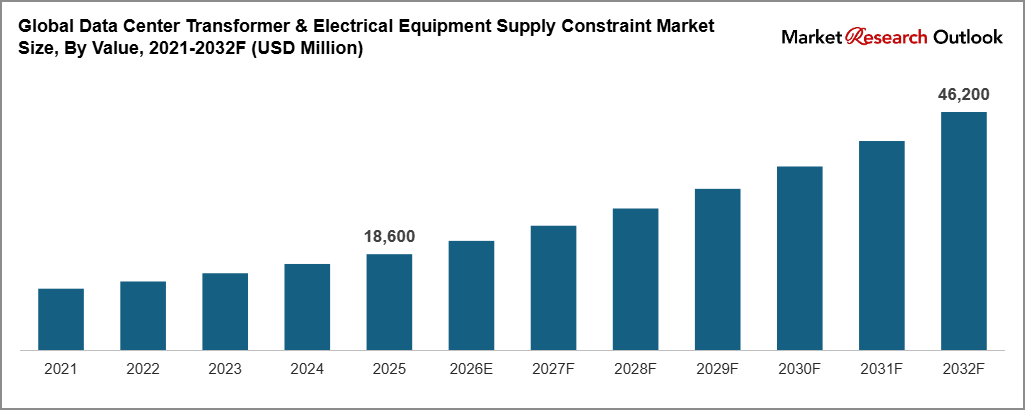
The global data center transformer and electrical equipment supply constraint market size is witnessing rapid expansion, driven by record data center construction, long waits for grid capacity, dedicated campus substations, and the move to medium-voltage distribution inside AI halls. Valued at USD 18,600 million in 2025 and projected to reach USD 46,200 million by 2032, growing at a CAGR of 13.9%, data center transformer demand is being fuelled by hyperscale AI campuses of 100 MW to 1 GW, colocation growth in every major market, and racks that now draw more than 100 kW. Distribution transformers lead spending, while power transformers above 10 MVA form the fastest growing category as operators build their own substations. Material shortages, long factory queues, and price increases are reshaping how operators buy power equipment. As transformer makers including Hitachi Energy, Siemens Energy, GE Vernova, HD Hyundai Electric, and Hyosung add capacity, and switchgear suppliers including Schneider Electric, Eaton, and ABB scale output, the market is evolving into a capacity-constrained, engineered, and fast-scaling segment with strong long-term growth potential.
Key Report Takeaways: Global Data Center Transformer & Electrical Equipment Supply Constraint Market
- The global data center transformer and electrical equipment supply constraint market size is projected to grow from USD 18,600 million in 2025 to USD 46,200 million by 2032, registering a strong CAGR of 13.9%, driven by AI and cloud data center construction, dedicated substation builds, and the structural shift toward pre-tested, modular power equipment.
- Distribution transformers dominate the market, accounting for 24% of total value in 2025, driven by the large number of units each campus needs, typical ratings of 2,500 kVA to 3,500 kVA per data hall block, and strong demand for oil-immersed and ester-filled designs placed outside buildings.
- Power transformers above 10 MVA are the fastest growing segment, expected to grow at a CAGR of 18.4% through 2032 as operators build dedicated 132 kV to 500 kV substations to connect large AI campuses directly to transmission networks.
- Rapid growth in data center power use, which the International Energy Agency projects to rise from 415 TWh in 2024 to 945 TWh by 2030, is structurally expanding demand for transformers, switchgear, busway, and power distribution units across hyperscale, colocation, and enterprise facilities.
- Rising investments by manufacturers such as Hitachi Energy, Siemens Energy, GE Vernova, Eaton, and Schneider Electric in new transformer and switchgear factories are strengthening supply and supporting the market forecast 2032.
Key Market Drivers: Global Data Center Transformer & Electrical Equipment Supply Constraint Market
Rapid Growth in AI and Cloud Data Center Capacity Driving Record Demand for Transformers, Switchgear, and Power Distribution
Growth in the global data center transformer and electrical equipment supply constraint market is being driven first by the scale of data center construction. The International Energy Agency estimates that data centers consumed 415 TWh of electricity in 2024 and projects 945 TWh by 2030, with accelerated servers for AI the fastest growing load. A typical 100 MW campus needs 30 to 40 distribution transformers, two to four large power transformers, and hundreds of switchgear sections, busway runs, and power distribution units. Large operators including Microsoft, Google, Amazon Web Services, Meta, Oracle, and CoreWeave have announced gigawatt-scale AI campuses, and combined capital expenditure by Microsoft, Alphabet, Amazon, and Meta exceeded USD 300 billion in 2025. Electrical systems usually account for 40% to 45% of data center construction cost, so this spending flows directly into data center transformer, switchgear, and distribution orders through 2032.
Source:
Grid Connection Bottlenecks Pushing Operators to Fund Dedicated Substations, On-Site Transformers, and Private Interconnection
Data center transformer demand is also driven by the gap between how fast campuses can be built and how fast grids can connect them. Grid connection waits for large loads now run to several years in northern Virginia, Dublin, Amsterdam, Frankfurt, London, and Singapore, and utilities in many markets ask large customers to fund or supply their own substations. Operators that bring their own power transformers, high-voltage switchgear, and protection systems can often cut energization time by 12 to 24 months. In the United States, the Department of Energy has reported that around 80% of large power transformers are imported, which makes early ordering even more important. As a result, an estimated 44% of new hyperscale campuses announced in 2025 included a customer-funded substation, lifting spend across the market.
Higher Rack Power Densities and Medium-Voltage Distribution Designs Raising Electrical Equipment Value Per Megawatt
Rack density is a major catalyst for the global data center transformer and electrical equipment supply constraint market. Traditional racks drew 8 kW to 15 kW, while NVIDIA’s GB200 NVL72 rack draws 120 kW and next-generation designs announced for 2027 aim for 600 kW. At these levels, low-voltage distribution becomes costly and bulky, so operators are moving medium voltage closer to the data hall, adding more transformers per megawatt, larger busway, and higher-rated switchgear. Some designs are testing 800 V direct current distribution and solid-state transformers for future AI racks. AI training loads also swing sharply in seconds, which calls for better protection, power quality, and monitoring equipment. Together, these factors are lifting electrical equipment value per megawatt by an estimated 15% to 25% for AI halls compared with conventional cloud halls.
Key Market Challenges: Global Data Center Transformer & Electrical Equipment Supply Constraint Market
Long Lead Times for Large Power and Distribution Transformers Delaying Data Center Energization Worldwide
The sector continues to face long delivery times for its most critical equipment. Lead times for large power transformers stretched to 120 to 210 weeks in 2024 and 2025 in North America and Europe, while distribution transformers that once shipped in 8 to 12 weeks have taken 50 to 100 weeks for many buyers. Prices for transformers have risen by 60% to 80% since 2020. Utilities, renewable developers, battery storage projects, and data centers are all drawing on the same factory capacity, and grid modernization programmes in the United States and Europe add further demand. Until new plants reach full output, transformer availability will remain the single biggest equipment constraint on data center delivery.
Shortages and Price Volatility in Grain-Oriented Electrical Steel, Copper, and Other Critical Transformer Materials
Equipment makers face real hurdles in securing materials. Grain-oriented electrical steel, the core material for transformers, is made by a small number of producers worldwide, and the United States has only one domestic producer, Cleveland-Cliffs. Copper prices reached record highs above USD 10,000 per tonne in 2024 and 2025, raising the cost of windings, busway, and cables. Tariffs introduced by the United States in 2025 on steel, aluminium, and copper products have added cost and uncertainty for imported components. Insulating materials, bushings, and tap changers have also seen longer lead times. These factors make it harder for manufacturers to quote fixed prices and delivery dates across the global data center transformer and electrical equipment supply constraint market.
Limited Factory Capacity, Testing Slots, and Skilled Labour for High-Voltage Equipment Manufacturing and Installation
The market faces practical constraints beyond materials. Large power transformers are built largely by hand and need skilled winders, assemblers, and test engineers, and training new staff takes years. Factory test bays for high-voltage units are fully booked at many plants, and shipping a 200-tonne transformer needs special rail cars, heavy-haul permits, and port slots. On site, a shortage of qualified high-voltage electricians and commissioning engineers slows installation. Price escalation clauses and currency swings have also reduced margins on fixed-price contracts. Operators are responding with frame agreements, prepaid slots, and standard designs, but equipment delays can still push back campus energization by two to four quarters.
Key Market Trends: Global Data Center Transformer & Electrical Equipment Supply Constraint Market
Rapid Shift Toward Multi-Year Capacity Agreements and Standardized Electrical Designs
The global data center transformer and electrical equipment supply constraint market is undergoing a clear shift from project-by-project buying to multi-year capacity agreements, with framework contracts expected to cover over 50% of hyperscale electrical equipment purchases by 2028. Large operators now reserve transformer and switchgear output years ahead, prepay deposits, and agree on standard ratings and designs that manufacturers can build in volume. Standardization cuts engineering time, raises factory throughput, and lets equipment be moved between projects if one site is delayed. Leading suppliers including Schneider Electric, Eaton, ABB, Siemens Energy, and Hitachi Energy have signed or expanded such agreements with hyperscale and colocation clients through 2024 and 2025, reinforcing the market forecast 2032 across hyperscale and colocation facilities.
Growth of Modular Substations, Pre-Fabricated Power Skids, and SF6-Free Equipment in the Global Data Center Transformer & Electrical Equipment Supply Constraint Market
A clear move toward factory-built power systems is reshaping electrical design, particularly at hyperscale and colocation campuses. Pre-fabricated power skids that combine medium-voltage switchgear, transformers, UPS, and controls in a single tested module can cut on-site installation time by 30% to 50%. Modular and containerized substations are also shortening grid connection schedules. In Europe, the revised F-gas Regulation adopted in 2024 phases out SF6 in new medium-voltage switchgear, starting with equipment up to 24 kV from 2026, which is moving buyers toward vacuum and clean-air designs. Natural ester-filled transformers are gaining ground for fire safety. By 2025, an estimated 36% of new hyperscale electrical capacity used pre-fabricated power modules, up from less than 15% in 2021, and the share is rising each year.
Factory Expansion, Acquisitions, and Localization Investments by Transformer and Switchgear Manufacturers
A wave of capacity expansion is reshaping the supply side of the global data center transformer and electrical equipment supply constraint market. Hitachi Energy has committed billions of dollars to new and expanded transformer and component plants worldwide through 2027, Siemens Energy announced its first large power transformer factory in the United States in Charlotte, North Carolina, and GE Vernova agreed to acquire full ownership of Prolec GE in 2025. Eaton, Schneider Electric, ABB, HD Hyundai Electric, Hyosung, and LS Electric have also expanded North American and Asian output of transformers, switchgear, and busway. Government support for domestic grid equipment manufacturing in the United States, Europe, and India has favoured local supply. Combined with AI campus construction and grid modernization, these developments are reinforcing the market forecast 2032 across the full value chain.
Segmental Insights: Global Data Center Transformer & Electrical Equipment Supply Constraint Market
By Data Center Type: Hyperscale Data Centers Dominate the Global Data Center Transformer & Electrical Equipment Supply Constraint Market
The hyperscale data center segment dominates the global data center transformer and electrical equipment supply constraint market, accounting for an estimated 39% of total value in 2025, driven by gigawatt-scale campuses, customer-funded substations, and multi-year supply agreements. Power transformers, medium-voltage switchgear, and large distribution transformers are the main purchases within this segment. Colocation data centers contribute another 27% of demand, followed by AI training and GPU cloud facilities at 18%, where high rack densities raise equipment value per megawatt. Enterprise data centers account for 10%, while edge and government facilities make up the remaining 6%. In 2025, Microsoft, Google, Amazon Web Services, Meta, Oracle, and CoreWeave placed large electrical equipment orders for new campuses, reinforcing segment dominance in the market.
By Equipment Type: Distribution Transformers Lead While Power Transformers Grow Fastest
Distribution transformers lead the global data center transformer and electrical equipment supply constraint market equipment mix, accounting for 24% of total value in 2025, driven by the number of units needed per campus. Medium-voltage switchgear contributes another 22%, power transformers above 10 MVA hold 18%, low-voltage switchgear and switchboards 17%, and busway and power distribution units 13%, while cables and protection relays make up the remaining 6%. Power transformers are the fastest growing category, expanding at 18.4% annually as dedicated substations become standard for large campuses. By insulation type, oil-immersed designs hold 46% of value, while natural ester fluid-filled and SF6-free gas-insulated designs grow fastest. Leading suppliers including Hitachi Energy, Siemens Energy, Schneider Electric, Eaton, and ABB have aligned their portfolios to this mix.
Regional Insights: Global Data Center Transformer & Electrical Equipment Supply Constraint Market
Regional analysis of the global data center transformer and electrical equipment supply constraint market shows that North America accounts for 46% of total value, driven by AI campuses in northern Virginia, Texas, Ohio, Georgia, Arizona, and Wisconsin, where grid queues and import dependence for large transformers are most acute. Asia Pacific contributes 27% of demand, led by China, Japan, Malaysia, Singapore, India, Australia, and South Korea, which is also home to major exporters such as HD Hyundai Electric, Hyosung, and LS Electric. Europe accounts for 19%, supported by Ireland, Germany, the Netherlands, the United Kingdom, and the Nordics, where grid limits and SF6 rules shape purchases. The Middle East and Africa hold 5%, led by Saudi Arabia and the UAE, and Latin America holds 3%, led by Brazil, Mexico, and Chile. In 2025, new AI campus launches across these regions reinforced demand for transformers and switchgear.
Recent Developments: Global Data Center Transformer & Electrical Equipment Supply Constraint Market
- The global data center transformer and electrical equipment supply constraint market saw strong momentum in orders and factory investment during 2024 and 2025. Transformer and switchgear makers reported record order backlogs, with data centers becoming one of the largest customer groups after utilities. Shipments of distribution transformers to data centers worldwide are estimated at 118 thousand units in 2025, up from 74 thousand units in 2023, and are projected to grow at an average 14% annually through 2030.
- Manufacturers have deepened capacity expansion. In 2025, Hitachi Energy, Siemens Energy, GE Vernova, Eaton, and Schneider Electric announced or progressed new transformer and switchgear plants in North America and Europe, while HD Hyundai Electric, Hyosung, and LS Electric expanded export capacity from Asia. GE Vernova agreed to take full ownership of Prolec GE. These developments are strengthening supply and supporting the market forecast 2032.
- Hyperscale momentum has gained strong traction in the global data center transformer and electrical equipment supply constraint market. In 2025, leading operators including Microsoft, Google, Amazon Web Services, Meta, Oracle, and CoreWeave expanded AI campus pipelines and signed multi-year electrical equipment agreements across North America, Europe, and Asia Pacific. Closer ties between operators, utilities, and manufacturers are positioning secure power equipment supply as a core competitive factor, strengthening the long-term outlook.
Key Market Players: Global Data Center Transformer & Electrical Equipment Supply Constraint Market
- Hitachi Energy Ltd.
- Siemens Energy AG
- GE Vernova Inc. (Prolec GE)
- Schneider Electric SE
- Eaton Corporation plc
- ABB Ltd.
- HD Hyundai Electric Co., Ltd.
- Hyosung Heavy Industries Corporation
- LS Electric Co., Ltd.
- Mitsubishi Electric Corporation
- Toshiba Energy Systems & Solutions Corporation
- WEG S.A.
- Legrand SA
| By Equipment Type | By Voltage Level | By Insulation Type | By DC Type | By End-User |
| Power Transformers Distribution Transformers MV Switchgear LV Switchgear Busway & PDUs Others | Below 1 kV 1-15 kV 15-36 kV 36-72.5 kV 72.5-145 kV 145-245 kV Above 245 kV | Oil-Immersed Natural Ester Dry-Type Gas-Insulated Air-Insulated | Hyperscale Colocation AI Training Enterprise Edge Government | Hyperscale Cloud AI & GPU Cloud BFSI & Enterprise Government & Research |
Report Scope
In this report, the Global Data Center Transformer & Electrical Equipment Supply Constraint Market has been segmented into the following categories, in addition to detailed analysis of key industry trends, market dynamics, competitive landscape, and growth opportunities across the forecast period:
- By Equipment Type
- Power Transformers (Above 10 MVA)
- Distribution Transformers
- Medium-Voltage Switchgear
- Low-Voltage Switchgear & Switchboards
- Busway & Power Distribution Units
- Others (Cables, Protection Relays)
- By Voltage Level
- Low Voltage (Below 1 kV)
- 1 kV to 15 kV
- 15 kV to 36 kV
- 36 kV to 72.5 kV
- 72.5 kV to 145 kV
- 145 kV to 245 kV
- Above 245 kV
- By Insulation Type
- Oil-Immersed (Mineral Oil)
- Natural Ester Fluid-Filled
- Dry-Type Cast Resin
- Gas-Insulated (SF6 & SF6-Free)
- Air-Insulated
- By Data Center Type
- Hyperscale Data Centers
- Colocation Data Centers
- AI Training & GPU Cloud Facilities
- Enterprise Data Centers
- Edge & Micro Data Centers
- Government & Sovereign Data Centers
- By End-User
- Hyperscale Cloud Providers
- AI & GPU Cloud Companies
- BFSI & Enterprise
- Government & Research
- By Geography
- North America
- Europe
- Asia Pacific
- Latin America
- Middle East & Africa
Competitive Landscape
Company Profiles:
Detailed analysis of the leading companies operating in the Global Data Center Transformer & Electrical Equipment Supply Constraint Market, including business overview, product portfolio, strategic initiatives, competitive positioning, and recent developments.
Company Information
Detailed profiling and strategic analysis of additional market players (up to five companies), including emerging transformer makers, specialty switchgear and busway suppliers, regional modular substation builders, or niche power skid integrators.
For a free sample of the Global Data Center Transformer & Electrical Equipment Supply Constraint Market report, customised insights or delivery timelines, submit your query here
Global Data Center Transformer & Electrical Equipment Supply Constraint Market, 2032
- Research Framework
- Market Segmentation
- Research Objective
- Research Methodology
- Qualitative Research
- Primary Research
- Secondary Research
- Quantitative Research
- Market Breakdown & Data Triangulation
- Demand Side
- Supply Side
- Primary Research Respondents
- Assumption & Limitation
- Executive Summary
- Market Overview, 2021-2032
- By Equipment Type
- By Voltage Level
- By Insulation Type
- By Data Center Type
- By End-User
- By Region
- Analyst Recommendations
- Geopolitical Impact on Global Data Center Transformer & Electrical Equipment Supply Constraint Market
- Global Data Center Transformer & Electrical Equipment Supply Constraint Market Insights
- Market Dynamics
- Growth Drivers
- Rapid growth in AI and cloud data center capacity driving record demand for transformers, switchgear, and power distribution.
- Grid connection bottlenecks pushing operators to fund dedicated substations, on-site transformers, and private interconnection.
- Higher rack power densities and medium-voltage distribution designs raising electrical equipment value per megawatt.
- Restraints
- Long data center transformer lead times for large power and distribution units delaying energization worldwide.
- Shortages and price volatility in grain-oriented electrical steel, copper, and other critical transformer materials.
- Limited factory capacity, testing slots, and skilled labour for high-voltage equipment manufacturing and installation.
- Opportunities
- Factory expansion and localization in North America, Europe, and India opening long-term data center transformer supply contracts.
- Standardized, pre-fabricated power skids and modular substations shortening delivery and installation schedules.
- SF6-free switchgear, ester-filled transformers, and digital monitoring creating premium product demand.
- Challenges
- Intense competition for factory slots between utilities, renewable developers, and data center operators.
- Tariff changes and trade restrictions on steel, aluminium, copper, and imported electrical equipment.
- Lack of common specifications across operators, limiting standard designs and slowing manufacturer throughput.
- Technological Advancements
- Recent Technological Advancements
- Prior to 2020
- Porter’s Five Forces Analysis
- PESTLE Analysis
- Industry Value Chain & Entry Points
- Upstream Raw Materials (grain-oriented electrical steel, copper, aluminium, insulating oil, ester fluids, resin)
- Core Components & Sub-Suppliers (bushings, tap changers, circuit breakers, relays, enclosures, busbars)
- Data Center Transformer Manufacturers (Hitachi Energy, Siemens Energy, GE Vernova Prolec GE, HD Hyundai Electric, Hyosung)
- Switchgear & Power Distribution Suppliers (Schneider Electric, Eaton, ABB, LS Electric, Legrand)
- Testing, Certification & Standards Bodies (IEEE, IEC, UL, national laboratories and utility approval bodies)
- Distributors, EPC Contractors & Substation Integrators (electrical contractors and modular power skid builders)
- Transmission & Distribution Utilities (grid interconnection, substation ownership, capacity allocation)
- Data Center Developers & Colocation Operators (Equinix, Digital Realty, NTT DATA, Vantage, STACK, AirTrunk)
- Hyperscale Cloud & AI Operators (Microsoft, Google, Amazon Web Services, Meta, Oracle, CoreWeave)
- End-Users (AI model developers, enterprises, banks, telecom operators, governments, research institutions)
- Global Data Center Transformer & Electrical Equipment Supply Constraint Market: Regulatory Framework
- Global Data Center Transformer & Electrical Equipment Supply Constraint Market Overview
- Market Size & Forecast, 2021-2032
- By Value (USD Million)
- By Volume (Thousand Units)
- Market Share & Forecast
- By Equipment Type
- Power Transformers (Above 10 MVA)
- Distribution Transformers
- Medium-Voltage Switchgear
- Low-Voltage Switchgear & Switchboards
- Busway & Power Distribution Units
- Others (Cables, Protection Relays)
- By Voltage Level
- Low Voltage (Below 1 kV)
- 1 kV to 15 kV
- 15 kV to 36 kV
- 36 kV to 72.5 kV
- 72.5 kV to 145 kV
- 145 kV to 245 kV
- Above 245 kV
- By Insulation Type
- Oil-Immersed (Mineral Oil)
- Natural Ester Fluid-Filled
- Dry-Type Cast Resin
- Gas-Insulated (SF6 & SF6-Free)
- Air-Insulated
- By Data Center Type
- Hyperscale Data Centers
- Colocation Data Centers
- AI Training & GPU Cloud Facilities
- Enterprise Data Centers
- Edge & Micro Data Centers
- Government & Sovereign Data Centers
- By End-User
- Hyperscale Cloud Providers
- AI & GPU Cloud Companies
- BFSI & Enterprise
- Government & Research
- By Geography
- North America
- Europe
- Asia Pacific
- Latin America
- Middle East & Africa
- Competitive Landscape
- Global Data Center Transformer & Electrical Equipment Supply Constraint Market Company Market Share Analysis, 2025
- Competitive Benchmarking, By Operating Parameters
- Key Strategic Development (Mergers, Acquisitions, Partnerships, Etc.)
- List of Emerging Players
- Company Profile
- Hitachi Energy Ltd.
- Introduction & Company Profile
- Product Benchmarking
- Strategic Outlook
- Key Competitors
- Financial Analysis
- SWOT Analysis
(Same Data Pointers Will Be Provided for The Below Companies)
- Siemens Energy AG
- GE Vernova Inc. (Prolec GE)
- Schneider Electric SE
- Eaton Corporation plc
- ABB Ltd.
- HD Hyundai Electric Co., Ltd.
- Hyosung Heavy Industries Corporation
- LS Electric Co., Ltd.
- Mitsubishi Electric Corporation
- Toshiba Energy Systems & Solutions Corporation
- WEG S.A.
- Legrand SA
- Other Prominent Players
* Financial information in case of non-listed companies will be provided as per availability
** The segmentation and the companies are subjected to modifications based on in-depth secondary for the final deliverable
Frequently Asked Questions
1. How large is the global data center transformer and electrical equipment supply constraint market and what is its growth forecast?
Ans: The global data center transformer and electrical equipment supply constraint market is valued at USD 18,600 million in 2025 and is projected to reach USD 46,200 million by 2032, growing at a CAGR of 13.9%.
2. Which segments are driving demand in the global data center transformer and electrical equipment supply constraint market?
Ans: Distribution transformers lead with a 24% value share, while power transformers above 10 MVA grow fastest at 18.4% annually, as operators build dedicated substations to connect large AI campuses to the grid.
3. What are the key drivers of growth in the global data center transformer and electrical equipment supply constraint market?
Ans: Key drivers include rapid AI and cloud data center construction, long grid connection queues, customer-funded substations, rack densities above 100 kW, and record hyperscale capital expenditure on new campuses across North America, Europe, and Asia.
4. Which regions are driving growth in the global data center transformer and electrical equipment supply constraint market?
Ans: North America leads with 46% of value, driven by Virginia, Texas, and Ohio, followed by Asia Pacific at 27% and Europe at 19%. The Middle East, Africa, and Latin America hold the remaining 8%.
5. What are the latest trends in the global data center transformer and electrical equipment supply constraint market?
Ans: Latest trends include multi-year capacity agreements, standardized electrical designs, modular substations, pre-fabricated power skids, SF6-free switchgear, ester-filled transformers, and new factories built by leading manufacturers in North America, Europe, and Asia to ease shortages.