

Global Transformer Supply Chain Bottlenecks & Energy Transition Impact Market, 2032
- Global Markets
- Oct 2026
- Pages 140
- Report Format: pdf
- Report Price: $3500 USD
The global transformer market is witnessing strong structural growth under the energy transition, driven by grid expansion, renewable integration, HVDC interconnectors, replacement of ageing fleets, rising data center and electrification load, multi-year lead times for large units, shortages of electrical steel, and heavy investment by transformer makers in new factories across North America, Europe, and Asia.
| Study Duration | 2021-2032 |
| Market Size (2025) | USD 68,400 Million |
| CAGR (2026-2032) | 8.2% |
| Leading Segment | Distribution Transformers (Oil-Immersed) |
| Fastest Growing Segment | HVDC Converter Transformers |
| Market Size (2032) | USD 118,600 Million |
Market Overview: Global Transformer Supply Chain Bottlenecks & Energy Transition Impact Market
The global transformer supply chain bottlenecks and energy transition impact market size is witnessing steady expansion, driven by record grid investment, renewable projects waiting for connection, ageing fleets, and new load from data centers, transport, and industry. Valued at USD 68,400 million in 2025 and projected to reach USD 118,600 million by 2032, growing at a CAGR of 8.2%, growth is being fuelled by transmission build-outs in the United States, Europe, China, and India, offshore wind and HVDC interconnectors, solar and battery storage connections, and data center campuses of 100 MW and more. Distribution transformers lead spending, while HVDC converter transformers form the fastest growing category. Material shortages, long factory queues, and price increases are reshaping how buyers plan and contract. As transformer makers including Hitachi Energy, Siemens Energy, GE Vernova, TBEA, and China XD add power transformer capacity, and suppliers including Eaton, Schneider Electric, HD Hyundai Electric, and Hyosung scale distribution output, the market is evolving into a capacity-constrained, engineered, and strategically important segment with strong long-term growth potential.
Key Report Takeaways: Global Transformer Supply Chain Bottlenecks & Energy Transition Impact Market
- The global transformer supply chain bottlenecks and energy transition impact market size is projected to grow from USD 68,400 million in 2025 to USD 118,600 million by 2032, registering a strong CAGR of 8.2%, driven by grid expansion, renewable integration, fleet replacement, and the structural shift toward standardized, locally made transformers.
- Distribution transformers dominate the market, accounting for 44% of total value in 2025, driven by the very large number of units needed for new housing, renewable connections, EV charging, and the replacement of pole-mounted and pad-mounted units installed 30 to 50 years ago.
- HVDC converter transformers are the fastest growing segment, expected to grow at a CAGR of 14.8% through 2032 as offshore wind links, cross-border interconnectors, and long-distance transmission lines move from planning to construction.
- Rapid growth in grid investment, which the International Energy Agency says must nearly double to more than USD 600 billion a year by 2030, is structurally expanding demand for power, distribution, and specialty transformers across utilities, developers, and industry.
- Rising investments by manufacturers such as Hitachi Energy, Siemens Energy, GE Vernova, HD Hyundai Electric, and Hyosung in new and expanded transformer factories are strengthening supply and supporting the market forecast 2032.
Key Market Drivers: Global Transformer Supply Chain Bottlenecks & Energy Transition Impact Market
Grid Expansion and Renewable Integration Under the Energy Transition Driving Record Transformer Demand Worldwide
Growth in the global transformer supply chain bottlenecks and energy transition impact market is being driven first by grid expansion. The International Energy Agency estimates that 80 million kilometres of grid lines must be added or refurbished by 2040, equal to the entire global grid built to date, and that annual grid investment must nearly double to more than USD 600 billion by 2030. At least 3,000 GW of renewable projects, half of them at an advanced stage, were waiting in grid connection queues. Every solar farm, wind farm, and battery project needs generator step-up or inverter-duty transformers, and every new transmission line needs substation power transformers at each end. The European Union’s grid action plan estimates EUR 584 billion of grid investment needed by 2030, and the United States, China, and India have similar programmes, creating steady pressure on the transformer supply chain through 2032.
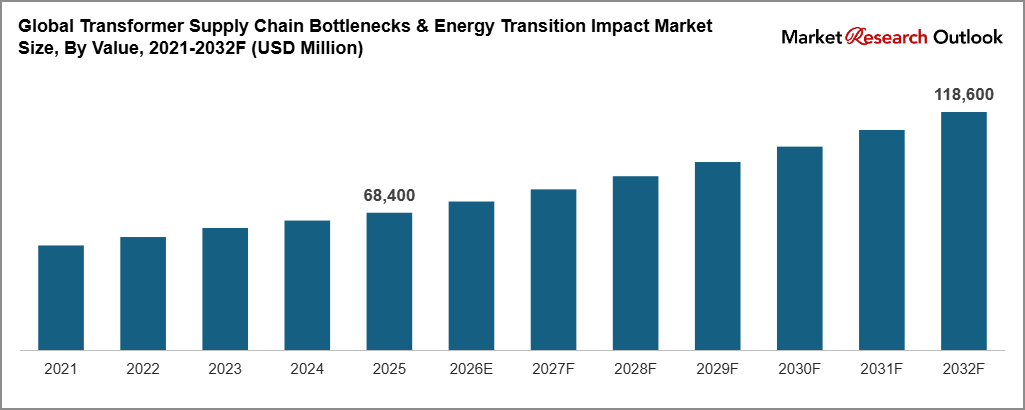
Source:
Ageing Transformer Fleets in North America, Europe, and Japan Creating a Large Replacement Cycle
Transformer supply chain pressure is also driven by the age of installed fleets. Many large power transformers in the United States, Europe, and Japan were installed in the 1960s and 1970s and are now beyond their typical design life of 40 years. A large share of US distribution transformers is also approaching the end of service, and storms, wildfires, and heat waves are causing more failures. Utilities must replace these units while also connecting new load and generation, which doubles the demand on factories. The US Department of Energy adopted new efficiency standards for distribution transformers in 2024, taking effect in 2029, which will further shape replacement designs. As a result, an estimated 38% of transformer value shipped in North America and Europe in 2025 went to replacement and refurbishment, lifting spend across the market.
Electrification of Data Centers, Transport, and Industry Adding New Load and New Transformer Requirements
New load is a major catalyst for the global transformer supply chain bottlenecks and energy transition impact market. The International Energy Agency projects data center electricity use to rise from 415 TWh in 2024 to 945 TWh by 2030, and each 100 MW campus needs dozens of distribution transformers and several large power transformers. Public EV charging hubs, electric bus depots, and rail electrification require new substations and medium-voltage transformers, while heat pumps raise peak demand on local networks. Industry is adding electric boilers, arc furnaces, and electrolysers for green hydrogen, each needing high-capacity rectifier or power transformers. Data centers alone accounted for an estimated 11% of global transformer value in 2025. Together, these factors are adding a new layer of demand on top of grid expansion and replacement.
Key Market Challenges: Global Transformer Supply Chain Bottlenecks & Energy Transition Impact Market
Long Transformer Supply Chain Lead Times for Large Power and Distribution Units Delaying Grid and Renewable Projects
The sector continues to face long delivery times for its most critical products. Lead times for large power transformers stretched to 120 to 210 weeks in 2024 and 2025 in North America and Europe, while distribution transformers that once shipped in 8 to 12 weeks have taken 50 to 100 weeks for many buyers. Prices for transformers have risen by 60% to 80% since 2020. Utilities, renewable developers, battery storage projects, and data centers are all drawing on the same factory capacity. In the United States, the Department of Energy has reported that around 80% of large power transformers are imported. Until new plants reach full output, transformer availability will remain one of the biggest constraints on grid and renewable project delivery.
Shortages and Price Volatility in Grain-Oriented Electrical Steel, Copper, and Other Critical Transformer Materials
Manufacturers face real hurdles in securing materials. Grain-oriented electrical steel, the core material for transformers, is made by a small number of producers worldwide, and the United States has only one domestic producer, Cleveland-Cliffs. Copper prices reached record highs above USD 10,000 per tonne in 2024 and 2025, raising the cost of windings. Tariffs introduced by the United States in 2025 on steel, aluminium, and copper products have added cost and uncertainty for imported cores and components. Bushings, on-load tap changers, and insulating materials have also seen longer lead times. These factors make it harder for manufacturers to quote fixed prices and delivery dates across the global transformer supply chain bottlenecks and energy transition impact market.
Limited Factory Capacity, Testing Slots, and Skilled Labour for High-Voltage Transformer Manufacturing
The market faces practical constraints beyond materials. Large power transformers are built largely by hand and need skilled winders, assemblers, and test engineers, and training new staff takes years. Factory test bays for high-voltage units are fully booked at many plants, and shipping a 200-tonne transformer needs special rail cars, heavy-haul permits, and port slots. New factories take two to three years to build and ramp up. Price escalation clauses and currency swings have also reduced margins on fixed-price contracts. Utilities are responding with framework agreements, standard designs, and shared spare pools, but transformer delays can still push back grid upgrades and renewable connections by two to four quarters.
Key Market Trends: Global Transformer Supply Chain Bottlenecks & Energy Transition Impact Market
Rapid Shift Toward Framework Agreements, Standardized Designs, and Spare Transformer Pools
The global transformer supply chain bottlenecks and energy transition impact market is undergoing a clear shift from one-off orders to multi-year framework agreements, with framework contracts expected to cover over 50% of utility power transformer purchases in North America and Europe by 2028. Utilities are agreeing on standard ratings and designs that factories can build in volume, prepaying for factory slots, and joining shared spare transformer programmes to cut recovery time after failures or extreme weather. Standardization cuts engineering hours, raises factory throughput, and allows units to be moved between projects. Leading suppliers including Hitachi Energy, Siemens Energy, GE Vernova, HD Hyundai Electric, and Hyosung have signed or expanded such agreements through 2024 and 2025, reinforcing the market forecast 2032 across utility and developer segments.
Growth of HVDC, Inverter-Duty, and Ester-Filled Transformers in the Global Transformer Supply Chain Bottlenecks & Energy Transition Impact Market
A clear move toward new transformer types is reshaping product demand, particularly for transmission and renewable projects. HVDC converter transformers are needed for offshore wind links in the North Sea and Baltic, cross-border interconnectors in Europe, and long-distance lines in China, India, and the United States. Inverter-duty transformers for solar and battery storage must handle harmonics and frequent load cycling. Natural ester-filled transformers are gaining ground for fire safety and biodegradability, especially in cities and data centers. Digital monitoring of oil, temperature, and partial discharge is also becoming standard. By 2025, an estimated 27% of new transformer value worldwide went to renewable, HVDC, and storage projects, up from 17% in 2021, and the share is rising each year.
Factory Expansion, Acquisitions, and Localization Investments by Transformer Manufacturers
A wave of capacity expansion is reshaping the supply side of the global transformer supply chain bottlenecks and energy transition impact market. Hitachi Energy has committed billions of dollars to new and expanded transformer and component plants worldwide through 2027, Siemens Energy announced its first large power transformer factory in the United States in Charlotte, North Carolina, and GE Vernova agreed to acquire full ownership of Prolec GE in 2025. Eaton, Schneider Electric, HD Hyundai Electric, Hyosung, LS Electric, and WEG have also expanded North American, Asian, and Latin American output. Government support for domestic grid equipment manufacturing in the United States, Europe, and India has favoured local supply. Combined with grid expansion and electrification, these developments are reinforcing the market forecast 2032 across the full value chain.
Segmental Insights: Global Transformer Supply Chain Bottlenecks & Energy Transition Impact Market
By Energy Transition Application: Utility Grid Expansion and Replacement Dominates the Global Transformer Supply Chain Bottlenecks & Energy Transition Impact Market
The utility grid expansion and replacement segment dominates the global transformer supply chain bottlenecks and energy transition impact market, accounting for an estimated 41% of total value in 2025, driven by network upgrades, new housing and commercial connections, and replacement of ageing units. Distribution and substation power transformers are the main purchases within this segment. Renewable energy integration contributes another 22% of demand, followed by transmission and HVDC interconnectors at 13% and data centers at 11%. Industrial electrification and green hydrogen account for 8%, while EV charging and electrified transport make up the remaining 5%. Data centers and HVDC links are the fastest growing applications. In 2025, utilities in the United States, Europe, China, and India placed large multi-year orders, reinforcing segment dominance in the market.
By Transformer Type: Distribution Transformers Lead While HVDC Converter Transformers Grow Fastest
Distribution transformers lead the global transformer supply chain bottlenecks and energy transition impact market product mix, accounting for 44% of total value in 2025, driven by the number of units needed for connections and replacement. Power transformers above 10 MVA contribute another 31%, generator step-up and inverter-duty transformers hold 9%, and instrument and specialty transformers 7%, while HVDC converter transformers hold 5% and mobile and phase-shifting units make up the remaining 4%. HVDC converter transformers are the fastest growing category, expanding at 14.8% annually as offshore wind and interconnector projects reach construction. By insulation type, oil-immersed designs hold the largest share, while ester fluid-filled units grow fastest. Leading suppliers including Hitachi Energy, Siemens Energy, GE Vernova, TBEA, and HD Hyundai Electric have aligned their portfolios to this mix.
Regional Insights: Global Transformer Supply Chain Bottlenecks & Energy Transition Impact Market
Regional analysis of the global transformer supply chain bottlenecks and energy transition impact market shows that Asia Pacific accounts for 45% of total value, driven by China’s ultra-high-voltage transmission build-out, India’s grid and renewable expansion, and South Korea’s export-led makers such as HD Hyundai Electric, Hyosung, and LS Electric. North America contributes 24% of demand, led by grid modernization, renewable connections, and data center growth in the United States, where import dependence for large transformers is most acute. Europe accounts for 21%, supported by offshore wind, interconnectors, and network upgrades in Germany, the United Kingdom, France, Spain, and the Nordics. The Middle East and Africa hold 6%, led by Saudi Arabia, the UAE, and South Africa, and Latin America holds 4%, led by Brazil, Mexico, and Chile. In 2025, new grid programmes across these regions reinforced demand for transformers.
Recent Developments: Global Transformer Supply Chain Bottlenecks & Energy Transition Impact Market
- The global transformer supply chain bottlenecks and energy transition impact market saw strong momentum in orders and factory investment during 2024 and 2025. Major transformer makers reported record order backlogs, with several Korean and European suppliers booking orders well into 2028 and beyond. Transformer prices stayed high, and lead times for large power units showed only early signs of easing in 2025. Global transformer orders are projected to grow at an average 8% annually through 2030, with power and HVDC units growing fastest.
- Manufacturers have deepened capacity expansion. In 2025, Hitachi Energy, Siemens Energy, GE Vernova, Eaton, and Schneider Electric announced or progressed new transformer plants in North America and Europe, while HD Hyundai Electric, Hyosung, and LS Electric expanded export capacity from Asia. GE Vernova agreed to take full ownership of Prolec GE. These developments are strengthening supply and supporting the market forecast 2032.
- Utility and policy momentum has gained strong traction in the global transformer supply chain bottlenecks and energy transition impact market. In 2025, utilities and governments in the United States, the European Union, China, and India expanded grid investment programmes, transformer framework agreements, and support for domestic manufacturing. Closer ties between utilities, developers, and manufacturers are positioning secure transformer supply as a core requirement of the energy transition, strengthening the long-term outlook.
Key Market Players: Global Transformer Supply Chain Bottlenecks & Energy Transition Impact Market
- Hitachi Energy Ltd.
- Siemens Energy AG
- GE Vernova Inc. (Prolec GE)
- Schneider Electric SE
- Eaton Corporation plc
- HD Hyundai Electric Co., Ltd.
- Hyosung Heavy Industries Corporation
- LS Electric Co., Ltd.
- TBEA Co., Ltd.
- China XD Electric Co., Ltd.
- Mitsubishi Electric Corporation
- Toshiba Energy Systems & Solutions Corporation
- WEG S.A.
| By Transformer Type | By Power Rating | By Insulation Type | By Application | By End-User |
| Distribution Power Step-Up & Inverter-Duty Specialty HVDC Others | Below 500 kVA 0.5-2.5 MVA 2.5-10 MVA 10-60 MVA 60-200 MVA 200-500 MVA Above 500 MVA | Oil-Immersed Ester-Filled Cast Resin VPI Gas-Insulated | Grid Expansion Renewables Transmission & HVDC Data Centers EV Charging Industrial | Utilities Power Producers Industrial & Commercial Railways & Transport |
Report Scope
In this report, the Global Transformer Supply Chain Bottlenecks & Energy Transition Impact Market has been segmented into the following categories, in addition to detailed analysis of key industry trends, market dynamics, competitive landscape, and growth opportunities across the forecast period:
- By Transformer Type
- Distribution Transformers
- Power Transformers (Above 10 MVA)
- Generator Step-Up & Inverter-Duty Transformers
- Instrument & Specialty Transformers
- HVDC Converter Transformers
- Others (Mobile & Phase-Shifting)
- By Power Rating
- Below 500 kVA
- 500 kVA to 2.5 MVA
- 2.5 MVA to 10 MVA
- 10 MVA to 60 MVA
- 60 MVA to 200 MVA
- 200 MVA to 500 MVA
- Above 500 MVA
- By Insulation Type
- Oil-Immersed (Mineral Oil)
- Natural & Synthetic Ester Fluid-Filled
- Dry-Type Cast Resin
- Dry-Type Vacuum Pressure Impregnated
- Gas-Insulated
- By Energy Transition Application
- Utility Grid Expansion & Replacement
- Renewable Energy Integration
- Transmission & HVDC Interconnectors
- Data Centers
- EV Charging & Electrified Transport
- Industrial Electrification & Green Hydrogen
- By End-User
- Utilities
- Renewable & Independent Power Producers
- Industrial & Commercial
- Railways & Transport
- By Geography
- North America
- Europe
- Asia Pacific
- Latin America
- Middle East & Africa
Competitive Landscape
Company Profiles:
Detailed analysis of the leading companies operating in the Global Transformer Supply Chain Bottlenecks & Energy Transition Impact Market, including business overview, product portfolio, strategic initiatives, competitive positioning, and recent developments.
Company Information
Detailed profiling and strategic analysis of additional market players (up to five companies), including emerging transformer makers, specialty component suppliers, regional distribution transformer brands, or niche refurbishment and monitoring service providers.
For a free sample of the Global Transformer Supply Chain Bottlenecks & Energy Transition Impact Market report, customised insights or delivery timelines, submit your query here
Global Transformer Supply Chain Bottlenecks & Energy Transition Impact Market, 2032
- Research Framework
- Market Segmentation
- Research Objective
- Research Methodology
- Qualitative Research
- Primary Research
- Secondary Research
- Quantitative Research
- Market Breakdown & Data Triangulation
- Demand Side
- Supply Side
- Primary Research Respondents
- Assumption & Limitation
- Executive Summary
- Market Overview, 2021-2032
- By Transformer Type
- By Power Rating
- By Insulation Type
- By Energy Transition Application
- By End-User
- By Region
- Analyst Recommendations
- Geopolitical Impact on Global Transformer Supply Chain Bottlenecks & Energy Transition Impact Market
- Global Transformer Supply Chain Bottlenecks & Energy Transition Impact Market Insights
- Market Dynamics
- Growth Drivers
- Grid expansion and renewable integration under the energy transition driving record transformer demand worldwide.
- Ageing transformer fleets in North America, Europe, and Japan creating a large replacement cycle.
- Electrification of data centers, transport, and industry adding new load and new transformer requirements.
- Restraints
- Long transformer supply chain lead times for large power and distribution units delaying grid and renewable projects.
- Shortages and price volatility in grain-oriented electrical steel, copper, and other critical transformer materials.
- Limited factory capacity, testing slots, and skilled labour for high-voltage transformer manufacturing.
- Opportunities
- Factory expansion and localization in North America, Europe, and India easing transformer supply chain gaps.
- Standardized designs, framework agreements, and spare transformer pools improving utility resilience.
- Refurbishment, life extension, and digital monitoring services for the installed transformer fleet.
- Challenges
- Intense competition for factory slots between utilities, renewable developers, and data center operators.
- Tariff changes and trade restrictions on steel, aluminium, copper, and imported transformers.
- Tightening efficiency standards and fluid rules requiring costly design and material changes.
- Technological Advancements
- Recent Technological Advancements
- Prior to 2020
- Porter’s Five Forces Analysis
- PESTLE Analysis
- Industry Value Chain & Entry Points
- Upstream Raw Materials (grain-oriented electrical steel, copper, aluminium, insulating oil, ester fluids, pressboard)
- Core Components & Sub-Suppliers (bushings, on-load tap changers, radiators, tanks, monitoring sensors)
- Power Transformer Manufacturers (Hitachi Energy, Siemens Energy, GE Vernova Prolec GE, TBEA, China XD)
- Distribution & Specialty Transformer Makers (Eaton, Schneider Electric, HD Hyundai Electric, Hyosung, LS Electric, WEG)
- Testing, Certification & Standards Bodies (IEEE, IEC, national laboratories, utility approval bodies)
- Logistics & Heavy-Haul Providers (special rail cars, heavy-lift shipping, road permits, port handling)
- EPC Contractors & Substation Integrators (transmission builders, renewable EPCs, modular substation makers)
- Transmission & Distribution Utilities (grid operators, TSOs, DSOs, regulated network owners)
- Renewable Developers, Data Centers & Industrial Buyers (solar, wind, storage, hydrogen, data center campuses)
- Aftermarket & Service Providers (refurbishment, oil testing, condition monitoring, spare transformer pools)
- Global Transformer Supply Chain Bottlenecks & Energy Transition Impact Market: Regulatory Framework
- Global Transformer Supply Chain Bottlenecks & Energy Transition Impact Market Overview
- Market Size & Forecast, 2021-2032
- By Value (USD Million)
- By Volume (GVA)
- Market Share & Forecast
- By Transformer Type
- Distribution Transformers
- Power Transformers (Above 10 MVA)
- Generator Step-Up & Inverter-Duty Transformers
- Instrument & Specialty Transformers
- HVDC Converter Transformers
- Others (Mobile & Phase-Shifting)
- By Power Rating
- Below 500 kVA
- 500 kVA to 2.5 MVA
- 2.5 MVA to 10 MVA
- 10 MVA to 60 MVA
- 60 MVA to 200 MVA
- 200 MVA to 500 MVA
- Above 500 MVA
- By Insulation Type
- Oil-Immersed (Mineral Oil)
- Natural & Synthetic Ester Fluid-Filled
- Dry-Type Cast Resin
- Dry-Type Vacuum Pressure Impregnated
- Gas-Insulated
- By Energy Transition Application
- Utility Grid Expansion & Replacement
- Renewable Energy Integration
- Transmission & HVDC Interconnectors
- Data Centers
- EV Charging & Electrified Transport
- Industrial Electrification & Green Hydrogen
- By End-User
- Utilities
- Renewable & Independent Power Producers
- Industrial & Commercial
- Railways & Transport
- By Geography
- North America
- Europe
- Asia Pacific
- Latin America
- Middle East & Africa
- Competitive Landscape
- Global Transformer Supply Chain Bottlenecks & Energy Transition Impact Market Company Market Share Analysis, 2025
- Competitive Benchmarking, By Operating Parameters
- Key Strategic Development (Mergers, Acquisitions, Partnerships, Etc.)
- List of Emerging Players
- Company Profile
- Hitachi Energy Ltd.
- Introduction & Company Profile
- Product Benchmarking
- Strategic Outlook
- Key Competitors
- Financial Analysis
- SWOT Analysis
(Same Data Pointers Will Be Provided for The Below Companies)
- Siemens Energy AG
- GE Vernova Inc. (Prolec GE)
- Schneider Electric SE
- Eaton Corporation plc
- HD Hyundai Electric Co., Ltd.
- Hyosung Heavy Industries Corporation
- LS Electric Co., Ltd.
- TBEA Co., Ltd.
- China XD Electric Co., Ltd.
- Mitsubishi Electric Corporation
- Toshiba Energy Systems & Solutions Corporation
- WEG S.A.
- Other Prominent Players
* Financial information in case of non-listed companies will be provided as per availability
** The segmentation and the companies are subjected to modifications based on in-depth secondary for the final deliverable
Frequently Asked Questions
1. How large is the global transformer supply chain bottlenecks and energy transition impact market and what is its growth forecast?
Ans: The global transformer supply chain bottlenecks and energy transition impact market is valued at USD 68,400 million in 2025 and is projected to reach USD 118,600 million by 2032, growing at a CAGR of 8.2%.
2. Which segments are driving demand in the global transformer supply chain bottlenecks and energy transition impact market?
Ans: Distribution transformers lead with a 44% value share, while HVDC converter transformers grow fastest at 14.8% annually, as offshore wind links and cross-border interconnectors move from planning into construction across Europe and Asia.
3. What are the key drivers of growth in the global transformer supply chain bottlenecks and energy transition impact market?
Ans: Key drivers include grid expansion, renewable integration, replacement of ageing transformer fleets, and new load from data centers, EV charging, and industrial electrification across North America, Europe, and Asia Pacific.
4. Which regions are driving growth in the global transformer supply chain bottlenecks and energy transition impact market?
Ans: Asia Pacific leads with 45% of value, driven by China, India, and South Korea, followed by North America at 24% and Europe at 21%. The Middle East, Africa, and Latin America hold the remaining 10%.
5. What are the latest trends in the global transformer supply chain bottlenecks and energy transition impact market?
Ans: Latest trends include framework agreements, standardized designs, spare transformer pools, growth in HVDC and inverter-duty units, ester-filled transformers, digital monitoring, and new factory investment by leading manufacturers in North America, Europe, and Asia.