

Global Grid-Forming Inverter Demand & Renewable Grid Stability Market, 2032
- Global Markets
- Oct 2026
- Pages 140
- Report Format: pdf
- Report Price: $3500 USD
The worldwide grid-forming inverter and renewable grid stability market is witnessing strong structural growth, driven by the rising share of inverter-based solar, wind and storage, the retirement of coal and gas units that once provided inertia and system strength, new grid code requirements and stability procurement programs in Australia, Great Britain and Europe, a record 108 GW of battery storage added in 2025, and lessons from the April 2025 Iberian blackout that are lifting demand for grid-forming inverters, synchronous condensers and advanced STATCOMs.
| Study Duration | 2021-2032 |
| Market Size (2025) | USD 4,380 Million |
| CAGR (2026-2032) | 21.7% |
| Leading Segment | Grid-Forming Battery Inverters (BESS PCS) |
| Fastest Growing Segment | Grid-Forming Solar & Hybrid Inverters |
| Market Size (2032) | USD 17,318 Million |
Market Overview: Global Grid-Forming Inverter Demand & Renewable Grid Stability Market
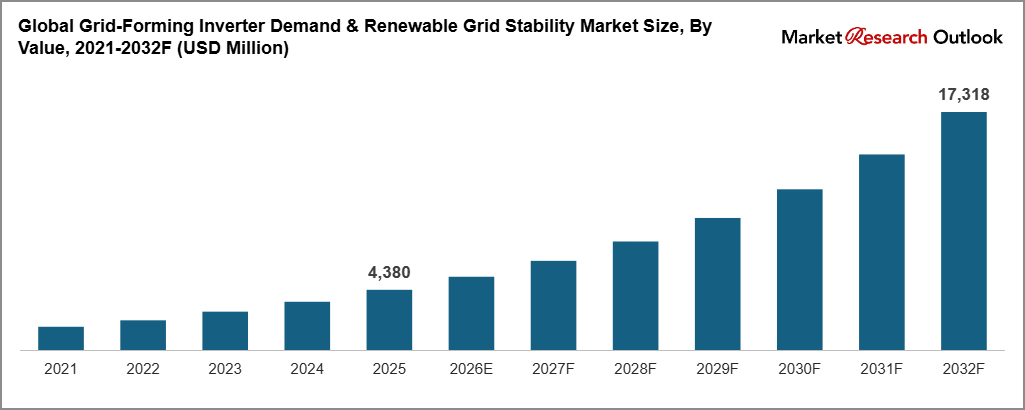
The global grid-forming inverter demand & renewable grid stability market size is witnessing rapid expansion, driven by the growing share of inverter-based resources, falling system inertia, new grid code requirements, system operator procurement of stability services and record battery storage deployment. Valued at USD 4,380 million in 2025 and projected to reach USD 17,318 million by 2032, growing at a CAGR of 21.7%, the market is being fuelled by transmission operators, independent power producers, battery developers and microgrid owners that need inverters able to set voltage and frequency rather than simply follow them. Grid-forming battery inverters lead spending, while grid-forming solar and hybrid inverters are emerging as the fastest growing category. Power systems in Australia, Great Britain, Ireland, Spain, Germany, California, Texas and China already run for long periods with very high shares of solar and wind, and the April 2025 Iberian blackout, which saw more than 2.5 GW of generation disconnect, showed how fast voltage problems can spread. As inverter makers including SMA, Sungrow, Huawei Digital Power and Power Electronics expand grid-forming lines, and equipment majors including Hitachi Energy, Siemens Energy and GE Vernova scale stability solutions, the worldwide grid-forming inverter and renewable grid stability market is evolving into a code-led, technology-driven and investment-backed category with strong long-term growth potential.
Key Report Takeaways: Global Grid-Forming Inverter Demand & Renewable Grid Stability Market
- The worldwide grid-forming inverter and renewable grid stability market size is projected to grow from USD 4,380 million in 2025 to USD 17,318 million by 2032, registering a strong CAGR of 21.7%, driven by inverter-based renewable growth, grid code reform and the shift from grid-following to grid-forming technology.
- Grid-forming battery inverters dominate spending, accounting for 44.6% of market value in 2025, driven by utility-scale battery projects that system operators now expect to provide inertia, fast frequency response and voltage support.
- Grid-forming solar and hybrid inverters are the fastest growing category, expected to expand at a CAGR of 31.8% through 2032 as grid codes extend grid-forming expectations from batteries to solar plants and hybrid solar-storage sites.
- A record 108 GW of battery storage was added worldwide in 2025, and Australia’s ARENA committed AUD 176 million to eight grid-forming batteries totalling about 2 GW and AUD 2.7 billion in project value.
- Great Britain’s GBP 323 million Stability Pathfinder Phase 2 contracts for five grid-forming batteries and five synchronous condensers, ENTSO-E’s grid-forming requirements work and the Iberian blackout findings are strengthening the pipeline behind the market forecast 2032.
Key Market Drivers: Global Grid-Forming Inverter Demand & Renewable Grid Stability Market
Rising Inverter-Based Renewable Share and Retirement of Synchronous Generators Eroding System Inertia and Strength
Growth in the market is being driven by a basic change in how power systems are built. Coal, gas, hydro and nuclear plants use large spinning generators that naturally provide inertia, fault current and voltage control. Solar panels, wind turbines and batteries connect through power electronic inverters that, in their conventional grid-following form, provide none of these by default. As renewable shares rise and older thermal units retire, grids lose inertia and system strength, frequency changes faster after a fault, and voltage becomes harder to control. South Australia, Ireland and Great Britain already operate for many hours with very high instantaneous shares of wind and solar, and system operators there have set targets for zero carbon or near 100% renewable operation. Grid-forming inverters solve this problem by behaving like a voltage source that can hold grid voltage and frequency and supply fast current during disturbances, creating strong demand across the worldwide grid-forming inverter and renewable grid stability market.
Source:
Grid Code Updates and System Operator Procurement Programs Mandating or Rewarding Grid-Forming Capability
The market is benefiting from new rules and contracts that turn grid-forming from a research topic into a requirement. Great Britain introduced a grid-forming specification into its Grid Code in 2022, and NESO’s Stability Pathfinder Phase 2 awarded ten contracts worth GBP 323 million for five grid-forming batteries and five synchronous condensers, with estimated savings of about GBP 500 million over ten years. The country’s first grid-forming battery under the program connected in Scotland in March 2025. In Australia, AEMO published a voluntary specification for grid-forming inverters in 2023, and ARENA’s Large Scale Battery Storage Funding Round committed AUD 176 million to eight grid-forming batteries. ENTSO-E published a Phase II technical report on grid-forming requirements in November 2025 to inform European connection codes, EirGrid released a Grid Forming Strategy in February 2026, and NERC has issued guidance for inverter-based resources in North America. These measures are steering capital toward grid-forming hardware across the worldwide grid-forming inverter and renewable grid stability market.
Record Battery Storage Deployment Providing a Low-Cost Platform for Grid-Forming Services
Battery storage growth is a major catalyst for the market. The IEA reported a record 108 GW of battery storage additions worldwide in 2025, led by China, the United States, Europe and Australia. Batteries are the natural home for grid-forming control because they can inject and absorb power instantly in both directions, and adding grid-forming capability to a battery inverter often requires mainly firmware and modest hardware oversizing rather than a separate plant. Early projects such as South Australia’s Hornsdale Power Reserve showed that large batteries running in virtual machine mode can provide inertia to the grid, and Tesla, Fluence, Wärtsilä, Sungrow and Huawei Digital Power now offer grid-forming operation on utility-scale products. As battery prices fall and project sizes rise to several hundred megawatts, the cost of adding grid-forming capability per megawatt keeps declining. Grid-forming battery inverters account for 44.6% of market value in 2025, structurally expanding the worldwide grid-forming inverter and renewable grid stability market through 2032.
Key Market Challenges: Global Grid-Forming Inverter Demand & Renewable Grid Stability Market
Lack of Harmonised Grid-Forming Standards, Testing and Compliance Methods Across Markets
The market continues to face challenges around standards. Each system operator defines grid-forming performance in its own way, with different requirements for inertia, phase jump response, fault current, damping and overload duration. Australia, Great Britain, Ireland, continental Europe and North American operators are moving in similar directions but not yet on identical terms, which forces inverter makers to develop and certify multiple versions of their control software. Testing methods are also still maturing, and many compliance checks rely on detailed simulation models that differ between vendors and tools. Developers face long interconnection studies while operators learn how to assess grid-forming plants. Until harmonised standards and type-testing methods emerge, uncertainty over compliance will slow procurement decisions across the worldwide grid-forming inverter and renewable grid stability market.
Higher Hardware Cost, Oversizing Needs and Unclear Revenue Streams for Grid-Forming Services
The market faces structural complexity from cost and revenue. To supply fault current and inertia, grid-forming inverters often need extra current headroom, larger semiconductors or reserved battery capacity, which raises capital cost compared with grid-following designs. In markets without paid stability services, developers struggle to recover this extra cost, since most revenue still comes from energy arbitrage, capacity payments and frequency services that do not reward grid-forming behaviour directly. Great Britain and Australia have created stability contracts and funding programs, but many other markets have not yet defined how inertia and system strength will be priced. Lenders and investors also need clear contract terms before financing the added cost. Until stability markets mature, revenue uncertainty will remain a near-term constraint on adoption across the worldwide grid-forming inverter and renewable grid stability market.
Interaction Risks, Protection Coordination and Limited Field Experience at High Grid-Forming Penetration
The market faces practical constraints from technical uncertainty. When many grid-forming and grid-following inverters operate close together, their control systems can interact and create oscillations that are hard to predict without detailed studies. Protection relays designed for fault current from spinning generators may not respond correctly to the different current profile of inverters, so protection schemes need review. Only a limited number of grids have operated large fleets of grid-forming plants for several years, so operators have less field data than they would like before relying on them for system security. The Iberian blackout investigation also highlighted that fixed power factor settings and early disconnection of renewable plants can worsen voltage events. Vendors, operators and research institutions are building evidence through pilots and monitoring, but confidence at very high penetration will take several years to build across the worldwide grid-forming inverter and renewable grid stability market.
Key Market Trends: Global Grid-Forming Inverter Demand & Renewable Grid Stability Market
Grid-Forming Battery Storage Becoming the Default Specification for New Utility-Scale Projects
The market is undergoing a clear technology shift as grid-forming becomes the standard for new large batteries. Grid-forming units are expected to account for 61.4% of new utility-scale battery inverter capacity by 2032, up from 17.3% in 2025. Australia’s eight ARENA-funded batteries, each rated at 200 MW or more, were among the first large fleets procured with grid-forming inverters, and Great Britain’s Stability Pathfinder projects have moved grid-forming batteries into commercial service. Inverter and battery suppliers including SMA, Sungrow, Huawei Digital Power, Power Electronics, Tesla and Fluence now market grid-forming as a standard or low-cost option. Developers are also retrofitting existing battery fleets with grid-forming firmware where hardware headroom allows. Virtual synchronous machine control holds the largest share of control methods at 46.2% of 2025 value. This technology transition is reinforcing the market forecast 2032 across both new build and retrofit projects.
Post-Blackout Focus on Voltage Control, Ride-Through and System Strength After the April 2025 Iberian Event
A clear shift toward voltage control and resilience is reshaping the market. On 28 April 2025, mainland Spain and Portugal lost power after cascading disconnections removed more than 2.5 GW of generation, and the final ENTSO-E expert report published in March 2026 traced the event to systemic weaknesses in voltage control and reactive power management. The report made 22 recommendations, including moving away from fixed power factor operation toward active voltage control, securing sufficient reactive power resources and strengthening overvoltage ride-through, especially for small generators. These findings are pushing European operators and regulators to accelerate requirements for advanced inverter capability, including grid-forming functions. Grid-forming STATCOMs and synchronous condensers together account for 29.3% of market value in 2025. This shift is lifting demand for inverters, plant controllers and stability equipment that can actively hold voltage across the market.
Hybrid Stability Solutions Combining Synchronous Condensers, Enhanced STATCOMs and Grid-Forming Inverters
A wave of hybrid stability investment is reshaping the market supply base. System operators are combining synchronous condensers, which provide large fault current and real inertia, with enhanced STATCOMs that add supercapacitors or batteries, and with grid-forming inverters at renewable and storage plants. Great Britain’s Stability Pathfinder Phase 2 split its contracts evenly between five synchronous condensers and five grid-forming batteries. Hitachi Energy, Siemens Energy, GE Vernova and ABB supply synchronous condensers and grid-forming STATCOMs, while inverter makers supply plant-level grid-forming capability. Offshore wind and HVDC projects are also adopting grid-forming converter controls to connect large wind farms to weak or island grids. Synchronous condensers accounted for 16.9% of market value in 2025. Combined with grid code reform and stability procurement, these developments are reinforcing the market forecast 2032 across the entire value chain.
Segmental Insights: Global Grid-Forming Inverter Demand & Renewable Grid Stability Market
By End-User: Independent Power Producers Dominate the Worldwide Grid-Forming Inverter and Renewable Grid Stability Market
The independent power producers segment dominates the market, accounting for 52.7% of market value in 2025, driven by utility-scale battery, solar and hybrid projects that must meet grid-forming connection requirements or win stability contracts. These developers buy grid-forming inverters and plant controllers from SMA, Sungrow, Huawei Digital Power, Power Electronics and Ingeteam, or integrated systems from Tesla, Fluence and Wärtsilä. Transmission operators and utilities contribute 31.4% of demand, led by purchases of synchronous condensers, grid-forming STATCOMs and utility-owned batteries. Commercial and industrial users account for 9.3%, supported by on-site storage that can island critical loads. Microgrid and off-grid operators make up the remaining 6.6%, with island grids, mines and remote communities using grid-forming inverters to run on high shares of solar and storage. In 2025 and 2026, new battery tenders with grid-forming clauses reinforced segment leadership in the market.
By Product Type: Grid-Forming Battery Inverters Lead While Solar & Hybrid Inverters Grow Fastest
Grid-forming battery inverters lead the market product mix, accounting for 44.6% of total value, driven by the scale of utility battery deployment and the ease of adding grid-forming control to storage. Synchronous condensers contribute another 16.9%, followed by grid-forming solar and hybrid inverters at 13.2% and grid-forming STATCOMs at 12.4%. Grid-forming wind converters account for 6.8% of value, while grid-forming controllers, software and compliance services together form 6.1%. Grid-forming solar and hybrid inverters are the fastest growing category, expanding at a CAGR of 31.8% through 2032 as connection rules extend to solar and hybrid plants. By power rating, units above 2.5 MW hold 57.3% of 2025 value. Leading suppliers including SMA, Sungrow, Huawei Digital Power, Hitachi Energy and Siemens Energy have aligned portfolios to this mix, driving higher value per megawatt across the market.
Regional Insights: Global Grid-Forming Inverter Demand & Renewable Grid Stability Market
Regional analysis of the market shows that Asia Pacific leads with 34.8% of market value in 2025, driven by Australia’s grid-forming battery fleet and AEMO specification, China’s large storage build-out and early grid-forming demonstrations, and growing projects in Japan, South Korea and India. Europe follows with 27.3% and is the fastest growing region at a CAGR of 25.9%, supported by Great Britain’s Stability Pathfinder, Ireland’s Grid Forming Strategy, Germany’s stability work and the push for stronger voltage control in Spain and Portugal after the Iberian blackout. North America contributes 22.6%, led by battery growth in California and Texas and NERC guidance on inverter-based resources. The Middle East and Africa account for 8.9%, with large solar and storage projects in Saudi Arabia, the UAE and South Africa. Latin America holds 6.4%, led by Chile’s high solar share and storage programs. In 2025 and 2026, new procurement rounds and grid code updates reinforced regional demand across the market.
Recent Developments: Global Grid-Forming Inverter Demand & Renewable Grid Stability Market
- The market witnessed strong momentum in deployment and regulation during 2025 and 2026. In March 2025, Great Britain’s first grid-forming battery under NESO’s Stability Pathfinder Phase 2 connected in Scotland, part of ten contracts worth GBP 323 million. The IEA reported a record 108 GW of battery storage additions worldwide in 2025, expanding the platform for grid-forming services.
- Regulators and system operators advanced grid-forming rules. In November 2025, ENTSO-E published its Phase II technical report on grid-forming requirements to inform future European connection codes, and in February 2026, EirGrid released its Grid Forming Strategy for Ireland. In March 2026, the final ENTSO-E report on the April 2025 Iberian blackout set out 22 recommendations on voltage control, reactive power and ride-through, supporting the market forecast 2032.
- Industry momentum has gained strong traction in the market. Australia’s eight ARENA-backed grid-forming batteries, totalling about 2 GW and AUD 2.7 billion in project value, are moving through construction and operation, while inverter makers and battery integrators are making grid-forming a standard feature of new products. Combined with growing stability procurement and grid code reform, this positions grid-forming technology as one of the fastest scaling segments in power electronics globally, strengthening long-term competitiveness in the market forecast 2032.
Key Market Players: Global Grid-Forming Inverter Demand & Renewable Grid Stability Market
- SMA Solar Technology AG
- Sungrow Power Supply Co., Ltd.
- Huawei Digital Power Technologies Co., Ltd.
- Tesla, Inc.
- Hitachi Energy Ltd.
- Siemens Energy AG
- GE Vernova Inc.
- Power Electronics España S.L.
- Fluence Energy, Inc.
- Wärtsilä Corporation
- ABB Ltd.
- Ingeteam S.A.
- Sineng Electric Co., Ltd.
| By Product Type | By Power Rating | By Control | By Application | By End-User |
| Battery Inverters Solar & Hybrid Wind Converters STATCOMs Synchronous Condensers Others | Below 100 kW 100-500 kW 500 kW-1 MW 1-2.5 MW 2.5-5 MW 5-10 MW Above 10 MW | VSM Droop Power Synchronisation Virtual Oscillator Hybrid | Battery Storage Solar PV Wind Microgrids HVDC C&I Storage | Utilities & TSOs IPPs C&I Microgrids |
Report Scope
In this report, the Global Grid-Forming Inverter Demand & Renewable Grid Stability Market has been segmented into the following categories, in addition to detailed analysis of key industry trends, market dynamics, competitive environment, and growth opportunities across the forecast period:
- By Product Type
- Grid-Forming Battery Inverters (BESS PCS)
- Grid-Forming Solar & Hybrid Inverters
- Grid-Forming Wind Converters
- Grid-Forming STATCOMs (E-STATCOM)
- Synchronous Condensers
- Others (Grid-Forming Controllers, Software & Compliance Services)
- By Power Rating
- Below 100 kW
- 100 kW to 500 kW
- 500 kW to 1 MW
- 1 MW to 2.5 MW
- 2.5 MW to 5 MW
- 5 MW to 10 MW
- Above 10 MW
- By Control Method
- Virtual Synchronous Machine (VSM)
- Droop Control
- Power Synchronisation Control
- Virtual Oscillator Control
- Hybrid & Other Control Methods
- By Application
- Utility-Scale Battery Storage
- Utility-Scale Solar PV
- Onshore & Offshore Wind
- Microgrids & Island Grids
- HVDC & Transmission Support
- Commercial & Industrial Storage
- By End-User
- Transmission Operators & Utilities
- Independent Power Producers
- Commercial & Industrial
- Microgrid & Off-Grid Operators
- By Geography
- North America
- Europe
- Asia Pacific
- Latin America
- Middle East & Africa
Competitive Landscape
Company Profiles:
Detailed analysis of the leading companies operating in the Worldwide Grid-Forming Inverter Demand & Renewable Grid Stability Market, including business overview, product portfolio, strategic initiatives, competitive positioning, and recent developments.
Company Information
Detailed profiling and strategic analysis of additional market players (up to five companies), including emerging inverter makers, battery integrators, power plant controller specialists, grid simulation and testing firms, or regional stability equipment suppliers.
For a free sample of the Global Grid-Forming Inverter Demand & Renewable Grid Stability Market report, customised insights or delivery timelines, submit your query here
Global Grid-Forming Inverter Demand & Renewable Grid Stability Market, 2032
- Research Framework
- Market Segmentation
- Research Objective
- Research Methodology
- Qualitative Research
- Primary Research
- Secondary Research
- Quantitative Research
- Market Breakdown & Data Triangulation
- Demand Side
- Supply Side
- Primary Research Respondents
- Assumption & Limitation
- Executive Summary
- Market Overview, 2021-2032
- By Product Type
- By Power Rating
- By Control Method
- By Application
- By End-User
- By Region
- Analyst Recommendations
- Geopolitical Impact on Grid-Forming Inverter Supply and Grid Stability
- Grid-Forming Inverter Demand & Renewable Grid Stability Insights
- Market Dynamics
- Growth Drivers
- Rising inverter-based renewable share and retirement of synchronous generators eroding system inertia and strength.
- Grid code updates and system operator procurement programs mandating or rewarding grid-forming capability.
- Record battery storage deployment providing a low-cost platform for grid-forming services.
- Restraints
- Lack of harmonised grid-forming standards, testing and compliance methods across markets.
- Higher hardware cost, oversizing needs and unclear revenue streams for grid-forming services.
- Interaction risks, protection coordination and limited field experience at high grid-forming penetration.
- Opportunities
- Retrofitting existing battery fleets with grid-forming firmware, upgraded controls and added current headroom.
- Black-start capable hybrid solar and storage plants supporting 100% renewable island grids and remote mining sites.
- Grid-forming converters for offshore wind farms, HVDC links and weak grid connections in remote renewable zones.
- Challenges
- Supply constraints for power semiconductors, capacitors and high-current inverter components during global demand peaks for storage projects.
- Long interconnection studies and EMT model validation requirements for new grid-forming plants.
- Cybersecurity and firmware management risks across large, remotely updated inverter fleets.
- Technological Advancements
- Recent Technological Advancements
- Prior to 2020
- Porter’s Five Forces Analysis
- PESTLE Analysis
- Industry Value Chain & Entry Points
- Upstream Components (IGBTs, SiC devices, capacitors, magnetics, control processors, battery cells)
- Inverter & Power Conversion Manufacturers (SMA, Sungrow, Huawei Digital Power, Power Electronics, Ingeteam, Sineng)
- Battery System Integrators (Tesla, Fluence, Wärtsilä, utility-scale BESS integrators)
- Stability Equipment Suppliers (Hitachi Energy, Siemens Energy, GE Vernova, ABB)
- Grid Codes, Standards & Testing Bodies (AEMO, NESO, ENTSO-E, NERC, IEEE, test laboratories)
- Engineering, Simulation & Compliance Service Providers (power system studies, EMT modelling, commissioning)
- EPC Contractors & Developers (utility-scale solar, wind and storage developers)
- Independent Power Producers & Asset Owners (renewable and battery portfolio owners)
- Transmission System Operators & Utilities (stability service buyers and network owners)
- End-Users (grid operators, industrial sites, data centers, mines, microgrids, island and remote communities)
- Global Grid-Forming Inverter Demand & Renewable Grid Stability Market: Regulatory Framework
- Global Grid-Forming Inverter Demand & Renewable Grid Stability Market Overview
- Market Size & Forecast, 2021-2032
- By Value (USD Million)
- By Volume (GW)
- Market Share & Forecast
- By Product Type
- Grid-Forming Battery Inverters (BESS PCS)
- Grid-Forming Solar & Hybrid Inverters
- Grid-Forming Wind Converters
- Grid-Forming STATCOMs (E-STATCOM)
- Synchronous Condensers
- Others (Grid-Forming Controllers, Software & Compliance Services)
- By Power Rating
- Below 100 kW
- 100 kW to 500 kW
- 500 kW to 1 MW
- 1 MW to 2.5 MW
- 2.5 MW to 5 MW
- 5 MW to 10 MW
- Above 10 MW
- By Control Method
- Virtual Synchronous Machine (VSM)
- Droop Control
- Power Synchronisation Control
- Virtual Oscillator Control
- Hybrid & Other Control Methods
- By Application
- Utility-Scale Battery Storage
- Utility-Scale Solar PV
- Onshore & Offshore Wind
- Microgrids & Island Grids
- HVDC & Transmission Support
- Commercial & Industrial Storage
- By End-User
- Transmission Operators & Utilities
- Independent Power Producers
- Commercial & Industrial
- Microgrid & Off-Grid Operators
- By Geography
- North America
- Europe
- Asia Pacific
- Latin America
- Middle East & Africa
- Competitive Landscape
- Company Market Share Analysis: Grid-Forming Inverters and Grid Stability Equipment, 2025
- Competitive Benchmarking, By Operating Parameters
- Key Strategic Development (Mergers, Acquisitions, Partnerships, Etc.)
- List of Emerging Players
- Company Profile
- SMA Solar Technology AG
- Introduction & Company Profile
- Product Benchmarking
- Strategic Outlook
- Key Competitors
- Financial Analysis
- SWOT Analysis
(Same Data Pointers Will Be Provided for The Below Companies)
- Sungrow Power Supply Co., Ltd.
- Huawei Digital Power Technologies Co., Ltd.
- Tesla, Inc.
- Hitachi Energy Ltd.
- Siemens Energy AG
- GE Vernova Inc.
- Power Electronics España S.L.
- Fluence Energy, Inc.
- Wärtsilä Corporation
- ABB Ltd.
- Ingeteam S.A.
- Sineng Electric Co., Ltd.
- Other Prominent Players
* Financial information in case of non-listed companies will be provided as per availability
** The segmentation and the companies are subjected to modifications based on in-depth secondary for the final deliverable
Frequently Asked Questions
1. How large is the global grid-forming inverter demand & renewable grid stability market and what is its growth forecast?
Ans: The market is valued at USD 4,380 million in 2025 and is projected to reach USD 17,318 million by 2032, growing at a CAGR of 21.7%, supported by renewable growth and new grid-forming requirements.
2. Which segments are driving demand in the grid-forming inverter and renewable grid stability market?
Ans: Grid-forming battery inverters lead with a 44.6% value share in 2025, while grid-forming solar and hybrid inverters are the fastest growing segment at a 31.8% CAGR as grid codes extend to solar plants.
3. What are the key drivers of growth in this market?
Ans: Key drivers include the rising share of inverter-based renewables and falling inertia, grid code updates and stability procurement in Australia, Great Britain and Europe, and record battery storage deployment worldwide.
4. Which regions are driving growth in grid-forming inverter demand?
Ans: Asia Pacific leads with a 34.8% share, driven by Australia and China. Europe holds 27.3% and is the fastest growing region, supported by Great Britain, Ireland and post-blackout reforms in Spain.
5. What are the latest trends in grid-forming technology and renewable grid stability?
Ans: The latest trends include grid-forming as the default for new utility batteries, stronger voltage control and ride-through after the Iberian blackout, and hybrid solutions combining synchronous condensers, STATCOMs and inverters.