

Global Long-Duration Energy Storage Deployment Feasibility Market, 2032
- Global Markets
- Oct 2026
- Pages 140
- Report Format: pdf
- Report Price: $3500 USD
The global market for long-duration storage deployment is witnessing strong structural growth, driven by rising wind and solar penetration, curtailment in major power markets, national pumped hydro and storage targets, cap and floor revenue schemes, investment tax credits, falling technology costs, the first commercial-scale iron-air, compressed air, and liquid air projects, and new demand from data centers and industrial heat users.
| Study Duration | 2021-2032 |
| Market Size (2025) | USD 6,800 Million |
| CAGR (2026-2032) | 20.1% |
| Leading Segment | Pumped Hydro Storage (8 to 12 Hours) |
| Fastest Growing Segment | Flow Batteries & Metal-Air Batteries |
| Market Size (2032) | USD 24,500 Million |
Market Overview: Global Long-Duration Energy Storage Deployment Feasibility Market
The global long-duration energy storage deployment feasibility market size is witnessing rapid expansion, driven by record renewable additions, growing curtailment, tighter reliability standards, and the limits of four-hour lithium-ion batteries in high-renewable grids. Valued at USD 6,800 million in 2025 and projected to reach USD 24,500 million by 2032, growing at a CAGR of 20.1%, growth is being fuelled by pumped hydro programmes in China, India, and Australia, compressed air and liquid air projects in North America and Europe, and the first 100-hour iron-air batteries delivered to US utilities. Pumped hydro storage leads spending, while flow batteries and metal-air batteries form the fastest growing category. The market covers project value for storage of 8 hours and above, including feasibility, engineering, equipment, and construction. As technology developers including Form Energy, Hydrostor, Highview Power, and Energy Dome reach commercial scale, and established suppliers including Voith Hydro, Andritz, Rongke Power, and Sumitomo Electric expand output, the market is evolving into a bankable, policy-supported, and fast-scaling segment with strong long-term growth potential.
Key Report Takeaways: Global Long-Duration Energy Storage Deployment Feasibility Market
- The global long-duration energy storage deployment feasibility market size is projected to grow from USD 6,800 million in 2025 to USD 24,500 million by 2032, registering a strong CAGR of 20.1%, driven by renewable penetration, procurement targets, revenue support schemes, and the structural shift from pilot projects to commercial deployment.
- Pumped hydro storage dominates the market, accounting for 52% of total value in 2025, driven by large programmes in China, India, and Australia, proven 50 to 80 year asset lives, and the strong order books of turbine suppliers such as Voith Hydro and Andritz.
- Flow batteries and metal-air batteries are the fastest growing segments, expected to grow at a combined CAGR of 31.4% through 2032 as vanadium, iron flow, and iron-air systems move from demonstration to utility-scale projects.
- Rapid growth in wind and solar capacity, together with curtailment in China, California, Germany, Spain, and Australia, is structurally expanding demand for storage of 8 hours and above across utilities, independent power producers, and industrial users.
- Rising investments by developers such as Form Energy, Hydrostor, Highview Power, and Energy Dome, together with public loans and revenue support schemes, are strengthening project pipelines and supporting the market forecast 2032.
Key Market Drivers: Global Long-Duration Energy Storage Deployment Feasibility Market
Rising Wind and Solar Penetration and Curtailment Driving Demand for Storage Beyond the Four-Hour Lithium-Ion Limit
Growth in the global long-duration energy storage deployment feasibility market is being driven first by the rapid rise of wind and solar. Variable renewables now supply more than 30% of electricity in several large markets, including Germany, Spain, the United Kingdom, and parts of Australia and the United States, and China added more solar capacity in 2024 than the rest of the world combined. Four-hour lithium-ion batteries are well suited to daily solar shifting, but they cannot cover windless winter weeks, long evening peaks, or seasonal gaps. Grid studies in Europe, California, and Australia show that systems above 60% to 70% variable renewables need storage lasting from 8 hours to several days to avoid costly overbuild or fossil backup. Curtailment of wind and solar in China, California, Germany, and Spain also leaves cheap surplus power that long-duration energy storage can capture, creating a steady project pipeline through 2032.
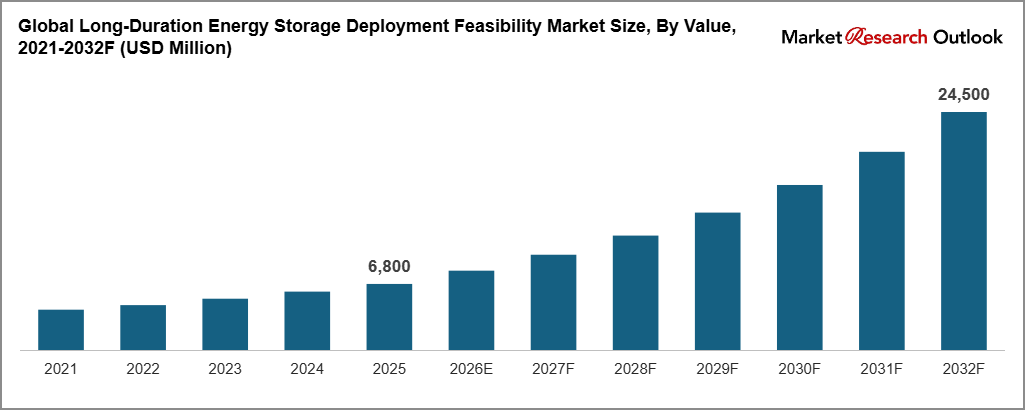
Source:
Government Procurement Targets, Cap and Floor Schemes, and Tax Credits Improving the Bankability of Long-Duration Projects
Long-duration energy storage feasibility has improved sharply because of policy support. China set targets for pumped hydro capacity of 120 GW by 2030, and its new-type energy storage plans support compressed air and flow batteries. In the United States, the Department of Energy’s Long Duration Storage Shot aims to cut costs by 90% for systems of 10 hours and more by 2030, investment tax credits now cover standalone storage, and the Loan Programs Office offered a conditional commitment of USD 1.76 billion to Hydrostor’s Willow Rock project in California. In the United Kingdom, Ofgem launched a cap and floor scheme for long-duration storage, while Australia’s Capacity Investment Scheme and India’s pumped storage guidelines support new projects. As a result, an estimated 41% of long-duration capacity reaching financial close in 2025 had a government-backed revenue or loan mechanism, lifting spend across the market.
Falling Technology Costs and First Commercial-Scale Deployments Proving the Feasibility of New Storage Technologies
Technology progress is a major catalyst for the global long-duration energy storage deployment feasibility market. Form Energy has begun delivering iron-air batteries with 100 hours of discharge from its factory in Weirton, West Virginia, to US utilities including Great River Energy. Highview Power reached financial close on a 50 MW, 300 MWh liquid air plant at Carrington in the United Kingdom, and Energy Dome has operated a CO2-based storage plant in Sardinia. China has commissioned large compressed air plants and Dalian Rongke Power’s 100 MW vanadium flow battery. Capital costs for several new technologies are falling toward USD 20 per kWh of storage capacity for multi-day systems, far below lithium-ion on a per kWh basis at long durations. Together, these factors are moving long-duration storage from technical promise to commercial feasibility.
Key Market Challenges: Global Long-Duration Energy Storage Deployment Feasibility Market
High Upfront Capital Cost and Financing Risk for First-of-a-Kind Long-Duration Energy Storage Projects
The sector continues to face high capital needs and financing risk. Large pumped hydro and compressed air projects can cost USD 1 billion to USD 3 billion each, and Australia’s Snowy 2.0 has faced major cost increases and delays. New technologies such as iron-air, liquid air, and thermal storage still lack long operating records, so lenders apply higher interest rates and demand stronger guarantees. Insurance, performance warranties, and technology risk add further cost for first-of-a-kind plants. Developers often need several years of feasibility work, grid studies, and permitting before reaching financial close. Until more projects prove their performance in the field, financing will remain a key constraint on deployment.
Electricity Market Designs That Undervalue Duration, Capacity, and Multi-Day Reliability Services
Storage developers face real hurdles from the way power markets pay for services. Most wholesale markets reward short-term arbitrage and fast frequency response, where four-hour lithium-ion batteries compete well, but few markets pay for energy delivered over many hours or days. Capacity markets often apply derating factors that do not fully reflect long-duration value, and revenue from rare multi-day weather events is hard to forecast. Without long-term contracts or regulated returns, merchant revenue alone rarely covers the cost of a long-duration plant. These market gaps slow investment decisions across the global long-duration energy storage deployment feasibility market.
Long Permitting, Siting, and Construction Timelines for Pumped Hydro and Compressed Air Storage Projects
The market faces practical constraints on project delivery. Pumped hydro projects need suitable sites with height difference, water rights, and environmental approvals, and can take 7 to 12 years from concept to operation. Compressed air storage needs salt caverns or purpose-built underground caverns, which limits siting. Grid connection queues in the United States, the United Kingdom, and Europe add further years to project schedules. Supply of large turbines, civil works contractors, and vanadium electrolyte is also tight. Developers are responding with closed-loop pumped hydro at former mines, modular systems that can be sited near substations, and standard designs, but long lead times still limit how quickly capacity can be added.
Key Market Trends: Global Long-Duration Energy Storage Deployment Feasibility Market
Rapid Shift From Demonstration Projects to Utility-Scale Commercial Long-Duration Deployments
The global long-duration energy storage deployment feasibility market is undergoing a clear shift from pilots to commercial projects, with utility-scale deployments of new technologies expected to account for over 35% of long-duration capacity additions outside pumped hydro by 2028. Iron-air, advanced compressed air, liquid air, and flow battery projects of 100 MWh to 4,000 MWh are now moving through procurement in the United States, the United Kingdom, Europe, China, and Australia. Leading developers including Form Energy, Hydrostor, Highview Power, ESS Tech, and Invinity have expanded pipelines and factory output through 2024 and 2025. Utilities are signing tolling agreements and capacity contracts for multi-day storage, reinforcing the market forecast 2032 across utility and independent power producer segments.
Growth of Thermal Energy Storage for Industrial Heat and Data Center Clean Power in the Global Long-Duration Energy Storage Deployment Feasibility Market
A clear move toward new end uses is reshaping long-duration storage demand, particularly in industry and digital infrastructure. Thermal batteries from Rondo Energy, Antora Energy, and others store cheap renewable power as heat and deliver steam or hot air to factories, replacing gas boilers in food, chemicals, and materials plants. Data centers seeking 24×7 carbon-free electricity are signing agreements with storage developers, including a partnership between Google and Energy Dome announced in 2025. Mines and island grids are also using long-duration storage to cut diesel use. By 2025, an estimated 14% of new long-duration capacity contracted worldwide served industrial heat or data center buyers, up from less than 3% in 2021, and the share is rising each year.
Capacity Expansion, Factory Investment, and Public Funding Across Long-Duration Storage Technologies
A wave of factory investment and public funding is reshaping the supply side of the global long-duration energy storage deployment feasibility market. Form Energy has opened its iron-air battery factory in West Virginia, Rongke Power and Sumitomo Electric have expanded vanadium flow battery production, and Voith Hydro and Andritz are running full order books for pumped hydro turbines in China, India, and Europe. Public funding from the US Department of Energy, the UK cap and floor scheme, EU innovation funds, and Chinese provincial programmes has lowered the cost of capital for early projects. Combined with rising renewable penetration and new industrial and data center demand, these developments are reinforcing the market forecast 2032 across the full value chain.
Segmental Insights: Global Long-Duration Energy Storage Deployment Feasibility Market
By Application: Renewable Energy Firming Dominates the Global Long-Duration Energy Storage Deployment Feasibility Market
The renewable energy firming and time-shifting segment dominates the global long-duration energy storage deployment feasibility market, accounting for an estimated 43% of total value in 2025, driven by solar and wind curtailment and the need to move surplus power into evening and night hours. Pumped hydro and compressed air are the main technologies within this segment. Grid capacity and resource adequacy contribute another 27% of demand, led by utilities and system operators planning for multi-day reliability. Transmission and distribution deferral accounts for 11%, industrial heat 9%, and microgrids 6%, while data center and commercial supply makes up the remaining 4% but grows fastest. In 2025, utilities and power producers in China, the United States, the United Kingdom, and Australia placed large long-duration orders, reinforcing segment dominance in the market.
By Technology: Pumped Hydro Leads While Flow and Metal-Air Batteries Grow Fastest
Pumped hydro storage leads the global long-duration energy storage deployment feasibility market technology mix, accounting for 52% of total value in 2025, driven by large programmes in China, India, and Australia. Flow batteries contribute another 14%, thermal energy storage 12%, and compressed air energy storage 11%, while metal-air batteries hold 5% and liquid air, gravity, and hydrogen storage make up the remaining 6%. Flow and metal-air batteries are the fastest growing categories, expanding at 31.4% annually as modular systems avoid the siting limits of pumped hydro. By duration, systems of 8 to 12 hours hold the largest share of value, while multi-day storage above 48 hours grows fastest. Leading suppliers including Voith Hydro, Andritz, Rongke Power, Form Energy, and Hydrostor have aligned their portfolios to this mix.
Regional Insights: Global Long-Duration Energy Storage Deployment Feasibility Market
Regional analysis of the global long-duration energy storage deployment feasibility market shows that Asia Pacific accounts for 48% of total value, driven by China’s pumped hydro, compressed air, and flow battery programmes, India’s pumped storage pipeline, and Australia’s Snowy 2.0 and state-backed storage tenders. North America contributes 22% of demand, led by California’s procurement orders for long-duration storage, iron-air deployments by US utilities, and Hydrostor’s Willow Rock project. Europe accounts for 21%, supported by the United Kingdom’s cap and floor scheme, pumped hydro upgrades in Spain, Portugal, Switzerland, and Austria, and Italy’s storage auctions. The Middle East and Africa hold 6%, led by Saudi Arabia, the UAE, and South Africa, and Latin America holds 3%, led by Chile and Brazil. In 2025, new project awards across these regions reinforced demand for long-duration energy storage.
Recent Developments: Global Long-Duration Energy Storage Deployment Feasibility Market
- The global long-duration energy storage deployment feasibility market saw strong momentum in project awards and financial closes during 2024 and 2025. Global long-duration capacity commissioned is estimated at 46 GWh in 2025, up from 31 GWh in 2023, with pumped hydro accounting for 71% of the total. Projects using flow batteries, compressed air, liquid air, thermal storage, and iron-air made up an estimated 29% of new capacity in 2025, against 8% in 2021. Annual long-duration deployment is projected to reach 190 GWh by 2032.
- Developers and suppliers have deepened capacity expansion. In 2025, Form Energy delivered iron-air batteries to US utilities, Hydrostor advanced its Willow Rock compressed air project in California, Highview Power progressed construction at Carrington, and Rongke Power and Sumitomo Electric expanded flow battery output. China commissioned further pumped hydro and compressed air capacity. These developments are strengthening supply and supporting the market forecast 2032.
- Utility and policy momentum has gained strong traction in the global long-duration energy storage deployment feasibility market. In 2025, utilities, grid operators, and governments in the United States, the United Kingdom, China, Australia, and India expanded procurement programmes and revenue schemes for long-duration storage. Long-term contracts between developers, utilities, and large energy buyers are positioning multi-day storage as a standard grid resource, strengthening the long-term outlook.
Key Market Players: Global Long-Duration Energy Storage Deployment Feasibility Market
- Form Energy Inc.
- Hydrostor Inc.
- Highview Power Storage Ltd.
- Energy Vault Holdings Inc.
- ESS Tech Inc.
- Invinity Energy Systems plc
- Dalian Rongke Power Co., Ltd.
- Sumitomo Electric Industries Ltd.
- Energy Dome S.p.A.
- Rondo Energy Inc.
- Antora Energy Inc.
- Voith Hydro GmbH & Co. KG
- Andritz AG
| By Technology | By Duration | By Business Model | By Application | By End-User |
| Pumped Hydro CAES Flow Batteries Thermal Iron-Air Others | 8-10 Hours 10-12 Hours 12-24 Hours 24-48 Hours 48-72 Hours 72-100 Hours Above 100 Hours | Utility-Owned Contracted Merchant Industrial Government | Renewable Firming Grid Capacity T&D Deferral Microgrids Industrial Heat Data Centers | Utilities IPPs Commercial & Industrial Government & Defense |
Report Scope
In this report, the Global Long-Duration Energy Storage Deployment Feasibility Market has been segmented into the following categories, in addition to detailed analysis of key industry trends, market dynamics, competitive landscape, and growth opportunities across the forecast period:
- By Technology
- Pumped Hydro Storage
- Compressed Air Energy Storage (CAES)
- Flow Batteries
- Thermal Energy Storage
- Metal-Air Batteries (Iron-Air)
- Others (Liquid Air, Gravity, Hydrogen)
- By Duration
- 8 to 10 Hours
- 10 to 12 Hours
- 12 to 24 Hours
- 24 to 48 Hours
- 48 to 72 Hours
- 72 to 100 Hours
- Above 100 Hours (Multi-Day & Seasonal)
- By Business Model
- Utility-Owned (Rate-Based)
- Contracted Capacity & Tolling Agreements
- Merchant & Arbitrage
- Industrial & Behind-the-Meter
- Government & Public Programme Funded
- By Application
- Renewable Energy Firming & Time-Shifting
- Grid Capacity & Resource Adequacy
- Transmission & Distribution Deferral
- Microgrids & Remote Grids
- Industrial Heat & Process Energy
- Data Center & Commercial Supply
- By End-User
- Utilities
- Independent Power Producers
- Commercial & Industrial
- Government & Defense
- By Geography
- North America
- Europe
- Asia Pacific
- Latin America
- Middle East & Africa
Competitive Landscape
Company Profiles:
Detailed analysis of the leading companies operating in the Global Long-Duration Energy Storage Deployment Feasibility Market, including business overview, technology portfolio, strategic initiatives, competitive positioning, and recent developments.
Company Information
Detailed profiling and strategic analysis of additional market players (up to five companies), including emerging storage start-ups, specialty flow battery and thermal storage makers, regional pumped hydro developers, or niche gravity and liquid air technology providers.
For a free sample of the Global Long-Duration Energy Storage Deployment Feasibility Market report, customised insights or delivery timelines, submit your query here
Global Long-Duration Energy Storage Deployment Feasibility Market, 2032
- Research Framework
- Market Segmentation
- Research Objective
- Research Methodology
- Qualitative Research
- Primary Research
- Secondary Research
- Quantitative Research
- Market Breakdown & Data Triangulation
- Demand Side
- Supply Side
- Primary Research Respondents
- Assumption & Limitation
- Executive Summary
- Market Overview, 2021-2032
- By Technology
- By Duration
- By Business Model
- By Application
- By End-User
- By Region
- Analyst Recommendations
- Geopolitical Impact on Global Long-Duration Energy Storage Deployment Feasibility Market
- Global Long-Duration Energy Storage Deployment Feasibility Market Insights
- Market Dynamics
- Growth Drivers
- Rising wind and solar penetration and curtailment driving demand for storage beyond the four-hour lithium-ion limit.
- Government procurement targets, cap and floor schemes, and tax credits improving the bankability of long-duration projects.
- Falling technology costs and first commercial-scale deployments proving the feasibility of new storage technologies.
- Restraints
- High upfront capital cost and financing risk for first-of-a-kind long-duration energy storage projects.
- Electricity market designs that undervalue duration, capacity, and multi-day reliability services.
- Long permitting, siting, and construction timelines for pumped hydro and compressed air storage projects.
- Opportunities
- Multi-day storage for grid reliability during extended wind and solar lulls in high-renewable power systems.
- Thermal energy storage supplying clean industrial heat for steel, chemicals, food, and cement producers.
- Long-duration energy storage contracts with data centers seeking 24×7 carbon-free electricity supply.
- Challenges
- Intense price competition from lithium-ion batteries extending toward six and eight hour durations.
- Limited operating track record and performance data for emerging long-duration technologies.
- Supply chain constraints for vanadium electrolyte, turbines, and large civil works capacity.
- Technological Advancements
- Recent Technological Advancements
- Prior to 2020
- Porter’s Five Forces Analysis
- PESTLE Analysis
- Industry Value Chain & Entry Points
- Upstream Raw Materials & Components (iron, vanadium, zinc, steel, molten salt, turbines, compressors, membranes)
- Long-Duration Technology Developers (Form Energy, Hydrostor, Highview Power, Energy Dome, ESS Tech)
- Pumped Hydro Equipment & Civil Works Suppliers (Voith Hydro, Andritz, GE Vernova, Harbin Electric, EPC contractors)
- Flow Battery & Thermal Storage Makers (Rongke Power, Sumitomo Electric, Invinity, Rondo Energy, Antora Energy)
- Testing, Standards & Certification Bodies (IEC, UL, DNV, national laboratories, grid code authorities)
- Project Developers, EPC Contractors & System Integrators (independent developers and engineering firms)
- Financiers & Public Funding Agencies (infrastructure funds, green banks, US DOE Loan Programs Office, EU funds)
- Grid Operators & Market Regulators (ISOs, TSOs, Ofgem, CPUC, NEA China, CEA India, AEMO)
- Utilities, Independent Power Producers & Offtakers (capacity buyers, tolling partners, corporate PPAs)
- End-Users (utilities, power producers, industrial plants, data centers, microgrids, defense sites)
- Global Long-Duration Energy Storage Deployment Feasibility Market: Regulatory Framework
- Global Long-Duration Energy Storage Deployment Feasibility Market Overview
- Market Size & Forecast, 2021-2032
- By Value (USD Million)
- By Volume (GWh)
- Market Share & Forecast
- By Technology
- Pumped Hydro Storage
- Compressed Air Energy Storage (CAES)
- Flow Batteries
- Thermal Energy Storage
- Metal-Air Batteries (Iron-Air)
- Others (Liquid Air, Gravity, Hydrogen)
- By Duration
- 8 to 10 Hours
- 10 to 12 Hours
- 12 to 24 Hours
- 24 to 48 Hours
- 48 to 72 Hours
- 72 to 100 Hours
- Above 100 Hours (Multi-Day & Seasonal)
- By Business Model
- Utility-Owned (Rate-Based)
- Contracted Capacity & Tolling Agreements
- Merchant & Arbitrage
- Industrial & Behind-the-Meter
- Government & Public Programme Funded
- By Application
- Renewable Energy Firming & Time-Shifting
- Grid Capacity & Resource Adequacy
- Transmission & Distribution Deferral
- Microgrids & Remote Grids
- Industrial Heat & Process Energy
- Data Center & Commercial Supply
- By End-User
- Utilities
- Independent Power Producers
- Commercial & Industrial
- Government & Defense
- By Geography
- North America
- Europe
- Asia Pacific
- Latin America
- Middle East & Africa
- Competitive Landscape
- Global Long-Duration Energy Storage Deployment Feasibility Market Company Market Share Analysis, 2025
- Competitive Benchmarking, By Operating Parameters
- Key Strategic Development (Mergers, Acquisitions, Partnerships, Etc.)
- List of Emerging Players
- Company Profile
- Form Energy Inc.
- Introduction & Company Profile
- Product Benchmarking
- Strategic Outlook
- Key Competitors
- Financial Analysis
- SWOT Analysis
(Same Data Pointers Will Be Provided for The Below Companies)
- Hydrostor Inc.
- Highview Power Storage Ltd.
- Energy Vault Holdings Inc.
- ESS Tech Inc.
- Invinity Energy Systems plc
- Dalian Rongke Power Co., Ltd.
- Sumitomo Electric Industries Ltd.
- Energy Dome S.p.A.
- Rondo Energy Inc.
- Antora Energy Inc.
- Voith Hydro GmbH & Co. KG
- Andritz AG
- Other Prominent Players
* Financial information in case of non-listed companies will be provided as per availability
** The segmentation and the companies are subjected to modifications based on in-depth secondary for the final deliverable
Frequently Asked Questions
1. How large is the global long-duration energy storage deployment feasibility market and what is its growth forecast?
Ans: The global long-duration energy storage deployment feasibility market is valued at USD 6,800 million in 2025 and is projected to reach USD 24,500 million by 2032, growing at a CAGR of 20.1%.
2. Which segments are driving demand in the global long-duration energy storage deployment feasibility market?
Ans: Pumped hydro storage leads with a 52% value share, while flow batteries and metal-air batteries grow fastest at 31.4% annually, as modular systems move from demonstration to utility-scale projects worldwide.
3. What are the key drivers of growth in the global long-duration energy storage deployment feasibility market?
Ans: Key drivers include rising wind and solar penetration, renewable curtailment, government procurement targets, cap and floor schemes, investment tax credits, and falling costs proven by the first commercial projects in the United States, Europe, and China.
4. Which regions are driving growth in the global long-duration energy storage deployment feasibility market?
Ans: Asia Pacific leads with 48% of value, driven by China, India, and Australia, followed by North America at 22% and Europe at 21%. The Middle East, Africa, and Latin America hold the remaining 9%.
5. What are the latest trends in the global long-duration energy storage deployment feasibility market?
Ans: Latest trends include the shift from pilots to utility-scale projects, iron-air and compressed air deployments, thermal storage for industrial heat, data center storage contracts, and new factory investment by technology developers.