

India Connected Appliances Market Size & Forecast 2032
- Consumer Goods & Retail, Home Appliances & Durables
- Aug 2026
- Pages 140
- Report Format: pdf
- Report Price: $2400 USD
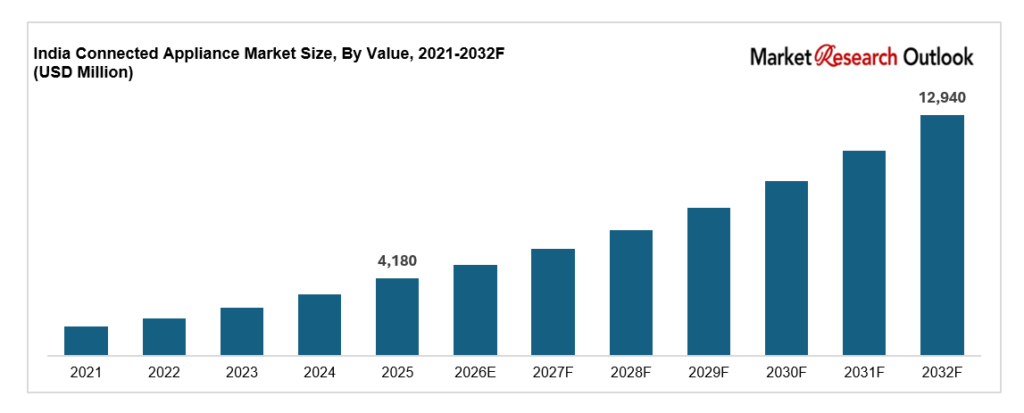
India connected appliance market to grow from USD 4,180 Mn in 2025 to USD 12,940 Mn by 2032 at a 17.5% CAGR. Explore trends, drivers, segments & key players. India’s connected appliance market is witnessing strong structural growth, driven by nationwide broadband and 5G scale, falling connectivity module costs, accelerating premium appliance demand across tier-1 and tier-2 cities, rising disposable incomes, growing demand for energy efficient and app controlled white goods, expansion of e-commerce and quick commerce distribution, and rising interest from domestic and global appliance majors investing in India-specific product innovation, manufacturing capacity, and connected service platforms.
Report Description
| Study Duration | 2021-2032 |
| Market Size (2025) | USD 4,180 Million |
| CAGR (2026-2032) | 17.5% |
| Leading Segment | Connected Climate Control Appliances (Smart Room Air Conditioners) |
| Fastest Growing Segment | Connected Kitchen Appliances & Cleaning Robotics |
| Market Size (2032) | USD 12,940 Million |
Source:
India Connected Appliances Market Overview
The India connected appliance market size is witnessing rapid expansion, driven by nationwide broadband growth, rising 5G coverage, falling connectivity module costs, expanding e-commerce distribution, increasing demand for energy efficient white goods, and major capacity additions by domestic and global appliance majors. Valued at USD 4,180 million in 2025 and projected to reach USD 12,940 million by 2032, growing at a CAGR of 17.5%, the India connected appliance market growth is being fuelled by strong demand from urban households, rising disposable incomes, and the rapid scaling of online electronics retail and quick commerce platforms across tier-1 and tier-2 cities. Connected climate control appliances lead consumption, while connected kitchen appliances and cleaning robotics are emerging as the fastest growing categories. Shifting consumer preferences toward app controlled convenience, growing energy cost awareness, and rising demand for interoperable smart home ecosystems are reshaping the supply landscape. As domestic majors including Voltas, Blue Star, Havells Lloyd, Godrej Appliances, and IFB Industries expand connected product lines, and global players including LG Electronics India, Samsung India, Whirlpool of India, Haier India, and Panasonic Life Solutions scale manufacturing pipelines, the India market is evolving into a consumer-led, innovation-driven, and digitally enabled ecosystem with strong long-term growth potential.
Related research: India Consumer Electronics and Appliances Market, India Robotic Vacuum Cleaner Market and India Smart Home Appliances Market.
Key Report Takeaways: India Connected Appliances Market
- The India connected appliance market size is projected to grow from USD 4,180 million in 2025 to USD 12,940 million by 2032, registering a strong CAGR of 17.5%, driven by nationwide broadband scale, falling connectivity costs, and the structural shift toward premium smart white goods across urban India.
- Connected climate control appliances dominate the India connected appliance market, accounting for 41% of total value in 2025, driven by strong demand for inverter smart room air conditioners, the deep retail presence of brands such as Voltas, Blue Star, LG, and Havells Lloyd, and rising urban cooling load across organised retail and e-commerce channels.
- Connected kitchen appliances and cleaning robotics are emerging as the fastest growing segments in the India connected appliance market, expected to grow at 24.8% annually as dual income households, compact urban homes, and premium buyers reshape purchase priorities across metro and tier-1 markets.
- Rapid scaling of India’s digital backbone, with broadband subscribers at 1,007.35 million by December 2025 and average data use of 21.53 GB per subscriber per month, is structurally expanding the India connected appliance market across modern retail, e-commerce, and builder led project categories.
- Rising investments by appliance majors such as LG Electronics India, Samsung India, Voltas, Havells Lloyd, and Godrej Appliances in local manufacturing, component localisation, and connected service platforms are strengthening domestic supply and supporting the India connected appliance market forecast 2032.
Key Drivers of the India Connected Appliances Market
Nationwide Broadband, 5G Scale, and Smartphone Penetration Driving Connected Appliance Demand Across India
Growth in the India connected appliance market is being driven by nationwide broadband expansion, the rollout of 5G, and near-universal smartphone ownership across tier-1, tier-2, and tier-3 cities. India’s broadband subscriber base crossed 1,007.35 million by December 2025, while 5G services moved past 400 million users on a deployed base of 518,854 base stations. Average mobile data consumption reached 21.53 GB per subscriber per month, among the highest globally, making persistent home connectivity a default rather than an exception. These products have become a signature category for organised retailers, with smart room air conditioners carrying an average selling price of INR 46,500 in the mainstream range. Connected penetration of total appliance sales in India remains at 9.4%, indicating significant long-term headroom for growth. A young buyer base, with 65% of Indians below age 35, falling connectivity module costs, and growing aspirational consumption are creating strong structural pull-through demand across the India connected appliance market.
Source:
Rising Disposable Incomes, Premiumisation, and PLI Backed Component Manufacturing Lowering Connected Appliance Costs
The India connected appliance market is benefiting from sustained growth in disposable incomes, with per-capita income rising by 70% between 2014 and 2024 according to MOSPI, alongside continued cost reductions in connectivity modules, inverter compressors, and BLDC motors. These products now carry a 22% price premium over comparable conventional models, down from 41% in 2020, with premium connected variants commanding an average of INR 92,000 per unit. Domestic manufacturing capacity has scaled rapidly under the PLI Scheme for White Goods, which carries an outlay of INR 6,238 crore and has selected 85 companies committing INR 11,198 crore of investment toward cumulative production of INR 1,90,050 crore between FY22 and FY29. BIS certification under the QCO 2025 order, revised BEE star rating norms, and growing trust in branded connected products have further strengthened organised supply, supporting price competitiveness across the India connected appliance market. Buyers aged 25 to 44 years now account for 61% of such purchases, with millennial and Gen-Z households preferring app control, energy tracking, and voice integration.
Matter Interoperability, AI Energy Management, and Voice Ecosystems Strengthening the Connected Appliance Value Proposition
Rapid adoption of the cross-vendor Matter standard and AI led energy management is a major catalyst for the India connected appliance market, with Matter over Thread enabled launches projected to grow at 34.2% annually through 2032. Fragmented app ecosystems affect 68% of multi-brand smart homes, creating strong demand for cross-vendor interoperability. Rising residential electricity tariffs and growing energy cost awareness are driving households toward appliances with real-time consumption tracking, where connected inverter air conditioners deliver energy savings of 18% against comparable non-connected units. The BEE star rating revision in 2025 has increased efficiency transparency for buyers, accelerating premium product adoption. Leading platform owners including Samsung SmartThings, LG ThinQ, Amazon Alexa, Google Home, and Xiaomi Mi Home have scaled India-specific ecosystem support, with the connected services and analytics layer alone representing a USD 310 million addressable opportunity. Government energy efficiency programmes combined with builder led smart home specifications are structurally expanding India connected appliance market growth across all major end-user categories through 2032.
India Connected Appliances Market Challenges
High Upfront Price Premium Over Conventional Appliances Limiting Mass-Market Adoption
The India connected appliance market continues to face challenges around upfront cost and limited affordability among mass-market buyers, with a typical connected room air conditioner priced 22% above an equivalent conventional model. While component localisation under the PLI scheme and falling module costs have improved affordability, connected penetration of total appliance sales remains at just 9.4%, reflecting bottlenecks in price sensitivity, financing access, and perceived payback. Retailers and dealers continue to steer entry-level buyers toward conventional models with faster stock turns, while affordable connected variants priced below INR 30,000 remain underdeveloped. India’s continued price-first purchase behaviour limits adoption among middle-income and first-time households across the India connected appliance market.
Fragmented Ecosystems, App Dependence, and Weak Interoperability Across Brands
The India connected appliance market faces structural complexity from variations in connectivity protocols, app quality, and cross-brand compatibility across different manufacturers. While metros such as Delhi, Mumbai, Bengaluru, Chennai, and Hyderabad have strong home network coverage with fixed broadband penetration at 82%, other markets maintain weaker network quality and inconsistent device performance. Average firmware support commitment for such products in India stands at 36 months, and unbroken cloud connectivity remains a key bottleneck in tier-2 and tier-3 rollout. Differential support for Wi-Fi, Bluetooth, Zigbee, and Thread across brands creates operational complexity for players such as LG, Samsung, Voltas, Havells Lloyd, and Godrej Appliances operating pan-India. While the Matter standard has begun to consolidate ecosystems, protocol fragmentation remains a near-term challenge for the India connected appliance market.
Data Privacy, Cyber Security, and After-Sales Service Gaps Impacting Consumer Confidence
The India connected appliance market faces practical constraints around data privacy, device security, and uneven after-sales coverage across the value chain. Concern over always-connected home devices affects 57% of prospective buyers in urban India, while compliance with the Digital Personal Data Protection Act has added governance workload for manufacturers. Smaller brands face additional complexity in funding secure cloud platforms and long-term firmware maintenance. Average gross margins for connected appliances in India stand at 27%, reducing the effective profitability of new launches by 6%. Authorised service coverage reaches only 41% of tier-3 towns and certified installation capability remains thin, but on-device processing, standardised security certification, and expanding service franchise networks are emerging as solutions, though premium pricing and limited consumer awareness remain barriers to widespread adoption across the India connected appliance market.
India Connected Appliances Market Trends
Rapid Adoption of Matter, Thread, and Cross-Vendor Interoperability in India
The India connected appliance market is undergoing a clear technology shift toward Matter, Thread, and cross-vendor interoperability, with these advanced protocols expected to capture 34% of new launches by 2028. Matter enabled appliances cut average setup time to 4 minutes per device, compared to 11 minutes for legacy Wi-Fi only pairing, while Thread mesh networking extends reliable coverage across larger homes. Leading domestic and global brands including Samsung, LG Electronics, Panasonic Life Solutions, Havells, and Bosch have scaled Matter compatible product lines through 2024 and 2025. Appliances with on-device AI, load sensing, and predictive fault detection are also gaining traction, particularly in metro cities such as Mumbai and Bengaluru where premium buyers are rising, with brands including Voltas, Blue Star, IFB, and Haier offering diagnostics led connected variants. This product transition is reinforcing the India connected appliance market forecast 2032 across both retail and project categories.
Growth of E-Commerce, Quick Commerce, and Digital Distribution in the India Connected Appliance Market
A clear shift toward e-commerce, quick commerce, and digital distribution models is reshaping the India connected appliance market, particularly in the urban and metro segment. Under platforms such as Amazon, Flipkart, Reliance Digital, and Croma, connected appliances are delivered and installed within 48 hours, with financing options covering 63% of online appliance transactions. Leading marketplaces have built combined operational reach exceeding 19,000 Indian pin codes, with connected air conditioners and refrigerators ranking among the top three appliance categories ordered. Digital platforms are also reducing customer acquisition costs and accelerating adoption across both retail and project segments of the India connected appliance market. By 2025, e-commerce channels account for 32.5% of appliance distribution in India, up from 14% in 2020, with metro buyers increasingly preferring doorstep delivery and app based installation scheduling over in-store purchase.
Capacity Expansion by Appliance Majors and Component Localisation Investments
A wave of domestic capacity expansion and component localisation investment is reshaping the India connected appliance market supply landscape. Combined India-focused capital expenditure announcements in appliance manufacturing, compressor plants, and electronics assembly exceeded USD 2.4 billion across 2023 to 2025. LG Electronics India expanded capacity at its Sri City plant, Samsung India scaled connected production at Chennai, Voltas grew output across Gujarat and Tamil Nadu, Havells expanded Lloyd manufacturing at Ghiloth, and Godrej Appliances raised connected refrigeration capacity at Shirwal. BIS certification under the QCO 2025 order, PLI White Goods allocations of INR 6,238 crore, and GST rationalisation on appliances have structurally favoured organised supply. Combined with builder led project demand and e-commerce procurement scaling rapidly, these developments are reinforcing the India connected appliance market forecast 2032 across the entire value chain.
India Connected Appliances Market Share by Segment
By End-User: Urban Households Segment Dominates the India Connected Appliance Market
The urban households end-user segment dominates the India connected appliance market, accounting for 63% of total value, driven by rising disposable incomes, growing apartment living, and improving connected appliance economics. Connected climate control and refrigeration are the dominant categories within this segment, with e-commerce and modern retail capturing 71% of urban smart white goods purchases. The semi-urban and tier-2 households segment contributes another 19% of demand, driven by expanding broadband coverage, entry-level connected models, and organised retail expansion into smaller cities. Residential projects and builders account for 11%, led by smart-home specified apartments and rental housing, while commercial and hospitality buyers contribute 7%. In 2025, leading players including LG Electronics India, Samsung India, Voltas, Havells Lloyd, and Godrej Appliances scaled urban and semi-urban focused connected deployment under e-commerce and modern retail expansion, reinforcing segment dominance nationwide.
By Product Type: Connected Climate Control Leads While Kitchen Appliances and Cleaning Robotics Grow Fastest
Connected climate control appliances lead the India connected appliance market product landscape, accounting for 41% of total value, driven by rising cooling demand, inverter technology adoption, and improving cost economics. Connected refrigeration contributes another 22%, primarily across metro and tier-1 households, while connected laundry accounts for 17% of value. Connected kitchen appliances and cleaning robotics are the fastest growing categories within the India connected appliance market, expanding at 24.8% annually, driven by compact urban homes, dual income households, and rising adoption in premium urban segments. Together they account for 17% of the market, with cleaning robotics expected to grow rapidly through 2032 in metro markets. Leading manufacturers including LG Electronics India, Samsung India, Voltas, Whirlpool of India, and IFB Industries have aligned product portfolios to this product mix, driving premium adoption across every major state cluster.
India Connected Appliances Market by Region
Regional analysis of the India connected appliance market shows that West India and North India collectively account for 55.7% of total value, driven by Maharashtra (Mumbai and Pune belt), Gujarat, Delhi NCR, Haryana, and Punjab, supported by high urban household incomes and dense organised retail networks, with West India alone contributing 28.3% and North India 27.4%. South India contributes 26.1% of demand, led by Karnataka, Tamil Nadu, and Telangana, supported by technology led household incomes and apartment adoption across Bengaluru, Chennai, and Hyderabad. Central and East India together account for 18.2% of demand, supported by Madhya Pradesh, West Bengal, Bihar, and Odisha, where modern retail and e-commerce adoption is accelerating. In 2025, capacity additions and distribution operations by LG across Andhra Pradesh, Samsung across Tamil Nadu, Voltas across Gujarat, Havells across Rajasthan, and Godrej Appliances across Maharashtra reinforced regional supply hubs, supporting closer execution of retail and project deliveries nationwide.
Recent Developments in the India Connected Appliances Market
- The India connected appliance market witnessed strong momentum in launches and capacity progress during 2024 and 2025. India added a record 640 new smart white goods SKUs in calendar year 2025, representing a 41% year-on-year increase from 454 SKUs in 2024, according to industry tracking. E-commerce platforms recorded 8.6 million connected unit shipments by the end of 2025, with connected climate control accounting for 44% of new orders. Cumulative connected unit shipments in India are projected to reach 21.4 million units by FY28 from 9.8 million units in FY25, growing at an average 30% annually.
- Appliance majors have deepened India-focused capacity expansion. In 2025, LG Electronics India scaled connected production at Sri City, Samsung India expanded SmartThings enabled manufacturing at Chennai, Voltas commissioned added capacity in Gujarat, Havells expanded Lloyd output at Ghiloth, and Godrej Appliances grew connected refrigeration at Shirwal. Panasonic Life Solutions widened its Matter compatible Miraie portfolio, and Blue Star expanded into connected premium room air conditioners with new IoT enabled lines. These developments are strengthening domestic supply and supporting the India connected appliance market forecast 2032.
- Ecosystem and retail momentum has gained strong traction in the India connected appliance market. In 2025, leading platform and retail players including Samsung SmartThings, LG ThinQ, Amazon Alexa, Google Home, Reliance Digital, and Croma expanded ecosystem ecosystem support and in-store demonstration capability. Strategic partnerships between appliance majors, chipset suppliers, and IoT platform providers are positioning India as one of the most actively scaling connected appliance markets globally, strengthening long-term competitive positioning in the India connected appliance market forecast 2032.
Key Companies in the India Connected Appliances Market
- LG Electronics India Limited
- Samsung India Electronics Private Limited
- Voltas Limited (Tata Group)
- Blue Star Limited
- Havells India Limited (Lloyd)
- Godrej Enterprises Group (Godrej Appliances)
- Whirlpool of India Limited
- IFB Industries Limited
- Panasonic Life Solutions India Private Limited
- Haier Appliances India Private Limited
- Bosch Limited (BSH Household Appliances)
- Daikin Airconditioning India Private Limited
- Xiaomi Technology India Private Limited
| By Product Type | By Connectivity | By Price Range | By Distribution | By End-User |
| Connected Climate Control Connected Refrigeration Connected Laundry Connected Kitchen Cleaning Robotics Others | Wi-Fi Bluetooth & BLE Matter over Thread Zigbee Cellular & NB-IoT Infrared & RF Bridge Others | Entry Mid Premium Luxury Modular & Built-In | E-Commerce & Quick Commerce Modern Retail Brand Exclusive Outlets Multi-Brand Retailers Builder & Institutional Others | Urban Households Semi-Urban Households Residential Projects & Builders Commercial & Hospitality |
Report Scope
In this report, the India Connected Appliance Market has been segmented into the following categories, in addition to detailed analysis of key industry trends, market dynamics, competitive landscape, and growth opportunities across the forecast period:
- By Product Type
- Connected Climate Control Appliances
- Connected Refrigeration Appliances
- Connected Laundry Appliances
- Connected Kitchen Appliances
- Cleaning Robotics & Smart Vacuum Systems
- Others
- By Connectivity Technology
- Wi-Fi
- Bluetooth & BLE
- Matter over Thread
- Zigbee
- Cellular & NB-IoT
- Infrared & RF Bridge
- Others
- By Price Range
- Entry (Below INR 25,000)
- Mid (INR 25,000 to INR 50,000)
- Premium (INR 50,000 to INR 100,000)
- Luxury (Above INR 100,000)
- Modular & Built-In
- By Distribution Channel
- E-Commerce & Quick Commerce
- Modern Retail & Large Format Stores
- Brand Exclusive Outlets
- Multi-Brand Electronics Retailers
- Builder, Institutional & Project Sales
- Others
- By End-User
- Urban Households
- Semi-Urban & Tier-2 Households
- Residential Projects & Builders
- Commercial & Hospitality
- By Geography
- North India
- South India
- West India
- East India
- Central India
Competitive Landscape
Company Profiles:
Detailed analysis of the leading companies operating in the India Connected Appliance Market, including business overview, product portfolio, strategic initiatives, competitive positioning, and recent developments.
Company Information
Detailed profiling and strategic analysis of additional market players (up to five companies), including emerging domestic connected appliance brands, specialty cleaning robotics and smart kitchen producers, regional white goods players, or niche IoT platform providers.
For a free sample of the India Connected Appliance Market report, customised insights or delivery timelines, submit your query here
Table of Contents
- Research Framework
- Market Segmentation
- Research Objective
- Research Methodology
- Qualitative Research
- Primary Research
- Secondary Research
- Quantitative Research
- Market Breakdown & Data Triangulation
- Demand Side
- Supply Side
- Primary Research Respondents
- Assumption & Limitation
- Executive Summary
- Market Overview, 2021-2032
- By Product Type
- By Connectivity Technology
- By Price Range
- By Distribution Channel
- By End-User
- By Region
- Analyst Recommendations
- Geopolitical Impact on India Connected Appliance Market
- India Connected Appliance Market Insights
- Market Dynamics
- Growth Drivers
- Nationwide broadband, 5G scale, and smartphone penetration driving connected appliance demand across India.
- Rising disposable incomes, premiumisation, and PLI backed component manufacturing lowering connected appliance costs.
- Matter interoperability, AI energy management, and voice ecosystems strengthening the connected appliance value proposition.
- Restraints
- High upfront price premium over conventional appliances limiting mass-market connected appliance adoption.
- Fragmented ecosystems, app dependence, and weak interoperability slowing repeat purchases across brands.
- Uneven after-sales, installation, and firmware support networks across tier-2 and tier-3 cities.
- Opportunities
- Affordable connected entry models opening untapped tier-2 and tier-3 household pools across India.
- Builder-led smart residential projects and rental housing creating institutional connected appliance demand.
- Subscription services, predictive maintenance, and energy analytics creating recurring connected revenue pools.
- Challenges
- Data privacy, cyber security, and consumer trust concerns around always-connected home appliances.
- Patchy home Wi-Fi quality and power reliability limiting smart feature usage in Indian homes.
- Low consumer awareness of connected features and limited retail demonstration capability in smaller cities.
- Technological Advancements
- Recent Technological Advancements
- Prior to 2020
- Porter’s Five Forces Analysis
- PESTLE Analysis
- Industry Value Chain & Entry Points
- Upstream Components (semiconductor chipsets, Wi-Fi and Bluetooth modules, sensors, BLDC motors, compressors, PCBs)
- Connected Appliance Manufacturers (LG, Samsung, Voltas, Havells Lloyd, Godrej Appliances, Whirlpool, IFB)
- Connectivity Module & Chipset Suppliers (Wi-Fi, Bluetooth, Zigbee, Thread, cellular NB-IoT modules)
- IoT Platform & Cloud Service Providers (device management, OTA firmware, telemetry and analytics)
- Quality Control, BIS Certification & Testing Laboratories (BIS, QCO 2025, BEE star rating standards)
- Distributors, Wholesalers & Modern Trade (national and regional appliance distribution networks)
- E-Commerce & Quick Commerce Platforms (Amazon, Flipkart, Reliance Digital, Croma, Vijay Sales)
- Brand Owners & Smart Home Ecosystem Providers (SmartThings, LG ThinQ, Alexa, Google Home, Matter)
- Installation, Service & After-Sales Networks (installation, firmware support, annual maintenance)
- End-Users (urban households, tier-2 households, builders, hospitality operators, commercial buyers)
- India Connected Appliance Market: Regulatory Framework
- India Connected Appliance Market Overview
- Market Size & Forecast, 2021-2032
- By Value (USD Million)
- By Volume (Million Units)
- Market Share & Forecast
- By Product Type
- Connected Climate Control Appliances
- Connected Refrigeration Appliances
- Connected Laundry Appliances
- Connected Kitchen Appliances
- Cleaning Robotics & Smart Vacuum Systems
- Others
- By Connectivity Technology
- Wi-Fi
- Bluetooth & BLE
- Matter over Thread
- Zigbee
- Cellular & NB-IoT
- Infrared & RF Bridge
- Others
- By Price Range
- Entry (Below INR 25,000)
- Mid (INR 25,000 to INR 50,000)
- Premium (INR 50,000 to INR 100,000)
- Luxury (Above INR 100,000)
- Modular & Built-In
- By Distribution Channel
- E-Commerce & Quick Commerce
- Modern Retail & Large Format Stores
- Brand Exclusive Outlets
- Multi-Brand Electronics Retailers
- Builder, Institutional & Project Sales
- Others
- By End-User
- Urban Households
- Semi-Urban & Tier-2 Households
- Residential Projects & Builders
- Commercial & Hospitality
- By Geography
- North India
- South India
- West India
- East India
- Central India
- Competitive Landscape
- India Connected Appliance Market Company Market Share Analysis, 2025
- Competitive Benchmarking, By Operating Parameters
- Key Strategic Development (Mergers, Acquisitions, Partnerships, Etc.)
- List of Emerging Players
- Company Profile
- LG Electronics India Limited
- Introduction & Company Profile
- Product Benchmarking
- Strategic Outlook
- Key Competitors
- Financial Analysis
- SWOT Analysis
(Same Data Pointers Will Be Provided for The Below Companies)
- Samsung India Electronics Private Limited
- Voltas Limited (Tata Group)
- Blue Star Limited
- Havells India Limited (Lloyd)
- Godrej Enterprises Group (Godrej Appliances)
- Whirlpool of India Limited
- IFB Industries Limited
- Panasonic Life Solutions India Private Limited
- Haier Appliances India Private Limited
- Bosch Limited (BSH Household Appliances)
- Daikin Airconditioning India Private Limited
- Xiaomi Technology India Private Limited
- Other Prominent Players
* Financial information in case of non-listed companies will be provided as per availability
** The segmentation and the companies are subjected to modifications based on in-depth secondary for the final deliverable
Frequently Asked Questions
1. How large is the India connected appliance market and what is its growth forecast?
Ans: The India connected appliance market is valued at USD 4,180 million in 2025 and is projected to reach USD 12,940 million by 2032, growing at a CAGR of 17.5%, supported by broadband scale and premium home upgrades.
2. Which segments are driving demand in the India connected appliance market?
Ans: Connected climate control appliances lead with 41% value share, while connected kitchen appliances and cleaning robotics grow fastest at 24.8% annually, driven by compact urban homes and dual income households across metro cities.
3. What are the key drivers of growth in the India connected appliance market?
Ans: Key drivers include nationwide broadband and 5G scale, rising disposable incomes, PLI backed component manufacturing, Matter interoperability, AI led energy management, and rapid expansion of e-commerce distribution across tier-1 and tier-2 cities.
4. Which regions are driving growth in the India connected appliance market?
Ans: : West India and North India lead with 55.7% of total value, driven by Maharashtra, Gujarat and Delhi NCR. South India follows at 26.1%, led by Karnataka, Tamil Nadu and Telangana.
5. What are the latest trends in the India connected appliance market?
Ans: Latest trends include Matter and Thread interoperability, AI led energy management, cleaning robotics adoption, voice ecosystem integration, and e-commerce channels reaching 32.5% of connected appliance distribution across urban and tier-2 India.