

India Smart Home Appliances Market Size & Forecast 2032
- Consumer Goods & Retail, Home Appliances & Durables
- Apr 2026
- Pages 180
- Report Format: pdf
- Report Price: $2400 USD
India’s smart home appliances market is expanding rapidly, driven by rising smart home adoption, growing internet penetration, increasing consumer preference for connected and energy-efficient devices, higher disposable income, and strong demand for convenience, automation, and app-based appliance control.
Report Description
| Study Duration | 2021-2032 |
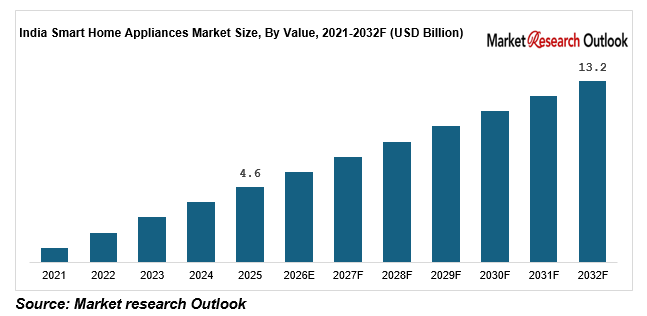
| Market Size (2025) | USD 4.6 Billion |
| CAGR (2026-2032) | 15.87% |
| Leading Segment | Security |
| Fastest Growing Segment | Energy Management |
| Market Size (2032) | USD 13.20 Billion |
India Smart Home Appliances Market Overview
The India smart home appliances market is witnessing strong and sustained expansion, valued at USD 4.6 billion in 2025 and projected to reach USD 13.20 billion by 2032, growing at a CAGR of 15.87 percent. This growth is being driven by rapidly increasing internet penetration, expected to exceed 900 million users by 2030, along with rising smartphone adoption across urban and semi-urban India. Consumers are increasingly shifting toward connected living, adopting smart air conditioners, lighting systems, security devices, and kitchen appliances that offer automation, energy efficiency, and remote control functionality. The expansion of e-commerce platforms, along with government initiatives such as Smart Cities Mission and Digital India, is further accelerating adoption across Tier I and Tier II cities. The report provides detailed insights into segment-level growth, technology adoption, and regional demand patterns, helping businesses identify where the most scalable opportunities exist in the India smart home appliances market.
Related research: India Consumer Electronics and Appliances Market, India Automatic Coffee Machines Market and India Robotic Vacuum Cleaner Market.
Key Report Takeaways: India Smart Home Appliances Market
- The India smart home appliances market is projected to grow at a CAGR of 15.87 percent, expanding from USD 4.6 billion in 2025 to USD 13.20 billion by 2032, but growth varies significantly by product category, pricing segment, and city tier. The report breaks down where the fastest growth is actually happening and which segments are scaling first.
- Smart security and surveillance dominates with over 25 to 30 percent market share, driven by rising safety concerns, but emerging categories such as energy management are reshaping long-term demand. The report identifies which segments will dominate next and where new opportunities are forming.
- Energy management is the fastest-growing segment, with smart appliances reducing electricity consumption by up to 20 percent, reflecting a strong shift toward cost optimization and sustainability. The report provides detailed insights into how energy efficiency is influencing purchasing decisions across segments.
- Online channels contribute 30 to 35 percent of total sales, driven by aggressive expansion of Amazon and Flipkart into Tier II and Tier III markets. The report highlights how distribution strategies are evolving and where offline still holds an advantage.
Key Drivers of the India Smart Home Appliances Market
Rising Internet Penetration and Smartphone Adoption Driving Connected Device Uptake
The India smart home appliances market is fundamentally driven by the rapid expansion of internet and smartphone usage, with the country expected to surpass 900 million internet users by 2030. This digital foundation is enabling seamless adoption of app-controlled and voice-enabled devices such as smart speakers, lighting systems, and surveillance solutions. As smartphone penetration deepens across Tier I and Tier II cities, consumers are increasingly comfortable integrating connected devices into daily life, accelerating adoption across both entry-level and premium segments. The report provides detailed insights into digital adoption trends, user behavior, and device penetration across regions.
Growing Demand for Energy Efficiency and Home Automation Solutions
Increasing awareness of energy efficiency is playing a critical role in shaping the India smart home appliances market, with connected devices capable of reducing electricity consumption by up to 15 to 20 percent. Rising power costs and sustainability concerns are pushing consumers toward smart HVAC systems, lighting, and energy management solutions that optimise usage in real time. At the same time, demand for convenience and automation is driving adoption of integrated smart home ecosystems. The report delivers in-depth analysis of energy-saving technologies, product adoption trends, and emerging automation use cases.
Rising Disposable Income and Urbanization Expanding Consumer Demand
Rapid urbanization and increasing disposable income are expanding the addressable market for smart home appliances in India, with the urban population expected to exceed 40 percent in the coming years. Consumers are increasingly upgrading from traditional appliances to connected alternatives, particularly in metro cities and emerging urban clusters. This shift is driving demand across both mid-range and premium product categories. The report provides granular insights into income segmentation, pricing dynamics, and regional demand distribution.
India Smart Home Appliances Market Challenges
High Upfront Costs Limiting Mass Market Adoption
One of the primary challenges in the India smart home appliances market is the high upfront cost of connected devices, which are typically priced 25 to 40 percent higher than conventional appliances. While entry-level products are becoming more accessible, full smart home integration still requires significant investment, limiting adoption among price-sensitive consumers. This pricing gap is particularly evident in Tier II and Tier III markets, where affordability remains a key barrier. The report provides detailed insights into pricing trends, affordability thresholds, and demand segmentation across income groups.
Data Privacy Concerns and Interoperability Challenges
Concerns around data privacy and cybersecurity are increasingly influencing consumer decisions in the connected home devices India market, particularly for surveillance and monitoring systems. At the same time, the lack of standardized protocols across technologies such as Wi-Fi, Zigbee, and Matter creates interoperability challenges, making it difficult for users to integrate devices across brands. Complex installation processes and infrastructure gaps in semi-urban regions further restrict adoption. The report offers detailed analysis of technology barriers, consumer concerns, and evolving standards shaping the market.
India Smart Home Appliances Market Trends
AI and Voice Enabled Ecosystems Driving Smart Home Adoption
The India smart home appliances market is increasingly being shaped by AI-powered and voice-enabled ecosystems, with platforms such as Amazon Alexa and Google Assistant enabling centralized control of multiple devices. This is driving strong demand across categories such as smart speakers, lighting, and security systems. The ability to automate daily functions through voice commands and mobile apps is significantly enhancing user experience and accelerating adoption. The report provides insights into platform ecosystems, feature adoption, and competitive positioning.
Rising Adoption of Energy Efficient Smart Appliances
Energy efficiency is emerging as a key trend in the smart home market India forecast 2032, with connected appliances capable of reducing electricity consumption by up to 20 percent. Smart HVAC systems, lighting, and energy management solutions are gaining traction as consumers look to optimise energy usage and reduce costs. This trend is further supported by increasing awareness of sustainability and rising electricity prices. The report provides detailed insights into energy-saving technologies and segment-wise adoption trends.
Improving Interoperability and Expansion of Smart Home Ecosystems
The emergence of interoperability standards such as Matter is improving device compatibility across brands, addressing one of the key barriers to adoption in the India smart home appliances market. At the same time, the expansion of e-commerce platforms is increasing accessibility across Tier II and Tier III cities. This is enabling faster market penetration and supporting the development of integrated smart home ecosystems. The report delivers insights into ecosystem development, technology evolution, and distribution expansion strategies.
India Smart Home Appliances Market Share by Segment
The India smart home appliances market segmentation highlights that smart security and surveillance currently leads the market, contributing over 25 to 30 percent share, driven by increasing demand for home safety, surveillance systems, and smart locks. At the same time, energy management and smart HVAC are emerging as the fastest-growing segments, with connected appliances capable of reducing electricity consumption by up to 20 percent, supported by rising power costs and sustainability awareness. From a connectivity perspective, Wi-Fi-enabled devices dominate due to ease of use and seamless smartphone integration, while emerging standards such as Matter are improving cross-device compatibility. In terms of end use, the residential segment accounts for over 70 percent of total demand, while online channels contribute 30 to 35 percent of total sales, reflecting the growing influence of e-commerce platforms such as Amazon and Flipkart in expanding reach across Tier II and Tier III cities. The report provides detailed segment-wise insights, market share analysis, and growth forecasts to help businesses identify high-potential categories and investment areas.
India Smart Home Appliances Market by Region
The India smart home appliances market regional analysis shows that metro cities such as Delhi NCR, Mumbai, Bengaluru, Hyderabad, and Chennai currently dominate demand, accounting for over 50 to 55 percent of total market size, supported by higher disposable income, stronger digital infrastructure, and early adoption of connected technologies. However, the next phase of growth is clearly shifting toward Tier II cities such as Pune, Ahmedabad, Jaipur, and Coimbatore, where rising middle-class income and expanding internet penetration are accelerating adoption. Southern and western India continue to lead in overall adoption due to higher digital literacy and real estate development, while northern regions are witnessing increasing demand for smart surveillance solutions driven by safety concerns. Government initiatives such as the Smart Cities Mission, covering 100+ cities, are further supporting long-term expansion of the IoT home appliances India market. The report provides detailed city-level and regional opportunity mapping, helping businesses identify high-growth markets and expansion strategies.
Recent Developments in the India Smart Home Appliances Market
- Samsung and Xiaomi are actively expanding their portfolios with AI-enabled smart appliances focused on automation, energy efficiency, and app-based control, strengthening competition in both premium and mid-range segments.
- Amazon has significantly expanded Alexa integration across 100+ smart device brands in India, accelerating ecosystem development and enabling seamless multi-device control within connected households.
- The adoption of interoperability standards such as Matter is gaining momentum, improving compatibility across brands and addressing one of the key barriers to large-scale smart home adoption in India.
Key Companies in the India Smart Home Appliances Market
- Xiaomi Technology India Pvt. Ltd.
- Amazon India (Echo / Alexa Devices)
- Google India (Nest Products)
- Philips India (Signify India Pvt. Ltd.)
- Havells India Ltd.
- Syska LED Lights Pvt. Ltd.
- Wipro Consumer Care & Lighting
- Bajaj Electricals Ltd.
- Honeywell Home (Resideo Technologies India)
- Samsung India Electronics Pvt. Ltd.
- Godrej & Boyce Manufacturing Company Ltd.
Report Scope:
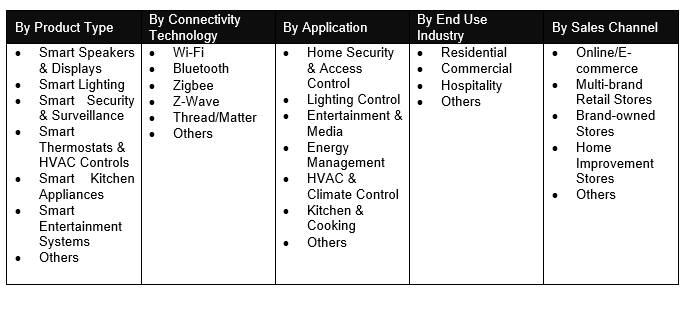
This report provides a comprehensive segmentation of the India Smart Home Appliances Market across key categories, along with in-depth insights into industry trends, technology adoption, pricing dynamics, and competitive landscape.
Segmentation
- By Product Type
- Smart Speakers & Displays
- Smart Lighting
- Smart Security & Surveillance
- Smart Thermostats & HVAC Controls
- Smart Kitchen Appliances
- Smart Entertainment Systems
- Others
- By Connectivity Technology
- Wi-Fi
- Bluetooth
- Zigbee
- Z-Wave
- Thread/Matter
- Others
- By Application
- Home Security & Access Control
- Lighting Control
- Entertainment & Media
- Energy Management
- HVAC & Climate Control
- Kitchen & Cooking
- Others
- By End Use
- Residential
- Commercial
- Hospitality
- Others
- By Sales Channel
- Online/E-commerce
- Multi-brand Retail Stores
- Brand-owned Stores
- Home Improvement Stores
- Others
Competitive Landscape
Company Profiles: In-depth profiling of leading companies operating in the India Smart Home Appliances Market, covering product portfolios, strategic initiatives, and competitive positioning.
Available Customizations
The India Smart Home Appliances Market report by Market Research Outlook can be tailored to align with specific business requirements and strategic objectives. In addition to the standard scope, the report offers the following customization options:
Company Information
Detailed profiling and analysis of additional market players (up to five), including product benchmarking, strategic initiatives, and competitive positioning
The India Smart Home Appliances Market report is currently under preparation and will be released soon. For early access, customized insights, or to confirm the release timeline, please reach out to our team at research@marketresearchoutlook.com
Table of content
India Smart Home Appliances Market, 2032
- Research Framework
- Market Segmentation
- Research Objective
- Research Methodology
- Qualitative Research
- Primary Research
- Secondary Research
- Quantitative Research
- Market Breakdown & Data Triangulation
- Demand Side
- Supply Side
- Primary Research Respondents
- Assumption & Limitation
- Qualitative Research
- Executive Summary
- Market Overview, 2021–2032
- By Product Type
- By Connectivity Technology
- By Application
- By End Use
- By Sales Channel
- Analyst Recommendations
- Market Overview, 2021–2032
- Geopolitical Impact on India Smart Home Appliances Market
- India Smart Home Appliances Market Insights
- Market Dynamics
- Growth Drivers
- Rising internet penetration and smartphone adoption driving smart home device uptake.
- Growing awareness of energy efficiency and home automation solutions.
- Increasing disposable income and rapid urbanization fueling consumer electronics demand.
- Restraints
- High upfront cost of smart home devices limiting mass market penetration.
- Concerns over data privacy and cybersecurity risks associated with connected devices.
- Lack of standardized protocols leading to device interoperability challenges.
- Opportunities
- Government Smart City initiatives creating a favorable environment for smart home adoption.
- Rapid growth of e-commerce and online retail channels expanding product reach.
- Rising demand for home security, energy management, and AI-powered automation systems.
- Challenges
- Complex installation and setup processes deterring non-tech-savvy consumers.
- Fragmented ecosystem with multiple competing standards hindering seamless integration.
- Infrastructure gaps in rural and semi-urban areas limiting widespread adoption.
- Technological Advancements
- Recent Technological Advancements
- Prior to 2020
- Porter’s Five Forces Analysis
- PESTLE Analysis
- Growth Drivers
- Market Dynamics
- Industry Value Chain & Entry Points
- Raw Material Suppliers (semiconductors, sensors, electronic components)
- Component Manufacturers (processors, connectivity modules, display panels)
- Product Assembly & Manufacturing
- Software Development & Platform Integration (AI, IoT platforms, app development)
- Quality Control & Testing (safety certifications, performance validation)
- Packaging & Logistics
- Distributors & Retailers (e-commerce, modern trade, traditional retail)
- End Users (residential, commercial, hospitality)
- After-sales Support & Maintenance Services
- India Smart Home Appliances Market: Regulatory Framework
- India Smart Home Appliances Market Overview
- Market Size & Forecast, 2021-2032
- By Value (USD Million)
- Market Share & Forecast
- By Product Type
- Smart Speakers & Displays
- Smart Lighting
- Smart Security & Surveillance
- Smart Thermostats & HVAC Controls
- Smart Kitchen Appliances
- Smart Entertainment Systems
- Others
- By Connectivity Technology
- Wi-Fi
- Bluetooth
- Zigbee
- Z-Wave
- Thread/Matter
- Others
- By Application
- Home Security & Access Control
- Lighting Control
- Entertainment & Media
- Energy Management
- HVAC & Climate Control
- Kitchen & Cooking
- Others
- By End Use
- Residential
- Commercial
- Hospitality
- Others
- By Sales Channel
- Online/E-commerce
- Multi-brand Retail Stores
- Brand-owned Stores
- Home Improvement Stores
- Others
- By Product Type
- Market Size & Forecast, 2021-2032
- Competitive Landscape
- India Smart Home Appliances Company Market Share Analysis, 2025
- Competitive Benchmarking, By Operating Parameters
- Key Strategic Development (Mergers, Acquisitions, Partnerships, Etc.)
- List of Emerging Players
- Company Profile
- Xiaomi Technology India Pvt. Ltd.
- Introduction & Company Profile
- Product Benchmarking
- Strategic Outlook
- Key Competitors
- Financial Analysis
- SWOT Analysis
- Xiaomi Technology India Pvt. Ltd.
**(Same Data Pointers Will Be Provided for The Below Companies)
- Amazon India (Echo/Alexa Devices)
- Google India (Nest Products)
- Philips India (Signify India Pvt. Ltd.)
- Havells India Ltd.
- Syska LED Lights Pvt. Ltd.
- Wipro Consumer Care & Lighting
- Bajaj Electricals Ltd.
- Honeywell Home (Resideo Technologies India)
- Samsung India Electronics Pvt. Ltd.
- Godrej & Boyce Manufacturing Company Ltd.
- Other Prominent Players
* Financial information in case of non-listed companies will be provided as per availability
** The segmentation and the companies are subjected to modifications based on in-depth secondary for the final deliverable.
Frequently Asked Questions
1. How large is the India smart home appliances market and what is its growth outlook?
Ans: The India smart home appliances market is valued at USD 4.6 billion in 2025 and is projected to reach USD 13.2 billion by 2032, growing at a CAGR of 15.87 percent. This growth is driven by increasing adoption of connected devices, rising internet penetration, and demand for automation and energy efficiency. The report provides a detailed breakdown of growth by segment, region, and technology, helping businesses identify high-growth investment areas.
2. Which segments are driving demand in the India smart home appliances market?
Ans: Demand is led by smart speakers, lighting, and security devices priced between INR 3,000 to 10,000, which act as entry points for consumers, while premium appliances such as smart air conditioners and refrigerators drive higher-value growth. The report identifies the fastest-growing segments, market share distribution, and future demand hotspots.
3. What are the key drivers of India smart home appliances market growth?
Ans: Key drivers include rising internet penetration exceeding 800 million users, increasing smartphone adoption, and growing awareness of energy-efficient solutions that reduce electricity consumption by up to 20 percent. The report provides in-depth insights into demand drivers, adoption trends, and consumer behavior shifts.
4. Which regions offer the highest growth opportunities in India?
Ans: Tier I cities account for 55 to 65 percent of current demand, while Tier II cities such as Pune, Jaipur, and Ahmedabad are emerging as the fastest-growing markets due to rising income levels and digital access. The report provides city-level opportunity mapping and regional growth analysis.
5. How is technology shaping the future of the smart home appliances market in India?
Ans: Advancements in AI, IoT, and interoperability standards such as Matter are enabling seamless device integration and enhancing user experience. Voice assistants and app-based control systems are becoming standard features across product categories. The report offers detailed insights into technology trends, innovation pipelines, and future market direction.