

India Carbon Black Market Size, Share & Forecast 2032
- Chemicals & Advanced Materials, Petrochemicals & Intermediates
- Jul 2026
- Pages 140
- Report Format: pdf
- Report Price: $2400 USD
India’s carbon black market is witnessing strong structural growth, driven by rising tyre production and radialisation, expanding non-tyre rubber goods output, accelerating specialty and conductive grade adoption across plastics, coatings, and energy storage, surging export volumes into Europe as buyers diversify away from Russian supply, large-scale capacity creation by domestic producers, and growing investment in circular products recovered from end-of-life tyres.
Report Description
| Study Duration | 2021-2032 |
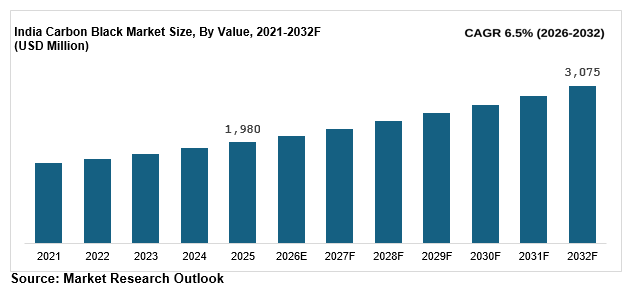
| Market Size (2025) | USD 1,980 Million |
| CAGR (2026-2032) | 6.5% |
| Leading Segment | Rubber Grade (ASTM N-Series) for Tyres |
| Fastest Growing Segment | Specialty & Conductive Grades |
| Market Size (2032) | USD 3,075 Million |
Source:
India Carbon Black Market Overview
The India carbon black market size is witnessing steady expansion, driven by rising tyre output, growing radialisation, accelerating specialty and conductive grade demand, expanding non-tyre rubber goods production, and surging exports into European and global markets. Valued at USD 1,980 million in 2025 and projected to reach USD 3,075 million by 2032, growing at a CAGR of 6.5%, the India carbon black market growth is being fuelled by strong offtake from tyre manufacturers, masterbatch converters, and coatings formulators, alongside improving realisation from a richer specialty mix. Rubber grade material leads consumption, while specialty and conductive grades are emerging as the fastest growing categories. India consumed 1,250 thousand tonnes domestically in 2025 against installed capacity of 1,960 thousand tonnes per annum, with a further 355 thousand tonnes exported. As PCBL Limited, Birla Carbon, Himadri Speciality Chemical, and Epsilon Carbon commission new lines and deepen feedstock integration, and global majors including Cabot, Orion, and Tokai Carbon compete for Indian and export offtake, the India carbon black market is evolving into a scale-driven, export-linked, and increasingly specialty-weighted market with durable long-term growth potential.
Related research: India Battery Materials Market, India Specialty Chemicals Market and India Electronic Chemicals Market.
Key Report Takeaways: India Carbon Black Market
- The India carbon black market size is projected to grow from USD 1,980 million in 2025 to USD 3,075 million by 2032, registering a CAGR of 6.5%, driven by rising tyre production, accelerating radialisation, expanding export volumes, and the structural shift toward specialty grades across Indian downstream industries.
- Rubber grade material dominates the India carbon black market, accounting for 78% of total consumption in 2025, driven by sustained demand from tyre manufacturers such as MRF, Apollo Tyres, JK Tyre, CEAT, and Balkrishna Industries, and by the deep presence of ASTM N-Series capacity across Gujarat, Tamil Nadu, and West Bengal.
- Specialty and conductive grades are emerging as the fastest growing categories in the India carbon black market, expected to grow at 14.2% annually as battery electrode formulators, masterbatch producers, and coatings manufacturers reshape sourcing strategies across metro and industrial clusters.
- Rapid scaling of domestic capacity, with installed capacity at 1,960 thousand tonnes per annum in 2025 and PCBL Limited alone targeting 1,000 thousand tonnes per annum by FY28, is structurally expanding the India carbon black market across tyre, non-tyre rubber, plastics, and energy storage categories.
- Rising investments by Indian producers such as PCBL Limited, Birla Carbon, Himadri Speciality Chemical, and Epsilon Carbon in specialty lines, waste heat power generation, and circular recovery from end-of-life tyres are strengthening local supply and supporting the India carbon black market forecast 2032.
Key Drivers of the India Carbon Black Market
Rising Tyre Production, Radialisation, and Replacement Demand Driving Reinforcing Filler Consumption Across India
Growth in the India carbon black market is being driven by rising tyre output, accelerating radialisation, and expanding replacement demand across Tamil Nadu, Gujarat, Maharashtra, Haryana, and Madhya Pradesh. Tyres and tyre components absorbed 68% of Indian consumption in 2025, while non-tyre rubber goods covering hoses, belts, and seals accounted for a further 13%, together representing 81% of national offtake. Domestic consumption reached 1,250 thousand tonnes in 2025 against 1,015 thousand tonnes in 2021, an average annual increase of 5.4%. Radialisation of the Indian truck and bus fleet reached 58% in 2025 against 42% in 2021, and each radial truck tyre carries 21% more reinforcing filler than the bias equivalent. Per-capita consumption in India stands at 0.87 kg per year against a global average of 1.9 kg, indicating substantial long-term headroom. Rising vehicle production, expanding highway freight movement, and growing two-wheeler and passenger car parc are creating strong structural pull-through demand across the India carbon black market.
Export-Led Growth as Indian Producers Replace Russian and Chinese Supply Into European and Global Markets
The India carbon black market is benefiting from a decisive shift in global trade flows, with India having overtaken China as the European Union’s largest supplier following restrictions on Russian material. Indian exports reached 355 thousand tonnes in 2025 against 143 thousand tonnes in 2021, expanding at an average 25.5% annually, and now represent 22% of national production. Exports and trading houses accounted for 8% of Indian sales channel volume in 2025 measured on domestic market terms, while export realisation ran 14% above domestic contract pricing. European tyre and rubber goods manufacturers have prioritised supply diversification, favouring Indian producers with ASTM D1765 grade conformity, low polycyclic aromatic hydrocarbon specifications, and audited emission performance. PCBL Limited, Birla Carbon, and Himadri Speciality Chemical have each expanded export-qualified capacity, positioning Indian supply as a structural replacement rather than a cyclical opportunity across the India carbon black market.
Capacity Expansion by PCBL, Birla Carbon, Himadri, and Epsilon Strengthening Domestic Supply Security
Large-scale capacity creation is a major catalyst for the India carbon black market, with installed national capacity reaching 1,960 thousand tonnes per annum in 2025 against 1,480 thousand tonnes in 2021. PCBL Limited operates 790 thousand tonnes per annum following commissioning of its second specialty phase at Mundra and is targeting 1,000 thousand tonnes per annum by FY28 through new lines at Mundra and in Tamil Nadu. Birla Carbon, which operates 19 plants across 14 countries with approximately 2,000 thousand tonnes of global capacity, is adding 240 thousand tonnes across India and Thailand. Himadri Speciality Chemical is raising specialty capacity from 180 thousand tonnes to 250 thousand tonnes and commenced trial production on a 70 thousand tonne line at Mahistikry in West Bengal. Epsilon Carbon and Continental Carbon India have added integrated capacity alongside coal tar distillation. Domestic capacity utilisation stood at 82% in 2025, structurally expanding India carbon black market growth across all major end-use categories through 2032.
India Carbon Black Market Challenges
Volatile Feedstock Oil Prices and Crude Linkage Compressing Producer Margins Across Commodity Grades
The India carbon black market continues to face challenges around feedstock volatility and cost pass-through. Carbon black feedstock oil accounts for 55% of production cash cost, and each tonne of finished material consumes 1.6 tonnes of feedstock, so crude-linked aromatic oil cycles feed directly into producer economics. Indian feedstock oil prices averaged USD 612 per tonne between 2022 and 2025 with peak-to-trough movement of 47%. Domestic refinery and coal tar distillation output covers only part of national requirement, leaving producers dependent on imported cargoes priced against global aromatics benchmarks. Quarterly contract resets with tyre manufacturers lag feedstock movement by one quarter, so margins compress sharply in rising cost cycles. Backward integration into coal tar distillation and long-term feedstock contracts remain the durable answer across the India carbon black market.
Tightening Particulate Emission Norms Raising Capital and Operating Compliance Costs for Producers
The India carbon black market faces structural complexity from emission compliance and environmental capital intensity. Central Pollution Control Board norms mandate continuous emission monitoring, high-efficiency bag filtration, and flue gas desulphurisation across furnace black plants, adding USD 68 per tonne to Indian conversion cost. The industry sits in the red category of pollution classification, so consent renewals, stack monitoring, and community scrutiny create operating uncertainty. Historical plant shutdowns linked to non-compliance, including at Kochi, illustrate the operational risk of falling behind on retrofit timelines. Larger producers absorb these costs across higher volumes, while smaller regional units face exit or sale, accelerating consolidation. Emission capital intensity now represents 18% of greenfield project cost, raising entry barriers across the India carbon black market.
Import Competition and Cyclical Global Oversupply Pressuring Domestic Price Realisation
The India carbon black market faces practical constraints from import competition and global supply cycles. Chinese capacity additions have repeatedly pushed landed prices below Indian production cost, and imports supplied 9% of domestic requirement in 2025 despite anti-dumping measures on material originating in China and Russia. Domestic realisation tracks the Asian benchmark closely, so periods of regional oversupply compress Indian pricing regardless of local demand strength. Average gross margins for Indian producers stood at 19% in 2025 on commodity rubber grades against 34% on specialty grades, underlining the strategic case for mix enrichment. Recovered material from end-of-life tyre pyrolysis is also entering the plastics and non-tyre rubber supply chain, meeting 2% of Indian requirement in 2025. Differentiation through grade breadth, structure consistency, and delivery reliability remains the principal defence across the India carbon black market.
India Carbon Black Market Trends
Rapid Shift Toward Specialty, Conductive, and Circular Grades in India
The India carbon black market is undergoing a clear mix shift toward specialty, conductive, and circular products, with these advanced grades expected to account for 24% of Indian consumption by 2030 against 15% in 2025. Conductive material for lithium-ion battery electrodes, semi-conductive cable compounds, and antistatic plastics is scaling as domestic cell manufacturing capacity comes online, with Himadri Speciality Chemical licensing advanced anode technology to link conductive know-how with battery customer qualification. High-jetness pigment grades for inks and coatings command realisation 2.4 times commodity rubber grades. Birla Carbon has scaled Continua sustainable carbonaceous material recovered from end-of-life tyres, targeting 300 thousand tonnes of tyre feedstock annually by 2030 and extending production into India through a dedicated joint venture. Low polycyclic aromatic hydrocarbon specialty grades meeting European regulatory limits are also gaining share, reinforcing the India carbon black market forecast 2032 across both domestic and export categories.
Growth of Contract Supply, Port-Linked Bulk Handling, and Direct Producer Relationships in the India Carbon Black Market
A clear shift toward structured procurement is reshaping the India carbon black market, particularly among large tyre manufacturers and masterbatch converters. Direct sales from producers to tyre manufacturers accounted for 52% of Indian volume in 2025, contract supply agreements for 21%, and distributors and dealers for 13%, with the balance moving through exports and trading houses, captive consumption, and digital B2B platforms. Quarterly contract pricing indexed to feedstock oil now covers 68% of Indian tyre-grade volume, replacing the annual negotiation pattern that dominated before 2021. Producers with port-adjacent inventory hubs at Mundra, Chennai, and Haldia have cut average delivery lead times to 9 days from 17 days in 2021, and bulk tanker and silo handling now covers 61% of tyre-grade deliveries against jumbo bag supply. Digital B2B chemical platforms remain a small channel at 1% of volume but are lowering search costs for smaller rubber goods converters across the India carbon black market.
Feedstock Integration, Waste Heat Power Generation, and Circular Recovery Investments
A wave of integration and energy monetisation is reshaping the India carbon black market cost structure. Combined India-focused capital expenditure announced across capacity, specialty lines, and co-generation reached USD 1,140 million between 2023 and 2025. Waste heat recovered from furnace reactors now supports 312 megawatts of installed co-generation capacity across Indian plants, converting a process by-product into green power sold to the grid or consumed captively, and contributing 11% of producer operating profit. Epsilon Carbon and Himadri Speciality Chemical have deepened backward integration into coal tar distillation, securing feedstock and improving cost predictability. Birla Carbon has extended circular recovery from end-of-life tyres into India through a joint venture, and PCBL Limited announced a sixth plant alongside its Mundra and Tamil Nadu expansions. Anti-dumping protection on imports and rising European offtake have structurally favoured domestic supply, reinforcing the India carbon black market forecast 2032 across the entire value chain.
India Carbon Black Market Share by Segment
By End-Use Industry: Automotive & Tyre Segment Dominates the India Carbon Black Market
The automotive and tyre end-use industry dominates the India carbon black market, accounting for 74% of total consumption in 2025, driven by tyre tread, sidewall, and carcass compounding demand from manufacturers concentrated in Tamil Nadu, Gujarat, Maharashtra, Haryana, and Madhya Pradesh. Rubber grade material is the dominant input within this segment, with ASTM N-Series grades capturing 94% of automotive-linked purchases. Building and construction contributes a further 11% of demand, driven by pipes, geomembranes, roofing membranes, and industrial rubber components. Packaging and consumer goods accounts for 9%, led by masterbatch for films, containers, and moulded goods, while electrical, electronics, and energy storage represent 6%, supported by semi-conductive cable compounds and battery electrode formulations. In 2025, leading suppliers including PCBL Limited, Birla Carbon, Himadri Speciality Chemical, Epsilon Carbon, and Continental Carbon India scaled deliveries into tyre and industrial rubber accounts, reinforcing segment dominance in the India carbon black market.
By Grade: Rubber Grade Leads While Specialty and Conductive Grow Fastest
Rubber grade material leads the India carbon black market product mix, accounting for 78% of total volume in 2025, driven by established tyre compounding demand, favourable cost economics against imported material, and steady replacement tyre offtake. Specialty grades contribute a further 9%, concentrated across plastics, masterbatch, and industrial applications. Specialty and conductive grades together form the fastest growing category within the India carbon black market, expanding at 14.2% annually, driven by battery electrode demand, semi-conductive cable compounds, and antistatic plastics, and commanding realisation 2.4 times commodity rubber grades. Pigment grades account for 6% of volume, conductive grades for 4%, and recovered and circular products for 2%, with the remaining 1% spread across niche uses. Measured by process, furnace black represents 81% of Indian output, followed by thermal black at 8%, acetylene black at 6%, channel black at 3%, and lamp black at 2%. Leading suppliers including PCBL Limited, Birla Carbon, Himadri Speciality Chemical, Cabot Corporation, and Orion have aligned grade portfolios to this mix, driving specialty adoption across the India carbon black market.
India Carbon Black Market by Region
Regional analysis of the India carbon black market shows that West India and South India collectively account for 61% of total consumption, driven by Gujarat (Mundra and Vadodara production and port infrastructure), Maharashtra (Mumbai, Pune, and Nashik industrial clusters), Tamil Nadu (Chennai and Coimbatore tyre corridors), Karnataka (Vijayanagar integrated capacity), and Kerala (Kochi legacy production base), supported by port access at Mundra, Chennai, and Cochin. West India alone contributes 34% of demand and South India 27%, reflecting the concentration of both production capacity and tyre manufacturing. North India contributes 21% of demand, led by Punjab, Haryana, Uttar Pradesh, and Rajasthan, supported by tyre, cycle tyre, and rubber goods clusters around Ludhiana, Ghaziabad, and Bhiwadi. East and Central India together account for 18% of demand, supported by West Bengal, Odisha, and Madhya Pradesh, where Himadri Speciality Chemical and PCBL Limited operate significant capacity. In 2025, capacity additions by PCBL Limited across Gujarat and Tamil Nadu, and by Himadri Speciality Chemical across West Bengal, reinforced regional supply hubs, supporting closer execution of downstream compounding projects across the India carbon black market.
Recent Developments in the India Carbon Black Market
- The India carbon black market recorded strong momentum in capacity and trade during 2024 and 2025. Domestic consumption reached 1,250 thousand tonnes in 2025 against 1,178 thousand tonnes in 2024, an increase of 6.1%, while national production rose to 1,605 thousand tonnes from 1,489 thousand tonnes. Exports stood at 355 thousand tonnes in 2025, equivalent to 22% of national production, with the European Union absorbing the largest share after India overtook China as its leading supplier. Indian export volumes have expanded at an average 25.5% annually since 2021.
- Domestic producers have deepened capacity and specialty programmes. PCBL Limited commissioned the second and final 20 thousand tonne specialty phase at Mundra, lifting combined capacity to 790 thousand tonnes per annum, announced a sixth plant, and set a 1,000 thousand tonne target for FY28. Himadri Speciality Chemical commenced trial production on a 70 thousand tonne specialty line at Mahistikry in West Bengal and is raising specialty capacity from 180 thousand tonnes to 250 thousand tonnes. Birla Carbon progressed 240 thousand tonnes of greenfield expansion across India and Thailand. Combined national capacity reached 1,960 thousand tonnes per annum with utilisation at 82%, supporting the India carbon black market forecast 2032.
- Sustainability momentum has gained strong traction in the India carbon black market. Birla Carbon scaled its Continua sustainable carbonaceous material range recovered from end-of-life tyres, extended production into India through a joint venture, and targets 300 thousand tonnes of tyre feedstock annually by 2030 in support of its net zero commitment. Global producers including Cabot Corporation, Orion, Tokai Carbon, Mitsubishi Chemical, and Denka continue to target Indian and export offtake through specialty and conductive portfolios, positioning India as one of the fastest scaling supply bases globally and strengthening long-term competitive positioning in the India carbon black market forecast 2032.
Key Companies in the India Carbon Black Market
- PCBL Limited (Phillips Carbon Black)
- Birla Carbon India Private Limited
- Himadri Speciality Chemical Limited
- Epsilon Carbon Private Limited
- Continental Carbon India Limited
- Ralson Shine Carbon Limited
- Cabot Corporation
- Orion S.A.
- Tokai Carbon Co. Ltd.
- Mitsubishi Chemical Group Corporation
- Denka Company Limited
- Imerys S.A.
- OMSK Carbon Group
Report Scope
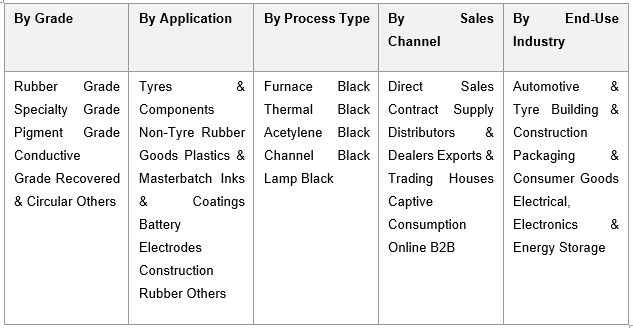
In this report, the India Carbon Black Market has been segmented into the following categories, in addition to detailed analysis of key industry trends, market dynamics, competitive landscape, and growth opportunities across the forecast period:
- By Grade
- Rubber Grade (ASTM N-Series)
- Specialty Grade
- Pigment Grade
- Conductive Grade
- Recovered & Circular Grade
- Others
- By Application
- Tyres & Tyre Components
- Non-Tyre Rubber Goods (Hoses, Belts, Seals)
- Plastics & Masterbatch
- Inks, Coatings & Paints
- Battery Electrodes & Conductive Compounds
- Construction & Industrial Rubber
- Others
- By Process Type
- Furnace Black
- Thermal Black
- Acetylene Black
- Channel Black
- Lamp Black
- By Sales Channel
- Direct Sales (Producer to Tyre Manufacturer)
- Contract Supply Agreements
- Distributors & Dealers
- Exports & Trading Houses
- Captive Consumption
- Online & B2B Platforms
- By End-Use Industry
- Automotive & Tyre
- Building & Construction
- Packaging & Consumer Goods
- Electrical, Electronics & Energy Storage
- By Geography
- North India
- South India
- West India
- East India
- Central India
Competitive Landscape
Company Profiles:
Detailed analysis of the leading companies operating in the India Carbon Black Market, including business overview, product portfolio, strategic initiatives, competitive positioning, and recent developments.
Company Information
Detailed profiling and strategic analysis of additional market players (up to five companies), including emerging specialty grade producers, regional rubber grade manufacturers, importers and trading houses, or niche circular recovery suppliers.
For a free sample of the India Carbon Black Market report, customised insights or delivery timelines, submit your query here
Table of Contents
- Research Framework
- Market Segmentation
- Research Objective
- Research Methodology
- Qualitative Research
- Primary Research
- Secondary Research
- Quantitative Research
- Market Breakdown & Data Triangulation
- Demand Side
- Supply Side
- Primary Research Respondents
- Assumption & Limitation
- Executive Summary
- Market Overview, 2021-2032
- By Grade
- By Application
- By Process Type
- By Sales Channel
- By End-Use Industry
- By Region
- Analyst Recommendations
- Geopolitical Impact on India Carbon Black Market
- India Carbon Black Market Insights
- Market Dynamics
- Growth Drivers
- Rising tyre production, radialisation, and replacement demand driving reinforcing filler consumption across India.
- Export-led growth as Indian producers replace Russian and Chinese supply into European and global markets.
- Capacity expansion by PCBL, Birla Carbon, Himadri, and Epsilon strengthening domestic supply security.
- Restraints
- Volatile feedstock oil prices and crude linkage compressing producer margins across commodity grades.
- Tightening particulate emission norms raising capital and operating compliance costs for producers.
- Import competition and anti-dumping dependence limiting pricing freedom across commodity rubber grades.
- Opportunities
- Specialty and conductive grades for battery, plastics, and coatings applications opening premium value pools.
- Circular and recovered material from end-of-life tyres meeting global sustainability sourcing mandates.
- Waste heat co-generation and green power monetisation improving plant economics across Indian producers.
- Challenges
- Competition from low-cost imports and cyclical global oversupply pressuring domestic price realisation.
- Feedstock availability constraints and continued dependence on imported carbon black feedstock oil.
- Maintaining structure, surface area, and batch consistency across expanding multi-site production.
- Technological Advancements
- Recent Technological Advancements
- Prior to 2020
- Porter’s Five Forces Analysis
- PESTLE Analysis
- Industry Value Chain & Entry Points
- Upstream Feedstock (carbon black feedstock oil, coal tar, ethylene cracker residue, natural gas)
- Refineries & Coal Tar Distillers (CBFO and creosote supply from domestic refiners)
- Carbon Black Producers (PCBL, Birla Carbon, Himadri, Epsilon Carbon, Continental Carbon)
- Imports & Trading Houses (bonded stocking and port-linked supply)
- Quality Control, R&D & Testing Laboratories (ASTM D1765 grade conformity, iodine and OAN testing)
- Pelletising, Bagging & Bulk Handling (bulk tanker, jumbo bag, and silo logistics)
- Tyre Manufacturers (MRF, Apollo Tyres, JK Tyre, CEAT, Balkrishna Industries)
- Non-Tyre Rubber, Plastics & Masterbatch Converters (hoses, belts, films, pipes)
- Inks, Coatings & Battery Electrode Formulators (specialty and conductive grade users)
- End-Users (automotive OEMs, construction, packaging, electrical and energy storage)
- India Carbon Black Market: Regulatory Framework
- India Carbon Black Market Overview
- Market Size & Forecast, 2021-2032
- By Value (USD Million)
- By Volume (Thousand Tonnes)
- Market Share & Forecast
- By Grade
- Rubber Grade (ASTM N-Series)
- Specialty Grade
- Pigment Grade
- Conductive Grade
- Recovered & Circular Grade
- Others
- By Application
- Tyres & Tyre Components
- Non-Tyre Rubber Goods (Hoses, Belts, Seals)
- Plastics & Masterbatch
- Inks, Coatings & Paints
- Battery Electrodes & Conductive Compounds
- Construction & Industrial Rubber
- Others
- By Process Type
- Furnace Black
- Thermal Black
- Acetylene Black
- Channel Black
- Lamp Black
- By Sales Channel
- Direct Sales (Producer to Tyre Manufacturer)
- Contract Supply Agreements
- Distributors & Dealers
- Exports & Trading Houses
- Captive Consumption
- Online & B2B Platforms
- By End-Use Industry
- Automotive & Tyre
- Building & Construction
- Packaging & Consumer Goods
- Electrical, Electronics & Energy Storage
- By Geography
- North India
- South India
- West India
- East India
- Central India
- Competitive Landscape
- India Carbon Black Market Company Market Share Analysis, 2025
- Competitive Benchmarking, By Operating Parameters
- Key Strategic Development (Mergers, Acquisitions, Partnerships, Etc.)
- List of Emerging Players
- Company Profile
- PCBL Limited (Phillips Carbon Black)
- Introduction & Company Profile
- Product Benchmarking
- Strategic Outlook
- Key Competitors
- Financial Analysis
- SWOT Analysis
(Same Data Pointers Will Be Provided for The Below Companies)
- Birla Carbon India Private Limited
- Himadri Speciality Chemical Limited
- Epsilon Carbon Private Limited
- Continental Carbon India Limited
- Ralson Shine Carbon Limited
- Cabot Corporation
- Orion S.A.
- Tokai Carbon Co. Ltd.
- Mitsubishi Chemical Group Corporation
- Denka Company Limited
- Imerys S.A.
- OMSK Carbon Group
- Other Prominent Players
* Financial information in case of non-listed companies will be provided as per availability
** The segmentation and the companies are subjected to modifications based on in-depth secondary for the final deliverable
Frequently Asked Questions
1. How large is the India carbon black market and what is its growth forecast?
Ans: The India carbon black market is valued at USD 1,980 million in 2025 and is projected to reach USD 3,075 million by 2032, growing at a CAGR of 6.5%.
2. Which grades are driving demand in the India carbon black market?
Ans: Rubber grade leads with 78% share, while specialty and conductive grades grow fastest at 14.2% annually, supported by battery electrode and masterbatch demand.
3. What are the key drivers of growth in the India carbon black market?
Ans: Key drivers include rising tyre production and radialisation, export-led substitution of Russian and Chinese supply into Europe, and large-scale domestic capacity expansion.
4. Which regions are driving growth in the India carbon black market?
Ans: West India and South India lead with 61% of consumption, driven by Gujarat, Maharashtra, Tamil Nadu, and Karnataka. North India contributes 21% of national demand.
5. What are the latest trends in the India carbon black market?
Ans: Latest trends include specialty and conductive grade growth, circular recovery from end-of-life tyres, waste heat co-generation, feedstock integration, and port-linked bulk handling.