

India PET Resins Market Size, Share & Forecast 2032
- Chemicals & Advanced Materials, Polymers, Plastics & Packaging
- Jun 2026
- Pages 140
- Report Format: pdf
- Report Price: $2400 USD
India’s PET resins market is witnessing strong structural growth, driven by rising packaged food and beverage consumption, rapid expansion of bottled water and carbonated drink demand, mandatory recycled content norms under the Plastic Waste Management Rules, growing food-grade rPET capacity, expansion of organized retail and e-commerce packaging, and rising interest from domestic and global polymer majors investing in India-specific resin capacity, recycling infrastructure, and specialty grade development.
Report Description
| Study Duration | 2021-2032 |
| Market Size (2025) | USD 2,340 Million |
| CAGR (2026-2032) | 8.4% |
| Leading Segment | Virgin PET (Bottle Grade) |
| Fastest Growing Segment | Recycled PET (rPET) & Specialty Grades |
| Market Size (2032) | USD 4,115 Million |
Source:
Market Overview: India PET Resins Market
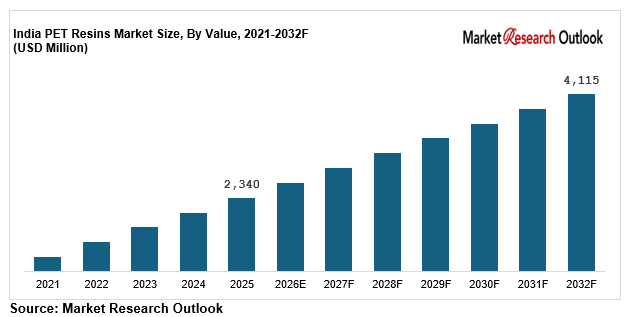
The India PET resins market size is witnessing rapid expansion, driven by accelerating packaged food and beverage consumption, growing bottled water penetration, mandatory recycled content adoption, rising demand from textile and thermoforming applications, and major capacity additions by domestic resin producers. Valued at USD 2,340 million in 2025 and projected to reach USD 4,115 million by 2032, growing at a CAGR of 8.4%, market growth is being fuelled by strong demand from beverage bottlers, packaging converters, and food companies, alongside the rapid scaling of food-grade rPET capacity and EPR-led compliance across brand owners. Virgin PET leads consumption, while the recycled PET and specialty grade segment is emerging as the fastest growing category. Shifting procurement preferences toward recycled content blending, growing food-contact compliance, and rising demand for barrier and lightweight grades are reshaping the supply base. As domestic majors including Reliance Industries, IVL Dhunseri Petrochem, JBF Industries, Ester Industries, and Chiripal Poly Films expand integrated resin capacity, and recyclers including Ganesha Ecosphere, Srichakra Polyplast, and Magpet Polymers scale food-grade rPET output, the India PET resins market is evolving into a regulation-led, investment-driven, and circularity-enabled industry with strong long-term growth potential.
Related research: India Engineering Plastics Market, India Silicones Market and India Polypropylene Market.
Key Report Takeaways: India PET Resins Market
- The India PET resins market size is projected to grow from USD 2,340 million in 2025 to USD 4,115 million by 2032, registering a strong CAGR of 8.4%, driven by accelerated packaging and beverage demand, rising recycled PET adoption, and the structural shift toward compliance-led resin procurement across urban India.
- Virgin PET dominates the domestic market, accounting for over 76% of total volume in 2025, driven by strong consumption in bottles, preforms, and films, the deep presence of producers such as Reliance Industries, IVL Dhunseri, and JBF Industries, and rising demand across beverage, bottled water, and food packaging clusters.
- Recycled PET and specialty grades are emerging as the fastest growing segments in the India PET resins market, expected to grow at 20% to 24% annually as recycled content mandates, food-grade approvals, and sustainability-led brand commitments reshape procurement strategies across packaging and beverage markets.
- Mandatory recycled content norms, requiring 30% recycled material in rigid plastic packaging from FY 2025-26 and rising by 10% every year to 60% by FY 2028-29, are structurally expanding demand across recycled, food-grade, and specialty resin categories.
- Rising investments by domestic majors such as Reliance Industries, IVL Dhunseri, Ester Industries, Ganesha Ecosphere, and Srichakra Polyplast in resin capacity, washing lines, and food-grade rPET plants are strengthening domestic supply and supporting the long-term market forecast through 2032.
Key Market Drivers: India PET Resins Market
Rising Packaged Food, Beverage, and Bottled Water Consumption Driving PET Resin Demand Across India
Growth in the India PET resins market is being driven by rapid expansion of packaged food, beverage, and bottled water consumption across tier-1, tier-2, and tier-3 cities. India consumes around 1.9 million tonnes of PET bottles annually, with bottles and containers accounting for over 90% of resin demand, led by carbonated drinks, bottled water, juices, edible oil, and pharmaceutical packaging. Organized beverage and bottling capacity continues to expand, supported by rising disposable incomes, growing modern retail and e-commerce penetration, and deepening cold-drink distribution across smaller cities. Per-capita PET consumption in India remains around 1.4 kg per year, well below global averages of approximately 5 kg, indicating significant long-term headroom for growth. PET preform and bottle prices have remained competitive against alternative packaging formats, with resin prices ranging between INR 85 and INR 105 per kg across 2024 and 2025. Rising summer beverage demand, expanding pharmaceutical and personal care packaging, and growing thermoformed food tray adoption are creating strong structural pull-through demand across the country.
Recycled Content Mandates Under Plastic Waste Management Rules and EPR Norms Fuelling Rapid rPET Adoption
The India PET resins market is benefiting from one of the most significant regulatory shifts in Indian packaging, with the Plastic Waste Management Rules mandating 30% recycled content in rigid plastic packaging from FY 2025-26, rising by 10% every year to reach 60% by FY 2028-29. Final guidelines notified for food-contact packaging require 40% recycled content from April 2026, with shortfalls allowed to be carried forward for up to three years. India’s PET collection rate of around 95%, among the highest globally, provides a strong feedstock base for this transition. Between 15 and 18 food-grade rPET facilities with combined capacity of close to 300,000 tonnes have been established at an estimated investment of INR 9,000 to 10,000 crore, adopting decontamination technologies aligned with EFSA and US FDA benchmarks. FSSAI food-contact approvals and BIS standards have further strengthened organized recycled supply, supporting compliance across the market. Brand owners in beverages, bottled water, and FMCG now treat recycled content as a board-level procurement priority, structurally expanding rPET demand.
Capacity Expansion by Domestic Resin Producers and Growing Recycling Investments Strengthening Organized Supply Growth
Rising investment in resin capacity, recycling infrastructure, and specialty grade development is a major catalyst for the domestic market, with India’s installed PET production capacity exceeding 3,400 kilotonnes against annual demand of around 1.9 to 2.0 million tonnes, supporting both domestic supply and exports. Reliance Industries leads with over 1,000 kilotonnes of capacity, followed by IVL Dhunseri Petrochem with around 720 kilotonnes across Haldia, Panipat, and Karnal, while Chiripal Poly Films operates a 220 kilotonne plant at Ahmedabad. Recyclers including Ganesha Ecosphere, Srichakra Polyplast, and Magpet Polymers are scaling food-grade rPET pellets and flakes, with the food-grade rPET segment alone representing an estimated 400,000 tonne per annum addressable opportunity by FY26, scaling to 1.0 to 1.2 million tonnes by FY30 under tightening mandates. Government EPR enforcement combined with brand-led sustainability commitments are structurally expanding India PET resins market growth across all major end-user categories through 2032.
Key Market Challenges: India PET Resins Market
Volatility in PTA, MEG, and Crude Oil Linked Feedstock Prices Impacting Production Margins
The market continues to face challenges around feedstock price volatility and margin compression, with purified terephthalic acid and monoethylene glycol together accounting for an estimated 80% to 85% of PET resin production cost. While integrated producers benefit from upstream linkages and scale economics, standalone resin makers remain exposed to crude oil linked swings in PTA and MEG prices, which moved by 15% to 25% across 2022 to 2025. Currency movements add a further layer of cost uncertainty for import-dependent buyers. Producers continue to face pricing pressure from large beverage and packaging buyers, while smaller converters absorb higher spot prices during demand peaks. India’s continued dependence on imported MEG volumes limits margin flexibility for producers across the industry.
Cheap Import Competition and Regional Oversupply Pressuring Domestic Realisations
The India PET resins market faces structural complexity from import competition, regional oversupply, and utilisation pressure across the value chain. Large PET capacity additions across China and Southeast Asia have created periodic global oversupply, with imported resin landing at discounts of 3% to 8% to domestic prices during weak demand phases. Anti-dumping reviews and quality control orders have provided partial protection, but trade flows continue to influence domestic realisations. Domestic operating rates have ranged between 65% and 80% across recent years, reflecting both export opportunities and import pressure. Differential cost positions across producers create margin dispersion for players such as Reliance Industries, IVL Dhunseri, JBF Industries, and Ester Industries operating pan-India. While BIS quality control orders and EPR-led domestic recycled demand are improving the supply outlook, import competition remains a near-term challenge for producers.
Collection, Sorting, and Food-Grade Compliance Gaps Restricting Recycled PET Supply
The market faces practical constraints around post-consumer bottle collection quality, sorting infrastructure, and food-grade compliance costs across the recycling chain. While India’s overall PET collection rate is around 95%, a large share has historically been downcycled into fibre, leaving limited clean feedstock for bottle-to-bottle applications. Food-grade rPET production requires hot-wash, decontamination, and solid-state polymerisation steps that add 15% to 25% to processing cost compared to conventional recycling. Smaller recyclers face additional compliance complexity in meeting FSSAI migration and traceability requirements without losing volume. Food-grade rPET has periodically traded at premiums of 5% to 15% over virgin resin, inverting conventional price logic and straining converter economics. Investments in washing lines, digital traceability, and chemical recycling are emerging as solutions, but feedstock quality and compliance costs remain barriers to faster recycled adoption across the country.
Key Market Trends: India PET Resins Market
Rapid Adoption of Food-Grade rPET, Bottle-to-Bottle Recycling, and Circular Packaging in India
The India PET resins market is undergoing a clear shift toward food-grade rPET, bottle-to-bottle recycling, and circular packaging models, with recycled material expected to account for over 30% of rigid packaging resin consumption by FY27 under tightening mandates. Food-grade rPET requires decontamination performance aligned with EFSA and US FDA benchmarks, compared to conventional fibre-grade recycling, while bottle-to-bottle plants demand consistent clean flake supply. Leading players including Ganesha Ecosphere, Srichakra Polyplast, Magpet Polymers, and Reliance Industries have scaled food-grade rPET capacity through 2024 and 2025. Brand-owner partnerships with recyclers are also gaining traction, particularly among beverage and bottled water companies in Maharashtra, Karnataka, and Tamil Nadu, with large bottlers signing multi-year offtake agreements for recycled pellets and preforms. This product transition is reinforcing the long-term market outlook across both packaging and textile categories.
Growth of EPR Compliance, Digital Traceability, and Long-Term Contracting in the India PET Resins Market
A clear shift toward EPR compliance platforms, digital traceability, and long-term contracting models is reshaping PET resin procurement in India, particularly in the beverage and FMCG segment. Under the centralised EPR portal, producers, importers, and brand owners register recycled content obligations and trade certificates with registered recyclers, creating an auditable compliance trail. Leading brand owners have moved from spot purchases to annual and multi-year resin and rPET contracts, reducing supply risk and price volatility by an estimated 5% to 10%. Digital traceability systems covering bale sourcing, flake quality, and pellet batches are expanding across organized recyclers, improving food-contact assurance for buyers nationwide. By 2025, contracted and compliance-linked volumes account for over 55% of organized recycled resin sales in India, with buyers increasingly preferring assured supply over opportunistic purchasing.
Capacity Expansion by Domestic Producers and Recycling Infrastructure Investments
A wave of domestic capacity expansion and recycling infrastructure investment is reshaping the supply base. Combined India-focused investment announcements in food-grade rPET capacity alone reached an estimated INR 9,000 to 10,000 crore across 15 to 18 facilities, alongside continued debottlenecking by virgin resin producers. Reliance Industries expanded integrated polyester and recycling operations, IVL Dhunseri strengthened capacity across Haldia, Panipat, and Karnal, Ester Industries scaled specialty and recycled offerings, Ganesha Ecosphere commissioned new bottle-to-bottle lines, and Srichakra Polyplast expanded food-grade pellet output. BIS quality control orders, FSSAI food-contact guidelines, and EPR enforcement have structurally favoured organized supply. Combined with beverage expansion driving converter demand and export channels scaling steadily, these developments are reinforcing the India PET resins market forecast 2032 across the entire value chain.
Segmental Insights: India PET Resins Market
By End-User: Packaging & FMCG Converters Segment Dominates the India PET Resins Market
The packaging and FMCG converters end-user segment dominates the domestic market, accounting for an estimated 55% to 60% of total volume, driven by expanding preform and bottle capacity, growing beverage contract manufacturing, and improving resin supply economics. Bottle grade virgin and recycled blends are the dominant input formats within this segment, with direct producer contracts and distributor supply capturing over 70% of converter purchases. The food and beverage brand owners segment contributes another 18% to 20% of demand, driven by captive preform operations and direct resin procurement by large bottlers. The textile and fiber manufacturers segment accounts for 14% to 16%, led by polyester staple fibre and yarn applications absorbing recycled flakes. In 2025, leading players including Reliance Industries, IVL Dhunseri, JBF Industries, Ganesha Ecosphere, and Srichakra Polyplast scaled up converter and brand-focused resin deployment under contract and compliance-led supply expansion, reinforcing segment dominance.
By Type: Virgin PET Leads While Recycled PET and Specialty Grades Grow Fastest
Virgin PET leads the India PET resins market type mix, accounting for approximately 76% of total volume, driven by established bottle and film applications, deep producer distribution presence, and competitive cost economics. Recycled PET contributes another 18% to 20%, primarily across packaging blends and fibre applications. Recycled PET and specialty grades are the fastest growing categories, expanding at 20% to 24% annually, driven by recycled content mandates rising from 30% in FY26 to 60% by FY29, food-grade approvals, and brand sustainability commitments. Bio-based and copolymer variants together account for 4% to 6% of the market, with specialty barrier and hot-fill grades expected to grow rapidly through 2032 in premium beverage markets. Leading producers including Reliance Industries, IVL Dhunseri, Ester Industries, and Chiripal Poly Films have aligned product portfolios to this type mix, driving organized resin adoption across the country.
Regional Insights: India PET Resins Market
Regional analysis of the India PET resins market shows that West India and North India collectively account for approximately 55% to 58% of total resin volume, driven by Gujarat (Ahmedabad and Dahej polymer belt), Maharashtra (Mumbai and Pune packaging cluster), Haryana (Panipat resin hub), and Delhi NCR, supported by dense converter networks and established production capacity. South India contributes around 22% to 25% of demand, led by Tamil Nadu, Karnataka, Telangana, and Andhra Pradesh, supported by beverage bottling, bottled water, and textile demand across Chennai, Bengaluru, and Hyderabad clusters. East and Central India together account for 18% to 20% of demand, supported by West Bengal (Haldia production hub), Odisha, and Madhya Pradesh, where packaging adoption is accelerating. In 2025, capacity and distribution operations by Reliance Industries across Gujarat, IVL Dhunseri across Haldia and Panipat, Chiripal across Ahmedabad, and Ganesha Ecosphere across Uttar Pradesh and Telangana reinforced regional supply hubs, supporting closer execution of packaging and recycling projects across key regions.
Recent Developments: India PET Resins Market
- The India PET resins market witnessed strong momentum in capacity additions and compliance progress during 2024 and 2025. India added an estimated 120,000 tonnes of new food-grade rPET capacity in calendar year 2025, representing a 33% year-on-year increase from around 90,000 tonnes added in 2024, according to industry tracking. The EPR portal recorded rapidly rising recycled content certificate trading by mid-2025, with bottle grade applications accounting for 71% of new recycled volumes. Cumulative organized PET resin demand in India is projected to reach 2.3 to 2.4 million tonnes by FY27 from around 1.95 million tonnes in FY25, growing at an average 9% annually.
- Domestic producers have deepened India-focused capacity expansion. In 2025, Reliance Industries expanded integrated polyester and recycling operations, IVL Dhunseri strengthened resin capacity across Haldia, Panipat, and Karnal, Ester Industries scaled specialty and recycled grades, Ganesha Ecosphere commissioned new bottle-to-bottle recycling lines, and Srichakra Polyplast expanded food-grade rPET pellet output. Magpet Polymers continued to scale recycled capacity in eastern India. These developments are strengthening domestic supply and supporting the long-term market forecast through 2032.
- Regulatory and brand-led recycled content momentum has gained strong traction across India. In 2025, the 30% recycled content mandate for rigid plastic packaging took effect, followed by final guidelines requiring 40% recycled content in food-contact PET packaging from April 2026, with three-year carry-forward provisions for shortfalls. Strategic partnerships between resin producers, recyclers, and beverage brand owners are positioning India as one of the most actively scaling PET recycling markets globally, strengthening long-term competitive positioning through 2032.
Key Market Players: India PET Resins Market
- Reliance Industries Limited
- IVL Dhunseri Petrochem Industries Pvt. Ltd.
- JBF Industries Limited
- Indorama Ventures Public Company Limited
- Ester Industries Limited
- Chiripal Poly Films Limited
- Ganesha Ecosphere Limited
- Srichakra Polyplast (India) Pvt. Ltd.
- Magpet Polymers Pvt. Ltd.
- SABIC
- Nan Ya Plastics Corporation
- Toray Industries, Inc.
- Far Eastern New Century Corporation
Report Scope
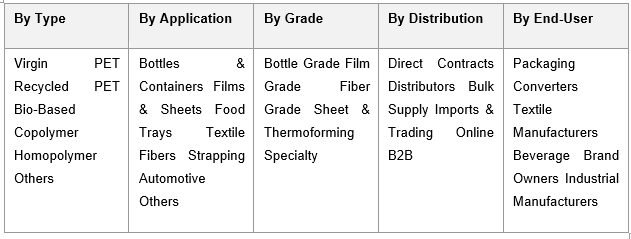
In this report, the India PET Resins Market has been segmented into the following categories, in addition to detailed analysis of key industry trends, market dynamics, competitive landscape, and growth opportunities across the forecast period:
- By Type
- Virgin PET
- Recycled PET (rPET)
- Bio-Based PET
- Copolymer PET
- Homopolymer PET
- Others
- By Application
- Bottles & Containers
- Films & Sheets
- Food Packaging Trays
- Textile Fibers & Yarns
- Strapping & Industrial
- Automotive & Electrical Components
- Others
- By Grade
- Bottle Grade
- Film Grade
- Fiber Grade
- Sheet & Thermoforming Grade
- Specialty Grades
- By Distribution Channel
- Direct Contracts with Converters
- Distributors & Resellers
- Bulk Institutional Supply
- Imports & Trading Channels
- Online B2B Platforms
- Exports
- By End-User
- Packaging & FMCG Converters
- Textile & Fiber Manufacturers
- Food & Beverage Brand Owners
- Automotive & Industrial Manufacturers
- By Geography
- North India
- South India
- West India
- East India
- Central India
Competitive Landscape
Company Profiles:
Detailed analysis of the leading companies operating in the India PET Resins Market, including business overview, product portfolio, strategic initiatives, competitive positioning, and recent developments.
Company Information
Detailed profiling and strategic analysis of additional market players (up to five companies), including emerging domestic recyclers, specialty and barrier grade resin producers, regional polymer traders, or niche state-level converters.
For a free sample of the India PET Resins Market report, customised insights or delivery timelines, submit your query hereresearch@marketresearchoutlook.com
Table of Contents
- Research Framework
- Market Segmentation
- Research Objective
- Research Methodology
- Qualitative Research
- Primary Research
- Secondary Research
- Quantitative Research
- Market Breakdown & Data Triangulation
- Demand Side
- Supply Side
- Primary Research Respondents
- Assumption & Limitation
- Executive Summary
- Market Overview, 2021-2032
- By Type
- By Application
- By Grade
- By Distribution Channel
- By End-User
- By Region
- Analyst Recommendations
- Geopolitical Impact on India PET Resins Market
- India PET Resins Market Insights
- Market Dynamics
- Growth Drivers
- Rising packaged food, beverage, and bottled water consumption driving PET resin demand across India.
- Recycled content mandates under Plastic Waste Management Rules and EPR norms fuelling rapid rPET adoption.
- Capacity expansion by domestic resin producers and growing recycling investments strengthening organized supply growth.
- Restraints
- Volatility in PTA, MEG, and crude oil linked feedstock prices impacting PET resin production margins.
- Cheap import competition and regional oversupply pressuring domestic PET resin realisations and utilisation.
- Collection, sorting, and food-grade compliance gaps restricting recycled PET supply across tier-2 and tier-3 cities.
- Opportunities
- Food-grade rPET, bottle-to-bottle recycling, and chemical recycling opening untapped demand pools across packaging.
- Specialty, barrier, and lightweight PET grades supporting next-generation growth in premium packaging segments.
- EPR-driven recycled content mandates, export demand, and modern retail expansion creating massive supply opportunities.
- Challenges
- Intense competition from imported resin, alternative polymers, and small regional traders.
- Limited food-grade recycling infrastructure and inconsistent collection coverage across smaller Indian cities.
- Maintaining quality consistency, purity, and compliance at scale across diverse Indian regional markets.
- Technological Advancements
- Recent Technological Advancements
- Prior to 2020
- Porter’s Five Forces Analysis
- PESTLE Analysis
- Industry Value Chain & Entry Points
- Upstream Raw Materials (PTA, MEG, catalysts, additives, post-consumer PET bottles)
- PET Resin Producers (Reliance Industries, IVL Dhunseri, JBF Industries, Ester, Chiripal Poly Films)
- Recycling & rPET Suppliers (washing lines, flakes, food-grade pellets, bottle-to-bottle plants)
- Specialty & Compounding Players (barrier grades, hot-fill grades, copolymer resins)
- Quality Control, R&D & Testing Laboratories (FSSAI, BIS, ISO food-contact and material standards)
- Distributors, Wholesalers & Polymer Traders (B2B and institutional distribution networks)
- Converters & Preform Manufacturers (bottles, preforms, films, sheets, strapping)
- Brand Owners & Packaging Service Providers (beverage, bottled water, FMCG, pharmaceutical companies)
- Retail Channels & Compliance Platforms (EPR portals, recyclers, waste management aggregators)
- End-Users (beverage bottlers, food companies, textile producers, industrial manufacturers)
- India PET Resins Market: Regulatory Framework
- India PET Resins Market Overview
- Market Size & Forecast, 2021-2032
- By Value (USD Million)
- By Volume (Thousand Tonnes)
- Market Share & Forecast
- By Type
- Virgin PET
- Recycled PET (rPET)
- Bio-Based PET
- Copolymer PET
- Homopolymer PET
- Others
- By Application
- Bottles & Containers
- Films & Sheets
- Food Packaging Trays
- Textile Fibers & Yarns
- Strapping & Industrial
- Automotive & Electrical Components
- Others
- By Grade
- Bottle Grade
- Film Grade
- Fiber Grade
- Sheet & Thermoforming Grade
- Specialty Grades
- By Distribution Channel
- Direct Contracts with Converters
- Distributors & Resellers
- Bulk Institutional Supply
- Imports & Trading Channels
- Online B2B Platforms
- Exports
- By End-User
- Packaging & FMCG Converters
- Textile & Fiber Manufacturers
- Food & Beverage Brand Owners
- Automotive & Industrial Manufacturers
- By Geography
- North India
- South India
- West India
- East India
- Central India
- Competitive Landscape
- India PET Resins Market Company Market Share Analysis, 2025
- Competitive Benchmarking, By Operating Parameters
- Key Strategic Development (Mergers, Acquisitions, Partnerships, Etc.)
- List of Emerging Players
- Company Profile
- Reliance Industries Limited
- Introduction & Company Profile
- Product Benchmarking
- Strategic Outlook
- Key Competitors
- Financial Analysis
- SWOT Analysis
(Same Data Pointers Will Be Provided for The Below Companies)
- IVL Dhunseri Petrochem Industries Pvt. Ltd.
- JBF Industries Limited
- Indorama Ventures Public Company Limited
- Ester Industries Limited
- Chiripal Poly Films Limited
- Ganesha Ecosphere Limited
- Srichakra Polyplast (India) Pvt. Ltd.
- Magpet Polymers Pvt. Ltd.
- SABIC
- Nan Ya Plastics Corporation
- Toray Industries, Inc.
- Far Eastern New Century Corporation
- Other Prominent Players
* Financial information in case of non-listed companies will be provided as per availability
** The segmentation and the companies are subjected to modifications based on in-depth secondary for the final deliverable
Frequently Asked Questions
1. How large is the India PET resins market and what is its growth forecast?
Ans: The India PET resins market is valued at USD 2,340 million in 2025 and is projected to reach USD 4,115 million by 2032, growing at a CAGR of 8.4%, supported by packaging demand, recycled content mandates, and capacity expansion.
2. Which segments are driving demand in the India PET resins market?
Ans: Virgin PET leads the market with over 76% volume share, while recycled PET and specialty grades are the fastest-growing segments, driven by recycled content mandates, food-grade approvals, and sustainability commitments across packaging and beverage buyers.
3. What are the key drivers of growth in the India PET resins market?
Ans: Key drivers include rising packaged food and beverage consumption, mandatory recycled content under Plastic Waste Management Rules, growing bottled water demand, and increasing investments in resin capacity and food-grade rPET recycling infrastructure.
4. Which regions are driving growth in the India PET resins market?
Ans: West India and North India lead with around 55% to 58% of total volume, driven by Gujarat, Maharashtra, Haryana, and Delhi NCR. South India and Tamil Nadu also show strong beverage-led demand.
5. What are the latest trends in the India PET resins market?
Ans: The latest trends include rapid adoption of food-grade PET, growth in bottle-to-bottle recycling, rising EPR compliance and certificate trading, digital traceability across recyclers, and expanding specialty barrier grades driving organized sales.