

India Fluoroelastomers Market Size, Share & Forecast 2032
- Chemicals & Advanced Materials, Polymers, Plastics & Packaging
- Apr 2026
- Pages 140
- Report Format: pdf
- Report Price: $2400 USD
India’s fluoroelastomers market is witnessing strong growth, driven by the rapid expansion of automotive and electric vehicle (EV) manufacturing, accelerated demand from oil and gas, chemical processing, and semiconductor industries, rising adoption of high-performance sealing solutions aligned with BS-VI and stricter emission norms, expanding aerospace, defense, and pharmaceutical manufacturing under PLI and Atmanirbhar Bharat initiatives, government-led specialty chemicals and electronics manufacturing schemes, and rising interest from global fluoroelastomer majors investing in India-specific manufacturing capacity and technology.
Report Description
| Study Duration | 2021-2032 |
| Market Size (2025) | USD 162 Million |
| CAGR (2026-2032) | 11.5% |
| Leading Segment | FKM (Vinylidene Fluoride-Based) |
| Fastest Growing Segment | FFKM (Perfluoroelastomers) for Semiconductor & EV Applications |
| Market Size (2032) | USD 348 Million |
Market Overview: India Fluoroelastomers Market
The India fluoroelastomers market size is expanding rapidly, driven by strong growth in automotive and EV manufacturing, semiconductor and electronics capacity under PLI schemes, and rising demand from oil and gas, chemical processing, and pharmaceutical industries. Valued at USD 162 million in 2025, the market is projected to reach USD 348 million by 2032, growing at a CAGR of 11.5%.
Related research: India Engineering Plastics Market, India High-Performance Polymers Market and India Silicones Market.
FKM continues to dominate overall consumption, while FFKM is emerging as the fastest-growing segment, particularly in semiconductor and advanced EV applications. Growth is being reinforced by regulatory support including BS-VI norms, EV incentives, and the India Semiconductor Mission, along with compliance requirements such as FDA standards and USP Class VI.
At the same time, global players such as Solvay, Chemours, Daikin, AGC Chemicals, and Shin-Etsu Chemical, alongside domestic companies including GFL Limited, SRF Limited, and Navin Fluorine International, are expanding capacity and strengthening local production.
As a result, the India fluoroelastomers market is shifting toward high-performance, application-driven materials, with increasing focus on sustainability, localisation, and export competitiveness.
Key Report Takeaways: India Fluoroelastomers Market
- The India fluoroelastomers market size is projected to grow from USD 162 million in 2025 to USD 348 million by 2032, registering a CAGR of 11.5%, driven by expanding EV and automotive manufacturing, semiconductor and electronics capacity, and rising industrial demand.
- FKM (vinylidene fluoride-based) fluoroelastomers dominate the market, accounting for over 70% of total demand, supported by widespread use in automotive sealing, fuel systems, and industrial applications.
- FFKM (perfluoroelastomers) are the fastest-growing segment, particularly in semiconductor fabrication, EV batteries, and high-purity pharmaceutical applications, with expected growth of 14% to 17% annually.
- Policy support through initiatives such as FAME II, Production Linked Incentive scheme, and India Semiconductor Mission is accelerating adoption across automotive electrification, electronics, and high-performance industrial sectors.
- Capacity expansion by domestic players such as GFL Limited, SRF Limited, and Navin Fluorine International, alongside global companies including Solvay, Chemours, Daikin, AGC Chemicals, and Shin-Etsu Chemical, is strengthening local manufacturing, innovation, and long-term growth in the India fluoroelastomers market
Key Market Drivers: India Fluoroelastomers Market
Rapid Expansion of Automotive and Electric Vehicle Manufacturing under FAME II and PLI Auto
Growth in the India fluoroelastomers market is being strongly driven by the rapid scale-up of automotive and electric vehicle (EV) manufacturing, supported by policy frameworks such as FAME II and the Production Linked Incentive scheme for auto and advanced chemistry cells.
India’s passenger vehicle production has crossed 4.6 million units annually, while two-wheeler output exceeds 18 million units. EV penetration is expected to reach 30% to 40% of new vehicle sales by 2032, significantly increasing demand for high-performance sealing materials.
Each internal combustion engine (ICE) vehicle typically uses 0.4 to 0.8 kg of FKM fluoroelastomers for seals and gaskets. In comparison, electric vehicles require 0.6 to 1.2 kg of FKM and FFKM components across battery sealing, thermal management systems, and emerging fuel cell applications.
Major OEMs such as Maruti Suzuki, Hyundai Motor India, Tata Motors, Mahindra & Mahindra, Bajaj Auto, TVS Motor Company, Ola Electric, Ather Energy, and Hero MotoCorp have announced cumulative EV investments exceeding USD 8 billion.
This is creating strong, long-term demand for high-grade FKM and FFKM compounds, positioning the India fluoroelastomers market as a critical materials segment within the broader automotive electrification ecosystem.

Structural Shift Toward Stricter Emission, Leakage, and Chemical Resistance Standards under BS-VI and REACH
The India fluoroelastomers market is seeing sustained demand driven by tighter emission, leakage, and chemical resistance standards across automotive, oil and gas, and food and pharmaceutical processing industries. Implementation of BS-VI Stage II norms has increased requirements around fuel permeation, evaporative emissions, and system durability, accelerating the use of high-fluorine FKM fluoroelastomers in fuel systems.
At the same time, global and domestic compliance frameworks such as REACH regulation, FDA 21 CFR 177.2600, USP Class VI, and Food Safety and Standards Authority of India are raising performance benchmarks for sealing materials used in food, beverage, and pharmaceutical applications.
In parallel, exposure to aggressive chemicals in oilfields, refineries, and chemical processing plants is driving demand for premium FFKM and FEPM elastomers, where high chemical resistance and long-term stability are critical.
Leading OEMs and Tier-1 suppliers such as Bosch India, Continental India, Trelleborg Sealing Solutions, and Parker Hannifin are expanding qualification programs and supply agreements, while EPC contractors and oilfield service providers continue to specify high-performance fluoroelastomer compounds for new projects.
This structural shift is reinforcing the transition of the India fluoroelastomers market toward high-specification, application-driven materials, where performance and compliance increasingly outweigh cost considerations.
Accelerated Semiconductor, Electronics, and Pharmaceutical Manufacturing under PLI Schemes
The India fluoroelastomers market is gaining strong momentum from the rapid expansion of semiconductor, electronics, and pharmaceutical manufacturing, supported by policy initiatives such as the India Semiconductor Mission and the Production Linked Incentive scheme for electronics and pharmaceuticals.
Rising investments in semiconductor fabrication and electronics production are increasing demand for high-purity FFKM fluoroelastomers, used in O-rings, gaskets, and chamber seals that must withstand extreme chemical, plasma, and thermal conditions. At the same time, pharmaceutical and medical device manufacturing is driving adoption of FDA-compliant FKM and FFKM materials across sterile processing, fluid handling, and bioprocessing systems.
Major players such as Tata Electronics, Micron Technology, Foxconn, Vedanta Limited, Sun Pharmaceutical Industries, Cipla, and Dr. Reddy’s Laboratories are strengthening long-term sourcing agreements with fluoroelastomer suppliers.
With PLI-driven capacity expansion across electronics and pharmaceuticals, the India fluoroelastomers market is expected to see sustained growth across both high-volume and high-performance application segments through 2032.
Key Market Challenges: India Fluoroelastomers Market
Raw Material Price Volatility Across Fluorochemical Supply Chain
The India fluoroelastomers market remains highly sensitive to fluctuations in key raw materials such as fluorspar, hydrofluoric acid (HF), and VDF/HFP monomers, which account for a significant share of production costs. Global supply disruptions, including Chinese export controls and environmental restrictions, have led to sharp cost movements over the past two years, impacting margins and long-term supply agreements.
India’s dependence on imported fluorochemical intermediates further amplifies this risk. In response, producers are focusing on backward integration, long-term sourcing contracts, and domestic monomer capacity development to improve cost stability and supply security.
Import Dependence for FFKM and High-Purity Grades
A major structural challenge in the India fluoroelastomers market is the continued reliance on imports for FFKM and high-performance FKM compounds, particularly for semiconductor-grade and ultra-high-purity applications. A large share of demand is met through imports from global suppliers, exposing end-users to lead time delays, pricing volatility, and supply disruptions.
Industries such as semiconductors, EV manufacturing, oil and gas, and pharmaceuticals are especially affected due to their dependence on consistent, high-specification materials. While domestic players are expanding capacity, full localisation of FFKM and specialty grades will take time, making supply security a near-term concern.
Environmental Compliance and PFAS Regulatory Pressure
The India fluoroelastomers market is also facing increasing regulatory pressure related to environmental compliance, fluorinated effluent management, and emerging PFAS restrictions. Manufacturing processes involve complex chemical handling and emissions, with stricter norms adding to operational costs.
Global regulatory developments, including REACH regulation and TSCA, are driving changes in product formulation and accelerating the shift toward PFAS-aware and lower-impact alternatives.
At the same time, downstream industries are imposing stricter sustainability and compliance requirements, increasing pressure on suppliers. While these regulations raise barriers, they also favour integrated, technology-driven players with strong R&D and compliance capabilities.
Key Market Trends: India Fluoroelastomers Market
Rapid Indigenisation of FKM and FFKM Production
The India fluoroelastomers market is witnessing a strong shift toward indigenous production of FKM and FFKM, supported by policy initiatives such as the Production Linked Incentive scheme and Atmanirbhar Bharat. Domestic players including GFL Limited, SRF Limited, and Navin Fluorine International are expanding fluoropolymer and fluoroelastomer capacity, reducing import dependence and strengthening local supply.
At the same time, global companies such as Solvay, Chemours, Daikin, and Shin-Etsu Chemical are deepening partnerships, application engineering, and distribution networks in India.
Capacity Expansion Across Domestic and Global Players
The India fluoroelastomers market is seeing significant capacity expansion across both domestic producers and global majors. Investments in fluorochemical intermediates, specialty fluoropolymers, and compounding capabilities are strengthening the supply base.
In parallel, Tier-1 component manufacturers such as Trelleborg Sealing Solutions and Parker Hannifin are scaling local production of compounds and finished sealing components, aligning closely with growth in EV, semiconductor, oil and gas, and pharmaceutical industries.
Rising Demand from EV, Hydrogen, and Semiconductor Applications
High-growth sectors including EV battery systems, hydrogen fuel cells, semiconductor fabrication, and pharmaceutical processing are emerging as key demand drivers in the India fluoroelastomers market.
EV battery and gigafactory expansion by companies such as Reliance Industries, Ola Electric, and Exide Industries is increasing demand for high-performance sealing materials. Hydrogen and energy transition projects led by NTPC Limited and Adani Group are further expanding use cases.
At the same time, semiconductor investments by Tata Electronics, Micron Technology, and Foxconn are driving demand for high-purity FFKM components.
This structural demand shift is expected to significantly strengthen the India fluoroelastomers market outlook, with increasing adoption across both domestic and export-oriented applications.
Segmental Insights: India Fluoroelastomers Market
By Application: O-Rings and Gaskets Dominate, EV and Semiconductor Sealing Accelerate
O-rings and gaskets lead the India fluoroelastomers market, accounting for approximately 32% to 35% of total demand, supported by strong usage across automotive engines, fuel systems, oil and gas equipment, and industrial machinery. Seals and hoses contribute 22% to 25%, while fuel system components account for 12% to 15%.
High-growth segments are emerging in semiconductor wafer processing and EV battery sealing, currently contributing 6% to 9% but expanding rapidly. OEMs and Tier-1 suppliers such as Maruti Suzuki, Tata Motors, Hyundai Motor India, Bosch India, Continental India, Trelleborg Sealing Solutions, and Parker Hannifin are strengthening long-term supply agreements, reinforcing demand across applications.
By Product Type: FKM Leads, FFKM Emerges as High-Growth Segment
FKM fluoroelastomers dominate the product mix, accounting for 70% to 75% of total consumption, driven by widespread use in automotive sealing, industrial equipment, and oil and gas applications.
FFKM represents 12% to 15% of the market and is the fastest-growing segment, particularly in semiconductor and EV applications requiring high purity and extreme chemical resistance. Other materials include FEPM (5% to 7%) and fluorosilicone (FVMQ) (4% to 6%), while bio-based and PFAS-aware alternatives remain at an early stage.
Regional Insights: West and South India Lead Production and Demand
West and South India together account for 60% to 65% of the India fluoroelastomers market, driven by strong industrial clusters in Gujarat, Maharashtra, Tamil Nadu, and Karnataka, supported by automotive, chemical, and electronics manufacturing hubs.
North India contributes 18% to 22% of demand, led by automotive and electronics clusters in Haryana and Uttar Pradesh, while East and Central India account for 15% to 18%, supported by oil and gas, mining, and heavy industrial activity.
Capacity expansion by domestic players such as GFL Limited, SRF Limited, and Navin Fluorine International is strengthening regional supply hubs and improving proximity to key end-use industries.
Recent Developments: India Fluoroelastomers Market
- The India fluoroelastomers market has seen strong momentum in capacity expansion and product innovation during 2024 and 2025. Domestic players such as GFL Limited, SRF Limited, and Navin Fluorine International have expanded fluoroelastomer, fluoropolymer, and fluorochemical intermediate capacity, while global majors including Solvay, Chemours, Daikin, AGC Chemicals, and Shin-Etsu Chemical have strengthened India-focused compounding and application engineering capabilities. Tier-1 players such as Trelleborg Sealing Solutions and Parker Hannifin are also expanding finished component production, reinforcing India’s position as a competitive manufacturing hub.
- Downstream industries including automotive, semiconductors, oil and gas, and pharmaceuticals are increasing local sourcing of fluoroelastomers. Companies such as Maruti Suzuki, Hyundai Motor India, Tata Motors, Mahindra & Mahindra, Bajaj Auto, TVS Motor Company, Ola Electric, Tata Electronics, Micron Technology, Oil and Natural Gas Corporation, Reliance Industries, Sun Pharmaceutical Industries, and Cipla are expanding long-term supply agreements. Policy-driven capacity additions under India Semiconductor Mission and Production Linked Incentive scheme are further strengthening demand.
- Sustainability-led innovation is gaining traction across the India fluoroelastomers market, with companies focusing on PFAS-aware, low-emission, and bio-based fluoroelastomer solutions. Global leaders such as Solvay, Chemours, Daikin, and Shin-Etsu Chemical are expanding sustainable product portfolios. Increasing collaboration between material producers, OEMs, and Tier-1 suppliers is positioning India as an emerging hub for advanced and sustainable fluoroelastomer chemistries, supporting long-term market growth.
Key Market Players: India Fluoroelastomers Market
- GFL Limited (Gujarat Fluorochemicals)
- SRF Limited
- Navin Fluorine International Limited
- Solvay Specialty Polymers India Pvt. Ltd.
- The Chemours Company India Pvt. Ltd.
- 3M India Limited (Dyneon)
- Daikin Industries (India) Pvt. Ltd.
- AGC Chemicals India Pvt. Ltd.
- Shin-Etsu Chemical India Pvt. Ltd.
- HaloPolymer India Operations
- Trelleborg Sealing Solutions India Pvt. Ltd.
- Parker Hannifin India Pvt. Ltd.
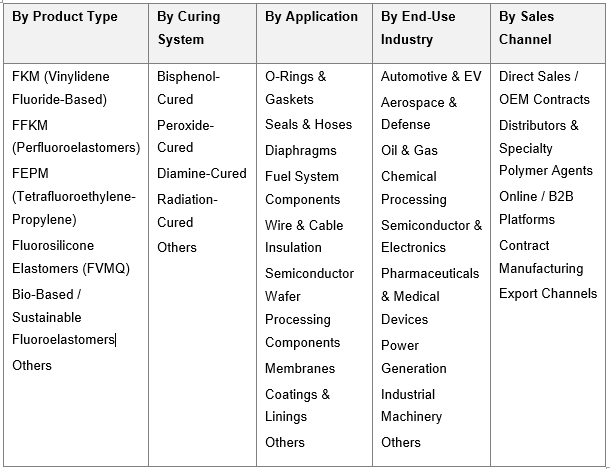
Report Scope
In this report, the India Fluoroelastomers Market has been segmented into the following categories, in addition to detailed analysis of key industry trends, market dynamics, competitive landscape, and growth opportunities across the forecast period:
- By Product Type
- FKM (Vinylidene Fluoride-Based)
- FFKM (Perfluoroelastomers)
- FEPM (Tetrafluoroethylene-Propylene)
- Fluorosilicone Elastomers (FVMQ)
- Bio-Based / Sustainable Fluoroelastomers
- Others
- By Fluorine Content
- Below 66%
- 66% to 68%
- 68% to 70%
- Above 70%
- By Curing System
- Bisphenol-Cured
- Peroxide-Cured
- Diamine-Cured
- Radiation-Cured
- Others
- By Form
- Pre-Compounded Stock
- Gum / Raw Polymer
- Latex / Dispersion
- Master-Batch
- Sheet & Strip
- Others
- By Application
- O-Rings & Gaskets
- Seals & Hoses
- Diaphragms
- Fuel System Components
- Wire & Cable Insulation
- Semiconductor Wafer Processing Components
- Membranes
- Coatings & Linings
- Others
- By End-Use Industry
- Automotive & EV
- Aerospace & Defense
- Oil & Gas
- Chemical Processing
- Semiconductor & Electronics
- Pharmaceuticals & Medical Devices
- Power Generation
- Industrial Machinery
- Others
- By Sales Channel
- Direct Sales / OEM Contracts
- Distributors & Specialty Polymer Agents
- Online / B2B Platforms
- Contract Manufacturing
- Export Channels
- By Geography
- North India
- South India
- West India
- East India
- Central India
Competitive Landscape
Company Profiles:
Detailed analysis of the leading companies operating in the India Fluoroelastomers Market, including business overview, product portfolio, strategic initiatives, competitive positioning, and recent developments.
Company Information
Detailed profiling and strategic analysis of additional market players (up to five companies), including emerging domestic fluoropolymer producers, specialty FFKM specialists, global entrants, or niche segment leaders.
For a free sample of the India Fluoroelastomers Market report, customised insights or delivery timelines, submit your query here
Table of Contents
- Research Framework
- Market Segmentation
- Research Objective
- Research Methodology
- Qualitative Research
- Primary Research
- Secondary Research
- Quantitative Research
- Market Breakdown & Data Triangulation
- Demand Side
- Supply Side
- Primary Research Respondents
- Assumption & Limitation
- Executive Summary
- Market Overview, 2021-2032
- By Product Type
- By Application
- By End-Use Industry
- By Curing System
- By Sales Channel
- By Region
- Analyst Recommendations
- Geopolitical Impact on India Fluoroelastomers Market
- India Fluoroelastomers Market Insights
- Market Dynamics
- Growth Drivers
- Rapid expansion of automotive and electric vehicle manufacturing under FAME II and PLI Auto schemes accelerating demand for high-performance fluoroelastomer seals, gaskets, and fuel system components.
- Structural shift toward stricter emission, leakage, and chemical resistance standards under BS-VI, REACH, and FSSAI mandates driving FKM and FFKM adoption across automotive, oil and gas, and food processing.
- Accelerated semiconductor, electronics, and pharmaceutical manufacturing under PLI Large-Scale Electronics, India Semiconductor Mission, and PLI Pharma schemes structurally expanding fluoroelastomer demand.
- Restraints
- Raw material price volatility linked to fluorspar, hydrofluoric acid, and VDF/HFP monomer pricing tied to global supply disruptions pressuring producer margins.
- Heavy import dependence for FFKM grades, specialty curing agents, and high-purity fluoroelastomer compounds creating supply security and forex risk.
- Environmental compliance, fluorinated effluent management, and tightening PFAS-related regulatory complexity raising operational and compliance costs.
- Opportunities
- Rapid scale-up of indigenous FKM and FFKM capacity aligned with PLI Specialty Chemicals, Atmanirbhar Bharat, and import substitution mandates.
- High-growth demand from EV battery seals, hydrogen fuel cells, semiconductor wafer processing, and pharmaceutical sealing applications supporting premium fluoroelastomer consumption.
- Emerging export opportunity for specialty fluoroelastomer compounds and finished sealing components to Middle East, Southeast Asia, and Africa with growing energy and electronics investments.
- Challenges
- Intense price-led competition between global majors from the US, Europe, Japan, and China and domestic producers compressing margins on commodity FKM grades.
- Shortage of skilled fluoropolymer chemists, compounding engineers, and elastomer formulation specialists limiting capacity scale-up speed of new fluoroelastomer plants.
- Fragmented downstream OEM customer base with diverse sealing, gasket, and chemical resistance specifications increasing inventory and customisation complexity.
- Technological Advancements
- Recent Technological Advancements
- Prior to 2020
- Porter’s Five Forces Analysis
- PESTLE Analysis
- Growth Drivers
- Industry Value Chain & Entry Points
- Upstream Raw Materials (fluorspar, hydrofluoric acid, chloroform, R-22, vinylidene fluoride)
- Monomer Producers (VDF, HFP, TFE, PMVE, perfluoroalkyl vinyl ether monomers)
- Bio-Based / Sustainable Monomer Producers (PFAS-free chemistries, low-GWP fluorinated alternatives)
- Emulsion & Suspension Polymerisation Operations (batch, semi-batch, continuous reactors)
- Compounding, Curing & Quality Laboratories (BIS, ASTM D1418, REACH, FDA, USP Class VI standards)
- Distributors, Specialty Polymer Agents & B2B Marketplaces
- Downstream Compounders & Component Fabricators (O-rings, gaskets, seals, hoses, diaphragms)
- OEMs & Tier-1 Suppliers (auto OEMs, aerospace primes, semiconductor fab tool builders, oilfield majors)
- Aftermarket & Service Channels (replacement seals, fleet maintenance, MRO contracts)
- End-Use Industries (automotive, EV, aerospace, oil & gas, semiconductors, pharma, power, industrial)
- India Fluoroelastomers Market: Regulatory Framework
- India Fluoroelastomers Market Overview
- Market Size & Forecast, 2021-2032
- By Value (USD Million)
- By Volume (Tons)
- Market Share & Forecast
- By Product Type
- FKM (Vinylidene Fluoride-Based)
- FFKM (Perfluoroelastomers)
- FEPM (Tetrafluoroethylene-Propylene)
- Fluorosilicone Elastomers (FVMQ)
- Bio-Based / Sustainable Fluoroelastomers
- Others
- By Fluorine Content
- Below 66%
- 66% to 68%
- 68% to 70%
- Above 70%
- By Curing System
- Bisphenol-Cured
- Peroxide-Cured
- Diamine-Cured
- Radiation-Cured
- Others
- By Form
- Pre-Compounded Stock
- Gum / Raw Polymer
- Latex / Dispersion
- Master-Batch
- Sheet & Strip
- Others
- By Application
- O-Rings & Gaskets
- Seals & Hoses
- Diaphragms
- Fuel System Components
- Wire & Cable Insulation
- Semiconductor Wafer Processing Components
- Membranes
- Coatings & Linings
- Others
- By End-Use Industry
- Automotive & EV
- Aerospace & Defense
- Oil & Gas
- Chemical Processing
- Semiconductor & Electronics
- Pharmaceuticals & Medical Devices
- Power Generation
- Industrial Machinery
- Others
- By Sales Channel
- Direct Sales / OEM Contracts
- Distributors & Specialty Polymer Agents
- Online / B2B Platforms
- Contract Manufacturing
- Export Channels
- By Geography
- North India
- South India
- West India
- East India
- Central India
- Competitive Landscape
- India Fluoroelastomers Market Company Market Share Analysis, 2025
- Competitive Benchmarking, By Operating Parameters
- Key Strategic Development (Mergers, Acquisitions, Partnerships, Etc.)
- List of Emerging Players
- Company Profile
- GFL Limited (Gujarat Fluorochemicals)
- Introduction & Company Profile
- Product Benchmarking
- Strategic Outlook
- Key Competitors
- Financial Analysis
- Swot Analysis
- GFL Limited (Gujarat Fluorochemicals)
- Market Size & Forecast, 2021-2032
- Market Dynamics
(Same Data Pointers Will Be Provided for the Below Companies):
- SRF Limited
- Navin Fluorine International Limited
- Solvay Specialty Polymers India Pvt. Ltd.
- The Chemours Company India Pvt. Ltd.
- 3M India Limited (Dyneon)
- Daikin Industries (India) Pvt. Ltd.
- AGC Chemicals India Pvt. Ltd.
- Shin-Etsu Chemical India Pvt. Ltd.
- HaloPolymer India Operations
- Trelleborg Sealing Solutions India Pvt. Ltd.
- Parker Hannifin India Pvt. Ltd.
- Other Prominent Players
* Financial information in case of non-listed companies will be provided as per availability.
** The segmentation and the companies are subjected to modifications based on in-depth secondary research for the final deliverable.
Frequently Asked Questions
1. How large is the India fluoroelastomers market and what is its growth forecast?
Ans: The India fluoroelastomers market size is valued at USD 162 million in 2025 and is projected to reach USD 348 million by 2032, growing at a CAGR of 11.5%. Growth is driven by expanding EV and automotive manufacturing, semiconductor capacity build-out, and stricter emission and chemical resistance standards. The report provides detailed market sizing, forecasts, and segment-level growth analysis.
2. Which segments are driving demand in the India fluoroelastomers market?
Ans: O-rings and gaskets lead demand with a 32% to 35% share, followed by seals and hoses (22% to 25%) and fuel system components (12% to 15%). By product type, FKM dominates with 70% to 75% share, while FFKM is the fastest-growing segment, especially in semiconductor and EV applications.
3. What are the key drivers of growth in the India fluoroelastomers market?
Ans: Key drivers include expansion of EV manufacturing under FAME II, stricter standards under BS-VI and REACH regulation, and growth in semiconductor and electronics manufacturing under the Production Linked Incentive scheme. Capacity expansion by players such as GFL Limited, SRF Limited, and Navin Fluorine International is also supporting growth.
4. Which regions are driving growth in the India fluoroelastomers market?
Ans: West and South India account for 60% to 65% of demand, led by industrial hubs in Gujarat, Maharashtra, Tamil Nadu, and Karnataka. North India contributes 18% to 22%, while East and Central India account for 15% to 18%, supported by automotive, electronics, oil and gas, and chemical industries.
5. What are the latest trends in the India fluoroelastomers market?
Ans: Key trends include indigenisation of FKM and FFKM production, capacity expansion by global and domestic players, and rising demand from EV batteries, hydrogen systems, semiconductor fabrication, and pharmaceutical applications. Sustainability trends such as PFAS-aware formulations and low-emission materials are also shaping the market.