

India Perfumes & Deodorants Market Size, Share & Trend 2032
- Beauty & Personal Care, Consumer Goods & Retail
- May 2026
- Pages 140
- Report Format: pdf
- Report Price: $2400 USD
India’s perfumes and deodorants market is witnessing robust structural growth, fuelled by rising disposable income, accelerating urbanization, expanding personal grooming culture, the premiumization wave in aspirational fragrance consumption, the rapid expansion of D2C and e-commerce channels, growing demand for natural and Ayurvedic perfume formulations, and rising investments by domestic and global beauty majors in India-specific product development, influencer-led marketing, and quick-commerce distribution platforms.
Report Description
| Study Duration | 2021-2032 |
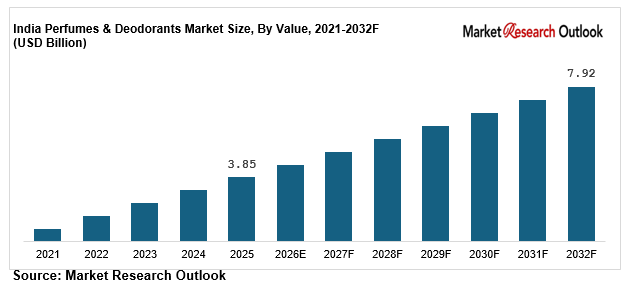
| Market Size (2025) | USD 3.85 Billion |
| CAGR (2026-2032) | 10.8% |
| Leading Segment | Deodorants (Spray/Aerosol Format) |
| Fastest Growing Segment | Premium Perfumes (Eau de Parfum) |
| Market Size (2032) | USD 7.92 Billion |
Source:
Market Overview: India Perfumes & Deodorants Market
The India perfumes & deodorants market size is witnessing rapid expansion, driven by rising disposable income, accelerating urbanization across Tier-I, Tier-II, and Tier-III cities, expanding personal grooming and self-care culture, growing aspirational fragrance consumption among the youth, and the rapid scaling of e-commerce, D2C, and quick-commerce distribution platforms. Valued at USD 3.85 billion in 2025 and projected to reach USD 7.92 billion by 2032, growing at a CAGR of 10.8%, the India perfumes & deodorants market growth is being fuelled by mass-market deodorant adoption, rising premium Eau de Parfum sales, expanding women’s and unisex fragrance segments, and growing institutional demand from salons, spas, hotels, and corporate gifting. Deodorants lead consumption, while the premium perfumes segment, particularly Eau de Parfum, is emerging as the fastest growing category. Strengthening influencer-led marketing, RE-commerce traction, and clean-beauty preferences by Indian consumers, alongside aggressive product launches by leading brands, are reshaping the supply landscape. As domestic majors including Vini Cosmetics (Fogg), Hindustan Unilever (Axe), ITC (Engage), McNROE (Wild Stone), and Adjavis (Stunner) scale mass and premium product portfolios, and global majors including Nivea, Procter & Gamble, and Reckitt Benckiser deepen India-specific innovation, the India perfumes & deodorants market is evolving into a brand-led, premiumizing, and digitally enabled ecosystem with strong long-term growth potential.
Related research: India Beauty and Personal Care Products Market, India Hair Care Market and India Sunscreen Market.
Key Report Takeaways: India Perfumes & Deodorants Market
- The India perfumes & deodorants market size is projected to grow from USD 3.85 billion in 2025 to USD 7.92 billion by 2032, registering a strong CAGR of 10.8%, driven by accelerated urbanization, rising premium fragrance adoption, and the structural shift toward branded grooming products across urban and Tier-II Indian markets.
- Deodorants dominate the India perfumes & deodorants market, accounting for over 60% of total category value in 2025, driven by mass-market price points of INR 150 to 350, rising daily-use grooming behaviour, and strong distribution across supermarkets, pharmacies, kirana stores, and online platforms across urban and semi-urban India.
- Premium perfumes, particularly Eau de Parfum, are emerging as the fastest growing segment in the India perfumes & deodorants market, expected to grow at 14% to 17% annually as aspirational consumers, women, and millennials trade up from mass deodorants to luxury and niche fragrance brands across metro markets.
- Rapid scaling of D2C beauty platforms, quick-commerce channels, and social commerce, with online perfume sales crossing 25% to 28% of premium fragrance demand by mid-2025, is structurally expanding the India perfumes & deodorants market across men’s, women’s, and unisex fragrance categories.
- Rising investments by domestic majors such as Vini Cosmetics, McNROE, Adjavis, ITC, and Bella Vita Organic in new product launches, gifting packs, and natural fragrance formulations are strengthening domestic supply and supporting the India perfumes & deodorants market forecast 2032.
Key Market Drivers: India Perfumes & Deodorants Market
Rising Disposable Income, Urbanization, and Grooming Awareness Driving Mass Deodorant Demand
Growth in the India perfumes & deodorants market is being driven by rising disposable income, accelerating urbanization, and a structural shift in grooming behaviour among urban and semi-urban consumers. India’s per-capita disposable income has grown at over 9% annually between 2020 and 2025, supporting discretionary spend on personal care, fragrances, and grooming categories. Deodorant penetration among urban Indian consumers has crossed 55% in 2025, up from 42% in 2020, while per-capita deodorant consumption remains well below global benchmarks of USD 8 to 12, indicating significant headroom for category expansion. Daily-use grooming behaviour among the 18 to 35 age cohort, supported by workplace return, college re-opening, and rising social interaction post-pandemic, is structurally pulling demand into the India perfumes & deodorants market. Mass-priced deodorants between INR 150 and 350, available across modern trade, pharmacies, general trade, and online platforms, continue to drive high-volume penetration across the country.
Premiumization and Aspirational Fine Fragrance Consumption Boosting Eau de Parfum Sales
The India perfumes & deodorants market is benefiting from a strong premiumization wave, with consumers, especially women and millennials, trading up from mass deodorants to premium Eau de Toilette and Eau de Parfum brands. Premium fragrance sales in India grew by over 22% in 2025 according to leading industry trackers, driven by rising aspirational consumption, social media influence, and growing exposure to international fragrance categories. Average ticket sizes for premium perfumes in India range from INR 1,500 to INR 6,500, while luxury fragrances from brands such as Dior, Chanel, Tom Ford, Versace, and Calvin Klein are seeing growing adoption in metro cities and Tier-I markets. Domestic premium and prestige players such as Ajmal Perfumes, Skinn by Titan, Bella Vita Organic, and Beardo are scaling Eau de Parfum portfolios, while international houses are increasing India-focused product launches and travel-retail expansion. Premium gifting occasions, including weddings, Diwali, Raksha Bandhan, and corporate gifting cycles, account for nearly 30% of premium perfume sales, supporting structural growth across the India perfumes & deodorants market.
E-commerce Expansion, D2C Brands, and Influencer-Led Marketing Accelerating Category Growth
Rapid growth in online and D2C distribution is a major catalyst for the India perfumes & deodorants market, with the e-commerce channel projected to grow at 18% to 22% annually through 2032. Online perfume and deodorant sales now account for an estimated 22% to 25% of total category value, led by platforms such as Amazon, Flipkart, Nykaa, Myntra, Tira, and direct brand websites. Quick-commerce platforms including Blinkit, Zepto, Swiggy Instamart, and BigBasket Now have emerged as new growth engines, contributing 6% to 8% of urban deodorant sales by mid-2025. Influencer-led marketing, particularly on Instagram, YouTube, and short-form video platforms, is reshaping consumer discovery, with over 70% of urban millennials citing social media as their primary fragrance discovery channel. Leading D2C and digital-first brands such as Bella Vita Organic, Plum, Beardo, Bombay Shaving Company, and Skinn by Titan have scaled aggressive influencer, content, and performance marketing pipelines, supporting structural expansion of the India perfumes & deodorants market across all major end-user categories through 2032.
Key Market Challenges: India Perfumes & Deodorants Market
High GST Taxation and Counterfeit Fragrance Product Proliferation
The India perfumes & deodorants market continues to face challenges around high GST taxation and a large counterfeit fragrance market. Deodorants and most perfumes attract GST of 18% to 28%, placing the category among the highest-taxed personal care segments, which inflates retail prices and limits affordability among lower-income consumers. The counterfeit and grey-market fragrance economy, estimated at 15% to 20% of total category value in major metros, undermines brand-building investments by leading players such as Vini Cosmetics, McNROE, Hindustan Unilever, and ITC. Look-alike packaging, imitation Wild Stone, Fogg, Axe, and Engage variants, and unauthorised online listings continue to challenge category economics. Strengthening enforcement under the Bureau of Indian Standards (BIS), CDSCO oversight, and tighter e-commerce listing policies are gradually easing these pressures, but counterfeit penetration remains a structural concern across the India perfumes & deodorants market.
Raw Material Price Volatility for Essential Oils, Aroma Chemicals, and Propellants
The India perfumes & deodorants market faces structural complexity from raw material price volatility, particularly for essential oils, aroma chemicals, alcohol, and aerosol propellants such as butane, propane, and isobutane. Global aroma chemical prices have fluctuated by 12% to 25% between 2022 and 2025, while specialty natural oils such as oud, sandalwood, rose, and jasmine have seen sustained inflation due to limited harvest cycles and rising global luxury demand. India imports over 60% of its high-end fragrance compounds and aroma chemicals, exposing manufacturers to currency volatility and global supply chain risks. Glass bottle, aluminium aerosol can, and pump dispenser costs have also risen by 8% to 14% over 2023 to 2025, compressing gross margins for mass-market deodorant manufacturers. While leading domestic fragrance houses such as S H Kelkar and global majors such as Givaudan, Firmenich, IFF, and Symrise are localising compounding and supply, raw material volatility remains a near-term challenge for the India perfumes & deodorants market.
Skin Sensitivity Concerns and Tightening Regulations on Alcohol and Propellant Content
The India perfumes & deodorants market faces practical constraints around growing consumer concern over skin sensitivity, allergic reactions, and tightening regulations on alcohol, parabens, and propellant content. Surveys by leading dermatology associations indicate that over 18% of urban Indian consumers report mild to moderate skin reactions to aerosol deodorants and alcohol-based perfumes, driving demand for alcohol-free, paraben-free, and natural formulations. Regulatory bodies including CDSCO, BIS, and the Ministry of Health are tightening labelling, ingredient disclosure, and aerosol propellant norms in line with IFRA and global cosmetic standards. The Drugs and Cosmetics Act, fragrance allergen disclosure rules, and pending sustainability mandates on aerosol cans add compliance complexity for both domestic and global brands. Natural attar, Ayurvedic perfumes, and alcohol-free fragrance formulations from players such as Patanjali, Forest Essentials, Bella Vita Organic, and Ajmal Perfumes are emerging as solutions, but premium pricing and limited consumer awareness remain barriers to mass adoption across the India perfumes & deodorants market.
Key Market Trends: India Perfumes & Deodorants Market
Rapid Adoption of Premium Eau de Parfum, Niche, and Long-Lasting Fragrances in India
The India perfumes & deodorants market is undergoing a clear product mix shift toward premium Eau de Parfum, niche, and long-lasting fragrances, with these higher-concentration categories expected to capture over 35% of total perfume category value by 2027. Eau de Parfum, with fragrance oil concentration of 15% to 20% and longevity of 6 to 8 hours, is increasingly preferred over lower-concentration Eau de Toilette and body sprays by aspirational urban consumers. Niche fragrance houses, oud-based attar brands, and Indian-origin premium players such as Ajmal Perfumes, Skinn, Bella Vita Luxe, and All Good Scents are scaling premium and prestige portfolios. Long-lasting deodorant variants, including 48-hour and 72-hour formats from Fogg, Wild Stone, Engage, Axe, and Nivea, are also gaining strong consumer traction. This product premiumization shift is reinforcing the India perfumes & deodorants market forecast 2032 across both mass and premium categories.
Growth of Natural, Vegan, Alcohol-Free, and Ayurvedic Fragrance Formulations
A clear shift toward natural, vegan, alcohol-free, and Ayurvedic formulations is reshaping the India perfumes & deodorants market, particularly across the women’s and premium segments. Clean-beauty positioned fragrance launches grew by over 30% in 2024 and 2025, with leading players including Bella Vita Organic, Plum, Forest Essentials, Khadi Natural, Patanjali, and Just Herbs scaling Ayurvedic and botanical attar portfolios. Vegan and cruelty-free certifications from PETA, Leaping Bunny, and IFRA-compliant clean fragrance labels are increasingly central to D2C brand positioning, especially among Gen-Z and millennial women consumers. Alcohol-free perfumes, oil-based attars, and roll-on formats are seeing structural demand in Tier-II and Tier-III cities, driven by religious sensitivity, skin-friendliness, and gifting use cases. This natural and clean fragrance momentum is supporting category premiumization and is reinforcing structural growth across the India perfumes & deodorants market.
Capacity Expansion, Quick-Commerce Distribution, and Digital-First Brand Launches
A wave of capacity expansion, quick-commerce distribution, and digital-first brand launches is reshaping the India perfumes & deodorants market supply landscape. Combined India-focused capital expenditure announcements by leading fragrance and personal care players exceeded INR 2,500 crore across 2023 to 2025. Vini Cosmetics scaled Fogg manufacturing capacity, McNROE expanded Wild Stone and Secret Temptation production, ITC scaled Engage portfolio capacity, and Bella Vita Organic added new fragrance lines. Quick-commerce platforms such as Blinkit, Zepto, Swiggy Instamart, and Bigbasket Now have emerged as a high-growth distribution channel for impulse and gifting deodorant and perfume purchases, with quick-commerce contribution rising to 6% to 8% of urban deodorant sales by mid-2025. Digital-first brands including Beardo, Skinn, Plum, Bombay Shaving Company, and Wow Skin Science are scaling Eau de Parfum, body mist, and gifting set portfolios on D2C, Nykaa, and Amazon Beauty platforms. Combined with rising aspirational consumption and premiumization across urban India, these developments are reinforcing the India perfumes & deodorants market forecast 2032 across the entire value chain.
Segmental Insights: India Perfumes & Deodorants Market
By Product Type: Deodorants Segment Dominates the India Perfumes & Deodorants Market
The deodorants segment dominates the India perfumes & deodorants market, accounting for an estimated 60% to 64% of total category value, driven by mass-market price points, daily-use grooming behaviour, and strong distribution across modern trade, general trade, pharmacies, and e-commerce. Spray and aerosol deodorants lead within this segment, capturing over 70% of deodorant volumes, supported by brands such as Fogg, Axe, Wild Stone, Engage, Nivea, and Old Spice. The perfumes segment contributes another 26% to 30% of demand, driven by rising aspirational Eau de Parfum and Eau de Toilette consumption among urban millennials and women consumers. Attar and ittar account for 4% to 6% of category value, supported by religious and gifting demand. Body mists make up 3% to 5%, driven by Gen-Z and women’s fragrance occasions. In 2025, leading brands including Vini Cosmetics, McNROE, Hindustan Unilever, ITC, Ajmal Perfumes, and Bella Vita Organic scaled product launches and gifting variants, reinforcing segment dominance in the India perfumes & deodorants market.
By Price Range and Gender: Mass Leads While Premium and Women’s Categories Grow Fastest
Mass-priced perfumes and deodorants lead the India perfumes & deodorants market price-tier landscape, accounting for approximately 65% to 68% of total category value, driven by daily-use deodorant consumption and affordable Eau de Toilette options under INR 800. Premium fragrances priced between INR 1,500 and INR 6,500 contribute another 22% to 25%, primarily in metro and Tier-I urban markets. Luxury perfumes, typically priced above INR 6,500, account for 7% to 10% of the category, led by imported brands and prestige beauty retail. By gender, men’s fragrances continue to lead category volumes with 50% to 53% share, supported by strong deodorant penetration, but women’s perfumes and body mists are the fastest growing sub-segment, expanding at 14% to 18% annually, supported by Bella Vita, Plum, Skinn, Engage, Wild Stone Secret Temptation, and global premium brands. Unisex fragrances are also gaining traction, particularly in D2C and niche perfume categories, reflecting evolving consumer preferences across the India perfumes & deodorants market.
Regional Insights: India Perfumes & Deodorants Market
Regional analysis of the India perfumes & deodorants market shows that West India and North India collectively account for approximately 55% to 60% of total category value, driven by Maharashtra (Mumbai, Pune metro consumption belt), Gujarat (premium fragrance and attar consumption), Delhi NCR, Uttar Pradesh, Punjab, and Rajasthan, supported by strong urban grooming penetration, gifting culture, and proximity to fragrance manufacturing clusters. South India contributes around 22% to 25% of demand, led by Karnataka (Bengaluru), Tamil Nadu (Chennai, Coimbatore), Telangana (Hyderabad), and Kerala, supported by Tier-I urban grooming adoption and a strong premium fragrance consumer base in IT clusters. East and Central India together account for 15% to 18% of demand, supported by West Bengal (Kolkata), Odisha, Madhya Pradesh, and Chhattisgarh, where mass deodorant and attar consumption is accelerating across Tier-II cities. In 2025, capacity additions and brand activity by Vini Cosmetics across West India, McNROE in East India, ITC across pan-India retail, Hindustan Unilever in modern trade, and Ajmal Perfumes in North India reinforced regional supply hubs, supporting closer execution of mass, premium, and gifting product strategies across the India perfumes & deodorants market.
Recent Developments: India Perfumes & Deodorants Market
- The India perfumes & deodorants market witnessed strong momentum in product launches and channel expansion during 2024 and 2025. The category grew by an estimated 13% to 15% in value terms in 2025, supported by aggressive new product launches, gifting season activations, and quick-commerce expansion. Online and D2C sales crossed 22% to 25% of total category value, with premium Eau de Parfum sales growing by over 22% year-on-year, according to leading industry trackers. Cumulative branded category penetration is projected to expand from 55% in 2025 to 70% to 75% by FY32, growing at an average 12% to 14% annually.
- Domestic perfumes and deodorants players have deepened India-focused capacity expansion and brand portfolio building. In 2025, Vini Cosmetics scaled Fogg manufacturing and launched new premium variants, McNROE expanded the Wild Stone and Secret Temptation product range, ITC strengthened the Engage portfolio with new Eau de Parfum launches, Adjavis Venture scaled Stunner deodorant production, and Bella Vita Organic added new clean-beauty Eau de Parfum lines. Patanjali and Forest Essentials expanded Ayurvedic and natural fragrance portfolios. These developments are strengthening domestic supply and supporting the India perfumes & deodorants market forecast 2032.
- Premium and D2C fragrance momentum has gained strong traction in the India perfumes & deodorants market. In 2025, leading premium and digital-first players including Skinn by Titan, Beardo (Marico), Bombay Shaving Company, Plum, Ajmal Perfumes, and Wow Skin Science scaled premium Eau de Parfum, body mist, and gifting set portfolios. Strategic partnerships between domestic fragrance brands, global beauty retailers such as Nykaa, Tira, and Sephora India, and quick-commerce platforms are positioning India as one of the most actively scaling premium fragrance markets globally, strengthening long-term competitive positioning in the India perfumes & deodorants market forecast 2032.
Key Market Players: India Perfumes & Deodorants Market
- Hindustan Unilever Limited (Axe, Rexona)
- ITC Limited (Engage, Wills)
- Vini Cosmetics Pvt. Ltd. (Fogg)
- McNROE Consumer Products Pvt. Ltd. (Wild Stone, Secret Temptation)
- Adjavis Venture Limited (Stunner)
- Nivea India Pvt. Ltd. (Beiersdorf India)
- Procter & Gamble Hygiene and Health Care Limited (Old Spice)
- Reckitt Benckiser (India) Pvt. Ltd.
- Patanjali Ayurved Limited
- Titan Company Limited (Skinn)
- Ajmal Perfumes India
- Bella Vita Organic
- Beardo (Marico Limited)
- Bombay Shaving Company
Report Scope
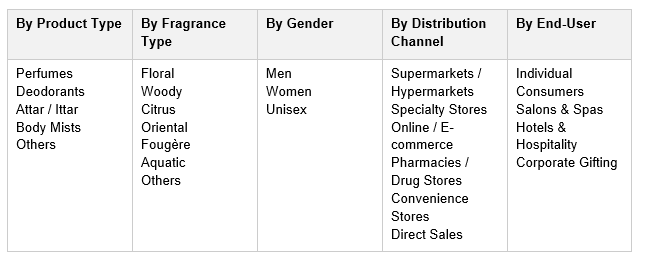
In this report, the India Perfumes & Deodorants Market has been segmented into the following categories, in addition to detailed analysis of key industry trends, market dynamics, competitive landscape, and growth opportunities across the forecast period:
- By Product Type
- Perfumes (Eau de Parfum, Eau de Toilette, Eau de Cologne)
- Deodorants (Roll-on, Spray/Aerosol, Stick)
- Attar / Ittar
- Body Mists
- Others
- By Fragrance Type
- Floral
- Woody
- Citrus
- Oriental
- Fougère
- Aquatic
- Others
- By Gender
- Men
- Women
- Unisex
- By Price Range
- Mass
- Premium
- Luxury
- By Packaging
- Glass Bottle
- Plastic Bottle
- Metal Can / Aerosol
- Others
- By Distribution Channel
- Supermarkets / Hypermarkets
- Specialty Stores
- Online / E-commerce
- Pharmacies / Drug Stores
- Convenience Stores
- Direct Sales / MLM
- By End-User
- Individual Consumers
- Salons & Spas
- Hotels & Hospitality
- Corporate Gifting
- By Geography
- North India
- South India
- West India
- East India
- Central India
Competitive Landscape
Company Profiles:
Detailed analysis of the leading companies operating in the India Perfumes & Deodorants Market, including business overview, product portfolio, strategic initiatives, competitive positioning, and recent developments.
Company Information
Detailed profiling and strategic analysis of additional market players (up to five companies), including emerging domestic D2C fragrance brands, specialty attar and Ayurvedic perfume producers, niche premium Eau de Parfum houses, or regional deodorant brands.
For a free sample of the India Perfumes & Deodorants Market report, customised insights or delivery timelines, submit your query here
Table of Contents
- Research Framework
- Market Segmentation
- Research Objective
- Research Methodology
- Qualitative Research
- Primary Research
- Secondary Research
- Quantitative Research
- Market Breakdown & Data Triangulation
- Demand Side
- Supply Side
- Primary Research Respondents
- Assumption & Limitation
- Executive Summary
- Market Overview, 2021-2032
- By Product Type
- By Fragrance Type
- By Gender
- By Price Range
- By Distribution Channel
- By End-User
- By Region
- Analyst Recommendations
- Geopolitical Impact on India Perfumes & Deodorants Market
- India Perfumes & Deodorants Market Insights
- Market Dynamics
- Growth Drivers
- Rising disposable income, urbanization, and grooming awareness driving mass-market deodorant demand.
- Premiumization trend and aspirational fine fragrance consumption boosting Eau de Parfum sales.
- E-commerce expansion, D2C brands, and influencer-led marketing accelerating category growth.
- Restraints
- High GST taxation of 18% to 28% and proliferation of counterfeit fragrance products.
- Raw material price volatility for essential oils, aroma chemicals, and aerosol propellants.
- Skin sensitivity concerns and tightening regulations on alcohol and propellant content.
- Opportunities
- Tier-II and Tier-III city expansion creating a massive untapped fragrance consumption base.
- Natural, vegan, alcohol-free, and Ayurvedic fragrance formulations opening new value pools.
- Quick-commerce and social commerce channels supporting next-generation fragrance retail growth.
- Challenges
- Strong unorganized attar and local deodorant market limiting branded category penetration.
- Limited consumer literacy on perfume notes, concentration grades, and fragrance families.
- Cold-chain and warehousing constraints for premium fragrances across Tier-II and rural India.
- Technological Advancements
- Recent Technological Advancements
- Prior to 2020
- Porter’s Five Forces Analysis
- PESTLE Analysis
- Industry Value Chain & Entry Points
- Upstream Raw Materials (essential oils, aroma chemicals, alcohol, propellants, glass)
- Fragrance Houses & Compounders (Givaudan, Firmenich, IFF, Symrise, S H Kelkar)
- Aerosol Can, Glass Bottle & Pump Suppliers (Hindustan National Glass, Piramal Glass)
- Contract Manufacturers & Private Label Producers
- Quality Control, R&D & Testing Laboratories (BIS, IFRA, FDA, CDSCO standards)
- Distributors, Wholesalers & Online Aggregators
- Brand Owners & Marketing Companies (HUL, ITC, Vini Cosmetics, McNROE, Nivea, P&G)
- Retailers, Specialty Stores, Salons, Quick-commerce & D2C Platforms
- End-Users (individual consumers, salons & spas, hotels, corporate gifting)
- India Perfumes & Deodorants Market: Regulatory Framework
- India Perfumes & Deodorants Market Overview
- Market Size & Forecast, 2021-2032
- By Value (USD Million)
- By Volume (Million Units)
- Market Share & Forecast
- By Product Type
- Perfumes (Eau de Parfum, Eau de Toilette, Eau de Cologne)
- Deodorants (Roll-on, Spray/Aerosol, Stick)
- Attar/Ittar
- Body Mists
- Others
- By Fragrance Type
- Floral
- Woody
- Citrus
- Oriental
- Fougère
- Aquatic
- Others
- By Gender
- Men
- Women
- Unisex
- By Price Range
- Mass
- Premium
- Luxury
- By Packaging
- Glass Bottle
- Plastic Bottle
- Metal Can / Aerosol
- Others
- By Distribution Channel
- Supermarkets / Hypermarkets
- Specialty Stores
- Online / E-commerce
- Pharmacies / Drug Stores
- Convenience Stores
- Direct Sales / MLM
- By End-User
- Individual Consumers
- Salons & Spas
- Hotels & Hospitality
- Corporate Gifting
- By Geography
- North India
- South India
- West India
- East India
- Central India
- Competitive Landscape
- India Perfumes & Deodorants Market Company Market Share Analysis, 2025
- Competitive Benchmarking, By Operating Parameters
- Key Strategic Development (Mergers, Acquisitions, Partnerships, Etc.)
- List of Emerging Players
- Company Profile
- Hindustan Unilever Limited (Axe, Rexona)
- Introduction & Company Profile
- Product Benchmarking
- Strategic Outlook
- Key Competitors
- Financial Analysis
- SWOT Analysis
- (Same Data Pointers Will Be Provided for The Below Companies)
- ITC Limited (Engage, Wills)
- Vini Cosmetics Pvt. Ltd. (Fogg)
- McNROE Consumer Products Pvt. Ltd. (Wild Stone, Secret Temptation)
- Adjavis Venture Limited (Stunner)
- Nivea India Pvt. Ltd. (Beiersdorf India)
- Procter & Gamble Hygiene and Health Care Limited (Old Spice)
- Reckitt Benckiser (India) Pvt. Ltd.
- Patanjali Ayurved Limited
- Titan Company Limited (Skinn)
- Ajmal Perfumes India
- Bella Vita Organic
- Beardo (Marico Limited)
- Bombay Shaving Company
- Other Prominent Players
- Hindustan Unilever Limited (Axe, Rexona)
- By Product Type
- Market Size & Forecast, 2021-2032
* Financial information in case of non-listed companies will be provided as per availability
** The segmentation and the companies are subjected to modifications based on in-depth secondary for the final deliverable
Frequently Asked Questions
1. How large is the India perfumes & deodorants market and what is its growth forecast?
Ans: The India perfumes & deodorants market is valued at USD 3.85 billion in 2025 and is projected to reach USD 7.92 billion by 2032, growing at a CAGR of 10.8%, supported by rising urbanization, premiumization, and strong digital retail expansion.
2. Which segments are driving demand in the India perfumes & deodorants market?
Ans: Deodorants dominate the India perfumes & deodorants market with over 60% value share, while premium Eau de Parfum and women's fragrances are the fastest growing segments, supported by aspirational urban consumption and D2C brand expansion.
3. What are the key drivers of growth in the India perfumes & deodorants market?
Ans: Key drivers include rising disposable income, urbanization, daily-use grooming culture, premiumization toward Eau de Parfum, expansion of e-commerce and D2C platforms, and aggressive influencer marketing across India's perfumes & deodorants market.
4. Which regions are driving growth in the India perfumes & deodorants market?
Ans: Maharashtra, Gujarat, Delhi NCR, Uttar Pradesh, Karnataka, and Tamil Nadu lead the India perfumes & deodorants market, supported by strong urban consumption, premium fragrance demand, and growing penetration across Tier-I and Tier-II cities.
5. What are the latest trends in the India perfumes & deodorants market?
Ans: Latest trends include rapid premium Eau de Parfum adoption, natural and Ayurvedic fragrance growth, alcohol-free formulations, quick-commerce expansion, D2C brand surge, and rising influencer-led perfume discovery across the India perfumes & deodorants market.