

India Premium Skincare Market Size, Share & Forecast 2032
- Beauty & Personal Care, Consumer Goods & Retail
- Apr 2026
- Pages 130
- Report Format: pdf
- Report Price: $2400 USD
India’s premium skincare market is witnessing strong growth, driven by rapid D2C brand expansion, rising premiumization in beauty spending, growing consumer preference for ingredient-led and dermatologist-backed products, increasing digital influence on purchase decisions, and rising FMCG as well as strategic investor interest in high-growth skincare brands.
Report Description
| Study Duration | 2021-2032 |
| Market Size (2025) | USD 4.09 Billion |
| CAGR (2026-2032) | 36% |
| Leading Segment | Facial Care |
| Fastest Growing Segment | Quick Commerce Channel |
| Market Size (2032) | USD 35.92 Billion |
Source:
Market Overview- India Premium Skincare Market
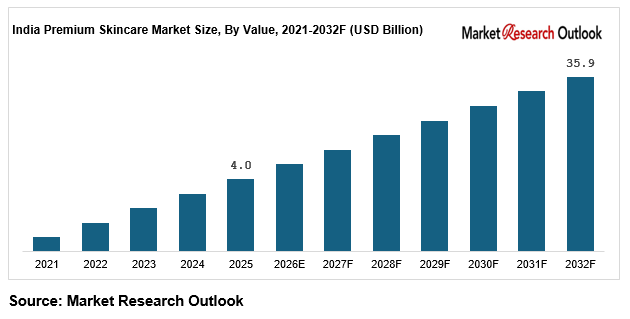
The India premium skincare market size is witnessing rapid expansion, driven by rising skin health awareness, increasing premiumization in beauty consumption, and the accelerated growth of digital-first D2C skincare brands. Valued at USD 4.09 billion in 2025 and projected to reach USD 35.92 billion by 2032, growing at a CAGR of 36 percent, the India premium skincare market growth is being fuelled by strong demand for ingredient-led, dermatologist-backed, and results-driven skincare products. Consumers, particularly Gen Z and millennials, are increasingly adopting multi-step skincare routines, with high-demand categories such as serums, moisturisers, and sunscreens leading overall consumption. The expansion of online marketplaces, brand-owned D2C platforms, and quick commerce channels is further strengthening product accessibility and driving impulse purchases across urban markets. Tier I and Tier II cities continue to dominate demand, supported by rising disposable income and increasing digital influence on purchase decisions. As competition intensifies among global skincare brands, FMCG players, and emerging D2C companies, the India premium skincare market is evolving into a highly competitive, innovation-led segment with strong long-term growth potential and expanding opportunities across premium beauty categories.
Related research: India Beauty and Personal Care Products Market, India Hair Care Market and India Sunscreen Market.
Key Report Takeaways – India Premium Skincare Market
- The India premium skincare market size is projected to grow from USD 4.09 billion in 2025 to USD 35.92 billion by 2032, registering a strong CAGR of 36 percent, driven by premiumization and rising skincare awareness.
- Rapid expansion of digital-first D2C skincare brands is reshaping the competitive landscape, enabling faster product innovation, direct consumer engagement, and accelerated market penetration.
- Increasing demand for ingredient-led, dermatologist-backed, and clinically tested skincare products is driving higher consumer trust and premium product adoption across urban markets.
- Quick commerce and online channels are emerging as key growth drivers, significantly improving product accessibility and influencing a large share of skincare purchase decisions.
- Rising disposable income and aspiration-driven consumption across Tier I and Tier II cities are accelerating the shift from mass to premium skincare, creating strong long-term growth opportunities.
Key Market Drivers – India Premium Skincare Market
Rising Skin-Consciousness and Premiumization in Beauty Consumption
Growth in the India premium skincare market is being driven by rising skin-consciousness among consumers, particularly Gen Z and millennials, who are increasingly adopting structured multi-step skincare routines involving 3 to 5 products on average. Demand for ingredient-led formulations such as serums, moisturisers, and sunscreens is expanding rapidly, supported by growing awareness of actives like niacinamide, retinol, and vitamin C. At the same time, premium skincare products, typically priced 2 to 3 times higher than mass-market alternatives, continue to witness strong adoption due to perceived efficacy and long-term skin health benefits. This shift reflects broader premiumization in beauty consumption, particularly across urban India, where higher disposable income and digital exposure are accelerating the transition toward dermatologist-backed, results-driven skincare solutions.
Rapid Expansion of D2C Brands and Digital-First Go-to-Market Strategies
The rapid expansion of digital-first D2C skincare brands is a key growth catalyst in the India premium skincare market, with online platforms influencing over 70 percent of skincare purchase decisions. These brands are leveraging social media, influencer-led marketing, and direct consumer engagement to accelerate product discovery and adoption cycles. Compared to traditional FMCG players, D2C brands operate with shorter innovation timelines, enabling faster response to evolving consumer preferences. In parallel, the rise of e-commerce marketplaces and quick commerce platforms, growing at 25 to 30 percent annually, is significantly improving accessibility, with delivery timelines as short as 10 to 30 minutes in metro cities. This digital-first distribution model is reshaping go-to-market strategies and driving sustained growth across the India premium skincare market.
Rising Disposable Income and Aspirational Consumption in Tier I and Tier II Cities
Rising disposable income and aspiration-driven consumption are significantly supporting expansion in the India premium skincare market, particularly across Tier I and Tier II cities where income levels are growing at approximately 10 to 12 percent annually. Consumers are allocating a higher share of discretionary spending toward personal care and wellness, with premium skincare emerging as a key consumption category. Tier II cities are contributing an increasing share of demand, supported by improving internet penetration exceeding 50 percent and greater exposure to global beauty trends. This shift is enabling wider adoption of mid-premium and luxury skincare products, particularly in categories such as anti-aging, brightening, and hydration, reinforcing long-term growth potential across both metro and emerging urban markets.
Key Market Challenges – India Premium Skincare Market
High Price Sensitivity Limiting Premium Skincare Market Penetration in India
Growth in the India premium skincare market is constrained by high price sensitivity, particularly beyond Tier I cities, limiting deeper market penetration across emerging regions. Premium skincare products are typically priced 2 to 4 times higher than mass-market alternatives, creating affordability barriers for a large consumer base in Tier II and Tier III cities. While awareness of ingredient-led and dermatologist-backed skincare is increasing, actual conversion remains concentrated in urban markets. This gap between rising awareness and affordability continues to impact broader adoption, especially in non-metro regions where price-to-value perception plays a critical role in purchasing decisions.
Intense Competition, Regulatory Complexity, and Rising Customer Acquisition Costs in Premium Skincare India
The India premium skincare market is becoming increasingly competitive, with global luxury brands, FMCG companies, and fast-growing D2C players intensifying pressure on pricing, differentiation, and digital visibility. At the same time, customer acquisition costs across digital platforms have increased by 20 to 30 percent, driven by higher spending on influencer marketing, performance advertising, and content-led campaigns. This rising cost structure is impacting profitability and scalability, particularly for digital-first brands operating in a highly competitive and rapidly evolving market environment.
Regulatory Complexity and Compliance Challenges in India Skincare Market
Increasing regulatory scrutiny around cosmetic ingredients, product claims, and labelling requirements is adding operational complexity across the India premium skincare market. Brands are required to meet evolving compliance standards related to safety, transparency, and dermatological validation, particularly for active ingredient-based formulations. This has led to higher testing, certification, and documentation costs, impacting product development timelines and overall operational efficiency. Regulatory challenges are becoming a critical factor influencing market entry and expansion strategies, especially for emerging and international skincare brands.
Key Market Trends – India Premium Skincare Market
Shift Toward Ingredient-Led and Dermatologist-Backed Skincare in India
Consumers in the India premium skincare market are increasingly shifting toward ingredient-led formulations and dermatologist-recommended products, prioritising transparency, efficacy, and long-term skin health. Products featuring actives such as niacinamide, retinol, hyaluronic acid, and vitamin C are driving higher engagement and repeat purchases, particularly among younger consumers. Premium skincare products with clinically backed claims are witnessing 15 to 20 percent higher conversion rates, reflecting growing trust in science-led formulations. This shift is further supported by recent product expansions from brands such as Minimalist and The Derma Co in 2025, reinforcing the move toward results-driven skincare.
Digital Channels and Quick Commerce Reshaping Skincare Distribution in India
The online skincare market in India is undergoing rapid transformation, with digital platforms influencing over 70 percent of premium skincare purchase decisions. The combined growth of D2C brands, e-commerce marketplaces, and quick commerce platforms, expanding at 25 to 30 percent annually, is redefining product accessibility and consumer buying behaviour. With delivery timelines as short as 10 to 30 minutes, quick commerce is enabling impulse purchases and increasing product visibility. In 2025, platforms such as Nykaa, Amazon India, Blinkit, and Zepto have significantly expanded their premium skincare offerings, accelerating digital-led growth across the India premium skincare market.
Expansion of Premium Skincare Demand Beyond Metro Cities in India
Premium skincare demand in India is increasingly expanding beyond metro cities, with Tier II markets emerging as high-growth regions. While Tier I cities continue to account for 60 to 65 percent of total market revenue, Tier II cities are contributing nearly 35 to 40 percent of incremental demand, supported by rising disposable income and increasing digital penetration exceeding 50 percent. Consumers in these regions are actively adopting premium skincare routines, particularly in segments such as anti-aging, hydration, and brightening. In 2025, brands such as Forest Essentials, Nykaa Luxe, and global players expanded their presence in cities like Jaipur, Ahmedabad, and Lucknow, strengthening omnichannel reach and accelerating market penetration.
Segmental Insights – India Premium Skincare Market
By Product Type – Facial Care Dominates India Premium Skincare Market
The facial care segment dominates the India premium skincare market, accounting for an estimated 65 to 70 percent of total market share, driven by strong demand for serums, moisturisers, sunscreens, and targeted treatment products. Consumers are increasingly shifting toward multi-step skincare routines, with serums emerging as one of the fastest-growing categories due to their high concentration of active ingredients. Premium facial care products are witnessing higher repeat purchase rates, particularly in urban markets where awareness of ingredient-led skincare is increasing. In 2025, brands such as Minimalist, The Derma Co, and global players like L’Oréal and Estée Lauder have expanded their facial care portfolios, focusing on actives like retinol and vitamin C, reinforcing the segment’s dominance in the India premium skincare market.
By Distribution Channel – Online Channels Lead Premium Skincare Sales in India
Online channels dominate the India premium skincare market distribution landscape, contributing over 60 percent of total sales, driven by the rapid growth of e-commerce platforms, D2C websites, and quick commerce. Digital platforms influence more than 70 percent of consumer purchase decisions, making them the primary channel for product discovery, reviews, and transactions. Quick commerce is emerging as a high-growth channel, expanding at 25 to 30 percent annually, with platforms such as Blinkit, Zepto, and Instamart offering delivery within minutes. In 2025, Nykaa and Amazon India have significantly expanded their premium skincare portfolios and brand partnerships, further strengthening online dominance and accelerating growth across the India premium skincare market.
Regional Insights – India Premium Skincare Market
The India premium skincare market regional analysis shows that Tier I cities such as Delhi NCR, Mumbai, Bengaluru, and Hyderabad account for approximately 60 to 65 percent of total market revenue, driven by higher disposable income, stronger brand awareness, and greater adoption of advanced skincare routines. However, the next phase of India premium skincare market growth is increasingly shifting toward Tier II cities, which are contributing nearly 35 to 40 percent of incremental demand, supported by rising income levels growing at 10 to 12 percent annually and internet penetration exceeding 50 percent. Cities such as Pune, Jaipur, Ahmedabad, and Lucknow are emerging as high-growth hubs, fueled by expanding digital access and increasing exposure to premium beauty trends. In 2025, brands such as Nykaa Luxe, Forest Essentials, and global premium skincare players have accelerated their omnichannel expansion into these markets through offline retail stores and quick commerce integrations, strengthening last-mile accessibility. This geographic shift is expected to play a critical role in expanding the India premium skincare market size and shaping long-term demand patterns across both metro and emerging urban regions.
Recent Developments – India Premium Skincare Market
- The India premium skincare market has witnessed strong momentum in ingredient-led product innovation, with leading D2C brands launching advanced, science-backed formulations. In 2025, brands such as Minimalist and The Derma Co expanded their portfolios with targeted solutions including ceramide-based barrier repair creams, retinol serums, and peptide-infused anti-aging products. At the same time, brands like Foxtale introduced dermatologist-tested daily skincare routines, reflecting a broader shift toward clinically validated and results-driven skincare in the India premium skincare market.
- The rapid expansion of the online skincare market in India and quick commerce platforms has significantly improved accessibility and reshaped buying behaviour. In 2025, platforms such as Nykaa strengthened its premium beauty segment through exclusive brand partnerships and wider SKU availability, while quick commerce players like Blinkit and Zepto expanded their premium skincare offerings with 10 to 30 minute delivery models across metro cities. This has led to a measurable increase in impulse purchases and contributed to online channels influencing over 70 percent of premium skincare purchase decisions in India.
- The India premium skincare market is also witnessing aggressive omnichannel and offline retail expansion, particularly beyond metro cities. In 2025, brands such as Forest Essentials and Nykaa Luxe expanded their physical retail footprint into Tier II cities including Jaipur, Ahmedabad, and Lucknow, targeting rising aspirational demand. Additionally, global premium skincare brands such as Estée Lauder and L’Oréal Luxe have continued to strengthen their presence in India through retail expansion and premium product launches. This strategic push into emerging cities is enabling deeper market penetration and supporting long-term growth in the India premium skincare market forecast 2032.
Key Market Players – India Premium Skincare Market
- Minimalist (Marico-backed)
• Plum Goodness (Pureplay Skin Sciences)
• Dot & Key Wellness Pvt. Ltd.
• SUGAR Cosmetics
• Pilgrim
• Foxtale
• MCaffeine (Pureplay Skin Sciences)
• Biotique (Bio Veda Action Research)
• L’Oréal India Pvt. Ltd.
• Hindustan Unilever Limited (HUL) – Lakmé, Simple
• Nykaa Beauty (FSN E-Commerce Ventures)
Report Scope
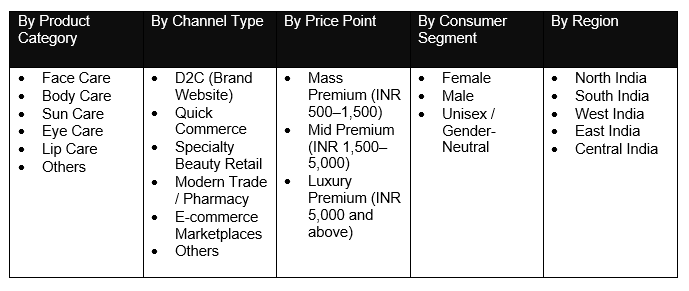
In this report, the India Premium Skincare Market has been segmented into the following categories, in addition to detailed analysis of key industry trends, market dynamics, competitive landscape, and growth opportunities across the forecast period:
- By Product Category
- Face Care
- Body Care
- Sun Care
- Eye Care
- Lip Care
- Others
- By Channel Type
- D2C (Brand Website)
- Quick Commerce
- Specialty Beauty Retail
- Modern Trade / Pharmacy
- E-commerce Marketplaces
- Others
- By Price Point
- Mass Premium (INR 500–1,500)
- Mid Premium (INR 1,500–5,000)
- Luxury Premium (INR 5,000 and above)
- By Consumer Segment
- Female
- Male
- Unisex / Gender-Neutral
- By Geography
- North India
- South India
- West India
- East India
- Central India
Competitive Landscape
Company Profiles:
Detailed analysis of the leading companies operating in the India Premium Skincare Market, including business overview, product portfolio, strategic initiatives, competitive positioning, and recent developments.
Company Information
Detailed profiling and strategic analysis of additional market players (up to five companies), including emerging D2C brands, global entrants, or niche segment leaders.
For a free sample of the India Premium Skincare Market report, customised insights or delivery timelines, submit your query hereresearch@marketresearchoutlook.com
Table of Contents
- Research Framework
- Market Segmentation
- Research Objective
- Research Methodology
- Qualitative Research
- Primary Research
- Secondary Research
- Quantitative Research
- Market Breakdown & Data Triangulation
- Demand Side
- Supply Side
- Primary Research Respondents
- Assumption & Limitation
- Qualitative Research
- Executive Summary
- Market Overview, 2021–2032
- By Product Category
- By Channel Type
- By Price Point
- By Consumer Segment
- By Distribution Channel
- Analyst Recommendations
- Market Overview, 2021–2032
- Geopolitical Impact on India Premium Skincare Market
- India Premium Skincare Market Insights
- Market Dynamics
- Growth Drivers
- Rising skin-consciousness and premiumization among urban millennials and Gen Z.
- Rapid expansion of D2C brands leveraging digital-first go-to-market strategies.
- Increasing disposable income and aspiration-driven consumption in Tier I & II cities.
- Restraints
- High price sensitivity limiting penetration beyond metro and Tier I markets.
- Regulatory complexities around cosmetic ingredients and labeling compliance.
- Consumer skepticism around product efficacy and greenwashing concerns.
- Opportunities
- Growing male grooming segment presenting an underpenetrated market opportunity.
- Rising demand for clean, natural, and Ayurvedic-inspired premium formulations.
- Strategic partnerships between D2C brands and FMCG majors accelerating distribution.
- Challenges
- Intense competition from global luxury brands and emerging homegrown D2C players.
- Supply chain complexities for specialty ingredients (niacinamide, retinol, AHAs/BHAs).
- Customer acquisition costs rising sharply on digital platforms reducing D2C margins.
- Technological Advancements
- Recent Technological Advancements
- Prior to 2020
- Porter’s Five Forces Analysis
- PESTLE Analysis
- Growth Drivers
- Market Dynamics
- Industry Value Chain & Entry Points
- Raw Material Suppliers (specialty actives, botanical extracts, emulsifiers)
- Contract Manufacturers & Formulators (CMOs/CDMOs)
- Quality Control & Regulatory Testing (dermatology testing, certifications)
- Packaging & Sustainable Packaging Suppliers
- Brand Owners (D2C, FMCG, luxury segments)
- Digital Platforms & Marketplaces (own website, quick commerce, marketplaces)
- Offline Retail (pharmacy chains, specialty beauty stores, modern trade)
- End Consumers (millennials, Gen Z, HNI, male grooming segment)
- After-sales Support & Loyalty Programs
- India Premium Skincare Market: Regulatory Framework
- India Premium Skincare Market Overview
- Market Size & Forecast, 2021-2032
- By Value (USD Million)
- Market Share & Forecast
- By Product Category
- Face Care
- Body Care
- Sun Care
- Eye Care
- Lip Care
- Others
- By Channel Type
- D2C (Brand Website)
- Quick Commerce
- Specialty Beauty Retail
- Modern Trade / Pharmacy
- E-commerce Marketplaces
- Others
- By Price Point
- Mass Premium (INR 500–1,500)
- Mid Premium (INR 1,500–5,000)
- Luxury Premium (INR 5,000 and above)
- By Consumer Segment
- Female
- Male
- Unisex / Gender-Neutral
- By Geography
- North India
- South India
- West India
- East India
- Central India
- By Product Category
- Market Size & Forecast, 2021-2032
- Competitive Landscape
- India Premium Skincare Company Market Share Analysis, 2025
- Competitive Benchmarking, By Operating Parameters
- Key Strategic Development (Mergers, Acquisitions, Partnerships, Etc.)
- List of Emerging Players
- Company Profile
- Minimalist (Marico-backed)
- Introduction & Company Profile
- Product Benchmarking
- Strategic Outlook
- Key Competitors
- Financial Analysis
- SWOT Analysis
- Minimalist (Marico-backed)
**(Same Data Pointers Will Be Provided for The Below Companies)
- Plum Goodness (Pureplay Skin Sciences)
- Dot & Key Wellness Pvt. Ltd.
- SUGAR Cosmetics
- Pilgrim
- Foxtale
- MCaffeine (Pureplay Skin Sciences)
- Biotique (Bio Veda Action Research)
- L’Oréal India Pvt. Ltd.
- Hindustan Unilever Limited (HUL) – Lakᵥé, Simple
- Nykáa Beauty (FSN E-Commerce Ventures)
- Other Prominent Players
* Financial information in case of non-listed companies will be provided as per availability
** The segmentation and the companies are subjected to modifications based on in-depth secondary for the final deliverable
Frequently Asked Questions
1. How large is the India premium skincare market and what is its growth forecast?
Ans: The India premium skincare market size is valued at USD 4.09 billion in 2025 and is projected to reach USD 35.92 billion by 2032, growing at a CAGR of around 36 percent. This strong India premium skincare market growth is driven by rising demand for ingredient-led skincare products, increasing premiumization in beauty spending, and rapid expansion of D2C skincare brands in India. The report provides detailed market sizing, forecast modelling, and segment-wise growth analysis to help businesses identify high-opportunity areas and plan long-term strategies.
2. Which segments are driving demand in the India premium skincare market?
Ans: The India premium skincare market segmentation shows that facial care products dominate with approximately 65 to 70 percent market share, including serums, moisturisers, and sunscreens. These categories are benefiting from increasing adoption of multi-step skincare routines and higher awareness of active ingredients such as retinol and vitamin C. The report breaks down demand across product categories, price tiers, and consumer segments, helping businesses understand where growth is accelerating and where to invest.
3. What are the key drivers of growth in the India premium skincare market?
Ans: Key India premium skincare market drivers include rising skin-consciousness, increasing disposable income growing at around 10 to 12 percent annually, and strong digital influence on consumer purchase behaviour. The growth of online skincare platforms in India and D2C brands is improving accessibility, while increasing preference for dermatologist-recommended and clean beauty products is accelerating adoption. The report provides in-depth analysis of growth drivers, supported by data-backed insights and real market trends, enabling better strategic decision-making.
4. Which regions are driving growth in the India premium skincare market?
Ans: The India premium skincare market regional analysis indicates that Tier I cities account for nearly 60 to 65 percent of total demand, driven by higher income levels and stronger brand awareness. However, Tier II cities contribute around 35 to 40 percent of incremental growth, supported by rising internet penetration above 50 percent and expanding premium retail presence. The report offers city-level and regional insights, helping businesses identify high-growth markets and optimise expansion strategies.
5. What are the latest trends in the India premium skincare market?
Ans: The latest India premium skincare market trends include rising demand for ingredient-led skincare products, increasing adoption of dermatologist-backed formulations, and rapid growth of D2C skincare brands and quick commerce channels in India. Digital platforms now influence over 70 percent of skincare purchase decisions, while consumers are increasingly investing in high-efficacy products such as serums and treatment-based skincare. You get detailed insights into emerging trends, innovation pipelines, and future demand shifts, helping businesses stay ahead of competition and capture new growth opportunities.