

India Essential Oils Market Size, Share & Trend Outlook 2032
- Chemicals & Advanced Materials, Specialty Chemicals
- May 2026
- Pages 140
- Report Format: pdf
- Report Price: $2400 USD
India’s essential oils market is witnessing strong growth, driven by the rapid expansion of natural, organic, and clean-label cosmetics and personal care, rising adoption of aromatherapy and holistic wellness aligned with AYUSH and Ayurveda integration, accelerated growth in pharmaceutical and nutraceutical applications, expanding food and beverage flavouring demand, government-led agricultural promotion under aroma mission, and rising interest from global essential oils majors investing in India-specific cultivation, distillation capacity, and export infrastructure.
Report Description
| Study Duration | 2021-2032 |
| Market Size (2025) | USD 218.5 Million |
| CAGR (2026-2032) | 10.2% |
| Leading Segment | Mint Oils & Citrus Oils |
| Fastest Growing Segment | Organic & Therapeutic-Grade Essential Oils |
| Market Size (2032) | USD 430.4 Million |
Market Overview: India Essential Oils Market
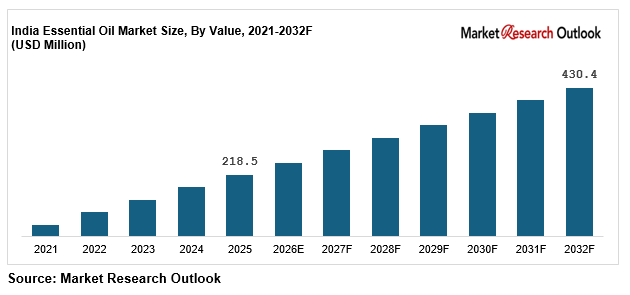
The India essential oils market size is witnessing rapid expansion, driven by accelerated natural and organic personal care demand, rising aromatherapy and holistic wellness adoption, the structural shift toward organic and therapeutic-grade essential oils, and major capacity expansions by global and domestic essential oils producers. Valued at USD 218.5 million in 2025 and projected to reach USD 430.4 million by 2032, growing at a CAGR of 10.2%, the India essential oils market growth is being fuelled by strong demand from cosmetics manufacturers, pharmaceutical and nutraceutical formulators, food and beverage flavouring companies, aromatherapy and wellness centers, and home care product applications. Mint oils and citrus oils lead consumption, while organic and therapeutic-grade essential oils are emerging as the fastest-growing segment. Tightening FSSAI, AYUSH, and BIS norms, IFRA fragrance compliance, REACH export standards, and corporate ESG commitments are reshaping the supply landscape. As global majors including Young Living, doTERRA, Symrise, and Firmenich expand India-specific sourcing capacity and domestic players including Synthite Industries, Norex Flavours, BMV Fragrances, Moksha Lifestyle Products, and Ultra International scale specialty essential oils capacity, the India essential oils market is evolving into a sustainability-led, application-specific, and export-competitive ecosystem with strong long-term growth potential.
Related research: India Beauty and Personal Care Products Market, India Natural Cosmetics Market and India Ayurvedic Products Market.
Key Report Takeaways: India Essential Oils Market
- The India essential oils market size is projected to grow from USD 218.5 million in 2025 to USD 430.4 million by 2032, registering a strong CAGR of 10.2%, driven by accelerated natural personal care demand, aromatherapy expansion, and the structural shift toward organic and therapeutic-grade essential oils.
- Mint oils and citrus oils dominate the India essential oils market, accounting for over 45% of total demand, driven by strong adoption across pharmaceutical, F&B flavouring, oral care, personal care, and aromatherapy applications, with India remaining the world’s largest mentha producer.
- Organic and therapeutic-grade essential oils are emerging as the fastest-growing segment in the India essential oils market, expected to grow at 13% to 15% annually as clean-label demand, IFRA standards, and global ESG-led procurement reshape sourcing strategies.
- Accelerated growth of the Indian natural cosmetics and ayurvedic personal care industry, led by Forest Essentials, Khadi Naturals, Soulflower, Biotique, Patanjali Ayurved, and Himalaya Wellness, along with new D2C entrants Mamaearth, Wow Skin Science, and Plum, is structurally expanding demand for essential oils across cosmetics and wellness categories.
- Rising investments by global essential oils majors such as Young Living, doTERRA, Symrise, and Firmenich in India-specific cultivation contracts, distillation infrastructure, and application laboratories are strengthening local innovation and supporting the India essential oils market forecast 2032.
Key Market Drivers: India Essential Oils Market
Rising Consumer Preference for Natural, Organic, and Plant-Based Products in Personal Care and Wellness
Growth in the India essential oils market is being driven by the rising consumer preference for natural, organic, and plant-based ingredients across cosmetics and personal care, which is growing at 13% to 16% annually, significantly outpacing most other personal care end-uses. Cosmetics and personal care account for approximately 38% to 42% of total essential oils consumption, with essential oils forming the core natural ingredient for skincare, haircare, oral care, and fragrance applications. Per-capita personal care spend in India currently stands at around USD 14 to USD 16 per year, compared to USD 100 to USD 350 in developed markets, indicating significant long-term headroom for growth. Major brands including Forest Essentials, Khadi Naturals, Soulflower, Biotique, Himalaya Wellness, and new D2C entrants Mamaearth, Wow Skin Science, and Plum have announced combined capacity expansions exceeding USD 500 million, creating strong structural pull-through demand for citrus, mint, eucalyptus, and lavender essential oils across the India essential oils market.
Structural Shift Toward Aromatherapy, Holistic Wellness, and Clean-Label Cosmetics Aligned with AYUSH and Ayurveda Integration
The India essential oils market is witnessing a strong and accelerating shift toward aromatherapy, holistic wellness, and clean-label cosmetics, growing at 13% to 15% annually, nearly twice the pace of conventional fragrance and flavouring alternatives. Tightening FSSAI norms, AYUSH ministry-led Ayurveda integration, IFRA fragrance compliance, and corporate ESG mandates are reshaping formulation strategies across cosmetics, pharmaceuticals, and home care. Therapeutic-grade and organic-certified essential oils typically command 40% to 60% price premium compared to conventional alternatives, making them the preferred choice for premium and wellness-focused product launches. Global majors including Young Living, doTERRA, Symrise, Firmenich, and IFF have launched expanded India-sourced portfolios in 2024 and 2025, while domestic players are parallelly scaling organic and traceable supply, reinforcing this structural trend across the India essential oils market.
Accelerated Pharmaceutical, Nutraceutical, and Food and Beverage Flavouring-Led Demand
Rapid pharmaceutical, nutraceutical, and F&B flavouring industry development is a major catalyst for the India essential oils market, with the Indian pharmaceutical industry growing at 11% to 13% annually, the nutraceutical sector expanding at 18% to 22%, and packaged F&B at 9% to 11%. Essential oils are core natural ingredients for cough drops, balms, ayurvedic formulations, dietary supplements, oral care, and natural F&B flavours, with demand driven by leading pharma companies, nutraceutical brands, and modern packaged food manufacturers. Leading players such as Synthite Industries, Norex Flavours, BMV Fragrances, Patanjali Ayurved, Dabur India, and Emami have scaled capacity and broadened product portfolios. Government initiatives including the Aroma Mission led by CSIR-CIMAP, AYUSH ministry funding, and Make in India agro-processing programs combined with formalisation of the natural ingredients sector are structurally expanding India essential oils market growth across premium and mass segments through 2032.
Key Market Challenges: India Essential Oils Market
Raw Material Price Volatility Linked to Weather, Crop Cycles, and Agricultural Commodity Supply
The India essential oils market is highly sensitive to price volatility in its core aromatic plant raw materials, including mentha, lemongrass, sandalwood, eucalyptus, and citrus crops, which together account for 55% to 70% of essential oil input cost and are directly linked to weather, monsoon patterns, and agricultural commodity dynamics. Aromatic plant price movements within an 18% to 35% range over the past 24 months have translated into 20% to 30% swings in landed essential oil costs, compressing producer margins and complicating long-term supply contracts with cosmetics, pharmaceutical, and F&B brand owners. India’s structural exposure to monsoon variability, smallholder cultivation patterns, and limited mechanisation amplifies this risk. Leading producers are responding through contract farming, backward integration, hedging programs, and accelerated organic certification across the India essential oils market.
Adulteration, Counterfeit Products, and Quality Inconsistency Limiting Premium Brand Trust
India remains structurally exposed to adulteration, counterfeit products, and quality inconsistency across several premium essential oil categories, with over 30% to 40% of retail essential oils reportedly affected by adulteration, dilution with carrier oils, synthetic substitutes, or misrepresented origins. High-value categories including sandalwood, rose, jasmine, and therapeutic-grade oils see the highest exposure. Fragmented smallholder supply, limited GC-MS testing infrastructure, and informal trade channels have exposed cosmetics, pharma, and aromatherapy brand owners to brand dilution risk and consumer trust erosion. While GC-MS testing capacity expansion, blockchain traceability pilots, and FSSAI/AYUSH enforcement by Synthite, Norex, BMV Fragrances, and other organised players are expected to reduce this dependence materially by 2028 to 2030, supply integrity remains a near-term strategic challenge in the India essential oils market.
Compliance Complexity Around FSSAI, AYUSH, BIS, and Tightening Export REACH and IFRA Standards
The India essential oils market faces rising compliance complexity around FSSAI food safety, AYUSH ministry standards, BIS certification, and export REACH and IFRA fragrance compliance. Essential oils manufacturing is increasingly quality and certification-intensive, with stringent FSSAI food-grade norms, AYUSH ASU&H pharmacopoeia standards, IFRA category limits, and CPCB effluent management adding 7% to 11% to compliance cost. Export markets such as the EU, US, and the Middle East impose additional requirements including REACH registration, FDA GRAS status, ECOCERT and USDA Organic certifications, and evolving sustainability disclosures under CSRD and CBAM. Downstream cosmetics, pharma, and F&B brand owners also face tightening clean-label, allergen labelling, and traceability mandates that cascade upstream to essential oil producers. While these regulations create entry barriers, they also favour organised, integrated, and R&D-led players in the India essential oils market.
Key Market Trends: India Essential Oils Market
Rapid Adoption of Organic, Therapeutic-Grade, and Sustainably-Sourced Essential Oils in India
The India essential oils market is undergoing a clear shift toward organic, therapeutic-grade, and sustainably-sourced essential oils, with organic certified essential oils growing at 14% to 17% annually, significantly outpacing conventional alternatives. Tightening AYUSH and FSSAI norms, ECOCERT and USDA Organic certifications, ESG-led procurement, and corporate clean-label commitments are reshaping sourcing strategies across cosmetics, pharma, and F&B flavouring. Sustainably-sourced and traceable single-origin oils are gaining traction as global brands commit to Scope 3 emission reductions and biodiversity preservation. In 2025, global majors including Young Living, doTERRA, Symrise, Firmenich, and IFF launched expanded organic and therapeutic-grade portfolios sourced from India, reinforcing the structural shift across the India essential oils market.
Capacity Expansion by Global Majors and Domestic Producers in the India Essential Oils Market
A wave of domestic capacity expansion and global major investment is reshaping the India essential oils market supply landscape. Combined India-focused capital expenditure announcements in essential oils cultivation, distillation, and quality infrastructure exceeded USD 350 million across 2023 to 2025. Synthite Industries expanded its Kerala spice oil and oleoresin capacity, Norex Flavours scaled mentha distillation in Uttar Pradesh, BMV Fragrances strengthened its Kannauj fragrance hub, and Moksha Lifestyle Products expanded therapeutic-grade portfolios. Domestic players including AG Organica, Indian Aroma Exports, Bo International, Kanta Enterprises, and Falcon Essential Oils expanded organic and specialty essential oils capacity. CSIR-CIMAP-led Aroma Mission Phase IV expansion, AYUSH-funded medicinal aromatic plant clusters, and downstream cosmetics capacity additions by Forest Essentials, Khadi Naturals, Mamaearth, and Wow Skin Science are structurally reinforcing demand growth in the India essential oils market.
Rising Role of Pharmaceuticals, Nutraceuticals, and F&B Flavouring in Essential Oils Demand
Pharmaceuticals, nutraceuticals, and F&B flavouring applications are emerging as high-growth pull-through segments for the India essential oils market, collectively expected to account for over 38% of total essential oils demand by 2032. The Indian nutraceutical market is growing at 18% to 22% annually, while pharmaceutical and ayurvedic formulations are expanding at 11% to 13%, with essential oils used extensively in balms, cough drops, oral care, dietary supplements, and natural flavours. Leading players including Synthite Industries, Norex Flavours, BMV Fragrances, Patanjali Ayurved, Dabur India, Emami, Himalaya Wellness, and Symrise have scaled capacity and launched premium organic and therapeutic-grade ranges. This structural pull-through is reinforcing the India essential oils market forecast 2032 across both domestic and export-oriented segments.
Segmental Insights: India Essential Oils Market
By Application: Cosmetics & Personal Care Dominate the India Essential Oils Market
The cosmetics and personal care application segment dominates the India essential oils market, accounting for an estimated 38% to 42% of total essential oils consumption, driven by strong demand from natural skincare, haircare, oral care, and fragrance applications across mass and premium segments. Citrus and mint essential oils are the dominant chemistries within this segment, with organic certified variants rapidly gaining share. Pharmaceutical and nutraceutical applications contribute another 22% to 25% of demand, while aromatherapy and spa contribute 14% to 17%, and F&B flavouring contributes 10% to 13%. In 2025, leading cosmetics and ayurvedic brands including Forest Essentials, Khadi Naturals, Biotique, Patanjali Ayurved, Himalaya, and Mamaearth scaled up essential oil procurement tied to new capacity additions, reinforcing the segment’s dominance in the India essential oils market.
By Product Type: Mint and Citrus Oils Lead While Organic and Therapeutic-Grade Grow Fastest
Mint oils and citrus oils lead the India essential oils market product landscape, accounting for approximately 45% to 48% of total consumption combined, driven by India’s leadership in mentha cultivation (over 80% of global mentha output), strong domestic pharmaceutical use, and broad cosmetic and flavouring applicability. Eucalyptus oil contributes another 12% to 14%, followed by lemongrass at 8% to 10%, and sandalwood and other premium oils at 7% to 9%. Organic, therapeutic-grade, and single-origin traceable essential oils are the fastest-growing categories within the India essential oils market, expanding at 13% to 17% annually, driven by clean-label demand, IFRA standards, and global cosmetics and aromatherapy sustainability commitments across personal care, pharma, and wellness applications.
Regional Insights: India Essential Oils Market
Regional analysis of the India essential oils market shows that North India and South India collectively account for approximately 65% to 70% of total essential oils production and consumption, driven by mentha, peppermint, and rose cultivation concentration in Uttar Pradesh and Uttarakhand, along with strong eucalyptus, lemongrass, sandalwood, and cardamom hubs in Kerala, Karnataka, Tamil Nadu, and Andhra Pradesh. North India alone contributes around 30% to 35% of demand, led by Uttar Pradesh’s Kannauj fragrance and Lucknow mentha clusters, supported by established distillation infrastructure. South India contributes around 30% to 35%, supported by Kerala’s spice oil hub, Karnataka’s sandalwood industry, and Tamil Nadu’s aromatic plant cultivation. West and Central India together account for 15% to 20% of demand, supported by Madhya Pradesh’s expanding aromatic plant cultivation and Maharashtra’s downstream cosmetics activity. In 2025, capacity additions by Synthite in Kerala, Norex Flavours in Uttar Pradesh, BMV Fragrances in Kannauj, and Moksha Lifestyle Products across multiple plants reinforced regional supply hubs, supporting closer collaboration with cosmetics, pharma, and F&B manufacturers across the India essential oils market.
Recent Developments: India Essential Oils Market
- The India essential oils market has witnessed strong momentum in capacity expansion and organic product innovation during 2024 and 2025. Synthite Industries expanded its Kerala spice oil and oleoresin capacity, Norex Flavours scaled additional mentha distillation lines in Uttar Pradesh, BMV Fragrances strengthened its Kannauj fragrance and essential oils hub, and Moksha Lifestyle Products expanded therapeutic-grade portfolios. Domestic players including AG Organica, Indian Aroma Exports, Bo International, and Falcon Essential Oils announced capacity additions for organic and specialty essential oils, reinforcing India as a globally competitive essential oils manufacturing and export hub.
- Downstream cosmetics, pharma, and F&B brands have deepened India sourcing of essential oils, with Forest Essentials, Khadi Naturals, Soulflower, Biotique, Patanjali Ayurved, Dabur India, Himalaya Wellness, and Emami scaling long-term supply contracts with domestic and global essential oils producers in 2025. New D2C entrants including Mamaearth, Wow Skin Science, Plum, and The Body Shop India commissioned major skincare and wellness ranges leveraging Indian essential oils, driving further structural demand. In November 2024, The Body Shop launched its India-inspired The India Edit collection with products made from over 90% natural ingredients, while in April 2025 Symrise expanded its essential oils sourcing partnerships in India, reinforcing downstream linkage across the India essential oils market.
- Sustainability-led innovation has gained strong traction in the India essential oils market. In 2025, global majors including Young Living, doTERRA, Symrise, Firmenich, and IFF launched expanded organic, therapeutic-grade, and traceable essential oil portfolios sourced from India, targeted at Indian and export cosmetics, pharma, and aromatherapy customers. Strategic partnerships under CSIR-CIMAP’s Aroma Mission Phase IV, AYUSH ministry-led medicinal aromatic plant clusters, and PLI-style support for natural ingredients are positioning India as an emerging hub for sustainable essential oils, strengthening long-term competitive positioning in the India essential oils market forecast 2032.
Key Market Players: India Essential Oils Market
- Synthite Industries Limited
- Norex Flavours Private Limited
- BMV Fragrances Pvt. Ltd.
- Moksha Lifestyle Products Pvt. Ltd.
- Ultra International B.V. (India Operations)
- AG Industries / AG Organica
- Indian Aroma Exports Pvt. Ltd.
- Bo International
- Kanta Enterprises Pvt. Ltd.
- Falcon Essential Oils Pvt. Ltd.
- Young Living Essential Oils India
- doTERRA International India
- Forest Essentials (Essential Oils Division)
- Soulflower Aromatic Naturals
- Khadi Naturals Healthcare

Report Scope
In this report, the India Essential Oils Market has been segmented into the following categories, in addition to detailed analysis of key industry trends, market dynamics, competitive landscape, and growth opportunities across the forecast period:
- By Product Type
- Citrus Oils (Lemon, Orange, Bergamot, Lime)
- Mint Oils (Peppermint, Spearmint, Cornmint)
- Eucalyptus Oil
- Lavender Oil
- Sandalwood Oil
- Tea Tree Oil
- Clove Oil
- Cardamom Oil
- Lemongrass Oil
- Jasmine & Rose Oils
- Others (Patchouli, Cinnamon, Frankincense, Vetiver)
- By Source
- Conventional
- Organic
- Wild-Harvested
- By Extraction Method
- Steam Distillation
- Cold Press
- Solvent Extraction
- CO2 Extraction
- Enfleurage
- By Application
- Cosmetics & Personal Care
- Food & Beverage Flavouring
- Pharmaceutical & Nutraceutical
- Aromatherapy & Spa
- Home Care & Cleaning
- Pet Care
- Industrial
- Others
- By End-Use Industry
- Cosmetics & Personal Care Manufacturing
- Pharmaceuticals & Healthcare
- Food & Beverage Manufacturing
- Aromatherapy & Wellness Centers
- Home Care Product Manufacturing
- Tobacco
- Others
- By Sales Channel
- Direct Sales / B2B Contracts
- Specialty Stores
- Pharmacies & Drug Stores
- Supermarkets / Hypermarkets
- E-Commerce / Online
- Export Channels
- By Geography
- North India
- South India
- West India
- East India
- Central India
Competitive Landscape
Company Profiles:
Detailed analysis of the leading companies operating in the India Essential Oils Market, including business overview, product portfolio, strategic initiatives, competitive positioning, and recent developments.
Company Information
Detailed profiling and strategic analysis of additional market players (up to five companies), including emerging domestic essential oils producers, organic and therapeutic-grade specialists, global entrants, or niche segment leaders.
For a free sample of the India Essential Oils Market report, customised insights or delivery timelines, submit your query hereresearch@marketresearchoutlook.com
Table of Contents
- Research Framework
- Market Segmentation
- Research Objective
- Research Methodology
- Qualitative Research
- Primary Research
- Secondary Research
- Quantitative Research
- Market Breakdown & Data Triangulation
- Demand Side
- Supply Side
- Primary Research Respondents
- Assumption & Limitation
- Executive Summary
- Market Overview, 2021-2032
- By Product Type
- By Source
- By Extraction Method
- By Application
- By End-Use Industry
- By Sales Channel
- By Region
- Analyst Recommendations
- Geopolitical Impact on India Essential Oils Market
- India Essential Oils Market Insights
- Market Dynamics
- Growth Drivers
- Rising consumer preference for natural, organic, and plant-based products driving core essential oils consumption.
- Structural shift toward aromatherapy, holistic wellness, and clean-label cosmetics aligned with AYUSH and Ayurveda integration.
- Accelerated pharmaceutical, nutraceutical, and food and beverage flavouring application-led demand for essential oils.
- Restraints
- Raw material price volatility linked to weather, crop cycles, and agricultural commodity supply pressuring producer margins.
- Adulteration, counterfeit products, and quality inconsistency limiting premium brand trust and creating supply risk.
- Compliance complexity around FSSAI, AYUSH, BIS, and export REACH and IFRA standards raising compliance costs.
- Opportunities
- Rapid scale-up of organic, sustainably-sourced, and traceable essential oils aligned with global clean-label and ESG mandates.
- High-growth export demand for India-origin oils (mentha, sandalwood, lemongrass, vetiver) to US, EU, and Middle East markets.
- Emerging opportunity in D2C, e-commerce, and aromatherapy-led wellness across tier-2 and tier-3 city consumers.
- Challenges
- Intense price-led competition between Indian producers and Chinese, Indonesian, and Brazilian essential oil exporters compressing margins.
- Fragmented agricultural supply base with smallholder farmers limiting traceability, certification, and supply consistency.
- Shortage of skilled distillation operators, aroma chemists, and quality control specialists limiting scale-up speed of new capacity.
- Technological Advancements
- Recent Technological Advancements
- Prior to 2020
- Porter’s Five Forces Analysis
- PESTLE Analysis
- Industry Value Chain & Entry Points
- Upstream Aromatic Plant Cultivation (mentha, sandalwood, lemongrass, vetiver, eucalyptus, lavender)
- Smallholder Farmers & Agricultural Cooperatives (Uttar Pradesh, Karnataka, Kerala, Tamil Nadu, Madhya Pradesh)
- Organic & Wild-Harvested Aromatic Plant Producers (certified organic, fair trade, traceability)
- Distillation & Extraction Operations (steam distillation, cold press, solvent extraction, CO2 extraction)
- Quality Control, R&D & Application Laboratories (FSSAI, AYUSH, BIS, IFRA, REACH, ISO certifications)
- Distributors, Specialty Aromatic Agents & B2B Marketplaces
- Downstream Formulators (cosmetics, pharma, nutraceutical, F&B flavouring, home care)
- Brand Owners & Manufacturers (cosmetics brands, ayurvedic brands, F&B companies, wellness brands)
- Retail & E-Commerce Channels (specialty stores, pharmacies, supermarkets, D2C, online platforms)
- End-Use Industries (personal care, pharma, food and beverage, aromatherapy, home care, pet care)
- India Essential Oils Market: Regulatory Framework
- India Essential Oils Market Overview
- Market Size & Forecast, 2021-2032
- By Value (USD Million)
- By Volume (Tons)
- Market Share & Forecast
- By Product Type
- Citrus Oils (Lemon, Orange, Bergamot, Lime)
- Mint Oils (Peppermint, Spearmint, Cornmint)
- Eucalyptus Oil
- Lavender Oil
- Sandalwood Oil
- Tea Tree Oil
- Clove Oil
- Cardamom Oil
- Lemongrass Oil
- Jasmine & Rose Oils
- Others
- By Source
- Conventional
- Organic
- Wild-Harvested
- By Extraction Method
- Steam Distillation
- Cold Press
- Solvent Extraction
- CO2 Extraction
- Enfleurage
- By Application
- Cosmetics & Personal Care
- Food & Beverage Flavouring
- Pharmaceutical & Nutraceutical
- Aromatherapy & Spa
- Home Care & Cleaning
- Pet Care
- Industrial
- Others
- By End-Use Industry
- Cosmetics & Personal Care Manufacturing
- Pharmaceuticals & Healthcare
- Food & Beverage Manufacturing
- Aromatherapy & Wellness Centers
- Home Care Product Manufacturing
- Tobacco
- Others
- By Sales Channel
- Direct Sales / B2B Contracts
- Specialty Stores
- Pharmacies & Drug Stores
- Supermarkets / Hypermarkets
- E-Commerce / Online
- Export Channels
- By Geography
- North India
- South India
- West India
- East India
- Central India
- Competitive Landscape
- India Essential Oils Market Company Market Share Analysis, 2025
- Competitive Benchmarking, By Operating Parameters
- Key Strategic Development (Mergers, Acquisitions, Partnerships, Etc.)
- List of Emerging Players
- Company Profile
- Synthite Industries Limited
- Introduction & Company Profile
- Product Benchmarking
- Strategic Outlook
- Key Competitors
- Financial Analysis
- SWOT Analysis
- Synthite Industries Limited
- Market Size & Forecast, 2021-2032
*(Same Data Pointers Will Be Provided for The Below Companies)
- Norex Flavours Private Limited
- BMV Fragrances Pvt. Ltd.
- Moksha Lifestyle Products Pvt. Ltd.
- Ultra International B.V. (India Operations)
- AG Industries / AG Organica
- Indian Aroma Exports Pvt. Ltd.
- Bo International
- Kanta Enterprises Pvt. Ltd.
- Falcon Essential Oils Pvt. Ltd.
- Young Living Essential Oils India
- doTERRA International India
- Forest Essentials (Essential Oils Division)
- Soulflower Aromatic Naturals
- Khadi Naturals Healthcare
- Other Prominent Players
** Financial information in case of non-listed companies will be provided as per availability*
*** The segmentation and the companies are subjected to modifications based on in-depth secondary for the final deliverable*
Frequently Asked Questions
1. How large is the India essential oils market and what is its growth forecast?
Ans: The India essential oils market size is valued at USD 218.5 million in 2025 and is projected to reach USD 430.4 million by 2032, growing at a CAGR of around 10.2%. This strong India essential oils market growth is driven by accelerated natural and organic personal care demand, rising aromatherapy and holistic wellness adoption, structural shift toward organic and therapeutic-grade essential oils, and major domestic and global capacity expansions. The report provides detailed market sizing, forecast modelling, and segment-wise growth analysis across value and volume terms, helping businesses identify high-opportunity areas and plan long-term strategies.
2. Which segments are driving demand in the India essential oils market?
Ans: The India essential oils market segmentation shows that cosmetics and personal care dominate with approximately 38% to 42% share, followed by pharmaceutical and nutraceutical at 22% to 25% and aromatherapy and spa at 14% to 17%. Mint and citrus oils lead by product type with 45% to 48% combined share, while organic and therapeutic-grade essential oils are the fastest-growing segment, expanding at 13% to 17% annually. The report breaks down demand across product types, sources, extraction methods, applications, end-use industries, and sales channels, helping businesses understand where growth is accelerating across the India essential oils market.
3. What are the key drivers of growth in the India essential oils market?
Ans: Key India essential oils market drivers include rising consumer preference for natural and organic personal care growing at 13% to 16% annually, structural shift toward aromatherapy and clean-label cosmetics driven by AYUSH and Ayurveda integration, and accelerated pharmaceutical, nutraceutical, and F&B flavouring-led demand. Global essential oils majors such as Young Living, doTERRA, Symrise, and Firmenich are investing in India-specific cultivation and distillation infrastructure. The report provides in-depth analysis of growth drivers, supported by data-backed insights and real market trends shaping the India essential oils market.
4. Which regions are driving growth in the India essential oils market?
Ans: Regional analysis of the India essential oils market shows that North and South India together account for nearly 65% to 70% of total demand, driven by mentha and rose cultivation in Uttar Pradesh and Uttarakhand, along with strong eucalyptus, lemongrass, sandalwood, and cardamom hubs in Kerala, Karnataka, Tamil Nadu, and Andhra Pradesh. North India alone contributes around 30% to 35%, supported by Kannauj fragrance and Lucknow mentha clusters. South India contributes around 30% to 35%, supported by Kerala’s spice oil hub and Karnataka’s sandalwood industry. The report offers state-level and regional insights, helping businesses identify high-growth markets and optimise expansion strategies.
5. What are the latest trends in the India essential oils market?
Ans: Recent trends in the India essential oils market include rapid adoption of organic, therapeutic-grade, and sustainably-sourced essential oils growing at 13% to 17% annually, capacity expansion by global majors and domestic producers under CSIR-CIMAP’s Aroma Mission Phase IV, rising role of pharmaceuticals, nutraceuticals, and F&B flavouring, and accelerated launches by Young Living, doTERRA, Symrise, Firmenich, and IFF. Sustainability-led innovation, blockchain traceability, and ECOCERT and USDA Organic certification are reshaping sourcing strategies. The report covers latest product launches, partnerships, capacity expansions, and competitive moves shaping the long-term India essential oils market forecast 2032.