

India Fumed Silica Market, 2032
- Chemicals & Advanced Materials, Specialty Chemicals
- Nov 2026
- Pages 140
- Report Format: pdf
- Report Price: $2400 USD
India’s fumed silica market is witnessing strong structural growth, driven by rapid expansion of silicone sealants, adhesives, and construction chemicals, a growing automotive, EV, and electronics manufacturing base, rising paint and coatings consumption, wider use of pharmaceutical and personal care grades, and new domestic capacity investments by global fumed silica majors serving India-specific demand.
| Study Duration | 2021-2032 |
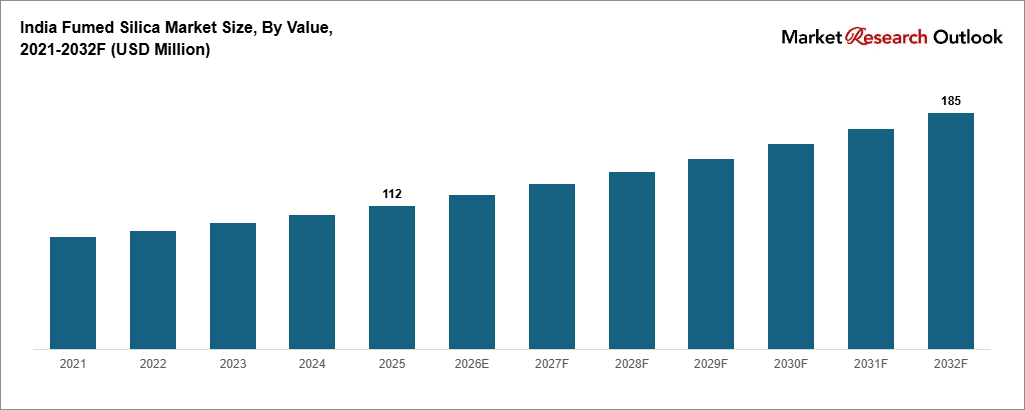
| Market Size (2025) | USD 112 Million |
| CAGR (2026-2032) | 7.4% |
| Leading Segment | Hydrophilic Fumed Silica (Silicone Rubber & Elastomers) |
| Fastest Growing Segment | Hydrophobic Fumed Silica (Batteries & Electronics) |
| Market Size (2032) | USD 185 Million |
Market Overview: India Fumed Silica Market
The India fumed silica market size is expanding at a healthy pace, driven by fast-growing silicone sealant and construction chemical consumption, rising automotive and EV production, a growing electronics manufacturing base, steady paint and coatings demand, and wider use of high-purity grades in pharmaceuticals and personal care. Valued at USD 112 million in 2025 and projected to reach USD 185 million by 2032, growing at a CAGR of 7.4%, the market is gaining from record infrastructure spending, PLI-led manufacturing and India’s position as a leading generic drug exporter. Hydrophilic fumed silica leads consumption, while hydrophobic fumed silica is the fastest growing type as formulators move to moisture-cured sealants, high-performance coatings, and battery applications. Volume demand stood at around 23 kilotons in 2025 and is expected to cross 36 kilotons by 2032. As global majors including Evonik, Cabot Sanmar, Wacker, Tokuyama, and OCI expand supply, application labs, and local capacity, the industry is evolving into a specification-led, innovation-driven, and increasingly localized industry with strong long-term growth potential.
Key Report Takeaways: India Fumed Silica Market
- The India fumed silica market size is projected to grow from USD 112 million in 2025 to USD 185 million by 2032, registering a CAGR of 7.4%, driven by silicone sealant and construction chemical demand, EV and electronics manufacturing, and rising use of high-purity grades.
- Hydrophilic fumed silica dominates overall demand, accounting for about 66% of total value in 2025, supported by heavy use in silicone rubber reinforcement, paints, inks, and unsaturated polyester resins.
- Hydrophobic fumed silica is the fastest growing type, expected to grow at 9% to 10% annually as sealant, coating, and battery makers demand better moisture resistance and stable rheology.
- Building and construction remains the largest end-use industry with a 26% to 29% share, while automotive and electrical and electronics together add about 40% of demand, structurally widening the market base.
- Rising investments by global majors such as Evonik, Cabot Sanmar, Wacker, Tokuyama, and OCI in local capacity, densified low-dust grades, and application support are strengthening supply and supporting the India fumed silica market forecast 2032.
Key Market Drivers: India Fumed Silica Market
Rapid Growth in Silicone Sealants, Adhesives, and Construction Chemicals Driving Fumed Silica Demand Across India
Demand is being driven by fast expansion of silicone sealants, adhesives, and construction chemicals across residential, commercial, and infrastructure projects. Union Budget capital expenditure rose to INR 11.21 lakh crore in FY26, and the National Infrastructure Pipeline continues to support roads, metros, airports, and urban housing. India’s construction chemicals industry is growing at 10% to 12% annually, with silicone and hybrid sealants used for glazing, facades, expansion joints, and waterproofing. Fumed silica is the preferred thixotropic agent in these systems, typically added at 1% to 8% depending on formulation, giving sag resistance and stable viscosity during storage. Leading sealant and adhesive brands are increasing local production in Gujarat, Maharashtra, and Tamil Nadu, and per capita sealant use in India remains well below global averages, indicating long-term headroom. Faster urbanization, glass facade adoption in commercial buildings, and rising quality standards for waterproofing are creating strong structural pull-through demand for fumed silica nationwide.
Expanding Automotive, EV, and Electronics Manufacturing Boosting Demand for High-Performance Silicone Rubber and Specialty Fumed Silica
Fumed silica consumption is benefiting from steady growth in automotive, EV, and electronics manufacturing. Domestic vehicle production crossed 31 million units in FY25, and EV sales reached close to 2 million units in the same year. High temperature vulcanized and liquid silicone rubber used in gaskets, hoses, seals, wire insulation, and battery pack components relies on fumed silica as a reinforcing filler at loadings of 20% to 40%. Electronics production in India crossed INR 9.5 lakh crore in FY24, supported by PLI schemes for mobile phones, IT hardware, and components, raising demand for electronic grade fumed silica in encapsulants, thermal interface materials, and CMP slurries. Battery makers are also testing fumed silica in gel electrolytes and separator coatings. High surface area grades of 200 to 400 m²/g command premium prices, supporting value growth across the market.
Rising Use of Fumed Silica in Paints, Coatings, Pharmaceuticals, and Personal Care Strengthening High-Purity Grade Consumption
Wider use of fumed silica in paints, coatings, pharmaceuticals, and personal care is a major catalyst for the India fumed silica market. India’s paints and coatings industry is valued at around INR 70,000 crore and continues to add capacity, using fumed silica for anti-settling, matting, rheology control, and scratch resistance in industrial and protective coatings. In pharmaceuticals, colloidal silicon dioxide is a standard glidant in tablets and capsules, and India’s pharma exports reached about USD 30.5 billion in FY25, supporting steady demand for IP, USP, and EP compliant grades. Personal care brands use fumed silica in toothpaste, powders, and creams for texture and oil absorption, while food processors use it as an anti-caking agent. These high-purity grades carry better margins than industrial grades, and their share of total demand is rising steadily through 2032.
Key Market Challenges: India Fumed Silica Market
High Import Dependence and Limited Domestic Production Capacity Exposing Buyers to Supply and Price Volatility
Domestic buyers continue to face challenges around import dependence and limited domestic capacity. An estimated 60% to 65% of domestic demand is still met through imports from Germany, China, Japan, and South Korea, which exposes buyers to freight swings, currency movements, and long lead times of 6 to 10 weeks. Cabot Sanmar’s Mettur plant in Tamil Nadu remains the main domestic production base, and its planned expansion will not come on stream until Q4 2027. Smaller formulators often buy through traders at prices 8% to 15% higher than direct buyers, which raises their input costs and limits their ability to shift to premium grades. Until new local capacity scales up, supply security will remain a key concern for buyers across the India fumed silica market.
Energy-Intensive Production and Volatile Chlorosilane Feedstock Costs Raising Operating Pressure
Producers face structural cost pressure because fumed silica is made through flame hydrolysis of chlorosilanes, mainly silicon tetrachloride and methyltrichlorosilane, at flame temperatures above 1,000°C. The process is energy intensive and depends closely on silicone and polysilicon production chains for feedstock. Chlorosilane and silicon metal prices have moved by 15% to 25% in recent cycles, while industrial power tariffs in several Indian states remain higher than in China. Hydrogen chloride recovery, emission control, and safe storage add further capital and compliance costs. These factors make new capacity expensive and lengthen payback periods, which slows domestic investment. While integrated producers manage these risks better, feedstock and energy volatility remain a near-term challenge for the industry.
Handling, Dust Exposure, and Dispersion Difficulties Limiting Adoption Among Small and Mid-Sized Formulators
Formulators face practical constraints around handling and dispersion. Fumed silica has a very low bulk density of about 40 to 60 grams per litre, creating dust, storage, and transport challenges for small plants. Proper dispersion needs high shear mixing equipment, and poor dispersion can reduce thickening efficiency by 20% to 30%, leading to batch rejections. Many small and mid-sized paint, adhesive, and resin makers lack this equipment and trained staff, so they often choose cheaper precipitated silica or organoclays. Occupational health rules on respirable dust also raise compliance needs. Densified grades, pre-dispersed masterbatches, and supplier training programs are emerging as solutions, but higher costs and limited awareness still slow wider adoption across the India fumed silica market.
Key Market Trends: India Fumed Silica Market
Rapid Shift Toward Hydrophobic and Surface-Treated Fumed Silica Grades in India
Indian buyers are making a clear shift toward hydrophobic and surface-treated grades, which are expected to account for over 38% of market value by 2030, up from about 34% in 2025. Grades treated with dimethyldichlorosilane, PDMS, or HMDS give better moisture resistance, stable viscosity in epoxy and polyurethane systems, and improved shelf life in one-component silicone sealants. Hydrophobic grades typically sell at INR 550 to 800 per kg, compared with INR 300 to 450 per kg for standard hydrophilic grades, lifting average realization. Evonik, Wacker, Cabot Sanmar, and Tokuyama are widening their hydrophobic portfolios for Indian sealant, coating, and toner customers. This product transition is reinforcing the India fumed silica market forecast 2032 across both industrial and specialty segments.
Growing Use of Fumed Silica in EV Batteries, Electronics, and Thermal Management Applications
A clear shift toward EV, battery, and electronics uses is reshaping demand. Fumed silica is used in lead-acid battery gel electrolytes, lithium-ion separator coatings, thermal interface pastes, potting compounds, and silicone encapsulants for power electronics. Cell manufacturing capacity in India is being built under the Advanced Chemistry Cell PLI scheme, while mobile phone and component assembly continues to grow. Electronic grade fumed silica used in CMP slurries and semiconductor packaging requires metal impurities below parts per million levels and tight particle size control. Batteries and electronics account for only about 3% of demand today, yet they are expected to grow at 11% to 13% annually, making them the fastest-growing application through 2032.
Capacity Expansion and Localization by Global Fumed Silica Majors in India
A wave of localization is reshaping the supply side. Cabot Sanmar announced a INR 220 crore brownfield investment to roughly double fumed silica capacity at its Mettur plant in Tamil Nadu, with commissioning planned for Q4 2027. Wacker has expanded silicone production in India, strengthening the local silicone value chain that consumes fumed silica, while Evonik continues to support Indian customers through technical service and application labs. Make in India policies, PLI schemes for electronics and auto components, and growing customer preference for shorter lead times are favouring local supply. Combined with rising construction and EV demand, these developments are reinforcing the India fumed silica market forecast 2032 across the full value chain.
Segmental Insights: India Fumed Silica Market
By End-Use Industry: Building & Construction Segment Dominates the India Fumed Silica Market
The building and construction segment dominates fumed silica consumption in India, accounting for an estimated 26% to 29% of total value, driven by silicone sealants, tile adhesives, waterproofing membranes, and construction coatings. Hydrophilic and hydrophobic grades with medium surface area are most widely used in this segment. Automotive and transportation contributes another 22% to 24% of demand, led by silicone rubber parts, underbody coatings, and adhesives for vehicle assembly. Electrical and electronics accounts for 17% to 19%, supported by cable compounds, encapsulants, and battery materials. Healthcare and pharmaceuticals add about 10% to 12%, while personal care and industrial uses make up the rest. In 2025, leading suppliers including Evonik, Cabot Sanmar, and Wacker increased technical support for construction chemical makers, reinforcing segment dominance in the India fumed silica market.
By Type: Hydrophilic Leads While Hydrophobic Grows Fastest
Hydrophilic fumed silica leads the market, accounting for approximately 66% of total value, driven by its wide use in silicone rubber, paints, inks, unsaturated polyester resins, and pharmaceuticals, along with its lower price point. Within applications, silicone rubber and elastomers hold about 31% share, followed by paints, coatings, and inks at around 21% and adhesives and sealants at about 16%. Hydrophobic fumed silica is the fastest growing type, expanding at 9% to 10% annually, supported by demand for moisture-resistant sealants, epoxy and polyurethane systems, toners, and battery materials. High surface area grades above 250 m²/g are gaining share as compounders seek better reinforcement. Leading suppliers including Evonik, Cabot Sanmar, Wacker, and Tokuyama have aligned their India portfolios to this mix, supporting premium grade adoption nationwide.
Regional Insights: India Fumed Silica Market
Regional analysis of the India fumed silica market shows that West India and South India together account for approximately 60% to 64% of total demand, driven by Gujarat (Vapi, Ankleshwar, and Dahej chemical clusters), Maharashtra (Mumbai, Pune, and Aurangabad auto and paint belt), Tamil Nadu (Chennai auto corridor and Mettur production base), Karnataka, and Telangana. North India contributes around 21% to 24% of demand, led by Delhi NCR, Haryana, Punjab, and Uttar Pradesh, supported by automotive clusters in Gurugram and Manesar and growing electronics assembly in Noida. Central and East India together account for 14% to 17% of demand, supported by Madhya Pradesh, West Bengal, and Odisha, where construction and industrial coatings demand is rising. In 2025, Cabot Sanmar’s Mettur base in Tamil Nadu, distributor networks across Gujarat and Maharashtra, and new silicone capacity in western India reinforced regional supply hubs across the country.
Recent Developments: India Fumed Silica Market
- The sector saw strong momentum in demand and investment during 2024 and 2025. Domestic consumption reached around 23 kilotons in 2025, up from about 19 kilotons in 2022, while imports of fumed silica under HS code 281122 continued to meet the larger share of demand. Volume is projected to cross 36 kilotons by 2032, supported by sealant, coating, and EV battery applications.
- Global majors have deepened India-focused capacity and support. Cabot Sanmar announced a INR 220 crore expansion to roughly double fumed silica capacity at Mettur, Tamil Nadu, with commissioning planned for Q4 2027. Wacker expanded silicone production in India, and Evonik continued to strengthen AEROSIL application support for Indian coating, adhesive, and silicone customers. These moves are strengthening local supply and supporting the India fumed silica market forecast 2032.
- Application momentum is building across EV and electronics. Battery, cell, and electronics manufacturers investing under PLI schemes are qualifying hydrophobic and electronic grade fumed silica for gel electrolytes, separator coatings, and thermal materials. Partnerships between fumed silica suppliers, silicone compounders, and battery makers are positioning India as one of the fastest growing fumed silica markets in Asia.
Key Market Players: India Fumed Silica Market
- Evonik Industries AG (Evonik India Pvt. Ltd.)
- Cabot Sanmar Limited
- Wacker Chemie AG (Wacker Metroark Chemicals Pvt. Ltd.)
- Tokuyama Corporation
- OCI Holdings Co., Ltd.
- Nippon Aerosil Co., Ltd.
- Orisil LLC
- Hubei Xingfa Chemicals Group Co., Ltd.
- Wynca Group (Zhejiang Xinan Chemical Industrial Group)
- Dongyue Group Limited
- Guangzhou GBS High-Tech & Industry Co., Ltd.
- Kemitura A/S
- Applied Material Solutions Inc.
| By Type | By Grade | By Surface Area | By Application | By End-Use Industry |
| Hydrophilic Fumed Silica Hydrophobic Fumed Silica |
Industrial Grade Pharmaceutical Grade Food Grade Electronic Grade |
Low (Below 150 m²/g) Medium (150 to 250 m²/g) High (Above 250 m²/g) |
Silicone Rubber & Elastomers Paints, Coatings & Inks Adhesives & Sealants Unsaturated Polyester Resins & Composites Pharmaceuticals & Nutraceuticals Cosmetics & Personal Care Food & Beverages Batteries & Electronics Others |
Building & Construction Automotive & Transportation Electrical & Electronics Healthcare & Pharmaceuticals Personal Care & Cosmetics Industrial & Others |
Report Scope
In this report, the India Fumed Silica Market has been segmented into the following categories, in addition to detailed analysis of key industry trends, market dynamics, competitive landscape, and growth opportunities across the forecast period:
- By Type
- Hydrophilic Fumed Silica
- Hydrophobic Fumed Silica
- By Grade
- Industrial Grade
- Pharmaceutical Grade
- Food Grade
- Electronic Grade
- By Surface Area
- Low (Below 150 m²/g)
- Medium (150 to 250 m²/g)
- High (Above 250 m²/g)
- By Application
- Silicone Rubber & Elastomers
- Paints, Coatings & Inks
- Adhesives & Sealants
- Unsaturated Polyester Resins & Composites
- Pharmaceuticals & Nutraceuticals
- Cosmetics & Personal Care
- Food & Beverages
- Batteries & Electronics
- Others
- By End-Use Industry
- Building & Construction
- Automotive & Transportation
- Electrical & Electronics
- Healthcare & Pharmaceuticals
- Personal Care & Cosmetics
- Industrial & Others
- By Geography
- North India
- South India
- West India
- East India
- Central India
Competitive Landscape
Company Profiles:
Detailed analysis of the leading companies operating in the India Fumed Silica Market, including business overview, product portfolio, strategic initiatives, competitive positioning, and recent developments.
Company Information
Detailed profiling and strategic analysis of additional market players (up to five companies), including emerging domestic fumed silica distributors, specialty hydrophobic grade producers, regional silica suppliers, or niche electronic grade material providers.
For a free sample of the India Fumed Silica Market report, customised insights or delivery timelines, submit your query here
India Fumed Silica Market, 2032
- Research Framework
- Market Segmentation
- Research Objective
- Research Methodology
- Qualitative Research
- Primary Research
- Secondary Research
- Quantitative Research
- Market Breakdown & Data Triangulation
- Demand Side
- Supply Side
- Primary Research Respondents
- Assumption & Limitation
- Executive Summary
- Market Overview, 2021-2032
- By Type
- By Grade
- By Surface Area
- By Application
- By End-Use Industry
- By Region
- Analyst Recommendations
- Geopolitical Impact on India Fumed Silica Market
- India Fumed Silica Market Insights
- Market Dynamics
- Growth Drivers
- Rapid growth in silicone sealants, adhesives, and construction chemicals driving fumed silica demand across India.
- Expanding automotive, EV, and electronics manufacturing boosting demand for high-performance silicone rubber and specialty fumed silica.
- Rising use of fumed silica in paints, coatings, pharmaceuticals, and personal care strengthening high-purity grade consumption.
- Restraints
- High import dependence and limited domestic production capacity exposing buyers to supply and price volatility.
- Energy-intensive production and volatile chlorosilane feedstock costs raising operating pressure for fumed silica suppliers.
- Handling, dust exposure, and dispersion difficulties limiting adoption among small and mid-sized formulators.
- Opportunities
- Domestic capacity additions and Make in India localization opening import substitution potential for fumed silica producers.
- Hydrophobic and specialty grades for EV batteries, CMP slurries, and thermal interface materials supporting next-generation growth.
- Rising pharmaceutical excipient, nutraceutical, and food-grade demand creating high-value growth avenues across India.
- Challenges
- Intense price competition from low-cost Chinese imports compressing margins for domestic and global suppliers.
- Substitution threat from precipitated silica, organoclays, and other rheology modifiers in price-sensitive applications.
- Maintaining consistent surface area, purity, and particle size specifications for high-end electronics and pharma users.
- Technological Advancements
- Recent Technological Advancements
- Prior to 2020
- Porter’s Five Forces Analysis
- PESTLE Analysis
- Industry Value Chain & Entry Points
- Upstream Raw Materials (silicon metal, silicon tetrachloride, methyltrichlorosilane, hydrogen, oxygen)
- Chlorosilane & Silicone Producers (Wacker, Shin-Etsu, Dow, Elkem, Hoshine Silicon)
- Fumed Silica Manufacturers (Evonik, Cabot Sanmar, Wacker, Tokuyama, OCI)
- Surface Treatment & Specialty Grade Processors (silane, PDMS, and HMDS treated grades)
- Quality Control, R&D & Testing Laboratories (BIS, IP, USP, EP pharmacopoeia, ISO standards)
- Importers, Distributors & Chemical Traders (B2B distribution networks)
- Formulators & Compounders (silicone rubber, sealants, paints, adhesives, composites)
- Brand Owners & OEM Buyers (paint, adhesive, automotive, and electronics companies)
- Application Industries (construction, automotive, electronics, pharma, personal care)
- End-Users (builders, vehicle makers, electronics firms, drug makers, consumers)
- India Fumed Silica Market: Regulatory Framework
- India Fumed Silica Market Overview
- Market Size & Forecast, 2021-2032
- By Value (USD Million)
- By Volume (Kilotons)
- Market Share & Forecast
- By Type
- Hydrophilic Fumed Silica
- Hydrophobic Fumed Silica
- By Grade
- Industrial Grade
- Pharmaceutical Grade
- Food Grade
- Electronic Grade
- By Surface Area
- Low (Below 150 m²/g)
- Medium (150 to 250 m²/g)
- High (Above 250 m²/g)
- By Application
- Silicone Rubber & Elastomers
- Paints, Coatings & Inks
- Adhesives & Sealants
- Unsaturated Polyester Resins & Composites
- Pharmaceuticals & Nutraceuticals
- Cosmetics & Personal Care
- Food & Beverages
- Batteries & Electronics
- Others
- By End-Use Industry
- Building & Construction
- Automotive & Transportation
- Electrical & Electronics
- Healthcare & Pharmaceuticals
- Personal Care & Cosmetics
- Industrial & Others
- By Geography
- North India
- South India
- West India
- East India
- Central India
- Competitive Landscape
- India Fumed Silica Market Company Market Share Analysis, 2025
- Competitive Benchmarking, By Operating Parameters
- Key Strategic Development (Mergers, Acquisitions, Partnerships, Etc.)
- List of Emerging Players
- Company Profile
- Evonik Industries AG (Evonik India Pvt. Ltd.)
- Introduction & Company Profile
- Product Benchmarking
- Strategic Outlook
- Key Competitors
- Financial Analysis
- SWOT Analysis
(Same Data Pointers Will Be Provided for The Below Companies)
- Cabot Sanmar Limited
- Wacker Chemie AG (Wacker Metroark Chemicals Pvt. Ltd.)
- Tokuyama Corporation
- OCI Holdings Co., Ltd.
- Nippon Aerosil Co., Ltd.
- Orisil LLC
- Hubei Xingfa Chemicals Group Co., Ltd.
- Wynca Group (Zhejiang Xinan Chemical Industrial Group)
- Dongyue Group Limited
- Guangzhou GBS High-Tech & Industry Co., Ltd.
- Kemitura A/S
- Applied Material Solutions Inc.
- Other Prominent Players
* Financial information in case of non-listed companies will be provided as per availability
The segmentation and the companies are subjected to modifications based on in-depth secondary for the final deliverable**
Frequently Asked Questions
1. How large is the India fumed silica market and what is its growth forecast?
Ans: The India fumed silica market is valued at USD 112 million in 2025 and is projected to reach USD 185 million by 2032, growing at a CAGR of 7.4%, supported by construction, EV, and electronics demand.
2. Which segments are driving demand in the India fumed silica market?
Ans: Hydrophilic fumed silica leads with about 66% value share, while hydrophobic fumed silica is the fastest growing type, driven by moisture-resistant sealants, high-performance coatings, and battery and electronics applications.
3. What are the key drivers of growth in the India fumed silica market?
Ans: Key drivers include rapid growth in silicone sealants and construction chemicals, expanding automotive, EV, and electronics manufacturing, and rising use of high-purity grades in paints, pharmaceuticals, and personal care.
4. Which regions are driving growth in the India fumed silica market?
Ans: West India and South India lead with around 60% to 64% of total demand, driven by Gujarat, Maharashtra, Tamil Nadu, Karnataka, and Telangana. North India follows with strong automotive and electronics demand.
5. What are the latest trends in the India fumed silica market?
Ans: Key trends include a shift toward hydrophobic and surface-treated grades, growing use in EV batteries and electronics, densified low-dust grades, and capacity expansion by global majors such as Cabot Sanmar.