

India Epoxy Resin Market, 2032
- Chemicals & Advanced Materials, Polymers, Plastics & Packaging
- Nov 2026
- Pages 140
- Report Format: pdf
- Report Price: $2400 USD
India’s epoxy resin market is witnessing steady structural growth, driven by record infrastructure spending, rising demand for protective coatings and construction chemicals, fast-growing wind energy capacity, expanding electronics manufacturing under PLI schemes, rising automotive and EV production, and fresh domestic capacity additions by producers such as Grasim Industries and Atul Ltd that are reducing import dependence across the epoxy resin value chain.
| Study Duration | 2021-2032 |
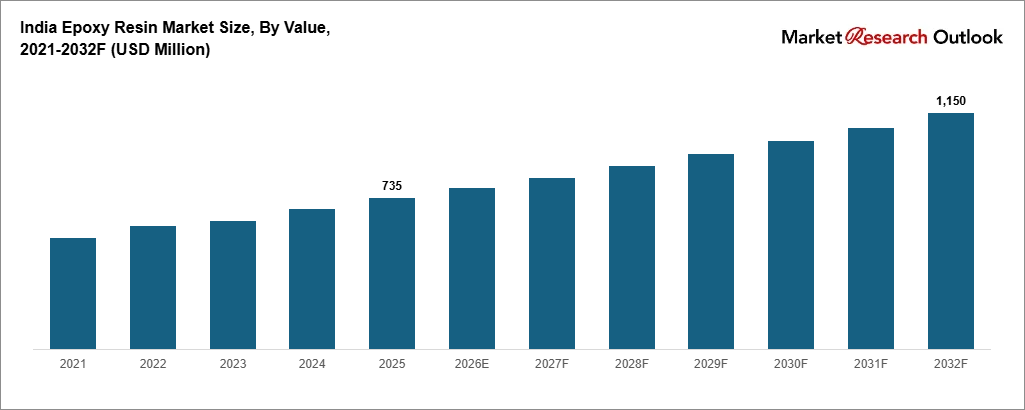
| Market Size (2025) | USD 735 Million |
| CAGR (2026-2032) | 6.6% |
| Leading Segment | DGEBA Epoxy Resins (Paints & Coatings) |
| Fastest Growing Segment | Composites & Wind Energy Applications |
| Market Size (2032) | USD 1,150 Million |
Market Overview: India Epoxy Resin Market
The India epoxy resin market size is expanding at a steady pace, supported by record public infrastructure spending, rising consumption of protective coatings and construction chemicals, rapid wind energy capacity additions, and a strong push for domestic electronics manufacturing. Valued at USD 735 million in 2025 and projected to reach USD 1,150 million by 2032, growing at a CAGR of 6.6%, the India epoxy resin market growth is being fuelled by demand from paints and coatings, adhesives, composites, and electrical laminates. Total consumption stood at around 280 kilo tonnes in 2025 and is expected to cross 420 kilo tonnes by 2032. DGEBA (Bisphenol-A based) resins lead consumption with close to 64% share, while composites and wind energy applications are emerging as the fastest growing category. Capital expenditure of over INR 11 lakh crore in the Union Budget 2025-26, the PM Gati Shakti National Master Plan, and India’s 500 GW non-fossil power target for 2030 are reshaping epoxy resin demand across the country. As domestic producers such as Grasim Industries (Aditya Birla Advanced Materials) and Atul Ltd scale local capacity, and global suppliers including Huntsman, Olin, Westlake Epoxy, and Kukdo Chemical deepen their India presence, the India epoxy resin market is evolving into a more self-reliant, innovation-driven, and application-rich ecosystem with strong long-term growth potential.
Key Report Takeaways: India Epoxy Resin Market
- The India epoxy resin market size is projected to grow from USD 735 million in 2025 to USD 1,150 million by 2032, registering a CAGR of 6.6%, driven by infrastructure spending, wind blade manufacturing, electronics production, and rising use of high-performance protective coatings across industrial India.
- DGEBA epoxy resins dominate the India epoxy resin market, accounting for nearly 64% of total volume in 2025, supported by their balanced cost, strong adhesion, and chemical resistance, and by wide use in paints and coatings, flooring, adhesives, and electrical laminates.
- Composites and wind energy applications are emerging as the fastest growing segments in the India epoxy resin market, expected to grow at 8.5% to 9.5% annually as blade makers, pressure vessel producers, and automotive suppliers shift toward lightweight, high-strength materials.
- India’s installed wind capacity crossed 50 GW in 2025, while national electronics production is targeted at USD 500 billion by 2030, structurally expanding the India epoxy resin market across composites, laminates, and encapsulation categories.
- Rising investments by domestic producers such as Grasim Industries, Atul Ltd, and Pidilite Industries in resin, formulation, and curing agent capacity are reducing import reliance and supporting the India epoxy resin market forecast 2032.
Key Market Drivers: India Epoxy Resin Market
Infrastructure Spending, Construction Chemicals, and Protective Coatings Demand Driving Epoxy Resin Consumption Across India
Growth in the India epoxy resin market is being driven by sustained infrastructure investment, rapid urban construction, and rising demand for long-life protective coatings. The Union Budget 2025-26 allocated over INR 11.2 lakh crore for capital expenditure, covering highways, railways, metro rail, ports, and water projects. India’s paints and coatings sector is expanding at 9% to 11% annually, and industrial and protective coatings use epoxy resin as the base binder for steel bridges, pipelines, tanks, and marine structures. Epoxy resin flooring, grouts, anchoring compounds, and repair mortars are now standard in warehouses, pharmaceutical plants, data centres, and metro depots. India’s operational metro network crossed 1,000 km in 2025 across more than 20 cities, with a similar length under construction, creating steady pull for epoxy-based coatings and construction chemicals. Per-capita epoxy resin consumption in India still stands below 0.2 kg against more than 1.3 kg in China, which signals considerable headroom for growth across the India epoxy resin market.
Wind Energy Capacity Additions and Composite Adoption Fuelling High-Performance Epoxy Resin Demand
The India epoxy resin market is benefiting from rapid growth in wind energy, where epoxy resin systems form the matrix for turbine blades, nacelle covers, and structural adhesives. India’s installed wind capacity crossed 50 GW in 2025, and the national goal of 500 GW of non-fossil power capacity by 2030 calls for much larger annual additions. A blade set for a 3 MW to 4 MW turbine uses roughly 8 to 12 tonnes of epoxy resin and hardener, so every gigawatt of new wind capacity adds meaningful volume. Blade makers such as Suzlon and LM Wind Power are expanding Indian production lines for both domestic and export orders. Beyond wind, epoxy resin composites are gaining ground in CNG and hydrogen cylinders, railway interiors, sporting goods, and lightweight automotive parts. Composites now account for 13% to 15% of epoxy resin demand in India, and this share is expected to rise steadily through 2032 as lightweighting and clean energy goals reshape material choices across the India epoxy resin market.
Electronics Manufacturing Expansion Under PLI Schemes Strengthening Electrical-Grade Epoxy Resin Growth
Rapid growth in electronics and electrical manufacturing is a major catalyst for the India epoxy resin market, with electrical-grade epoxy resins projected to grow at 7.5% to 8.5% annually through 2032. Epoxy resin is the core material in copper clad laminates for printed circuit boards, semiconductor moulding compounds, transformer insulation, switchgear, and LED encapsulation. India’s electronics production crossed USD 130 billion in FY25, supported by Production Linked Incentive schemes for mobile phones, IT hardware, and components. The Electronics Component Manufacturing Scheme approved in 2025 with an outlay of INR 22,919 crore is expected to bring PCB laminate and component makers into India, adding local demand for high-purity epoxy resin. Power sector expansion is adding further volume, as transmission and distribution projects use epoxy cast resin transformers, insulators, and bushings. Together, these programmes are expanding India epoxy resin market growth across all major end-user categories through 2032.
Key Market Challenges: India Epoxy Resin Market
Volatility in Bisphenol-A and Epichlorohydrin Prices Impacting Epoxy Resin Margins
The India epoxy resin market continues to face pressure from volatile raw material costs, as bisphenol-A (BPA) and epichlorohydrin (ECH) together make up 70% to 75% of the production cost of standard liquid epoxy resin. India imports a large part of its BPA requirement, and global BPA and ECH prices swung by 25% to 40% between 2021 and 2025 due to crude oil movements, Chinese capacity additions, and plant outages. Converters and formulators often work on fixed-price contracts with paint, construction, and OEM customers, so sudden input spikes cannot be passed on quickly. Gross margins for small and mid-sized epoxy resin formulators in India typically range between 14% and 22%, and a sharp feedstock rise can cut this by 4% to 8% within a quarter. This cost uncertainty limits capacity planning and weakens pricing power for smaller players across the India epoxy resin market.
High Import Dependence and Trade Remedy Uncertainty Across the Epoxy Resin Supply Chain
The India epoxy resin market faces structural complexity from heavy reliance on imports. Domestic epoxy resin capacity still meets only around 50% to 55% of national demand, with the balance sourced from China, South Korea, Taiwan, Thailand, and Saudi Arabia. Anti-dumping investigations by the Directorate General of Trade Remedies and the rollout of BIS Quality Control Orders for epoxy resins have created uncertainty over landed costs and supply timelines. Lead times for imported specialty grades such as novolac, glycidylamine, and brominated epoxy resins can stretch to 6 to 10 weeks, which strains inventory planning for laminate makers and composite fabricators. Currency movements add another layer of risk, since most imported grades are priced in US dollars. Although new domestic capacity is narrowing the gap, supply security remains a near-term challenge for the India epoxy resin market.
Stricter Environmental, Health and Safety Norms on BPA and Solvent Emissions Raising Compliance Costs
The India epoxy resin market faces practical constraints from tightening environmental, health, and safety norms. BPA is under regulatory watch in the European Union, where its use in food contact materials is being phased out under rules adopted in late 2024, and Indian exporters of coated goods must now meet these standards. Solvent-borne epoxy resin coatings release volatile organic compounds, and state pollution control boards are tightening VOC and effluent norms for resin and coating plants in Gujarat, Maharashtra, and Tamil Nadu. Amine hardeners are classified as skin sensitisers, which calls for better handling, labelling, and worker training on construction sites. Compliance upgrades, including effluent treatment, solvent recovery, and REACH-style documentation for exports, can add 3% to 6% to operating costs for mid-sized producers. Low-VOC, waterborne, and bio-based alternatives are emerging as solutions, but higher prices and limited applicator awareness remain barriers across the India epoxy resin market.
Key Market Trends: India Epoxy Resin Market
Rapid Shift Toward Waterborne, Low-VOC, and Bio-Based Epoxy Resins in India
The India epoxy resin market is undergoing a clear shift toward waterborne, solvent-free, and bio-based systems, with these grades expected to account for over 18% of new epoxy resin coating launches by 2028. Waterborne epoxy resin primers and floor coatings cut VOC emissions by 60% to 80% compared with solvent-borne systems while offering similar adhesion and chemical resistance. Leading domestic and global players including Grasim Industries, Huntsman, Pidilite Industries, Sika India, and BASF India widened their low-VOC and solvent-free portfolios during 2024 and 2025. Bio-based epoxy resins made from cardanol, sourced from cashew nut shell liquid, are gaining traction, and India’s position as a major cashew processor gives local producers a natural raw material advantage. Hospitals, food plants, and green-certified buildings under IGBC and GRIHA norms increasingly specify these products. This material transition is reinforcing the India epoxy resin market forecast 2032 across both coatings and construction categories.
Growing Use of Epoxy Resins in EV Batteries, Semiconductors, and Advanced Electronics in the India Epoxy Resin Market
A clear shift toward high-value electronic and mobility applications is reshaping the India epoxy resin market, particularly in the specialty grade segment. Electric vehicle battery packs use epoxy-based structural adhesives, potting compounds, and thermally conductive encapsulants, with each pack using roughly 2 kg to 5 kg of epoxy resin systems. India’s electric vehicle sales came close to 2 million units in FY25, and the PM E-DRIVE scheme is supporting further growth in electric two-wheelers, three-wheelers, and buses. Approved semiconductor assembly and testing units in Gujarat, Assam, and Uttar Pradesh under the India Semiconductor Mission will need epoxy resin moulding compounds and underfill materials. Specialty grades such as novolac, multifunctional, and low-halogen epoxy resins already account for over 12% of electrical-grade demand in India, up from less than 7% in 2020. As local electronics and EV value chains deepen, these high-margin applications are adding new growth layers to the India epoxy resin market.
Domestic Capacity Expansion and Backward Integration by Leading Epoxy Producers
A wave of domestic capacity expansion and backward integration is reshaping the India epoxy resin market supply landscape. Combined India-focused investment announcements in epoxy resin, epichlorohydrin, curing agents, and formulation capacity exceeded USD 600 million across 2023 to 2025. Grasim Industries commissioned a 123,000 tonnes per year expansion at Vilayat in Gujarat in 2024, taking its Advanced Materials capacity to 246,000 tonnes per year and making it one of the largest epoxy resin producers in Asia. Atul Ltd has widened its epoxy resin and hardener range at Valsad, while several mid-sized players are adding formulation and system house capacity in Gujarat and Maharashtra. Make in India policies, Production Linked Incentive support for downstream electronics, and trade remedy measures on low-priced imports have structurally favoured local supply. Combined with rising infrastructure and renewable energy demand, these developments are reinforcing the India epoxy resin market forecast 2032 across the entire value chain.
Segmental Insights: India Epoxy Resin Market
By End-User: Building & Construction Segment Dominates the India Epoxy Resin Market
The building and construction end-user segment dominates the India epoxy resin market, accounting for an estimated 34% to 37% of total volume, driven by infrastructure projects, industrial flooring, protective coatings, and construction chemicals. Liquid DGEBA epoxy resins are the dominant variants within this segment, with coatings, grouts, and floor systems capturing over 70% of construction-related epoxy resin use. The electrical and electronics segment contributes another 22% to 24% of demand, driven by copper clad laminates, transformers, switchgear, and LED encapsulation. The wind energy and industrial segment accounts for 22% to 25%, led by wind blades, tanks, pipes, and tooling, while automotive and transportation holds 16% to 18%. In 2025, leading players including Grasim Industries, Huntsman, Pidilite Industries, Sika India, and BASF India scaled up construction-focused epoxy resin offerings under infrastructure and real estate expansion, reinforcing segment dominance in the India epoxy resin market.
By Raw Material: DGEBA Leads While Novolac and DGBF Grow Fastest
DGEBA epoxy resins lead the India epoxy resin market raw material landscape, accounting for approximately 64% of total epoxy volume, driven by their cost efficiency, versatile curing behaviour, and strong adhesion across coatings, adhesives, and laminates. DGBF (Bisphenol-F) epoxy resins contribute another 11% to 13%, mainly in solvent-free flooring, tank linings, and low-viscosity composite systems. Novolac and DGBF epoxy resins are the fastest growing categories within the India epoxy resin market, expanding at 7.5% to 9% annually, driven by superior heat and chemical resistance, demand from electronics and chemical plants, and growing use in high-temperature composites. Aliphatic and glycidylamine epoxy resins together account for 7% to 9% of the market, with glycidylamine expected to grow quickly through 2032 in aerospace and defence composites. Leading producers including Grasim Industries, Atul Ltd, Huntsman, Olin, and Kukdo Chemical have aligned product portfolios to this mix, driving specialty epoxy resin adoption across the India epoxy resin market.
Regional Insights: India Epoxy Resin Market
Regional analysis of the India epoxy resin market shows that West India accounts for approximately 40% to 43% of total epoxy resin volume, driven by Gujarat (Vilayat, Dahej, Ankleshwar, and Vapi chemical clusters) and Maharashtra (Mumbai, Pune, and Aurangabad industrial belts), supported by resin plants, paint factories, and wind blade units. South India contributes around 26% to 28% of demand, led by Tamil Nadu, Karnataka, Telangana, and Andhra Pradesh, supported by wind energy, electronics, and automotive manufacturing around Chennai, Bengaluru, and Hyderabad. North India accounts for 18% to 20%, supported by Delhi NCR, Haryana, Punjab, and Uttar Pradesh, where construction, electrical equipment, and two-wheeler production are strong. East and Central India together account for 11% to 13% of demand, supported by West Bengal, Odisha, Madhya Pradesh, and Chhattisgarh, where steel, power, and infrastructure projects are expanding. In 2025, capacity additions by Grasim Industries and Atul Ltd in Gujarat and growing wind blade output in Tamil Nadu and Gujarat reinforced regional supply hubs, supporting faster delivery of epoxy resin systems across the India epoxy resin market.
Recent Developments: India Epoxy Resin Market
- The India epoxy resin market witnessed strong momentum in demand and capacity progress during 2024 and 2025. India added over 4 GW of new wind capacity in FY25, the highest in several years, lifting wind blade epoxy resin demand. Industrial and protective coatings volumes rose by an estimated 9% to 11% in 2025, while construction chemical makers recorded double-digit growth in epoxy resin flooring and grouts. Total epoxy resin consumption in India is projected to reach 300 to 310 kilo tonnes by FY27 from about 270 kilo tonnes in FY25, growing at an average 6% to 7% annually.
- Domestic producers have deepened India-focused capacity expansion. Grasim Industries completed its Vilayat expansion, taking Advanced Materials capacity to 246,000 tonnes per year, and widened its range of formulated systems for wind, coatings, and electrical uses. Atul Ltd expanded epoxy resin and curing agent output, Pidilite Industries grew its epoxy adhesive and construction chemical lines, and several system houses added formulation capacity in Gujarat and Maharashtra. These developments are strengthening domestic supply and supporting the India epoxy resin market forecast 2032.
- Global epoxy resin suppliers have also stepped up activity in the India epoxy resin market. In 2024 and 2025, leading global players including Huntsman, Olin, Westlake Epoxy, Kukdo Chemical, BASF, and Sika expanded technical centres, distribution networks, and application support for wind, electronics, and construction customers. Strategic partnerships between resin makers, paint companies, and composite fabricators are positioning India as one of the fastest scaling epoxy resin markets in Asia, strengthening long-term competitive positioning in the India epoxy resin market forecast 2032.
Key Market Players: India Epoxy Resin Market
- Grasim Industries Limited (Aditya Birla Advanced Materials)
- Atul Ltd.
- Huntsman International (India) Pvt. Ltd.
- Olin Corporation
- Westlake Epoxy (Westlake Corporation)
- Kukdo Chemical Co., Ltd.
- Nan Ya Plastics Corporation
- Chang Chun Plastics Co., Ltd.
- BASF India Limited
- Pidilite Industries Limited
- Sika India Pvt. Ltd.
- 3M India Limited
- Asian Paints PPG Pvt. Ltd.
| By Raw Material | By Application | By Form | By Distribution Channel | By End-User |
| DGEBA (Bisphenol-A Based) DGBF (Bisphenol-F Based) Novolac Epoxy Resins Aliphatic Epoxy Resins Glycidylamine Epoxy Resins Others |
Paints & Coatings Adhesives & Sealants Composites Electrical Laminates & Encapsulation Construction & Flooring Tooling & Casting Others |
Liquid Epoxy Resins Solid Epoxy Resins Solution Epoxy Resins Waterborne Epoxy Resins Powder Epoxy Resins |
Direct Sales to OEMs Distributors & Dealers Formulators & System Houses Online B2B Platforms Retail & Hardware Stores Traders & Importers |
Building & Construction Automotive & Transportation Electrical & Electronics Wind Energy & Industrial |
Report Scope
In this report, the India Epoxy Resin Market has been segmented into the following categories, in addition to detailed analysis of key industry trends, market dynamics, competitive landscape, and growth opportunities across the forecast period:
- By Raw Material
- DGEBA (Bisphenol-A Based)
- DGBF (Bisphenol-F Based)
- Novolac Epoxy Resins
- Aliphatic Epoxy Resins
- Glycidylamine Epoxy Resins
- Others
- By Application
- Paints & Coatings
- Adhesives & Sealants
- Composites
- Electrical Laminates & Encapsulation
- Construction & Flooring
- Tooling & Casting
- Others
- By Form
- Liquid Epoxy Resins
- Solid Epoxy Resins
- Solution Epoxy Resins
- Waterborne Epoxy Resins
- Powder Epoxy Resins
- By Distribution Channel
- Direct Sales to OEMs
- Distributors & Dealers
- Formulators & System Houses
- Online B2B Platforms
- Retail & Hardware Stores
- Traders & Importers
- By End-User
- Building & Construction
- Automotive & Transportation
- Electrical & Electronics
- Wind Energy & Industrial
- By Geography
- North India
- South India
- West India
- East India
- Central India
Competitive Landscape
Company Profiles:
Detailed analysis of the leading companies operating in the India Epoxy Resin Market, including business overview, product portfolio, strategic initiatives, competitive positioning, and recent developments.
Company Information
Detailed profiling and strategic analysis of additional market players (up to five companies), including emerging domestic resin producers, specialty curing agent makers, regional formulators and system houses, or niche composite suppliers.
For a free sample of the India Epoxy Resin Market report, customised insights or delivery timelines, submit your query here
India Epoxy Resin Market, 2032
- Research Framework
- Market Segmentation
- Research Objective
- Research Methodology
- Qualitative Research
- Primary Research
- Secondary Research
- Quantitative Research
- Market Breakdown & Data Triangulation
- Demand Side
- Supply Side
- Primary Research Respondents
- Assumption & Limitation
- Executive Summary
- Market Overview, 2021-2032
- By Raw Material
- By Application
- By Form
- By Distribution Channel
- By End-User
- By Region
- Analyst Recommendations
- Geopolitical Impact on India Epoxy Resin Market
- India Epoxy Resin Market Insights
- Market Dynamics
- Growth Drivers
- Infrastructure spending, construction chemicals, and protective coatings demand driving epoxy resin consumption across India.
- Wind energy capacity additions and composite adoption fuelling high-performance epoxy resin demand.
- Electronics manufacturing expansion under PLI schemes strengthening electrical-grade epoxy resin growth.
- Restraints
- Volatility in bisphenol-A and epichlorohydrin prices impacting epoxy resin margins.
- High import dependence and trade remedy uncertainty across the epoxy resin supply chain.
- Stricter environmental, health and safety norms on BPA and solvent emissions raising compliance costs.
- Opportunities
- Bio-based, waterborne, and low-VOC epoxy innovation opening new demand in green buildings and food-grade plants.
- EV batteries, semiconductors, and advanced electronics supporting next-generation demand for specialty epoxy grades.
- Hydrogen cylinders, rail composites, and defence programmes creating high-value composite opportunities.
- Challenges
- Intense competition from low-priced epoxy imports from China, South Korea, Taiwan, and Thailand.
- Substitution threat from polyurethane, vinyl ester, and polyaspartic systems in coatings and flooring.
- Shortage of skilled applicators and inconsistent quality among small regional formulators.
- Technological Advancements
- Recent Technological Advancements
- Prior to 2020
- Porter’s Five Forces Analysis
- PESTLE Analysis
- Industry Value Chain & Entry Points
- Upstream Raw Materials (bisphenol-A, bisphenol-F, epichlorohydrin, phenol, acetone, caustic soda)
- Epoxy Resin Producers (Grasim Industries, Atul Ltd, Huntsman, Olin, Kukdo Chemical)
- Curing Agent & Additive Suppliers (amines, polyamides, anhydrides, reactive diluents, fillers)
- Formulators & System Houses (coating, adhesive, flooring, and composite systems)
- Quality Control, R&D & Testing Laboratories (BIS, NABL, ISO, IEC standards)
- Distributors, Traders & Importers (B2B and regional distribution networks)
- Paint & Coating Manufacturers (Asian Paints, Berger Paints, Kansai Nerolac, Akzo Nobel India)
- Composite & Laminate Fabricators (wind blades, PCB laminates, pipes, tanks, cylinders)
- Construction Chemical & Adhesive Brands (Pidilite, Sika, Fosroc, BASF, 3M)
- End-Users (construction, automotive, electronics, wind energy, marine, industrial)
- India Epoxy Resin Market: Regulatory Framework
- India Epoxy Resin Market Overview
- Market Size & Forecast, 2021-2032
- By Value (USD Million)
- By Volume (Kilo Tonnes)
- Market Share & Forecast
- By Raw Material
- DGEBA (Bisphenol-A Based)
- DGBF (Bisphenol-F Based)
- Novolac Epoxy Resins
- Aliphatic Epoxy Resins
- Glycidylamine Epoxy Resins
- Others
- By Application
- Paints & Coatings
- Adhesives & Sealants
- Composites
- Electrical Laminates & Encapsulation
- Construction & Flooring
- Tooling & Casting
- Others
- By Form
- Liquid Epoxy Resins
- Solid Epoxy Resins
- Solution Epoxy Resins
- Waterborne Epoxy Resins
- Powder Epoxy Resins
- By Distribution Channel
- Direct Sales to OEMs
- Distributors & Dealers
- Formulators & System Houses
- Online B2B Platforms
- Retail & Hardware Stores
- Traders & Importers
- By End-User
- Building & Construction
- Automotive & Transportation
- Electrical & Electronics
- Wind Energy & Industrial
- By Geography
- North India
- South India
- West India
- East India
- Central India
- Competitive Landscape
- India Epoxy Resin Market Company Market Share Analysis, 2025
- Competitive Benchmarking, By Operating Parameters
- Key Strategic Development (Mergers, Acquisitions, Partnerships, Etc.)
- List of Emerging Players
- Company Profile
- Grasim Industries Limited (Aditya Birla Advanced Materials)
- Introduction & Company Profile
- Product Benchmarking
- Strategic Outlook
- Key Competitors
- Financial Analysis
- SWOT Analysis
(Same Data Pointers Will Be Provided for The Below Companies)
- Atul Ltd.
- Huntsman International (India) Pvt. Ltd.
- Olin Corporation
- Westlake Epoxy (Westlake Corporation)
- Kukdo Chemical Co., Ltd.
- Nan Ya Plastics Corporation
- Chang Chun Plastics Co., Ltd.
- BASF India Limited
- Pidilite Industries Limited
- Sika India Pvt. Ltd.
- 3M India Limited
- Asian Paints PPG Pvt. Ltd.
- Other Prominent Players
* Financial information in case of non-listed companies will be provided as per availability
** The segmentation and the companies are subjected to modifications based on in-depth secondary for the final deliverable
Frequently Asked Questions
1. How large is the India epoxy resin market and what is its growth forecast?
Ans: The India epoxy resin market is valued at USD 735 million in 2025 and is projected to reach USD 1,150 million by 2032, growing at a CAGR of 6.6%, led by infrastructure, wind energy, and electronics demand.
2. Which segments are driving demand in the India epoxy resin market?
Ans: DGEBA resins lead with nearly 64% volume share, while composites and wind energy applications grow fastest. Building and construction remains the largest end-user, followed by electrical and electronics.
3. What are the key drivers of growth in the India epoxy resin market?
Ans: Key drivers include rising infrastructure spending, demand for protective coatings and construction chemicals, wind energy capacity additions, and electronics manufacturing growth under PLI schemes.
4. Which regions are driving growth in the India epoxy resin market?
Ans: West India leads with 40% to 43% of total volume, driven by Gujarat and Maharashtra chemical clusters. South India follows, supported by wind energy, electronics, and automotive hubs.
5. What are the latest trends in the India epoxy resin market?
Ans: Latest trends include waterborne, low-VOC, and bio-based epoxies, rising use in EV batteries and semiconductors, and domestic capacity expansion by producers such as Grasim Industries and Atul Ltd.