

India Fashion Retail Market: D2C Premiumisation, Quick Commerce, and Tier 2/3 City Demand Power Structural Growth, Forecasts 2032
- Consumer Goods & Retail
- May 2026
- Pages 140
- Report Format: pdf
- Report Price: $1800 USD
The India Fashion Retail Market is witnessing strong structural growth, driven by rising disposable incomes, rapid urbanisation, expanding organised retail networks across Tier 2 and Tier 3 cities, accelerating e-commerce and quick-commerce fashion penetration, growing influence of social media and digital-first D2C brands, government-led Make in India textile manufacturing initiatives, and rising premiumisation supported by young aspirational consumers shaping the long-term market outlook.
Report Description
| Study Duration | 2021-2032 |
| Market Size (2025) | USD 115.5 Billion |
| CAGR (2026-2032) | 9.6% |
| Leading Segment | Women’s Apparel (Ethnic & Western Wear) |
| Fastest Growing Segment | Online / E-commerce Fashion Retail |
| Market Size (2032) | USD 218.4 Billion |
Source: Market Research Outlook
Market Overview: India Fashion Retail Market
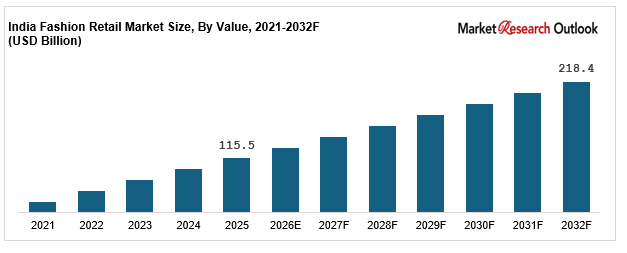
The India Fashion Retail Market size is witnessing rapid expansion, supported by rising disposable incomes, expanding organised retail penetration across Tier 2 and Tier 3 cities, the rapid scaling of e-commerce and quick commerce fashion delivery, the rise of digital-first D2C brands, and government-led Make in India textile manufacturing initiatives. Valued at USD 115.5 billion in 2025 and projected to reach USD 218.4 billion by 2032, growing at a CAGR of 9.6%, the industry growth is being fuelled by strong women’s apparel demand, the accelerating shift toward online and omnichannel retail, growing premiumisation, and rising adoption of branded ethnic, western, and fusion wear among India’s young aspirational consumer base. Women’s apparel leads consumption, while online and e-commerce retail is emerging as the fastest growing distribution channel. Rising influencer-led discovery, social commerce platforms, and Generation Z preferences are reshaping the demand landscape. As organised retail majors including Reliance Retail, Aditya Birla Fashion and Retail, Trent (Tata Group), Shoppers Stop, and Lifestyle International expand store networks and private-label portfolios, and digital-first players such as Myntra, Ajio, Nykaa Fashion, and Meesho scale rapidly, the sector is evolving into a technology-driven, consumer-led, and omnichannel-first ecosystem with strong long-term growth potential.
Key Report Takeaways: India Fashion Retail Market
- The India Fashion Retail Market size is projected to grow from USD 115.5 billion in 2025 to USD 218.4 billion by 2032, registering a CAGR of 9.6%, driven by rising disposable incomes, expanding organised retail penetration, accelerating e-commerce adoption, and the structural shift toward branded, premium, and digitally enabled fashion consumption.
- Women’s apparel dominates the industry, accounting for over 45% of total fashion retail sales in 2025, driven by ethnic wear demand from Tier 2 and Tier 3 cities, expanding western wear adoption among urban working women, and rising spending on occasion wear, fusion wear, and premium innerwear categories.
- Online and e-commerce fashion is emerging as the fastest growing distribution channel within the sector, expected to grow at 18% to 22% annually as Myntra, Ajio, Flipkart Fashion, Nykaa Fashion, and Meesho expand Tier 2/3 city reach, supported by quick commerce fashion delivery and influencer-driven discovery.
- Rapid scaling of value fashion formats such as Trent’s Zudio, Reliance Trends, and V-Mart, with combined store count crossing 3,000 outlets by 2025, is structurally expanding fashion retail in India across small towns, semi-urban centres, and aspirational mass-market segments.
- Rising investments by domestic majors such as Reliance Retail, Aditya Birla Fashion, Trent, Shoppers Stop, and Vedant Fashions in store expansion, private-label development, and D2C acquisitions are strengthening the supply landscape and supporting the industry forecast 2032.
Key Market Drivers: India Fashion Retail Market
Rising Disposable Incomes, Urbanisation, and a Growing Young Consumer Base Driving Fashion Retail Consumption
Growth in fashion retail in India is being driven by rising disposable incomes, rapid urbanisation, and a young aspirational consumer base, with over 65% of India’s population below 35 years of age. India’s per-capita disposable income has grown at 8% to 10% annually over the last five years, supporting discretionary spending on apparel, footwear, and accessories. The country’s urban population is projected to exceed 600 million by 2030, with Tier 2 and Tier 3 cities emerging as the fastest growing fashion retail catchments. Per-capita apparel spending in India remains below USD 80, compared with USD 350 to USD 500 in developed markets, indicating significant long-term headroom for growth. Combined with rising female workforce participation, growing exposure to global fashion trends through social media, and the cultural emphasis on occasion-based dressing across weddings, festivals, and events, these structural shifts are creating strong demand pull-through across the industry.
Source: Market Research Outlook
Rapid Expansion of Organised Retail, Omnichannel Networks, and Tier 2/3 City Penetration
The fashion retail sector in India is benefiting from rapid expansion of organised retail networks, with the organised retail share of total fashion retail rising from around 25% in 2018 to over 40% in 2025, and projected to cross 55% by 2032. Leading retailers such as Reliance Retail (Trends, Ajio), Aditya Birla Fashion and Retail (Pantaloons, Allen Solly, Van Heusen, Louis Philippe), Trent (Westside, Zudio), Shoppers Stop, and Lifestyle International have scaled combined store footprints to over 10,000 outlets across India, with significant expansion focused on Tier 2 and Tier 3 cities. Value fashion chains such as Zudio (Trent), Reliance Trends, V-Mart, and Style Union have crossed 3,000 stores collectively by 2025, capturing aspirational mass-market demand. Omnichannel integration, click-and-collect models, and seamless online-offline experiences are further accelerating organised fashion retail penetration across the country.
E-commerce Boom, Fast Fashion Adoption, and Digital Influence Reshaping Consumer Behaviour
Rapid growth in online fashion is a major catalyst for the sector, with the e-commerce fashion segment projected to grow at 18% to 22% annually through 2032. Online fashion penetration in India crossed 15% of total fashion retail sales in 2025, led by platforms such as Myntra (Flipkart), Ajio (Reliance), Nykaa Fashion, Meesho, Amazon Fashion, and Tata CLiQ. Quick commerce fashion delivery through platforms such as Myntra M-Express, Ajio Rush, and Blinkit Fashion is reshaping consumer expectations around speed and convenience, with same-day and two-hour delivery becoming the new benchmark. Social commerce, influencer-led discovery on Instagram and YouTube, AI-driven personalisation, and AR/VR virtual try-on technologies are deepening engagement and conversion. The combined influence of fast fashion brands such as Zara, H&M, Uniqlo, Mango, and Shein along with rapidly scaling D2C brands is structurally expanding fashion retail in India across all major end-user categories through 2032.
Key Market Challenges: India Fashion Retail Market
Intense Competition, Thin Margins, and Price-Sensitive Indian Consumers Limiting Profitability
The fashion retail industry in India continues to face challenges around intense competition, thin operating margins, and a structurally price-sensitive consumer base. With over 100,000 organised retail outlets, more than 15 large online fashion platforms, and millions of unorganised retailers, competitive intensity has compressed gross margins across mass and mid-market fashion to 30% to 40%, well below global benchmarks of 50% to 60%. Aggressive discounting cycles, end-of-season sales, festive promotions, and platform-led price wars have made discount-led conversion the norm rather than the exception. Average selling prices in value fashion remain below INR 500 per unit, limiting unit economics. While premium and luxury fashion segments enjoy healthier margins, the volume base remains concentrated in price-sensitive mass-market consumers across Tier 2 and Tier 3 cities, limiting near-term profitability across the sector.
High Operating Costs, Real Estate Inflation, and Supply Chain Complexity Affecting Offline Retail Expansion
The Indian fashion retail sector faces structural complexity from rising operating costs, real estate inflation, and a fragmented supply chain. Prime retail real estate rentals in Tier 1 cities such as Mumbai, Delhi NCR, Bengaluru, and Hyderabad have grown at 8% to 12% annually, with high-street and mall rentals often consuming 12% to 18% of store-level revenue. Average store payback periods range between 24 to 36 months, with break-even varying significantly across formats and locations. Supply chain complexity, multi-tier sourcing, and inventory pile-up due to fast-changing fashion cycles add operational pressure. Variations in GST classification on apparel below and above INR 1,000, evolving labelling and packaging norms under the Legal Metrology Act, and state-level retail licensing requirements further create execution friction for retailers operating pan-India.
Counterfeit Products, Grey Market Imports, and Quality Inconsistencies Affecting Premium Fashion Segments
Fashion retail in India faces practical constraints around counterfeit products, grey market parallel imports, and quality inconsistencies, particularly in the premium, bridge-to-luxury, and luxury fashion segments. Industry estimates suggest counterfeit fashion accounts for 25% to 30% of unorganised market sales, with hubs in Delhi, Mumbai, Surat, and Bengaluru wholesale markets impacting brand equity for global and premium Indian labels. Grey market imports of luxury handbags, footwear, and apparel through duty-free routes, hand-baggage channels, and unauthorised resellers further erode authorised distributor pricing. Quality inconsistencies in online-only D2C brands, sizing variability across platforms, and return rates exceeding 25% to 35% in online fashion remain operational challenges. While brand-protection initiatives, anti-counterfeit technologies such as RFID and QR-coded authentication, and stricter customs enforcement are emerging, these issues remain a near-term challenge for premium players operating in the country.
Key Market Trends: India Fashion Retail Market
Rising Premiumisation, D2C Brand Growth, and Sustainable Fashion Adoption Across India
The Indian fashion retail industry is undergoing a clear shift toward premiumisation, with bridge-to-luxury and premium segments expected to grow at 12% to 15% annually through 2032, outpacing the mass-market segment. Average ticket sizes in premium fashion have grown at 10% to 12% annually, with consumers increasingly willing to pay for design, brand equity, sustainability credentials, and product longevity. Direct-to-consumer (D2C) fashion brands such as Bewakoof, The Souled Store, Snitch, Bombay Shirt Company, Sugar Cosmetics, and Mokobara have scaled rapidly, with the D2C fashion category attracting venture capital funding exceeding USD 1.5 billion between 2022 and 2025. Sustainable fashion, recycled fabrics, organic cotton, and slow-fashion movements are gaining traction, particularly among urban millennials and Generation Z consumers, with brands such as FabIndia, Doodlage, No Nasties, and Suta scaling rapidly. This consumer transition is reinforcing the long-term outlook across both organised retail and digital-first categories.
Growth of Quick Commerce Fashion, Omnichannel Retail, and AI-Driven Personalisation
A clear shift toward quick commerce fashion, omnichannel retail, and AI-driven personalisation is reshaping fashion retail in India, particularly in the online and premium segments. Quick commerce platforms such as Myntra M-Express, Ajio Rush, Blinkit Fashion, and Zepto Fashion now offer fashion delivery in 60 to 120 minutes across 25 to 30 metros and Tier 1 cities, with the quick-commerce fashion category projected to grow at 35% to 40% annually through 2027. Omnichannel integration including click-and-collect, endless aisle, virtual try-on, and unified customer profiles is becoming standard across leading players such as Reliance Retail, Aditya Birla Fashion, Shoppers Stop, and Lifestyle. AI-powered recommendation engines, generative AI for design and merchandising, AR-based virtual try-on, and computer-vision-driven inventory management are accelerating personalisation and operational efficiency, reshaping the retail value chain.
Capacity Expansion by Domestic Retailers, Private-Label Growth, and Make in India Textile Manufacturing
A wave of domestic capacity expansion and private-label growth is reshaping the supply landscape across fashion retail in India. Combined India-focused capital expenditure announcements in fashion retail expansion exceeded USD 4 billion across 2023 to 2025. Trent’s Zudio crossed 700 stores by 2025, Reliance Retail expanded Trends, Ajio, and Azorte formats across 3,500-plus outlets, Aditya Birla Fashion scaled Pantaloons and Style Up store count, Shoppers Stop expanded Intune value-fashion format, and Vedant Fashions (Manyavar) scaled Manyavar and Mohey ethnic wear stores. Private-label penetration has crossed 60% in value fashion and 35% to 45% in mid-market fashion, supporting margin expansion. Make in India initiatives, the Production Linked Incentive (PLI) scheme for textiles with INR 10,683 crore outlay, PM MITRA textile parks, and rising integrated apparel manufacturing are structurally strengthening domestic supply across the entire value chain.
Segmental Insights: India Fashion Retail Market
By Category: Women’s Wear Segment Dominates the India Fashion Retail Market
The women’s wear segment dominates fashion retail in India, accounting for an estimated 45% to 48% of total fashion retail sales, driven by rising female workforce participation, growing ethnic and fusion wear demand, expanding occasion wear consumption, and rapid premiumisation across western wear categories. Ethnic wear including sarees, salwar-kameez, lehengas, and kurtis remains the largest sub-category, with brands such as Manyavar, Mohey, Biba, W, Aurelia, FabIndia, and Global Desi leading branded penetration. The men’s wear segment contributes another 38% to 40% of demand, driven by formal wear, casual wear, and emerging premium denim and athleisure categories. Kids’ wear accounts for 12% to 15%, growing rapidly through dedicated brands such as Hopscotch, FirstCry Fashion, and Mothercare. In 2025, leading retailers including Reliance Retail, Aditya Birla Fashion, Trent, Shoppers Stop, and Lifestyle scaled women’s wear assortments under both private-label and branded formats, reinforcing segment dominance within the sector.
By Distribution Channel: Online Leads Growth While Specialty and Multi-Brand Outlets Anchor Volume
Specialty stores and multi-brand outlets together account for approximately 50% of total fashion retail sales, supported by exclusive brand outlets, large-format department stores, and chain specialty retailers across malls and high streets. Online and e-commerce fashion is the fastest growing distribution channel, expanding at 18% to 22% annually, with current online penetration at 15% to 17% of total fashion retail and projected to cross 25% by 2032. Hypermarkets and supermarkets contribute 10% to 12%, primarily through value fashion and private labels in formats such as Reliance Smart, DMart, and Big Bazaar successors. Department stores including Shoppers Stop, Lifestyle, Pantaloons, and Central anchor mid-market and premium consumption, while exclusive brand outlets remain critical for premium and luxury fashion. Quick commerce fashion is the emerging channel, expanding rapidly across metro markets and reshaping consumer expectations across the country.
Regional Insights: India Fashion Retail Market
Regional analysis of fashion retail in India shows that West India and North India collectively account for approximately 55% to 60% of total fashion retail sales, driven by Maharashtra (Mumbai, Pune), Gujarat (Ahmedabad, Surat), Delhi NCR, Uttar Pradesh, and Punjab, supported by high per-capita apparel spending, dense urban catchments, and strong wedding-and-festival driven demand cycles. South India contributes around 22% to 25% of demand, led by Karnataka (Bengaluru), Tamil Nadu (Chennai, Coimbatore), Telangana (Hyderabad), and Kerala, supported by strong IT-services employment, dual-income households, and growing premium fashion adoption. Central and East India together account for 15% to 18% of demand, supported by Madhya Pradesh, Chhattisgarh, West Bengal, Odisha, and Jharkhand, where Tier 2 and Tier 3 city consumption is accelerating through value fashion expansion. In 2025, store expansion by Trent (Westside, Zudio) across South India, Reliance Trends and Ajio across pan-India catchments, Aditya Birla Fashion across North and West India, and Vedant Fashions (Manyavar) across wedding-led markets reinforced regional supply hubs, supporting closer execution of mass and premium fashion retail projects across the country.
Recent Developments: India Fashion Retail Market
- The India Fashion Retail Market witnessed strong momentum in store expansion, e-commerce growth, and category launches during 2024 and 2025. India added a record 1,800-plus new organised fashion retail stores in calendar year 2025, with Trent’s Zudio alone opening over 200 stores and crossing 700 outlets cumulatively. Online fashion penetration crossed 15% of total fashion retail sales by mid-2025, with the residential and Tier 2/3 city segment accounting for over 55% of new e-commerce fashion buyers. Cumulative organised fashion retail revenue in India is projected to reach USD 95 to USD 100 billion by FY28, growing at an average 14% to 16% annually.
- Domestic fashion retailers have deepened India-focused expansion and private-label growth. In 2025, Reliance Retail scaled Trends, Ajio, and Azorte to over 3,500 outlets with new omnichannel integration, Trent expanded Zudio and Westside aggressively across Tier 2 and Tier 3 cities, Aditya Birla Fashion strengthened Pantaloons, Style Up, and TMRW D2C portfolio, Shoppers Stop accelerated the Intune value-fashion format rollout, and Vedant Fashions expanded Manyavar and Mohey ethnic wear stores. Page Industries scaled Jockey innerwear and athleisure capacity, and Arvind Fashions deepened US Polo Assn and Tommy Hilfiger penetration. These developments are strengthening domestic supply and supporting the long-term industry forecast.
- Online and quick commerce fashion momentum has gained strong traction across the country. In 2025, leading platforms including Myntra (Flipkart), Ajio (Reliance), Nykaa Fashion, Meesho, Amazon Fashion, and Tata CLiQ expanded fashion assortments, D2C brand integrations, and quick-commerce delivery footprints. Strategic partnerships between domestic D2C brands such as Bewakoof, The Souled Store, Snitch, and Bombay Shirt Company with marketplace platforms, and category expansion by global fast-fashion players such as Zara, H&M, Uniqlo, and Mango are positioning India as one of the most actively scaling fashion retail markets globally, strengthening long-term competitive positioning across the forecast period to 2032.
Key Market Players: India Fashion Retail Market
- Reliance Retail Limited (Trends, Ajio, Azorte)
- Aditya Birla Fashion and Retail Limited (Pantaloons, Allen Solly, Louis Philippe, Van Heusen)
- Trent Limited (Westside, Zudio – Tata Group)
- Shoppers Stop Limited
- Lifestyle International Pvt. Ltd. (Landmark Group)
- Vedant Fashions Limited (Manyavar, Mohey)
- Arvind Fashions Limited
- Page Industries Limited (Jockey)
- V-Mart Retail Limited
- Cantabil Retail India Limited
- Myntra Designs Pvt. Ltd. (Flipkart Group)
- FabIndia Limited
- Bata India Limited
Report Scope
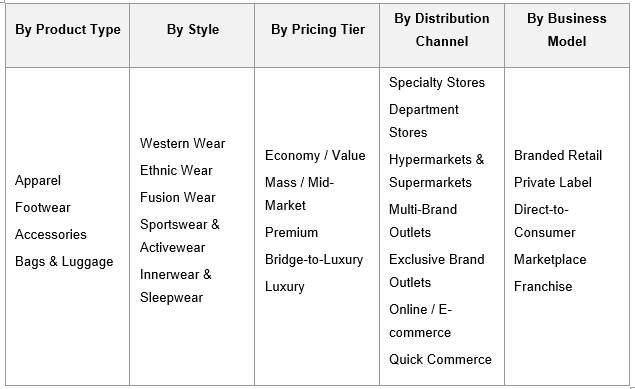
In this report, the India Fashion Retail Market has been segmented into the following categories, in addition to detailed analysis of key industry trends, market dynamics, competitive landscape, and growth opportunities across the forecast period:
- By Product Type
- Apparel
- Footwear
- Accessories
- Bags & Luggage
- By Category
- Men’s Wear
- Women’s Wear
- Kids’ Wear
- Unisex
- By Style
- Western Wear
- Ethnic Wear
- Fusion Wear
- Sportswear & Activewear
- Innerwear & Sleepwear
- By Pricing Tier
- Economy / Value
- Mass / Mid-Market
- Premium
- Bridge-to-Luxury
- Luxury
- By Distribution Channel
- Specialty Stores
- Department Stores
- Hypermarkets & Supermarkets
- Multi-Brand Outlets
- Exclusive Brand Outlets
- Online / E-commerce
- Quick Commerce
- By Business Model
- Branded Retail
- Private Label
- Direct-to-Consumer (D2C)
- Marketplace
- Franchise
- By Geography
- North India
- South India
- West India
- East India
- Central India
Competitive Landscape
Company Profiles:
Detailed analysis of the leading companies operating in the India Fashion Retail Market, including business overview, product portfolio, strategic initiatives, competitive positioning, and recent developments.
Company Information
Detailed profiling and strategic analysis of additional market players (up to five companies), including emerging D2C fashion brands, specialty ethnic and athleisure players, quick-commerce fashion platforms, or niche premium and luxury retailers.
The India Fashion Retail Market report is part of our ongoing research coverage. For early access, customised insights, or to confirm the release timeline, please contact our team at sarita@marketresearchoutlook.com
Table of Contents
- Research Framework
- Market Segmentation
- Research Objective
- Research Methodology
- Qualitative Research
- Primary Research
- Secondary Research
- Quantitative Research
- Market Breakdown & Data Triangulation
- Demand Side
- Supply Side
- Primary Research Respondents
- Assumption & Limitation
- Executive Summary
- Market Overview, 2021-2032
- By Product Type
- By Category
- By Style
- By Pricing Tier
- By Distribution Channel
- By Business Model
- By Region
- Analyst Recommendations
- Geopolitical Impact on India Fashion Retail Market
- India Fashion Retail Market Insights
- Market Dynamics
- Growth Drivers
- Rising disposable incomes, urbanisation, and a growing young consumer base driving fashion retail consumption.
- Rapid expansion of organised retail, omnichannel networks, and Tier 2/3 city penetration driving fashion retail demand.
- E-commerce boom, fast fashion adoption, and digital influence reshaping consumer purchase behaviour.
- Restraints
- Intense competition, thin margins, and price-sensitive Indian consumers limiting profitability.
- High operating costs, real estate inflation, and supply chain complexity affecting offline retail expansion.
- Counterfeit products, grey market parallel imports, and quality inconsistencies affecting premium fashion segments.
- Opportunities
- Rising premiumisation, D2C brand growth, and Tier 2/3 city demand creating new white spaces in fashion retail.
- Sustainable fashion, circular economy, and Make in India textile manufacturing aligning with global ESG trends.
- AI-driven personalisation, AR/VR virtual try-on, and quick-commerce fashion delivery opening next-gen retail innovation.
- Challenges
- Inventory management, fast-changing fashion cycles, and high return rates challenging operational efficiency.
- Skilled workforce shortage in design, merchandising, and store operations limiting retail scale-up.
- Regulatory complexity in FDI norms, GST classification, and labelling compliance creating execution friction.
- Technological Advancements
- Recent Technological Advancements
- Prior to 2020
- Porter’s Five Forces Analysis
- PESTLE Analysis
- Industry Value Chain & Entry Points
- Upstream Raw Materials (cotton, synthetic yarn, dyes, accessories, trims, packaging)
- Textile & Fabric Manufacturers (woven, knitted, denim, technical textiles)
- Garment Manufacturers & Apparel Producers (private label, branded, contract manufacturing)
- Designers, Brand Owners & D2C Players (Reliance, Aditya Birla, Trent, Manyavar, D2C brands)
- Quality Control, R&D & Testing Laboratories (BIS, AEPC, ISO, OEKO-TEX standards)
- Distributors, Wholesalers & B2B Marketplaces (Udaan, IndiaMART, regional distributors)
- Organised Retail Chains & Department Stores (Trent, Pantaloons, Shoppers Stop, Lifestyle)
- Online Marketplaces & E-commerce Platforms (Myntra, Ajio, Nykaa Fashion, Amazon, Meesho)
- Quick Commerce & Last-Mile Delivery Partners (M-Express, Ajio Rush, Blinkit, Zepto)
- End-Users (men’s wear, women’s wear, kids’ wear, unisex consumers across pricing tiers)
- India Fashion Retail Market: Regulatory Framework
- India Fashion Retail Market Overview
- Market Size & Forecast, 2021-2032
- By Value (USD Million)
- By Volume (Million Units)
- Market Share & Forecast
- By Product Type
- Apparel
- Footwear
- Accessories
- Bags & Luggage
- By Category
- Men’s Wear
- Women’s Wear
- Kids’ Wear
- Unisex
- By Style
- Western Wear
- Ethnic Wear
- Fusion Wear
- Sportswear & Activewear
- Innerwear & Sleepwear
- By Pricing Tier
- Economy / Value
- Mass / Mid-Market
- Premium
- Bridge-to-Luxury
- Luxury
- By Distribution Channel
- Specialty Stores
- Department Stores
- Hypermarkets & Supermarkets
- Multi-Brand Outlets
- Exclusive Brand Outlets
- Online / E-commerce
- Quick Commerce
- By Business Model
- Branded Retail
- Private Label
- Direct-to-Consumer (D2C)
- Marketplace
- Franchise
- By Geography
- North India
- South India
- West India
- East India
- Central India
- Competitive Landscape
- India Fashion Retail Market Company Market Share Analysis, 2025
- Competitive Benchmarking, By Operating Parameters
- Key Strategic Development (Mergers, Acquisitions, Partnerships, Etc.)
- List of Emerging Players
- Company Profile
- Reliance Retail Limited
- Introduction & Company Profile
- Product Benchmarking
- Strategic Outlook
- Key Competitors
- Financial Analysis
- SWOT Analysis
- (Same Data Pointers Will Be Provided for The Below Companies)
- Aditya Birla Fashion and Retail Limited
- Trent Limited (Tata Group)
- Shoppers Stop Limited
- Lifestyle International Pvt. Ltd.
- Vedant Fashions Limited (Manyavar)
- Arvind Fashions Limited
- Page Industries Limited
- V-Mart Retail Limited
- Cantabil Retail India Limited
- Myntra Designs Pvt. Ltd.
- FabIndia Limited
- Bata India Limited
- Other Prominent Players
- By Product Type
- Market Size & Forecast, 2021-2032
* Financial information in case of non-listed companies will be provided as per availability
** The segmentation and the companies are subjected to modifications based on in-depth secondary for the final deliverable
Frequently Asked Questions
1. How large is the India Fashion Retail Market and what is its growth forecast?
Ans: The India Fashion Retail Market is projected to grow from USD 115.5 billion in 2025 to USD 218.4 billion by 2032, at a CAGR of 9.6%, supported by rising disposable incomes, expanding organised retail, and accelerating online fashion adoption.
2. Which segments are driving demand in the India Fashion Retail Market?
Ans: Women's wear leads the market with over 45% share, while online and quick commerce fashion are the fastest growing channels. Ethnic, western, and fusion wear drive sustained category-level growth nationwide.
3. What are the key drivers of growth in the India Fashion Retail Market?
Ans: Key growth drivers include rising disposable incomes, urbanisation, organised retail expansion, e-commerce boom, social media-led discovery, premiumisation, D2C brand growth, and Make in India textile manufacturing initiatives strengthening domestic supply.
4. Which regions are driving growth in the India Fashion Retail Market?
Ans: West India and North India together drive 55% to 60% of total fashion retail sales, led by Maharashtra, Gujarat, Delhi NCR, and UP. South India and Tier 2/3 cities are accelerating fastest in 2025.
5. What are the latest trends in the India Fashion Retail Market?
Ans: Latest market trends include rising premiumisation, D2C brand growth, quick commerce fashion delivery, AI-driven personalisation, sustainable fashion adoption, omnichannel retail integration, and rapid expansion of value formats in Tier 2 and Tier 3 cities.
Frequently Asked Questions
1. How large is the India Fashion Retail Market and what is its growth forecast?
Ans: The India Fashion Retail Market is projected to grow from USD 115.5 billion in 2025 to USD 218.4 billion by 2032, at a CAGR of 9.6%, supported by rising disposable incomes, expanding organised retail, and accelerating online fashion adoption.
2. Which segments are driving demand in the India Fashion Retail Market?
Ans: Women's wear leads the market with over 45% share, while online and quick commerce fashion are the fastest growing channels. Ethnic, western, and fusion wear drive sustained category-level growth nationwide.
3. What are the key drivers of growth in the India Fashion Retail Market?
Ans: Key growth drivers include rising disposable incomes, urbanisation, organised retail expansion, e-commerce boom, social media-led discovery, premiumisation, D2C brand growth, and Make in India textile manufacturing initiatives strengthening domestic supply.
4. Which regions are driving growth in the India Fashion Retail Market?
Ans: West India and North India together drive 55% to 60% of total fashion retail sales, led by Maharashtra, Gujarat, Delhi NCR, and UP. South India and Tier 2/3 cities are accelerating fastest in 2025.
5. What are the latest trends in the India Fashion Retail Market?
Ans: Latest market trends include rising premiumisation, D2C brand growth, quick commerce fashion delivery, AI-driven personalisation, sustainable fashion adoption, omnichannel retail integration, and rapid expansion of value formats in Tier 2 and Tier 3 cities.