

India Air Compressor Market Size, Share & Forecast 2032
- Chemicals & Advanced Materials
- May 2026
- Pages 140
- Report Format: pdf
- Report Price: $2400 USD
India’s air compressor market is witnessing robust, broad-based growth, driven by accelerated manufacturing capex under Make in India and Production-Linked Incentive (PLI) schemes, rapid expansion of construction, mining, and infrastructure projects, the structural shift toward energy-efficient and oil-free air compressor systems aligned with sustainability and clean-air regulations, growing demand from pharmaceuticals, food & beverage, and electronics industries, and rising investments by global air compressor majors and domestic players in India-specific manufacturing capacity, service infrastructure, and aftermarket networks.
Related research: India Copper Market, India Steel Pipes and Steel Tubes Market and India Soft Magnetic Materials Market.
Report Description
| Study Duration | 2021-2032 |
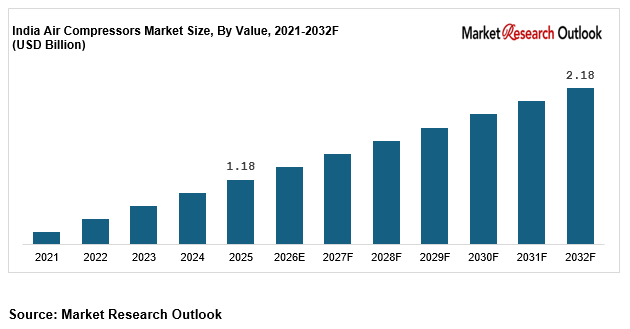
| Market Size (2025) | USD 1.18 Billion |
| CAGR (2026-2032) | 9.2% |
| Leading Segment | Rotary Screw Air Compressors |
| Fastest Growing Segment | Oil-Free & Energy-Efficient Air Compressors |
| Market Size (2032) | USD 2.18 Billion |
Market Overview: India Air Compressor Market
The India air compressor market is growing steadily, supported by rising manufacturing capex under Make in India and PLI schemes, along with strong demand from construction, mining, and infrastructure sectors. The air compressor market in India is valued at USD 1.18 billion in 2025 and is expected to reach USD 2.18 billion by 2032, growing at a CAGR of 9.2%. Demand across manufacturing, oil and gas, power, pharmaceuticals, food and beverage, and electronics is driving expansion in the industrial air compressor market in India.
Rotary screw air compressors dominate the market, while oil-free and energy-efficient air compressor systems are the fastest-growing segments due to increasing focus on lifecycle cost, uptime, and ISO 8573 compliance.
Energy-efficient and oil-free technologies are reshaping the India air compressor market.
Key Report Takeaways: India Air Compressor Market
- The India air compressor market size is projected to grow from USD 1.18 billion in 2025 to USD 2.18 billion by 2032, registering a CAGR of 9.2%. Growth in the air compressor market in India is driven by rising manufacturing capex, strong construction and infrastructure activity, and increasing adoption of energy-efficient and oil-free air compressor systems.
- Rotary screw air compressors dominate the India air compressor market, accounting for over 50% to 55% of total demand. Their widespread use across manufacturing, oil and gas, power generation, and process industries is driven by high efficiency, continuous-duty performance, and reliable compressed air supply across the industrial air compressor market in India.
- Oil-free air compressors are emerging as the fastest-growing segment in the industrial air compressor market in India, expected to grow at 12% to 15% annually. Increasing demand from pharmaceuticals, food and beverage, electronics, and semiconductor industries for ISO 8573-1 Class 0 contamination-free compressed air is driving this trend.
- Accelerated manufacturing investments under Make in India and PLI schemes, combined with expansion of metro rail, expressways, mining, and oil and gas infrastructure, are structurally increasing demand across stationary, portable, and rental compressors in the air compressor industry in India.
- Rising investments by global manufacturers such as Atlas Copco, Ingersoll Rand, Kaeser, Sullair, and Gardner Denver, along with capacity expansion and service network strengthening by domestic players like ELGi Equipments, Kirloskar Pneumatic, and BHEL, are enhancing innovation, localisation, and long-term growth prospects in the India air compressor market forecast 2032.
Key Market Drivers: India Air Compressor Market
Accelerated Manufacturing Capex Under Make in India and PLI Schemes Driving Industrial Air Compressor Demand
The India air compressor market is being strongly driven by the ongoing manufacturing capex cycle supported by Make in India and Production-Linked Incentive (PLI) schemes. Covering 14 priority sectors such as electronics, automotive, pharmaceuticals, telecom, white goods, and specialty steel, total PLI outlays of nearly INR 1.97 lakh crore are triggering large-scale capacity additions. This is significantly boosting demand across the industrial air compressor market in India, as new factories, EV component plants, pharma units, and metal processing facilities require reliable compressed air infrastructure.
Air compressors account for nearly 5% to 10% of a plant’s total power consumption, making them a core utility investment rather than a discretionary purchase. As manufacturers expand production capacity and modernise existing plants, demand for energy-efficient and high-performance systems is rising across the air compressor industry in India.
Manufacturing capex expansion is creating long-term, structural demand for air compressors across the India air compressor market.
Rapid Expansion of Construction, Mining, and Infrastructure Projects Boosting Portable Air Compressor Sales
The India air compressor market is being significantly driven by rapid expansion in construction, mining, and infrastructure activity across the country. Large-scale government programmes such as the National Infrastructure Pipeline (NIP), Bharatmala, Sagarmala, Gati Shakti, Smart Cities Mission, and metro rail projects are accelerating demand for compressed air solutions. These projects rely heavily on portable air compressors and diesel-driven systems for applications including drilling, jackhammering, sandblasting, road construction, tunnelling, and concrete spraying across the broader air compressor market in India.
The mining sector is also a key demand driver, with companies like Coal India and private operators requiring high-pressure portable compressors for extraction and processing activities. As a result, portable air compressors are witnessing strong adoption, with demand in the industrial air compressor market in India growing at 9% to 11% annually. Increasing use of rental and leasing models is further supporting deployment across short-cycle and project-based applications.
Infrastructure expansion and project-driven demand are making portable air compressors a key growth segment in the India air compressor market.
Structural Shift Toward Energy-Efficient, Oil-Free, and VSD Air Compressors
A major transformation in the India air compressor market is the shift toward energy-efficient air compressors, oil-free compressor systems, and Variable Speed Drive (VSD) enabled technologies. Rising electricity costs and increasing focus on operational efficiency are pushing industrial buyers to adopt advanced systems across the air compressor industry in India. VSD-enabled rotary screw compressors can deliver 20% to 35% energy savings compared to fixed-speed units, with typical payback periods of 18 to 30 months.
Demand for oil-free air compressors is also rising rapidly, particularly from pharmaceuticals, food and beverage, and electronics sectors that require ISO 8573-1 Class 0 contamination-free compressed air. Leading manufacturers are launching new energy-efficient and oil-free models tailored for Indian applications, reinforcing premiumisation across the industrial air compressor market in India.
Energy efficiency, compliance, and lifecycle cost optimisation are driving the next phase of growth in the India air compressor market.
Key Market Challenges: India Air Compressor Market
High Upfront Capital Cost and Total Cost of Ownership Slowing MSME Adoption
The India air compressor market continues to face adoption barriers due to high upfront capital cost and total cost of ownership concerns, particularly among MSME buyers. A mid-range rotary screw air compressor (30 to 75 kW) typically costs between INR 4 lakh and INR 18 lakh, while oil-free and VSD-enabled air compressor systems can be 30% to 50% more expensive. For small and mid-sized manufacturers, this CAPEX outlay, combined with AMC, energy consumption, and overhaul costs over a 7-to-10-year lifecycle, creates hesitation in adopting advanced systems across the industrial air compressor market in India.
Although leading brands are offering financing, rental, and service-based models, cost sensitivity remains high in tier-2 and tier-3 industrial clusters. This is slowing the shift toward premium, energy-efficient air compressor technologies in the broader air compressor industry in India.
High lifecycle cost perception remains a key barrier to faster penetration of advanced air compressor systems in India.
Heavy Import Dependence for High-Pressure, Oil-Free, and Specialty Components
The India air compressor market remains dependent on imports for high-end components such as airends, advanced controllers, oil-free rotor assemblies, and centrifugal compressor parts. Around 40% to 50% of these critical components are sourced from Europe, Japan, the United States, and China, impacting supply reliability across the air compressor market in India.
This import dependence exposes OEMs and end-users to currency fluctuations, shipping delays, and extended lead times of 10 to 16 weeks for key spares. While Make in India and PLI initiatives are encouraging localisation, full domestic manufacturing of advanced oil-free and centrifugal air compressor technologies is expected only by 2028 to 2030.
Import dependency continues to pose supply chain and cost risks for the India air compressor market.
Volatility in Electricity Tariffs and Energy Costs Pressuring Margins
Energy cost remains a critical challenge in the India air compressor market, as air compressors account for 5% to 10% of total plant electricity consumption, and up to 15% in process-intensive industries. Industrial electricity tariffs in India have increased by 12% to 22% over the past three years, significantly raising operating costs across the industrial air compressor market in India.
This has led many end-users, especially in sectors such as steel, cement, chemicals, paper, and textiles, to delay upgrades and extend the life of older, less efficient compressor systems. While OEMs are introducing VSD-enabled compressors, heat recovery systems, and IoT-based energy monitoring, energy cost volatility continues to influence procurement decisions and upgrade cycles.
Rising energy costs are directly impacting operating margins and slowing technology upgrades in the India air compressor market.
Key Market Trends: India Air Compressor Market
Rapid Adoption of Energy-Efficient, Oil-Free, and IoT-Connected Air Compressors
The India air compressor market is witnessing a strong shift toward energy-efficient air compressors, oil-free air compressor systems, and IoT-enabled compressor technologies, with this segment growing at 12% to 15% annually—well ahead of the overall air compressor market in India. Increasing focus on Bureau of Energy Efficiency norms, ISO 8573 air-quality compliance, and Industry 4.0 adoption across factories is accelerating this transition.
Modern industrial air compressors now integrate real-time energy monitoring, predictive maintenance, remote diagnostics, and OEM-managed service platforms, improving uptime and reducing lifecycle cost across the industrial air compressor market in India. Leading players such as Atlas Copco, Ingersoll Rand, Kaeser, ELGi Equipments, and Kirloskar Pneumatic have expanded connected and oil-free product portfolios in 2024–2025, reinforcing this structural trend
Smart, connected, and energy-efficient compressor systems are redefining the India air compressor market.
Capacity Expansion, India-Focused R&D, and Aftermarket Growth
The India air compressor market is seeing strong momentum in capacity expansion and India-specific R&D investments. Combined capital expenditure across OEMs, component manufacturers, and service networks exceeded USD 400 million between 2023 and 2025, strengthening supply capabilities across the air compressor industry in India.
Global and domestic manufacturers are expanding production and service infrastructure to meet rising demand. Atlas Copco has strengthened its Pune operations, ELGi Equipments expanded Coimbatore facilities, and Kirloskar Pneumatic scaled rotary screw and centrifugal capacity. At the same time, companies such as Ingersoll Rand, Kaeser, and Sullair are deepening service coverage, while domestic players including BHEL and Anest Iwata Motherson are expanding product portfolios.
Localisation, service-led models, and R&D investment are strengthening long-term competitiveness in the India air compressor market.
Rising Role of Rental, Leasing, and Pay-Per-CFM Models
Rental, leasing, and pay-per-CFM service models are emerging as high-growth channels in the India air compressor market, expected to account for 18% to 22% of total revenue by 2032. Rental demand is growing at 10% to 13% annually, outpacing traditional outright sales, particularly across construction, mining, oil and gas, and short-cycle industrial applications.
Specialised rental fleets from Atlas Copco, Ingersoll Rand, and ELGi Equipments are expanding rapidly, while pay-per-CFM and BOOM (Build-Own-Operate-Maintain) models are gaining traction among large industrial customers. These flexible procurement options are reshaping the air compressor market in India by reducing upfront investment and improving operational efficiency
Flexible, service-based models are transforming how air compressors are bought and deployed in India.
Segmental Insights: India Air Compressor Market
By Product Type: Rotary Screw Compressors Dominate
Rotary screw air compressors dominate the India air compressor market, accounting for 50% to 55% of total demand due to their suitability for continuous-duty industrial operations. Reciprocating compressors contribute 25% to 28%, mainly in MSME and small-scale applications, while centrifugal compressors account for 10% to 12%, primarily in refineries, petrochemical plants, and large industrial facilities.
Oil-free compressors and scroll compressor systems are the fastest-growing categories, driven by demand from pharmaceuticals, food processing, and electronics manufacturing. Increasing adoption of high-efficiency and contamination-free compressed air solutions is reshaping product mix across the industrial air compressor market in India
Product mix is shifting toward high-efficiency and oil-free compressor technologies across India.
By End-Use Industry: Manufacturing Leads, Pharma and Electronics Grow Fastest
Manufacturing remains the largest segment in the India air compressor market, accounting for 35% to 40% of total demand. Oil and gas contributes 12% to 15%, construction and mining 10% to 12%, and power generation around 8% to 10%.
Pharmaceuticals, food and beverage, and electronics sectors are the fastest-growing, expanding at 12% to 15% annually due to increasing demand for oil-free and ISO 8573-1 compliant compressed air systems. Automotive, textiles, and chemicals also contribute significantly, supported by ongoing industrial expansion across the air compressor industry in India
Regional Insights: India Air Compressor Market
Regional analysis of the India air compressor market shows strong concentration in West and South India, which together account for 60% to 64% of total demand. Key industrial hubs include Maharashtra, Gujarat, Tamil Nadu, Karnataka, and Telangana, supported by dense manufacturing clusters and infrastructure development.
North India contributes 20% to 24% of demand, led by NCR, Haryana, Uttar Pradesh, and Rajasthan, while East and Central India account for 14% to 18%, driven by steel, mining, and power sector investments. Expansion of service networks and manufacturing capacity by major OEMs is improving regional penetration and strengthening demand across the air compressor market in India
Regional industrial clusters are driving demand concentration and expansion across the India air compressor market.
Recent Developments: India Air Compressor Market
- The India air compressor market is witnessing strong momentum in capacity expansion, energy-efficient product launches, and manufacturing scale-up during 2024 and 2025. Leading players such as Atlas Copco strengthened their Pune facility, while ELGi Equipments expanded rotary screw and oil-free air compressor capacity in Coimbatore. Kirloskar Pneumatic scaled centrifugal compressor production, and Ingersoll Rand broadened operations across Naroda and Chennai. Domestic companies including BHEL and Anest Iwata Motherson have also introduced new product lines, reinforcing India’s position in the global air compressor industry in India and strengthening the overall industrial air compressor market in India.
- Aftermarket expansion and service-led models are emerging as key growth drivers in the air compressor market in India. Major OEMs including Atlas Copco, Ingersoll Rand, Kaeser, Sullair, ELGi Equipments, and Kirloskar Pneumatic are strengthening distributor networks, deploying IoT-based monitoring systems, and offering predictive maintenance solutions across industrial clusters. Rental and leasing operators such as Atlas Copco Specialty Rental and IR Rental are expanding fleets for construction, mining, and oil and gas applications, while pay-per-CFM and BOOM (Build-Own-Operate-Maintain) models are gaining traction among large industrial buyers.
- Sustainability-driven innovation is gaining strong traction in the India air compressor market, with increasing focus on energy-efficient and low-emission technologies. In 2024 and 2025, manufacturers launched VSD-enabled rotary screw air compressors delivering 20% to 35% energy savings, along with oil-free Class 0 ISO 8573-1 compliant systems for pharmaceuticals and electronics industries. Heat recovery systems that reuse compressor waste energy are also being adopted across large industrial facilities. Strategic collaborations between OEMs, EPC contractors, and energy auditors are accelerating adoption of advanced compressed air solutions across the industrial air compressor market in India.
Key Market Players: India Air Compressor Market
- Atlas Copco (India) Limited
- Ingersoll Rand (India) Limited
- ELGi Equipments Limited
- Kirloskar Pneumatic Company Limited
- Sullair India (Hitachi Group)
- Kaeser Compressors India Pvt. Ltd.
- Gardner Denver India Pvt. Ltd.
- BHEL (Bharat Heavy Electricals Limited)
- Mitsubishi Heavy Industries India Pvt. Ltd.
- Anest Iwata Motherson Pvt. Ltd.
- Boge Compressors India Pvt. Ltd.
- Chicago Pneumatic India
Report Scope
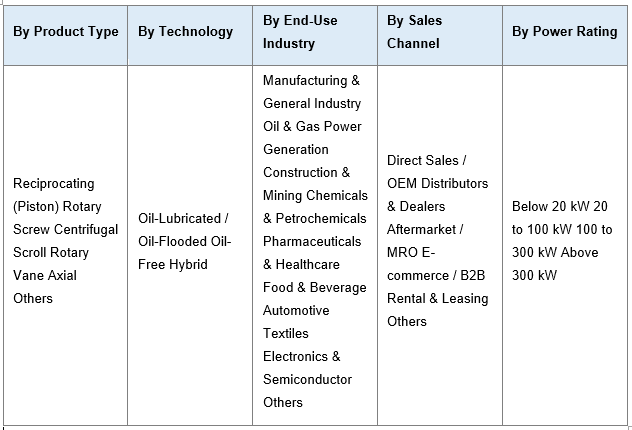
In this report, the India Air Compressor Market has been segmented into the following categories, in addition to detailed analysis of key industry trends, market dynamics, competitive landscape, and growth opportunities across the forecast period:
- By Product Type
- Reciprocating (Piston) Compressors
- Rotary Screw Compressors
- Centrifugal Compressors
- Scroll Compressors
- Rotary Vane Compressors
- Axial Compressors
- Others
- By Technology
- Oil-Lubricated / Oil-Flooded
- Oil-Free
- Hybrid
- By Operation Stage
- Single-Stage
- Multi-Stage
- By Power Rating
- Below 20 kW
- 20 to 100 kW
- 100 to 300 kW
- Above 300 kW
- By Pressure Range
- Low Pressure (Below 20 bar)
- Medium Pressure (20 to 100 bar)
- High Pressure (Above 100 bar)
- By Portability
- Stationary
- Portable
- By Sales Channel
- Direct Sales / OEM Contracts
- Distributors & Dealers
- Aftermarket Service / MRO Channels
- E-commerce / Online B2B
- Rental & Leasing
- Others
- By End-Use Industry
- Manufacturing & General Industry
- Oil & Gas
- Power Generation
- Construction & Mining
- Chemicals & Petrochemicals
- Pharmaceuticals & Healthcare
- Food & Beverage
- Automotive
- Textiles
- Electronics & Semiconductor
- Others
- By Geography
- North India
- South India
- West India
- East India
- Central India
Competitive Landscape
Company Profiles:
Detailed analysis of leading air compressor companies operating in the India Air Compressor Market, covering business overview, product portfolio, strategic initiatives, competitive positioning, and recent developments.
Company Information
Detailed profiling and strategic analysis of additional players in the India air compressor market (up to five companies), including emerging Indian air compressor brands, oil-free and energy-efficient specialists, premium global entrants, and niche segment leaders.
For a free sample of the India Air Compressor Market report, customised insights or delivery timelines, submit your query hereresearch@marketresearchoutlook.com
Table of Contents
- Research Framework
- Market Segmentation
- Research Objective
- Research Methodology
- Qualitative Research
- Primary Research
- Secondary Research
- Quantitative Research
- Market Breakdown & Data Triangulation
- Demand Side
- Supply Side
- Primary Research Respondents
- Assumption & Limitation
- Executive Summary
- Market Overview, 2021-2032
- By Product Type
- By Technology
- By End-Use Industry
- By Power Rating
- By Sales Channel
- By Region
- Analyst Recommendations
- Geopolitical Impact on India Air Compressor Market
- India Air Compressor Market Insights
- Market Dynamics
- Growth Drivers
- Accelerated manufacturing capex under Make in India and PLI schemes driving core industrial air compressor demand.
- Rapid expansion of construction, mining, and infrastructure projects boosting portable and diesel-driven air compressor sales.
- Structural shift toward energy-efficient, oil-free, and variable speed drive (VSD) air compressors driven by sustainability mandates.
- Restraints
- High upfront capital cost and total cost of ownership concerns slowing adoption among MSME end-users.
- Heavy import dependence for high-pressure, oil-free, and specialty air compressor components creating supply risk.
- Volatility in electricity tariffs and energy costs pressuring operating margins for end-users running large compressor fleets.
- Opportunities
- Rapid scale-up of oil-free air compressors aligned with pharmaceuticals, food & beverage, electronics, and clean-air mandates.
- Strong demand from PLI-linked sectors, semiconductor fabs, EV manufacturing, and renewable energy projects creating fresh capex cycle.
- Emerging export opportunity for India-made air compressors to Middle East, Africa, and Southeast Asia under cost-competitive sourcing.
- Challenges
- Intense price-led competition between global air compressor majors and Indian players compressing OEM and aftermarket margins.
- Shortage of skilled service technicians and aftermarket gaps in tier-2, tier-3, and remote industrial belts limiting uptime.
- Fragmented MSME end-user base with diverse pressure, flow, and reliability needs increasing inventory and service complexity.
- Technological Advancements
- Recent Technological Advancements
- Prior to 2020
- Porter’s Five Forces Analysis
- PESTLE Analysis
- Industry Value Chain & Entry Points
- Raw Material & Component Suppliers (steel, aluminium, castings, motors, bearings)
- Critical Sub-System Suppliers (airends, cylinders, valves, pistons, heat exchangers, controllers)
- Original Equipment Manufacturers (OEMs) & Air Compressor Brand Owners
- Quality Testing & Certification (BIS, ISO 8573, ISO 1217, ISI, CE marking)
- Distributors, Authorised Dealers & MRO Channel Partners
- System Integrators & Compressed Air Audit / Energy Efficiency Specialists
- Rental & Leasing Service Providers (portable and project compressors)
- Aftermarket, Spare Parts & Annual Maintenance Contract Providers
- End-Use Industries (manufacturing, oil & gas, construction, power, pharma, F&B, electronics)
- India Air Compressor Market: Regulatory Framework
- India Air Compressor Market Overview
- Market Size & Forecast, 2021-2032
- By Value (USD Million)
- By Volume (Thousand Units)
- Market Share & Forecast
- By Product Type
- Reciprocating (Piston) Compressors
- Rotary Screw Compressors
- Centrifugal Compressors
- Scroll Compressors
- Rotary Vane Compressors
- Axial Compressors
- Others
- By Technology
- Oil-Lubricated / Oil-Flooded
- Oil-Free
- Hybrid
- By Operation Stage
- Single-Stage
- Multi-Stage
- By Power Rating
- Below 20 kW
- 20 to 100 kW
- 100 to 300 kW
- Above 300 kW
- By Pressure Range
- Low Pressure (Below 20 bar)
- Medium Pressure (20 to 100 bar)
- High Pressure (Above 100 bar)
- By Portability
- Stationary
- Portable
- By Sales Channel
- Direct Sales / OEM Contracts
- Distributors & Dealers
- Aftermarket Service / MRO Channels
- E-commerce / Online B2B
- Rental & Leasing
- Others
- By End-Use Industry
- Manufacturing & General Industry
- Oil & Gas
- Power Generation
- Construction & Mining
- Chemicals & Petrochemicals
- Pharmaceuticals & Healthcare
- Food & Beverage
- Automotive
- Textiles
- Electronics & Semiconductor
- Others
- By Geography
- North India
- South India
- West India
- East India
- Central India
- Competitive Landscape
- India Air Compressor Market Company Market Share Analysis, 2025
- Competitive Benchmarking, By Operating Parameters
- Key Strategic Development (Mergers, Acquisitions, Partnerships, Etc.)
- List of Emerging Players
- Company Profile
- Atlas Copco (India) Limited
- Introduction & Company Profile
- Product Benchmarking
- Strategic Outlook
- Key Competitors
- Financial Analysis
- SWOT Analysis
- Atlas Copco (India) Limited
- Market Size & Forecast, 2021-2032
*(Same Data Pointers Will Be Provided for The Below Companies)
- Ingersoll Rand (India) Limited
- ELGi Equipments Limited
- Kirloskar Pneumatic Company Limited
- Sullair India (Hitachi Group)
- Kaeser Compressors India Pvt. Ltd.
- Gardner Denver India Pvt. Ltd.
- BHEL (Bharat Heavy Electricals Limited)
- Mitsubishi Heavy Industries India Pvt. Ltd.
- Anest Iwata Motherson Pvt. Ltd.
- Boge Compressors India Pvt. Ltd.
- Chicago Pneumatic India
- Other Prominent Players
** Financial information in case of non-listed companies will be provided as per availability*
*** The segmentation and the companies are subjected to modifications based on in-depth secondary for the final deliverable*
Frequently Asked Questions
1. How large is the India air compressor market and what is its growth forecast?
Ans: The India air compressor market size is valued at USD 1.18 billion in 2025 and is projected to reach USD 2.18 billion by 2032, growing at a CAGR of around 9.2%. This strong India air compressor market growth is driven by accelerated manufacturing capex under Make in India and PLI schemes, the rapid build-out of construction and infrastructure projects, the structural shift toward energy-efficient and oil-free air compressors, and aggressive aftermarket expansion by both global and Indian brands. The report provides detailed market sizing, forecast modelling, and segment-wise growth analysis across both value and volume terms, helping businesses identify high-opportunity areas and plan long-term India air compressor market strategies.
2. Which segments are driving demand in the India air compressor market?
Ans: The India air compressor market segmentation shows that rotary screw air compressors dominate with around 50% to 55% share, followed by reciprocating (piston) units at 25% to 28% and centrifugal compressors at 10% to 12%. On the end-user side, manufacturing leads with 35% to 40% of demand, followed by oil & gas at 12% to 15%, construction and mining at 10% to 12%, and power generation at 8% to 10%. Oil-free air compressors are the fastest-growing segment, expanding at 12% to 15% annually. The report breaks down demand across product type, technology, operation stage, power rating, pressure range, portability, sales channel, and end-use industry, helping businesses understand where India air compressor market growth is accelerating.
3. What are the key drivers of growth in the India air compressor market?
Ans: Key India air compressor market drivers include accelerated manufacturing capex under Make in India and PLI schemes, the rapid expansion of construction, mining, and infrastructure projects, and the structural shift toward energy-efficient, oil-free, and Variable Speed Drive (VSD) air compressors aligned with sustainability mandates. Major global air compressor brands such as Atlas Copco, Ingersoll Rand, Kaeser, Sullair, and Gardner Denver, alongside Indian leaders including ELGi Equipments, Kirloskar Pneumatic, BHEL, and Anest Iwata Motherson, are investing heavily in India-specific manufacturing capacity, IoT-based service platforms, and aftermarket networks. The report provides in-depth analysis of growth drivers supported by data-backed insights and real market trends shaping the India air compressor market.
4. Which regions are driving growth in the India air compressor market?
Ans: Regional analysis of the India air compressor market shows that West India and South India together account for around 60% to 64% of total demand, supported by dense industrial clusters in Pune, Mumbai, Aurangabad, Ahmedabad, Vadodara, Sanand, Chennai, Coimbatore, Bengaluru, and Hyderabad. North India contributes around 20% to 24%, supported by automotive, electronics, food, and infrastructure projects across NCR, Haryana, Punjab, Uttar Pradesh, and Rajasthan. East and Central India together account for 14% to 18% of demand, driven by steel, mining, and power capex in Odisha, Jharkhand, West Bengal, Chhattisgarh, and Madhya Pradesh. The report offers state-level and regional insights, helping businesses identify high-growth markets and optimise expansion strategies in the India air compressor market.
5. What are the latest trends in the India air compressor market?
Ans: The latest India air compressor market trends include the rapid adoption of energy-efficient, oil-free, and IoT-connected air compressor models, growing preference for Variable Speed Drive (VSD) rotary screw units, and the rise of rental, leasing, and pay-per-CFM service formats in construction, mining, and short-cycle industrial projects. Sustainability-led innovation is another clear trend, with low-energy compressors, heat recovery systems, and Class 0 ISO 8573-1 certified oil-free models gaining strong traction. Aftermarket service depth, predictive maintenance dashboards, and energy-audit-led procurement now play a much bigger role in India air compressor sales, while strategic tie-ups between air compressor brands, EPC contractors, and corporate sustainability teams are creating fresh bundled-utility opportunities across the India air compressor market.