

India Electric Car Market, 2032
- Automotive & EV
- Nov 2026
- Pages 140
- Report Format: pdf
- Report Price: $2400 USD
India’s electric car market is witnessing strong structural growth, driven by falling battery prices, a large running cost advantage over petrol and diesel cars, a 5% GST rate on electric cars, state road tax waivers, rapid expansion of public fast charging networks, a growing range of electric SUVs, and rising investment from domestic and global carmakers in local battery packs, cells, dedicated EV platforms, and new manufacturing plants.
| Study Duration | 2021-2032 |
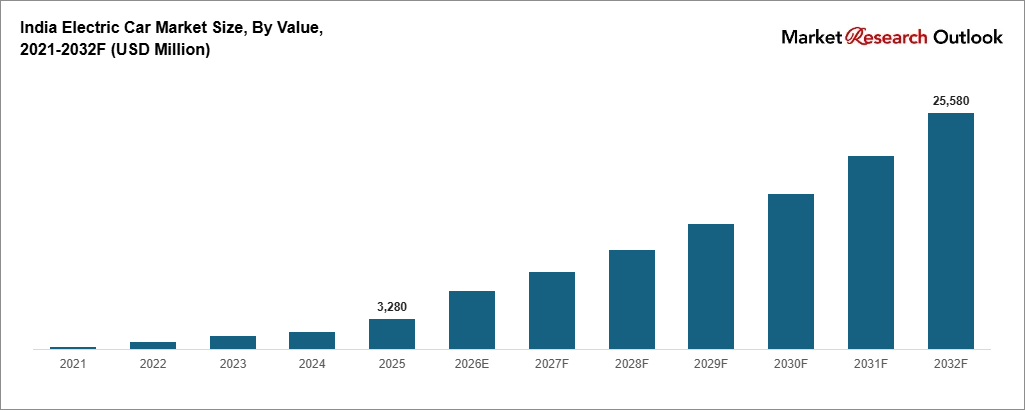
| Market Size (2025) | USD 3,280 Million |
| CAGR (2026-2032) | 34.1% |
| Leading Segment | Compact SUV (BEV) |
| Fastest Growing Segment | Mid-Size & Large Electric SUVs |
| Market Size (2032) | USD 25,580 Million |
Market Overview: India Electric Car Market
The India electric car market size is witnessing rapid expansion, driven by falling battery prices, low running costs, a growing range of electric SUVs, supportive tax and road tax policies, expanding fast charging networks, and major capacity additions by domestic and global carmakers. Valued at USD 3,280 million in 2025 and projected to reach USD 25,580 million by 2032, growing at a CAGR of 34.1%, the India electric car market growth is being fuelled by urban families, fleet operators, and first-time electric car buyers across tier-1 and tier-2 cities. Electric car retail sales rose 77% to 1,76,817 units in 2025, and registrations crossed 2,87,453 units in the first ten months of 2026, with electric cars reaching about 8.5% of passenger vehicle registrations in September 2026. Compact SUVs lead electric car demand, while mid-size and large electric SUVs are emerging as the fastest growing category. Shifting buyer preferences toward longer range, safer, and feature-rich electric cars are reshaping the supply landscape. As Tata Motors, JSW MG Motor, Mahindra, Hyundai, and Maruti Suzuki scale dedicated EV capacity, and global brands including BYD, VinFast, Tesla, Kia, and Toyota widen their line-ups, the India electric car market is evolving into a competitive, technology-led, and increasingly localized ecosystem with strong long-term growth potential.
Key Report Takeaways: India Electric Car Market
- The India electric car market size is projected to grow from USD 3,280 million in 2025 to USD 25,580 million by 2032, registering a strong CAGR of 34.1%, driven by falling battery prices, lower running costs, a 5% GST rate, and the steady shift from petrol and diesel cars to electric cars across urban India.
- Compact SUVs dominate the India electric car market, accounting for around 46% to 50% of total volume in 2025, driven by strong demand for models such as the Tata Nexon EV, Punch EV, and Hyundai Creta Electric, and wide electric car availability through dealer networks in metro and tier-2 cities.
- Mid-size and large electric SUVs are emerging as the fastest growing segment in the India electric car market, expected to grow at 45% to 50% annually as Mahindra, Tata Motors, Maruti Suzuki, and Tesla launch longer range electric cars with premium features for upgrading buyers.
- Rapid build-out of charging infrastructure, with over 25,000 public charging stations by 2025 and PM E-DRIVE funding of INR 2,000 crore for about 72,000 new public chargers, is structurally expanding the India electric car market across private, fleet, and highway use.
- Rising investments by Tata Motors, Mahindra, JSW MG Motor, Hyundai, Maruti Suzuki, and VinFast in battery packs, cell plants, dedicated EV platforms, and new factories are strengthening local electric car supply and supporting the India electric car market forecast 2032.
Key Market Drivers: India Electric Car Market
Falling Battery Prices, Lower Running Costs, and a Wider Range of Affordable Models Driving Electric Car Adoption Across India
Growth in the India electric car market is being driven by falling battery prices, a large running cost advantage over petrol and diesel cars, and a much wider choice of electric car models across price points. Global lithium-ion pack prices dropped to around USD 108 per kWh in 2025, and LFP packs used in many Indian electric cars cost even less, which has allowed OEMs to cut prices and add range. An electric car costs roughly INR 1.0 to INR 1.5 per km to run on home charging, against INR 6 to INR 8 per km for a petrol compact SUV, so a family driving 1,200 km a month saves INR 70,000 to INR 90,000 a year. Buyers can now pick from more than 30 electric car models, from the MG Comet and Tata Tiago EV at around INR 7 to 8 lakh to the Hyundai Creta Electric, Mahindra BE 6, and Tata Harrier EV in the INR 18 to 30 lakh band. India’s electric car retail sales jumped 77% to 1,76,817 units in 2025, and January to October 2026 registrations already reached 2,87,453 units. Lifetime battery warranties for first owners, rising fuel prices, and growing comfort with EV technology are creating strong structural pull-through demand across the India electric car market.
Supportive Government Policies Including Lower GST, Road Tax Waivers, PLI and SPMEPCI Schemes Accelerating Electric Car Sales
The India electric car market is benefiting from steady policy support at central and state levels. Electric cars attract GST of only 5%, compared with 18% on small petrol cars and 40% on larger SUVs after the 2025 GST revision, which keeps electric car pricing competitive in the mid and premium segments. States such as Delhi, Maharashtra, Tamil Nadu, Telangana, Karnataka, and Gujarat offer full or partial road tax waivers and registration fee exemptions on electric cars, saving buyers INR 1 lakh to INR 3 lakh on a typical purchase. On the supply side, the INR 25,938 crore PLI scheme for automobiles and auto components and the INR 18,100 crore PLI scheme for advanced chemistry cell batteries are pushing electric car makers to localize battery packs, motors, and power electronics. The Scheme to Promote Manufacturing of Electric Passenger Cars in India (SPMEPCI) allows imports of electric cars priced above USD 35,000 at a reduced 15% customs duty for OEMs that commit at least INR 4,150 crore to local manufacturing. Government fleet orders and corporate green mobility targets are also pulling forward electric car demand across the India electric car market.
Rapid Expansion of Public Charging Infrastructure and Fleet Electrification Strengthening Market Growth
Rapid growth in charging infrastructure is a major catalyst for the India electric car market. India had over 25,000 public charging stations by 2025, and the PM E-DRIVE scheme has set aside INR 2,000 crore to install about 72,000 public chargers, including over 22,000 fast chargers for electric cars, along highways, in cities, and at fuel outlets. Charge point operators such as Tata Power EZ Charge, Statiq, ChargeZone, and Jio-bp pulse, along with OEM networks from Tata Motors, Mahindra, and JSW MG Motor, are adding 60 kW to 180 kW DC fast chargers that can top up most electric cars from 20% to 80% in 25 to 40 minutes. Residential societies in Mumbai, Pune, Bengaluru, Hyderabad, and Delhi NCR are installing shared home chargers under state building bye-law changes. Fleet electrification is another strong lever, as ride-hailing operators, airport taxi services, and corporate employee transport firms switch to electric cars to cut fuel spend by 60% to 70%. These developments are structurally expanding India electric car market growth across private, commercial, and government end-user categories through 2032.
Key Market Challenges: India Electric Car Market
High Upfront Prices and Narrowing Tax Advantage After GST Revision Limiting Mass-Market Affordability
The India electric car market continues to face challenges around upfront pricing, especially in the sub INR 15 lakh segment where most Indian car buyers sit. A popular electric compact SUV still costs INR 2 lakh to INR 4 lakh more than a comparable petrol variant, largely because the battery makes up 35% to 40% of the vehicle cost. Unlike electric two wheelers, private electric cars receive no central purchase subsidy under PM E-DRIVE. The 2025 GST revision cut the tax on small petrol cars from 28% plus cess to 18%, which narrowed the price gap that electric cars once enjoyed in the entry segment and briefly slowed electric car sales in late 2025. Retail finance for electric cars also carries slightly higher interest rates in some cases, and insurance premiums are higher due to costly battery repairs. Together, these factors limit electric car adoption among price-sensitive first-time buyers and middle-income households across the India electric car market.
Charging Infrastructure Gaps, Range Anxiety, and Slow Charging Speeds Outside Metro Cities
The India electric car market faces structural complexity from uneven charging coverage and charger reliability across regions. While metros such as Delhi NCR, Mumbai, Bengaluru, Pune, Chennai, and Hyderabad host most public fast chargers, many tier-2 and tier-3 cities and long highway stretches still have sparse coverage. India’s ratio of electric cars to public chargers remains high, and drivers often report broken or occupied chargers, multiple apps for payment, and inconsistent charging speeds. Real-world range for many mass-market electric cars sits at 250 to 350 km against claimed figures of 350 to 500 km, and range drops further in peak summer heat with heavy air conditioning use. Apartment dwellers without dedicated parking struggle to install home chargers, which most electric car owners rely on for 70% to 80% of their charging. While PM E-DRIVE funding and OEM networks are adding chargers, interoperability and uptime gaps remain a near-term challenge for the India electric car market.
Import Dependence on Battery Cells, Rare Earth Magnets, and Uncertain Resale Values Affecting Margins
The India electric car market faces practical constraints around supply chain risk, cost volatility, and residual values. Most lithium-ion cells used in Indian electric cars are still imported from China and South Korea, and local cell plants such as Agratas in Sanand are yet to reach full output. China’s curbs on heavy rare earth magnet exports from April 2025 disrupted traction motor supply, and some electric car makers had to revise production plans during 2025. Currency movement and freight costs add further pressure on electric car margins, which already run thinner than on petrol models for most mass-market OEMs. Resale values also remain uncertain, with many three-year-old electric cars retaining 45% to 55% of their price, compared with 60% to 65% for petrol cars, because buyers worry about battery health. Lifetime battery warranties, certified used electric car programs, and buyback offers are emerging as solutions, but supply risk and weak residual values remain barriers to widespread adoption across the India electric car market.
Key Market Trends: India Electric Car Market
Shift Toward Electric SUVs, Longer Range Battery Packs, and Dedicated EV Platforms in India
The India electric car market is undergoing a clear product shift toward electric SUVs, larger battery packs, and dedicated EV platforms. SUVs and crossovers accounted for over 70% of electric car sales in 2025, led by the Tata Nexon EV and Punch EV, MG Windsor EV, Mahindra BE 6 and XEV 9e, and Hyundai Creta Electric. Battery sizes have moved up as well, with 40 to 60 kWh packs now common and claimed ranges of 400 to 550 km per charge. Mahindra’s INGLO platform, Tata’s acti.ev architecture, and Maruti Suzuki’s e Vitara platform are designed only for electric cars, which frees up cabin space, improves safety scores, and supports faster charging. Leading electric car brands also offer level 2 ADAS, connected car apps, vehicle-to-load features, and over-the-air software updates as standard on higher variants. Several electric cars have earned five-star Bharat NCAP ratings, which has improved buyer trust in battery safety. This product transition is reinforcing the India electric car market forecast 2032 across both private and fleet categories.
Entry of Global Brands and Rising Competition Reshaping the India Electric Car Market
A clear change in competitive structure is reshaping the India electric car market, as new entrants challenge the early leader. In 2025, Tata Motors sold 70,004 electric cars with a 39.6% share, down from about 62% in 2024, while JSW MG Motor India rose to 51,387 units and a 29.1% share, and Mahindra grew 369% to 33,513 units. Hyundai, BYD, Kia, Mercedes-Benz, and BMW added volume, and Tesla and VinFast made their first entries in 2025. VinFast, which builds cars at Thoothukudi in Tamil Nadu, reached about 7% of electric car sales in October 2026, only 15 months after launch. Maruti Suzuki and Toyota have also entered the electric car segment, bringing their large dealer and service networks into play. More brands are launching electric cars in the INR 10 to 20 lakh band, which is the heart of India’s car market. Rising competition is pushing prices down and features up, creating a large new pool of demand for the India electric car market.
Battery as a Service, Local Battery Production, and Capacity Expansion by Domestic OEMs
A wave of new ownership models and capacity investment is reshaping the India electric car market supply landscape. JSW MG Motor’s battery as a service plan, which lets buyers pay for the battery per km, helped the Windsor EV become India’s best-selling electric car in 2025, with an estimated 46,735 units dispatched. Combined electric car related investments announced by Tata Motors, Mahindra, Hyundai, Maruti Suzuki, JSW, and VinFast for new platforms, battery packs, and plants exceeded USD 5 billion across 2023 to 2026. Tata’s Agratas is building a 20 GWh cell gigafactory at Sanand in Gujarat, Mahindra is scaling its Chakan EV plant, Hyundai is localizing battery pack assembly at Chennai, and Maruti Suzuki builds the e Vitara at its Gujarat plant for India and export markets. The PLI auto scheme, the ACC battery PLI scheme, and the INR 7,280 crore rare earth magnet scheme have structurally favoured local supply. Combined with fleet demand and rising first-time electric car buyers, these developments are reinforcing the India electric car market forecast 2032 across the entire value chain.
Segmental Insights: India Electric Car Market
By End-User: Private Buyers Segment Dominates the India Electric Car Market
The private buyers end-user segment dominates the India electric car market, accounting for an estimated 72% to 76% of total volume, driven by low running costs, state road tax waivers, and a wider choice of electric SUVs. Electric cars with 40 to 60 kWh batteries priced between INR 12 lakh and INR 25 lakh are the dominant products within this segment, with authorized dealerships handling over 90% of private purchases. The commercial fleets and ride-hailing segment contributes another 18% to 21% of demand, driven by airport taxis, employee transport, and app-based cab services, even after BluSmart halted operations in 2025. Operators such as Refex eVeelz, Evera, and Uber Green continue to add electric cars, many based on the Tata Xpres-T and Tigor EV. Government and corporate fleets account for 5% to 7%, led by public sector leasing and green mobility targets. In 2025, leading players including Tata Motors, JSW MG Motor, Mahindra, Hyundai, and BYD expanded retail finance, exchange offers, and lifetime battery warranties, reinforcing segment dominance in the India electric car market.
By Vehicle Type: Compact SUVs Lead While Mid-Size and Large Electric SUVs Grow Fastest
Compact SUVs lead the India electric car market product landscape, accounting for approximately 46% to 50% of total volume, driven by models such as the Tata Nexon EV, Punch EV, Hyundai Creta Electric, and Mahindra XUV400 that match India’s preference for high ground clearance and road presence. MPVs and crossovers contribute another 20% to 22%, led by the MG Windsor EV and Kia Carens Clavis EV, while hatchbacks such as the Tata Tiago EV and MG Comet account for 12% to 14%. Mid-size and large electric SUVs hold a 12% to 14% share but are the fastest growing category within the India electric car market, expanding at 45% to 50% annually, driven by the Mahindra BE 6 and XEV 9e, Tata Harrier EV, Maruti Suzuki e Vitara, and Tesla Model Y. Electric sedans account for 3% to 5% of the market. Leading manufacturers including Tata Motors, JSW MG Motor, Mahindra, Hyundai, and Maruti Suzuki have aligned their electric car portfolios to this mix, driving wider adoption across the India electric car market.
Regional Insights: India Electric Car Market
Regional analysis of the India electric car market shows that West India and South India collectively account for approximately 55% to 59% of total volume, driven by Maharashtra (Mumbai and Pune), Karnataka (Bengaluru), Tamil Nadu (Chennai and the Thoothukudi manufacturing cluster), Kerala, Telangana (Hyderabad), and Gujarat, supported by early state EV policies, road tax waivers, and dense electric car dealer networks. North India contributes around 26% to 29% of demand, led by Delhi NCR, Uttar Pradesh, Haryana, and Punjab, supported by private and fleet electric car adoption in metro and tier-1 clusters around Delhi, Gurugram, Noida, Lucknow, and Chandigarh. Central and East India together account for 13% to 16% of demand, supported by Madhya Pradesh, West Bengal, Odisha, and Bihar, where charging access and electric car dealer reach are improving. In 2025, manufacturing and sales operations by Tata Motors in Maharashtra and Gujarat, Mahindra at Chakan, Hyundai in Tamil Nadu, Maruti Suzuki in Gujarat, and VinFast at Thoothukudi reinforced regional supply hubs, supporting faster delivery and service across the India electric car market.
EV sales data: see the India EV Sales by State Tracker for electric car registrations in every state, and the India Vehicle Sales Tracker for monthly retail sales by vehicle segment.
Recent Developments: India Electric Car Market
- The India electric car market witnessed strong momentum in sales and launches during 2025 and 2026. Electric car retail sales reached 1,76,817 units in calendar year 2025, a 77% rise over 2024, according to FADA data. September 2026 set a monthly record of 38,335 units, and October 2026 retail sales rose 76% year-on-year to 37,049 units. Electric car volumes for calendar year 2026 are projected to reach around 3.75 lakh units, more than double the 2025 level.
- Domestic carmakers have deepened India-focused electric car investment. In 2025 and 2026, Tata Motors launched the Harrier EV, Mahindra expanded its BE 6 and XEV 9e range on the INGLO platform, Maruti Suzuki began making the e Vitara in Gujarat for India and exports, and Hyundai added the Creta Electric. Agratas progressed its 20 GWh cell plant at Sanand, and the Union Cabinet approved a INR 7,280 crore rare earth magnet scheme in November 2025. These developments are strengthening domestic supply and supporting the India electric car market forecast 2032.
- Global brand momentum has gained strong traction in the India electric car market. In 2025, Tesla opened its first showrooms in Mumbai and Delhi with the Model Y, and VinFast began local assembly at Thoothukudi, reaching about 7% of electric car sales by October 2026. BYD, Kia, Toyota, Mercedes-Benz, and BMW also widened their electric car line-ups. Rising competition is positioning India as one of the fastest growing electric car markets globally, strengthening long-term competitive positioning in the India electric car market forecast 2032.
Key Market Players: India Electric Car Market
- Tata Passenger Electric Mobility Ltd. (Tata Motors)
- JSW MG Motor India Pvt. Ltd.
- Mahindra Electric Automobile Ltd.
- Hyundai Motor India Limited
- Maruti Suzuki India Limited
- Kia India Pvt. Ltd.
- Toyota Kirloskar Motor Pvt. Ltd.
- BYD India Pvt. Ltd.
- VinFast Auto India Pvt. Ltd.
- Tesla India Motors and Energy Pvt. Ltd.
- Mercedes-Benz India Pvt. Ltd.
- BMW Group India
- Stellantis India (Citroën)
| By Vehicle Type | By Propulsion Type | By Battery Capacity | By Price Range | By End-User |
| Hatchback Sedan Compact SUV Mid-Size & Large SUV MPV & Crossover |
Battery Electric Vehicle (BEV) Plug-in Hybrid Electric Vehicle (PHEV) Fuel Cell Electric Vehicle (FCEV) |
Below 30 kWh 30 kWh to 50 kWh 50 kWh to 70 kWh Above 70 kWh |
Below INR 15 Lakh INR 15 Lakh to INR 25 Lakh INR 25 Lakh to INR 50 Lakh Above INR 50 Lakh |
Private Buyers Commercial Fleets & Ride-Hailing Government & Corporate Fleets |
Report Scope
In this report, the India Electric Car Market has been segmented into the following categories, in addition to detailed analysis of key industry trends, market dynamics, competitive landscape, and growth opportunities across the forecast period:
- By Vehicle Type
- Hatchback
- Sedan
- Compact SUV
- Mid-Size & Large SUV
- MPV & Crossover
- By Propulsion Type
- Battery Electric Vehicle (BEV)
- Plug-in Hybrid Electric Vehicle (PHEV)
- Fuel Cell Electric Vehicle (FCEV)
- By Battery Capacity
- Below 30 kWh
- 30 kWh to 50 kWh
- 50 kWh to 70 kWh
- Above 70 kWh
- By Price Range
- Below INR 15 Lakh
- INR 15 Lakh to INR 25 Lakh
- INR 25 Lakh to INR 50 Lakh
- Above INR 50 Lakh
- By End-User
- Private Buyers
- Commercial Fleets & Ride-Hailing
- Government & Corporate Fleets
- By Geography
- North India
- South India
- West India
- East India
- Central India
Competitive Landscape
Company Profiles:
Detailed analysis of the leading companies operating in the India Electric Car Market, including business overview, product portfolio, strategic initiatives, competitive positioning, and recent developments.
Company Information
Detailed profiling and strategic analysis of additional market players (up to five companies), including emerging electric car brands, luxury EV importers, battery as a service providers, or niche electric fleet operators.
For a free sample of the India Electric Car Market report, customised insights or delivery timelines, submit your query here
India Electric Car Market, 2032
- Research Framework
- Market Segmentation
- Research Objective
- Research Methodology
- Qualitative Research
- Primary Research
- Secondary Research
- Quantitative Research
- Market Breakdown & Data Triangulation
- Demand Side
- Supply Side
- Primary Research Respondents
- Assumption & Limitation
- Executive Summary
- Market Overview, 2021-2032
- By Vehicle Type
- By Propulsion Type
- By Battery Capacity
- By Price Range
- By End-User
- By Region
- Analyst Recommendations
- Geopolitical Impact on India Electric Car Market
- India Electric Car Market Insights
- Market Dynamics
- Growth Drivers
- Falling battery prices, lower running costs, and a wider range of affordable models driving electric car adoption across India.
- Supportive government policies including lower GST, road tax waivers, PLI and SPMEPCI schemes accelerating electric car sales.
- Rapid expansion of public charging infrastructure and fleet electrification strengthening market growth.
- Restraints
- High upfront prices and narrowing tax advantage after GST revision limiting mass-market affordability.
- Charging infrastructure gaps, range anxiety, and slow charging speeds outside metro cities.
- Import dependence on battery cells, rare earth magnets, and uncertain resale values affecting margins.
- Opportunities
- Affordable electric hatchbacks and compact SUVs under INR 15 lakh opening untapped buyer pools in tier-2 and tier-3 cities.
- Battery as a service, subscription models, and fleet electrification supporting next-generation growth in ride-hailing and corporate mobility.
- Local cell manufacturing, electric car exports, and global OEM investment under SPMEPCI creating large manufacturing opportunities.
- Challenges
- Intense price competition and pressure on margins as global brands enter the Indian electric car segment.
- Limited fast charging along highways and uneven electric car service networks across smaller Indian cities.
- Maintaining battery performance, thermal safety, and consistent real-world range across extreme Indian climates.
- Technological Advancements
- Recent Technological Advancements
- Prior to 2020
- Porter’s Five Forces Analysis
- PESTLE Analysis
- Industry Value Chain & Entry Points
- Upstream Raw Materials (lithium, nickel, cobalt, manganese, graphite, rare earth elements, copper, steel, aluminium)
- Electric Car Battery Cell & Pack Manufacturers (Agratas, Tata AutoComp, Exide Energy, Amara Raja, imported cells)
- Electric Car Motor, Power Electronics & Thermal System Suppliers (traction motors, inverters, BMS, on-board chargers)
- Electric Car OEMs (Tata Motors, JSW MG Motor, Mahindra, Hyundai, Maruti Suzuki)
- Quality Control, R&D & Testing (ARAI, ICAT, GARC, AIS-038 battery safety, Bharat NCAP)
- Electric Car Dealerships & EV Showrooms (B2C retail, test drives, and service networks)
- Charging Infrastructure Operators (Tata Power EZ Charge, Statiq, ChargeZone, Jio-bp pulse, OEM networks)
- Electric Car Financing, Insurance & Leasing Providers (banks, NBFCs, battery as a service and subscription firms)
- Fleet Operators & Ride-Hailing Platforms (Uber, Refex eVeelz, Evera, corporate mobility providers)
- End-Users (private buyers, fleet operators, government departments, corporate employees)
- India Electric Car Market: Regulatory Framework
- India Electric Car Market Overview
- Market Size & Forecast, 2021-2032
- By Value (USD Million)
- By Volume (Thousand Units)
- Market Share & Forecast
- By Vehicle Type
- Hatchback
- Sedan
- Compact SUV
- Mid-Size & Large SUV
- MPV & Crossover
- By Propulsion Type
- Battery Electric Vehicle (BEV)
- Plug-in Hybrid Electric Vehicle (PHEV)
- Fuel Cell Electric Vehicle (FCEV)
- By Battery Capacity
- Below 30 kWh
- 30 kWh to 50 kWh
- 50 kWh to 70 kWh
- Above 70 kWh
- By Price Range
- Below INR 15 Lakh
- INR 15 Lakh to INR 25 Lakh
- INR 25 Lakh to INR 50 Lakh
- Above INR 50 Lakh
- By End-User
- Private Buyers
- Commercial Fleets & Ride-Hailing
- Government & Corporate Fleets
- By Geography
- North India
- South India
- West India
- East India
- Central India
- Competitive Landscape
- India Electric Car Market Company Market Share Analysis, 2025
- Competitive Benchmarking, By Operating Parameters
- Key Strategic Development (Mergers, Acquisitions, Partnerships, Etc.)
- List of Emerging Players
- Company Profile
- Tata Passenger Electric Mobility Ltd. (Tata Motors)
- Introduction & Company Profile
- Product Benchmarking
- Strategic Outlook
- Key Competitors
- Financial Analysis
- SWOT Analysis
(Same Data Pointers Will Be Provided for The Below Companies)
- JSW MG Motor India Pvt. Ltd.
- Mahindra Electric Automobile Ltd.
- Hyundai Motor India Limited
- Maruti Suzuki India Limited
- Kia India Pvt. Ltd.
- Toyota Kirloskar Motor Pvt. Ltd.
- BYD India Pvt. Ltd.
- VinFast Auto India Pvt. Ltd.
- Tesla India Motors and Energy Pvt. Ltd.
- Mercedes-Benz India Pvt. Ltd.
- BMW Group India
- Stellantis India (Citroën)
- Other Prominent Players
* Financial information in case of non-listed companies will be provided as per availability
** The segmentation and the companies are subjected to modifications based on in-depth secondary for the final deliverable
Frequently Asked Questions
1. How large is the India electric car market and what is its growth forecast?
Ans: The India electric car market is valued at USD 3,280 million in 2025 and is projected to reach USD 25,580 million by 2032, growing at a CAGR of 34.1%, supported by falling battery prices and rising electric SUV launches.
2. Which segments are driving demand in the India electric car market?
Ans: Compact SUVs lead with around 46% to 50% volume share, while mid-size and large electric SUVs are the fastest growing segment, driven by longer range models, premium features, and upgrading urban buyers.
3. What are the key drivers of growth in the India electric car market?
Ans: Key drivers include falling battery prices, low running costs, a 5% GST rate, state road tax waivers, PLI and SPMEPCI schemes, expanding fast charging networks, and rising fleet electrification.
4. Which regions are driving growth in the India electric car market?
Ans: West India and South India lead with around 55% to 59% of total volume, driven by Maharashtra, Karnataka, Tamil Nadu, Kerala, Telangana, and Gujarat. North India, led by Delhi NCR, also shows strong demand.
5. What are the latest trends in the India electric car market?
Ans: The latest trends include a shift toward electric SUVs, larger battery packs, dedicated EV platforms, battery as a service plans, entry of global brands like Tesla and VinFast, and local cell production.