

India EV Traction Motor Market, 2032
- Automotive & EV
- Nov 2026
- Pages 140
- Report Format: pdf
- Report Price: $2400 USD
India’s EV traction motor market is witnessing strong structural growth, driven by record electric two-wheeler and three-wheeler sales, rising electric passenger car launches, PM E-DRIVE and PLI Auto incentives, phased localization rules, growing electric bus deployment under state tenders, and rising interest from domestic and global component majors investing in India-specific EV traction motor design, magnet supply, and integrated e-axle capacity.
| Study Duration | 2021-2032 |
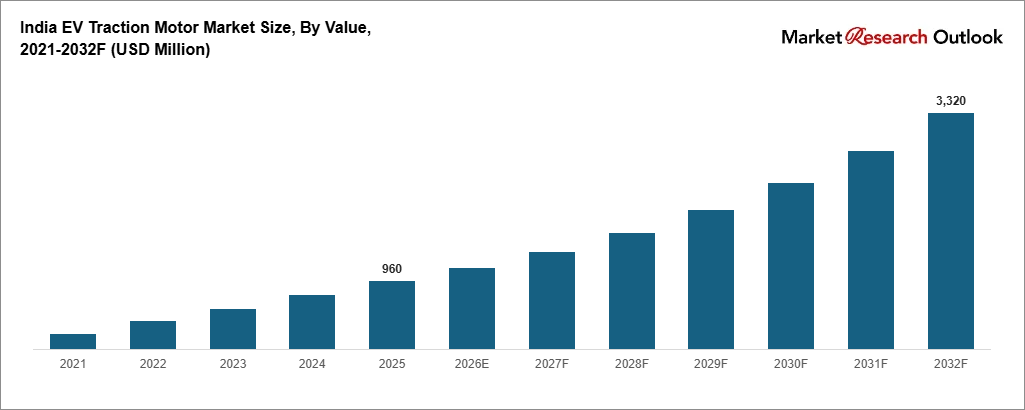
| Market Size (2025) | USD 960 Million |
| CAGR (2026-2032) | 19.4% |
| Leading Segment | PMSM (Electric Two-Wheelers) |
| Fastest Growing Segment | Rare-Earth-Free Motors (SRM & SynRM) |
| Market Size (2032) | USD 3,320 Million |
Market Overview: India EV Traction Motor Market
The India EV traction motor market size is expanding quickly, driven by record EV registrations, rising electric two-wheeler and three-wheeler penetration, a growing pipeline of electric passenger cars, government incentives under PM E-DRIVE and PLI Auto, and large capacity additions by domestic component makers. Valued at USD 960 million in 2025 and projected to reach USD 3,320 million by 2032, growing at a CAGR of 19.4%, the India EV traction motor market growth is being fuelled by about 2.3 million EV sales in 2025, equal to roughly 8% of all new vehicle registrations. PMSM motors lead the EV traction motor market by value, while rare-earth-free SRM and SynRM motors are emerging as the fastest growing category. Rising fuel costs, lower running costs of EVs, and tighter local value addition rules are reshaping the EV traction motor supply landscape. As domestic suppliers including Sona Comstar, Bosch, Varroc, Uno Minda, and Lucas-TVS scale dedicated EV traction motor lines, and OEMs such as Ola Electric, Ather Energy, Tata Motors, and Mahindra deepen in-house drive development, the India EV traction motor market is turning into a technology-led, localized, and export-ready ecosystem with strong long-term potential.
Key Report Takeaways: India EV Traction Motor Market
- The India EV traction motor market size is projected to grow from USD 960 million in 2025 to USD 3,320 million by 2032, registering a strong CAGR of 19.4%, driven by two-wheeler and three-wheeler electrification, rising electric passenger car volumes, and the structural shift toward locally built, high-efficiency drive units.
- PMSM motors dominate the India EV traction motor market, accounting for about 62% of total value in 2025, driven by their high power density, 94% to 97% peak efficiency, and wide use across electric two-wheelers, passenger cars, and buses supplied by Sona Comstar, Bosch, Varroc, and Lucas-TVS.
- Rare-earth-free SRM and SynRM EV traction motors are emerging as the fastest growing segment in the India EV traction motor market, expected to grow at 28% to 32% annually as OEMs respond to China’s 2025 magnet export curbs and seek stable, lower-cost EV traction motor designs.
- Rapid scaling of EV sales, with electric two-wheelers at about 1.28 million units and electric three-wheelers at about 0.8 million units in 2025, is structurally expanding the India EV traction motor market across BLDC hub motors, mid-drive units, and compact PMSM designs.
- Rising investments by domestic component majors such as Sona Comstar, Varroc, Uno Minda, Lucas-TVS, and Bosch in EV traction motor assembly, magnet sourcing, and integrated e-axle capacity, along with the INR 7,280 crore magnet scheme, are strengthening local supply and supporting the India EV traction motor market forecast 2032.
Key Market Drivers: India EV Traction Motor Market
Rapid EV Adoption Across Two-Wheelers, Three-Wheelers, and Passenger Cars Driving Traction Motor Demand Across India
Growth in the India EV traction motor market is being driven by fast electrification of two-wheelers, three-wheelers, and passenger cars. India sold about 2.3 million EVs in 2025, close to 8% of the 28.2 million vehicles registered during the year. Electric two-wheelers led with about 1.28 million units, or 57% of EV sales, while electric three-wheelers added about 0.8 million units, or 35%. Electric four-wheeler sales reached about 1.75 lakh units, supported by launches from Tata Motors, Mahindra, MG, Hyundai, and Maruti Suzuki. Every one of these vehicles needs at least one EV traction motor, and premium dual-motor cars need two. Electric three-wheelers have already crossed about 32% penetration in their category, which shows how quickly fleet buyers switch once running cost savings are clear. Falling battery prices, lower per-km costs, and a wider charging network are creating strong structural pull-through demand across the India EV traction motor market.
Government Incentives Under PM E-DRIVE, PLI Auto, and Localization Norms Fuelling Domestic Traction Motor Manufacturing
The India EV traction motor market is benefiting from steady policy support. The PM E-DRIVE scheme carries an outlay of INR 10,900 crore and backs electric two-wheelers, three-wheelers, ambulances, trucks, and a target of 14,028 electric buses. The PLI scheme for automobiles and auto components, with an outlay of INR 25,938 crore, rewards advanced automotive technology products, including EV traction motors and controllers, that meet domestic value addition thresholds. Phased manufacturing rules under these programs push OEMs to localize EV traction motors, controllers, and related parts rather than import complete kits. As a result, suppliers such as Sona Comstar, Varroc, Uno Minda, Lucas-TVS, and Bosch have expanded local EV traction motor lines in Tamil Nadu, Maharashtra, and Haryana. State EV policies in Tamil Nadu, Maharashtra, Karnataka, Gujarat, and Uttar Pradesh add capital subsidies and land support, further strengthening domestic supply across the India EV traction motor market.
Technology Innovation in High-Efficiency PMSM, Integrated e-Axles, and Rare-Earth-Free EV Traction Motors Strengthening Product Performance
Technology progress is a major catalyst for the India EV traction motor market. PMSM designs now deliver peak efficiency of 94% to 97%, compared with 90% to 94% for typical induction motors, which directly improves vehicle range and makes the EV traction motor a key lever for OEMs. Oil-cooled hairpin stators raise continuous power density, while integrated e-axles that combine the motor, inverter, and reduction gear cut weight and wiring cost for passenger cars. After China’s 2025 export curbs on rare earth magnets, Indian players accelerated rare-earth-free work, with Ola Electric and Sona Comstar among those showcasing ferrite and magnet-free EV traction motor designs. Silicon carbide inverters and 800V-ready drive units are also entering premium vehicle programs. Global specialists such as BorgWarner, Valeo, Mahle, and Nidec are bringing proven e-drive and EV traction motor platforms to Indian OEMs, structurally expanding India EV traction motor market growth across all major vehicle categories through 2032.
Key Market Challenges: India EV Traction Motor Market
Heavy Dependence on Imported Rare Earth Magnets and China Export Curbs Disrupting Traction Motor Supply
The India EV traction motor market continues to face a serious supply risk from rare earth magnets. Most PMSM and BLDC EV traction motors rely on NdFeB magnets, and India meets nearly 90% of this demand through imports, mainly from China. When China tightened export licensing for rare earth elements and magnets in April 2025, several Indian two-wheeler and passenger car makers reported delays and cut production plans. Spot prices for available magnets rose sharply, and lead times stretched from weeks to months. The INR 7,280 crore rare earth permanent magnet scheme, approved in November 2025, targets 6,000 tonnes per year of local capacity, but new plants will take several years to ramp up. Until then, magnet dependence remains the single largest constraint across the India EV traction motor market.
Limited Localization of Electrical Steel, Power Electronics, and Testing Infrastructure Raising EV Traction Motor Production Complexity
The India EV traction motor market also faces structural complexity from shallow localization of key inputs. High-grade CRNO electrical steel for motor laminations, power semiconductors such as IGBT and SiC modules, and precision bearings are still largely imported. Testing and validation capacity for high-power motors is concentrated at a few centres such as ARAI and ICAT, so homologation slots can delay new launches. Smaller EV traction motor makers in tier-2 clusters often lack dynamometer rigs, thermal chambers, and end-of-line testers needed for consistent quality. This creates uneven product quality, especially in low-cost e-rickshaw and entry-level e-scooter EV traction motors. While the Ministry of Heavy Industries is pushing deeper localization through PLI and PM E-DRIVE rules, the input and testing gap remains a near-term challenge for the India EV traction motor market.
Volatility in Copper, Electrical Steel, and Magnet Prices Impacting Overall Traction Motor Margins
The India EV traction motor market faces practical cost pressure from raw material swings. Copper, which makes up a large share of EV traction motor stator cost, saw prices rise by 12% to 18% between 2023 and 2025, while electrical steel and aluminium housings moved up by 6% to 10% over the same period. Magnet costs proved the most volatile after the 2025 supply shock. Smaller EV traction motor suppliers struggle to pass these increases to OEMs, who negotiate hard on price in a cost-sensitive market. Average gross margins for EV traction motor suppliers in India range between 14% and 22%, and input swings can cut realized margins by 3% to 6% in a single year. Ferrite designs, aluminium windings, and long-term supply contracts are emerging as solutions, but they need fresh validation and investment across the India EV traction motor market.
Key Market Trends: India EV Traction Motor Market
Rapid Shift Toward Rare-Earth-Free and Reduced-Magnet Traction Motor Designs in India
The India EV traction motor market is seeing a clear technology shift toward rare-earth-free and reduced-magnet designs, which are expected to account for over 15% of new two-wheeler and three-wheeler EV traction motor programs by 2028. Ferrite-based PMSM, switched reluctance, and synchronous reluctance EV traction motors avoid heavy rare earths and cut exposure to import shocks, although they need smarter control software to match torque density. Ola Electric announced a ferrite motor for its scooters in 2025, and several suppliers, including Sona Comstar and start-ups working on magnet-free designs, are running pilot programs with OEMs. Some makers are also reducing magnet content per EV traction motor through better rotor geometry and grain boundary diffusion. This transition is reinforcing the India EV traction motor market forecast 2032 across both two-wheeler and commercial vehicle categories.
Growth of Integrated e-Axles, High-Voltage Platforms, and Power-Dense Drive Units in the India EV Traction Motor Market
A clear move toward integrated e-axles, higher-voltage platforms, and power-dense drive units is reshaping the India EV traction motor market, particularly in passenger cars and buses. Integrated three-in-one units that combine motor, inverter, and gearbox are expected to account for over 30% of EV traction motor fitments in electric passenger cars by 2030. New skateboard platforms from Mahindra, Tata Motors, and Maruti Suzuki support higher-output EV traction motors in the 75 kW to 210 kW range, with dual-motor all-wheel drive in top variants. In electric buses, operators such as PMI, Olectra, JBM, Switch, and Tata Motors use central drive EV traction motors and e-axle setups above 150 kW. Global suppliers BorgWarner, Valeo, and Mahle are localizing e-drive assembly to win these programs, lifting average EV traction motor value per vehicle across the India EV traction motor market.
Capacity Expansion by Domestic Auto Component Majors and Localization Investments
A wave of domestic capacity expansion and localization investment is reshaping the India EV traction motor market supply landscape. Combined India-focused capital spending announcements for EV traction motors, controllers, and e-axles exceeded USD 900 million across 2023 to 2025. Sona Comstar has supplied well over 180,000 EV traction motors from its Chennai operations, Varroc and Lucas-TVS expanded two-wheeler and three-wheeler EV traction motor lines, Uno Minda built EV powertrain capacity through technology partnerships, and Bosch scaled motor and controller supply for leading two-wheeler OEMs. Ola Electric and Ather Energy deepened in-house EV traction motor design to control cost and performance. PLI Auto incentives, PM E-DRIVE localization rules, and the new magnet scheme have structurally favoured local supply. Combined with growing export interest from global OEMs, these developments are reinforcing the India EV traction motor market forecast 2032 across the entire value chain.
Segmental Insights: India EV Traction Motor Market
By Vehicle Type: Electric Two-Wheelers Segment Dominates the India EV Traction Motor Market
The electric two-wheeler segment dominates the India EV traction motor market, accounting for an estimated 40% to 42% of total value, driven by high unit volumes, rising scooter and motorcycle launches, and improving EV traction motor economics. BLDC hub motors and compact mid-drive PMSM units are the main EV traction motor variants here, with motors below 5 kW making up nearly half of all units shipped. The electric passenger car segment contributes another 24% to 26% of value, helped by much higher EV traction motor content per vehicle, and it is growing at 24% to 27% annually. Electric three-wheelers account for 19% to 21%, led by passenger e-autos and cargo carriers. In 2025, leading OEMs including TVS Motor, Bajaj Auto, Ather Energy, Ola Electric, and Hero MotoCorp scaled two-wheeler EV traction motor sourcing and in-house design, reinforcing segment dominance in the India EV traction motor market.
By Motor Type: PMSM Leads While Rare-Earth-Free Motors Grow Fastest
PMSM motors lead the India EV traction motor market by motor type, accounting for about 62% of total value, driven by high efficiency, strong torque density, and wide use in mid-drive two-wheelers, passenger cars, and buses. BLDC EV traction motors contribute another 23% to 25%, mainly as hub motors in entry-level scooters and e-rickshaws. AC induction motors hold around 8%, mostly in heavier commercial and off-highway uses. Rare-earth-free SRM and SynRM motors are the fastest growing category within the India EV traction motor market, expanding at 28% to 32% annually as OEMs seek supply security after the 2025 magnet shock. Axial flux and wound rotor designs remain niche but are gaining interest in performance motorcycles and premium cars. Leading suppliers including Sona Comstar, Bosch, Varroc, Uno Minda, and Lucas-TVS have aligned product portfolios to this mix, driving higher-value adoption across the India EV traction motor market.
Regional Insights: India EV Traction Motor Market
Regional analysis of the India EV traction motor market shows that South India and West India together account for about 60% to 64% of total value, driven by Tamil Nadu (Hosur, Krishnagiri, and Chennai EV clusters), Karnataka (Bengaluru design and assembly base), Maharashtra (Pune and Aurangabad automotive belt), and Gujarat, supported by strong state EV policies and dense OEM and EV traction motor supplier presence. North India contributes around 24% to 27% of demand, led by Uttar Pradesh, which topped state EV sales in 2025, along with Delhi NCR and Haryana, where Manesar and Gurugram host major component plants. Central and East India together account for 11% to 14%, supported by Madhya Pradesh, West Bengal, Bihar, and Odisha, where e-rickshaw and electric bus adoption is rising. In 2025, EV traction motor capacity additions by Sona Comstar in Chennai, Ola Electric in Krishnagiri, Uno Minda and Bosch in the North and West, and Varroc in Maharashtra reinforced regional supply hubs across the India EV traction motor market.
EV manufacturing data: see the India EV Projects Tracker for EV and component plant investments, and the India Vehicle Sales Tracker for monthly vehicle sales by segment.
Recent Developments: India EV Traction Motor Market
- The India EV traction motor market saw strong momentum in launches and capacity during 2024 and 2025. India recorded about 2.3 million EV sales in calendar year 2025, up from about 2 million in 2024, with electric two-wheelers at about 1.28 million units. Electric passenger vehicle sales reached a record of about 1.75 lakh units. Domestic traction EV traction motor shipments are estimated at about 2.4 million units in 2025, and are projected to cross 7 million units by 2032 as penetration rises across all vehicle classes.
- Domestic component majors deepened India-focused capacity. In 2025, Sona Comstar expanded EV traction motor programs for two-wheeler and passenger car OEMs, Varroc and Lucas-TVS scaled local EV traction motor lines, Uno Minda strengthened its EV powertrain portfolio, and Bosch increased motor and controller supply to leading two-wheeler makers. In November 2025, the Union Cabinet approved the INR 7,280 crore scheme for 6,000 tonnes per year of sintered rare earth magnet capacity, with bids invited in 2026. These developments are strengthening domestic supply and supporting the India EV traction motor market forecast 2032.
- OEM-led EV traction motor development gained strong traction in the India EV traction motor market. In 2025, Ola Electric unveiled its ferrite motor, Ather Energy continued in-house PMSM development, and Mahindra and Tata Motors launched new electric SUVs on dedicated EV platforms with higher-output drive units. Partnerships between domestic suppliers and global e-drive specialists such as BorgWarner, Valeo, Mahle, and Nidec are positioning India as one of the fastest scaling EV traction motor hubs globally, strengthening long-term competitive positioning in the India EV traction motor market forecast 2032.
Key Market Players: India EV Traction Motor Market
- Sona BLW Precision Forgings Limited (Sona Comstar)
- Bosch Limited
- Varroc Engineering Limited
- Uno Minda Limited
- Lucas-TVS Limited
- Nidec India Private Limited
- Mahle Electric Drives India Pvt. Ltd.
- CG Power and Industrial Solutions Limited
- Kirloskar Electric Company Limited
- Ola Electric Mobility Limited
- Ather Energy Limited
- BorgWarner India Pvt. Ltd.
- Valeo India Private Limited
| By Motor Type | By Vehicle Type | By Power Output | By Motor Placement | By Propulsion |
| Permanent Magnet Synchronous Motor (PMSM) Brushless DC Motor (BLDC) AC Induction Motor Switched Reluctance Motor (SRM) Synchronous Reluctance Motor (SynRM) Others (Axial Flux, Wound Rotor) |
Electric Two-Wheelers Electric Three-Wheelers Electric Passenger Cars Electric Light Commercial Vehicles Electric Buses Electric Trucks Off-Highway & Others |
Below 5 kW 5-25 kW 25-75 kW 75-150 kW Above 150 kW |
In-Wheel Hub Motor Mid-Drive Motor Central Drive Motor Integrated e-Axle Dual & Multi-Motor Configuration Others |
Battery Electric Vehicles (BEV) Plug-in Hybrid Electric Vehicles (PHEV) Hybrid Electric Vehicles (HEV) Fuel Cell Electric Vehicles (FCEV) |
Report Scope
In this report, the India EV Traction Motor Market has been segmented into the following categories, in addition to detailed analysis of key industry trends, market dynamics, competitive landscape, and growth opportunities across the forecast period:
- By Motor Type
- Permanent Magnet Synchronous Motor (PMSM)
- Brushless DC Motor (BLDC)
- AC Induction Motor
- Switched Reluctance Motor (SRM)
- Synchronous Reluctance Motor (SynRM)
- Others (Axial Flux, Wound Rotor)
- By Vehicle Type
- Electric Two-Wheelers
- Electric Three-Wheelers
- Electric Passenger Cars
- Electric Light Commercial Vehicles
- Electric Buses
- Electric Trucks
- Off-Highway & Others
- By Power Output
- Below 5 kW
- 5-25 kW
- 25-75 kW
- 75-150 kW
- Above 150 kW
- By Motor Placement
- In-Wheel Hub Motor
- Mid-Drive Motor
- Central Drive Motor
- Integrated e-Axle
- Dual & Multi-Motor Configuration
- Others
- By Propulsion
- Battery Electric Vehicles (BEV)
- Plug-in Hybrid Electric Vehicles (PHEV)
- Hybrid Electric Vehicles (HEV)
- Fuel Cell Electric Vehicles (FCEV)
- By Geography
- North India
- South India
- West India
- East India
- Central India
Competitive Landscape
Company Profiles:
Detailed analysis of the leading companies operating in the India EV Traction Motor Market, including business overview, product portfolio, strategic initiatives, competitive positioning, and recent developments.
Company Information
Detailed profiling and strategic analysis of additional market players (up to five companies), including emerging domestic motor start-ups, rare-earth-free motor developers, regional e-rickshaw EV traction motor makers, or niche e-axle and power electronics suppliers.
For a free sample of the India EV Traction Motor Market report, customised insights or delivery timelines, submit your query here
India EV Traction Motor Market, 2032
- Research Framework
- Market Segmentation
- Research Objective
- Research Methodology
- Qualitative Research
- Primary Research
- Secondary Research
- Quantitative Research
- Market Breakdown & Data Triangulation
- Demand Side
- Supply Side
- Primary Research Respondents
- Assumption & Limitation
- Executive Summary
- Market Overview, 2021-2032
- By Motor Type
- By Vehicle Type
- By Power Output
- By Motor Placement
- By Propulsion
- By Region
- Analyst Recommendations
- Geopolitical Impact on India EV Traction Motor Market
- India EV Traction Motor Market Insights
- Market Dynamics
- Growth Drivers
- Rapid EV adoption across two-wheelers, three-wheelers, and passenger cars driving EV traction motor demand across India.
- Government incentives under PM E-DRIVE, PLI Auto, and localization norms fuelling domestic EV traction motor manufacturing.
- Technology innovation in high-efficiency PMSM, integrated e-axles, and rare-earth-free EV traction motors strengthening product performance.
- Restraints
- Heavy dependence on imported rare earth magnets and China export curbs disrupting EV traction motor supply.
- Limited localization of electrical steel, power electronics, and testing infrastructure raising EV traction motor production complexity.
- Volatility in copper, electrical steel, and magnet prices impacting overall EV traction motor margins.
- Opportunities
- Rare-earth-free ferrite, SRM, and SynRM EV traction motor innovation opening cost-efficient design pathways.
- Integrated e-axles, 800V platforms, and SiC-based drives supporting next-generation EV traction motor growth.
- Electric bus tenders, fleet electrification, and export-oriented manufacturing creating large-scale EV traction motor demand.
- Challenges
- Intense price competition from low-cost imported hub motors and unorganized e-rickshaw EV traction motor suppliers.
- Limited testing, validation, and homologation capacity for high-power EV traction motors across smaller clusters.
- Maintaining EV traction motor efficiency, thermal performance, and quality consistency at scale across diverse Indian duty cycles.
- Technological Advancements
- Recent Technological Advancements in EV Traction Motors
- Prior to 2020
- Porter’s Five Forces Analysis
- PESTLE Analysis
- Industry Value Chain & Entry Points
- Upstream Raw Materials (electrical steel, copper wire, NdFeB magnets, ferrite, aluminium housings, insulation)
- EV Traction Motor Manufacturers (Sona Comstar, Bosch, Varroc, Uno Minda, Lucas-TVS)
- Magnet & Lamination Suppliers for EV Traction Motors (rare earth magnets, ferrite magnets, CRNO electrical steel stampings)
- EV Traction Motor Controller & Power Electronics Suppliers (inverters, IGBT modules, SiC MOSFETs)
- Quality Control, R&D & EV Traction Motor Testing Laboratories (ARAI, ICAT, AIS-041, AIS-156 standards)
- Distributors, Tier-2 Suppliers & Integrators (B2B EV traction motor supply networks)
- e-Axle & Drivetrain Integrators (BorgWarner, Valeo, Mahle, Nidec)
- Vehicle OEMs (Tata Motors, Mahindra, TVS Motor, Bajaj Auto, Hero MotoCorp, Ola Electric, Ather Energy)
- Aftermarket & Service Networks (dealers, service centres, EV traction motor repair and refurbishment)
- End-Users (private owners, fleet operators, logistics firms, state transport undertakings)
- India EV Traction Motor Market: Regulatory Framework
- India EV Traction Motor Market Overview
- Market Size & Forecast, 2021-2032
- By Value (USD Million)
- By Volume (Thousand Units)
- Market Share & Forecast
- By Motor Type
- Permanent Magnet Synchronous Motor (PMSM)
- Brushless DC Motor (BLDC)
- AC Induction Motor
- Switched Reluctance Motor (SRM)
- Synchronous Reluctance Motor (SynRM)
- Others (Axial Flux, Wound Rotor)
- By Vehicle Type
- Electric Two-Wheelers
- Electric Three-Wheelers
- Electric Passenger Cars
- Electric Light Commercial Vehicles
- Electric Buses
- Electric Trucks
- Off-Highway & Others
- By Power Output
- Below 5 kW
- 5-25 kW
- 25-75 kW
- 75-150 kW
- Above 150 kW
- By Motor Placement
- In-Wheel Hub Motor
- Mid-Drive Motor
- Central Drive Motor
- Integrated e-Axle
- Dual & Multi-Motor Configuration
- Others
- By Propulsion
- Battery Electric Vehicles (BEV)
- Plug-in Hybrid Electric Vehicles (PHEV)
- Hybrid Electric Vehicles (HEV)
- Fuel Cell Electric Vehicles (FCEV)
- By Geography
- North India
- South India
- West India
- East India
- Central India
- Competitive Landscape
- India EV Traction Motor Market Company Market Share Analysis, 2025
- Competitive Benchmarking, By Operating Parameters
- Key Strategic Development (Mergers, Acquisitions, Partnerships, Etc.)
- List of Emerging EV Traction Motor Players
- Company Profile
- Sona BLW Precision Forgings Limited (Sona Comstar)
- Introduction & Company Profile
- Product Benchmarking
- Strategic Outlook
- Key Competitors
- Financial Analysis
- SWOT Analysis
(Same Data Pointers Will Be Provided for The Below Companies)
- Bosch Limited
- Varroc Engineering Limited
- Uno Minda Limited
- Lucas-TVS Limited
- Nidec India Private Limited
- Mahle Electric Drives India Pvt. Ltd.
- CG Power and Industrial Solutions Limited
- Kirloskar Electric Company Limited
- Ola Electric Mobility Limited
- Ather Energy Limited
- BorgWarner India Pvt. Ltd.
- Valeo India Private Limited
- Other Prominent Players
* Financial information in case of non-listed companies will be provided as per availability
** The segmentation and the companies are subjected to modifications based on in-depth secondary for the final deliverable
Frequently Asked Questions
1. How large is the India EV traction motor market and what is its growth forecast?
Ans: The India EV traction motor market is valued at USD 960 million in 2025 and is projected to reach USD 3,320 million by 2032, growing at a CAGR of 19.4%, led by two-wheeler and passenger car electrification.
2. Which segments are driving demand in the India EV traction motor market?
Ans: PMSM motors lead with about 62% value share, electric two-wheelers are the largest vehicle segment, and rare-earth-free SRM and SynRM motors are the fastest growing category.
3. What are the key drivers of growth in the India EV traction motor market?
Ans: Key drivers include record EV sales, PM E-DRIVE and PLI Auto incentives, localization rules, and new high-efficiency PMSM, e-axle, and rare-earth-free motor technologies.
4. Which regions are driving growth in the India EV traction motor market?
Ans: South India and West India lead with about 60% to 64% of value, driven by Tamil Nadu, Karnataka, Maharashtra, and Gujarat. Uttar Pradesh and Delhi NCR anchor North India demand.
5. What are the latest trends in the India EV traction motor market?
Ans: Major trends include rare-earth-free EV traction motor designs, integrated e-axles, 800V-ready drive units, in-house OEM motor development, and capacity expansion by domestic component majors.