

India Rare Earth Permanent Magnet Market, 2032
- Automotive & EV, Chemicals & Advanced Materials, Specialty Chemicals
- Nov 2026
- Pages 140
- Report Format: pdf
- Report Price: $2400 USD
India’s rare earth permanent magnet market is witnessing strong structural growth, driven by rapid EV adoption and traction motor localisation, rising wind energy and electronics manufacturing, growing industrial automation, China’s 2025 export curbs that exposed supply risk, the INR 7,280 crore REPM scheme, the National Critical Mineral Mission, and rising interest from domestic and global players investing in India-specific oxide refining, alloy making, permanent magnet sintering, and recycling capacity.
| Study Duration | 2021-2032 |
| Market Size (2025) | USD 268 Million |
| CAGR (2026-2032) | 16.1% |
| Leading Segment | Sintered NdFeB Magnets (Automotive & EV) |
| Fastest Growing Segment | EV Traction Motor & Wind Applications |
| Market Size (2032) | USD 762 Million |
Market Overview: India Rare Earth Permanent Magnet Market
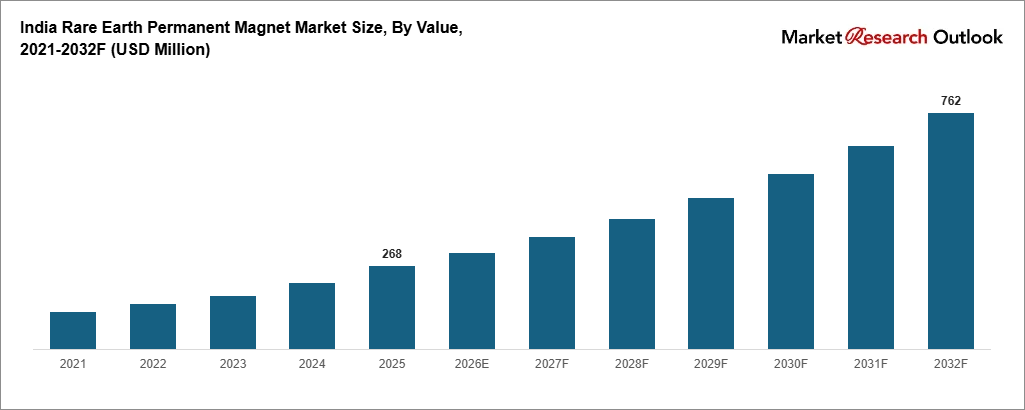
The India rare earth permanent magnet market size is witnessing rapid expansion, driven by fast EV adoption, traction motor localisation, rising wind power and electronics output, growing industrial automation, and new government support for domestic permanent magnet manufacturing. Valued at USD 268 million in 2025 and projected to reach USD 762 million by 2032, growing at a CAGR of 16.1%, the India rare earth permanent magnet market growth is being fuelled by strong demand from EV and motor makers, wind turbine OEMs, electronics and appliance brands, and defence programmes. India’s consumption of rare earth permanent magnets stood at about 4,010 tonnes in 2025 and is projected to reach nearly 8,220 tonnes by 2030. Sintered NdFeB permanent magnets lead consumption, while EV traction motor and wind applications are emerging as the fastest growing categories. China’s 2025 export curbs, rising focus on supply security, and demand for heat-resistant grades are reshaping the supply landscape. As domestic players including IREL (India), Midwest Advanced Materials, and MIDHANI expand oxide, alloy, and permanent magnet capacity, and global producers including Shin-Etsu, Proterial, TDK, and Vacuumschmelze deepen Indian supply ties, the India rare earth permanent magnet market is evolving into a secure, technology-led, and increasingly local ecosystem with strong long-term growth potential.
Key Report Takeaways: India Rare Earth Permanent Magnet Market
- The India rare earth permanent magnet market size is projected to grow from USD 268 million in 2025 to USD 762 million by 2032, registering a strong CAGR of 16.1%, driven by rapid EV adoption, traction motor localisation, wind and electronics growth, and the structural shift toward domestic rare earth permanent magnet supply.
- NdFeB permanent magnets, led by sintered grades, dominate the India rare earth permanent magnet market, accounting for about 89% of total value in 2025, driven by the highest energy density of any commercial permanent magnet, wide use in EV traction motors, electronics, and wind generators, and established supply from Japanese, European, and Chinese producers.
- EV traction motor and wind turbine generator applications are emerging as the fastest growing segments in the India rare earth permanent magnet market, expected to grow at 21% to 24% annually as EV sales rise and direct-drive wind turbines gain share.
- India’s rare earth permanent magnet consumption of about 4,010 tonnes in 2025, projected to double to nearly 8,220 tonnes by 2030, is structurally expanding the India rare earth permanent magnet market across automotive, renewable energy, electronics, industrial, and defence categories.
- Rising investments by IREL (India), Midwest Advanced Materials, MIDHANI, and bidders under the INR 7,280 crore REPM scheme in oxide refining, alloy making, and sintering capacity are strengthening local supply and supporting the India rare earth permanent magnet market forecast 2032.
Key Market Drivers: India Rare Earth Permanent Magnet Market
Rapid Electric Vehicle Adoption and Traction Motor Localisation Driving Rare Earth Permanent Magnet Demand Across India
Growth in the India rare earth permanent magnet market is being driven by rapid EV adoption and the localisation of EV traction motors. India sold a record 2.27 million EVs in CY2025, up 16% from 1.95 million units in CY2024, according to VAHAN retail data, including about 1.28 million electric two-wheelers and nearly 0.8 million electric three-wheelers. Most EV traction motors use PMSM or BLDC designs built around NdFeB permanent magnets, with 0.3 to 0.8 kg used per electric two-wheeler and 1 to 2 kg per electric car. The automotive and electric mobility segment already accounts for 38% to 42% of rare earth permanent magnet value in India. The INR 10,900 crore PM E-DRIVE scheme and the INR 25,938 crore PLI scheme for automobiles and auto components link incentives to local sourcing of traction motors, pulling permanent magnet demand toward Indian supply chains. Electric two-wheeler penetration of only about 6.3% in CY2025, against national ambitions of far higher EV shares by 2030, indicates large headroom and is creating strong structural pull-through demand across the India rare earth permanent magnet market.
Renewable Energy Expansion, Electronics Manufacturing, and Industrial Automation Fuelling High-Performance Permanent Magnet Adoption
The India rare earth permanent magnet market is benefiting from fast growth in renewable energy, electronics manufacturing, and industrial automation. India is targeting 500 GW of non-fossil power capacity by 2030, and installed wind capacity has crossed 50 GW, with direct-drive and hybrid permanent magnet generators using about 600 to 700 kg of NdFeB permanent magnets per MW. Domestic electronics production has expanded sharply under PLI schemes for mobile phones, IT hardware, and components, raising demand for small permanent magnets in speakers, vibration motors, camera modules, and hard drives. Inverter air conditioners, BLDC ceiling fans, and refrigerator compressors are moving to permanent magnet motors to meet BEE star rating norms, while servo motors, robots, and CNC machines in automotive and electronics plants rely on high-grade NdFeB permanent magnets. Together, electronics, industrial, and renewable energy uses account for over 45% of demand, supporting price competitiveness and scale across the India rare earth permanent magnet market.
Government Support Through the REPM Scheme, National Critical Mineral Mission, and Rare Earth Corridors Strengthening Domestic Supply
Strong policy support is a major catalyst for the India rare earth permanent magnet market. In November 2025, the Union Cabinet approved the INR 7,280 crore Scheme to Promote Manufacturing of Sintered Rare Earth Permanent Magnets, which aims to create 6,000 tonnes per year of integrated capacity covering oxide to metal, metal to alloy, and alloy to finished permanent magnet. The scheme offers INR 6,450 crore in sales-linked incentives over five years and INR 750 crore in capital subsidy, runs for seven years including a two-year setup period, and is expected to be awarded to up to five beneficiaries through competitive bidding. The National Critical Mineral Mission, approved in January 2025 with an outlay of INR 16,300 crore, supports exploration, processing, and recycling, while the Union Budget 2026-27 announced dedicated rare earth corridors in Odisha, Kerala, Andhra Pradesh, and Tamil Nadu. India holds about 6.9 million tonnes of rare earth oxide reserves, mainly in coastal monazite sands, and IREL already produces around 500 tonnes of NdPr oxide a year, enough for roughly 1,500 tonnes of sintered permanent magnets. These measures are structurally expanding India rare earth permanent magnet market growth across all major end-use categories through 2032.
Key Market Challenges: India Rare Earth Permanent Magnet Market
Near-Total Import Dependence on China and Export Control Risks Disrupting Permanent Magnet Supply
The India rare earth permanent magnet market continues to face challenges around near-total import dependence, as almost all rare earth permanent magnets used in India are still imported. India imported about 53,700 tonnes of permanent magnets of all types in FY25, nearly 88% more than the 28,700 tonnes imported in FY24, with around 93% sourced from China. China’s April 2025 export curbs on seven heavy rare earths, including dysprosium and terbium, and related permanent magnets left Indian EV and motor makers with only two to three weeks of stock, forcing several two-wheeler OEMs to cut or reschedule production. Licence-based approvals continue to slow deliveries and add paperwork for Indian buyers. Since China controls about 90% of global rare earth processing and permanent magnet output, India’s reliance on a single dominant source limits planning certainty for buyers across the India rare earth permanent magnet market.
Limited Mid-Stream Processing, Technology Gaps, and Long Gestation for Integrated Permanent Magnet Plants
The India rare earth permanent magnet market faces structural complexity from limited mid-stream capacity to convert rare earth oxides into metals, alloys, and finished permanent magnets. While IREL mines and refines rare earths from monazite sands in Odisha, Kerala, and Tamil Nadu, India still lacks commercial-scale facilities for NdPr metal reduction, strip-cast alloy production, hydrogen decrepitation, jet milling, and high-volume sintering. Integrated permanent magnet plants need two years or more to set up, specialised furnaces, and tight process control, and most sintering and grain boundary diffusion know-how sits with Chinese, Japanese, and European producers. Heavy rare earths such as dysprosium and terbium, needed for high-temperature grades, are largely unavailable from Indian deposits. Skilled metallurgists and process engineers are also in short supply. While the REPM scheme and IREL’s pilot NdFeB work in Hyderabad are building capability, the processing gap remains a near-term challenge for the India rare earth permanent magnet market.
Volatility in Rare Earth Oxide Prices and Low-Cost Imports Impacting Domestic Permanent Magnet Margins
The India rare earth permanent magnet market faces practical constraints around raw material price volatility, aggressive import pricing, and margin pressure across the value chain. NdPr oxide prices swung by more than 50% between 2022 and 2025, and dysprosium and terbium prices remain highly sensitive to Chinese export policy. In FY25, India’s permanent magnet import volume rose by about 88%, while import value grew only in low single digits, pointing to sharp price cuts by Chinese suppliers that make it hard for new domestic plants to compete. Raw materials can make up 60% to 75% of a sintered NdFeB permanent magnet’s cost, so oxide price swings flow directly into margins. Smaller domestic permanent magnet makers face added risk from long-term supply contracts and buyer price resistance. Sales-linked incentives, long-term offtake agreements, and recycled feedstock are emerging as solutions, but cost parity with imports remains a barrier to widespread adoption across the India rare earth permanent magnet market.
Key Market Trends: India Rare Earth Permanent Magnet Market
Rapid Build-Out of Domestic Integrated Rare Earth Permanent Magnet Manufacturing in India
The India rare earth permanent magnet market is undergoing a clear shift toward domestic integrated manufacturing, with locally made permanent magnets expected to meet over 25% of national demand by 2030, up from almost none in 2024. The government has set a target of about 5,000 tonnes of domestic rare earth permanent magnet production capacity by 2030, while the REPM scheme aims to create 6,000 tonnes per year of integrated oxide-to-magnet capacity through up to five plants of about 1,200 tonnes each. IREL (India) operates a samarium cobalt permanent magnet plant in Visakhapatnam and is running pilot NdFeB magnet work in Hyderabad, while private players such as Midwest Advanced Materials have announced rare earth permanent magnet projects in South India. Auto component and electronics companies are also evaluating bids and offtake deals under the scheme. This build-out is reinforcing the India rare earth permanent magnet market forecast 2032 across both EV and industrial categories.
Heavy Rare Earth Reduction, Grain Boundary Diffusion, and Permanent Magnet Recycling Gaining Momentum in the India Rare Earth Permanent Magnet Market
A clear shift toward lower heavy rare earth content, advanced processing, and recycling is reshaping the India rare earth permanent magnet market, particularly for EV and industrial motor grades. Grain boundary diffusion lets permanent magnet makers place dysprosium and terbium only at grain edges, cutting heavy rare earth use by 40% to 60% while keeping strength above 150°C. Motor designers are also using better cooling and rotor layouts to run lower-grade permanent magnets, while rare-earth-free and ferrite motors from Ola Electric and startups such as Chara Technologies are creating a partial substitution trend in low-cost two-wheelers. Recycling is gaining attention, with India generating over 1.7 million tonnes of e-waste a year and recyclers such as Attero working on rare earth recovery from hard drives, motors, and electronics. By 2032, recycled feedstock is expected to supply 8% to 12% of domestic rare earth needs for magnet making, improving supply security across the India rare earth permanent magnet market.
Supply Diversification, Strategic Partnerships, and Rare Earth Corridors Reshaping the Permanent Magnet Supply Chain
A wave of supply diversification and strategic partnerships is reshaping the India rare earth permanent magnet market supply landscape. After China’s 2025 export curbs, Indian OEMs and motor makers began dual sourcing from Japan, South Korea, Vietnam, and Europe, building safety stocks, and signing longer supply agreements. India is working with Quad partners, Australia, Japan, and Central Asian countries on critical mineral supply, while KABIL is pursuing overseas mineral assets. The Union Budget 2026-27 plan for dedicated rare earth corridors in Odisha, Kerala, Andhra Pradesh, and Tamil Nadu links mining, refining, research, and magnet making in one zone. Combined with the INR 7,280 crore REPM scheme, the INR 16,300 crore National Critical Mineral Mission, and rising EV and wind demand, these developments are reinforcing the India rare earth permanent magnet market forecast 2032 across the entire value chain.
Segmental Insights: India Rare Earth Permanent Magnet Market
By End-Use Industry: Automotive & Electric Mobility Dominates the India Rare Earth Permanent Magnet Market
The automotive and electric mobility segment dominates the India rare earth permanent magnet market, accounting for an estimated 38% to 42% of total value, driven by 2.27 million EV sales in CY2025, traction motor localisation, and growing use of permanent magnets in electric power steering, starter generators, and small motors in conventional vehicles. Sintered NdFeB permanent magnets in high-coercivity grades are the main variants within this segment, covering over 80% of automotive magnet purchases. The electronics and electricals segment contributes another 20% to 23% of demand, driven by mobile phones, speakers, hard drives, inverter air conditioners, and BLDC fans. Industrial manufacturing accounts for 14% to 17%, led by servo motors, robots, pumps, and lifts. Renewable energy holds 9% to 11%, led by wind generators, while defence, aerospace, and healthcare together make up the remaining 9% to 12%. In 2025, EV and motor makers including Ola Electric, TVS, Bajaj, Sona Comstar, and Lucas TVS stepped up permanent magnet sourcing and safety stocks, reinforcing segment dominance in the India rare earth permanent magnet market.
By Magnet Type: Sintered NdFeB Leads While High-Coercivity Grades Grow Fastest
NdFeB permanent magnets lead the India rare earth permanent magnet market product landscape, accounting for approximately 89% of total value, driven by the highest energy product of any commercial permanent magnet, compact size, and wide use across EVs, electronics, wind, and industrial motors. Within NdFeB, sintered permanent magnets hold about 76% of total market value, while bonded NdFeB permanent magnets contribute 11% to 13%, mainly in small motors, sensors, and electronics where complex shapes matter most. Samarium cobalt permanent magnets account for about 7% to 9%, used in defence, aerospace, and high-temperature applications above 250°C. High-coercivity grades such as SH, UH, and EH are the fastest growing categories within the India rare earth permanent magnet market, expanding at 19% to 22% annually, driven by EV traction motors that run hot and need strong resistance to demagnetisation. Hot-deformed and cerium-substituted permanent magnets together account for 2% to 4% of the market, with hot-deformed grades expected to grow quickly as heavy rare earth-free options through 2032. Leading suppliers including Shin-Etsu, Proterial, TDK, Vacuumschmelze, and Chinese majors have aligned Indian product portfolios to this grade mix, supporting higher-grade adoption across the India rare earth permanent magnet market.
Regional Insights: India Rare Earth Permanent Magnet Market
Regional analysis of the India rare earth permanent magnet market shows that South India and West India collectively account for approximately 56% to 60% of total permanent magnet demand, driven by Tamil Nadu (Hosur and Chennai EV, electronics, and wind belt), Karnataka (Bengaluru electronics and EV cluster), Andhra Pradesh (Sri City electronics and IREL Visakhapatnam), Telangana (Hyderabad defence and permanent magnet research base), Maharashtra (Pune and Aurangabad auto belt), and Gujarat (wind and auto hubs), supported by dense motor and electronics supplier bases. North India contributes around 22% to 25% of demand, led by Delhi NCR, Haryana, Uttar Pradesh, and Punjab, supported by electronics manufacturing in Noida and Greater Noida and two-wheeler and car plants in Haryana. Central and East India together account for 17% to 20% of demand, supported by Odisha, Jharkhand, West Bengal, and Madhya Pradesh, where IREL’s Odisha operations and rare earth corridor plans are building upstream supply. In 2025, IREL activity across Odisha, Kerala, Tamil Nadu, and Andhra Pradesh, along with planned rare earth corridors in the same states, reinforced regional supply hubs, supporting closer integration of mining, refining, and magnet making across the India rare earth permanent magnet market.
EV manufacturing data: see the India EV Projects Tracker for EV and component plant investments, and the India ACC Battery PLI Tracker for battery cell capacity under the PLI scheme.
Recent Developments: India Rare Earth Permanent Magnet Market
- The India rare earth permanent magnet market witnessed strong momentum in demand and policy action during 2024 and 2025. India imported about 53,700 tonnes of permanent magnets of all types in FY25, an 88% year-on-year rise from 28,700 tonnes in FY24, with about 93% sourced from China, according to official trade data. India’s rare earth permanent magnet consumption stood at about 4,010 tonnes in 2025 and is projected to reach nearly 8,220 tonnes by 2030, growing at an average of around 15% annually.
- Government action has deepened India-focused permanent magnet capacity plans. In November 2025, the Union Cabinet approved the INR 7,280 crore Scheme to Promote Manufacturing of Sintered Rare Earth Permanent Magnets, targeting 6,000 tonnes per year of integrated capacity, with INR 6,450 crore in sales-linked incentives and INR 750 crore in capital subsidy. The Union Budget 2026-27 followed with dedicated rare earth corridors in Odisha, Kerala, Andhra Pradesh, and Tamil Nadu. These developments are strengthening domestic supply and supporting the India rare earth permanent magnet market forecast 2032.
- Industry momentum has gained strong traction in the India rare earth permanent magnet market. In 2025, IREL (India) expanded rare earth refining and magnet development work, Midwest Advanced Materials advanced plans for NdFeB permanent magnet production, and EV makers and motor suppliers built safety stocks and diversified sourcing beyond China. Indian bidders under the REPM scheme are seeking technology partners in Japan, Europe, and South Korea, positioning India as one of the most actively scaling permanent magnet markets outside China and strengthening long-term competitive positioning in the India rare earth permanent magnet market forecast 2032.
Key Market Players: India Rare Earth Permanent Magnet Market
- IREL (India) Limited
- Midwest Advanced Materials Pvt. Ltd.
- Mishra Dhatu Nigam Limited (MIDHANI)
- Shin-Etsu Chemical Co., Ltd.
- Proterial, Ltd.
- TDK Corporation
- Ningbo Yunsheng Co., Ltd.
- JL Mag Rare-Earth Co., Ltd.
- Beijing Zhong Ke San Huan Hi-Tech Co., Ltd.
- Vacuumschmelze GmbH & Co. KG
- Arnold Magnetic Technologies Corporation
- Neo Performance Materials Inc.
- Daido Electronics Co., Ltd.
| By Magnet Type | By Manufacturing Process | By Grade | By Application | By End-Use Industry |
| Neodymium Iron Boron (NdFeB) Samarium Cobalt (SmCo) Others (Cerium-Substituted, Praseodymium-Based) |
Sintered Bonded Hot-Deformed |
Standard Grade (N35-N45) High-Energy Grade (N48-N55) High-Coercivity Grade (H, SH, UH, EH, AH) |
Traction Motors Industrial Motors & Robotics Wind Turbine Generators Consumer Electronics & Acoustics HVAC Compressors & Home Appliances Medical Devices (MRI & Imaging) Defence & Aerospace Systems Others |
Automotive & Electric Mobility Renewable Energy Electronics & Electricals Industrial Manufacturing Healthcare Defence & Aerospace |
Report Scope
In this report, the India Rare Earth Permanent Magnet Market has been segmented into the following categories, in addition to detailed analysis of key industry trends, market dynamics, competitive landscape, and growth opportunities across the forecast period:
- By Magnet Type
- Neodymium Iron Boron (NdFeB)
- Samarium Cobalt (SmCo)
- Others (Cerium-Substituted, Praseodymium-Based)
- By Manufacturing Process
- Sintered
- Bonded
- Hot-Deformed
- By Grade
- Standard Grade (N35-N45)
- High-Energy Grade (N48-N55)
- High-Coercivity Grade (H, SH, UH, EH, AH)
- By Application
- Traction Motors
- Industrial Motors & Robotics
- Wind Turbine Generators
- Consumer Electronics & Acoustics
- HVAC Compressors & Home Appliances
- Medical Devices (MRI & Imaging)
- Defence & Aerospace Systems
- Others
- By End-Use Industry
- Automotive & Electric Mobility
- Renewable Energy
- Electronics & Electricals
- Industrial Manufacturing
- Healthcare
- Defence & Aerospace
- By Geography
- North India
- South India
- West India
- East India
- Central India
Competitive Landscape
Company Profiles:
Detailed analysis of the leading companies operating in the India Rare Earth Permanent Magnet Market, including business overview, product portfolio, strategic initiatives, competitive positioning, and recent developments.
Company Information
Detailed profiling and strategic analysis of additional market players (up to five companies), including emerging domestic permanent magnet manufacturers, rare earth refiners and alloy makers, permanent magnet recycling companies, or niche bonded and samarium cobalt permanent magnet producers.
For a free sample of the India Rare Earth Permanent Magnet Market report, customised insights or delivery timelines, submit your query here
India Rare Earth Permanent Magnet Market, 2032
- Research Framework
- Market Segmentation
- Research Objective
- Research Methodology
- Qualitative Research
- Primary Research
- Secondary Research
- Quantitative Research
- Market Breakdown & Data Triangulation
- Demand Side
- Supply Side
- Primary Research Respondents
- Assumption & Limitation
- Executive Summary
- Market Overview, 2021-2032
- By Magnet Type
- By Manufacturing Process
- By Grade
- By Application
- By End-Use Industry
- By Region
- Analyst Recommendations
- Geopolitical Impact on India Rare Earth Permanent Magnet Market
- India Rare Earth Permanent Magnet Market Insights
- Market Dynamics
- Growth Drivers
- Rapid electric vehicle adoption and traction motor localisation driving rare earth permanent magnet demand across India.
- Renewable energy expansion, electronics manufacturing, and industrial automation fuelling high-performance permanent magnet adoption.
- Government support through the REPM scheme, National Critical Mineral Mission, and rare earth corridors strengthening domestic supply.
- Restraints
- Near-total import dependence on China and export control risks disrupting permanent magnet supply.
- Limited mid-stream processing, technology gaps, and long gestation for integrated permanent magnet plants.
- Volatility in rare earth oxide prices and low-cost imports impacting domestic permanent magnet margins.
- Opportunities
- Domestic integrated permanent magnet manufacturing under the REPM scheme opening new supply pools for Indian EV and electronics makers.
- Rare earth permanent magnet recycling from e-waste and end-of-life motors supporting next-generation circular supply.
- Wind energy, defence, and export-oriented permanent magnet demand creating large growth opportunities for Indian producers.
- Challenges
- Intense price competition from low-cost Chinese permanent magnets and finished magnet-containing assemblies.
- Shortage of skilled metallurgy, sintering, and permanent magnet processing talent across India.
- Maintaining permanent magnet performance, coating quality, and grade consistency at commercial scale.
- Technological Advancements
- Recent Technological Advancements
- Prior to 2020
- Porter’s Five Forces Analysis
- PESTLE Analysis
- Industry Value Chain & Entry Points
- Upstream Mining & Mineral Sands (monazite, ilmenite, beach sand minerals, IREL, KMML) feeding permanent magnet supply
- Rare Earth Separation & Oxide Refining (NdPr oxide, dysprosium, terbium, samarium oxides)
- Metal & Alloy Production (NdPr metal, NdFeB strip-cast alloy, SmCo alloys for permanent magnets)
- Permanent Magnet Manufacturers (sintered, bonded, and hot-deformed NdFeB, SmCo magnets)
- Coating, Machining & Magnetisation Service Providers (nickel, epoxy, and zinc coatings for permanent magnets)
- Quality Control, R&D & Testing Laboratories (BARC, DMRL, NML, IIT centres, BIS standards)
- Distributors, Traders & Import Channels (B2B permanent magnet and assembly distribution)
- Motor, Generator & Device Manufacturers (EV traction motors, wind generators, electronics, servo motors)
- Recycling & Recovery Players (e-waste recyclers, end-of-life permanent magnet recovery)
- End-Users (automotive, renewable energy, electronics, industrial, healthcare, defence sectors)
- India Rare Earth Permanent Magnet Market: Regulatory Framework
- India Rare Earth Permanent Magnet Market Overview
- Market Size & Forecast, 2021-2032
- By Value (USD Million)
- By Volume (Tonnes)
- Market Share & Forecast
- By Magnet Type
- Neodymium Iron Boron (NdFeB)
- Samarium Cobalt (SmCo)
- Others (Cerium-Substituted, Praseodymium-Based)
- By Manufacturing Process
- Sintered
- Bonded
- Hot-Deformed
- By Grade
- Standard Grade (N35-N45)
- High-Energy Grade (N48-N55)
- High-Coercivity Grade (H, SH, UH, EH, AH)
- By Application
- Traction Motors
- Industrial Motors & Robotics
- Wind Turbine Generators
- Consumer Electronics & Acoustics
- HVAC Compressors & Home Appliances
- Medical Devices (MRI & Imaging)
- Defence & Aerospace Systems
- Others
- By End-Use Industry
- Automotive & Electric Mobility
- Renewable Energy
- Electronics & Electricals
- Industrial Manufacturing
- Healthcare
- Defence & Aerospace
- By Geography
- North India
- South India
- West India
- East India
- Central India
- Competitive Landscape
- India Rare Earth Permanent Magnet Market Company Market Share Analysis, 2025
- Competitive Benchmarking, By Operating Parameters
- Key Strategic Development (Mergers, Acquisitions, Partnerships, Etc.)
- List of Emerging Players
- Company Profile
- IREL (India) Limited
- Introduction & Company Profile
- Product Benchmarking
- Strategic Outlook
- Key Competitors
- Financial Analysis
- SWOT Analysis
(Same Data Pointers Will Be Provided for The Below Companies)
- Midwest Advanced Materials Pvt. Ltd.
- Mishra Dhatu Nigam Limited (MIDHANI)
- Shin-Etsu Chemical Co., Ltd.
- Proterial, Ltd.
- TDK Corporation
- Ningbo Yunsheng Co., Ltd.
- JL Mag Rare-Earth Co., Ltd.
- Beijing Zhong Ke San Huan Hi-Tech Co., Ltd.
- Vacuumschmelze GmbH & Co. KG
- Arnold Magnetic Technologies Corporation
- Neo Performance Materials Inc.
- Daido Electronics Co., Ltd.
- Other Prominent Players
* Financial information in case of non-listed companies will be provided as per availability
** The segmentation and the companies are subjected to modifications based on in-depth secondary for the final deliverable
Frequently Asked Questions
1. How large is the India rare earth permanent magnet market and what is its growth forecast?
Ans: The India rare earth permanent magnet market is valued at USD 268 million in 2025 and is projected to reach USD 762 million by 2032, growing at a CAGR of 16.1%, supported by EV, wind, and electronics demand.
2. Which segments are driving demand in the India rare earth permanent magnet market?
Ans: NdFeB permanent magnets, led by sintered grades, hold about 89% value share, while automotive and electric mobility is the largest end-use at 38% to 42%. EV traction motor and wind applications are the fastest-growing segments.
3. What are the key drivers of growth in the India rare earth permanent magnet market?
Ans: Key drivers include rapid EV adoption, traction motor localisation, renewable energy and electronics growth, industrial automation, and government support through the INR 7,280 crore REPM scheme and the National Critical Mineral Mission.
4. Which regions are driving growth in the India rare earth permanent magnet market?
Ans: South India and West India lead with around 56% to 60% of total demand, driven by Tamil Nadu, Karnataka, Andhra Pradesh, Telangana, Maharashtra, and Gujarat. East India gains from Odisha rare earth processing.
5. What are the latest trends in the India rare earth permanent magnet market?
Ans: Latest trends include domestic integrated permanent magnet plants under the REPM scheme, heavy rare earth reduction through grain boundary diffusion, permanent magnet recycling from e-waste, rare earth corridors, and supply diversification away from China.