

India Electric Two Wheeler Market, 2032
- Automotive & EV
- Nov 2026
- Pages 140
- Report Format: pdf
- Report Price: $2400 USD
India’s electric two wheeler market is witnessing strong structural growth, driven by high petrol prices, a clear electric two wheeler running cost advantage over petrol scooters and motorcycles, continued demand incentives under the PM E-DRIVE scheme, expanding charging and battery swapping networks, falling lithium-ion battery prices, and aggressive capacity expansion by legacy OEMs and EV startups investing in local motors, battery packs, cells, and digital sales platforms.
| Study Duration | 2021-2032 |
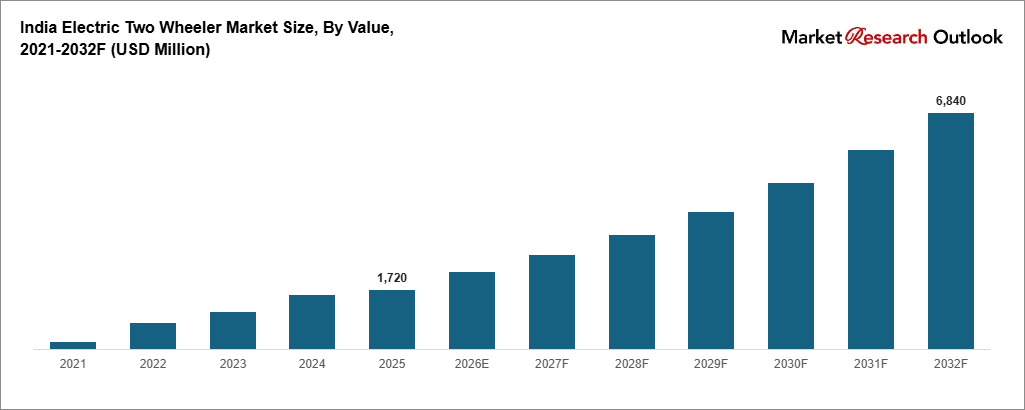
| Market Size (2025) | USD 1,720 Million |
| CAGR (2026-2032) | 21.8% |
| Leading Segment | Electric Scooters (Lithium-Ion) |
| Fastest Growing Segment | Electric Motorcycles |
| Market Size (2032) | USD 6,840 Million |
Market Overview: India Electric Two Wheeler Market
The India electric two wheeler market size is witnessing rapid expansion, driven by high petrol prices, a strong electric two wheeler total cost of ownership advantage, continued government incentives, expanding charging and battery swapping networks, and major capacity additions by legacy two wheeler makers and EV startups. Valued at USD 1,720 million in 2025 and projected to reach USD 6,840 million by 2032, growing at a CAGR of 21.8%, the India electric two wheeler market growth is being fuelled by daily urban commuters, delivery fleets, and a wider model range priced from INR 70,000 to INR 1.8 lakh. Electric two wheeler retail sales touched about 12.8 lakh units in 2025, up 11% from 11.5 lakh units in 2024, and monthly registrations crossed 2 lakh units in September 2026. Electric scooters lead consumption, while electric motorcycles are emerging as the fastest growing category. Shifting electric two wheeler buyer preferences toward connected, longer range, and safer products are reshaping the supply landscape. As legacy players including TVS Motor, Bajaj Auto, Hero MotoCorp, and Honda scale dedicated EV capacity, and startups such as Ather Energy, Ola Electric, River, and Ultraviolette widen their portfolios, the India electric two wheeler market is evolving into a competitive, technology-led, and increasingly localized ecosystem with strong long-term growth potential.
Key Report Takeaways: India Electric Two Wheeler Market
- The India electric two wheeler market size is projected to grow from USD 1,720 million in 2025 to USD 6,840 million by 2032, registering a strong CAGR of 21.8%, driven by lower running costs, PM E-DRIVE incentives extended to March 2028, and the steady shift from petrol scooters to electric two wheelers across urban India.
- Electric scooters dominate the India electric two wheeler market, accounting for around 86% of total volume in 2025, driven by strong demand for practical family scooters such as the TVS iQube, Bajaj Chetak, Ather Rizta, and Ola S1 range, and wide electric two wheeler availability through dealer networks in metro and tier-2 cities.
- Electric motorcycles are emerging as the fastest growing segment in the India electric two wheeler market, expected to grow at 35% to 40% annually as Ola Electric, Revolt, Ultraviolette, Oben, and legacy brands launch electric two wheeler commuter and performance bikes for riders who have so far preferred petrol motorcycles.
- Rapid build-out of charging and swapping infrastructure, with over 25,000 public charging stations by 2025 and PM E-DRIVE funding of INR 2,000 crore for about 72,000 new public chargers, is structurally expanding the India electric two wheeler market across personal, delivery, and shared mobility use.
- Rising investments by TVS Motor, Bajaj Auto, Ather Energy, Ola Electric, and Hero MotoCorp in battery packs, motors, cell manufacturing, and new plants are strengthening local supply and supporting the India electric two wheeler market forecast 2032.
Key Market Drivers: India Electric Two Wheeler Market
Rising Fuel Prices, Lower Running Costs, and Urban Commuting Demand Driving Electric Two Wheeler Adoption Across India
Growth in the India electric two wheeler market is being driven by high fuel prices, the clear running cost advantage of electric two wheelers, and rising daily commuting needs across tier-1, tier-2, and tier-3 cities. For electric two wheeler buyers, the math is simple. Petrol retails at roughly INR 94 to INR 105 per litre in most large cities, which puts the running cost of a 110 cc scooter at about INR 2.0 to INR 2.5 per km. A comparable electric two wheeler costs only INR 0.25 to INR 0.40 per km on home charging and has far fewer moving parts to service. For an electric two wheeler rider covering 40 km a day, the saving works out to INR 25,000 to INR 30,000 a year, which recovers the price gap with a petrol scooter in about two to three years. India sold close to 12.8 lakh electric two wheelers at retail in 2025, and FY26 electric two wheeler volumes climbed to around 14.6 lakh units from 11.5 lakh units in FY25. Electric two wheeler penetration has also moved up quickly, reaching 11.6% of all two wheeler registrations in September 2026. Growing traffic congestion, longer commutes in expanding metros, and steady electric two wheeler demand from delivery riders are creating strong structural pull-through demand across the India electric two wheeler market.
Government Incentives Under PM E-DRIVE, PLI Schemes, and State EV Policies Accelerating Electric Two Wheeler Sales
The India electric two wheeler market is benefiting from steady policy support at both central and state levels. In August 2026, the Ministry of Heavy Industries extended PM E-DRIVE demand incentives for electric two wheelers to March 31, 2028, and raised the segment allocation by INR 1,000 crore to INR 2,767 crore, taking the overall scheme outlay to INR 11,900 crore. The number of electric two wheelers eligible for support was raised to 4.57 million, and the incentive stays capped at 15% of the ex-factory price for models priced up to INR 1.5 lakh. On the supply side, the INR 25,938 crore PLI scheme for automobiles and auto components and the INR 18,100 crore PLI scheme for advanced chemistry cell batteries are pushing electric two wheeler OEMs to localize motors, controllers, and battery packs. States such as Maharashtra, Delhi, Tamil Nadu, Gujarat, and Karnataka add electric two wheeler road tax waivers, registration fee exemptions, and purchase incentives under their own EV policies. A 5% GST rate on electric two wheelers further supports price competitiveness, while public procurement and fleet mandates in cities like Delhi are pulling commercial demand forward across the India electric two wheeler market.
Expansion of Charging and Battery Swapping Networks, and Falling Battery Prices Strengthening Market Growth
Rapid growth in charging and swapping infrastructure is a major catalyst for the India electric two wheeler market, alongside a sharp fall in battery costs. India had over 25,000 public charging stations by 2025 serving electric two wheelers and cars, and PM E-DRIVE has set aside INR 2,000 crore to add about 72,000 public chargers in cities, along highways, and at fuel outlets. Private electric two wheeler charging networks are growing as well, with Ather Grid fast chargers, Ola Hypercharger points, and swapping operators such as Battery Smart, Sun Mobility, and Yulu Energy expanding across Delhi NCR, Bengaluru, Mumbai, Pune, Hyderabad, and Jaipur. Global lithium-ion pack prices fell to around USD 108 per kWh in 2025, and the LFP packs used in many Indian scooters cost even less, which has helped OEMs bring 2 to 3 kWh electric two wheelers below INR 1 lakh. Battery as a service plans, electric two wheeler warranties of five to eight years, and assured buyback schemes are lowering ownership risk for first-time electric two wheeler buyers. Delivery fleets serving Zomato, Swiggy, Blinkit, Zepto, and Amazon are switching to swappable electric two wheelers to cut daily fuel spend, structurally expanding India electric two wheeler market growth across all major end-user categories through 2032.
Key Market Challenges: India Electric Two Wheeler Market
High Upfront Purchase Price and Shrinking Subsidy Support Limiting Mass-Market Affordability
The India electric two wheeler market continues to face challenges around upfront pricing, especially in the entry segment where most first-time buyers sit. A popular electric two wheeler with a 3 kWh battery still sells at INR 1.0 lakh to INR 1.4 lakh ex-showroom, against INR 75,000 to INR 95,000 for a 110 cc petrol scooter. Central demand incentives for electric two wheelers have been cut in stages, from INR 5,000 per kWh capped at INR 10,000 per vehicle in FY25 to INR 2,500 per kWh capped at INR 5,000 in FY26, so buyers now pay closer to the full ex-factory price. The 2025 GST revision also lowered the tax on petrol two wheelers up to 350 cc from 28% to 18%, which narrowed the price gap that electric two wheelers once enjoyed. Retail finance for electric two wheelers remains harder to access, with lenders charging higher interest rates and offering lower loan-to-value ratios because resale values are still uncertain. Together, these factors limit adoption among price-sensitive rural and semi-urban households across the India electric two wheeler market.
Rare Earth Magnet Supply Disruptions and Import Dependence on Battery Cells Affecting Production
The India electric two wheeler market faces supply-side complexity from its heavy reliance on imported components. China’s curbs on heavy rare earth magnet exports from April 2025 disrupted the supply of traction motors, and several OEMs, including Bajaj Auto, had to cut or pause electric two wheeler output during mid-2025. More than 70% of the lithium-ion cells used in Indian electric two wheelers are still imported, mostly from China, which exposes electric two wheeler OEMs to currency swings, freight costs, and trade policy risk. The Union Cabinet approved a INR 7,280 crore scheme in November 2025 to build local sintered rare earth permanent magnet capacity, and ACC battery PLI plants are under construction, yet meaningful domestic output will take a few years. Until then, component shortages and input price swings remain a near-term challenge for the India electric two wheeler market.
Battery Safety Concerns, Range Anxiety, and After-Sales Service Gaps Across Tier-2 and Tier-3 Cities
The India electric two wheeler market faces practical constraints around consumer trust, real-world range, and service quality. A string of electric two wheeler battery fire incidents in 2022 led to stricter AIS-156 safety norms for battery packs, which raised testing and compliance costs for manufacturers. Many entry-level electric two wheelers deliver a real-world range of 80 to 110 km against claimed figures of 120 to 150 km, a gap that still worries riders in smaller cities with sparse public charging. Service problems have also hurt electric two wheeler sentiment, as some brands faced long repair queues, spare part shortages, and a rise in consumer complaints during 2024 and 2025. Resale values for electric two wheelers remain unclear because battery health is hard to judge at the time of sale, which makes buyers cautious. Longer electric two wheeler warranties, battery health certification, and wider authorized service networks are emerging as solutions, but uneven service coverage outside the metros remains a barrier to widespread adoption across the India electric two wheeler market.
Key Market Trends: India Electric Two Wheeler Market
Shift Toward LFP Batteries, Longer Range Models, and Connected Smart Scooters in India
The India electric two wheeler market is undergoing a clear technology shift toward LFP battery chemistry, larger battery packs, and connected features. LFP cells offer electric two wheelers better thermal stability and a cycle life of 2,000 to 3,000 cycles, and they are expected to power over 45% of new electric two wheelers sold in India by 2027. Electric two wheeler battery capacity has also moved up, with 3 to 4 kWh packs now common in mainstream family scooters that claim 120 to 160 km of range per charge. Leading electric two wheeler brands including TVS Motor, Bajaj Auto, Ather Energy, Ola Electric, and Hero MotoCorp now offer touchscreen dashboards, turn-by-turn navigation, ride analytics, theft alerts, and over-the-air software updates, often through paid connectivity plans. Family-focused electric two wheelers such as the Ather Rizta and the wider TVS iQube range have shown that a bigger seat, more storage, and simple controls appeal to buyers well beyond early adopters. This product transition is reinforcing the India electric two wheeler market forecast 2032 across both personal and commercial categories.
Growth of Electric Motorcycles and Expansion of Legacy OEMs Reshaping Competition in the India Electric Two Wheeler Market
A clear change in competitive structure is reshaping the India electric two wheeler market, as legacy two wheeler makers overtake the electric two wheeler startups that built the category. In 2025, TVS Motor led annual electric two wheeler retail sales with about 2.98 lakh units, followed by Bajaj Auto at 2.69 lakh units, Ather Energy at around 2.0 lakh units, and Ola Electric at about 1.97 lakh units. Ola’s electric two wheeler share dropped to roughly 16% in 2025 from close to 37% in 2024, while Hero MotoCorp’s Vida brand and Honda’s Activa e and QC1 widened the field. Legacy OEMs use their large electric two wheeler dealer networks, finance tie-ups, and service reach in small towns to win buyers, which startups find hard to match. Electric motorcycles are becoming the next battleground for electric two wheeler brands. Ola Electric has begun Roadster X deliveries, while Revolt, Ultraviolette, Oben Electric, and Matter are scaling commuter and performance bikes. Motorcycles make up over 60% of petrol two wheeler sales in India, so even small gains here open a large new pool of demand for the India electric two wheeler market.
Localization of Battery Cells, Motors, and Rare Earth Magnets, and New Plant Investments
A wave of localization and capacity investment is reshaping the India electric two wheeler market supply landscape. Capital expenditure announced by leading electric two wheeler makers for new plants, battery pack lines, motor production, and cell manufacturing exceeded USD 2 billion across 2023 to 2026. Ola Electric commissioned its cell gigafactory at Krishnagiri in Tamil Nadu to produce its 4680 Bharat cell, Ather Energy is building a new plant at Bidkin near Chhatrapati Sambhajinagar in Maharashtra, TVS Motor and Bajaj Auto expanded dedicated EV lines at Hosur and Akurdi, and Hero MotoCorp scaled Vida output at Chittoor. Several electric two wheeler OEMs are also developing motors that use fewer or no heavy rare earth elements after the 2025 supply shock. The PLI scheme for automobiles and auto components, the ACC battery PLI scheme, and the INR 7,280 crore rare earth magnet scheme have structurally favoured local supply. Combined with rising delivery fleet demand and growing rural interest in low-cost electric two wheelers, these developments are reinforcing the India electric two wheeler market forecast 2032 across the entire value chain.
Segmental Insights: India Electric Two Wheeler Market
By End-User: Personal Segment Dominates the India Electric Two Wheeler Market
The personal end-user segment dominates the India electric two wheeler market, accounting for an estimated 76% to 80% of total volume, driven by daily commuting needs, lower running costs, and a wider choice of family scooters. Electric two wheelers with 2.5 to 4 kWh batteries, mostly scooters, are the dominant products within this segment, with authorized dealerships handling over 70% of personal purchases. The commercial and delivery fleet electric two wheeler segment contributes another 15% to 18% of demand, driven by gig workers and fleet operators serving food delivery, quick commerce, and e-commerce platforms, many of whom rely on swappable electric two wheelers. Shared mobility and rentals account for 4% to 6%, led by operators such as Yulu and Bounce and by electric two wheeler bike taxi services in large cities. In 2025, leading players including TVS Motor, Bajaj Auto, Ather Energy, Hero MotoCorp, and Ola Electric expanded retail finance, exchange offers, and family-focused models, reinforcing segment dominance in the India electric two wheeler market.
By Vehicle Type: Electric Scooters Lead While Electric Motorcycles Grow Fastest
Electric scooters lead the India electric two wheeler market product landscape, accounting for approximately 86% of total volume, driven by their gearless ease of use, under-seat storage, and suitability for short city trips. Electric mopeds and low-cost utility electric two wheelers contribute another 6% to 7%, mainly across semi-urban markets and among small traders. Electric motorcycles hold a 4% to 5% share today but are the fastest growing category within the India electric two wheeler market, expanding at 35% to 40% annually, driven by new launches in the 100 cc to 150 cc equivalent class, a real-world range of 150 to 250 km, and strong electric two wheeler interest from young riders in tier-2 and tier-3 towns. Other formats, including cargo electric two wheelers and three-wheeled scooters, account for 2% to 3% of the market. Leading manufacturers including TVS Motor, Bajaj Auto, Ather Energy, Ola Electric, and Hero MotoCorp have aligned their product portfolios to this mix, driving wider adoption across the India electric two wheeler market.
Regional Insights: India Electric Two Wheeler Market
Regional analysis of the India electric two wheeler market shows that West India and South India collectively account for approximately 58% to 62% of total volume, driven by Maharashtra (Pune and Mumbai commuter belt), Karnataka (Bengaluru), Tamil Nadu (Chennai and Hosur manufacturing cluster), Kerala, Telangana, and Gujarat, supported by early state EV policies and dense electric two wheeler dealer networks. North India contributes around 22% to 25% of demand, led by Delhi NCR, Uttar Pradesh, Rajasthan, and Haryana, supported by personal and delivery fleet electric two wheeler adoption in metro and tier-1 clusters around Delhi, Gurugram, Noida, Lucknow, and Jaipur. Central and East India together account for 15% to 18% of demand, supported by Madhya Pradesh, West Bengal, Odisha, and Bihar, where electric two wheeler dealer reach and charging access are improving. In 2025, manufacturing and sales operations by TVS Motor and Ather Energy in Tamil Nadu, Bajaj Auto in Maharashtra, Ola Electric at Krishnagiri, and Hero MotoCorp in Andhra Pradesh reinforced regional supply hubs, supporting faster delivery and service across the India electric two wheeler market.
EV sales data: see the India EV Sales by State Tracker for electric two wheeler registrations and EV share in every state, and the India Vehicle Sales Tracker for monthly retail sales by vehicle segment.
Recent Developments: India Electric Two Wheeler Market
- The India electric two wheeler market witnessed strong momentum in sales and policy support during 2025 and 2026. Retail sales reached about 12.8 lakh units in calendar year 2025, an 11% rise over 11.5 lakh units in 2024, according to FADA data. Monthly electric two wheeler registrations crossed 2.07 lakh units in September 2026, and EV penetration in the two wheeler category rose to 11.6%, based on Vahan data. Annual electric two wheeler volumes are projected to cross 20 lakh units by FY28, growing at an average of 18% to 20% annually.
- Electric two wheeler policy and supply chain support has deepened. In August 2026, the government extended PM E-DRIVE incentives for electric two wheelers to March 31, 2028, raised the segment allocation to INR 2,767 crore, and lifted the eligible vehicle cap to 4.57 million. In November 2025, the Union Cabinet approved a INR 7,280 crore scheme to manufacture sintered rare earth permanent magnets in India, aimed at cutting electric two wheeler dependence on Chinese imports. These steps are strengthening domestic supply and supporting the India electric two wheeler market forecast 2032.
- Product and capacity momentum has gained strong traction in the India electric two wheeler market. In 2025 and 2026, TVS Motor, Bajaj Auto, Ather Energy, Ola Electric, Hero MotoCorp, and Honda expanded their electric two wheeler portfolios with new family scooters, lower-priced variants, and electric motorcycles, while Ather and Ola added new plant and cell capacity. Wider electric two wheeler dealer reach in tier-2 and tier-3 towns is positioning India as one of the largest electric two wheeler markets globally, strengthening long-term competitive positioning in the India electric two wheeler market forecast 2032.
Key Market Players: India Electric Two Wheeler Market
- TVS Motor Company Limited
- Bajaj Auto Limited
- Ather Energy Limited
- Ola Electric Mobility Limited
- Hero MotoCorp Limited (Vida)
- Honda Motorcycle & Scooter India Pvt. Ltd.
- Greaves Electric Mobility Pvt. Ltd. (Ampere)
- Revolt Motors (RattanIndia Enterprises Ltd.)
- Kinetic Green Energy & Power Solutions Ltd.
- BGauss Auto Pvt. Ltd.
- River Mobility Pvt. Ltd.
- Ultraviolette Automotive Pvt. Ltd.
- Oben Electric (Oben Electric Vehicles Pvt. Ltd.)
| By Vehicle Type | By Battery Type | By Battery Capacity | By Sales Channel | By End-User |
| Electric Scooters Electric Motorcycles Electric Mopeds Others |
Lithium-Ion (NMC) Lithium Iron Phosphate (LFP) Lead-Acid Others |
Below 2 kWh 2 kWh to 3 kWh 3 kWh to 4 kWh Above 4 kWh |
Authorized Dealerships Company-Owned Experience Centres Online & D2C Platforms |
Personal Commercial & Delivery Fleets Shared Mobility & Rentals |
Report Scope
In this report, the India Electric Two Wheeler Market has been segmented into the following categories, in addition to detailed analysis of key industry trends, market dynamics, competitive landscape, and growth opportunities across the forecast period:
- By Vehicle Type
- Electric Scooters
- Electric Motorcycles
- Electric Mopeds
- Others
- By Battery Type
- Lithium-Ion (NMC)
- Lithium Iron Phosphate (LFP)
- Lead-Acid
- Others
- By Battery Capacity
- Below 2 kWh
- 2 kWh to 3 kWh
- 3 kWh to 4 kWh
- Above 4 kWh
- By Sales Channel
- Authorized Dealerships
- Company-Owned Experience Centres
- Online & D2C Platforms
- By End-User
- Personal
- Commercial & Delivery Fleets
- Shared Mobility & Rentals
- By Geography
- North India
- South India
- West India
- East India
- Central India
Competitive Landscape
Company Profiles:
Detailed analysis of the leading companies operating in the India Electric Two Wheeler Market, including business overview, product portfolio, strategic initiatives, competitive positioning, and recent developments.
Company Information
Detailed profiling and strategic analysis of additional market players (up to five companies), including emerging electric scooter brands, specialty electric motorcycle makers, battery swapping operators, or niche state-level EV brands.
For a free sample of the India Electric Two Wheeler Market report, customised insights or delivery timelines, submit your query here
India Electric Two Wheeler Market, 2032
- Research Framework
- Market Segmentation
- Research Objective
- Research Methodology
- Qualitative Research
- Primary Research
- Secondary Research
- Quantitative Research
- Market Breakdown & Data Triangulation
- Demand Side
- Supply Side
- Primary Research Respondents
- Assumption & Limitation
- Executive Summary
- Market Overview, 2021-2032
- By Vehicle Type
- By Battery Type
- By Battery Capacity
- By Sales Channel
- By End-User
- By Region
- Analyst Recommendations
- Geopolitical Impact on India Electric Two Wheeler Market
- India Electric Two Wheeler Market Insights
- Market Dynamics
- Growth Drivers
- Rising fuel prices, lower running costs, and urban commuting demand driving electric two wheeler adoption across India.
- Government incentives under PM E-DRIVE, PLI schemes, and state EV policies accelerating electric two wheeler sales.
- Expansion of charging and battery swapping networks, and falling battery prices strengthening market growth.
- Restraints
- High upfront purchase price and shrinking subsidy support limiting mass-market affordability.
- Rare earth magnet supply disruptions and import dependence on battery cells affecting production.
- Battery safety concerns, range anxiety, and after-sales service gaps across tier-2 and tier-3 cities.
- Opportunities
- Electric motorcycles and affordable commuter models opening untapped buyer pools in tier-2, tier-3, and rural markets.
- Battery swapping, battery as a service, and fleet electrification supporting next-generation growth in delivery and shared mobility.
- Local manufacturing of cells, motors, and rare earth magnets, and exports of Indian-made electric scooters creating large opportunities.
- Challenges
- Intense price competition and consolidation pressure on smaller electric two wheeler startups.
- Limited public charging and uneven electric two wheeler service networks across smaller Indian cities.
- Maintaining battery quality, safety compliance, and consistent real-world range at scale across diverse Indian climates.
- Technological Advancements
- Recent Technological Advancements
- Prior to 2020
- Porter’s Five Forces Analysis
- PESTLE Analysis
- Industry Value Chain & Entry Points
- Upstream Raw Materials (lithium, nickel, cobalt, graphite, rare earth elements, steel, aluminium, plastics)
- Electric Two Wheeler Battery Cell & Pack Manufacturers (Ola Cell, Exide Energy, Amara Raja, LOHUM, imported cells)
- Electric Two Wheeler Motor, Controller & Electronics Suppliers (BLDC and PMSM motors, controllers, BMS, chargers)
- Electric Two Wheeler OEMs (TVS Motor, Bajaj Auto, Ather Energy, Ola Electric, Hero MotoCorp)
- Quality Control, R&D & Testing (ARAI, ICAT, AIS-156 battery safety, PM E-DRIVE localization norms)
- Electric Two Wheeler Dealerships & Experience Centres (B2C retail and service networks)
- Charging & Battery Swapping Operators (Ather Grid, Battery Smart, Sun Mobility, Tata Power EZ Charge)
- Electric Two Wheeler Financing, Insurance & Leasing Providers (banks, NBFCs, battery as a service and fleet leasing firms)
- Online & D2C Sales Platforms (OEM websites, Amazon, Flipkart, fleet aggregators)
- End-Users (daily commuters, students, delivery riders, fleet operators, rental and bike taxi services)
- India Electric Two Wheeler Market: Regulatory Framework
- India Electric Two Wheeler Market Overview
- Market Size & Forecast, 2021-2032
- By Value (USD Million)
- By Volume (Thousand Units)
- Market Share & Forecast
- By Vehicle Type
- Electric Scooters
- Electric Motorcycles
- Electric Mopeds
- Others
- By Battery Type
- Lithium-Ion (NMC)
- Lithium Iron Phosphate (LFP)
- Lead-Acid
- Others
- By Battery Capacity
- Below 2 kWh
- 2 kWh to 3 kWh
- 3 kWh to 4 kWh
- Above 4 kWh
- By Sales Channel
- Authorized Dealerships
- Company-Owned Experience Centres
- Online & D2C Platforms
- By End-User
- Personal
- Commercial & Delivery Fleets
- Shared Mobility & Rentals
- By Geography
- North India
- South India
- West India
- East India
- Central India
- Competitive Landscape
- India Electric Two Wheeler Market Company Market Share Analysis, 2025
- Competitive Benchmarking, By Operating Parameters
- Key Strategic Development (Mergers, Acquisitions, Partnerships, Etc.)
- List of Emerging Players
- Company Profile
- TVS Motor Company Limited
- Introduction & Company Profile
- Product Benchmarking
- Strategic Outlook
- Key Competitors
- Financial Analysis
- SWOT Analysis
(Same Data Pointers Will Be Provided for The Below Companies)
- Bajaj Auto Limited
- Ather Energy Limited
- Ola Electric Mobility Limited
- Hero MotoCorp Limited (Vida)
- Honda Motorcycle & Scooter India Pvt. Ltd.
- Greaves Electric Mobility Pvt. Ltd. (Ampere)
- Revolt Motors (RattanIndia Enterprises Ltd.)
- Kinetic Green Energy & Power Solutions Ltd.
- BGauss Auto Pvt. Ltd.
- River Mobility Pvt. Ltd.
- Ultraviolette Automotive Pvt. Ltd.
- Oben Electric (Oben Electric Vehicles Pvt. Ltd.)
- Other Prominent Players
* Financial information in case of non-listed companies will be provided as per availability
** The segmentation and the companies are subjected to modifications based on in-depth secondary for the final deliverable
Frequently Asked Questions
1. How large is the India electric two wheeler market and what is its growth forecast?
Ans: The India electric two wheeler market is valued at USD 1,720 million in 2025 and is projected to reach USD 6,840 million by 2032, growing at a CAGR of 21.8%, supported by low running costs and PM E-DRIVE incentives.
2. Which segments are driving demand in the India electric two wheeler market?
Ans: Electric scooters lead with around 86% volume share, while electric motorcycles are the fastest growing segment, driven by new commuter launches, better range, and rising interest among young riders in tier-2 cities.
3. What are the key drivers of growth in the India electric two wheeler market?
Ans: Key drivers include high petrol prices, lower running costs, PM E-DRIVE incentives extended to March 2028, state EV policies, falling battery prices, and expanding charging and battery swapping networks.
4. Which regions are driving growth in the India electric two wheeler market?
Ans: West India and South India lead with around 58% to 62% of total volume, driven by Maharashtra, Karnataka, Tamil Nadu, Kerala, and Gujarat. North India, led by Delhi NCR, also shows strong demand.
5. What are the latest trends in the India electric two wheeler market?
Ans: The latest trends include wider use of LFP batteries, connected smart scooters, rapid growth of electric motorcycles, legacy OEMs gaining share, and local production of battery cells, motors, and rare earth magnets.