

India EV Battery Swapping Market, 2032
- Automotive & EV
- Nov 2026
- Pages 140
- Report Format: pdf
- Report Price: $2400 USD
India’s EV battery swapping market is witnessing strong structural growth, driven by rapid adoption of electric two-wheelers and three-wheelers, fast growth of quick-commerce and last-mile delivery fleets, rising demand for zero-downtime mobility among gig workers, wider Battery-as-a-Service adoption, Ministry of Power guidelines for battery swapping stations, and rising interest from oil marketing companies, OEMs, and battery makers investing in station networks, smart batteries, and digital platforms.
| Study Duration | 2021-2032 |
| Market Size (2025) | USD 128 Million |
| CAGR (2026-2032) | 33.5% |
| Leading Segment | Electric Three-Wheelers (LFP Batteries) |
| Fastest Growing Segment | Electric Two-Wheelers & Automated Stations |
| Market Size (2032) | USD 965 Million |
Market Overview: India EV Battery Swapping Market
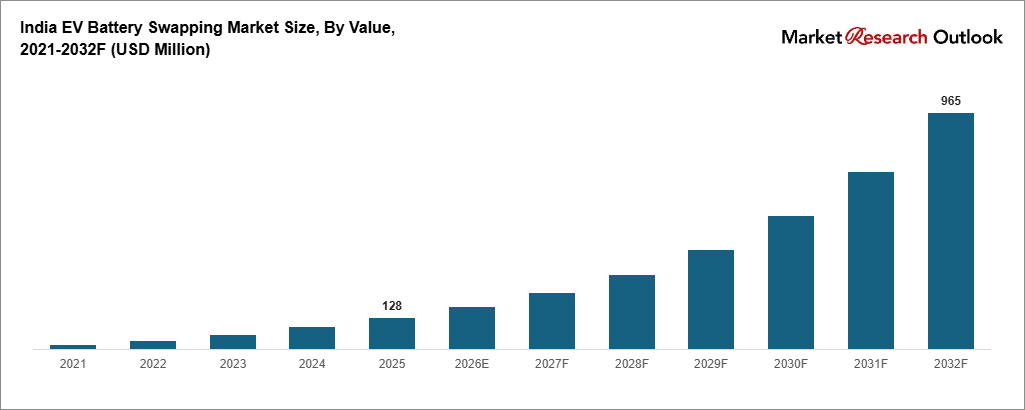
The India EV battery swapping market size is witnessing rapid expansion, driven by fast fleet electrification, growing quick-commerce delivery volumes, rising e-rickshaw ridership, wider station networks, falling battery prices, and steady policy support from the Ministry of Power and PM E-DRIVE. Valued at USD 128 million in 2025 and projected to reach USD 965 million by 2032, growing at a CAGR of 33.5%, India EV battery swapping market growth is being fuelled by strong demand from delivery riders, e-rickshaw drivers, and fleet owners who cannot afford long charging downtime. Electric three-wheelers lead battery swapping revenue, while electric two-wheelers are emerging as the fastest growing vehicle category. Rising daily usage, tight delivery timelines, and the high cost of owning a battery are reshaping how commercial users buy energy. As operators including Battery Smart, SUN Mobility, Indofast Energy, Yuma Energy, and VoltUp add battery swapping stations, and OEMs including Honda, Gogoro, and Bounce Infinity scale swappable models, the India EV battery swapping market is evolving into a fleet-led, data-driven, and policy-backed ecosystem with strong long-term growth potential.
Key Report Takeaways: India EV Battery Swapping Market
- The India EV battery swapping market size is projected to grow from USD 128 million in 2025 to USD 965 million by 2032, registering a strong CAGR of 33.5%, driven by fast fleet electrification, rising swap demand from gig workers, and the structural shift toward Battery-as-a-Service models across urban India.
- Electric three-wheelers dominate the India EV battery swapping market, accounting for over 56% of total battery swapping revenue in 2025, driven by high daily running of e-rickshaws and cargo L5 vehicles, the deep presence of operators such as Battery Smart, SUN Mobility, and Indofast Energy, and rising demand across Delhi NCR, Uttar Pradesh, and Bihar.
- Electric two-wheelers are emerging as the fastest growing segment in the India EV battery swapping market, expected to grow at 38% to 42% annually as delivery riders, ride-hailing drivers, and fleet aggregators shift from fixed batteries to swap-ready scooters across metro and tier-1 markets.
- Rapid network scaling, with over 4,000 battery swapping stations across India by mid-2025 and projected expansion past 20,000 stations by 2030, is structurally expanding the India EV battery swapping market across fleet, passenger, and personal mobility categories.
- Rising investments by operators and energy majors such as Battery Smart, SUN Mobility, IndianOil through Indofast Energy, Yuma Energy, and Honda Power Pack Energy in smart batteries, automated battery swapping stations, and fuel station battery swapping points are strengthening network depth and supporting the India EV battery swapping market forecast 2032.
Key Market Drivers: India EV Battery Swapping Market
Rapid EV Adoption in Two-Wheeler and Three-Wheeler Fleets Driving Battery Swapping Demand Across India
Growth in the India EV battery swapping market is being driven by rapid EV adoption in two-wheeler and three-wheeler fleets across tier-1, tier-2, and tier-3 cities. India sold 2.3 million EVs in 2025, taking the EV share of new registrations to 8%, according to Vahan data. Electric three-wheelers crossed 0.8 million units in 2025 and now make up over 60% of all three-wheeler sales, while electric two-wheeler sales reached 1.28 million units. A battery swap takes under 2 minutes, against 3 to 5 hours for a normal plug-in charge, which matters for drivers who run 120 to 180 km a day. Swap charges in India range between INR 50 and INR 180 per swap, depending on vehicle type and battery size. Battery swapping stations crossed 4,000 by mid-2025, yet the ratio of battery swapping stations to commercial EVs on the road remains low, showing large long-term headroom. Rising fleet orders, falling LFP pack prices, and lower running cost per km versus CNG and petrol are creating strong structural pull-through demand across the India EV battery swapping market.
Quick-Commerce Growth, Gig Economy Expansion, and Fleet Uptime Needs Fuelling Battery Swapping Network Adoption
The India EV battery swapping market is benefiting from fast growth in quick-commerce, food delivery, and e-commerce logistics, where every hour of downtime means lost income for riders. Quick-commerce platforms such as Blinkit, Zepto, and Instamart, along with Zomato and Swiggy, now depend on large gig fleets that run 10 to 14 hours a day. Battery Smart, the largest operator by battery swapping network size, runs more than 1,600 battery swapping stations across over 50 cities and completed its 100 millionth swap in December 2025. Gig workers between 18 and 35 years now account for over 65% of battery swapping users, and most prefer pay-per-use plans that remove the need to buy a battery upfront. Since the battery makes up 35% to 45% of an EV’s price, separating it from the vehicle cuts upfront cost by 30% to 40%. Fleet aggregators such as Zypp and Yulu have tied up with battery swapping operators to keep vehicles on the road, supporting steady price competitiveness across the India EV battery swapping market.
Government Policy Support, BIS Standards, and Battery-as-a-Service Models Strengthening Battery Swapping Infrastructure Growth
Policy support is a major catalyst for the India EV battery swapping market, with the government treating battery swapping as core EV infrastructure rather than a side option. NITI Aayog released the draft Battery Swapping Policy in April 2022, and the Ministry of Power issued the Guidelines for Installation and Operation of Battery Swapping and Battery Charging Stations in January 2025, setting rules for safety, pricing, and site approvals. The PM E-DRIVE scheme, with a total outlay of INR 10,900 crore, covers EV demand incentives and public charging and battery swapping infrastructure. The Bureau of Indian Standards has notified IS 17896 standards for battery swapping stations and is working on interoperability norms for battery packs. Battery-as-a-Service models are now scaling fast, with Indofast Energy following a BaaS approach across 22 cities and SUN Mobility running an open battery swapping platform for multiple OEMs. Public policy combined with private fleet demand is structurally expanding India EV battery swapping market growth across all major end-user categories through 2032.
Key Market Challenges: India EV Battery Swapping Market
Lack of Battery Standardisation and Limited Interoperability Across OEMs Restricting Battery Swapping Network Scale
The India EV battery swapping market continues to face challenges around lack of battery standardisation and limited interoperability, with each major operator using its own pack size, connector, and battery management software. While BIS standards and the draft battery swapping policy have improved clarity, a rider using one brand of battery still cannot swap at a rival battery swapping station in most cities, which keeps battery swapping station utilisation below 40% at many sites in smaller towns. OEMs remain cautious about designing vehicles around a common pack, as it limits design freedom and brand control. Industry estimates suggest that less than 15% of swappable vehicles on Indian roads can use more than one network. Without common standards, operators must build duplicate battery swapping stations in the same areas, raising cost and slowing reach across the India EV battery swapping market.
High Upfront Capital Costs and Battery Inventory Requirements Across Tier-2 and Tier-3 Cities
The India EV battery swapping market faces structural pressure from high upfront capital needs and the large battery inventory required to keep stations running. A manual battery swapping station costs between INR 8 lakh and INR 15 lakh to set up, while automated and robotic stations can cost INR 20 lakh to INR 40 lakh or more. Operators also need 1.5 to 2 batteries in circulation for every vehicle served, which ties up large sums in battery stock. Payback periods typically range between 3 and 5 years, and depend heavily on daily swaps per battery swapping station. In tier-2 and tier-3 cities, lower vehicle density and limited access to low-cost land and grid power make it harder for operators such as Battery Smart, SUN Mobility, VoltUp, and Esmito to reach breakeven. While PM E-DRIVE support and fuel station partnerships are helping, funding gaps remain a near-term challenge for the India EV battery swapping market.
GST Disparity, Battery Safety Concerns, and Thermal Risks Impacting Overall Battery Swapping Margins
The India EV battery swapping market faces practical constraints around GST disparity, battery safety, and thermal risk. EVs attract 5% GST, while standalone batteries and battery swapping services are taxed at a higher rate, which raises the effective cost of the swap model compared to buying an EV with a fixed battery. Battery fire incidents in 2022 and 2023 led to stricter AIS-156 safety norms, adding testing and design costs for pack makers. Summer temperatures above 45°C in North and Central India speed up battery wear and require active cooling at battery swapping stations. Average operating margins for battery swapping operators in India range between 12% and 20%, and battery replacement after 2,000 to 3,000 cycles can cut effective returns by 4% to 8%. LFP chemistry, smart thermal management, and IoT battery tracking are emerging as solutions, but tax and safety gaps remain barriers to wider adoption across the India EV battery swapping market.
Key Market Trends: India EV Battery Swapping Market
Rapid Adoption of Automated, IoT-Connected, and AI-Enabled Battery Swapping Stations in India
The India EV battery swapping market is undergoing a clear technology shift toward automated, IoT-connected, and AI-enabled stations, with these advanced formats expected to make up over 25% of new battery swapping station installations by 2028. Smart batteries now carry sensors that track charge level, temperature, and location in real time, helping operators predict demand and cut idle stock by 15% to 20%. Leading operators and OEMs including SUN Mobility, Indofast Energy, Gogoro, Honda Power Pack Energy, and Esmito Solutions have scaled smart battery swapping station rollouts through 2024 and 2025. Robotic battery swapping docks for electric four-wheelers and buses are also gaining interest, particularly in Bengaluru and Delhi NCR where fleet density is rising, with players like Numocity and RACEnergy building software and hardware for multi-vehicle battery swapping. This technology transition is reinforcing the India EV battery swapping market forecast 2032 across both fleet and personal mobility categories.
Growth of Fuel Station Integration, Energy Partnerships, and Digital Payments in the India EV Battery Swapping Market
A clear shift toward fuel station integration, energy partnerships, and digital payments is reshaping the India EV battery swapping market, particularly in the urban and highway segment. IndianOil and SUN Mobility, through their joint venture Indofast Energy, plan to install over 10,000 battery swapping stations, using IndianOil’s network of more than 37,000 fuel outlets. Indofast set up its 1,000th battery swapping station in September 2025, after completing 39 million swaps and serving 50,000 EVs across 22 cities. Other oil marketing companies and state discoms are also exploring battery swapping points to make use of existing land and grid links. App-based booking, UPI payments, and fleet dashboards are cutting customer acquisition costs and speeding up adoption across the India EV battery swapping market. By 2025, digital and app-led payments account for over 85% of swap transactions in India, with fleet riders preferring instant, cashless swaps over cash payments at the counter.
Network Expansion by Leading Battery Swapping Operators and OEM Partnership Investments
A wave of battery swapping network expansion and OEM partnership investments is reshaping the India EV battery swapping market supply landscape. Combined India-focused funding and capital spending announced by battery swapping operators, battery makers, and energy companies exceeded USD 600 million across 2023 to 2025. Battery Smart grew its network beyond 1,600 battery swapping stations, SUN Mobility crossed 630 stations of its own, Indofast Energy reached its 1,000th station, Yuma Energy expanded battery swapping points through its Yulu and Magna partnership, and Honda launched its e:Swap network for the Activa e: in Bengaluru. Ministry of Power guidelines, PM E-DRIVE support worth INR 10,900 crore, and state EV policies in Delhi, Karnataka, Telangana, and Maharashtra have structurally favoured organised operators. Combined with quick-commerce fleets growing fast and OEMs launching swap-ready models, these developments are reinforcing the India EV battery swapping market forecast 2032 across the entire value chain.
Segmental Insights: India EV Battery Swapping Market
By End-User: Commercial Fleets Segment Dominates the India EV Battery Swapping Market
The commercial fleets and last-mile logistics segment dominates the India EV battery swapping market, accounting for an estimated 40% to 44% of total battery swapping revenue, driven by quick-commerce growth, rising e-commerce parcel volumes, and the need for vehicles to run through long shifts. LFP-based packs are the dominant battery type within this segment, with manual and semi-automated battery swapping stations handling over 70% of fleet swaps. The e-rickshaw and passenger operator segment contributes another 27% to 30% of demand, driven by shared e-rickshaws in Delhi NCR, Uttar Pradesh, and Bihar. The ride-hailing and shared mobility segment accounts for 16% to 18%, led by bike taxis and app-based fleets. In 2025, leading operators including Battery Smart, SUN Mobility, Indofast Energy, Yuma Energy, and VoltUp scaled fleet-focused battery swapping deals, reinforcing segment dominance in the India EV battery swapping market.
By Vehicle Type: Electric Three-Wheelers Lead While Electric Two-Wheelers Grow Fastest
Electric three-wheelers lead the India EV battery swapping market vehicle landscape, accounting for approximately 56% of total battery swapping revenue, driven by their high daily running, large battery packs, and strong presence in passenger and cargo use. Electric two-wheelers contribute another 34% to 36%, mainly across delivery fleets and bike taxis in metro and tier-1 cities. Electric two-wheelers are the fastest growing category within the India EV battery swapping market, expanding at 38% to 42% annually, driven by quick-commerce demand, swap-ready scooter launches, and lower upfront vehicle cost under BaaS plans. Electric four-wheelers and electric buses together account for 6% to 8% of the market, with automated battery swapping for these vehicles expected to grow rapidly through 2032 in fleet and public transport use. Leading players including Battery Smart, SUN Mobility, Indofast Energy, Honda Power Pack Energy, and Gogoro have aligned their networks to this vehicle mix, driving wider battery swapping adoption across the India EV battery swapping market.
Regional Insights: India EV Battery Swapping Market
Regional analysis of the India EV battery swapping market shows that North India and South India collectively account for approximately 68% to 72% of total battery swapping revenue, driven by Delhi NCR (dense e-rickshaw and delivery fleets), Uttar Pradesh, Bihar, Haryana, Karnataka (Bengaluru fleet and startup hub), Telangana, and Tamil Nadu, supported by active state EV policies and high commercial EV registrations. West India contributes around 15% to 18% of demand, led by Maharashtra and Gujarat, supported by delivery and ride-hailing fleets in Mumbai, Pune, Ahmedabad, and Surat. Central and East India together account for 10% to 13% of demand, supported by Madhya Pradesh, West Bengal, Odisha, and Assam, where e-rickshaw adoption is speeding up. In 2025, battery swapping network expansion by Battery Smart across Delhi NCR and Uttar Pradesh, SUN Mobility and Indofast Energy across Karnataka and Delhi NCR, Yuma Energy across Bengaluru and Mumbai, and Honda across Bengaluru reinforced regional battery swapping hubs, supporting faster rollout of fleet and passenger services across the India EV battery swapping market.
Charging and swapping data: see India EV Charging Stations by State for public charging stations in every state, and the India EV Sales by State Tracker for state-wise EV registrations.
Recent Developments: India EV Battery Swapping Market
- The India EV battery swapping market witnessed strong momentum in battery swapping network growth and swap volumes during 2024 and 2025. India’s battery swapping stations rose from 2,611 in January 2025 to over 4,000 by mid-2025, according to BEE and industry tracking. This marked a sharp increase from fewer than 1,000 stations two years earlier. Battery Smart completed its 100 millionth swap in December 2025, with electric three-wheelers making up the largest share of swaps. Total annual swaps in India are projected to rise from about 130 million in 2025 to 340 to 380 million by FY28, growing at an average 35% to 40% annually.
- Battery swapping operators and energy majors have deepened India-focused battery swapping network expansion. In 2025, Indofast Energy set up its 1,000th station after completing 39 million swaps across 22 cities, SUN Mobility and IndianOil confirmed plans for over 10,000 stations, Battery Smart crossed 1,600 battery swapping stations in over 50 cities, Yuma Energy grew its battery swapping points with Yulu and Magna, and Honda Power Pack Energy expanded its e:Swap network in Bengaluru. The Ministry of Power also issued new battery swapping station guidelines in January 2025. These developments are strengthening network depth and supporting the India EV battery swapping market forecast 2032.
- OEM and fleet partnerships have gained strong traction in the India EV battery swapping market. In 2025, leading OEMs and fleet players including Honda, Hero MotoCorp, Mahindra, Piaggio, Zypp Electric, and Yulu expanded swap-ready vehicle offerings and battery swapping tie-ups. Strategic partnerships between battery swapping operators, oil marketing companies, and delivery platforms are positioning India as one of the fastest scaling battery swapping markets globally, strengthening long-term competitive positioning in the India EV battery swapping market forecast 2032.
Key Market Players: India EV Battery Swapping Market
- Battery Smart
- SUN Mobility Pvt. Ltd.
- Indofast Energy (IndianOil and SUN Mobility Joint Venture)
- Yuma Energy (Yulu and Magna Joint Venture)
- Gogoro Inc.
- Honda Power Pack Energy India Pvt. Ltd.
- Bounce Infinity (Wicked Ride Adventure Services Pvt. Ltd.)
- VoltUp
- Esmito Solutions Pvt. Ltd.
- Lithion Power Pvt. Ltd.
- RACEnergy
- Numocity Technologies Pvt. Ltd.
- Chargeup
| By Vehicle Type | By Battery Type | By Station Type | By Service Model | By End-User |
| Electric Two-Wheelers Electric Three-Wheelers (Passenger) Electric Three-Wheelers (Cargo) Electric Four-Wheelers Electric Buses Others |
Lithium Iron Phosphate (LFP) Nickel Manganese Cobalt (NMC) Lithium Titanate Oxide (LTO) Sodium-Ion Lead-Acid Solid-State Others |
Manual Battery Swapping Stations Semi-Automated Battery Swapping Stations Fully Automated (Robotic) Stations Battery Swap Kiosks & Cabinets Mobile Battery Swapping Units |
Pay-Per-Use Model Subscription Model Battery-as-a-Service (BaaS) Fleet Contract Model OEM-Integrated Battery Swapping Franchise-Operated Networks |
Commercial Fleets & Last-Mile Logistics E-Rickshaw & Passenger Operators Ride-Hailing & Shared Mobility Personal Vehicle Owners |
Report Scope
In this report, the India EV Battery Swapping Market has been segmented into the following categories, in addition to detailed analysis of key industry trends, market dynamics, competitive landscape, and growth opportunities across the forecast period:
- By Vehicle Type
- Electric Two-Wheelers
- Electric Three-Wheelers (Passenger)
- Electric Three-Wheelers (Cargo)
- Electric Four-Wheelers
- Electric Buses
- Others
- By Battery Type
- Lithium Iron Phosphate (LFP)
- Nickel Manganese Cobalt (NMC)
- Lithium Titanate Oxide (LTO)
- Sodium-Ion
- Lead-Acid
- Solid-State
- Others
- By Station Type
- Manual Battery Swapping Stations
- Semi-Automated Battery Swapping Stations
- Fully Automated (Robotic) Stations
- Battery Swap Kiosks & Cabinets
- Mobile Battery Swapping Units
- By Service Model
- Pay-Per-Use Model
- Subscription Model
- Battery-as-a-Service (BaaS)
- Fleet Contract Model
- OEM-Integrated Battery Swapping
- Franchise-Operated Networks
- By End-User
- Commercial Fleets & Last-Mile Logistics
- E-Rickshaw & Passenger Operators
- Ride-Hailing & Shared Mobility
- Personal Vehicle Owners
- By Geography
- North India
- South India
- West India
- East India
- Central India
Competitive Landscape
Company Profiles:
Detailed analysis of the leading companies operating in the India EV Battery Swapping Market, including business overview, service portfolio, strategic initiatives, competitive positioning, and recent developments.
Company Information
Detailed profiling and strategic analysis of additional market players (up to five companies), including emerging domestic battery swapping startups, battery pack and BMS suppliers, regional e-rickshaw battery swapping operators, or niche state-level fleet energy providers.
For a free sample of the India EV Battery Swapping Market report, customised insights or delivery timelines, submit your query here
India EV Battery Swapping Market, 2032
- Research Framework
- Market Segmentation
- Research Objective
- Research Methodology
- Qualitative Research
- Primary Research
- Secondary Research
- Quantitative Research
- Market Breakdown & Data Triangulation
- Demand Side
- Supply Side
- Primary Research Respondents
- Assumption & Limitation
- Executive Summary
- Market Overview, 2021-2032
- By Vehicle Type
- By Battery Type
- By Station Type
- By Service Model
- By End-User
- By Region
- Analyst Recommendations
- Geopolitical Impact on India EV Battery Swapping Market
- India EV Battery Swapping Market Insights
- Market Dynamics
- Growth Drivers
- Rapid EV adoption in two-wheeler and three-wheeler fleets driving battery swapping demand across India.
- Quick-commerce growth, gig economy expansion, and fleet uptime needs fuelling battery swapping network adoption.
- Government policy support, BIS standards, and Battery-as-a-Service models strengthening battery swapping infrastructure growth.
- Restraints
- Lack of battery standardisation and limited interoperability across OEMs restricting battery swapping network scale.
- High upfront capital costs and battery inventory requirements restricting battery swapping expansion across tier-2 and tier-3 cities.
- GST disparity, battery safety concerns, and thermal risks impacting overall battery swapping margins.
- Opportunities
- Interoperable battery swapping networks for e-rickshaws opening untapped demand across tier-2 and tier-3 cities.
- Electric four-wheeler, e-bus, and commercial cargo battery swapping supporting next-generation growth in fleet segments.
- Fuel station integration, renewable energy storage, and second-life battery use creating new battery swapping revenue opportunities.
- Challenges
- Intense competition for battery swapping from fast-charging networks, home charging, and fixed-battery EV models.
- Limited grid capacity, land availability, and power quality for battery swapping stations across dense urban and smaller Indian cities.
- Managing battery health, degradation, and lifecycle tracking at scale across battery swapping networks in diverse Indian regional markets.
- Technological Advancements
- Recent Technological Advancements
- Prior to 2020
- Porter’s Five Forces Analysis
- PESTLE Analysis
- Industry Value Chain & Entry Points
- Upstream Raw Materials (lithium, iron phosphate, nickel, cobalt, graphite, electrolytes, copper, cell casings)
- Battery Cell & Pack Manufacturers (Exide Energy, Amara Raja, Trontek, Log9, Lithion Power)
- BMS & IoT Suppliers (battery management systems, telematics, cloud analytics, smart locks)
- Battery Swapping Station Hardware Makers (charging cabinets, robotic docks, thermal management, power electronics)
- Testing, Certification & Standards Bodies (BIS, ARAI, ICAT, CEA, AIS-156 battery safety norms)
- Energy Utilities & Battery Swapping Site Partners (IndianOil, HPCL, BPCL, state discoms, real estate owners)
- Battery Swapping Network Operators (Battery Smart, SUN Mobility, Indofast, VoltUp, Yuma Energy)
- EV OEMs & Fleet Aggregators (Honda, Hero MotoCorp, Mahindra, Piaggio, Zypp)
- Digital Platforms & Demand Partners (Zomato, Swiggy, Blinkit, Zepto, Instamart, Porter)
- End-Users (e-rickshaw drivers, delivery riders, fleet operators, ride-hailing drivers, private owners)
- India EV Battery Swapping Market: Regulatory Framework
- India EV Battery Swapping Market Overview
- Market Size & Forecast, 2021-2032
- By Value (USD Million)
- By Volume (Million Swaps)
- Market Share & Forecast
- By Vehicle Type
- Electric Two-Wheelers
- Electric Three-Wheelers (Passenger)
- Electric Three-Wheelers (Cargo)
- Electric Four-Wheelers
- Electric Buses
- Others
- By Battery Type
- Lithium Iron Phosphate (LFP)
- Nickel Manganese Cobalt (NMC)
- Lithium Titanate Oxide (LTO)
- Sodium-Ion
- Lead-Acid
- Solid-State
- Others
- By Station Type
- Manual Battery Swapping Stations
- Semi-Automated Battery Swapping Stations
- Fully Automated (Robotic) Stations
- Battery Swap Kiosks & Cabinets
- Mobile Battery Swapping Units
- By Service Model
- Pay-Per-Use Model
- Subscription Model
- Battery-as-a-Service (BaaS)
- Fleet Contract Model
- OEM-Integrated Battery Swapping
- Franchise-Operated Networks
- By End-User
- Commercial Fleets & Last-Mile Logistics
- E-Rickshaw & Passenger Operators
- Ride-Hailing & Shared Mobility
- Personal Vehicle Owners
- By Geography
- North India
- South India
- West India
- East India
- Central India
- Competitive Landscape
- India EV Battery Swapping Market Company Market Share Analysis, 2025
- Competitive Benchmarking, By Operating Parameters
- Key Strategic Development (Mergers, Acquisitions, Partnerships, Etc.)
- List of Emerging Players
- Company Profile
- Battery Smart
- Introduction & Company Profile
- Product Benchmarking
- Strategic Outlook
- Key Competitors
- Financial Analysis
- SWOT Analysis
(Same Data Pointers Will Be Provided for The Below Companies)
- SUN Mobility Pvt. Ltd.
- Indofast Energy (IndianOil and SUN Mobility Joint Venture)
- Yuma Energy (Yulu and Magna Joint Venture)
- Gogoro Inc.
- Honda Power Pack Energy India Pvt. Ltd.
- Bounce Infinity (Wicked Ride Adventure Services Pvt. Ltd.)
- VoltUp
- Esmito Solutions Pvt. Ltd.
- Lithion Power Pvt. Ltd.
- RACEnergy
- Numocity Technologies Pvt. Ltd.
- Chargeup
- Other Prominent Players
* Financial information in case of non-listed companies will be provided as per availability
** The segmentation and the companies are subjected to modifications based on in-depth secondary for the final deliverable
Frequently Asked Questions
1. How large is the India EV battery swapping market and what is its growth forecast?
Ans: The India EV battery swapping market is valued at USD 128 million in 2025 and is projected to reach USD 965 million by 2032, growing at a CAGR of 33.5%, led by fleet electrification and quick-commerce demand.
2. Which segments are driving demand in the India EV battery swapping market?
Ans: Electric three-wheelers lead with over 56% revenue share, while electric two-wheelers grow fastest, driven by delivery riders, bike taxis, and swap-ready scooter launches across metro cities.
3. What are the key drivers of growth in the India EV battery swapping market?
Ans: Key drivers include rapid two-wheeler and three-wheeler EV adoption, quick-commerce fleet growth, gig worker demand for zero downtime, Battery-as-a-Service models, and Ministry of Power battery swapping guidelines.
4. Which regions are driving growth in the India EV battery swapping market?
Ans: North India and South India lead with around 68% to 72% of revenue, driven by Delhi NCR, Uttar Pradesh, Bihar, Karnataka, and Telangana, where e-rickshaw and delivery fleets are dense.
5. What are the latest trends in the India EV battery swapping market?
Ans: Key trends include automated and IoT-connected stations, battery swapping points at fuel outlets, AI-based battery tracking, UPI-led payments, and growing OEM partnerships for swap-ready electric two-wheelers.