

India Electric Three Wheeler Market, 2032
- Automotive & EV
- Nov 2026
- Pages 140
- Report Format: pdf
- Report Price: $2400 USD
India’s electric three wheeler market is witnessing strong structural growth, driven by low running costs compared with CNG and diesel autos, PM E-DRIVE and state EV policy support, rapid growth of e-commerce and quick-commerce deliveries, falling lithium-ion battery prices, wider charging and battery swapping networks, and rising investment from legacy OEMs scaling L5 electric three wheeler production across India.
| Study Duration | 2021-2032 |
| Market Size (2025) | USD 1,365 Million |
| CAGR (2026-2032) | 12.5% |
| Leading Segment | L5 Passenger E-Auto (Lithium-Ion LFP) |
| Fastest Growing Segment | L5 Cargo E-Loader |
| Market Size (2032) | USD 3,115 Million |
Market Overview: India Electric Three Wheeler Market
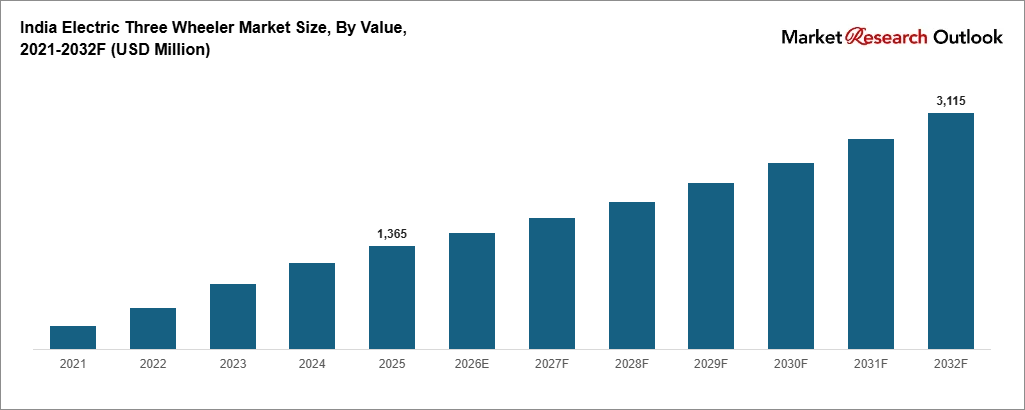
The India electric three wheeler market size is expanding quickly, driven by lower running costs, rising last-mile mobility demand, strong policy support under PM E-DRIVE, falling lithium-ion battery prices, and large capacity additions by legacy OEMs. Valued at USD 1,365 million in 2025 and projected to reach USD 3,115 million by 2032, growing at a CAGR of 12.5%, the India electric three wheeler market growth is being fuelled by owner-drivers switching from CNG and diesel autos, fleet operators adding electric three wheelers for shared mobility, and e-commerce companies adding electric cargo loaders. Electric three wheelers captured 61% of India’s three wheeler sales in FY2026, with record retail volume of 830,819 units. L5 passenger electric three wheelers lead market value, while L5 cargo e-loaders form the fastest growing segment. Low-speed e-rickshaws still hold the largest share of electric three wheeler unit volume, but buyers are steadily moving to L5 electric three wheelers with LFP batteries, longer range, and warranty support. As Mahindra Last Mile Mobility, Bajaj Auto, TVS Motor, and Piaggio expand L5 electric three wheeler capacity, and pure-play brands such as YC Electric, Saera Electric, Euler Motors, and Altigreen grow their dealer networks, the India electric three wheeler market is evolving into an organised, technology-led, and finance-enabled ecosystem with strong long-term growth potential.
Key Report Takeaways: India Electric Three Wheeler Market
- The India electric three wheeler market size is projected to grow from USD 1,365 million in 2025 to USD 3,115 million by 2032, registering a strong CAGR of 12.5%, driven by lower running costs, rising L5 electric three wheeler adoption, and the structural shift away from CNG and diesel autos across urban and semi-urban India.
- L5 passenger electric three wheelers dominate the India electric three wheeler market by value, accounting for about 46% of revenue in 2025, supported by Mahindra, Bajaj, and TVS, which together held about 84% of L5 passenger sales in FY2026.
- L5 cargo electric three wheelers are the fastest growing segment in the India electric three wheeler market, expected to grow at 18% to 22% annually as e-commerce, quick-commerce, and FMCG companies electrify their last-mile delivery fleets.
- Electric three wheelers took 61% of all three wheeler sales in India in FY2026, up from 57% in FY2025, with retail sales rising 19% to a record 830,819 units, structurally expanding the electric three wheeler market across passenger and cargo categories.
- Rising investments by Mahindra Last Mile Mobility, Bajaj Auto, TVS Motor, Piaggio, and Euler Motors in L5 electric three wheeler capacity, LFP battery sourcing, and dealer networks are strengthening local supply and supporting the India electric three wheeler market forecast 2032.
Key Market Drivers: India Electric Three Wheeler Market
Lower Total Cost of Ownership, Fuel Savings, and Rising Last-Mile Mobility Demand Driving Electric Three Wheeler Adoption Across India
Growth in the India electric three wheeler market is being driven mainly by operating economics. An L5 electric three wheeler costs about INR 0.5 to INR 0.8 per km to run, compared with INR 2.5 to INR 3.0 per km for CNG and diesel autos, saving a full-time electric three wheeler driver INR 8,000 to INR 12,000 every month. Even with purchase prices of INR 3.0 lakh to INR 3.9 lakh, most L5 electric three wheeler owners recover the price gap within two to three years. Low-speed electric three wheelers such as e-rickshaws, priced between INR 1.1 lakh and INR 1.8 lakh, have become the cheapest way to start a livelihood in towns across Uttar Pradesh, Bihar, West Bengal, and Assam. Demand for short trips is also rising as cities expand metro networks and need electric three wheelers for feeder connectivity. Electric three wheelers reached 61% of India’s total three wheeler sales of 1.36 million units in FY2026, and December 2025 saw a record 88,276 electric three wheeler retail sales in a single month. These numbers point to strong pull-through demand across the India electric three wheeler market.
Government Incentives under PM E-DRIVE, State EV Policies, and Permit Reforms Fuelling Electric Three Wheeler Sales
The India electric three wheeler market is benefiting from steady policy support at central and state levels. The PM E-DRIVE scheme, with a total outlay of INR 10,900 crore, supported 2,88,809 L5 electric three wheelers before that sub-component closed on 26 December 2025 after meeting its target. Support for registered e-rickshaws and e-carts continues until March 2028 at INR 2,500 per kWh, capped at INR 12,500 per vehicle, and the scheme has set aside INR 2,000 crore for public charging stations. States such as Delhi, Uttar Pradesh, Maharashtra, Karnataka, Telangana, and Assam offer road tax waivers, registration fee exemptions, and permit relaxations for electric three wheelers, while several cities have stopped issuing fresh permits for diesel autos. The PLI schemes for advanced chemistry cell batteries and auto components are also cutting local electric three wheeler manufacturing costs, supporting price competitiveness across the India electric three wheeler market.
Rapid E-Commerce, Quick-Commerce, and Urban Logistics Growth Strengthening Electric Cargo Three Wheeler Demand
Fast growth in e-commerce and quick-commerce deliveries is a major catalyst for the India electric three wheeler market, with the L5 cargo segment projected to grow at 18% to 22% annually through 2032. Platforms such as Amazon, Flipkart, Blinkit, Zepto, Swiggy Instamart, and BigBasket need low-cost electric three wheelers that can carry 300 to 700 kg over 80 to 150 km a day, a job well suited to electric three wheelers built for cargo. Many of these companies have made public commitments to electrify last-mile fleets, which pushes their logistics partners toward electric three wheelers. Fleet and leasing firms such as MoEVing, Zypp Electric, and Magenta Mobility are adding electric three wheelers for cargo in large numbers and renting them to delivery partners. Electric three wheeler cargo models from Mahindra, Bajaj, Euler Motors, Altigreen, Omega Seiki, and Montra Electric now offer payloads above 500 kg with telematics support. E-carts remain the largest electric cargo category by volume, but L5 goods vehicles are growing much faster, expanding the electric three wheeler market across all major end-user categories through 2032.
Key Market Challenges: India Electric Three Wheeler Market
High Upfront Cost, Limited Formal Financing, and Uncertain Resale Value Restricting Electric Three Wheeler Adoption Among Owner-Drivers
The India electric three wheeler market continues to face challenges around upfront cost and access to credit. An L5 electric three wheeler still costs 25% to 40% more than a comparable CNG model, and the battery alone makes up 35% to 45% of the electric three wheeler price. Most electric three wheeler buyers are first-time owner-drivers with thin credit histories, so banks stay cautious and NBFC loans often carry interest rates of 18% to 26% a year. The lack of a reliable resale market for used electric three wheelers adds to lender risk, since battery health is hard to judge at the time of resale. The electric three wheeler financing market was valued at roughly USD 700 million in 2025, which covers only part of total demand. Without wider credit access, electric three wheeler adoption among low-income drivers in smaller towns stays slow, limiting growth across the India electric three wheeler market.
Inadequate Charging Infrastructure and Battery Performance Concerns for Electric Three Wheelers Across Tier-2 and Tier-3 Cities
The India electric three wheeler market faces structural complexity from uneven charging access across cities. Metros such as Delhi, Bengaluru, Mumbai, Hyderabad, and Pune have growing public charging and battery swapping networks for electric three wheelers, but many tier-2 and tier-3 towns still depend on home charging from weak local grids. A full charge for an L5 electric three wheeler takes 3.5 to 5 hours on a standard charger, which means lost earning time for electric three wheeler drivers who work 10 to 12 hour shifts. Electric three wheeler battery output also drops in summer heat above 45°C, and the lead-acid packs used in many e-rickshaws need replacing every 12 to 18 months, raising ownership costs. Unauthorised charging points and overloaded transformers have pushed some power distribution companies to tighten rules on e-rickshaw charging. While PM E-DRIVE has allocated INR 2,000 crore for charging stations, infrastructure gaps remain a near-term challenge for the India electric three wheeler market.
Subsidy Rationalisation and Battery Raw Material Price Volatility Impacting Electric Three Wheeler Margins
The India electric three wheeler market faces practical constraints from subsidy cuts and input cost swings. The demand incentive for L5 electric three wheelers fell from INR 5,000 per kWh, capped at INR 50,000 per vehicle, in FY2025 to INR 2,500 per kWh, capped at INR 25,000, and then closed fully on 26 December 2025. Electric three wheeler OEMs have had to absorb part of this loss or pass it on to buyers. India also imports most of the lithium-ion cells used in electric three wheelers, so prices of lithium carbonate, cathode materials, and rare-earth magnets feed straight into electric three wheeler costs. Lithium prices have moved sharply in both directions since 2022, making long-term pricing difficult. Gross margins for smaller electric three wheeler brands usually sit between 8% and 15%, leaving little room to absorb shocks. Local cell production and wider LFP use are emerging as solutions, but import dependence remains a barrier across the India electric three wheeler market.
Key Market Trends: India Electric Three Wheeler Market
Rapid Shift from Lead-Acid E-Rickshaws to Lithium-Ion LFP Powered L5 Electric Three Wheelers in India
The India electric three wheeler market is going through a clear technology shift from low-speed lead-acid e-rickshaws toward L5 electric three wheelers powered by lithium-ion LFP batteries. In Q2 FY2027, L5 passenger sales reached about 1.28 lakh units against 93,036 e-rickshaws, and the L5 share of the passenger segment rose from about 34% to 58% in a year. LFP batteries are now standard in L5 electric three wheelers because of their longer life of 2,000 to 3,000 charge cycles, better thermal safety, and falling cost. Mahindra, Bajaj, TVS, and Piaggio have launched L5 electric three wheelers with 8 to 12 kWh packs and certified ranges of 150 to 200 km. Mahindra’s UDO, launched in February 2026, uses a full monocoque body, while TVS has scaled the King EV Max and King Kargo HD EV. Electric three wheeler makers such as YC Electric and Saera Electric are also moving to lithium-ion packs. This transition is reinforcing the India electric three wheeler market forecast 2032 across both passenger and cargo categories.
Growth of Battery Swapping, Fleet Electrification, and Energy-as-a-Service Models in the India Electric Three Wheeler Market
A clear shift toward battery swapping, fleet ownership, and energy-as-a-service models is reshaping the India electric three wheeler market, mainly in the e-rickshaw and cargo segments. Swapping operators for electric three wheelers, such as Battery Smart, Sun Mobility, and Yuma Energy, let drivers exchange a drained battery in about two minutes and pay per swap instead of buying the battery. This cuts the upfront electric three wheeler price by 30% to 40% and removes battery replacement risk. Battery Smart alone runs over 1,500 swap stations serving electric three wheelers and two wheelers across more than 50 cities. Fleet operators and ride platforms including Rapido, Yulu, and Zypp Electric are also adding electric three wheelers and cargo loaders and renting them to drivers on daily or weekly plans. Telematics platforms help these electric three wheeler fleets track battery health, utilisation, and driving behaviour, which also improves lender confidence. These models are lowering entry barriers and speeding up adoption across owner-driver and fleet segments of the electric three wheeler market.
Capacity Expansion by Legacy Electric Three Wheeler OEMs and Localisation of Battery and Motor Supply
A wave of capacity expansion and supply localisation is reshaping the India electric three wheeler market supply base. Legacy electric three wheeler OEMs have taken a firm lead, with Mahindra Last Mile Mobility selling 101,905 units in FY2026, up 46%, and Bajaj Auto selling 89,604 units, up 76%, while Bajaj outsold Mahindra in a single month for the first time in January 2026. TVS Motor, Piaggio, Atul Auto, and Kinetic Green are also expanding electric three wheeler plant capacity and dealer reach. On the supply side, battery makers such as Exide Energy, Amara Raja, and Log9 Materials are building local cell and pack capacity, and motor suppliers are developing rare-earth-free motors for electric three wheelers to reduce import risk. The PLI schemes for advanced chemistry cells and auto components, along with AIS-156 battery safety norms, have structurally favoured organised manufacturers. Combined with fleet operators scaling cargo demand and better financing, these developments are reinforcing the India electric three wheeler market forecast 2032 across the entire value chain.
Segmental Insights: India Electric Three Wheeler Market
By End-User: Individual Owner-Drivers Segment Dominates the India Electric Three Wheeler Market
The individual owner-driver segment dominates the India electric three wheeler market, accounting for an estimated 58% to 62% of total volume, driven by low running costs, livelihood demand in small towns, and easier access to vehicle loans. E-rickshaws and L5 passenger autos are the main electric three wheelers in this segment, with lithium-ion electric three wheelers taking a rising share of new purchases. Fleet operators contribute another 20% to 23% of demand, led by ride platforms, rental companies, and leasing firms. Logistics and e-commerce companies account for 13% to 15%, driven by last-mile delivery fleets using L5 cargo electric three wheelers and e-carts, while government and municipal bodies make up the rest through waste collection and civic service vehicles. In 2025, leading OEMs including Mahindra, Bajaj, TVS, Piaggio, and YC Electric widened retail finance tie-ups for electric three wheeler owner-drivers, reinforcing segment dominance in the India electric three wheeler market.
By Vehicle Type: L5 Passenger Electric Three Wheelers Lead While L5 Cargo Grows Fastest
L5 passenger electric three wheelers lead the India electric three wheeler market by value, accounting for about 46% of total revenue in 2025, driven by higher selling prices, longer range, and fast growth in cities that allow electric auto permits. E-rickshaws contribute another 30% to 32% of value but still hold the largest share of unit volume, mainly across North and East India. E-carts, the low-speed cargo electric three wheelers, account for 9% to 11% of value, serving goods movement in local markets. L5 cargo electric three wheelers hold 10% to 12% of value and are the fastest growing category in the India electric three wheeler market, expanding at 18% to 22% annually on the back of 500 to 700 kg payloads, telematics features, and strong demand from e-commerce and FMCG distribution. Others, including waste collection and utility electric three wheelers, make up 1% to 3%. Manufacturers such as Mahindra, Bajaj, TVS, Euler Motors, and Altigreen have aligned their portfolios to this mix, driving higher-value adoption across the India electric three wheeler market.
Regional Insights: India Electric Three Wheeler Market
Regional analysis of the India electric three wheeler market shows that North India accounts for approximately 42% to 45% of total volume, driven by Uttar Pradesh, Delhi NCR, Punjab, Haryana, and Uttarakhand. Uttar Pradesh alone has about 4.5 lakh e-rickshaws on its roads and leads the country in electric three wheeler registrations. East India contributes around 22% to 25% of demand, led by Bihar, West Bengal, Assam, and Jharkhand, where low-cost electric three wheelers such as e-rickshaws have become the main form of short-distance public transport. South and West India together account for 24% to 27% of demand, supported by Karnataka, Maharashtra, Tamil Nadu, Telangana, and Gujarat, where L5 passenger and cargo electric three wheelers are growing fast in cities such as Bengaluru, Pune, Hyderabad, and Chennai. Central India accounts for 6% to 8%, led by Madhya Pradesh and Chhattisgarh, where electric three wheeler penetration is among the highest in the country. In 2025, electric three wheeler plant expansions and dealer growth by Mahindra in Telangana, Bajaj in Maharashtra, TVS in Tamil Nadu and Karnataka, and YC Electric in North India reinforced regional supply hubs, supporting faster electric three wheeler deliveries across the India electric three wheeler market.
EV sales data: see the India EV Sales by State Tracker for electric three wheeler registrations in every state, and the India Vehicle Sales Tracker for monthly retail sales by vehicle segment.
Recent Developments: India Electric Three Wheeler Market
- The India electric three wheeler market recorded strong sales momentum during 2025 and 2026. Retail sales rose 19% to a record 830,819 units in FY2026, with electric three wheelers taking 61% of all three wheeler sales, up from 57% in FY2025. December 2025 set a new monthly high of 88,276 electric three wheelers, and in Q2 FY2027 L5 passenger sales of about 1.28 lakh units overtook e-rickshaw sales of 93,036 units, marking a turning point for the passenger segment.
- Legacy OEMs have deepened their hold on the electric three wheeler market. In January 2026, Bajaj Auto sold 8,510 electric three wheelers against 7,492 for Mahindra, outselling the long-time leader in a single month for the first time. Mahindra Last Mile Mobility still closed FY2026 as the market leader with 101,905 electric three wheelers, while TVS Motor grew its share with the King EV Max and King Kargo HD EV. In February 2026, Mahindra launched the UDO electric three wheeler with a monocoque body. These developments are strengthening domestic supply and supporting the India electric three wheeler market forecast 2032.
- Policy support has continued to evolve in the India electric three wheeler market. Under PM E-DRIVE, the L5 sub-component reached its target of 2,88,809 electric three wheelers and closed on 26 December 2025, while support for e-rickshaws and e-carts was extended until 31 March 2028 at INR 2,500 per kWh. Together with state EV policies and charging investments, this keeps India the largest electric three wheeler market in the world, strengthening long-term competitive positioning in the India electric three wheeler market forecast 2032.
Key Market Players: India Electric Three Wheeler Market
- Mahindra Last Mile Mobility Limited
- Bajaj Auto Limited
- TVS Motor Company Limited
- Piaggio Vehicles Pvt. Ltd.
- YC Electric Vehicle
- Saera Electric Auto Pvt. Ltd.
- Dilli Electric Auto Pvt. Ltd.
- Kinetic Green Energy & Power Solutions Ltd.
- Atul Auto Limited
- Omega Seiki Mobility Pvt. Ltd.
- Euler Motors Pvt. Ltd.
- Altigreen Propulsion Labs Pvt. Ltd.
- TI Clean Mobility Pvt. Ltd. (Montra Electric)
| By Vehicle Type | By Battery Type | By Battery Capacity | By Application | By End-User |
| E-Rickshaw (L3 Passenger) E-Cart (L3 Cargo) L5 Passenger E-Auto L5 Cargo E-Loader Others |
Lead-Acid Lithium-Ion (LFP) Lithium-Ion (NMC) Sodium-Ion Others |
Up to 3 kWh 3-6 kWh 6-9 kWh 9-12 kWh Above 12 kWh |
Passenger Mobility Last-Mile Delivery & E-Commerce FMCG & Retail Logistics Municipal & Waste Management Personal Use Others |
Individual Owner-Drivers Fleet Operators Logistics & E-Commerce Companies Government & Municipal Bodies |
Report Scope
In this report, the India Electric Three Wheeler Market has been segmented into the following categories, in addition to detailed analysis of key industry trends, market dynamics, competitive landscape, and growth opportunities across the forecast period:
- By Vehicle Type
- E-Rickshaw (L3 Passenger)
- E-Cart (L3 Cargo)
- L5 Passenger E-Auto
- L5 Cargo E-Loader
- Others
- By Battery Type
- Lead-Acid
- Lithium-Ion (LFP)
- Lithium-Ion (NMC)
- Sodium-Ion
- Others
- By Battery Capacity
- Up to 3 kWh
- 3-6 kWh
- 6-9 kWh
- 9-12 kWh
- Above 12 kWh
- By Application
- Passenger Mobility
- Last-Mile Delivery & E-Commerce
- FMCG & Retail Logistics
- Municipal & Waste Management
- Personal Use
- Others
- By End-User
- Individual Owner-Drivers
- Fleet Operators
- Logistics & E-Commerce Companies
- Government & Municipal Bodies
- By Geography
- North India
- South India
- West India
- East India
- Central India
Competitive Landscape
Company Profiles:
Detailed analysis of the leading companies operating in the India Electric Three Wheeler Market, including business overview, product portfolio, strategic initiatives, competitive positioning, and recent developments.
Company Information
Detailed profiling and strategic analysis of additional market players (up to five companies), including emerging electric three wheeler start-ups, specialty electric cargo makers, regional e-rickshaw assemblers, or battery swapping partners.
For a free sample of the India Electric Three Wheeler Market report, customised insights or delivery timelines, submit your query here
India Electric Three Wheeler Market, 2032
- Research Framework
- Market Segmentation
- Research Objective
- Research Methodology
- Qualitative Research
- Primary Research
- Secondary Research
- Quantitative Research
- Market Breakdown & Data Triangulation
- Demand Side
- Supply Side
- Primary Research Respondents
- Assumption & Limitation
- Executive Summary
- Market Overview, 2021-2032
- By Vehicle Type
- By Battery Type
- By Battery Capacity
- By Application
- By End-User
- By Region
- Analyst Recommendations
- Geopolitical Impact on India Electric Three Wheeler Market
- India Electric Three Wheeler Market Insights
- Market Dynamics
- Growth Drivers
- Lower total cost of ownership, fuel savings, and rising last-mile mobility demand driving electric three wheeler adoption across India.
- Government incentives under PM E-DRIVE, state EV policies, and permit reforms fuelling electric three wheeler sales.
- Rapid e-commerce, quick-commerce, and urban logistics growth strengthening electric cargo three wheeler demand.
- Restraints
- High upfront cost, limited formal financing, and uncertain resale value restricting electric three wheeler adoption among owner-drivers.
- Inadequate charging infrastructure and battery performance concerns for electric three wheelers across tier-2 and tier-3 cities.
- Subsidy rationalisation and battery raw material price volatility impacting electric three wheeler margins.
- Opportunities
- Battery swapping networks and energy-as-a-service models opening new revenue pools for electric three wheeler operators across Indian cities.
- Electrification of last-mile cargo fleets by e-commerce, quick-commerce, and FMCG companies supporting next-generation electric three wheeler growth.
- Replacement of the large CNG, diesel, and lead-acid e-rickshaw fleet creating strong electric three wheeler upgrade demand.
- Challenges
- Intense price competition among over 680 electric three wheeler OEMs, including unorganised e-rickshaw assemblers.
- Battery safety, thermal management, and quality issues in electric three wheelers linked to uncertified imported cells and packs.
- Limited electric three wheeler battery recycling and second-life infrastructure under the Battery Waste Management Rules.
- Technological Advancements
- Recent Technological Advancements
- Prior to 2020
- Porter’s Five Forces Analysis
- PESTLE Analysis
- Industry Value Chain & Entry Points
- Upstream Raw Materials (lithium, LFP cathode, graphite, copper, steel, aluminium, rare-earth magnets)
- Battery Cell & Pack Manufacturers (Exide Energy, Amara Raja, Log9 Materials, Trontek, imported LFP cells)
- Electric Three Wheeler Motor, Controller & Powertrain Suppliers (BLDC hub motors, PMSM motors, controllers, DC-DC converters)
- Electric Three Wheeler OEMs (Mahindra, Bajaj, TVS, Piaggio, YC Electric, Euler Motors)
- Testing, Homologation & Certification Agencies (ARAI, ICAT, AIS-156, AIS-038 standards)
- Electric Three Wheeler Dealers, Distributors & Financing Partners (dealer networks, NBFCs, banks, fintech lenders)
- Electric Three Wheeler Charging & Battery Swapping Operators (Battery Smart, Sun Mobility, Tata Power, public charging stations)
- Fleet Operators & Mobility Platforms (MoEVing, Zypp Electric, Magenta Mobility, Yulu, Rapido)
- Logistics & E-Commerce Users (Amazon, Flipkart, Zomato, Swiggy, Blinkit, BigBasket)
- End-Users (owner-drivers, fleet operators, logistics firms, municipal bodies, daily commuters)
- India Electric Three Wheeler Market: Regulatory Framework
- India Electric Three Wheeler Market Overview
- Market Size & Forecast, 2021-2032
- By Value (USD Million)
- By Volume (Thousand Units)
- Market Share & Forecast
- By Vehicle Type
- E-Rickshaw (L3 Passenger)
- E-Cart (L3 Cargo)
- L5 Passenger E-Auto
- L5 Cargo E-Loader
- Others
- By Battery Type
- Lead-Acid
- Lithium-Ion (LFP)
- Lithium-Ion (NMC)
- Sodium-Ion
- Others
- By Battery Capacity
- Up to 3 kWh
- 3-6 kWh
- 6-9 kWh
- 9-12 kWh
- Above 12 kWh
- By Application
- Passenger Mobility
- Last-Mile Delivery & E-Commerce
- FMCG & Retail Logistics
- Municipal & Waste Management
- Personal Use
- Others
- By End-User
- Individual Owner-Drivers
- Fleet Operators
- Logistics & E-Commerce Companies
- Government & Municipal Bodies
- By Geography
- North India
- South India
- West India
- East India
- Central India
- Competitive Landscape
- India Electric Three Wheeler Market Company Market Share Analysis, 2025
- Competitive Benchmarking, By Operating Parameters
- Key Strategic Development (Mergers, Acquisitions, Partnerships, Etc.)
- List of Emerging Players
- Company Profile
- Mahindra Last Mile Mobility Limited
- Introduction & Company Profile
- Product Benchmarking
- Strategic Outlook
- Key Competitors
- Financial Analysis
- SWOT Analysis
(Same Data Pointers Will Be Provided for The Below Companies)
- Bajaj Auto Limited
- TVS Motor Company Limited
- Piaggio Vehicles Pvt. Ltd.
- YC Electric Vehicle
- Saera Electric Auto Pvt. Ltd.
- Dilli Electric Auto Pvt. Ltd.
- Kinetic Green Energy & Power Solutions Ltd.
- Atul Auto Limited
- Omega Seiki Mobility Pvt. Ltd.
- Euler Motors Pvt. Ltd.
- Altigreen Propulsion Labs Pvt. Ltd.
- TI Clean Mobility Pvt. Ltd. (Montra Electric)
- Other Prominent Players
* Financial information in case of non-listed companies will be provided as per availability
** The segmentation and the companies are subjected to modifications based on in-depth secondary for the final deliverable
Frequently Asked Questions
1. How large is the India electric three wheeler market and what is its growth forecast?
Ans: The India electric three wheeler market is valued at USD 1,365 million in 2025 and is projected to reach USD 3,115 million by 2032, growing at a CAGR of 12.5%.
2. Which segments are driving demand in the India electric three wheeler market?
Ans: L5 passenger electric three wheelers lead with about 46% of market value, while L5 cargo e-loaders are the fastest growing segment, driven by e-commerce, quick-commerce, and FMCG fleet electrification.
3. What are the key drivers of growth in the India electric three wheeler market?
Ans: Key drivers include lower running costs than CNG and diesel autos, PM E-DRIVE and state EV incentives, falling lithium-ion battery prices, and rising last-mile delivery demand across Indian cities.
4. Which regions are driving growth in the India electric three wheeler market?
Ans: North India leads with about 42% to 45% of total volume, driven by Uttar Pradesh and Delhi NCR, while East India follows with strong e-rickshaw demand in Bihar, West Bengal, and Assam.
5. What are the latest trends in the India electric three wheeler market?
Ans: Key trends include the shift from lead-acid e-rickshaws to lithium-ion L5 electric three wheelers, growth of battery swapping, fleet electrification by logistics firms, and capacity expansion by Mahindra, Bajaj, and TVS.