

India Spandex Fiber Market, 2032
- Chemicals & Advanced Materials, Polymers, Plastics & Packaging
- Oct 2026
- Pages 140
- Report Format: pdf
- Report Price: $2400 USD
India’s spandex fiber market is witnessing strong structural growth, driven by rising demand for athleisure, activewear, innerwear, and stretch denim, fast growth in organised and online fashion retail, export-led garment manufacturing, rising use of elastane in diapers and medical textiles, government support through the PLI scheme and PM MITRA parks, and rising interest from domestic and global producers investing in Indian spandex capacity, specialty grades, recycled yarns, and technical service centres.
| Study Duration | 2021-2032 |
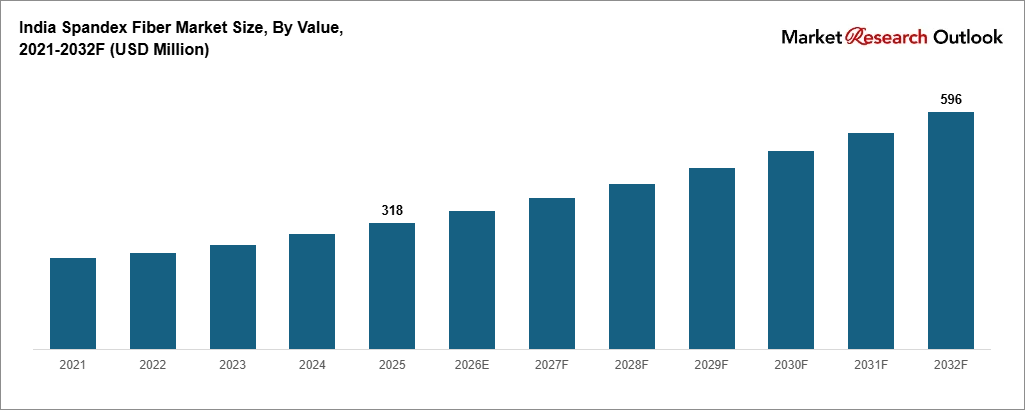
| Market Size (2025) | USD 318 Million |
| CAGR (2026-2032) | 9.4% |
| Leading Segment | Conventional Spandex (21D to 40D for Circular Knits) |
| Fastest Growing Segment | Recycled & Bio-Based Spandex |
| Market Size (2032) | USD 596 Million |
Market Overview: India Spandex Fiber Market
The India spandex fiber market size is witnessing rapid expansion, driven by rising stretch content in everyday clothing, fast growth in athleisure and activewear, wider use of elastane in denim and womenswear, and steady demand from innerwear, hosiery, and hygiene products. Valued at USD 318 million in 2025 and projected to reach USD 596 million by 2032, growing at a CAGR of 9.4%, market growth is being fuelled by India’s young population, rising spending on branded clothing, expanding knitwear and denim clusters, and export orders supported by new trade agreements. Conventional spandex in the 21D to 40D range leads consumption, while recycled and bio-based spandex is emerging as the fastest growing category. Government programmes, including the Production Linked Incentive scheme for man-made fibre apparel and technical textiles with an outlay of INR 10,683 crore and seven PM MITRA textile parks with an outlay of INR 4,445 crore, are pulling more garment production into India. As Indorama India and Hyosung expand domestic supply, and global producers including The LYCRA Company, Asahi Kasei, Taekwang, and Chinese majors compete for Indian mills, the sector is evolving into a quality-led, application-focused, and increasingly self-reliant industry with strong long-term growth potential.
Key Report Takeaways: India Spandex Fiber Market
- The India spandex fiber market size is projected to grow from USD 318 million in 2025 to USD 596 million by 2032, registering a strong CAGR of 9.4%, driven by athleisure and stretch denim demand, export garment growth, and the structural shift toward domestically produced, application-specific elastane across India.
- Conventional spandex dominates the market, accounting for 74% of total value in 2025, driven by bare and covered yarns in the 21D to 40D range for circular knits, innerwear, and hosiery, supplied by Indorama India, Hyosung, and importers of Chinese and Vietnamese yarn.
- Recycled and bio-based spandex are emerging as the fastest growing segment, expected to grow at a CAGR of 18.2% through 2032, as global apparel brands set recycled content targets and Indian exporters seek certified yarns such as Indorama’s ECOModa100 and Hyosung’s regen range.
- Rising production of knitwear in Tiruppur, denim in Ahmedabad, innerwear in Kolkata and Tiruppur, and activewear for export brands, together with diaper and medical textile output, is structurally expanding elastane demand across apparel, hygiene, and technical textile categories.
- Rising investments by domestic and global producers such as Indorama India, Hyosung, and The LYCRA Company in local capacity, specialty grades, and customer service centres, including Indorama’s fivefold rise in Baddi capacity to 25,000 tonnes per annum, are strengthening local supply and supporting the India spandex fiber market forecast 2032.
Key Market Drivers: India Spandex Fiber Market
Rising Athleisure, Activewear, and Comfort Wear Demand Driving Spandex Consumption Across India
Growth in the India spandex fiber market is being driven by a clear change in how Indians dress, with stretch fabrics moving from gym and sportswear into office wear, college wear, and daily casual clothing. Leggings, joggers, track pants, T-shirts, sports bras, and stretch jeans now carry up to 20% elastane by fabric weight, depending on the garment. Organised retailers, value fashion chains, and online platforms have widened access to branded activewear in tier-2 and tier-3 cities, while domestic sportswear and athleisure brands have scaled quickly. Working women, students, and fitness-focused consumers prefer garments that offer comfort, shape retention, and easy movement, which raises the average elastane content per garment. Innerwear and hosiery, traditionally the largest users of spandex, continue to grow with rising brand penetration in men’s and women’s innerwear. Knitting clusters in Tiruppur, Ludhiana, Kolkata, and Surat are adding circular knitting machines to meet this demand, creating strong structural pull-through demand for elastane yarn.
Source:
Government Textile Schemes, Export Growth, and Integrated Garment Parks Fuelling Elastane Adoption
The spandex fiber market in India is benefiting from strong policy support for man-made fibre textiles and garment exports. The Production Linked Incentive scheme for man-made fibre apparel, fabrics, and technical textiles, with an outlay of INR 10,683 crore, rewards investment in exactly the synthetic and blended fabrics that use the most spandex. The PM MITRA scheme is developing seven integrated textile parks with an outlay of INR 4,445 crore, bringing spinning, knitting, processing, and garmenting to single locations that suit large stretch fabric orders. The India-UK Comprehensive Economic and Trade Agreement, signed in July 2025, gives Indian textiles and apparel duty-free access to the United Kingdom, improving the competitiveness of Indian activewear and denim. The National Technical Textiles Mission is also promoting medical, hygiene, and sports textiles that use elastane. These measures shift more value-added garment production to India and strengthen elastane demand across the sector.
Domestic Spandex Capacity, Specialty Grades, and Hygiene Applications Strengthening Supply-Side Growth
Rising domestic production and new applications are a major catalyst for the sector, with recycled and bio-based spandex projected to grow at a CAGR of 18.2% through 2032. Indorama India raised its spandex capacity at Baddi in Himachal Pradesh from 5,000 tonnes per annum at start-up in 2012 to 25,000 tonnes per annum, using continuous polymerisation and dry spinning, and launched ECOModa100 recycled spandex with RCS 100 and EU REACH compliance. Hyosung started commercial production at its creora plant in the AURIC industrial area near Aurangabad in 2019, with planned capacity of up to 18,000 tonnes per year. Local supply shortens lead times, cuts inventory needs for knitters, and gives mills technical support for heat-setting and dyeing. Demand from adult incontinence products, baby diapers, compression bandages, and surgical hosiery is adding a new, less seasonal outlet for coarse denier yarn. These developments are structurally expanding elastane supply across all major end-user categories through 2032.
Key Market Challenges: India Spandex Fiber Market
Low-Priced Imports and Chinese Overcapacity Putting Pressure on Domestic Spandex Prices
The sector continues to face challenges from low-priced imports and large surplus capacity in China, which dominates global spandex production. When Chinese producers add capacity faster than demand, surplus yarn is exported at low prices, cutting margins for Indian producers and making it hard to recover investment. India previously imposed anti-dumping duties on elastomeric filament yarn from China, South Korea, Taiwan, and Vietnam, but in 2022 the government chose not to extend them despite a DGTR recommendation. On 28 March 2025, DGTR opened a fresh anti-dumping investigation into elastomeric filament yarn from China and Vietnam, following a petition by Indorama India. Price-sensitive knitters often switch to the cheapest source, which makes quality inconsistent across batches. Until trade remedies settle and domestic capacity gains scale, import pressure remains a key constraint on pricing across the India spandex fiber market.
Raw Material Price Volatility and Import Dependence for PTMEG and MDI Weighing on Producer Margins
Spandex producers in India face margin pressure from volatile prices of polytetramethylene ether glycol (PTMEG) and methylene diphenyl diisocyanate (MDI), the two main raw materials for elastane. PTMEG depends on butanediol, whose price follows energy and coal markets in China, while MDI prices swing with global polyurethane demand and plant outages. India imports a large share of these intermediates, which exposes producers to freight costs, exchange rate moves, and supply delays. Solvents such as dimethylacetamide used in dry spinning add further cost and need strict recovery systems. Because spandex is sold to price-sensitive knitters and covering units, producers cannot always pass on sudden cost increases. While long-term supply contracts and backward integration help, raw material volatility remains a near-term challenge for the industry.
Processing Gaps at Small Mills and Difficulty of Recycling Elastane Blends Impacting Quality and Sustainability
The spandex fiber sector faces practical constraints around fabric processing and end-of-life handling. Many small knitting and processing units lack controlled heat-setting, tension control, and testing equipment, which leads to uneven stretch, curling, and loss of recovery in finished garments. Spandex can also be damaged by chlorine, high dyeing temperatures, and harsh finishing chemicals if processes are not matched to the yarn grade. At the end of life, elastane blended into cotton, polyester, or nylon is hard to separate, which makes mechanical and chemical recycling of stretch garments difficult. Export customers in the European Union and the United Kingdom are asking for recycled content and recyclability data, putting pressure on suppliers. Technical support centres, recycled spandex, and new separation methods are emerging as solutions, but adoption remains slow across the country.
Key Market Trends: India Spandex Fiber Market
Rapid Shift Toward Recycled, Bio-Based, and Specialty Spandex Grades in India
The market is undergoing a clear shift toward recycled, bio-based, and specialty spandex grades, with these products expected to make up 33% of spandex value by 2027. Indorama’s ECOModa100 uses 100% pre-consumer spandex waste, and its bio-spandex is under development, while Hyosung, The LYCRA Company, and Asahi Kasei offer recycled and partly bio-derived grades to global brands. High heat-settable spandex allows mills to process elastane with polyester and nylon at higher temperatures, which suits fast-growing activewear, while chlorine-resistant grades serve swimwear and sports uniforms. Brands sourcing from India increasingly ask for traceable, certified yarn, and exporters in Tiruppur and Bengaluru are switching first. This product transition is reinforcing the India spandex fiber market forecast 2032 across both domestic and export categories.
Growth of Stretch Denim, Woven Stretch Fabrics, and Comfort Wear in the India Spandex Fiber Market
A clear shift toward stretch denim, stretch shirting, and woven comfort wear is reshaping elastane demand, particularly in womenswear and casual menswear. Denim mills in Gujarat, Maharashtra, and Karnataka now produce a large share of their output with core-spun cotton and spandex yarns, which give jeans shape retention and ease of movement. Woven trousers, chinos, kurtis, and office wear are also adding 2% or more elastane for comfort. Core-spun yarn spinners and covering units have expanded capacity to serve these mills, and denim exporters use stretch fabrics to meet buyer specifications. Woven stretch fabrics account for 22% of spandex value in 2025 and are expected to reach 26% by 2032, with comfort-led office and casual wear set to drive the next phase of growth.
Hygiene, Medical, and Compression Applications Expanding Coarse Denier Spandex Demand
A wave of demand from hygiene, medical, and compression products is reshaping the elastane supply base. Baby diapers, adult incontinence products, and sanitary products use coarse denier spandex for leg cuffs and waistbands, and rising hygiene product penetration in India is lifting this demand each year. Medical applications, including compression stockings, orthopaedic supports, bandages, and surgical hosiery, need consistent stretch and recovery, which favours quality-assured local supply. Sports compression wear and shapewear add further demand for high-power elastane. The National Technical Textiles Mission promotes these medical and hygiene textiles, and producers are creating application labs to support converters. Combined with stable domestic supply from Indorama India and Hyosung, these developments are reinforcing the India spandex fiber market forecast 2032 across the entire value chain.
Segmental Insights: India Spandex Fiber Market
By End-User: Apparel & Activewear Segment Dominates the India Spandex Fiber Market
The apparel and activewear end-user segment dominates the market, accounting for 47% of total value in 2025, driven by leggings, track pants, T-shirts, stretch denim, womenswear, and export activewear. Conventional 21D to 40D spandex is the dominant grade within this segment, with circular knits capturing 58% of apparel spandex value. The innerwear and hosiery segment contributes another 28% of demand, driven by men’s and women’s innerwear, socks, and shapewear from clusters in Tiruppur, Kolkata, and Ludhiana. Medical and hygiene accounts for 16%, led by diapers, adult incontinence products, and compression garments, while technical and industrial textiles make up the remaining 9%. In 2025 and 2026, leading producers including Indorama India, Hyosung, and The LYCRA Company widened specialty and recycled grades for apparel brands and exporters, reinforcing apparel segment dominance.
By Product Type: Conventional Spandex Leads While Recycled and Bio-Based Spandex Grow Fastest
Conventional spandex leads the product mix, accounting for 74% of total value in 2025, driven by bare and covered yarns for circular knits, innerwear, hosiery, and denim. High heat-settable spandex contributes another 9%, mainly for polyester and nylon activewear, while chlorine-resistant spandex holds 5% across swimwear and sports uniforms. Recycled and bio-based spandex are the fastest growing category, together expanding at a CAGR of 18.2%, driven by brand sustainability targets, export buyer requirements, and new launches such as ECOModa100. Recycled spandex holds 6% and bio-based spandex 2% of value today, while other functional grades, including antibacterial, cooling, and easy-dye yarns, account for 4%. Leading producers including Indorama India, Hyosung, The LYCRA Company, Asahi Kasei, and Taekwang have aligned product portfolios to this mix, driving specialty spandex adoption across the India spandex fiber market.
Regional Insights: India Spandex Fiber Market
Regional analysis shows that South India and West India together account for 67% of total spandex value in 2025, driven by Tamil Nadu (Tiruppur and Coimbatore knitwear belt), Karnataka (Bengaluru garment exporters), Gujarat (Ahmedabad denim and Surat synthetic weaving), and Maharashtra (Mumbai, Bhiwandi, and Ichalkaranji), supported by large knitting, weaving, and garment export bases. South India holds 36% and West India 31% of demand. North India contributes 20%, led by Punjab (Ludhiana hosiery and knitwear), Delhi NCR, and Himachal Pradesh, where Indorama’s Baddi plant is located. Central and East India together account for 13% of demand, supported by West Bengal (Kolkata innerwear and hosiery hub), Madhya Pradesh, and Odisha. In 2025 and 2026, Indorama’s Baddi plant, Hyosung’s AURIC plant near Aurangabad, and distributor networks in Tiruppur, Surat, Ahmedabad, Delhi NCR, and Kolkata reinforced regional supply hubs, supporting faster delivery to knitters and mills across the country.
Recent Developments: India Spandex Fiber Market
- India’s spandex fiber industry witnessed strong momentum in trade, capacity, and product activity during 2024 to 2026. On 28 March 2025, DGTR opened an anti-dumping investigation into elastomeric filament yarn from China and Vietnam, covering the period from October 2023 to September 2024, following a petition by Indorama India. Indorama India has expanded its Baddi spandex capacity to 25,000 tonnes per annum, five times its 2012 start-up level.
- Domestic and global producers have deepened India-focused product and service offerings. Indorama India launched ECOModa100 recycled spandex, made from 100% pre-consumer waste with RCS 100 certification, and is developing bio-spandex. Hyosung continues to serve Indian mills from its creora plant at AURIC, while The LYCRA Company, Asahi Kasei, and Taekwang supply specialty grades for activewear, swimwear, and shapewear. These developments are strengthening domestic supply and supporting long-term growth.
- Policy momentum has gained strong traction across the textile sector. The India-UK Comprehensive Economic and Trade Agreement, signed in July 2025, opens duty-free access for Indian apparel, while the PLI scheme for man-made fibre textiles and the PM MITRA parks continue to attract garment investment. Together, these measures are positioning India as one of the most actively growing stretch apparel production bases globally, strengthening long-term competitive positioning in the India spandex fiber market forecast 2032.
Key Market Players: India Spandex Fiber Market
- Indorama India Pvt. Ltd. (INVIYA)
- Hyosung TNC Corporation (creora)
- The LYCRA Company
- Asahi Kasei Corporation (ROICA)
- Taekwang Industrial Co., Ltd.
- TK Chemical Corporation
- Toray Industries, Inc.
- Zhejiang Huafon Spandex Co., Ltd.
- Xinxiang Chemical Fiber Co., Ltd.
- Yantai Tayho Advanced Materials Co., Ltd.
- Jiangsu Shuangliang Spandex Co., Ltd.
- Highsun Holding Group
- Xiamen Lilong Spandex Co., Ltd.
| By Product Type | By Denier | By Fabric Construction | By Sales Channel | By End-User |
| Conventional Spandex High Heat-Settable Spandex Chlorine-Resistant Spandex Recycled Spandex Bio-Based Spandex Others (Antibacterial, Cooling, Dyeable) |
Up to 20D 21D to 40D 41D to 70D 71D to 140D 141D to 280D 281D to 560D Above 560D |
Circular Knits Warp Knits Woven Stretch Fabrics (Denim, Shirting, Bottoms) Narrow Elastic Fabrics & Tapes Nonwovens & Hygiene Laminates |
Direct Supply to Spinners & Knitters Authorised Distributors & Yarn Agents Importers & Yarn Traders Covering & Twisting Units Online B2B Yarn Platforms Export Sales |
Apparel & Activewear Innerwear & Hosiery Medical & Hygiene Technical & Industrial Textiles |
Report Scope
In this report, the India Spandex Fiber Market has been segmented into the following categories, in addition to detailed analysis of key industry trends, market dynamics, competitive landscape, and growth opportunities across the forecast period:
- By Product Type
- Conventional Spandex
- High Heat-Settable Spandex
- Chlorine-Resistant Spandex
- Recycled Spandex
- Bio-Based Spandex
- Others (Antibacterial, Cooling, Dyeable)
- By Denier
- Up to 20D
- 21D to 40D
- 41D to 70D
- 71D to 140D
- 141D to 280D
- 281D to 560D
- Above 560D
- By Fabric Construction
- Circular Knits
- Warp Knits
- Woven Stretch Fabrics (Denim, Shirting, Bottoms)
- Narrow Elastic Fabrics & Tapes
- Nonwovens & Hygiene Laminates
- By Sales Channel
- Direct Supply to Spinners & Knitters
- Authorised Distributors & Yarn Agents
- Importers & Yarn Traders
- Covering & Twisting Units
- Online B2B Yarn Platforms
- Export Sales
- By End-User
- Apparel & Activewear
- Innerwear & Hosiery
- Medical & Hygiene
- Technical & Industrial Textiles
- By Geography
- North India
- South India
- West India
- East India
- Central India
Competitive Landscape
Company Profiles:
Detailed analysis of the leading companies operating in the India Spandex Fiber Market, including business overview, product portfolio, strategic initiatives, competitive positioning, and recent developments.
Company Information
Detailed profiling and strategic analysis of additional market players (up to five companies), including emerging spandex producers, covered and core-spun yarn makers, elastic fabric and tape manufacturers, or niche regional yarn distributors.
For a free sample of the India Spandex Fiber Market report, customised insights or delivery timelines, submit your query here
India Spandex Fiber Market, 2032
- Research Framework
- Market Segmentation
- Research Objective
- Research Methodology
- Qualitative Research
- Primary Research
- Secondary Research
- Quantitative Research
- Market Breakdown & Data Triangulation
- Demand Side
- Supply Side
- Primary Research Respondents
- Assumption & Limitation
- Executive Summary
- Market Overview, 2021-2032
- By Product Type
- By Denier
- By Fabric Construction
- By Sales Channel
- By End-User
- By Region
- Analyst Recommendations
- Geopolitical Impact on India Spandex Fiber Market
- India Spandex Fiber Market Insights
- Market Dynamics
- Growth Drivers
- Rising athleisure, activewear, and comfort wear demand driving spandex consumption across India.
- Government textile schemes, export growth, and integrated garment parks fuelling elastane adoption.
- Domestic spandex capacity, specialty grades, and hygiene applications strengthening supply-side growth.
- Restraints
- Low-priced imports and Chinese overcapacity putting pressure on domestic spandex prices.
- Raw material price volatility and import dependence for PTMEG and MDI weighing on producer margins.
- Processing gaps at small mills and difficulty of recycling elastane blends impacting quality and sustainability.
- Opportunities
- Recycled, bio-based, and specialty spandex grades opening premium demand from export brands.
- Stretch denim, woven comfort wear, and activewear supporting next-generation growth in elastane consumption.
- Diapers, adult incontinence products, and medical compression textiles creating new coarse denier demand.
- Challenges
- Outcome of the 2025 anti-dumping investigation on yarn from China and Vietnam shaping price stability.
- Supply delays and freight costs for imported PTMEG, MDI, and dry spinning solvents.
- Limited heat-setting and testing capability at small knitting and processing units.
- Technological Advancements
- Recent Technological Advancements
- Prior to 2020
- Porter’s Five Forces Analysis
- PESTLE Analysis
- Industry Value Chain & Entry Points
- Upstream Raw Materials (PTMEG, MDI, butanediol, chain extenders, dimethylacetamide solvent, spin finishes)
- Spandex Fiber Producers (Indorama India, Hyosung, The LYCRA Company, Asahi Kasei, Taekwang)
- Importers & Yarn Traders (Chinese and Vietnamese spandex suppliers, yarn agents)
- Covering, Air-Covering & Core-Spun Yarn Makers (single covered, double covered, core-spun cotton and spandex)
- Quality Control, Testing & Certification (BIS, ISO, RCS, GRS, OEKO-TEX, textile testing laboratories)
- Knitters, Weavers & Elastic Fabric Makers (circular knits, warp knits, denim mills, narrow elastics)
- Dyeing, Processing & Finishing Units (heat-setting, dyeing, chlorine-resistant finishing)
- Garment Manufacturers & Exporters (activewear, innerwear, denim, hosiery, swimwear)
- Brands, Retail Channels & Online Platforms (sportswear brands, innerwear brands, value fashion chains, e-commerce)
- End-Users (consumers of apparel and innerwear, hygiene product makers, hospitals, sports and industrial users)
- India Spandex Fiber Market: Regulatory Framework
- India Spandex Fiber Market Overview
- Market Size & Forecast, 2021-2032
- By Value (USD Million)
- By Volume (Tonnes)
- Market Share & Forecast
- By Product Type
- Conventional Spandex
- High Heat-Settable Spandex
- Chlorine-Resistant Spandex
- Recycled Spandex
- Bio-Based Spandex
- Others (Antibacterial, Cooling, Dyeable)
- By Denier
- Up to 20D
- 21D to 40D
- 41D to 70D
- 71D to 140D
- 141D to 280D
- 281D to 560D
- Above 560D
- By Fabric Construction
- Circular Knits
- Warp Knits
- Woven Stretch Fabrics (Denim, Shirting, Bottoms)
- Narrow Elastic Fabrics & Tapes
- Nonwovens & Hygiene Laminates
- By Sales Channel
- Direct Supply to Spinners & Knitters
- Authorised Distributors & Yarn Agents
- Importers & Yarn Traders
- Covering & Twisting Units
- Online B2B Yarn Platforms
- Export Sales
- By End-User
- Apparel & Activewear
- Innerwear & Hosiery
- Medical & Hygiene
- Technical & Industrial Textiles
- By Geography
- North India
- South India
- West India
- East India
- Central India
- Competitive Landscape
- India Spandex Fiber Market Company Market Share Analysis, 2025
- Competitive Benchmarking, By Operating Parameters
- Key Strategic Development (Mergers, Acquisitions, Partnerships, Etc.)
- List of Emerging Players
- Company Profile
- Indorama India Pvt. Ltd. (INVIYA)
- Introduction & Company Profile
- Product Benchmarking
- Strategic Outlook
- Key Competitors
- Financial Analysis
- SWOT Analysis
(Same Data Pointers Will Be Provided for The Below Companies)
- Hyosung TNC Corporation (creora)
- The LYCRA Company
- Asahi Kasei Corporation (ROICA)
- Taekwang Industrial Co., Ltd.
- TK Chemical Corporation
- Toray Industries, Inc.
- Zhejiang Huafon Spandex Co., Ltd.
- Xinxiang Chemical Fiber Co., Ltd.
- Yantai Tayho Advanced Materials Co., Ltd.
- Jiangsu Shuangliang Spandex Co., Ltd.
- Highsun Holding Group
- Xiamen Lilong Spandex Co., Ltd.
- Other Prominent Players
* Financial information in case of non-listed companies will be provided as per availability
** The segmentation and the companies are subjected to modifications based on in-depth secondary for the final deliverable
Frequently Asked Questions
1. How large is the India spandex fiber market and what is its growth forecast?
Ans: The India spandex fiber market is valued at USD 318 million in 2025 and is projected to reach USD 596 million by 2032, growing at a CAGR of 9.4%, supported by athleisure, stretch denim, and export garment growth.
2. Which segments are driving demand in the India spandex fiber market?
Ans: Conventional spandex leads with 74% of 2025 value, driven by 21D to 40D yarns for knits and innerwear, while recycled and bio-based spandex grows fastest at a CAGR of 18.2% on brand sustainability targets.
3. What are the key drivers of growth in the India spandex fiber market?
Ans: Key drivers include rising athleisure and comfort wear demand, stretch denim adoption, the textile PLI scheme, PM MITRA parks, the India-UK trade agreement, hygiene product growth, and domestic capacity at Indorama India and Hyosung.
4. Which regions are driving growth in the India spandex fiber market?
Ans: South India and West India lead with 67% of 2025 value, driven by Tiruppur, Bengaluru, Ahmedabad, Surat, and Mumbai. North India, led by Ludhiana hosiery and the Baddi production hub, also shows strong demand.
5. What are the latest trends in the India spandex fiber market?
Ans: The latest trends include recycled and bio-based spandex, high heat-settable grades for activewear, stretch denim and woven comfort wear, and rising use of coarse denier spandex in diapers and medical compression products.