

India Green Ammonia Market, 2032
- Chemicals & Advanced Materials, Energy, Power & Storage, Petrochemicals & Intermediates, Renewables & Clean Fuels
- Oct 2026
- Pages 140
- Report Format: pdf
- Report Price: $2400 USD
India’s green ammonia market is witnessing rapid structural growth, driven by the National Green Hydrogen Mission, SECI auctions that contracted 724,000 tonnes per year of green ammonia for fertilizer units, binding export offtake agreements with buyers in Germany and Japan, notified green hydrogen hubs at three major ports, falling renewable power tariffs, and rising investment by domestic developers in integrated renewable power, electrolyser and ammonia synthesis capacity.
| Study Duration | 2021-2032 |
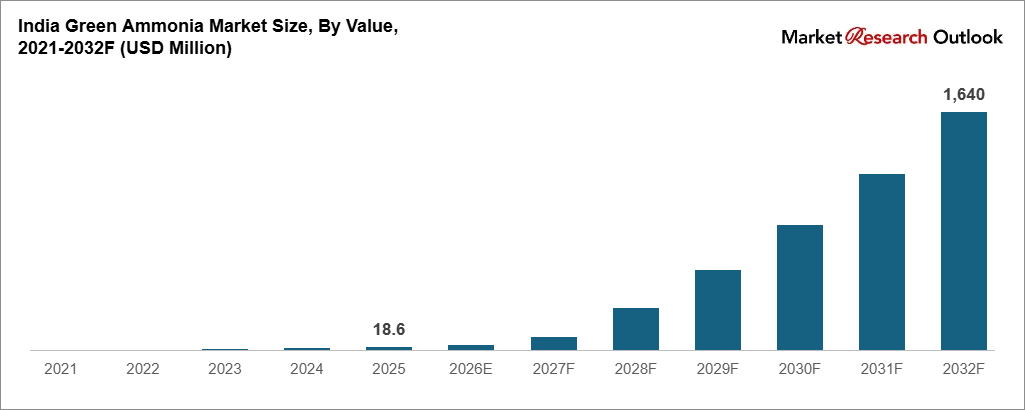
| Market Size (2025) | USD 18.6 Million |
| CAGR (2026-2032) | 89.6% |
| Leading Segment | Fertilizers (Alkaline Electrolysis) |
| Fastest Growing Segment | Hydrogen Carrier Export & Marine Fuel |
| Market Size (2032) | USD 1,640 Million |
Market Overview: India Green Ammonia Market
The India green ammonia market size is expanding rapidly from a small base, driven by the National Green Hydrogen Mission, SECI offtake auctions for fertilizer plants, export agreements with overseas utilities, falling solar and wind tariffs, and the first large coastal production complexes now under construction. Valued at USD 18.6 million in 2025 and projected to reach USD 1,640 million by 2032, growing at a CAGR of 89.6%, market growth is being led by fertilizer producers seeking to replace imported grey ammonia, by exporters supplying Japan and Europe, and by ports preparing for ammonia bunkering. Fertilizers remain the largest application today, while hydrogen carrier exports and marine fuel are the fastest growing uses. India already consumes more than 17 million tonnes of ammonia a year, most of it made from natural gas, which gives green ammonia a large and ready replacement market. As developers including AM Green, ACME, ReNew, Adani New Industries and Reliance Industries move from announcements to construction, and as SECI-contracted volumes start delivery from 2028, the market is evolving into a contract-led, export-linked and policy-backed industry with strong long-term growth potential.
Key Report Takeaways: India Green Ammonia Market
- The India green ammonia market size is projected to grow from USD 18.6 million in 2025 to USD 1,640 million by 2032, registering a CAGR of 89.6%, driven by SECI-contracted fertilizer demand, binding export offtake agreements and the commissioning of large coastal green ammonia plants.
- Fertilizers dominate the industry, accounting for 61% of value in 2025, as fertilizer units shift part of their ammonia feedstock to renewable supply under the 724,000 tonnes per year awarded through SECI auctions at a weighted average price of USD 605 per tonne.
- Hydrogen carrier exports and marine fuel are the fastest growing applications in the India green ammonia market, together expected to reach 42% of value by 2032, as AM Green, ACME and other developers begin supplying buyers such as Uniper in Germany and IHI in Japan from export-oriented coastal plants.
- Project scale is rising sharply. AM Green is building a 1 million tonne per year plant at Kakinada, and ACME is developing a 1.2 million tonne per year complex at Gopalpur, which together signal the shift of the India green ammonia market from pilot units to world-scale facilities.
- Policy support through the SIGHT programme, the waiver of inter-state transmission charges, the green ammonia emission standard of 0.38 kg CO2 equivalent per kg of ammonia, and port-based hydrogen hubs is lowering project risk and supporting the India green ammonia market forecast 2032.
Key Market Drivers: India Green Ammonia Market
National Green Hydrogen Mission Incentives and SECI Offtake Auctions Driving Green Ammonia Demand Across India
Growth in the India green ammonia market is being driven first by policy. The National Green Hydrogen Mission, approved in January 2023 with an outlay of INR 19,744 crore, targets 5 million tonnes of green hydrogen production a year by 2030, and green ammonia is the main route through which much of that hydrogen will be used or shipped. Under the SIGHT programme, which carries INR 17,490 crore of the mission budget, SECI ran a series of auctions in 2025 that awarded 724,000 tonnes per year of green ammonia for supply to fertilizer plants. The contracts run for ten years at fixed prices, with a volume-weighted average delivered price of USD 605 per tonne, and require supply to start within 36 months of signing. ACME alone won 370,000 tonnes per year across six awards. These contracts give developers bankable revenue, which is what moves a project from feasibility study to construction. Added support from inter-state transmission charge waivers, state land and power incentives, and certification under the national green hydrogen scheme is creating strong pull-through demand across the market.
Source:
Fertilizer Sector Decarbonization and Import Substitution Fuelling Domestic Green Ammonia Adoption
The India green ammonia market benefits from the size of the country’s fertilizer industry. India consumes more than 17 million tonnes of ammonia a year, mainly for urea, DAP and complex fertilizers, and the bulk of it is made from natural gas, much of which is imported as LNG. Every tonne of grey ammonia produced from gas emits close to two tonnes of carbon dioxide, which exposes fertilizer exporters and their customers to future carbon border costs. Replacing part of this feedstock with green ammonia reduces both import dependence and emissions, and the SECI contracts link this demand directly to fertilizer sites at Visakhapatnam, Kandla, Paradeep, Zuarinagar and Haldia among others. Leading buyers such as IFFCO and phosphate fertilizer makers are building internal experience with green ammonia handling and blending. Because fertilizer plants already own ammonia storage, piping and safety systems, they can absorb green volumes with modest new investment, which keeps adoption costs low across the industry.
Global Export Offtake Agreements and Port-Based Hydrogen Hubs Strengthening Export-Oriented Capacity
Export demand is a major catalyst for this market, with hydrogen carrier exports and marine fuel expected to account for 42% of market value by 2032. In January 2026, Uniper signed a long-term binding agreement with AM Green for up to 500,000 tonnes per year of renewable ammonia, with the first shipment expected as early as 2028. ACME signed an agreement with IHI of Japan in 2024 to supply 0.4 million tonnes per year from the first phase of its Gopalpur project in Odisha, planned at 1.2 million tonnes per year in total. Japan, Korea and the European Union are all building demand for clean ammonia in power generation, shipping and industry, and India’s low renewable power tariffs and long coastline make it one of the most competitive supply locations for these buyers. In 2025, MNRE recognised Deendayal Port at Kandla, Paradip Port and V.O. Chidambaranar Port at Tuticorin as green hydrogen hubs, giving exporters access to land, storage terminals and jetty capacity. Together, these factors are expanding India green ammonia market growth well beyond domestic fertilizer use through 2032.
Key Market Challenges: India Green Ammonia Market
High Production Costs and Price Gap Against Grey Ammonia Limiting Near-Term Commercial Uptake
The India green ammonia market continues to face a cost gap against conventional ammonia. Even after the 2025 SECI auctions brought delivered prices down to a weighted average of USD 605 per tonne, green ammonia remains costlier than grey ammonia in periods of low gas prices, and the gap widens whenever LNG prices soften. Electricity accounts for the largest share of production cost, since producing one tonne of ammonia through electrolysis needs close to 10 MWh of power, so every small change in renewable tariffs or plant utilisation moves the final price. Fertilizer prices in India are also controlled through the subsidy system, which limits how much of any green premium can be passed on to farmers. Without contracted offtake, merchant buyers have little reason to pay more, and that keeps uncontracted capacity on the drawing board across the sector.
Round-the-Clock Renewable Power Supply and Transmission Constraints Across Project Sites
The India green ammonia market faces technical complexity because an ammonia synthesis loop needs steady hydrogen supply, while solar and wind output varies by hour and season. Developers must combine solar, wind, batteries and pumped storage to reach round-the-clock supply, which raises capital cost and adds execution risk. Many of the best wind and solar sites are in Rajasthan, Gujarat and Karnataka, while the export plants sit on the east and south coasts, so projects rely on inter-state transmission lines that are still under construction in several corridors. Delays in grid connectivity, banking rules that differ from state to state, and limited pumped storage capacity can cut electrolyser utilisation and raise costs for players such as AM Green, ACME, ReNew and Adani New Industries. While the transmission charge waiver and new green energy corridors help, grid readiness remains a near-term challenge for the market.
Electrolyser Supply Chain Dependence, Water Availability and Project Financing Risks Impacting Green Ammonia Margins
The India green ammonia market also faces practical limits around equipment supply, water and finance. Domestic electrolyser manufacturing is still ramping up, so early plants depend partly on imported stacks and balance of plant equipment, exposing them to currency and supply chain risk. Electrolysis needs high-purity water, and coastal plants must invest in desalination and water treatment, adding cost and permitting steps. Large plants cost several billion dollars, and lenders still treat green ammonia as a new asset class, which raises interest costs and slows financial closure. Smaller developers find it hard to secure both long-term offtake and construction finance at the same time. Concessional finance, export credit support and standardised offtake contracts are emerging as solutions, but they are not yet available at the scale the industry needs.
Key Market Trends: India Green Ammonia Market
Shift Toward Large Integrated Coastal Green Ammonia Complexes in India
The India green ammonia market is moving from small pilot units to large integrated complexes built next to ports. ACME commissioned an early green ammonia plant at Bikaner, Rajasthan, in 2021, but the current pipeline is of a very different scale, with AM Green building a 1 million tonne per year plant at Kakinada in Andhra Pradesh and ACME developing a 1.2 million tonne per year complex at Gopalpur in Odisha. These projects combine dedicated solar and wind capacity, storage, electrolysers, air separation units, ammonia synthesis and export terminals under one owner, which lowers unit cost and simplifies certification. Plants above 1,000 tonnes per day are expected to account for 68% of installed capacity by 2032. State governments in Odisha, Andhra Pradesh, Tamil Nadu and Gujarat are offering land, water and power incentives to attract these complexes, reinforcing the 2032 market outlook across both domestic and export segments.
Growth of Green Ammonia as a Marine Fuel and Hydrogen Carrier in the India Green Ammonia Market
A clear shift toward the use of ammonia as a shipping fuel and as a carrier for hydrogen trade is reshaping the sector. Ammonia is easier to store and transport than liquid hydrogen, and it can be cracked back into hydrogen or burned directly in engines and power plants. Japanese and Korean utilities are testing ammonia co-firing in coal plants, and engine makers are bringing ammonia-fuelled ship engines to market. Indian ports at Kandla, Paradip and Tuticorin are planning storage and bunkering facilities as part of their hydrogen hub role, which could make India a refuelling point on major east-west shipping routes. Marine fuel and bunkering are expected to reach 8% of India green ammonia market value by 2032, from a negligible base in 2025, while hydrogen carrier exports are expected to reach 34%, making export-linked uses the largest growth source for the market over the forecast period.
Domestic Electrolyser Manufacturing Scale-Up and Falling Delivered Green Ammonia Prices
A wave of investment in domestic electrolyser manufacturing is reshaping the supply side of the India green ammonia market. Under the SIGHT programme, incentives have been allocated for 3,000 MW of annual electrolyser manufacturing capacity, with companies including Reliance Industries, L&T, Adani New Industries and Ohmium International building factories for alkaline and PEM systems. Local supply reduces lead times, cuts import duties and allows developers to source spares and service within the country. At the same time, India has recorded some of the lowest solar and hybrid power tariffs in the world, which directly lowers the largest cost element in green ammonia. The fall in delivered prices seen across the SECI auction rounds in 2025 shows how quickly competition is compressing costs. Combined with the green ammonia emission standard notified in 2026 and the national certification scheme, these developments are reinforcing the 2032 market outlook across the full value chain.
Segmental Insights: India Green Ammonia Market
By Application: Fertilizers Segment Dominates the India Green Ammonia Market
The fertilizers application segment dominates the India green ammonia market, accounting for 61% of value in 2025, driven by SECI-contracted supply to fertilizer units, existing ammonia storage and handling at fertilizer sites, and the need to cut gas imports. Urea, DAP and complex fertilizer plants are the main users within this segment, with green ammonia used as a direct substitute for part of their grey ammonia feedstock. By 2032, fertilizers are expected to hold 44% of value as export volumes grow faster. Hydrogen carrier exports are expected to contribute 34% of value by 2032, supported by agreements with Uniper and IHI, while marine fuel and bunkering are expected to reach 8%. Power generation and co-firing, industrial chemicals and explosives, refrigeration and other uses together account for the remaining 14%. In 2025, developers including AM Green, ACME, ReNew and Adani New Industries aligned their project pipelines with both fertilizer and export offtake, reinforcing the leading role of fertilizers in the industry.
By Technology: Alkaline Electrolysis Leads While PEM Electrolysis Grows Fastest
Alkaline electrolysis leads the India green ammonia market by technology, accounting for 64% of value in 2025, owing to its lower capital cost per MW, long operating history and the availability of large stacks suited to plants above 1,000 tonnes per day. PEM electrolysis holds 28% and is the fastest growing technology, because it responds quickly to changes in solar and wind output and needs less space, which suits hybrid renewable plants with variable supply. Solid oxide and anion exchange membrane electrolysis are at demonstration stage and together account for 5% of value, while biomass gasification and other routes make up the remaining 3%. Leading developers and equipment suppliers including Reliance Industries, L&T, Adani New Industries and Ohmium International are matching their manufacturing plans to this technology mix, supporting the growth of alkaline and PEM systems across this market.
Regional Insights: India Green Ammonia Market
Regional analysis of the India green ammonia market shows that South India and East India together account for 71% of planned production capacity by 2032, led by Andhra Pradesh (Kakinada), Tamil Nadu (Tuticorin) and Odisha (Gopalpur and Paradip), supported by deep-water ports, state green hydrogen policies and access to strong wind and solar resources. South India alone holds 38% of capacity and East India 33%. West India contributes 21%, led by Gujarat around Deendayal Port at Kandla, which combines a recognised hydrogen hub with a large fertilizer and chemical cluster. North India accounts for 6%, mainly through renewable power generation in Rajasthan, the site of ACME’s early Bikaner plant, while Central India holds the remaining 2%. In 2025, project progress by AM Green in Andhra Pradesh, ACME in Odisha, Sembcorp in Tamil Nadu and IFFCO at Kandla strengthened these regional clusters, supporting closer links between production sites, fertilizer users and export terminals across the sector.
Recent Developments: India Green Ammonia Market
- The India green ammonia market recorded its first large commercial contracts during 2025 and 2026. SECI completed a series of auctions in 2025 that awarded 724,000 tonnes per year of green ammonia for fertilizer units, with ten-year fixed price contracts and a weighted average delivered price of USD 605 per tonne. ACME emerged as the largest single winner with 370,000 tonnes per year across six awards. In February 2026, MNRE notified the green ammonia standard, setting an emission limit of 0.38 kg CO2 equivalent per kg of ammonia averaged over 12 months.
- Export offtake has moved from memoranda to binding contracts. In January 2026, Uniper signed a long-term agreement with AM Green for up to 500,000 tonnes per year of renewable ammonia from India, with first shipments expected as early as 2028, while AM Green continues construction of its 1 million tonne per year plant at Kakinada. ACME is progressing its Gopalpur project in Odisha, where the first phase is linked to a 0.4 million tonne per year supply agreement with IHI of Japan. These developments are strengthening export capacity and supporting the India green ammonia market forecast 2032.
- Infrastructure support has gained strong momentum in the India green ammonia market. In 2025, MNRE recognised Deendayal Port at Kandla, Paradip Port and V.O. Chidambaranar Port at Tuticorin as green hydrogen hubs, giving developers access to land, storage and jetty capacity. Electrolyser manufacturing under SIGHT has also progressed, with incentives allocated for 3,000 MW of annual capacity. These steps are positioning India as one of the most competitive green ammonia supply bases globally, strengthening long-term competitive positioning in the 2032 market outlook.
Key Market Players: India Green Ammonia Market
- AM Green (Greenko Group)
- ACME Cleantech Solutions Private Limited
- ReNew Energy Global Plc
- Adani New Industries Limited
- Reliance Industries Limited
- Larsen & Toubro Limited
- NTPC Green Energy Limited
- Avaada Group
- Sembcorp Industries Ltd.
- Jakson Green Private Limited
- Hygenco Green Energies Private Limited
- Indian Farmers Fertiliser Cooperative Limited (IFFCO)
- Ohmium International Inc.
| By Technology | By Application | By Renewable Power Source | By Plant Capacity | By Offtake Model |
| Alkaline Electrolysis Proton Exchange Membrane (PEM) Electrolysis Solid Oxide Electrolysis (SOEC) Anion Exchange Membrane (AEM) Electrolysis Biomass Gasification Others |
Fertilizers Hydrogen Carrier & Export Marine Fuel & Bunkering Power Generation & Co-firing Industrial Chemicals & Explosives Refrigeration Others |
Solar PV Onshore Wind Hybrid Solar-Wind with Storage Hydro & Pumped Storage Green Open Access Grid Power |
Below 50 TPD (Pilot) 50-500 TPD 500-1,000 TPD 1,000-2,000 TPD 2,000-3,000 TPD Above 3,000 TPD |
Domestic Contracted Offtake (SECI) Captive Consumption Export Offtake Merchant Sales |
Report Scope
In this report, the India Green Ammonia Market has been segmented into the following categories, in addition to detailed analysis of key industry trends, market dynamics, competitive dynamics and growth opportunities across the forecast period:
- By Technology
- Alkaline Electrolysis
- Proton Exchange Membrane (PEM) Electrolysis
- Solid Oxide Electrolysis (SOEC)
- Anion Exchange Membrane (AEM) Electrolysis
- Biomass Gasification
- Others
- By Application
- Fertilizers
- Hydrogen Carrier & Export
- Marine Fuel & Bunkering
- Power Generation & Co-firing
- Industrial Chemicals & Explosives
- Refrigeration
- Others
- By Renewable Power Source
- Solar PV
- Onshore Wind
- Hybrid Solar-Wind with Storage
- Hydro & Pumped Storage
- Green Open Access Grid Power
- By Plant Capacity
- Below 50 TPD (Pilot)
- 50-500 TPD
- 500-1,000 TPD
- 1,000-2,000 TPD
- 2,000-3,000 TPD
- Above 3,000 TPD
- By Offtake Model
- Domestic Contracted Offtake (SECI)
- Captive Consumption
- Export Offtake
- Merchant Sales
- By Geography
- North India
- South India
- West India
- East India
- Central India
Competitive Landscape
Company Profiles:
Detailed analysis of the leading companies operating in the India Green Ammonia Market, including business overview, project portfolio, strategic initiatives, competitive positioning and recent developments.
Company Information
Detailed profiling and strategic analysis of additional market players (up to five companies), including emerging green hydrogen developers, electrolyser makers, fertilizer producers with green ammonia plans, or state-level renewable project companies.
For a free sample of the India Green Ammonia Market report, customised insights or delivery timelines, submit your query here
India Green Ammonia Market, 2032
- Research Framework
- Market Segmentation
- Research Objective
- Research Methodology
- Qualitative Research
- Primary Research
- Secondary Research
- Quantitative Research
- Market Breakdown & Data Triangulation
- Demand Side
- Supply Side
- Primary Research Respondents
- Assumption & Limitation
- Executive Summary
- Market Overview, 2021-2032
- By Technology
- By Application
- By Renewable Power Source
- By Plant Capacity
- By Offtake Model
- By Region
- Analyst Recommendations
- Geopolitical Impact on India Green Ammonia Market
- India Green Ammonia Market Insights
- Market Dynamics
- Growth Drivers
- National Green Hydrogen Mission incentives and SECI offtake auctions driving green ammonia demand across India.
- Fertilizer sector decarbonization and import substitution fuelling domestic green ammonia adoption.
- Global export offtake agreements and port-based hydrogen hubs strengthening export-oriented capacity.
- Restraints
- High production costs and price gap against grey ammonia limiting near-term commercial uptake.
- Round-the-clock renewable power supply and transmission constraints across project sites.
- Electrolyser supply chain dependence, water availability and project financing risks impacting green ammonia margins.
- Opportunities
- Green ammonia bunkering at Kandla, Paradip and Tuticorin opening a new marine fuel market on east-west shipping routes.
- Long-term export supply to Japan, Korea and Europe supporting next-generation growth in the green ammonia market.
- Ammonia co-firing in thermal power plants and certified low-carbon fertilizer creating new domestic demand pools.
- Challenges
- Competition from low-cost grey ammonia imports during periods of weak global gas prices.
- Safety, toxicity and handling regulations for large-scale ammonia storage, bunkering and port operations.
- Securing certification, traceability and buyer acceptance across different international green ammonia standards.
- Technological Advancements
- Recent Technological Advancements
- Prior to 2020
- Porter’s Five Forces Analysis
- PESTLE Analysis
- Industry Value Chain & Entry Points
- Upstream Inputs (renewable power, desalinated water, nitrogen from air separation, electrolyser stacks, catalysts)
- Green Hydrogen & Ammonia Producers (AM Green, ACME, ReNew, Adani New Industries, Reliance Industries)
- Electrolyser & Technology Suppliers (alkaline and PEM electrolysers, Haber-Bosch synthesis loop licensors)
- Renewable Power Developers & Storage Providers (solar, wind, hybrid, battery and pumped storage)
- Certification, Testing & Standards Bodies (MNRE green ammonia standard, Green Hydrogen Certification Scheme of India, ISO)
- Storage, Terminals & Logistics (refrigerated tanks, port terminals, pipelines, ammonia carriers)
- Fertilizer Producers & Industrial Buyers (IFFCO, phosphate and urea producers, chemical and explosives makers)
- Offtake Aggregators & International Buyers (SECI, Uniper, IHI and other overseas utilities)
- Ports & Bunkering Operators (Deendayal Port Kandla, Paradip Port, V.O. Chidambaranar Port Tuticorin)
- End-Users (fertilizer plants, power utilities, shipping lines, refineries, chemical producers)
- India Green Ammonia Market: Regulatory Framework
- India Green Ammonia Market Overview
- Market Size & Forecast, 2021-2032
- By Value (USD Million)
- By Volume (Thousand Tonnes)
- Market Share & Forecast
- By Technology
- Alkaline Electrolysis
- Proton Exchange Membrane (PEM) Electrolysis
- Solid Oxide Electrolysis (SOEC)
- Anion Exchange Membrane (AEM) Electrolysis
- Biomass Gasification
- Others
- By Application
- Fertilizers
- Hydrogen Carrier & Export
- Marine Fuel & Bunkering
- Power Generation & Co-firing
- Industrial Chemicals & Explosives
- Refrigeration
- Others
- By Renewable Power Source
- Solar PV
- Onshore Wind
- Hybrid Solar-Wind with Storage
- Hydro & Pumped Storage
- Green Open Access Grid Power
- By Plant Capacity
- Below 50 TPD (Pilot)
- 50-500 TPD
- 500-1,000 TPD
- 1,000-2,000 TPD
- 2,000-3,000 TPD
- Above 3,000 TPD
- By Offtake Model
- Domestic Contracted Offtake (SECI)
- Captive Consumption
- Export Offtake
- Merchant Sales
- By Geography
- North India
- South India
- West India
- East India
- Central India
- Competitive Landscape
- India Green Ammonia Market Company Market Share Analysis, 2025
- Competitive Benchmarking, By Operating Parameters
- Key Strategic Development (Mergers, Acquisitions, Partnerships, Etc.)
- List of Emerging Players
- Company Profile
- AM Green (Greenko Group)
- Introduction & Company Profile
- Product Benchmarking
- Strategic Outlook
- Key Competitors
- Financial Analysis
- SWOT Analysis
(Same Data Pointers Will Be Provided for The Below Companies)
- ACME Cleantech Solutions Private Limited
- ReNew Energy Global Plc
- Adani New Industries Limited
- Reliance Industries Limited
- Larsen & Toubro Limited
- NTPC Green Energy Limited
- Avaada Group
- Sembcorp Industries Ltd.
- Jakson Green Private Limited
- Hygenco Green Energies Private Limited
- Indian Farmers Fertiliser Cooperative Limited (IFFCO)
- Ohmium International Inc.
- Other Prominent Players
* Financial information in case of non-listed companies will be provided as per availability
** The segmentation and the companies are subjected to modifications based on in-depth secondary for the final deliverable
Frequently Asked Questions
1. How large is the India green ammonia market and what is its growth forecast?
Ans: The India green ammonia market is valued at USD 18.6 million in 2025 and is projected to reach USD 1,640 million by 2032, growing at a CAGR of 89.6%, backed by SECI fertilizer contracts and export offtake deals.
2. Which segments are driving demand in the India green ammonia market?
Ans: Fertilizers lead with 61% of value in 2025, while hydrogen carrier exports and marine fuel are the fastest growing uses, expected to reach 42% of value by 2032 as coastal export plants start shipping.
3. What are the key drivers of growth in the India green ammonia market?
Ans: Key drivers include the National Green Hydrogen Mission, 724,000 tonnes per year of SECI-awarded fertilizer supply, binding export agreements with Uniper and IHI, port-based hydrogen hubs and falling renewable power tariffs.
4. Which regions are driving growth in the India green ammonia market?
Ans: South India and East India hold 71% of planned capacity by 2032, led by Kakinada, Tuticorin, Gopalpur and Paradip. West India follows with 21%, centred on Gujarat and Deendayal Port at Kandla.
5. What are the latest trends in the India green ammonia market?
Ans: Key trends include large integrated coastal plants, green ammonia as a marine fuel and hydrogen carrier, domestic electrolyser manufacturing under SIGHT, falling auction prices and the 2026 green ammonia emission standard.