

India Optical Brightener Market, 2032
- Chemicals & Advanced Materials, Specialty Chemicals
- Nov 2026
- Pages 140
- Report Format: pdf
- Report Price: $2400 USD
India’s optical brightener market is witnessing strong structural growth, driven by expanding detergent and home care consumption, rising paper and board production, growing textile and apparel processing, wider use of high-performance brighteners in plastics and packaging, and rising export demand as global buyers shift sourcing of stilbene intermediates and brighteners toward Indian producers.
| Study Duration | 2021-2032 |
| Market Size (2025) | USD 705 Million |
| CAGR (2026-2032) | 6.4% |
| Leading Segment | Stilbene Derivatives (Detergents & Soaps) |
| Fastest Growing Segment | Benzoxazole Derivatives (Plastics & Polymers) |
| Market Size (2032) | USD 1,088 Million |
Market Overview: India Optical Brightener Market
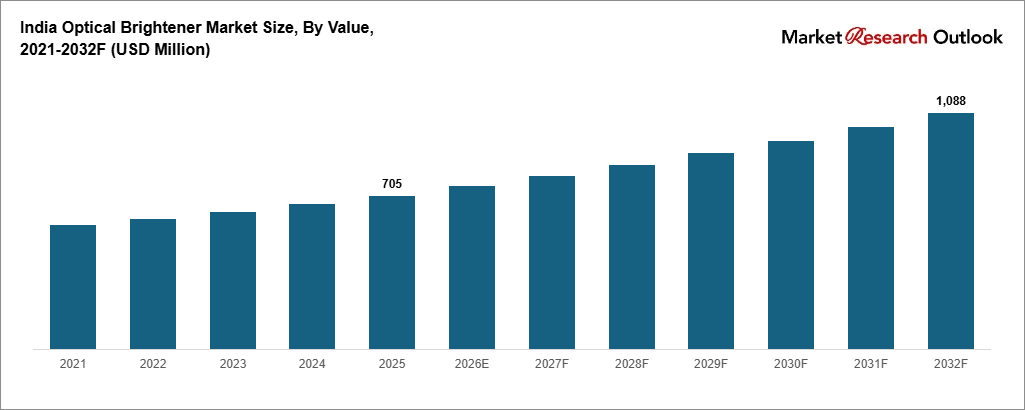
The India optical brightener market size is expanding at a steady pace, driven by rising detergent and home care consumption, new paper and board capacity, growing textile and apparel processing, wider use of brighteners in plastics and packaging, and stronger export demand for Indian-made stilbene chemistry. Valued at USD 705 million in 2025 and projected to reach USD 1,088 million by 2032, growing at a CAGR of 6.4%, the market is gaining from higher household spending on branded detergents, premium paper demand from publishing and office use, and capacity additions in textile processing clusters. Stilbene derivatives lead consumption, while benzoxazole derivatives are the fastest growing chemical type as plastics, masterbatch, and packaging users seek heat-stable brighteners. Volume demand stood at around 148 kilotons in 2025 and is expected to cross 215 kilotons by 2032. As BASF, Archroma, Clariant, Deepak Nitrite, Paramount, and Daikaffil widen product ranges and application support, the industry is evolving into a specification-led, export-oriented, and increasingly integrated sector with strong long-term growth potential.
Key Report Takeaways: India Optical Brightener Market
- The India optical brightener market size is projected to grow from USD 705 million in 2025 to USD 1,088 million by 2032, registering a CAGR of 6.4%, driven by detergent consumption, paper capacity additions, textile processing growth, and rising plastics applications.
- Stilbene derivatives dominate overall demand, accounting for about 72% of total value in 2025, supported by wide use in detergents, paper, and cotton textiles, along with India’s strong DASDA intermediate base.
- Benzoxazole derivatives are the fastest growing chemical type, expected to grow at 8.5% to 9.5% annually as plastics, masterbatch, PET packaging, and synthetic fibre users demand heat-stable brightening.
- Detergents and soaps remain the largest application with a 36% to 38% share, while paper and board and textiles together add about 49% of demand, giving the market a broad and stable base.
- Rising investments by BASF, Archroma, Clariant, Deepak Nitrite, Paramount, and Daikaffil in liquid formulations, backward integration, and application support are strengthening supply and supporting the India optical brightener market forecast 2032.
Key Market Drivers: India Optical Brightener Market
Expanding Detergent, Home Care, and FMCG Consumption Driving Optical Brightener Demand Across India
Demand is being driven by steady expansion of detergent, home care, and FMCG consumption across urban and rural India. The country uses more than 5.5 million tonnes of detergents every year, making it one of the largest laundry markets in the world, and washing machine penetration is rising quickly in urban households. Optical brighteners are added to detergent powders, bars, and liquids at 0.05% to 0.3% to make white fabrics look brighter after every wash. Leading brands such as HUL, P&G India, Jyothy Labs, RSPL, and Nirma are shifting toward premium powders and liquid detergents that use higher-efficiency DSBP and stilbene brighteners. Rural detergent penetration is still below urban levels, and per capita detergent use in India remains well under global averages, indicating long-term headroom. Rising incomes, growth of modern retail and quick commerce, and premiumization of laundry care are creating strong structural pull-through demand for brighteners nationwide.
Rising Paper, Packaging, and Writing and Printing Grade Production Boosting Stilbene-Based Brightener Consumption
Brightener consumption is benefiting from steady growth in paper, packaging, and writing and printing grades. India produces around 24 million tonnes of paper and board each year, and leading mills such as ITC PSPD, JK Paper, TNPL, West Coast Paper, and Century Pulp and Paper continue to add capacity. Stilbene-based brighteners are dosed at about 0.2% to 1.0% on dry fibre in wet end, size press, and coating applications to reach CIE whiteness levels of 140 to 170 demanded for copier, maplitho, and coated papers. Rising literacy, education spending, and office paper demand support writing and printing grades, while folding box board for pharma, FMCG, and cosmetics packaging also uses brighteners on its top layers. Liquid tetra and hexa-sulfonated grades command premium prices, supporting value growth across the market.
Growing Textile, Apparel, and Technical Fabric Processing Strengthening Optical Brightener Demand
Growth in textile, apparel, and technical fabric processing is a major catalyst for brightener demand. India’s textile and apparel exports reached about USD 37 billion in FY25, and the government is developing seven PM MITRA mega textile parks to scale integrated processing. Optical brighteners are used to whiten cotton, polyester, and blended fabrics during bleaching and finishing, with stilbene grades for cellulosic fibres and benzoxazole grades for polyester. Large processing clusters in Surat, Ahmedabad, Bhiwandi, Tiruppur, Erode, and Ludhiana consume steady volumes, while export buyers insist on bright whites and restricted substance compliance. Home textiles such as bed linen and towels add further demand. These specialty textile grades carry better margins than commodity detergent grades, and their share of total demand is rising steadily through 2032.
Key Market Challenges: India Optical Brightener Market
Volatility in DASDA, Cyanuric Chloride, and Aniline Derivative Prices Squeezing Optical Brightener Margins
Domestic producers continue to face challenges around raw material price volatility. Most stilbene brighteners are built on DASDA (4,4′-diaminostilbene-2,2′-disulfonic acid), cyanuric chloride, and aniline derivatives, and prices of these inputs have moved by 15% to 25% in recent cycles due to changes in Chinese supply, energy costs, and environmental shutdowns. Raw materials account for an estimated 60% to 70% of brightener production cost, so even small price swings hit margins. Large detergent and paper buyers negotiate annual contracts, which makes it difficult for producers to pass through sudden cost increases. Smaller formulators without backward integration are most exposed and often lose orders on price. Until feedstock supply becomes more stable, cost volatility will remain a key concern across the India optical brightener market.
Tightening Environmental, Effluent, and Food-Contact Regulations Increasing Compliance Costs
Producers face structural compliance pressure because brightener and intermediate manufacturing generates high-salt, colored effluent that needs advanced treatment. Pollution control boards in Gujarat and Maharashtra have tightened norms in chemical clusters such as Vapi, Ankleshwar, and Tarapur, and zero liquid discharge requirements can raise treatment costs by 10% to 20% of conversion cost. Export customers also need REACH registration and restricted substance list compliance, adding testing and documentation costs. In addition, food-contact packaging norms discourage fluorescent whitening agents in paper that touches food. These factors raise capital needs and slow capacity additions for smaller units. While larger, integrated producers handle these rules better, regulatory pressure remains a near-term challenge for the industry.
Rising Demand for Unbleached, Recycled, and Brightener-Free Products in Food Packaging and Eco-Labelled Goods
Brightener suppliers face practical constraints from changing consumer and brand preferences. Some food packaging, baby care, and eco-labelled products now promote unbleached, natural, or brightener-free claims, and certain global retailers limit fluorescent whitening agents in food-contact paper and baby textiles. Recycled fibre content in Indian paper and board is also rising, and recycled pulp can reduce brightener efficiency by 15% to 25% because of residual inks and fillers. This pushes mills to rethink dosage and chemistry. Low-dosage, high-efficiency brighteners and bio-based shading systems are emerging as solutions, but higher costs and limited awareness still slow adoption, keeping this a watch point for the industry.
Key Market Trends: India Optical Brightener Market
Shift Toward Liquid, Hexa-Sulfonated, and High-Efficiency Optical Brighteners in Paper Applications
Indian paper mills are making a clear shift toward liquid, tetra-sulfonated, and hexa-sulfonated brighteners, which are expected to account for over 60% of paper-grade brightener value by 2030. Liquid grades remove dust, improve dosing accuracy, and work well in size press and coating systems, while hexa-sulfonated grades reduce greening and deliver higher whiteness in coated papers. These grades typically sell at a 15% to 30% premium over standard di-sulfonated powders, lifting average realization. BASF, Archroma, Clariant, Paramount, and Daikaffil are widening their liquid portfolios for Indian paper customers, often with on-site technical support. This product transition is reinforcing the India optical brightener market forecast 2032 across both paper and packaging segments.
Growing Use of Benzoxazole and DSBP Brighteners in Plastics, Masterbatches, and Premium Detergents
A clear shift toward plastics and premium detergents is reshaping demand. Benzoxazole brighteners such as OB and OB-1 are used in PET bottles, PVC profiles, polyolefin films, synthetic leather, and masterbatches at very low loadings of 0.01% to 0.05%, giving bright, clean whites that survive high processing temperatures. India’s growing packaging, footwear, and polyester fibre industries are steadily raising this demand. In detergents, DSBP brighteners are gaining share because they work at low wash temperatures and are stable in liquid detergents. Plastics and polymers account for about 7% of demand today, yet they are expected to grow at 8.5% to 9.5% annually, making them the fastest-growing application through 2032.
China+1 Sourcing and Capacity Expansion by Indian Brightener and Intermediate Producers
A wave of China+1 sourcing is reshaping the supply side. Global brightener and chemical buyers are adding Indian suppliers to reduce dependence on China, and India’s strong base in DASDA and stilbene intermediates, led by producers such as Deepak Nitrite, gives local brightener makers a cost and supply security advantage. Indian companies are investing in liquid formulation lines, effluent treatment, and REACH registrations to win export orders from Europe, Southeast Asia, and the Middle East. PLI and Make in India policies, specialty chemical park development in Gujarat, and customer demand for shorter lead times are favouring local supply. Combined with rising domestic demand, these developments are reinforcing the India optical brightener market forecast 2032 across the full value chain.
Segmental Insights: India Optical Brightener Market
By Application: Detergents & Soaps Segment Dominates the India Optical Brightener Market
The detergents and soaps segment dominates optical brightener consumption in India, accounting for an estimated 36% to 38% of total value, driven by powders, bars, and liquid detergents sold across urban and rural markets. Stilbene and DSBP brighteners are the most widely used chemistries in this segment. Paper and board contributes another 27% to 29% of demand, led by writing and printing grades and coated board. Textiles account for 20% to 22%, supported by cotton and polyester processing in major clusters. Plastics and polymers add about 7%, while cosmetics, personal care, coatings, and inks make up the rest. In 2025, leading suppliers including BASF, Archroma, Clariant, and Deepak Nitrite strengthened supply to major detergent brands, reinforcing segment dominance.
By Chemical Type: Stilbene Derivatives Lead While Benzoxazole Grows Fastest
Stilbene derivatives lead the market, accounting for approximately 72% of total value, driven by their wide use in detergents, paper, and cotton textiles, their good water solubility, and India’s strong DASDA intermediate supply. Distyrylbiphenyl brighteners hold about 10% share, mainly in premium detergents, while benzoxazole derivatives account for around 9%. Benzoxazole is the fastest growing chemical type, expanding at 8.5% to 9.5% annually, supported by demand from plastics, masterbatches, PET packaging, and polyester fibres. Coumarin, pyrazoline, and other types serve niche uses in coatings, inks, and acrylic fibres. By form, powder leads with about 52% share, but liquid grades are gaining quickly in paper. Leading suppliers including BASF, Archroma, Clariant, and Paramount have aligned their India portfolios to this mix, supporting premium grade adoption nationwide.
Regional Insights: India Optical Brightener Market
Regional analysis of the India optical brightener market shows that West India and South India together account for approximately 61% to 65% of total demand, driven by Gujarat (Vapi, Ankleshwar, and Vadodara chemical clusters and Surat and Ahmedabad textile hubs), Maharashtra (Bhiwandi textiles, Tarapur chemicals, and detergent plants), Tamil Nadu (Tiruppur and Erode textile clusters and TNPL paper mills), Andhra Pradesh, and Telangana. North India contributes around 21% to 24% of demand, led by Punjab, Haryana, Uttar Pradesh, and Delhi NCR, supported by Ludhiana textile processing, agro-based paper mills in Uttar Pradesh, and large detergent plants. Central and East India together account for 13% to 16% of demand, supported by Madhya Pradesh, West Bengal, and Odisha, where paper mills and detergent capacity are growing. In 2025, production hubs in Gujarat and Maharashtra and distribution networks across South and North India reinforced regional supply across the country.
Recent Developments: India Optical Brightener Market
- The sector saw strong momentum in demand and investment during 2024 and 2025. Domestic consumption reached around 148 kilotons in 2025, up from about 131 kilotons in 2022, supported by higher detergent sales and new paper capacity. Volume is projected to cross 215 kilotons by 2032, led by detergents, paper, textiles, and fast-growing plastics applications.
- Domestic and global players have deepened India-focused capacity and support. Deepak Nitrite continued to strengthen its position in DASDA and stilbene intermediates, while BASF, Archroma, and Clariant widened liquid brightener ranges and application services for Indian paper and textile customers. Paramount and Daikaffil expanded supply to paper and detergent users. These moves are strengthening local supply and supporting long-term market growth through 2032.
- Export and plastics momentum is building. Indian producers are adding REACH registrations and effluent treatment upgrades to serve buyers in Europe, Southeast Asia, and the Middle East under China+1 sourcing, while masterbatch and PET packaging makers are qualifying benzoxazole brighteners. These shifts are positioning India as one of the fastest growing optical brightener markets in Asia.
Key Market Players: India Optical Brightener Market
- BASF India Limited
- Archroma India Pvt. Ltd.
- Clariant Chemicals (India) Limited
- Deepak Nitrite Limited
- Paramount Minerals and Chemicals Limited
- Daikaffil Chemicals India Limited
- Sarex Chemicals Ltd.
- Colourex Industries
- Rudolf Atul Chemicals Ltd.
- 3V Sigma S.p.A.
- Teh Fong Min International Co., Ltd.
- Mayzo Inc.
- Blankophor GmbH & Co. KG
| By Chemical Type | By Form | By Sulfonation Level | By Application | By Distribution Channel |
| Stilbene Derivatives Distyrylbiphenyl (DSBP) Benzoxazole Derivatives Coumarin Derivatives Pyrazoline Derivatives Others |
Powder Liquid Granules |
Di-Sulfonated Tetra-Sulfonated Hexa-Sulfonated Non-Sulfonated |
Detergents & Soaps Paper & Board Textiles Plastics & Polymers Cosmetics & Personal Care Coatings, Inks & Others |
Direct Sales Distributors & Traders Online B2B Platforms |
Report Scope
In this report, the India Optical Brightener Market has been segmented into the following categories, in addition to detailed analysis of key industry trends, market dynamics, competitive landscape, and growth opportunities across the forecast period:
- By Chemical Type
- Stilbene Derivatives
- Distyrylbiphenyl (DSBP)
- Benzoxazole Derivatives
- Coumarin Derivatives
- Pyrazoline Derivatives
- Others
- By Form
- Powder
- Liquid
- Granules
- By Sulfonation Level
- Di-Sulfonated
- Tetra-Sulfonated
- Hexa-Sulfonated
- Non-Sulfonated
- By Application
- Detergents & Soaps
- Paper & Board
- Textiles
- Plastics & Polymers
- Cosmetics & Personal Care
- Coatings, Inks & Others
- By Distribution Channel
- Direct Sales
- Distributors & Traders
- Online B2B Platforms
- By Geography
- North India
- South India
- West India
- East India
- Central India
Competitive Landscape
Company Profiles:
Detailed analysis of the leading companies operating in the India Optical Brightener Market, including business overview, product portfolio, strategic initiatives, competitive positioning, and recent developments.
Company Information
Detailed profiling and strategic analysis of additional market players (up to five companies), including emerging domestic brightener formulators, specialty plastics brightener producers, regional chemical distributors, or niche textile auxiliary suppliers.
For a free sample of the India Optical Brightener Market report, customised insights or delivery timelines, submit your query here
India Optical Brightener Market, 2032
- Research Framework
- Market Segmentation
- Research Objective
- Research Methodology
- Qualitative Research
- Primary Research
- Secondary Research
- Quantitative Research
- Market Breakdown & Data Triangulation
- Demand Side
- Supply Side
- Primary Research Respondents
- Assumption & Limitation
- Executive Summary
- Market Overview, 2021-2032
- By Chemical Type
- By Form
- By Sulfonation Level
- By Application
- By Distribution Channel
- By Region
- Analyst Recommendations
- Geopolitical Impact on India Optical Brightener Market
- India Optical Brightener Market Insights
- Market Dynamics
- Growth Drivers
- Expanding detergent, home care, and FMCG consumption driving optical brightener demand across India.
- Rising paper, packaging, and writing and printing grade production boosting stilbene-based brightener consumption.
- Growing textile, apparel, and technical fabric processing strengthening optical brightener demand.
- Restraints
- Volatility in DASDA, cyanuric chloride, and aniline derivative prices squeezing optical brightener margins.
- Tightening environmental, effluent, and food-contact regulations increasing compliance costs for brightener producers.
- Rising demand for unbleached, recycled, and brightener-free products in food packaging and eco-labelled goods.
- Opportunities
- High-performance benzoxazole and DSBP brighteners for plastics, masterbatches, and packaging opening new demand pools.
- Liquid, eco-friendly, and low-dosage brightener formulations supporting next-generation paper and detergent growth.
- Export demand and China+1 sourcing shifts creating large growth potential for Indian brightener producers.
- Challenges
- Intense price competition from Chinese brightener suppliers and fragmented local producers.
- Fluorescence quenching, shade consistency, and compatibility issues across varied substrates and water conditions.
- Wastewater treatment, zero liquid discharge norms, and hazardous chemical handling at manufacturing clusters.
- Technological Advancements
- Recent Technological Advancements
- Prior to 2020
- Porter’s Five Forces Analysis
- PESTLE Analysis
- Industry Value Chain & Entry Points
- Upstream Raw Materials (4-nitrotoluene-2-sulfonic acid, DASDA, cyanuric chloride, aniline derivatives, amines)
- Intermediate Producers (DASDA and triazine intermediate manufacturers such as Deepak Nitrite)
- Optical Brightener Manufacturers (BASF, Archroma, Clariant, Paramount, Daikaffil)
- Formulation & Liquid Blending Units (paper, detergent, and textile ready formulations)
- Quality Control, R&D & Testing Laboratories (BIS, ISO, CIE whiteness, REACH compliance)
- Distributors, Traders & Chemical Marketers (B2B distribution networks)
- Detergent & Soap Manufacturers (HUL, P&G India, Jyothy Labs, RSPL, Nirma)
- Paper & Board Mills (ITC PSPD, JK Paper, TNPL, West Coast Paper, Century Pulp & Paper)
- Textile Processors & Plastic Compounders (process houses, masterbatch makers, polymer converters)
- End-Users (households, publishers, apparel brands, packaging converters)
- India Optical Brightener Market: Regulatory Framework
- India Optical Brightener Market Overview
- Market Size & Forecast, 2021-2032
- By Value (USD Million)
- By Volume (Kilotons)
- Market Share & Forecast
- By Chemical Type
- Stilbene Derivatives
- Distyrylbiphenyl (DSBP)
- Benzoxazole Derivatives
- Coumarin Derivatives
- Pyrazoline Derivatives
- Others
- By Form
- Powder
- Liquid
- Granules
- By Sulfonation Level
- Di-Sulfonated
- Tetra-Sulfonated
- Hexa-Sulfonated
- Non-Sulfonated
- By Application
- Detergents & Soaps
- Paper & Board
- Textiles
- Plastics & Polymers
- Cosmetics & Personal Care
- Coatings, Inks & Others
- By Distribution Channel
- Direct Sales
- Distributors & Traders
- Online B2B Platforms
- By Geography
- North India
- South India
- West India
- East India
- Central India
- Competitive Landscape
- India Optical Brightener Market Company Market Share Analysis, 2025
- Competitive Benchmarking, By Operating Parameters
- Key Strategic Development (Mergers, Acquisitions, Partnerships, Etc.)
- List of Emerging Players
- Company Profile
- BASF India Limited
- Introduction & Company Profile
- Product Benchmarking
- Strategic Outlook
- Key Competitors
- Financial Analysis
- SWOT Analysis
(Same Data Pointers Will Be Provided for The Below Companies)
- Archroma India Pvt. Ltd.
- Clariant Chemicals (India) Limited
- Deepak Nitrite Limited
- Paramount Minerals and Chemicals Limited
- Daikaffil Chemicals India Limited
- Sarex Chemicals Ltd.
- Colourex Industries
- Rudolf Atul Chemicals Ltd.
- 3V Sigma S.p.A.
- Teh Fong Min International Co., Ltd.
- Mayzo Inc.
- Blankophor GmbH & Co. KG
- Other Prominent Players
* Financial information in case of non-listed companies will be provided as per availability
The segmentation and the companies are subjected to modifications based on in-depth secondary for the final deliverable**
Frequently Asked Questions
1. How large is the India optical brightener market and what is its growth forecast?
Ans: The India optical brightener market is valued at USD 705 million in 2025 and is projected to reach USD 1,088 million by 2032, growing at a CAGR of 6.4%, supported by detergent, paper, and textile demand.
2. Which segments are driving demand in the India optical brightener market?
Ans: Stilbene derivatives lead with about 72% value share, while benzoxazole derivatives are the fastest growing type, driven by plastics, masterbatch, PET packaging, and polyester fibre applications.
3. What are the key drivers of growth in the India optical brightener market?
Ans: Key drivers include expanding detergent and home care consumption, rising paper and board production, and growing textile, apparel, and technical fabric processing across major Indian manufacturing clusters.
4. Which regions are driving growth in the India optical brightener market?
Ans: West India and South India lead with around 61% to 65% of total demand, driven by Gujarat, Maharashtra, Tamil Nadu, Andhra Pradesh, and Telangana. North India follows with strong textile and paper demand.
5. What are the latest trends in the India optical brightener market?
Ans: Key trends include a shift toward liquid and hexa-sulfonated grades in paper, growing use of benzoxazole brighteners in plastics, DSBP adoption in premium detergents, and China+1 export sourcing.